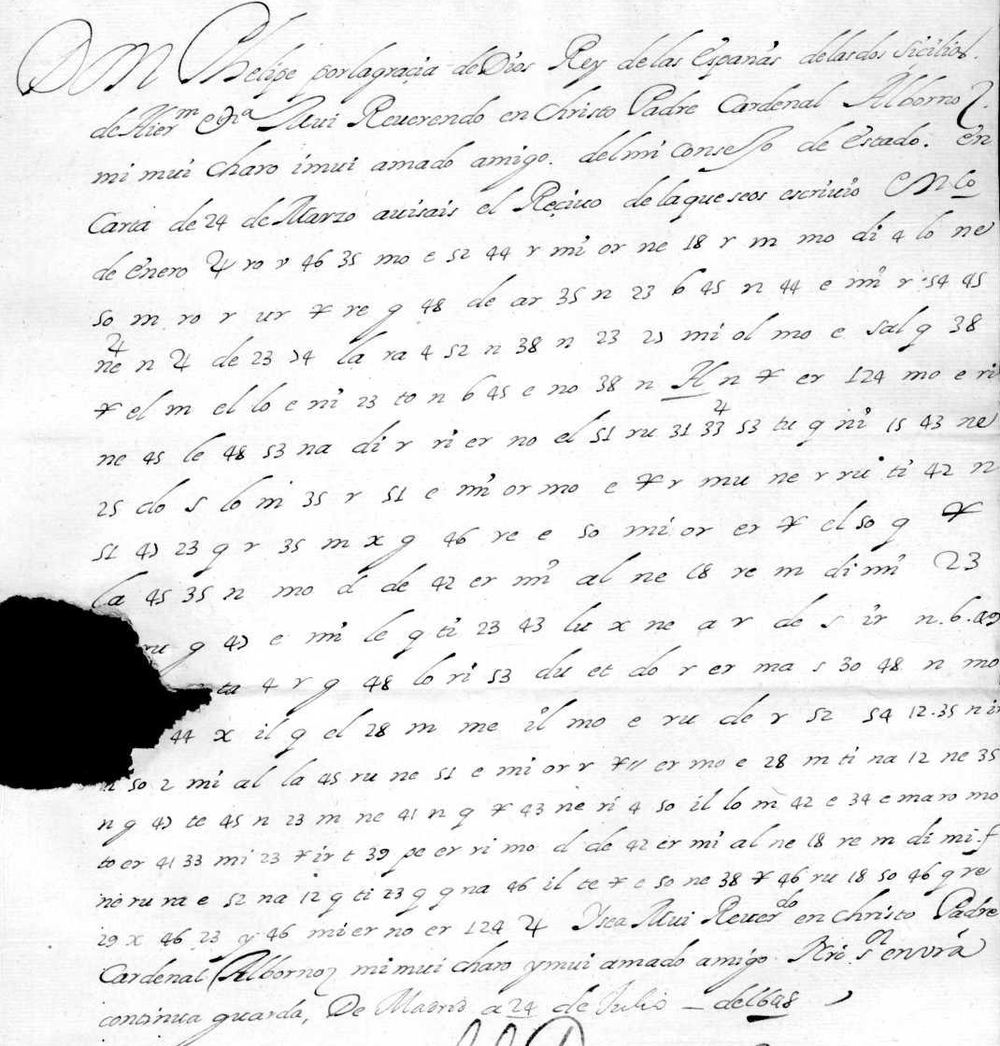
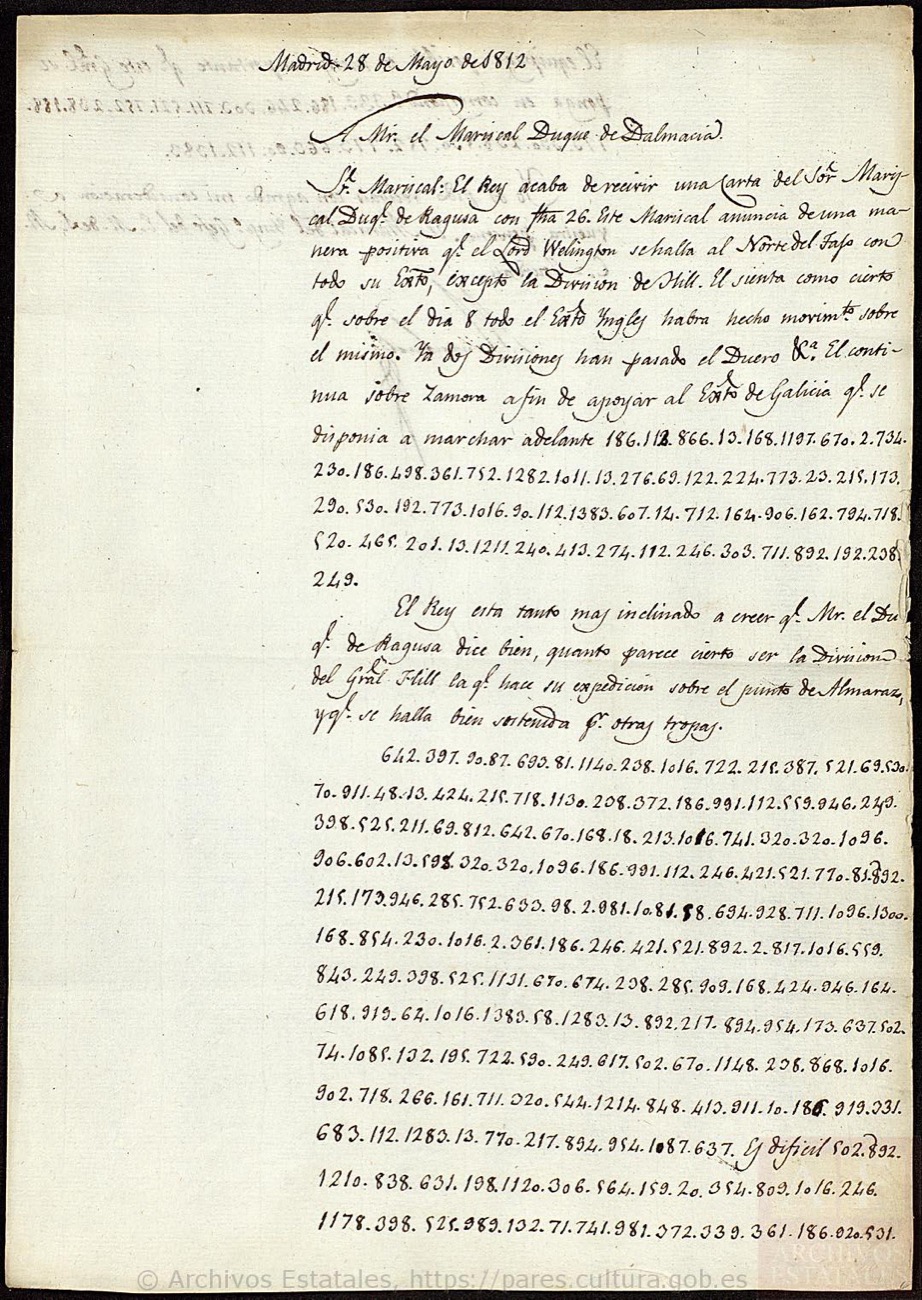
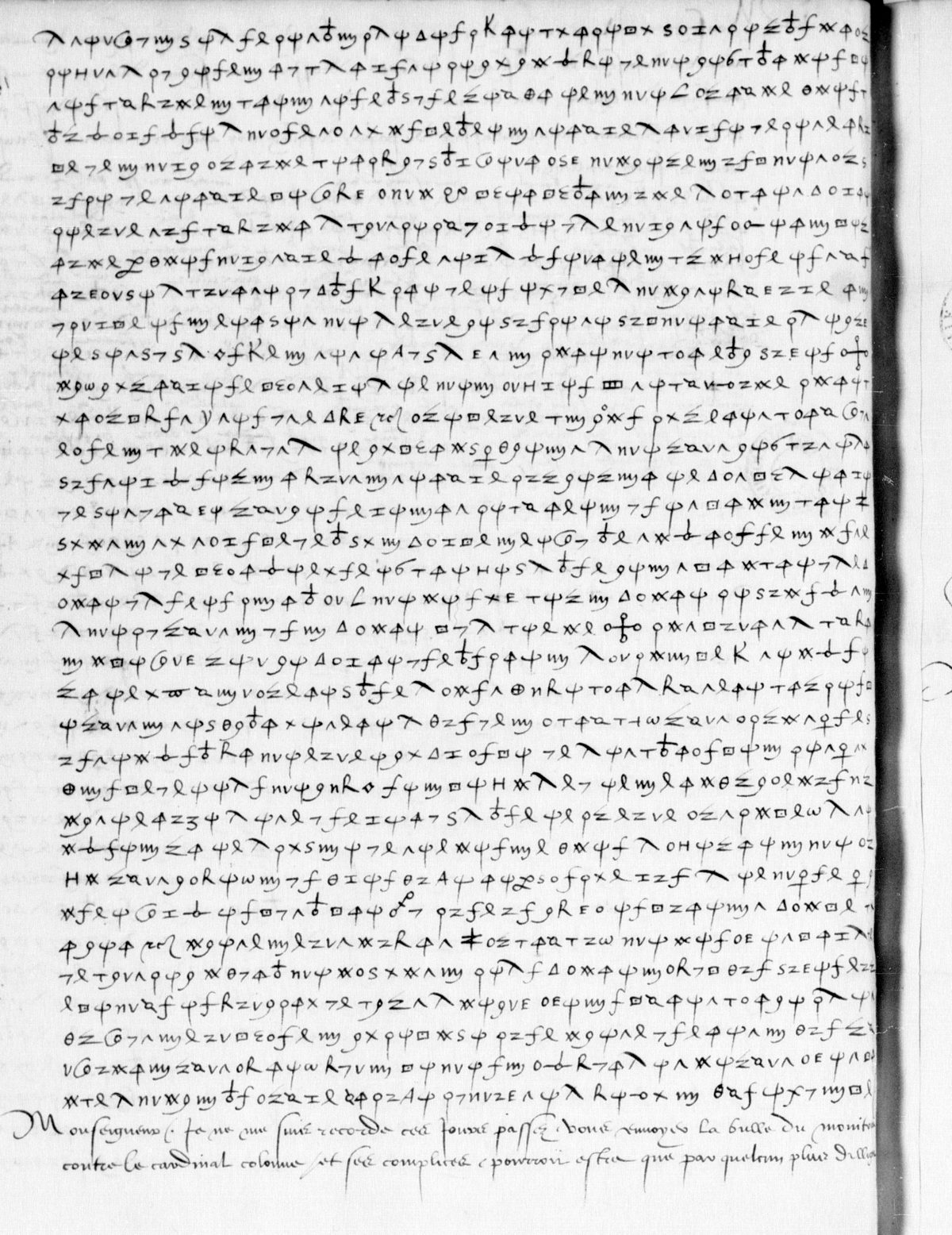
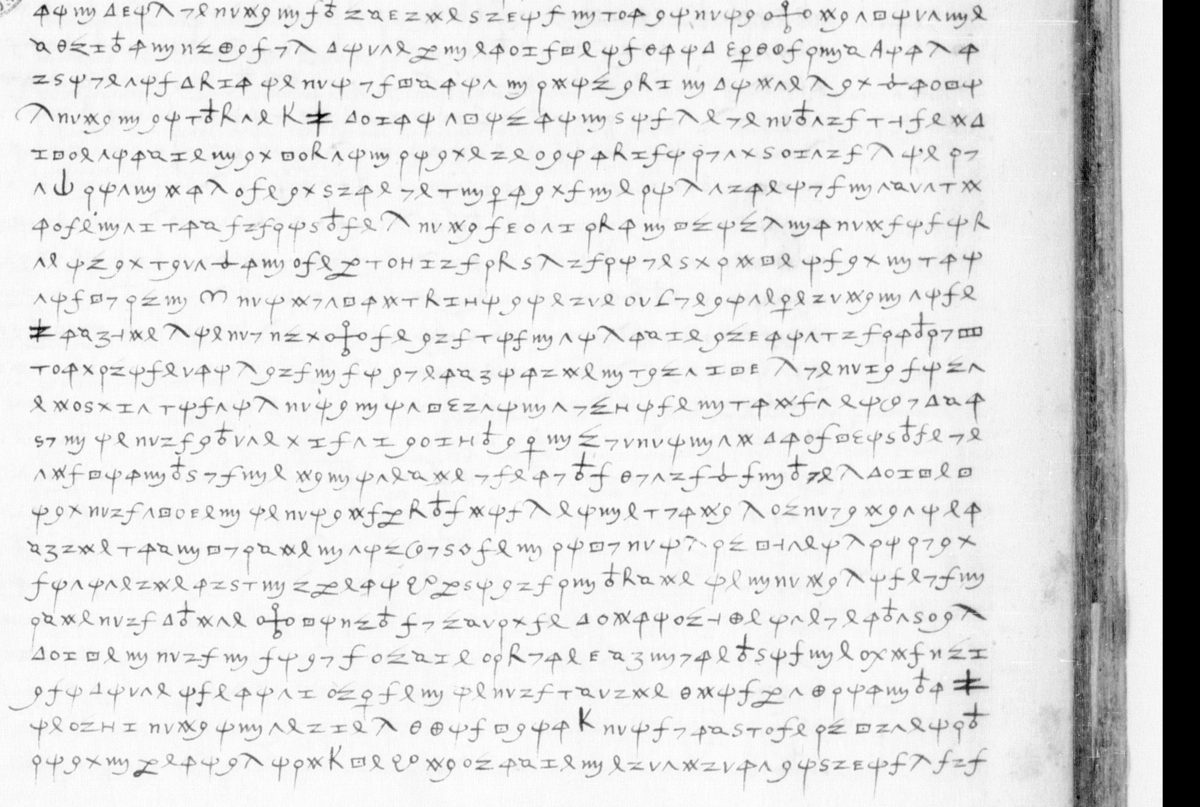
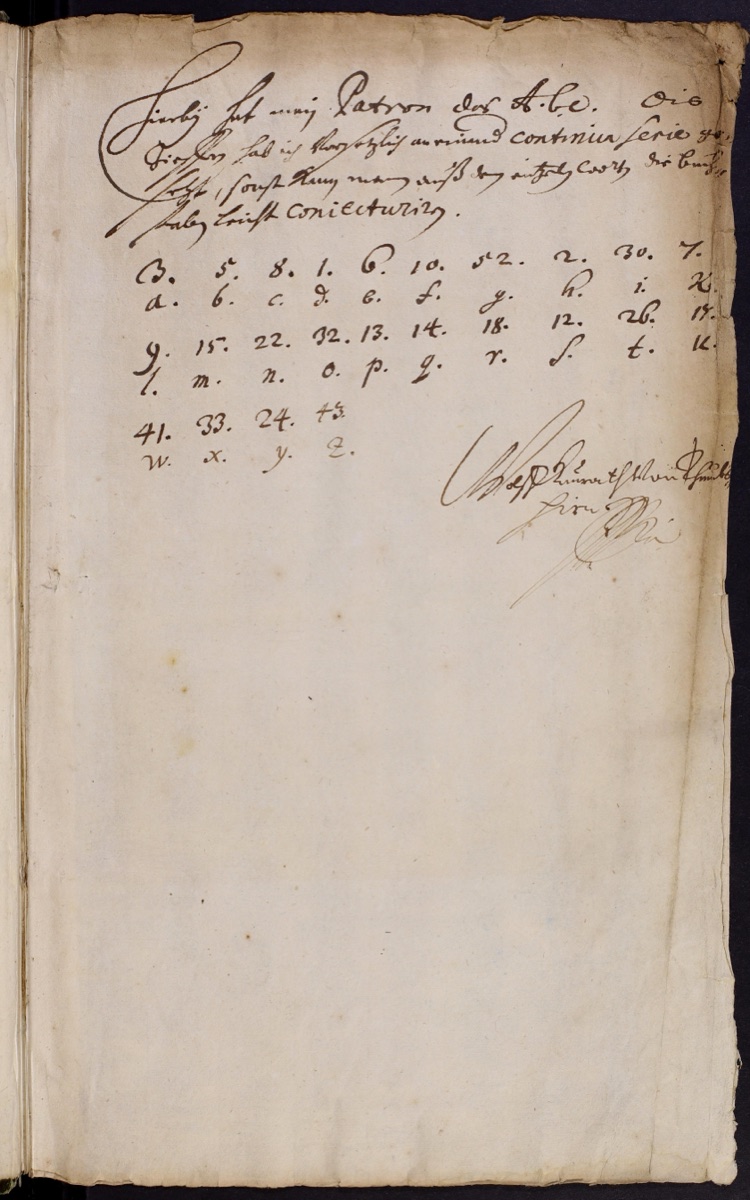
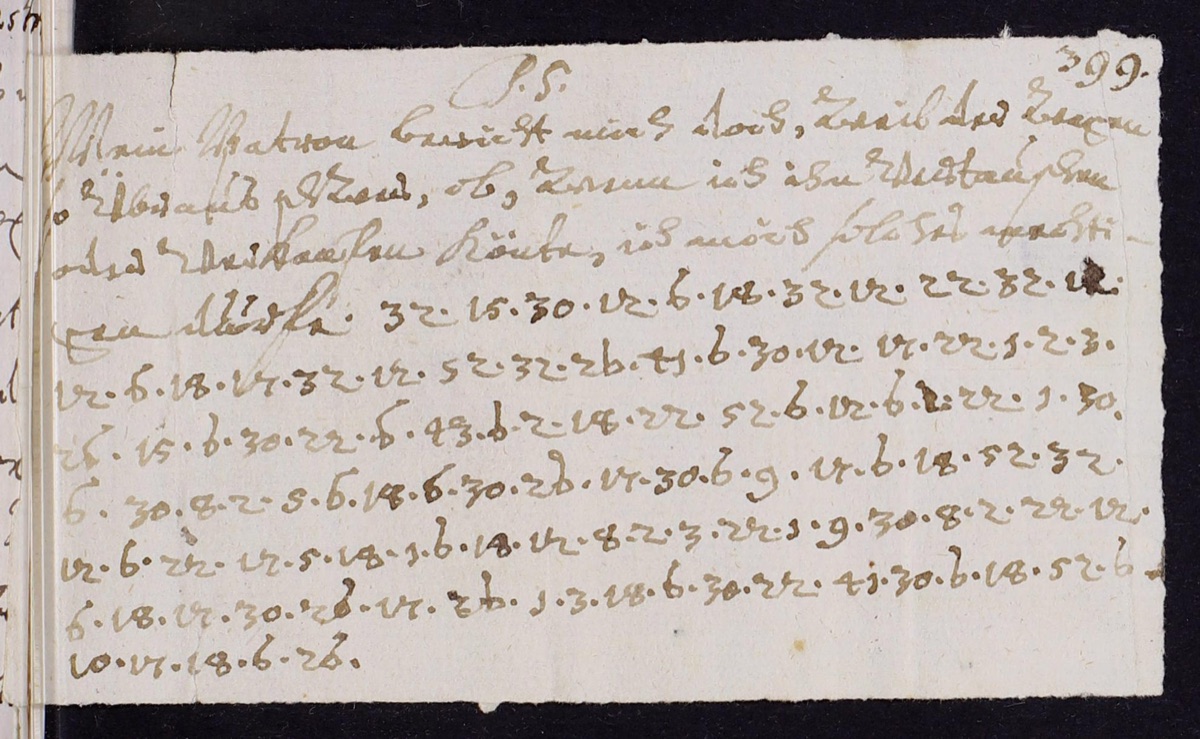
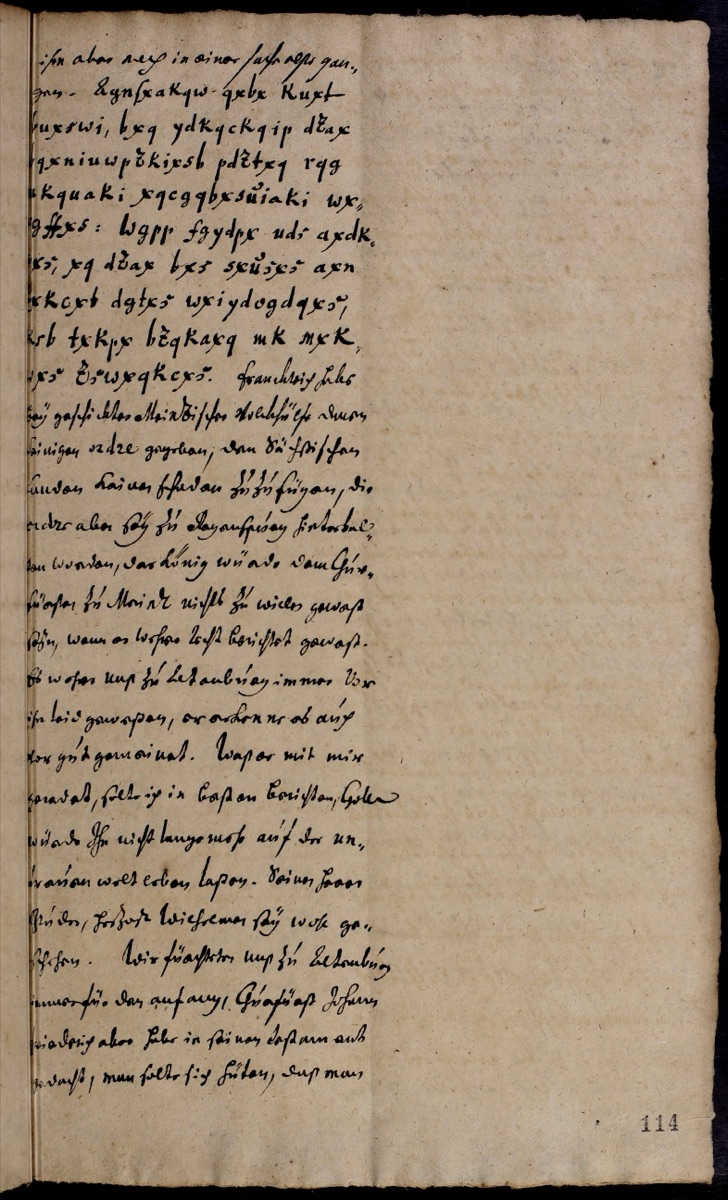
Maria av Medici · 1610 · Legaten Sega · 1593 · Ferducci · 1532 · Karl XII · 1710 · Høeg · Meyercrone · 1675 · Duplessis-Mornay · 1593 · Vila Flor · 1663 · Puebla · 1506 · Everett · 1825 · Dana · 1783 · Wąsowicz · 1663 · Henrik II · 1547 · Johan IV · 1644 · Crawford · 1813 · Lope Hurtado · 1520 · Filip IV · 1648 · Jourdan · 1812 · Raince · 1526 · Winslow · 1918 · Partyet · 1721 · D’Orvilliers · 1761
Dokumenten, så nära texten som möjligt.
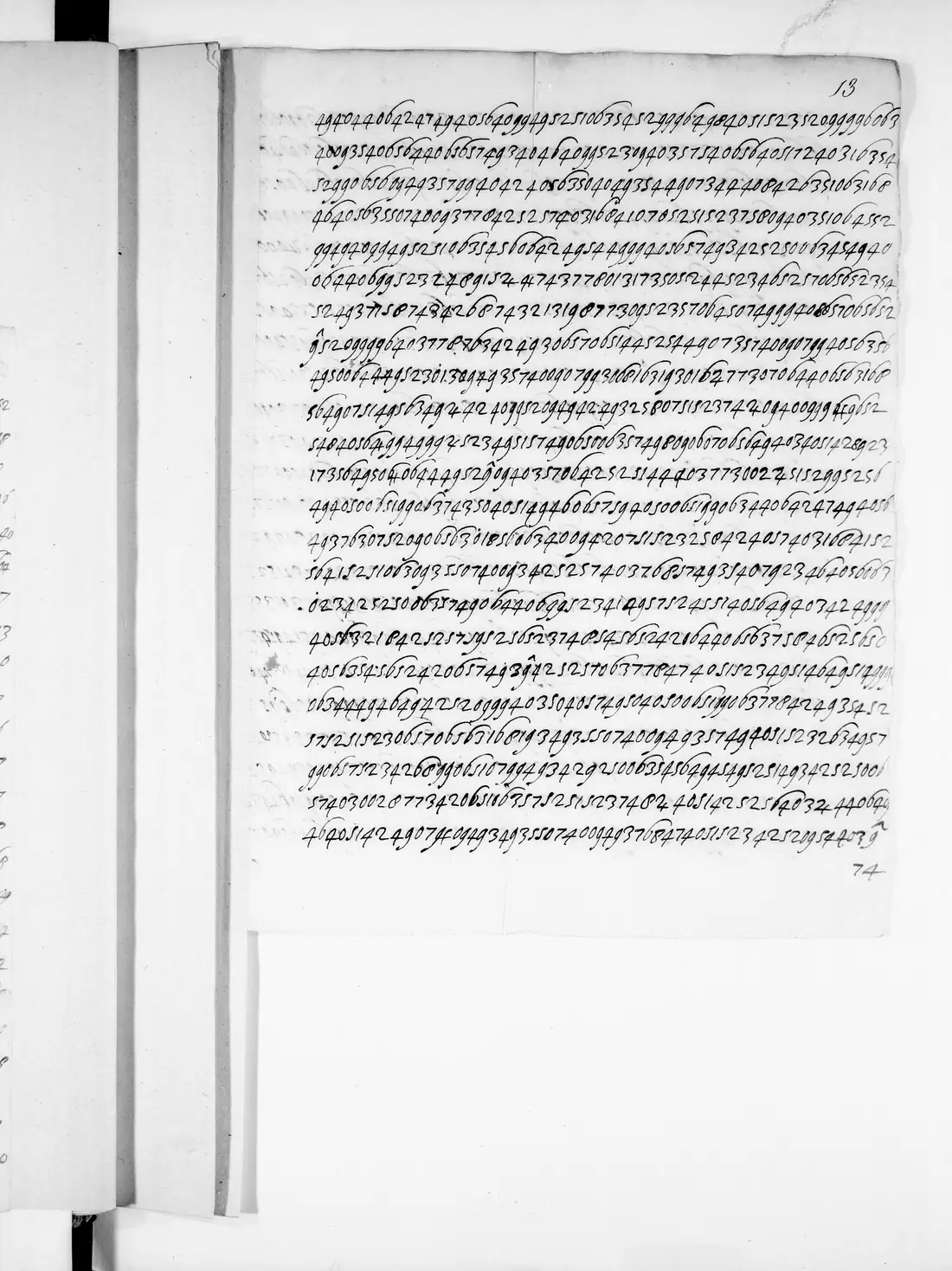
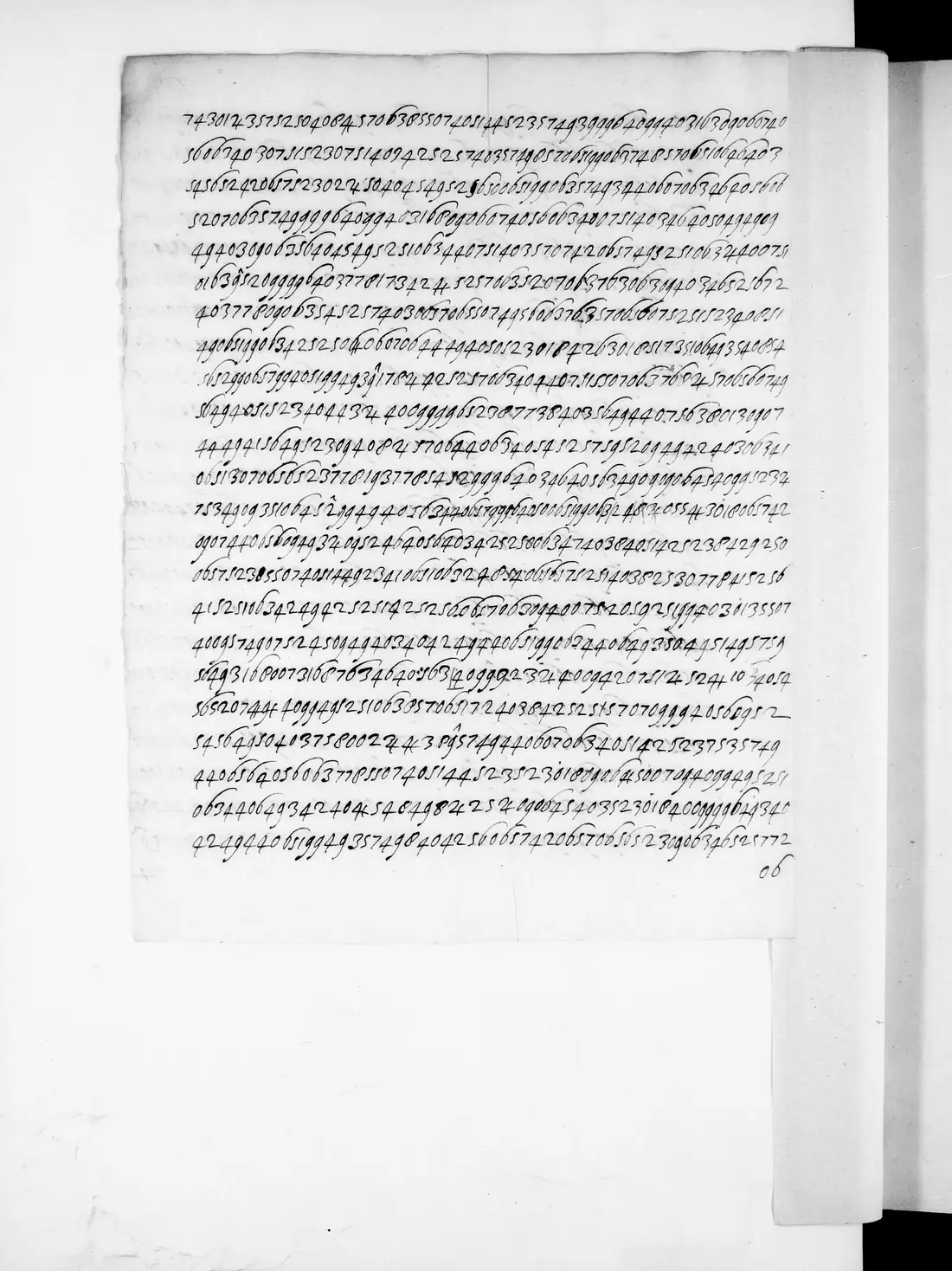
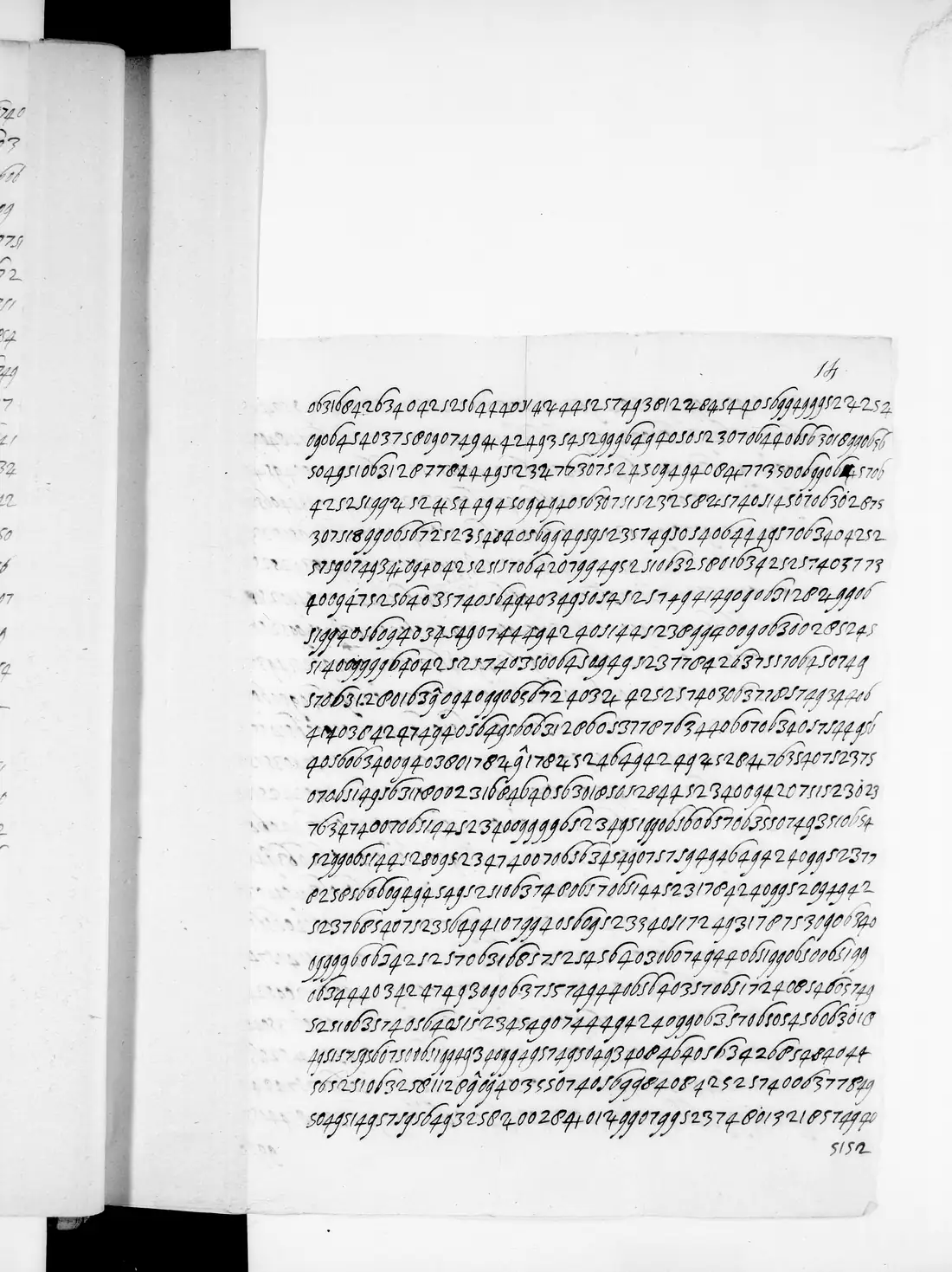
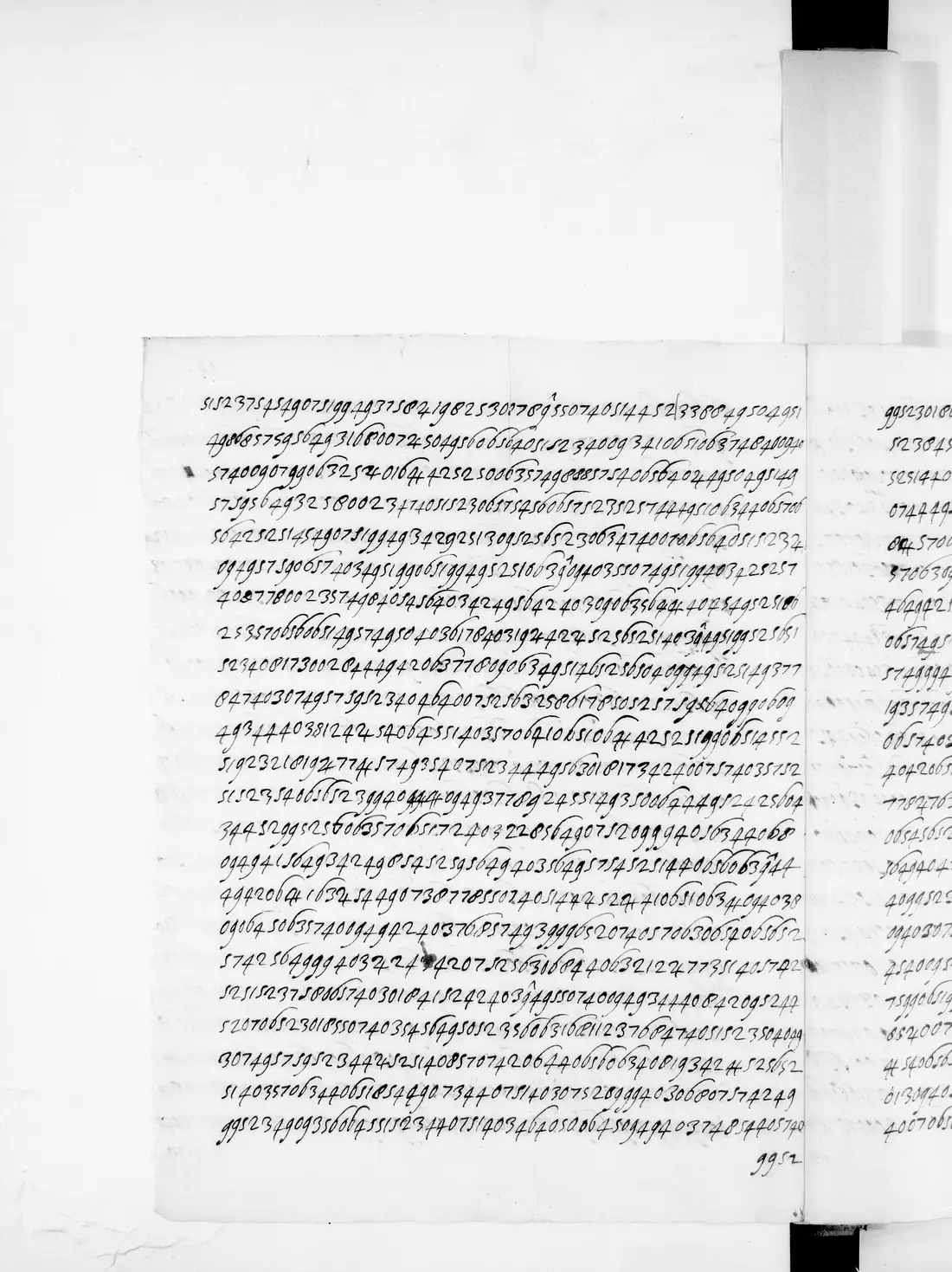
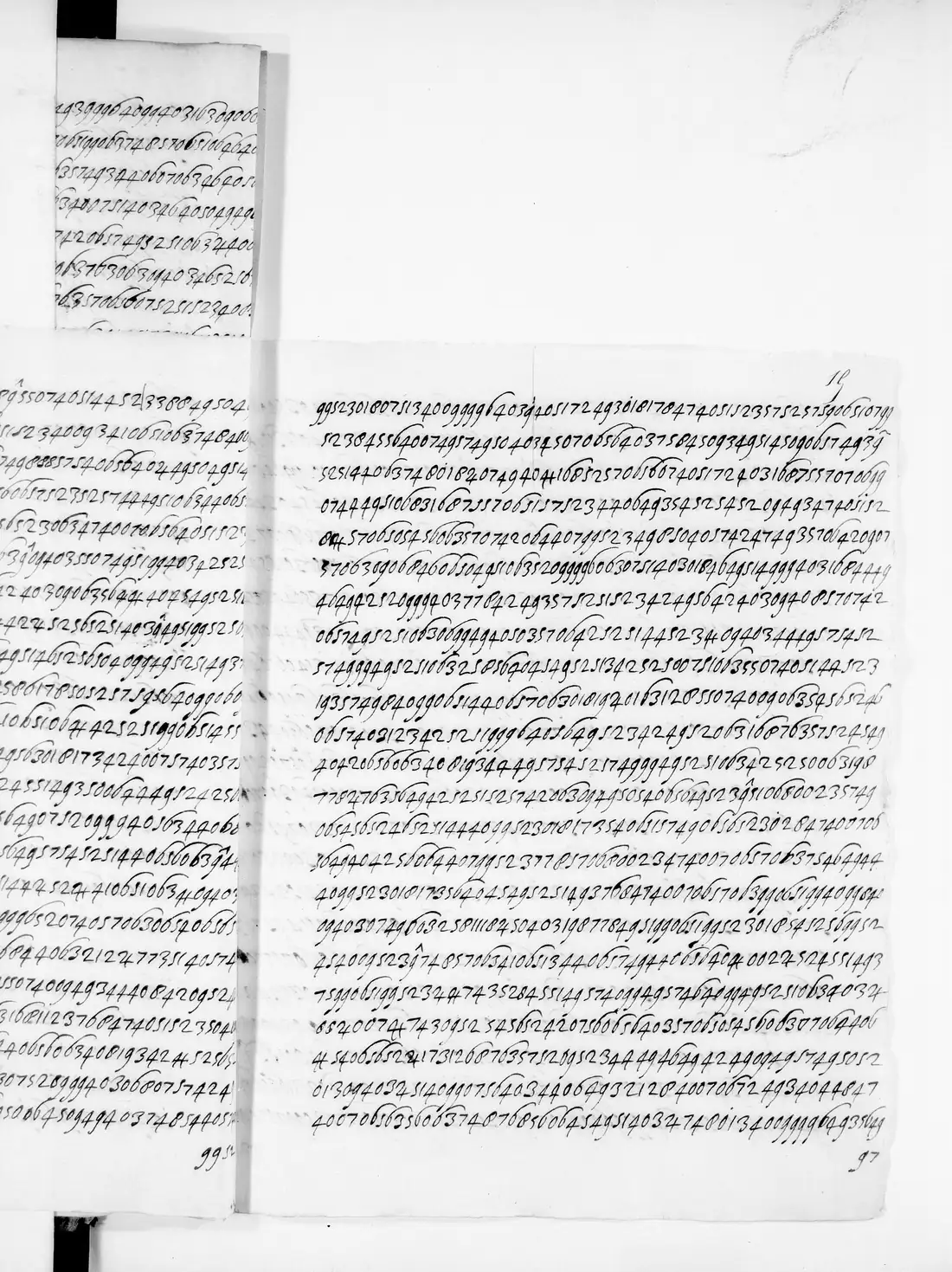
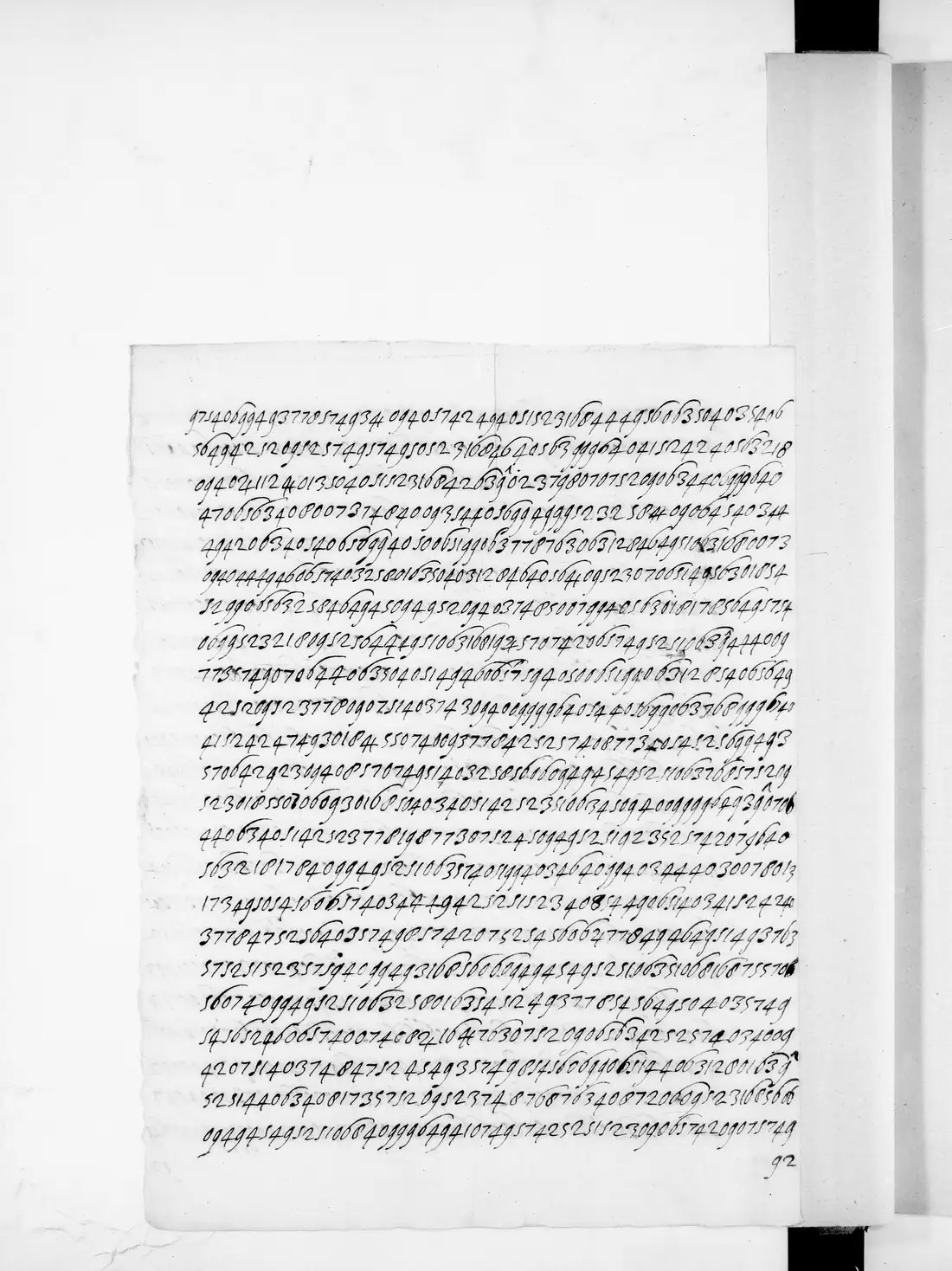
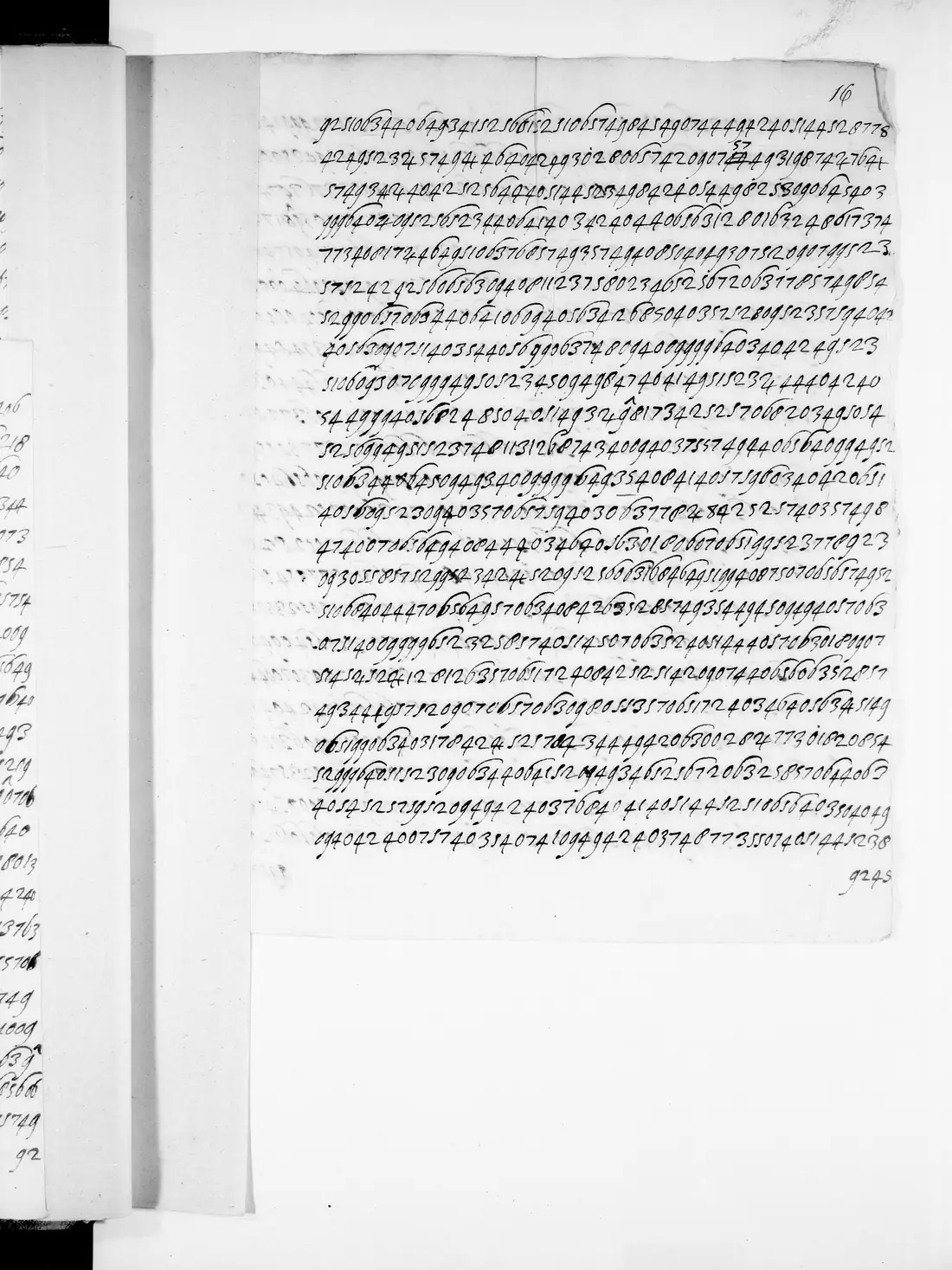
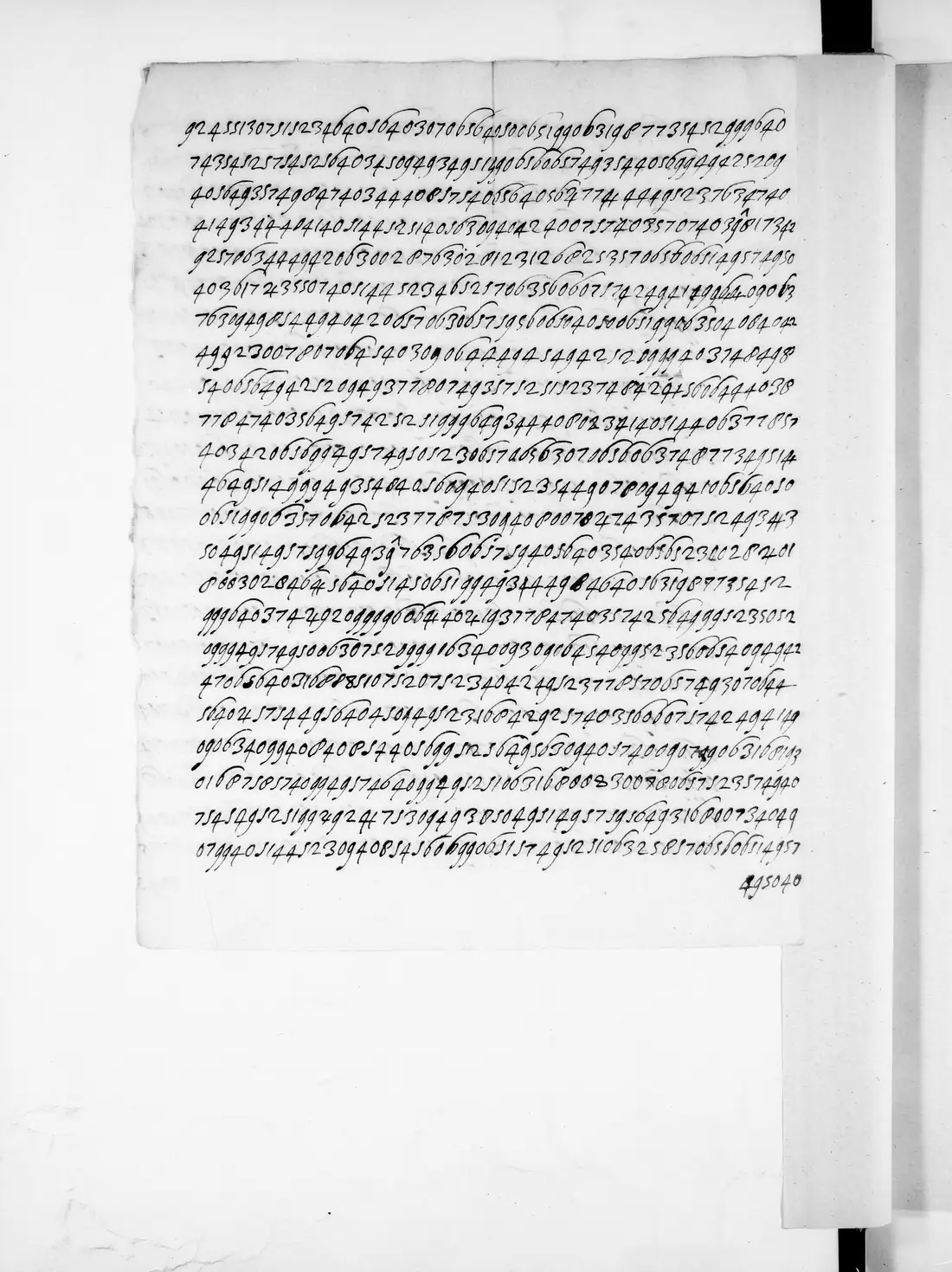
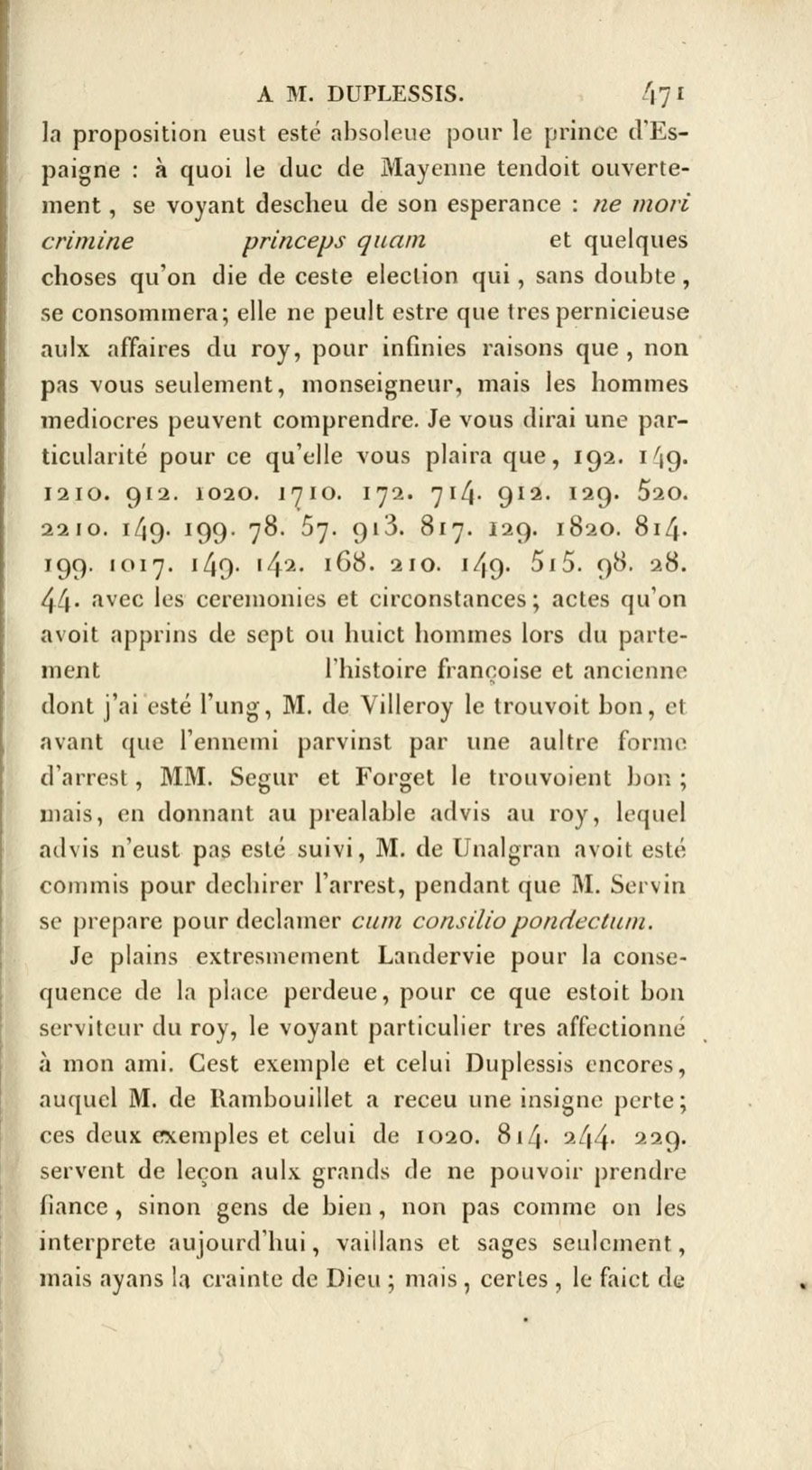
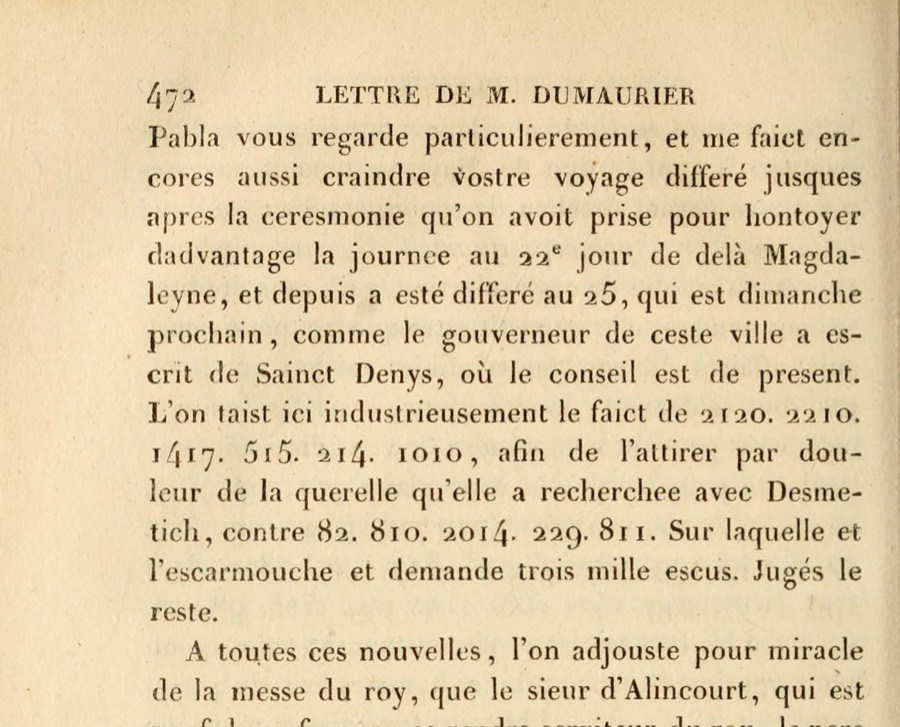
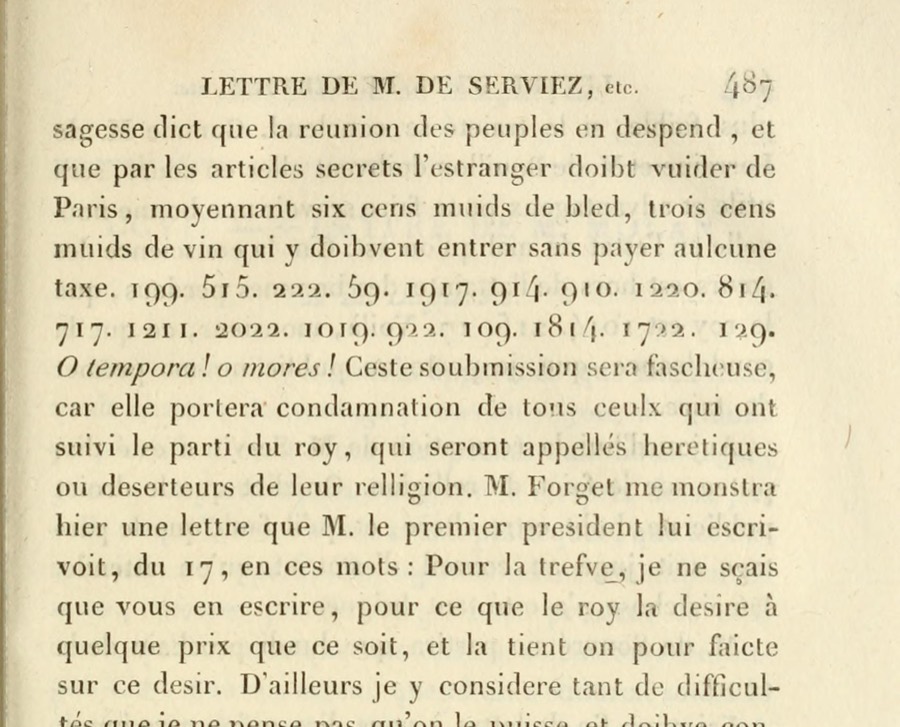
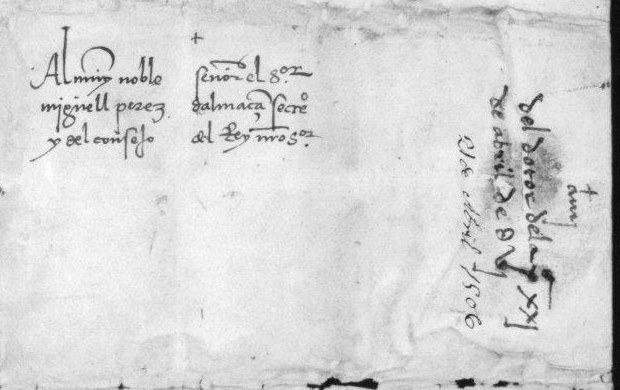
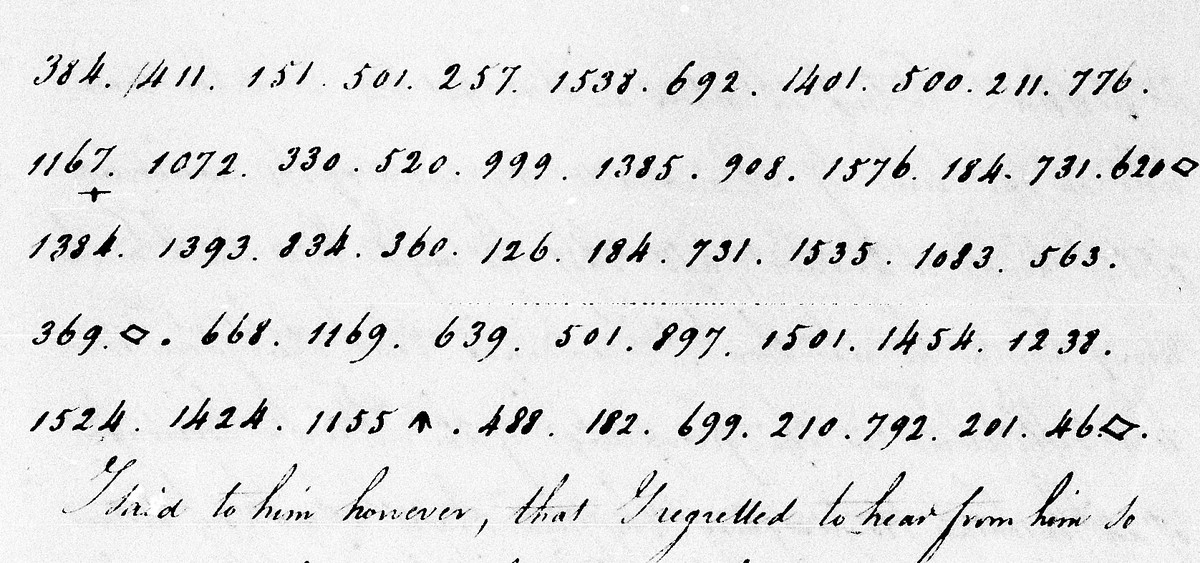
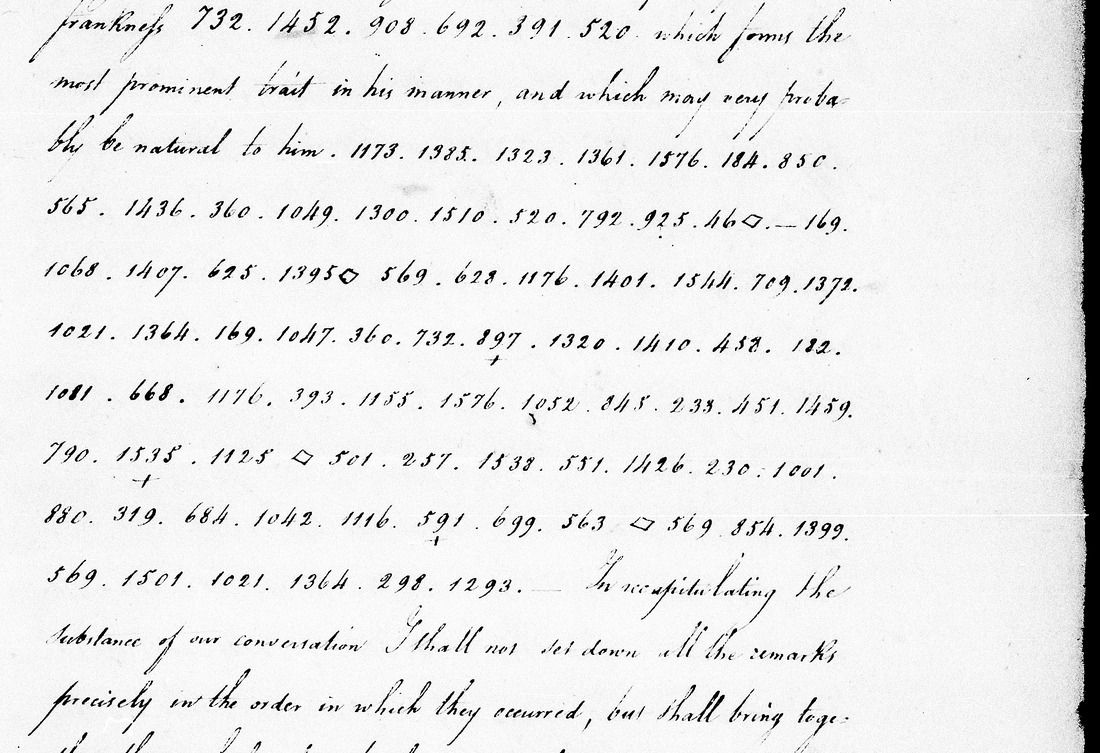
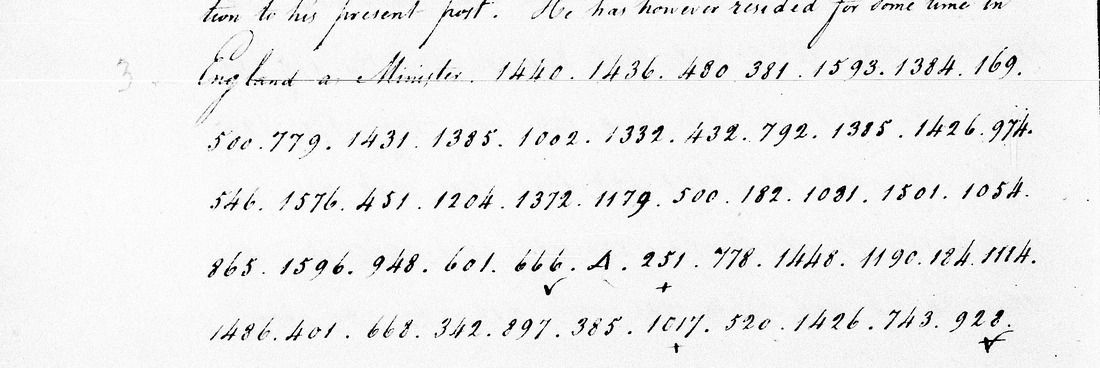
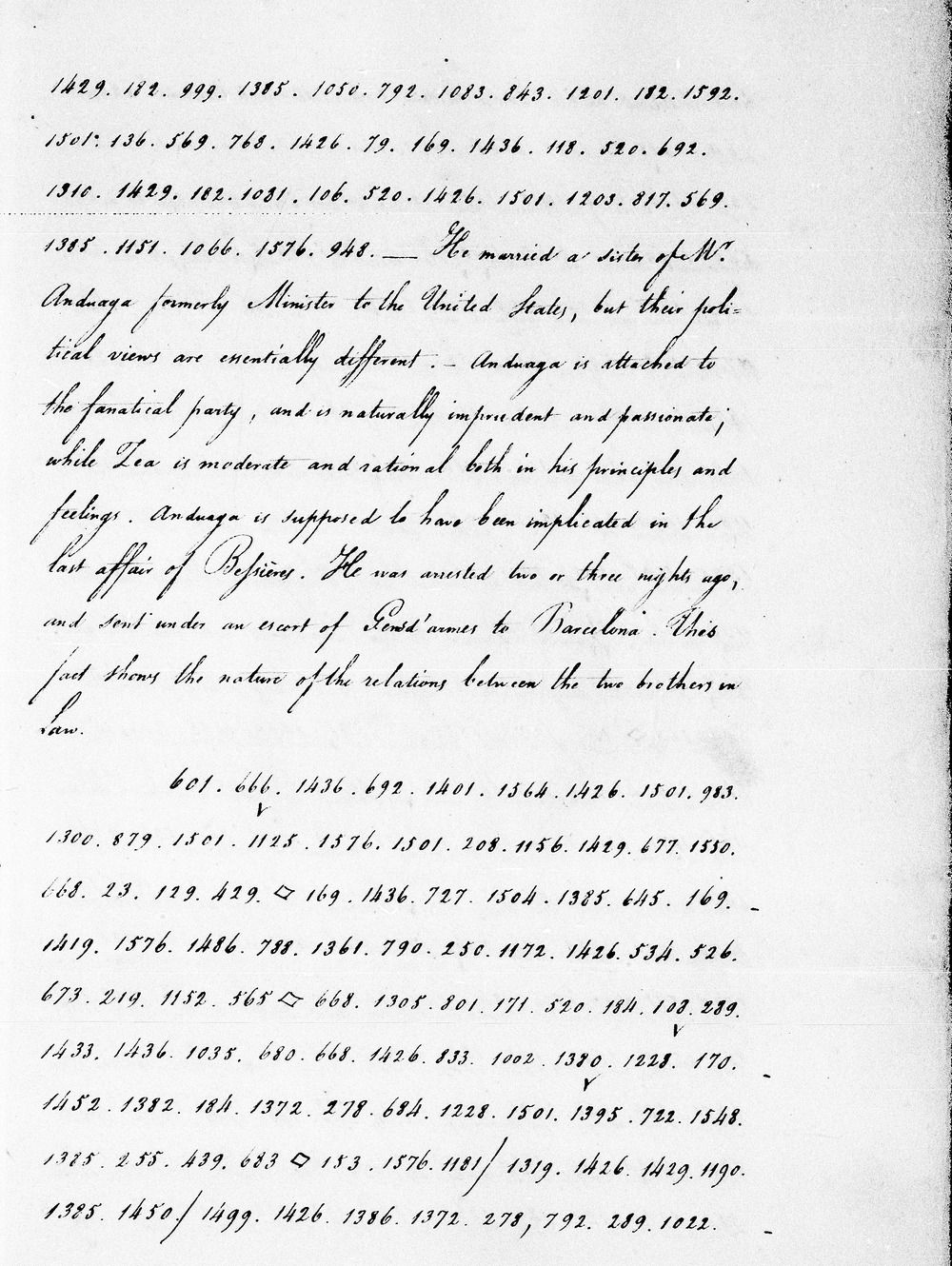
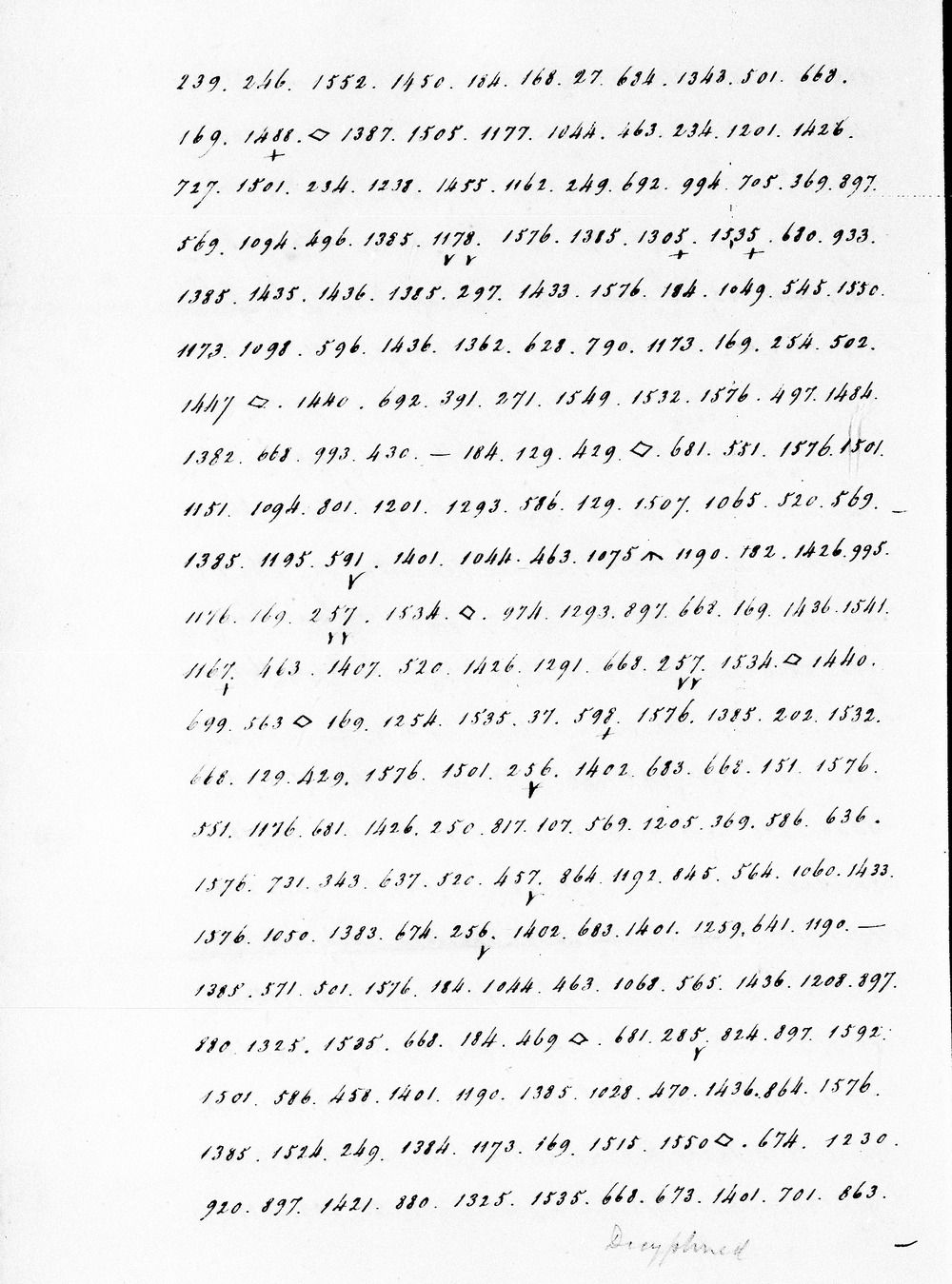
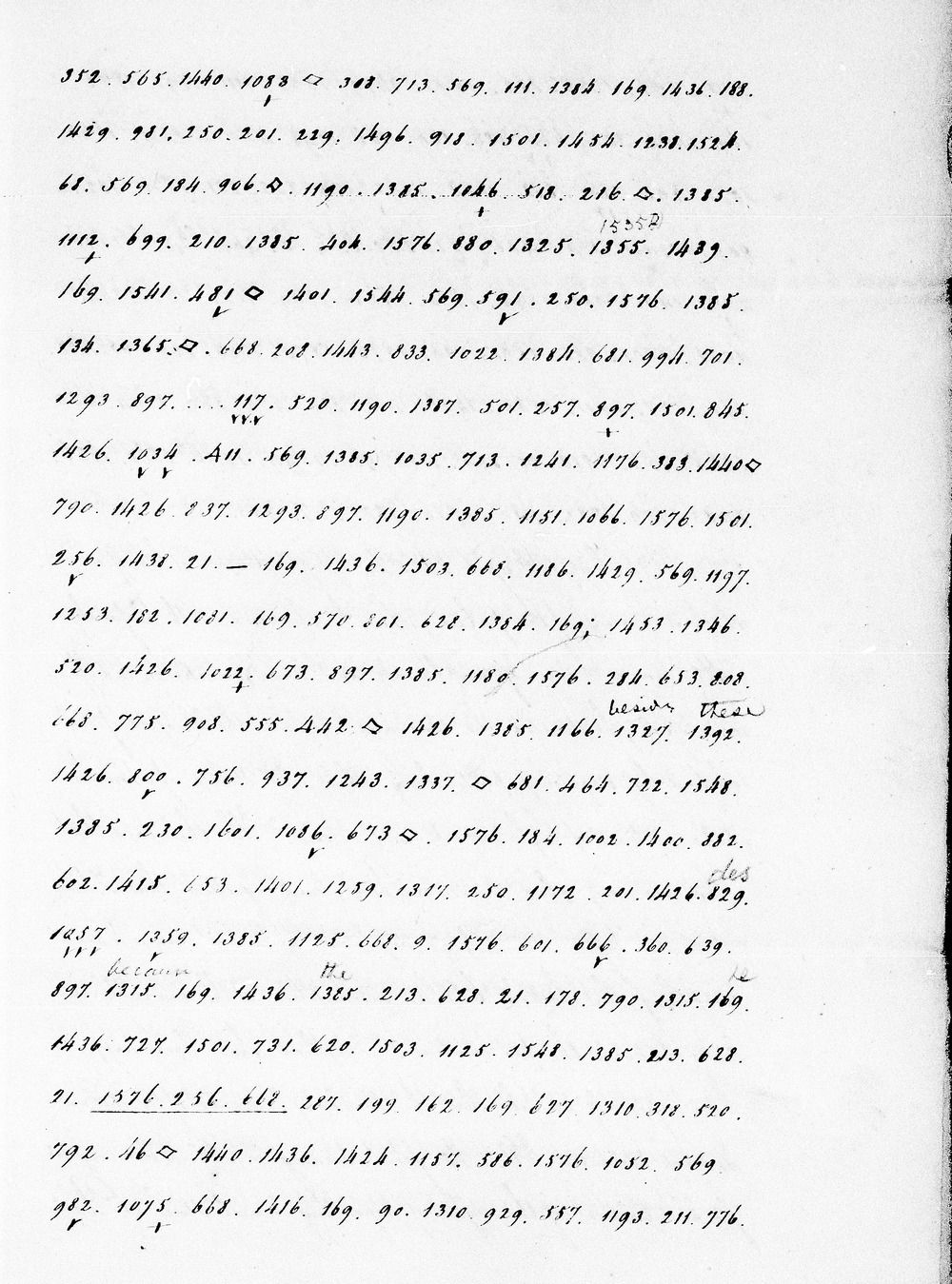
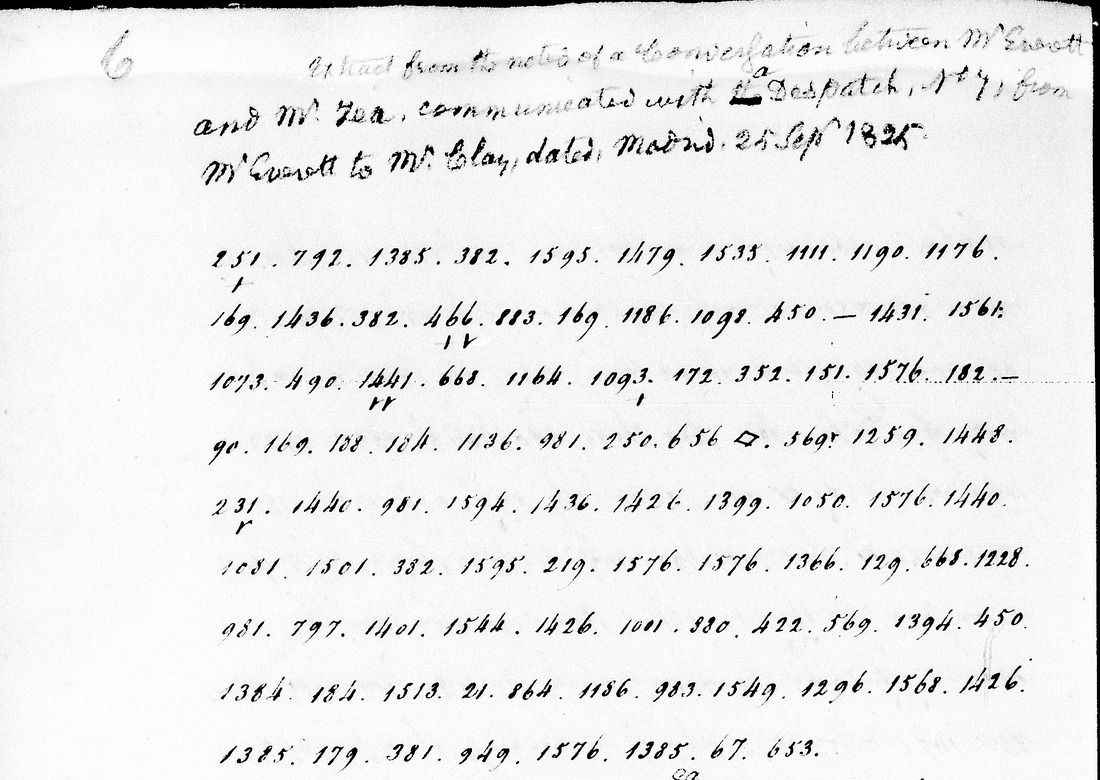
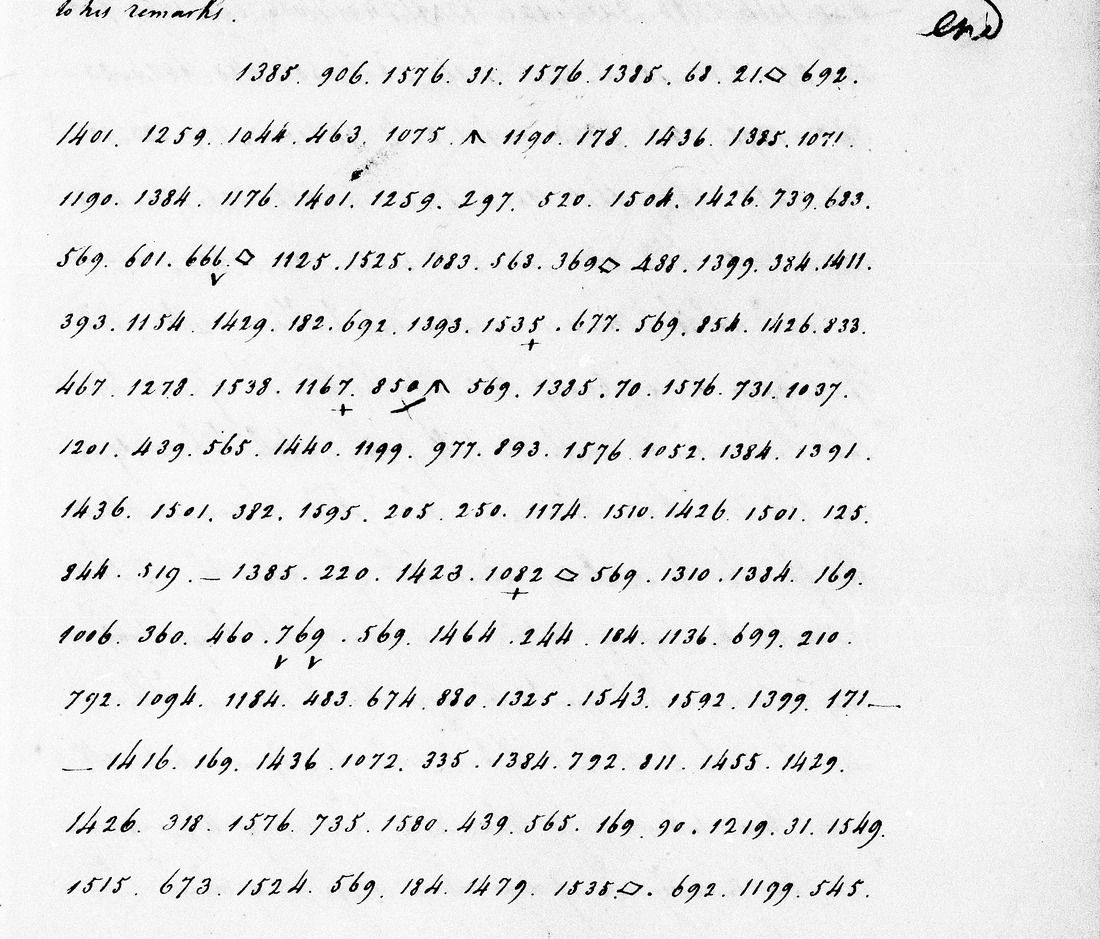
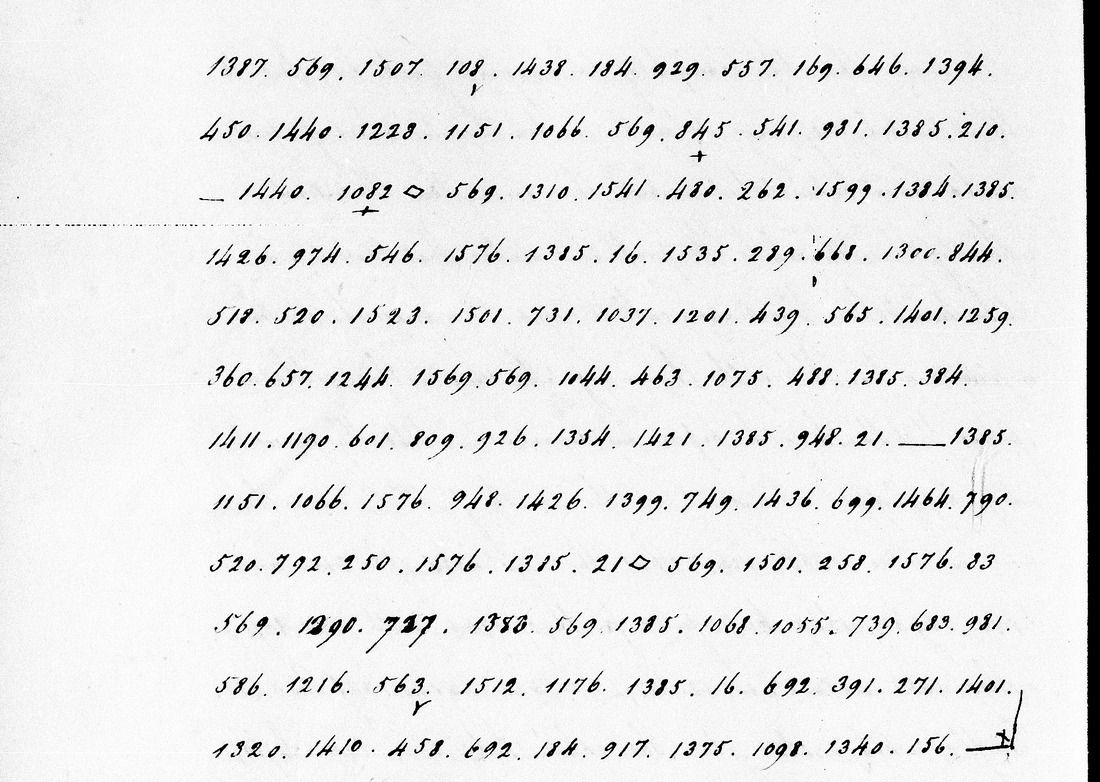
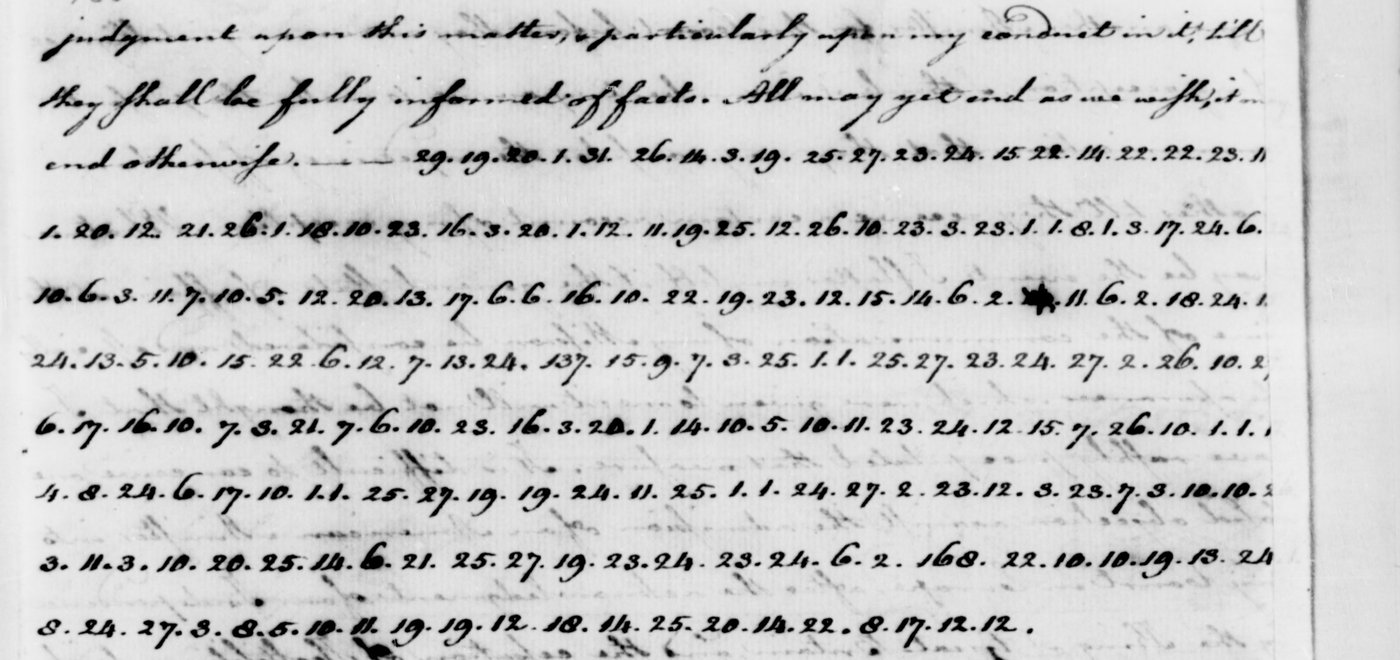
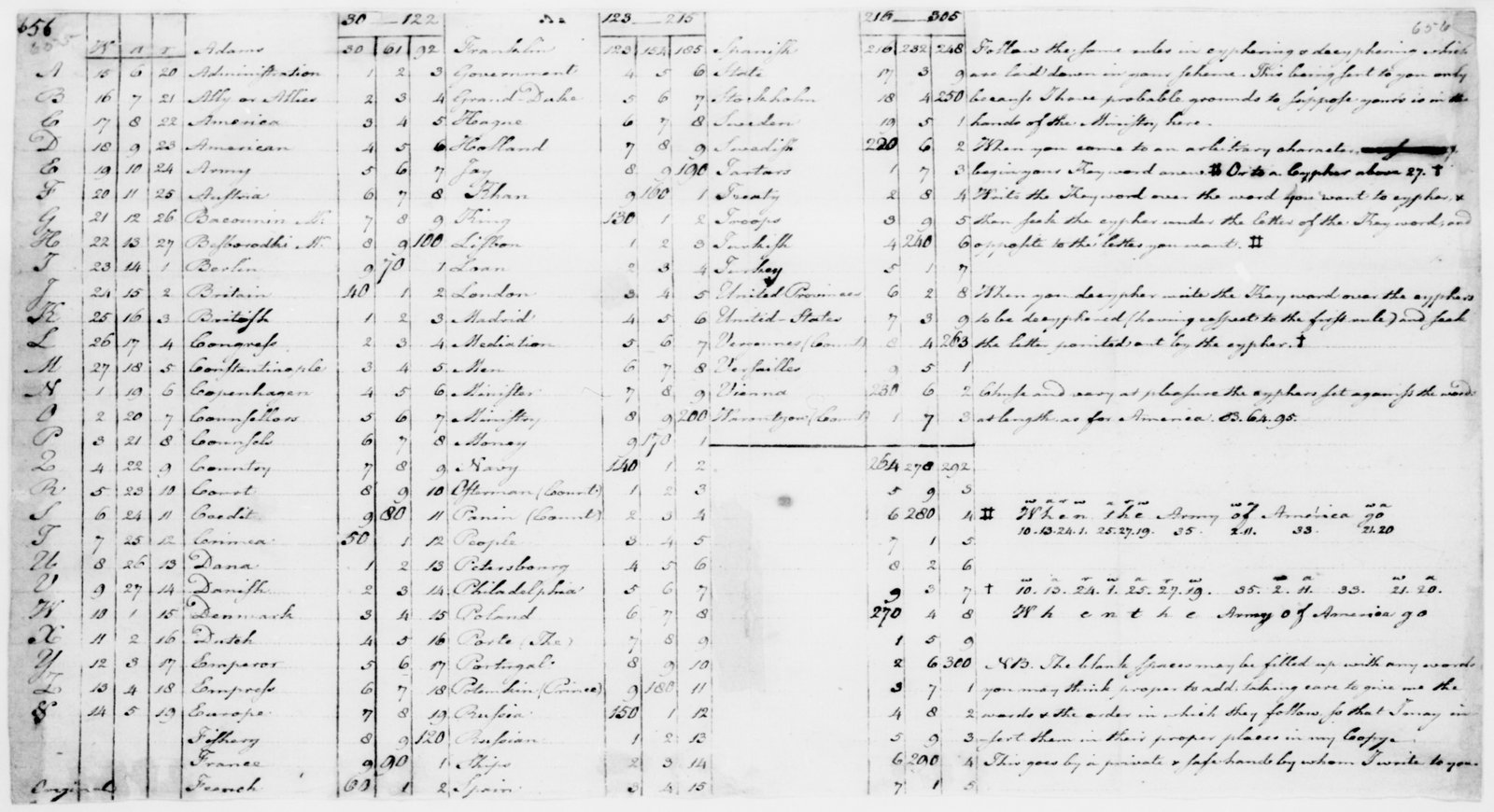
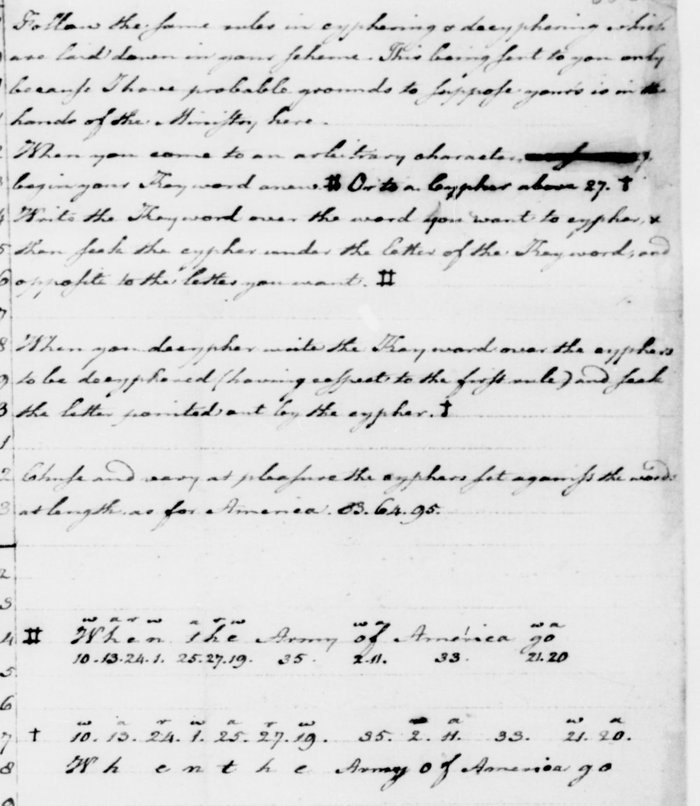
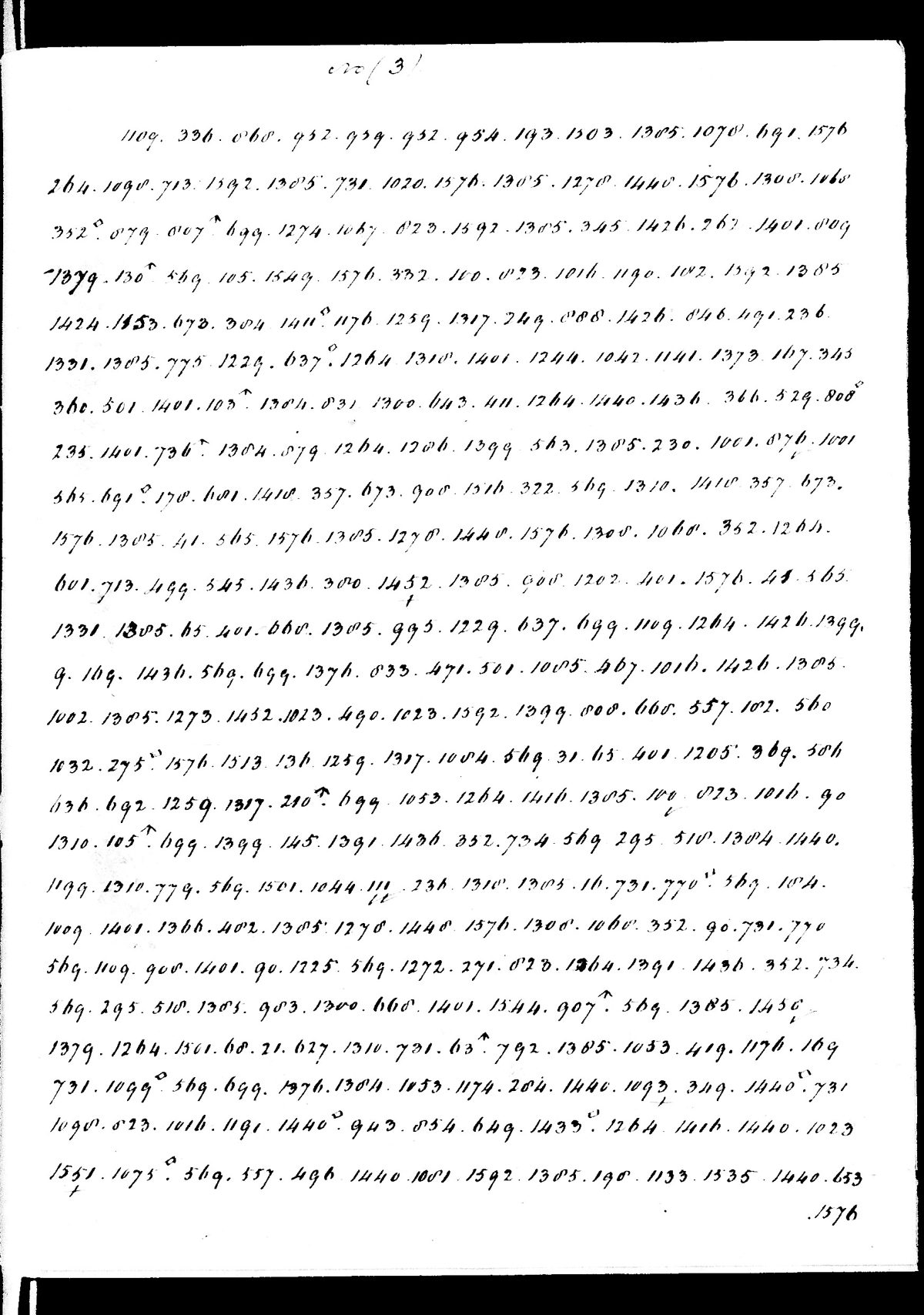
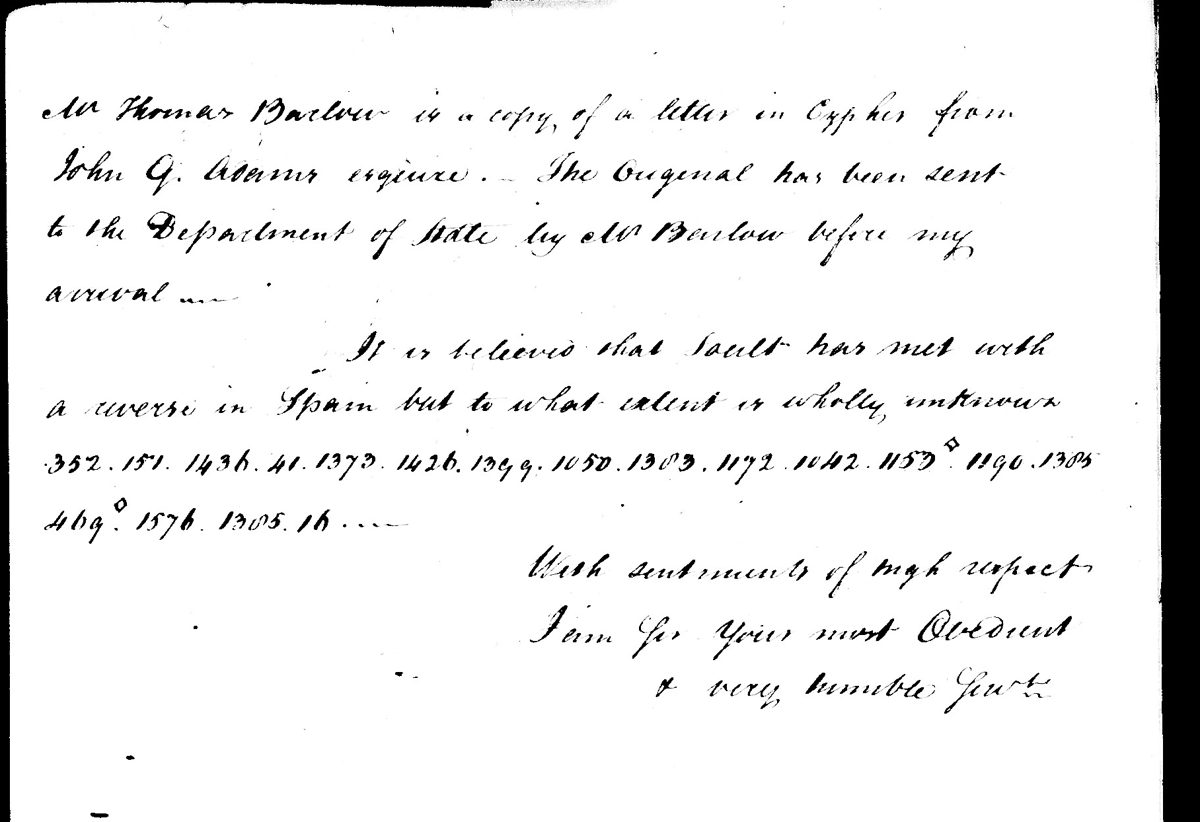
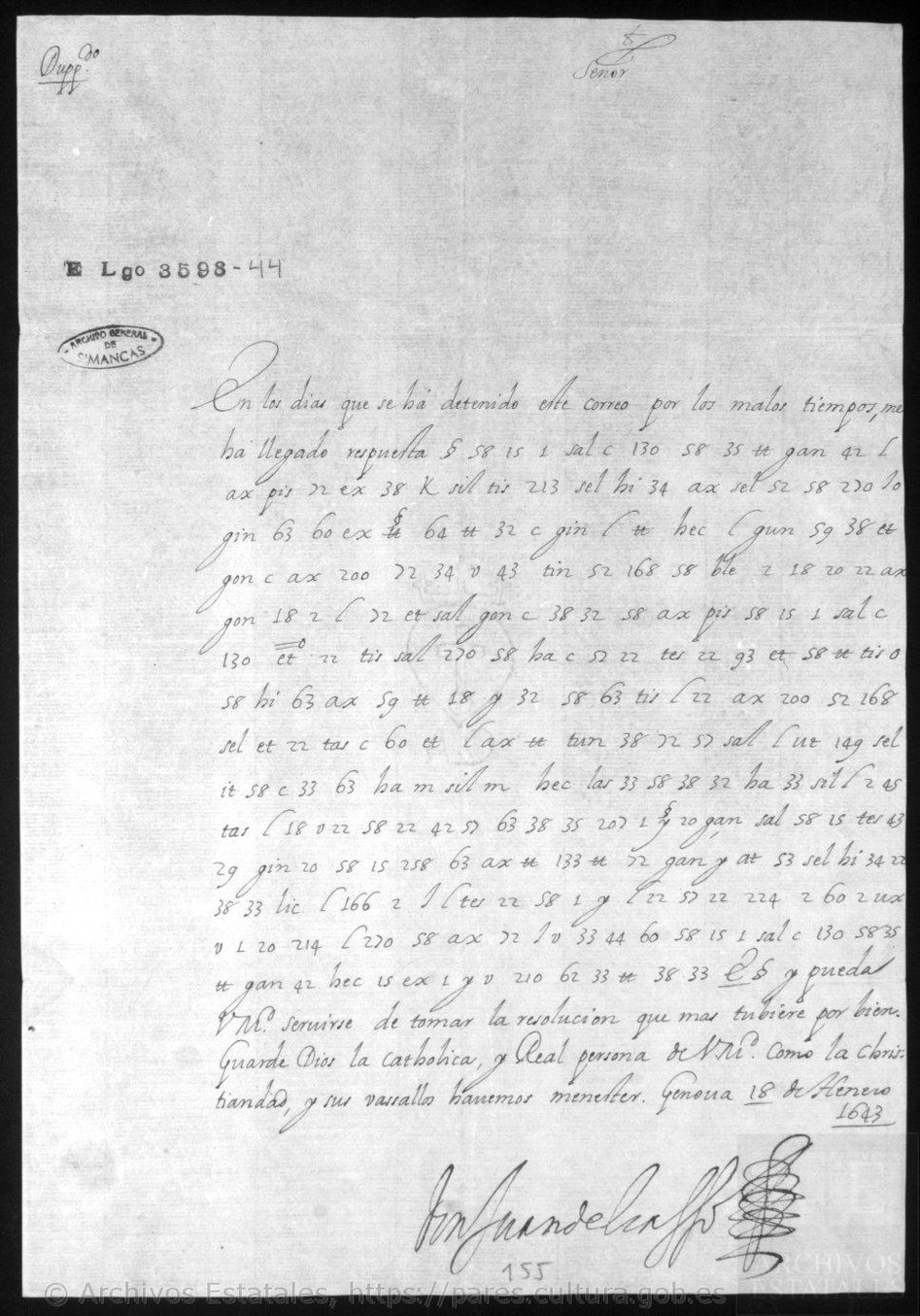
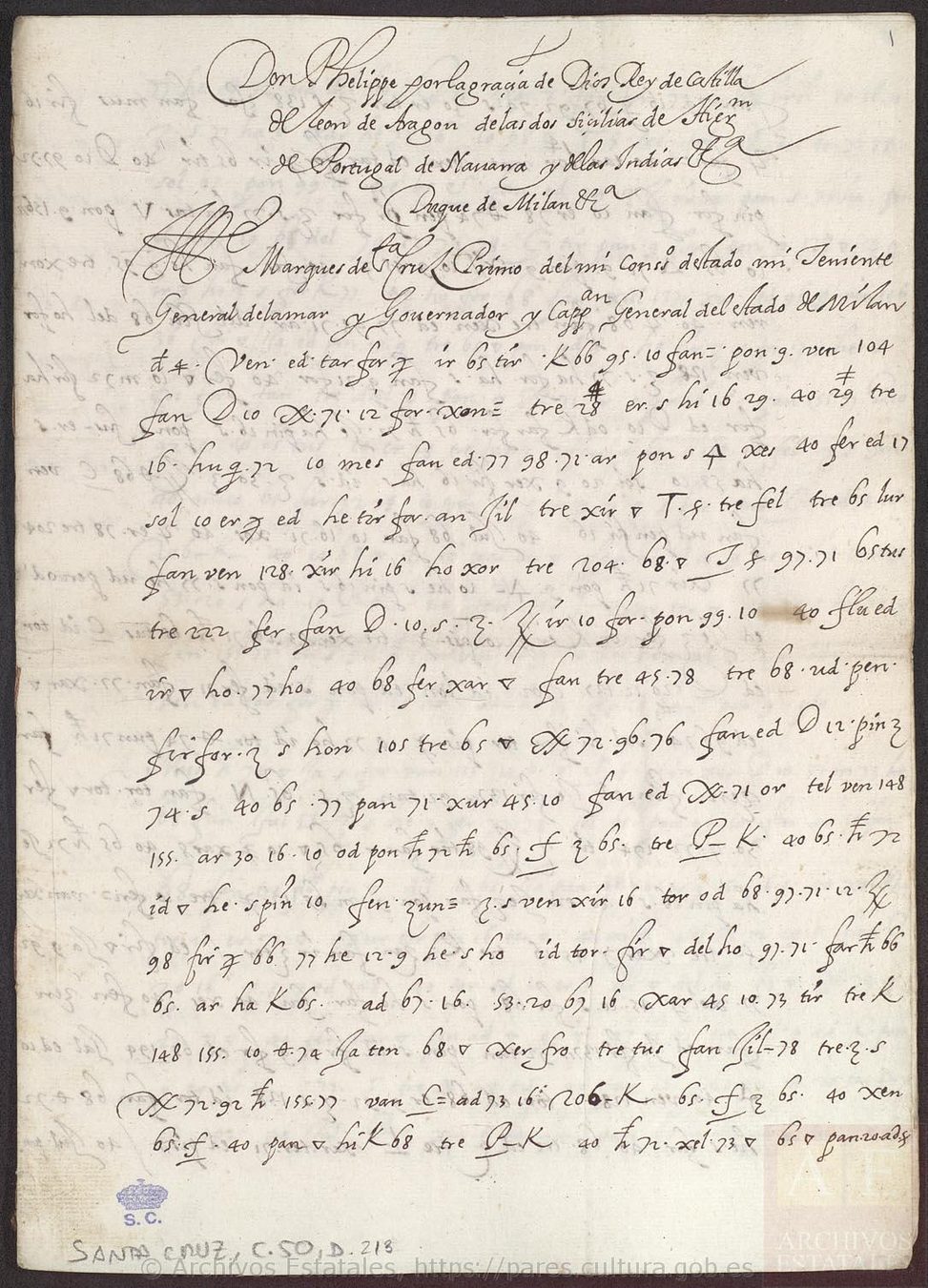
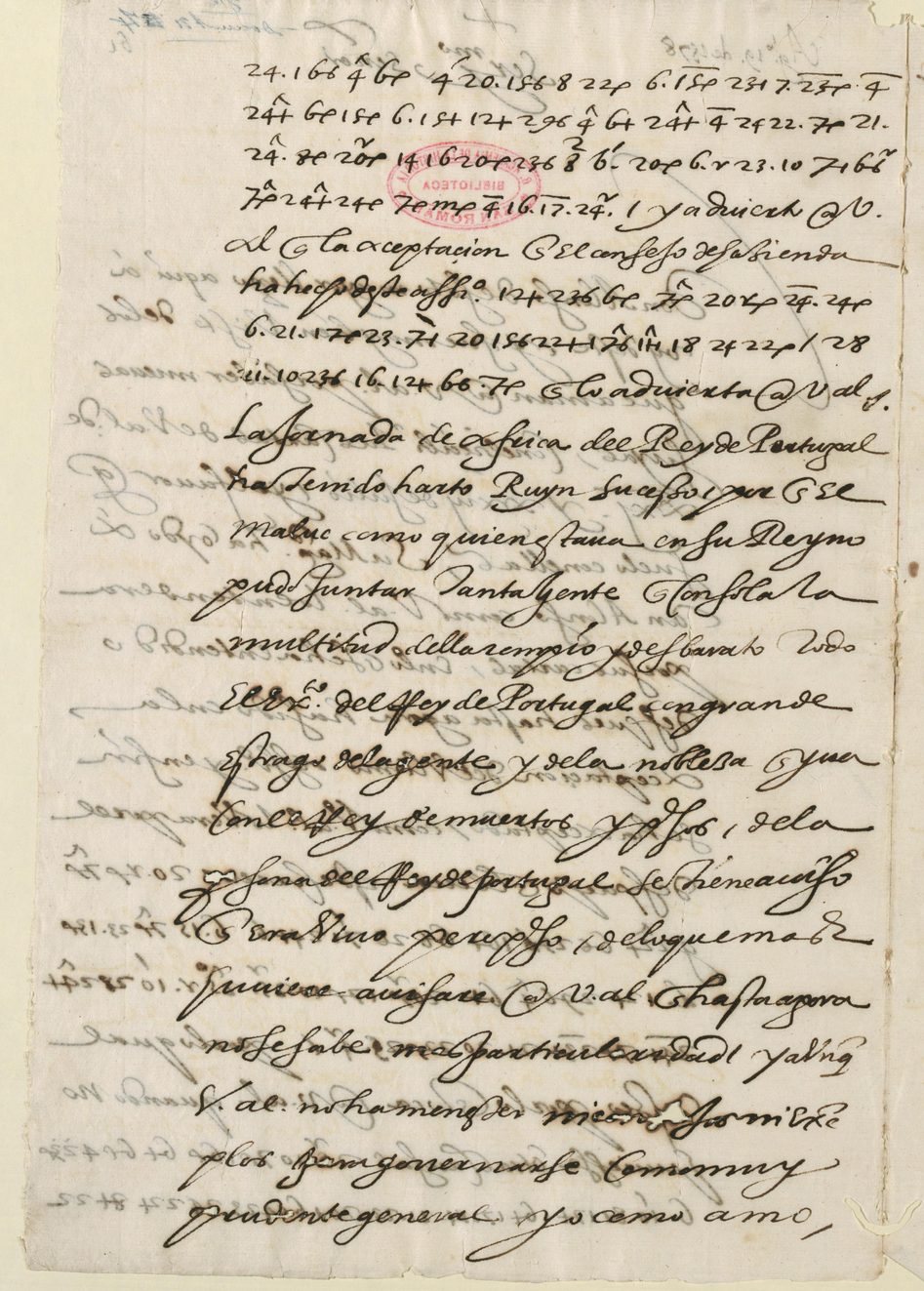
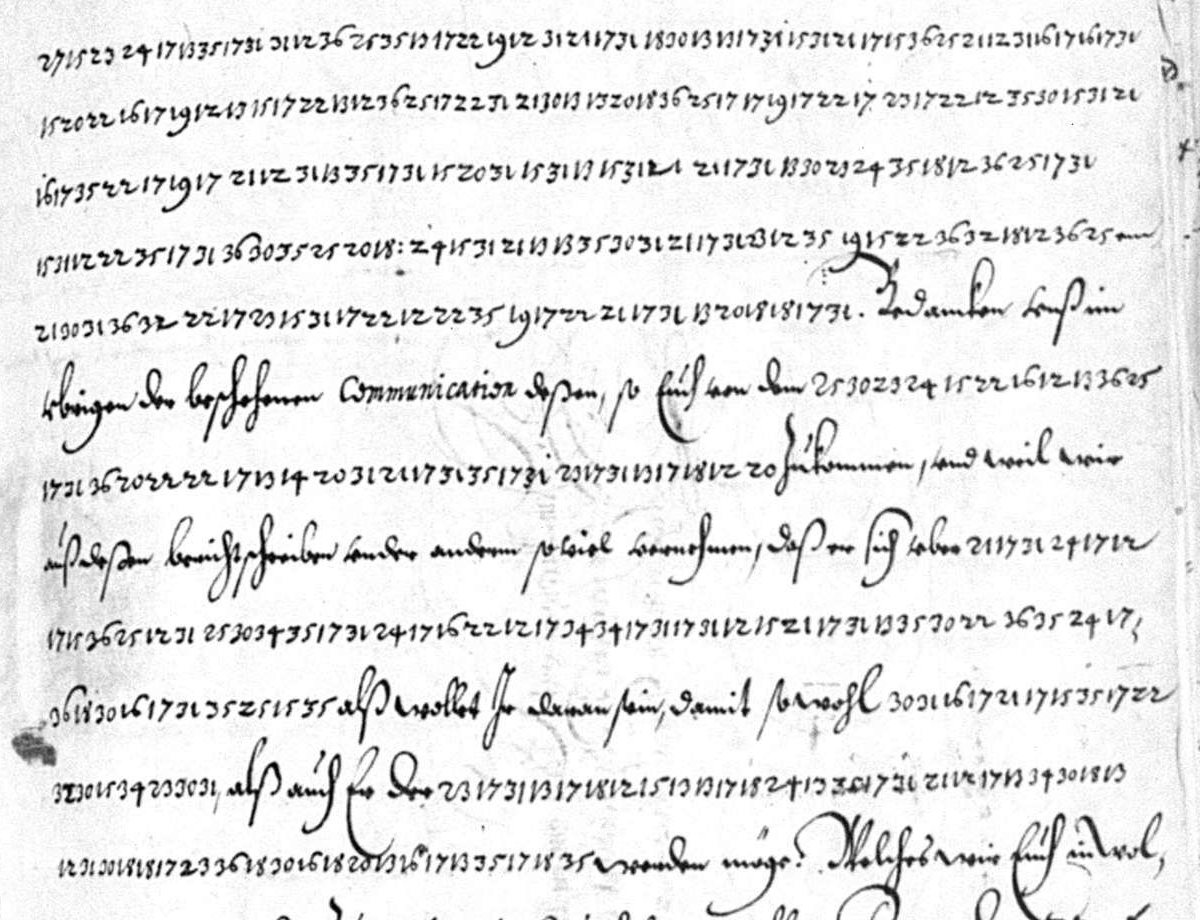
Femtionio chiffrerade dokument, presenterade som poster: datum, avsändare och mottagare, väg, faksimil, föreslagen läsning och moderniserad läsning. Maria av Medicis två brev till Brèves (1610) innehåller bara fem chiffrerade rader; Roms instruktion till legaten Sega (1593) omfattar tolv sidor; Niccolò Ferduccis brev till Ferdinand I (Fiume, 19 juli 1532) chiffrerar bara åtta ord, som avslöjar en plan att bortföra Frankrikes ambassadör; två chiffrerade avskrifter av ett brev från Karl XII (Bender, 26 april 1710) visar kungen beredd att förhandla med Danmark och sluta ett stillestånd; arton depescher från Köpenhamn till Just Høeg, sändebud i Haag, och nitton till Henning Meyercrone, sändebud i Paris (januari–juni 1675), lästa i sin helhet med en nyckel som återfunnits i arkiven, visar ett Danmark som oroas av den svenska invasionen av Brandenburg och sedan i hemlighet förhandlar om sin neutralitet med Frankrike; slutligen kan åtta chiffrerade ställen ur brev från sommaren 1593 till Duplessis-Mornay, tryckta 1824 utan översättning i brist på nyckel, läsas med ett ”vikt” alfabet: ”le roy est trahi” (kungen är förrådd). Vidare meddelar fyra chiffrerade brev från Afonso VI till greven av Vila Flor (Lissabon, 13, 15 och 26 maj 1663) det kavalleri som sänts som förstärkning och beordrar sedan att det belägrade Évora ska undsättas ”a todo o risco” (till varje pris), även om det kostar ett fältslag. Därtill kommer ett brev från doktor de Puebla till sekreteraren Almazán (London, 21 april 1506), som, läst med den tabell som Satoshi Tomokiyo rekonstruerat, i chiffer försvarar Katarina av Aragoniens hov mot ”codicia de algunas personas” (vissa personers girighet). Vidare sex chiffrerade rader av Alexander H. Everett, Förenta staternas minister i Madrid (25 september 1825), som utrikesdepartementet strök 1826: Everett tror där inte på Zeas vägran att erkänna de nya amerikanska staterna, ”a language imposed upon him at present by particular circumstances” (ett språk som särskilda omständigheter för tillfället påtvingar honom). Och åtta rader av Francis Dana, kongressens sändebud i Sankt Petersburg (6/17 april 1783), som Wharton lät stå kvar i siffror: lästa med Danas tabell, återfunnen i kongressens arkiv, säger de att det vid Katarina II:s hov ”properly speaking, there is no Minister here” (egentligen inte finns någon minister). Vidare sju brev från Ludwik Wąsowicz till Aleksander Michał Lubomirski (november 1662 – december 1663), lästa med en tabell som rekonstruerades på 1800-talet: hovet håller ett öga på marskalken, Jerzy Sebastian Lubomirski, mottagarens bror, och undrar om han, så som han har lovat, kommer att lösgöra sina fanor från den konfedererade armén. Vidare tre brev från Henrik II till Süleyman den store (1547), avskrivna på latin och chiffrerade av Malvezzi, Ferdinand I:s resident i Konstantinopel: kungen fördömer Karl V:s ”literas lusorias et ridicolas” (bedrägliga och löjliga brev), begär att schweizarna ska inbegripas i stilleståndet och att den osmanska flottan ska hålla sig redo. Och fyra chiffrerade rader från Johan IV till markisen av Nisa (Lissabon, 21 september 1644), den enda handlingen i hans register utan samtida dechiffrering: den återkallade ambassadören ska varken anförtro markisen eller någon annan person hemligheten om prins Teodósios och infantinnornas giftermål: ”ao Marquês nem a outra alguma pessoa”. Vidare det helt chiffrerade brevet från William H. Crawford, Förenta staternas minister i Paris, till James Monroe (15 augusti 1813): Napoleon stannar i Dresden, Crawford vägrar att följa honom dit, och han upptäcker sin föregångare Barlows hemliga uppgörelse med kapitalister kring en ”plan of indemnities” (skadeståndsplan). Vidare ett helt chiffrerat brev från Lope Hurtado de Mendoza till Karl V (Tordesillas, 10 december 1520), skrivet fem dagar efter att staden återtagits från comuneros, vars nyckel vi har rekonstruerat ur själva texten: amiralen tvekar att regera, markisen av Denia är hatad, armén, ”muy mal mandada” (mycket illa ledd), är ”el mayor temor que tenemos” (vår största fruktan). Och Jourdans brev till Soult (Madrid, 28 maj 1812), uppsnappat och översatt till spanska, vars tal i 1812 års stora chiffer hade förblivit odechiffrerade: att d’Erlon ska slå Hill vid Guadiana, eller gå över Tajo vid bron i Arzobispo för att täcka Madrid. Och konsul Partyets depesch till Conseil de Marine (Cádiz, 7 april 1721), vars sex chiffrerade rader hade förblivit otranskriberade: striden mellan Pedro de los Ríos, Patiño och Dormay, befälhavare för sjökadetterna, kommer inom kort att avgöras i Madrid. De detaljerade posterna nedan presenteras på engelska (översättning pågår); varje dokuments artikel är däremot översatt när en sådan finns.
Tecknen inom hakparentes förblir sannolika eller obekräftade. Blått markerar de siffervärden som bekräftats av Satoshi Tomokiyo; deras tillämpning på Marias nyckel är ännu ett förslag. Läs sammanfattningen.
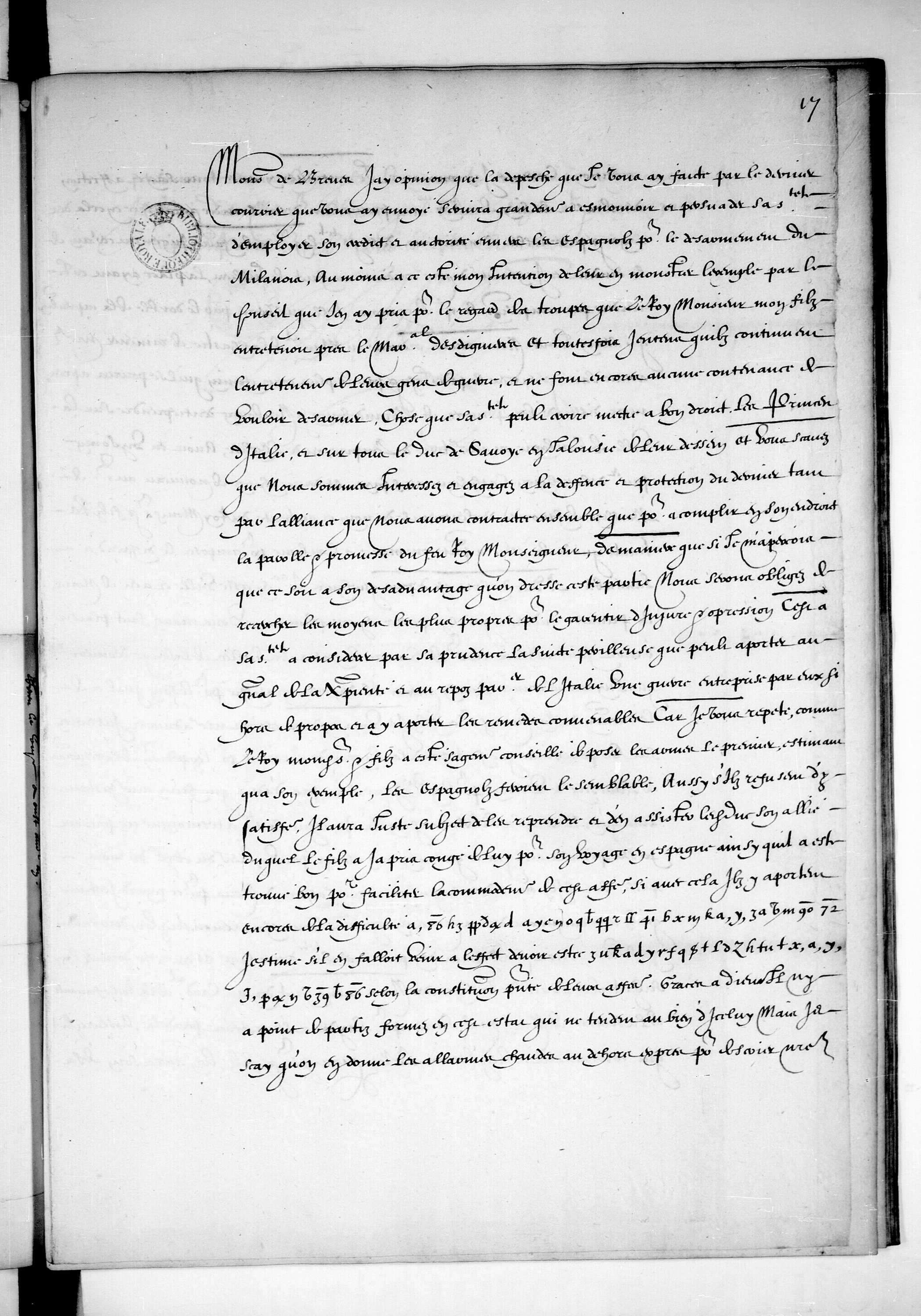
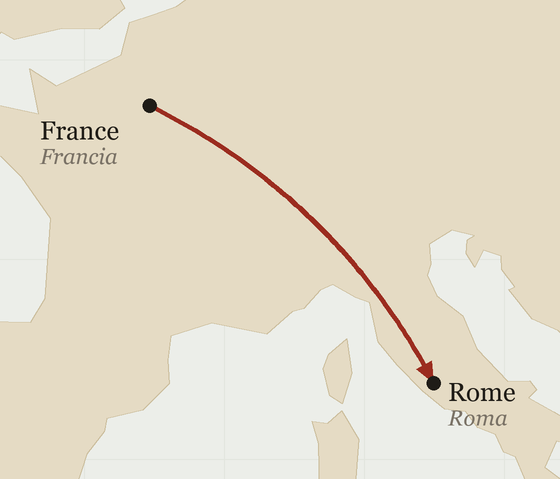
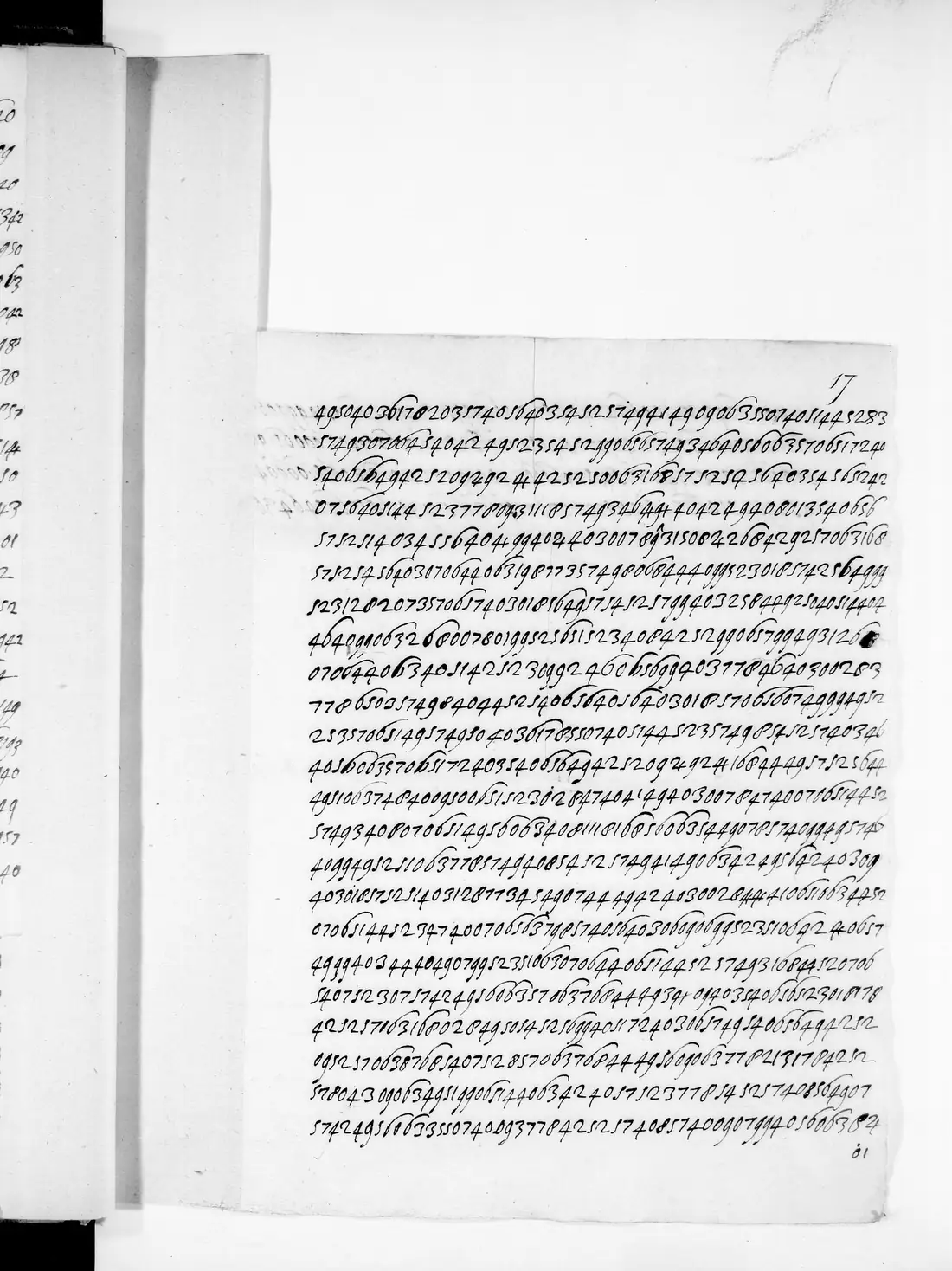
Date15 September 1610 Route France → Rome SenderMarie de’ Medici, queen regent (regent since the death of Henry IV on 14 May 1610) RecipientFrançois Savary de Brèves, French ambassador in Rome Shelfmark BnF, Français 3789, no. 11 · f17r · Gallica, view 32 · Source gallica.bnf.fr / BnF Cipher a few enciphered lines inserted in the French text: letters, syllables and numerical signs; key very close to Henry IV’s (BnF Français 3462, view 112)
State of the reading. First decipherment to our knowledge. Connected reading; bracketed characters remain probable but unconfirmed. Four numerical values are corroborated by Satoshi Tomokiyo (in blue).
Conventions: [b?] = probable character, not confirmed; blue = numerical value corroborated by Satoshi Tomokiyo, whose use in Marie’s key remains proposed.
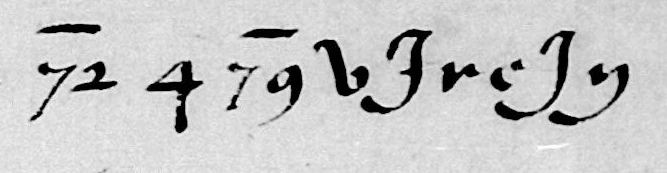
Enciphered line · f17 L1 · Source gallica.bnf.fr / BnF
Proposed reading
ce sera trop manifester leurs malice et am[b?]itionque
Enciphered line · f17 L2 · Source gallica.bnf.fr / BnF
Proposed reading
acompagne[z?] d’imprudence et
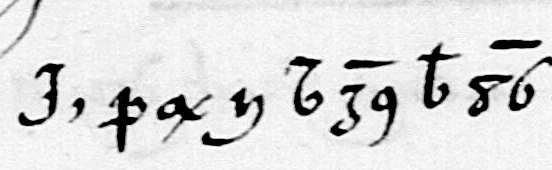
Enciphered line · f17 L3 · Source gallica.bnf.fr / BnF
Proposed reading
[de?] foi[b?]lesse
The passage in context (clear text, enciphered part highlighted)
« […] si avec cela ilz y apportent encore de la difficulté, ce sera trop manifester leurs malice et am[b?]ition que j’estime, s’il en falloit venir à l’effet, devoir estre acompagne[z?] d’imprudence et [de?] foi[b?]lesse, selon la constitution présente de leurs affaires. »
Modern reading
If they (the Spaniards, named just before in the letter) raise further difficulties, this will reveal their malice and ambition all too clearly, which, if put into effect, I consider would be accompanied by imprudence and weakness, given the present state of their affairs.
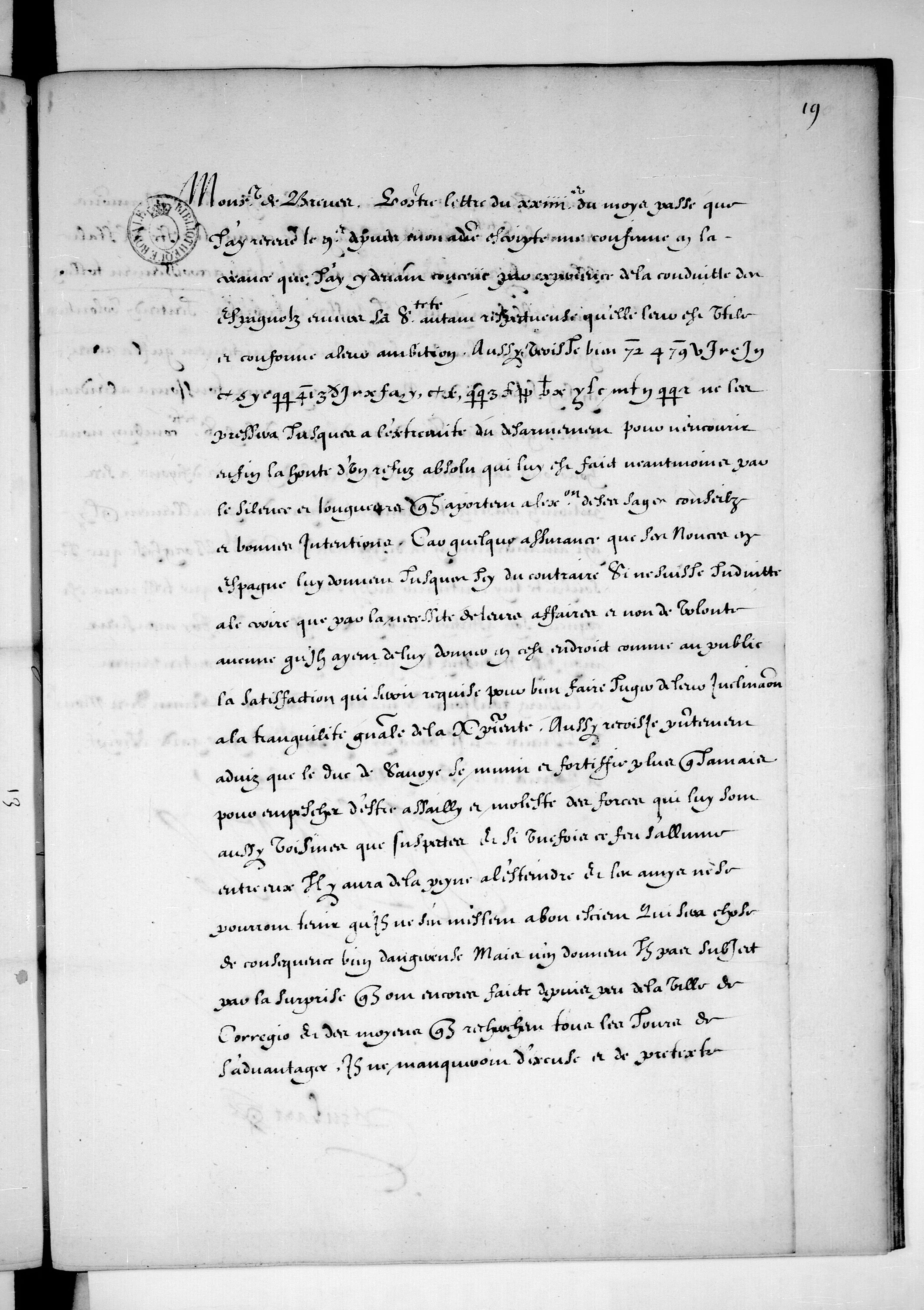
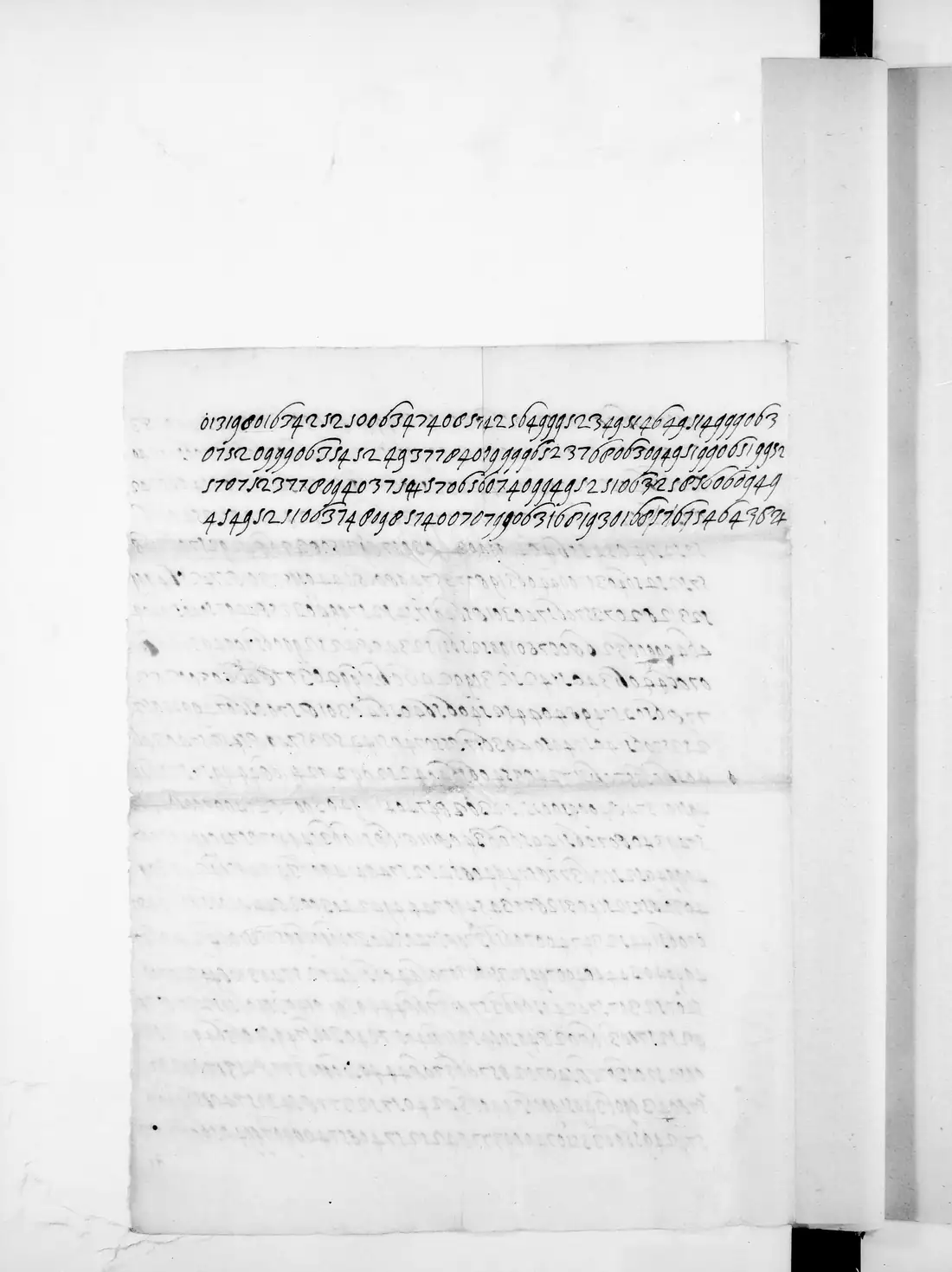
Date10 November 1610 Route France → Rome SenderMarie de’ Medici, queen regent (regent since the death of Henry IV on 14 May 1610) RecipientFrançois Savary de Brèves, French ambassador in Rome Shelfmark BnF, Français 3789, no. 12 · f19r · Gallica, view 36 · Source gallica.bnf.fr / BnF Cipher a few enciphered lines inserted in the French text: letters, syllables and numerical signs; key very close to Henry IV’s (BnF Français 3462, view 112)
State of the reading. First decipherment to our knowledge. Connected reading; bracketed characters remain probable but unconfirmed. Four numerical values are corroborated by Satoshi Tomokiyo (in blue).
Conventions: [b?] = probable character, not confirmed; blue = numerical value corroborated by Satoshi Tomokiyo, whose use in Marie’s key remains proposed.
Enciphered line · f19 L1 · Source gallica.bnf.fr / BnF
Proposed reading
que Sa Sainteté recognoi
Enciphered line · f19 L2 · Source gallica.bnf.fr / BnF
Proposed reading
ssant leurs arogance et sentant sa timidite
The passage in context (clear text, enciphered part highlighted)
« Aussi vois-je bien que Sa Sainteté recognoissant leurs arogance et sentant sa timidite ne les pressera jusques à l’extrémité du désarmement, pour recevoir enfin la honte d’un refus absolu […] »
Modern reading
I can also see clearly that His Holiness, recognising their arrogance and feeling his own timidity, will not press them to the extreme of disarmament, only to receive in the end the shame of an outright refusal.
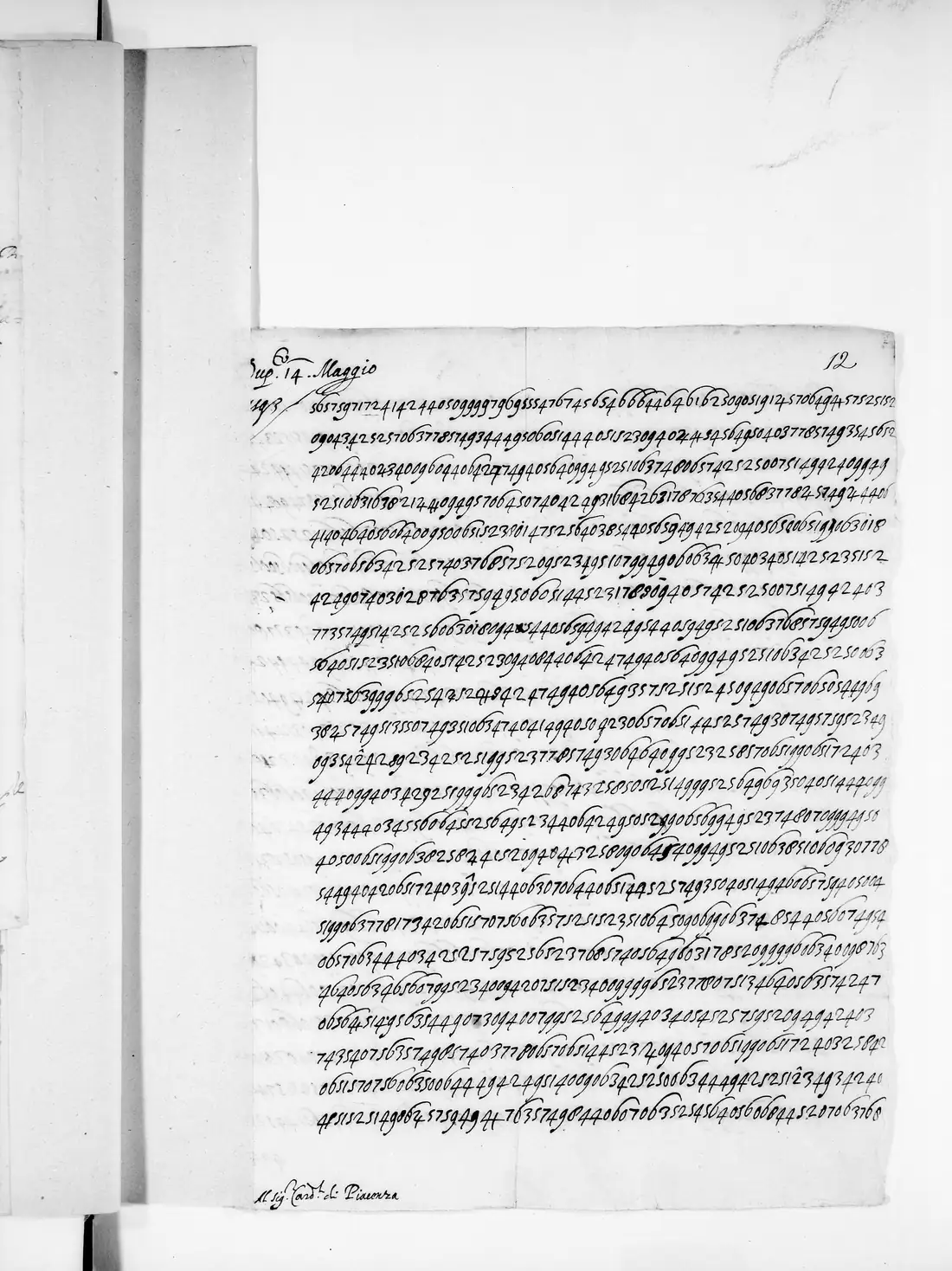
Legate Sega, 14 May 1593
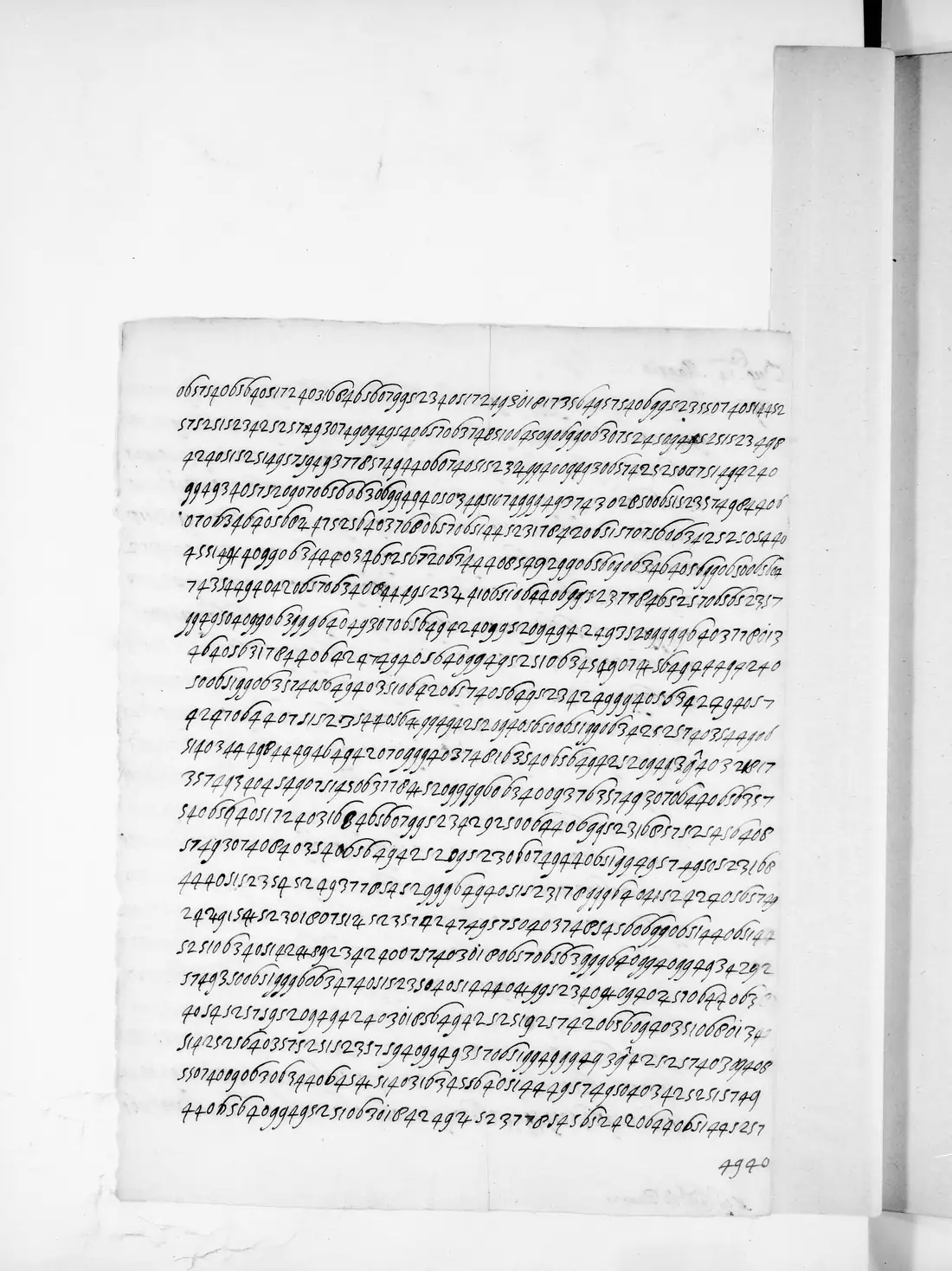
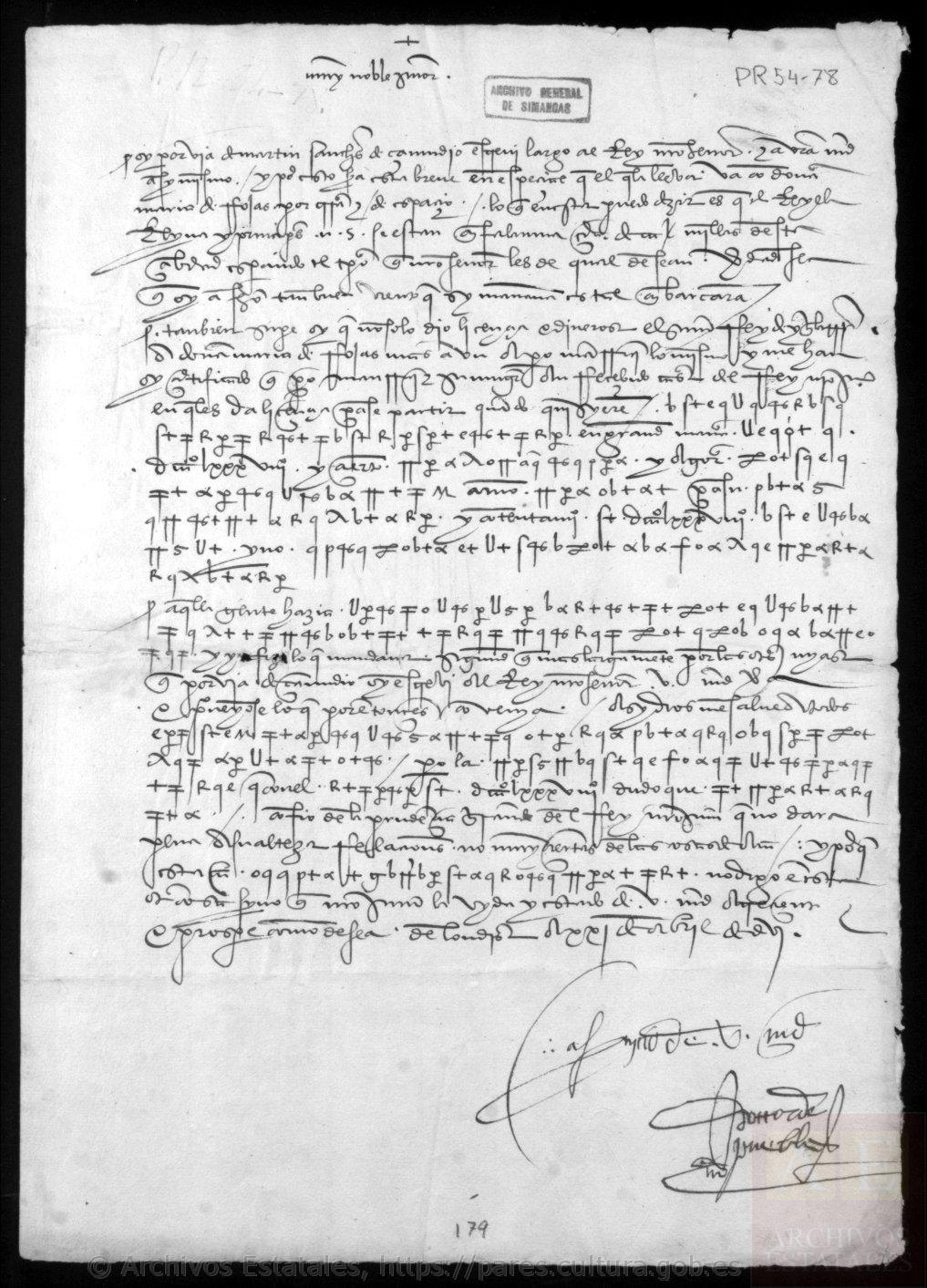
Instruction from Rome to the cardinal legate, BnF Français 3984, no. 6: twelve pages entirely in cipher. Each page is given with its image, the proposed Italian reading, a modern reading and the full deciphered text. Read the article →
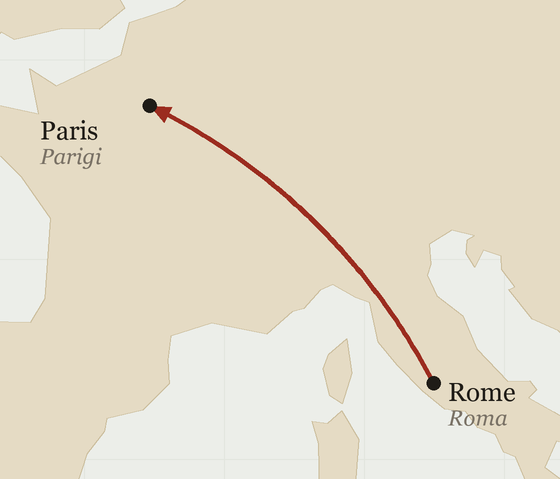
Date14 May 1593 (duplicate: “Dup.to 14 Maggio 1593” in the margin of the first leaf) Route Rome → Paris Sender Rome, on behalf of Pope Clement VIII (writer not named; the text speaks of “His Holiness” in the third person) RecipientFilippo Sega, cardinal legate in Paris (“cardinal of Piacenza”; at the foot: “Al sig. Card.le di Piacenza”) Shelfmark BnF, Français 3984, no. 6 · ff. 12r–17v · Gallica, views 24–35 · Source gallica.bnf.fr / BnF Cipher continuous figures: nulls 3 and 8, pairs for letters, nomenclator framed by nulls
KeywordsNavarra · Infanta · scisma · legge salica · finta conversione · terzo partito
State of the reading. Probable and partial decipherment. Third sign review made on the image by Claude (Opus 5.5, counter-checked by Claude Fable), not yet confirmed by Brice Dudout. Update of 23 October 2026: compared with Satoshi Tomokiyo’s preliminary reading (2019); 27 figures corrected and two letter values (97 = s, 61 = b) taken from it.
Conventions: [Navarra] = nomenclator number with a value ([x?] weak, [02] no value yet); ‹x› = restoration; “…” = passage not read. In the full deciphered text, without word division, 4? marks an isolated figure (break). Dotted underline: figures corrected after Satoshi Tomokiyo, Cryptologia 43(1), 2019.
… [le cose] che si dimandano … La prima, che si proceda alla dechiaratione et escomunicatione di … seguaci di [Navarra] … par che si debba fare almeno hora, particolarmente in esser cosa non solo inutile, ma anco nociva, stimando la scomunica che sin hora … participatione non stimeranno ; né anco la dechiaratione, come pur troppo chiari sono gli esempi che sin qui ne habbiamo, essendosi visto il poco conto che si è fatto della sentenza data contro [Navarra] et del monitorio emanato da Gregorio decimo tertio [sic], et ultimamente della bolla della legatione nel [077] Piacenza ; onde, vedendosi manifestamente che le censure sono neglette, … da costoro non saria ‹stimata›, oltre al non far frutto alcuno, altro che un far schernire più l’autorità apostolica. Et pur si sa che, essendo la sentenza delle censure medicinale, come dicono li canonisti, si deve operare dove non
Modern reading
The Leaguers’ first request: to declare the excommunication of Navarre’s supporters. Rome judges it useless, and even harmful for now. Little notice was taken of the sentence against Navarre, of Gregory’s monitory (“XIII” in the cipher, probably for XIV) or of the bull of legation. The censures are scorned; a new declaration would only expose the apostolic authority to more ridicule.
Full deciphered text of the page (no word division)
‹è› speranza di frutto, anzi in rispetto, quando sono così vili … et neglette ; vogliono li canonisti che si devano tali escomunicati assolvere etiam in … ; [02] meno si deve fare hora, non essendo le censure compagnate da forze da poterle far temere … Oltra che, a far la dechiaratione giuridicamente, saria necessario citarci ciascheduno particolarmente, cosa piena di difficoltà et pericoli ; … si aggiunge che, oltra al non si veder speranza di frutto, come è detto di sopra, si va a pericolo evidentissimo di danno, poi che potriano li … traboccarsi in uno scisma … et anco causa in esser trattati … alla Sede apostolica in riconoscerla … come sono stati sentiti, cosa la quale è degna di grandissima consideratione, in ciò che, procedendo
Modern reading
Censures are “medicinal”, the canonists say: they are worth something only where they can work. Without forces to make them feared, one should refrain. A formal declaration would mean summoning each person individually, which is full of difficulties and dangers. Above all, it would risk driving those concerned into a schism.
Full deciphered text of the page (no word division)
‹al› perdersi affatto la speranza di poterli staccar mai più da [Navarra], né di far qualche cosa di buono con la negotiatione … precipitarsi, come già è detto … [Navarra] et tutti quei che lo seguitano … oltra che, essendo più salutar rimedio … riunir … l’uno et l’altro partito insieme, si leveria anco il rimedio. La seconda, che è notoriamente et manifestamente dechiarati non voler in re alcuno della casa di Borbone, per la qual cosa non si può fare … ; bisognaria citar tutti costoro et proceder con a formar processi, cose che hanno in sé infinite difficoltà, massimamente che ci ponno esser de’ quali siano [26] istessi [Navarra] tenuti come prigioni, come sa [S. S.?] che ce ne sono, et anco … li quali non hanno colpa.
Modern reading
All hope would be lost of ever detaching his followers from Navarre, and of reuniting the two parties. Second request: to declare that no one of the house of Bourbon is wanted as king. All these people would have to be summoned and tried, with endless difficulties. Some are held “like prisoners”, and the pope knows that some of them are blameless.
Full deciphered text of the page (no word division)
… quando si tratta di levare a una famiglia la ragione d’una successione … oltra che a cose ove ‹non› è la forza che le possa eseguire non servono a niente, come vediamo in [Navarra] … nei [principi] protestanti ; le cose adunque non serviriano ad altro che a ridur in ‹ludibrio› la ‹Sede› apostolica. È ben vero che potrà far il legato con il negotiar destramente … in escluderli ; lo farà come ha anco … Borbone … in qualsivoglia accidente, dei ministri di [Spagna?] ; et non farà … approvatione senza consultarlo prima … ; deve anco considerare che, quando … l’emulatione dei capi della Lega … altri accidenti … cresce …
Modern reading
Taking away a family’s right of succession by sentence is useless without the force to enforce it: Navarre and the Protestant princes show it. It would only expose the Holy See to ridicule. The legate may, however, negotiate skilfully to exclude them. He must approve nothing without consulting Rome, and beware of the rivalry among the League’s leaders.
Full deciphered text of the page (no word division)
… [Navarra] accordandosi … partito … Lega con lui, ci potriamo veder in termine che Dio … voglia che mettesse conto pigliar uno del sangue [02] et un terzo partito ; s’impedisse a costui la consecutione della cosa, che all’hora saria impossibile tentarla, giudicando tale [S. S.?] ogn’altra cosa meglio che [Navarra] … il [regno]. La terza cosa è che si debba chiarire … chi deve aspirare alla [Infanta] … non può evenir … [S. S.?] … far in modo alcuno [02], et havendo altro interesse … potendolo haver giustificato che ‹è di› religione, et essendo il catolico, non può rifiutarlo ; anzi le altre cose di sopra, evidentemente, da chi le considera senza passione saranno giudicate sempre instrumenti … a far [Navarra] padrone … La quarta cosa è che i ministri … tanto et tutti sia-
Modern reading
If Navarre came to terms with part of the League, it might be necessary to take a prince of the blood or a “third party”, to bar him from the crown. Third point: to settle who should seek the Infanta’s hand. A Catholic prince of proven religion could not be refused. Otherwise, everything above would seem, to an unbiased judge, a means of making Navarre master. Fourth point: the [Spanish] ministers…
Full deciphered text of the page (no word division)
‹no› e giunti … quando i ministri di … mireranno al bene et alla salute ‹del regno›, come si spera ; i ministri … hanno espresso … congiunti con loro, et haveranno … intentione. La quinta cosa, che [S. S.?] sia pratica circa le ragioni della serenissima [Infanta] alla corona : intorno a che [S. S.?] dice che le informationi che ha visto a favore della [Infanta], mostrateli da Pegna, se bene contengono tutto …, non però tali, che ogni mediocre dottore, senza … rivoltar libri, ci potria rispondere. Dice di più che, quando bene la legge salica [di Francia?] non si trovasse scritta, è però scritta ‹nei› cuori ‹dei Francesi›, che nascono con essa in bocca ; i quali da Clodoveo in qua … non hanno mai visto donna succedere alla corona, et più d’una volta è uscito il regno d’una famiglia et passato
Modern reading
The ministers should aim at the good and safety [of the kingdom]. Fifth point: the Infanta’s rights to the crown. The pope has seen the memoranda in her favour shown to him by “Pegna” (probably Francisco Peña; a hypothesis). Any mediocre doctor, without opening a book, could answer them. The Salic law, even if unwritten, is written in the hearts of the French, who are born with it on their lips. Since Clovis no woman has succeeded, and the kingdom has more than once passed from one family to another.
Full deciphered text of the page (no word division)
in un’altra ; anzi … hanno sostenuto gravissima guerra con gl’Inglesi ; onde … osservanza di consuetudine et consenso dei popoli, hanno sempre succeduto li maschi, escluse le femine, oltre una infinità di difficoltà che ci sono circa la successione, etiam secondo la dispositione della ragion comune, quando … si attendesse … il quale professa il contrario, cioè di soggiacere alla dispositione … come … riconosce l’impero. … [S. S.?] si è ‹profondato› nel pensiero [02] ; haveria creduto che se [S. S.?] havesse fidato nelle ragioni [di Francia?], havesse tentato la via … ; ma è che intento in Portogallo, et se ben desidera ogni satisfatione … lo procurerà sempre ; vede però … non solo difficilissimo … la natura dei … havesse da haver … [di Francia?] regina, et altri ri-
Modern reading
The French fought a very hard war against the English over this. Custom and the consent of the peoples have always called the males, excluding the women, and common law also raises many difficulties. The pope has thought about it at length. Portugal is mentioned; the pope wishes to give Spain every possible satisfaction, but sees the drawbacks of giving France a queen…
Full deciphered text of the page (no word division)
-spetti, che si lasciano di dire, ma pericolosissimo di far traboccar tutti … dalle mani di … vuole detrahere a [Spagna?] al partito della Lega ; dice apertamente che è il fine di [Spagna?] la difesa ‹del›[regno], ma il farlo venir in poter della figliola, et ‹mutar› in rispetto di tutti l’ordine di successione ; da che si vede manifestamente il pericolo che l’una et l’altra parte non trabocchi in qualche cosa che apporti seco la ‹ruina› della religione non solo in quel [regno], ma anco negl’altri ; … vogliono oscurar tutte le attioni sante fatte da [Spagna?] nella impresa ; dicono a piena bocca che hora si scuoprono i fini, che non sono stati di religione … poi che prima si professava … non voler cosa alcuna, et hoggi si pretende … [regno] … solo, et nel zelo per religione attribuiscono l’esclusi-
Modern reading
It would be most dangerous to make everything tip over. The Spaniards say openly that their aim is to defend the kingdom; they are suspected of wanting to put it in the power of the king’s daughter and to change, with regard to everyone, the order of succession. Both parties might tip over, at the risk of ruining religion in France and elsewhere. Their opponents say “openly” that their aims are now uncovered, and that they were not religious.
Full deciphered text of the page (no word division)
-one dei Borboni, giudicando che ciò … esclusi … accordando li capi della Lega … et loro … [regno] a [Infanta] … a fine … si sia mai voluto soccorrerla … a forze, le si potesse debellar [Navarra], ma solo staccar l’una parte et l’altra, acciò nell’ultimo gli habbino da capitar ‹nelle› mani le cose importanti … consideratione degli altri [principi], basta accennarlo. La sesta è che cosa si haveria da avvertire in evento che … sotto colore di finta ‹con›versione aderisse a [Navarra], o si pigliasse un altro del sangue, o andasse in lungo … senza concludere, o si dissolvesse … senza far niente ; … dice [S. S.?] che … potranno le deboli forze della Sede apostolica, non abbandonerà mai la causa publica, che quando
Modern reading
They attribute the exclusion of the Bourbons to religious zeal alone. Spain is suspected of never having wanted to defeat Navarre, but only to divide the two parties, so that everything ends up in its hands. Sixth point: what to do if Navarre, under colour of a feigned conversion, won over the Catholics, if another prince of the blood were taken, or if the Estates dragged on or dissolved without doing anything. Weak as its forces are, the Holy See will never abandon the public cause.
Full deciphered text of the page (no word division)
ognuno farà veramente che potrà posporre gl’interessi particolari ; si ha da sperare che Dio non habbia d’abbandonar la causa sua. Le cose, dice [S. S.?], [02] … serenissima … quando fossero riuscite, … non li piaceria estremamente … [Spagna?] … eguale difficoltà et i pericoli che vi sono, et … che ha riscontri da [02] bande, che sa certissimo … che infiniti parlano più liberamente seco che [Spagna?] e i suoi … ministri … ; resterà però … di fare che potrà … che ha scritto moltissime volte al legato … di nuovo, acciò che, se si vede spiraglio di cosa riuscibile, atta a partorir la salute di [regno] et satisfatione di … giunti … i ministri di [Spagna?] aiutando la pretensione della serenis-
Modern reading
Everyone will have to put private interests second; one must hope that God will not abandon his cause. The pope sees the difficulties and dangers of the Infanta’s candidacy. He knows, from several sides, that many speak more freely to him than to Spain and its ministers. He has written very many times to the legate: if a workable way out appears for the salvation of the kingdom, the legate may help the Spanish ministers in the Infanta’s claim…
Full deciphered text of the page (no word division)
-ima [Infanta] ; sarà possibile quando … senza pericolo … come di sopra, procurando che … sia … in persona grata … [Spagna?] … cose di sopra … che si è dato in scritto … in risposta delle domande fatte [da Spagna?] intorno a cotesti … anco l’offerta che fa [S. S.?] … ; si adoprerà in servitio della serenissima [Infanta], quando si possa fare senza pericolo et disordine, et almeno … habbia [Spagna?], havendosi a venire a … , più satisfatione che sia possibile circa la persona, che giudica [S. S.?] … dovendo haver … aiuto ; né vedendosi per dove può uscire … [di Francia?] … et cose [02] importanza … non può … intende, caso che non si possa riuscire qualche cosa salutare.
Modern reading
The legate will do so only if it can be done without danger or disorder, with an acceptable person, giving Spain as much satisfaction as possible over the choice of person. The pope refers to the written answer given to the Spanish requests, and to his own offer. He sees little other way out if nothing salutary can be achieved.
Full deciphered text of the page (no word division)
-ne [regno], come ha scritto infinite volte, poi che … è intento suo che la conservatione della religione per la salute di [regno] … [fin du chiffre]
Modern reading
End of the cipher, in four lines: as he has written many times, the pope’s intention remains the preservation of religion, for the salvation of the kingdom.
Full deciphered text of the page (no word division)
A spy’s letter from the Ragusa network during Süleyman’s campaign: written in clear, it enciphers only eight words — names of people and places, the date and the signature. Once these groups are read, it reveals a plan: to seize the French ambassador at sea on his way back from the sultan.
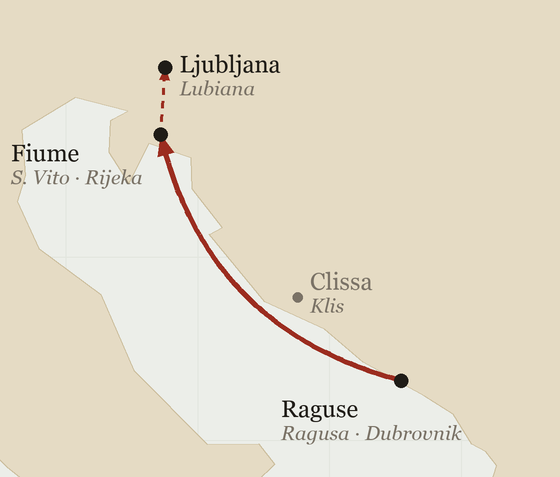
Schematic map (Natural Earth background): the brigantine from Ragusa reaches Fiume; the letter leaves by post for Ljubljana. Clissa is marked.
Date19 July 1532 (“a dì 19”, month and year in cipher; archival dockets “1532. 19/7” and “19. Juli 1532” on the letter) Route Fiume → Ljubljana (by post) → court of Ferdinand I SenderNiccolò Ferducci (Nicolaus Verducius), Ferdinand’s agent at Fiume (signature in cipher, 543; the online inventory lists the letter as “N.N.”, sender enciphered) RecipientFerdinand I, King of the Romans, of Hungary and of Bohemia (address on the back: “Invictissimo Ferdinando … et Boemie”) Shelfmark Österreichisches Staatsarchiv, HHStA, StAbt Türkei I 2-2-19, fols. 60–61 Cipher letter in clear (Venetian Italian) with a small nomenclator: three-figure numbers (543, 547, 518, 520, 521), barred Q + number (Q19), D + number for months and year
Keywordsambasciatore de Francia · bregantino · peschara · Chlisa · gardinal Colona · gardinal di Medici
No facsimile here: the AIS images carry no open re-use licence. They can be viewed free of charge online (3 views).
State of the reading.A new reading of an unglossed piece. In this collection most other cipher pieces carry a contemporary decipherment (interlinear or attached) or a nineteenth-century one; this is the only letter of Ferducci’s without a gloss. All eight groups are read with a table drawn from the contemporary glosses of two other Ferducci letters; no group is left unresolved. The uncertainties concern the handwriting of the clear text and its interpretation, marked below. Reading of 27 October 2026 by Claude (Opus 5.5), not yet reviewed by Brice Dudout. Not edited before, to our knowledge (checked the same day).
Conventions: Martino Lucio547 = cipher group and its value; {x} = probable reading or sense; ‹x› = unresolved. Abbreviations expanded silently.
The cipher groups and their key
The table was built only from the contemporary glosses written above the same groups in two other letters of Ferducci (2 June and 18 September 1532), then frozen before it was applied to this letter. Independent check: the table drawn separately from the glosses of 1542 (Bourdeau catalogue no. 499) gives the same value to the six groups in common (6/6, no conflict).
Group
Value
Contemporary gloss (1532)
Table of 1542
543
Niccolò Ferducci
2-2-9, 2-2-24 : « Nicolaus Verducius »
S43 = Ferducci
547
Martino Lucio
2-2-9 : « Martino lucio Ragusa » ; 2-2-24 : « da martinolucio da Ragusa »
—
Q19
Ragusa
2-2-9 (deux fois), 2-2-24 : « Ragusa »
Q19 = Ragusa
518
S. Vito (Fiume)
2-2-9 : « S. Veit » ; 2-2-24 : « Data a S.to Vito »
—
520
ambasciatore
2-2-9 : « Ambasciator »
S20 = ambasciatore
521
Francia
2-2-9 : « Ambasciator del Re di Fran[cia] »
S21 = Francia
D7
luglio
règle Dn : D6 « Junij » (2-2-9), D9 « Septembre » (2-2-24)
D3, D5, D6 = mois
D19
1532 (année courante)
2-2-9 : « D6 D19 » glosé « 1532 »
D19 glosé « 42 » en 1542
Deciphered text (Italian)
Ser.me Rex atque invictissime princeps, domine colendissime, post servitiorum meorum humillimam commendationem.
L’ultima mia fu de 24 del passato, con la inchiusa dal loro servitore Martino Lucio547, sotto littere del signore Andrea {Lanbergher}. La cagion di questa sie per dinottare a vostra Maestà Serenissima come in questa hora a tardi è gionto qui el bregantino da RagusaQ19 con le presente ligatte in questa; e per esere in esse gran nove, subitto subitto ho meso un mio servo ha cavallo per le poste e mandatollo a Lubiana, e scritto al signore Andrea {Lanbergher} che senza nullo ritegnio le manda a vostra Maestà Serenissima. La cosa di Chlisa è cosa certissima; similiter di monsignore gardinal Colona.
Si vostra Maestà ha a piacere di aver nelle mane l’ambasciatore520 de Francia521 al suo ritorno, che verà per mare in qualche bregantino, io andarò in persona con 10 o 12 compagni harmati; si fengiremo d’andare {a peschara}, e secretto modo si sforzaremo di averllo, per aviso da vostra Maestà Serenissima.
El gardinal di Medici fa gente a gran furia per la Marcha e per la Romagnia; si dici per el volgo che viene {a divotione} di vostra Maestà. Staremo vigilanti, e facendo altro subitto {ve se avisarà}; el simille di altro che s’intenderà. Per hora no avemo altro. A vostra Maestà Serenissima humilmente mi richomando. Datta S. Vito518 a dì 19 luglioD7 1532D19.
De vostra Maestà Serenissima humil servo Niccolò Ferducci543.
Translation
Most serene King and most invincible prince, my most honoured lord, after the humble commendation of my services.
My last letter was of the 24th of last month, with the enclosed letter from your servant [Martino Lucio], under cover of Signor Andrea Lamberger. The purpose of this one is to let Your Most Serene Majesty know that this evening, late, the brigantine from [Ragusa] arrived here with the letters enclosed with this one; and since they contain great news, I at once, in all haste, put one of my servants on horseback by the post and sent him to Ljubljana, and I wrote to Signor Andrea Lamberger to forward them to Your Most Serene Majesty without any delay. The matter of Clissa is quite certain; likewise that of Monsignor Cardinal Colonna.
If Your Majesty would like to have [the ambassador] of [France] in your hands on his return, which will be by sea on some brigantine, I will go in person with ten or twelve armed companions; we shall pretend to go fishing, and secretly we shall do our best to take him, on word from Your Most Serene Majesty.
The Cardinal de’ Medici is raising troops in great haste in the Marche and in Romagna; the common people say he is coming to Your Majesty’s service. We shall stay vigilant, and if anything else happens you will be told at once, and likewise of any other news we hear. For now we have nothing else. I humbly commend myself to Your Most Serene Majesty. Given at [San Vito, that is Fiume], the 19th of [July] [1532].
Your Most Serene Majesty’s humble servant [Niccolò Ferducci].
Reading notes and historical notes
“a peschara”: the letters are certain. Probable sense {fishing} (Venetian andar a pescar), a natural cover for a dozen armed men in a boat. “To Pescara”, the Abruzzo port, is less likely: the town belonged to the Kingdom of Naples, that is to the Habsburgs, so there was no reason to pretend to go there.
“a divotione”: the hand writes “a d”, three minims (iu, read iv), “o”, a tall looped letter read t, then “ione”. The reading {a divotione} gives the common formula venire a divotione di, “to come over to the service of”. It fits the facts: the legate Ippolito de’ Medici left Rome on 8 July 1532 to join Charles V and Ferdinand against the Turks.
“ve se avisarà”: the hand writes “~ose auisara”, with the hooked v of “viene”. Read {ve se avisarà}, “you will be told”; our first reading, “vostra [Maestà] sarà avisata”, assumed an abbreviation that is not there.
Andrea “Lanbergher”: the ending “…gher” is certain in both places; the first vowel may be a or o. Probably a member of the Carniolan Lamberg family, Ferducci’s relay at Ljubljana; his office is not established.
The French ambassador is not named. Probable identification: {Antonio Rincon}, Francis I’s envoy to Süleyman in 1532. A Spanish report of April 1532 says he would travel by Sebenico and Ragusa; on 21 June the Conte da Ella wrote from Ragusa that Rincon was leaving for Belgrade, “dicesi essere ambassatore di Re di Francia” (2-2-13). According to Gévay, he brought to Venice on 20 August 1532 a copy of Süleyman’s letter of 12 July: he did return by the Adriatic, as Ferducci expected. No sequel to the plan is known. Rincon was killed in July 1541 near Pavia by men of the Marquis del Vasto.
“La cosa di Chlisa”: Clissa (Klis), Petar Kružić’s fortress above Split, held against the Ottomans; the same spelling is glossed in September 1532 (“li turchi a presso Chlisa”). The exact news remains ‹unresolved›.
“Monsignore gardinal Colona”: Pompeo Colonna, cardinal and viceroy of Naples, died on 28 June 1532. The “quite certain matter” is probably {his death}.
Context: Süleyman is marching on Vienna; he will be halted in August before Güns (Kőszeg). The enclosed “great news” is probably the Conte da Ella’s letters to Ferducci of 11 and 12 July, kept in the same file (2-2-17). The next piece, 2-2-18, is Süleyman’s letter to Ferdinand of 12 July.
Method and credits
Method: (1) table of groups built only from the contemporary glosses of 2-2-9 (2 June 1532) and 2-2-24 (18 September 1532), frozen before use; (2) mechanical application to 2-2-19, which has no gloss; (3) checks: agreement between the two glossed letters (0 conflicts), agreement with the independent table of 1542 (6/6), date confirmed by the archival dockets on the letter; (4) targeted palaeographic review of the clear text on the AIS images.
Prior work, checked on 27 October 2026: Daniel Bourdeau’s catalogue lists no. 498 as open; nothing on Cryptiana or in a web search; the letter is not printed in Gévay’s Urkunden und Actenstücke.
Found through Daniel Bourdeau’s catalogue, no. 498 ↗. Archives: Österreichisches Staatsarchiv, Haus-, Hof- und Staatsarchiv, StAbt Türkei I 2-2-19 (AIS ↗), glosses in 2-2-9 (AIS ↗) and 2-2-24 (AIS ↗). Context: Anton von Gévay, Urkunden und Actenstücke zur Geschichte der Verhältnisse zwischen Österreich, Ungern und der Pforte, Vienna, 1838–1842. See also Sources.
Charles XII to the Council of the Realm and to his envoys, Bender, 26 April 1710
A refugee at Bender, on Ottoman soil, since Poltava, Charles XII learns of the rout of the Danish army at Helsingborg. In a chancery letter whose sensitive passages are in cipher, he declares himself ready to make peace with Denmark under the mediation of England and the United Provinces, and gives the Council a “free hand” to negotiate and to conclude an armistice, “even for a whole year”. Two ciphered copies, received by the Swedish government of Bremen-Verden, are kept at Stade.
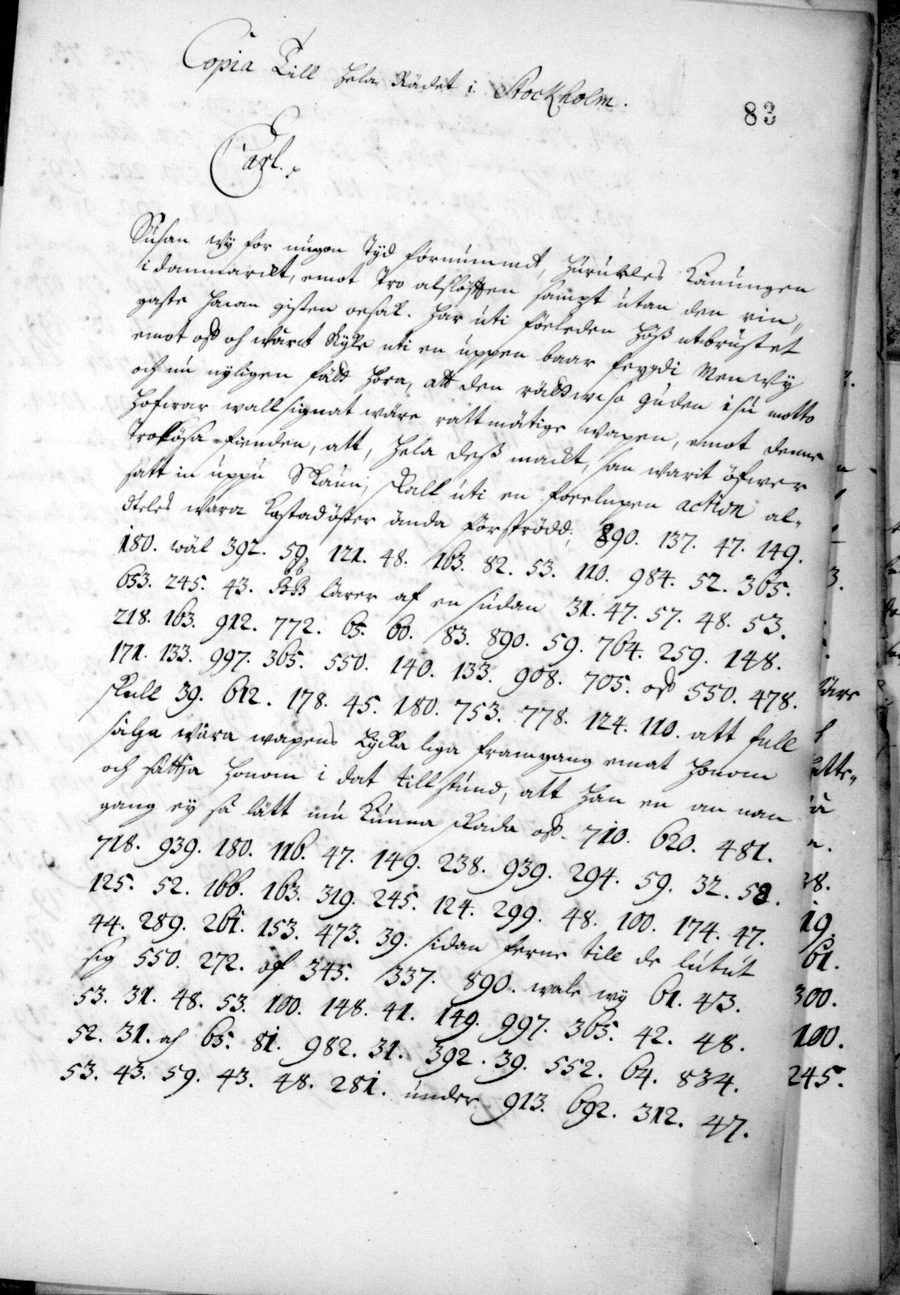
Fol. 83r, beginning of the copy for the Rådet: “Copia till hela Rådet i Stockholm. Carl.”; the account of Helsingborg is in clear, the rest in cipher groups. NLA Stade, Rep. 5a Nr. 670, image 0084 (Public Domain Mark 1.0).
Date26 April 1710 (Swedish calendar, i.e. 7 May 1710 Gregorian; “Bender d. 26 April 1710”) Route Bender (Ottoman Moldavia) → Stockholm and The Hague / London; copies to the governor-general of Bremen-Verden at Stade SenderCharles XII, King of Sweden (“Carolus”; countersigned by Gustaf Henrik von Müllern, secretary of the field chancery) Recipientsthe Rådet (Council of the Realm, Stockholm) — “Copia till hela Rådet i Stockholm”, fols. 83r–84r; the envoys Leijoncrona (London) and Palmquist (The Hague) — “Copia till Envoyerne Leijoncrona och Palmqvist mut. mutand.”, fol. 85r–v Shelfmark Niedersächsisches Landesarchiv, Abt. Stade, Rep. 5a Nr. 670 (old shelfmark Fach 76 Nr. 38), fols. 83–85; file “Diverse chiffrierte Schreiben von und an Generalgouverneur Baron Nils Gyllenstierna”, 1700–1711 Cipher homophonic Swedish nomenclator of about 1,100 numbers in alphabetical order: letters (31–98, two series), syllables (99–182), numbers (183–211), endings (212–304), words and names (310–1102); powers written as sigla in clear: B.B. = Denmark, LL = England, ddd = Holland
State of the reading.A new reading of the Stade cipher copies. No key or decipherment accompanies them. The key (“K1710”) was rebuilt from a ciphered troop list in the same file whose clear draft survives, then frozen and validated on letters never opened before (93% and 96% of words recognised, against at most 77–80% for scrambled control keys). Of 640 groups, one remains unresolved; six readings are probable (marked {x}) and five clerk’s slips are flagged (‹x›). The clear text of the original, in a fast cursive, is a working reading. The clear copy received by the Council is probably kept in the Riksarkivet, Stockholm; we have not consulted it, and the letter’s content may be known to historians that way. Reading of 27 October 2026 by Claude (Opus 5.5), targeted checks by Brice Dudout.
Conventions: grey text = written in clear in the original (working reading; [?] = word not read); black text = deciphered; {x} = probable reading; ‹x› = unresolved or clerk’s slip; B.B., LL, ddd = sigla in clear.
The K1710 key (extract)
Structure of the nomenclator, deduced from the recovered values (no table of this cipher survives in the file), then the values actually used in the two copies of the letter. The recovered code words follow alphabetical order at 99.7% (against 0.6 for random permutations).
Numbers
Content
Examples
31–64
letters, 1st series: a ä å b c ch ck d e f g h i k l m n o p q – r s sk sch sp st – t u w x y z
31 a, 47 n, 52 r, 59 t
65–98
letters, 2nd series = 1st + 34
65 a, 81 n, 87 s, 93 t
99–182
consonant + vowel syllables, from ba to wu
100 be, 149 ne, 163 ra, 180 wi
183–211
numbers
183 = 1 (“en”), 210 hundra, 211 tusen
212–304
endings, alphabetical
245 en, 267 ing, 304 tion
310–1102
words and names, from “af” to “Wismar” (proper names at the end)
552 fred, 653 Konung, 956 stille, 1033 wapen
Values used in the letter
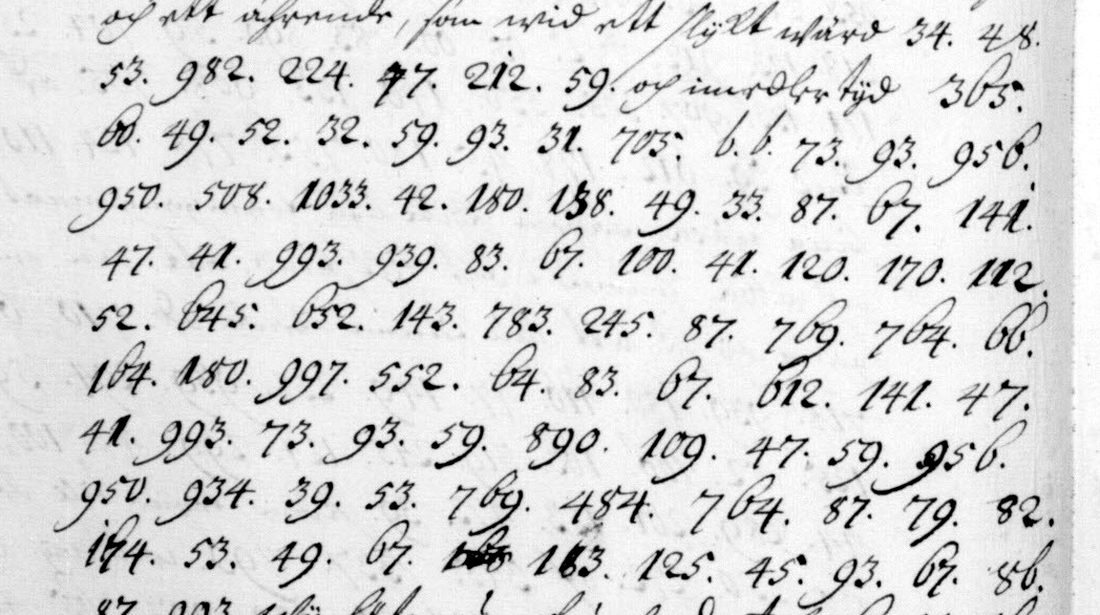
Letters31 a / c · 32 ä · 33 å · 34 b · 38 d · 39 e · 40 f · 41 g · 42 h · 43 i · 44 k · 45 l · 46 m · 47 n · 48 o · 49 p · 52 r · 53 s · 57 st · 58r · 59 t · 60 u · 61 w · 64 z · 65 a · 66 ä · 67 å · 73 e · 74 f · 77 i · 78 k · 79 l · 80 m · 81 n · 82 o · 83 p · 86 r · 87 s · 88 sk · 93 t
Syllables100 be · 109 da · 110 de · 111 di · 112 do · 114 fa · 116 fi · 118 fu · 119 ga · 120 ge · 121 gi · 124 ha · 125 he · 133 ka · 137 ku · 138 la · 139 le · 140 li · 141 lo · 143 ma · 144 me · 146 mo · 148 na · 149 ne · 151 no · 153 pa · 160 qui · 163 ra · 164 re · 166 ro · 168 sa · 169‹se› · 170 si · 171 so · 173 ta · 174 te · 175 ti · 178 wa · 179 we · 180 wi
Number183 en (1)
Endings212‹212› · 218 änd · 224 are · 231 dan · 232 de · 236 der · 238det · 240 dra · 243 else · 245 en · 259 ge · 261 het · 262 heter · 267 ing · 272 leda · 274 lig · 281 ner · 282 ning · 285 ra · 289 sam · 292 ska · 293 skap · 294 sta · 299 stig · 300 tit · 303 tig · 304 tion
Words312 er · 319 af · 333 all · 337allt · 345andra · 365 att · 392 billig · 395 blifw · 473Dansk · 478 den · 481 dess · 484 det · 495 Drottning · 499 eder · 508 eller · 512emot · 531 fall · 548fort · 550 för · 552 fred · 554 fri · 572gärna · 587 hafwa · 589 hand · 612 huru · 615 hwar · 620 icke · 645 kan · 652 kom · 653 Konung · 670 led · 671 lägenhet · 672 läng · 677 lid · 692 makt · 703 med · 705 med · 710 men · 718 mindre · 720 Minist · 753 nog · 764 och · 769 om · 772 ond · 778 orsak · 783 öfwer · 796 på · 834 propo · 890 så · 891 såsom · 907 sielf · 908 sig · 910 sin · 912 sina · 913 Sjö · 934slut · 939 som · 950 stand · 956 stille · 982 tag · 984 tanka · 986 tar · 993 tid · 997 till · 1008 tro · 1021 under · 1024 ut · 1026 ut · 1033 wapen · 1049wilkor
Outside the series25ak
Transcription of the groups
Each line of the copy: the numbers as written (the original’s clear text in brackets, shortened), then the value of each group. Lines follow the layout of the folios.
men · icke · dess · mindre · som · wi · fi · n · ne · det · som · sta · t · ä · r · he · r · ro · ra · af · en · ha · stig · o · be · te · n · k · sam · het · pa · Dansk · e · si · dan · hwar · till · de · la · tit · sig · för · leda · af · andra · så · ä · re · wi · be · na · g · ne · att · i · n · ga · med · Konung · en
i · [B.B.] · en · billig · fred · under · Sjö · makt · er · n · a · s · me · di · a · tion · så · f · r · a · m · t · wi · om · så · dan · t · blifw · a · re · qui · re · ra · de · och · för · ut · för · sa · k · ra · de · om · en · no · i · ak · tig · sa · ti · s · fa · c* · tion · för · all · den · o · för · r · ä · t · ska · da · och · för · f · å · n · g
[som] · wi · och · wa · re · under · så · tar · e · [af att så …] · hafwa · mo · st · lid · a · [wil ?upstrandes att …] · Konung · en · i · [B.B.] · ut · dra · ge · [kriget och] · fort · [för] · med · fi · en · te · lig · heter · emot
[och ?på widare …] · o · s · till · fred · z · [i framtiden] · och · fu · l · l · gi · o · ra · [sedan] · för · no · i · else · [som wij ?hafwe …] · såsom · ut · af · eder · sielf · we · [och utan någon] · w · å · r · be · fall · ning · att · för · k · la · ra
[icke allenast detta] · w · ä · r · t · fred · ä · l · ska · n · de · sin · ne · [utan och det] · för · tro · en · de · [wij hafwe till] · Drottning · en · s · i · [LL] · w · ä · n · skap · [och benägenhet till …] · för · ska · fa · [och] · en · he · der · lig · och · s · ä · k · e · r · fred · med · [B.B.] · [hwarmed etc. Bender …]
Fol. 83v, lines wholly in cipher: “upprätta med [b.b.] ett stillestånd eller wapenhwila på så lång tid som på begge sidor kan kommas öfwerens…” (“to conclude with Denmark an armistice or suspension of arms for as long as can be agreed on both sides”). Image 0085 (Public Domain Mark 1.0).
som · i · b · ä · st · f · i · n · ne · n · [hwarmed etc. Bender …]
Established text (Swedish)
Copy for the envoys (fol. 85r–v)
Carl. Emedan såsom wij nyligen förnummit, det Konungens i Danmarck krigsmakt, hwilken förledne höst blef skeppad in uti Skåne, skall för liten tid sedan uti en förlidne action aldeles warit öfwerwunnen, slagen och förströdd, så att wi billigt deraf kunne giöra oss de tankar, att ‹att›bemälte Konung‹se›en, dess huru som den rättwisa Guden i så måtto hafwer straffat hans trolöshet och orättmätiga förfarande emot ord och [?] Sigill, lärer ändra sina onda upsåt och ge(r)na söka till att förlika sig med oss. Altså, ehuruwäl wi nog orsak hade will att fullfölja wåra wapens lyckliga framgång emot honom och bringa honom så i trångmål, att han [?] icke kunna skada oss, då wij hafwe med andra wåra fiender att giöra, men icke dess mindre, som wi finne det, som Staterherrorna af en hastig obetänksamhet på Danske sidan, hwartill de låtit sig förleda af andra, så äre wi benägne att inga med Konungen i B.B. en billig fred under Sjömakternas mediation, så framt wi om sådant blifwa requirerade och förut försäkrade om en nöjaktig satisfaction för all den oförrätt, skada och förfång som wi och wåre undersåtare af ett så obilligt fredsbrott hafwa måst lida. (…) att ju längre Konungen i B.B. utdrage kriget ochfortfar med fiendteligheter emotoss, ju (swårare) lärer det blifwa (…) att ställa oss tillfredz i framtiden och fullgiöra den förnöjelse som wij (…) af honom (…) skall såsom utaf eder sielfwe och utan någon wår befallning att förklara icke allenast detta wårt fredälskande sinne, utan och det förtroende wij hafwe till Drottningens i LL wänskap och benägenhet till att förskaffa oss en hederlig och säker fred med B.B.. Hwarmed etc. Bender d. 26. April 1710. Carolus. H. G. von Müllern
Copy for the Rådet (fols. 83r–84r)
… skall uti en förlorad action aldeles warit öfwerwunnen och förströdd, så kunne wi wäl billigt giöra oss de tankar, att Konungen i B.B.lärer af en sådan anstos ändra sina onda upsåt och ge(r)na söka till att förlika sig med oss ?; för den skull, ehuruwäl wi nog orsak hade att fullfölja wåra wapens lyckliga framgång emot honom och sätta honom i det tillstånd, att han nu en annan gång ej så lätt må kunna skada oss, men icke dess mindre, som wi finne det, som Statärherrorna af en hastig obetänksamhet på Danske sidan, hwartill de låtit sig förleda afandra, alltså wela wij wisa oss benägne till att höra och antaga billige fredz propositioner under Sjömakternas mediation, så framt ochDanske det gärnawilligt utan längre upskof begiära, och [?] förut försäkra oss på en billig förnöjelse för skada och olägenhet som wij och wåra undersåtare af detta fredsbrott och föröfwade fiendtligheter på ett eller annat sätt hafwa måst lida. Altså wele wij här med lemna eder tillstånd och fria händer underll och ddds mediation till att inleda eder uti en fredzhandling med bbpå sådanawilkorsom här ofwan till är nämndt (…) en fred och allt öfrigt, som wid ett slikt wärk (?) bo‹s‑tag‑are‑i‑212›t, och imedlertid att upprätta med b.b. ett stillestånd eller wapenhwila på så lång tid som på begge sidor kan kommas öfwerens; om och äre wi tillfredz på huru lång tid ett sådant stillestånd slutes, om det och ‹slores› på ‹…› heelt års tid. Wij låta nu och (…) till wåre Ministri i ll och ddd att [?] såsom af sig sielfwe skole där förklara detta wårt fredälskande sinne, såsom allt sådant widare (…) bilaga widare kan ses. Förlitandes wij oss uppå eder bekante dexteritet och beprofwade nit för wår tienst och interesse, att bestämma allt detta som I bäst finnen. Hwarmed etc. Bender d. 26 April 1710. Carolus. H. G. von Müllern
Translation
Copy for the envoys (fol. 85r–v)
Charles. Since we have lately learnt that the King of Denmark’s army, which last autumn was shipped over into Scania, has a short while ago, in an action, been utterly overcome, beaten and scattered, we may rightly conclude that the said King — inasmuch as the just God has thus punished his faithlessness and his wrongful dealing against his given word and seal — will change his evil designs and willingly seek to come to terms with us.
Therefore, although we have reason enough to pursue the happy success of our arms against him and to bring him into such straits that he can no longer harm us, while we have our other enemies to deal with, nevertheless, as we find that the Lords States, out of hasty thoughtlessness, [have placed themselves] on the Danish side, to which they have let themselves be led by others, we are inclined to enter into an equitable peace with the King of Denmark under the mediation of the Maritime Powers, provided that we are requested to do so and assured beforehand of a sufficient satisfaction for all the wrong, damage and prejudice that we and our subjects have had to suffer from so unjust a breach of the peace.
[You shall give to understand] that the longer the King of Denmark draws out the war and continues hostilities against us, the harder it will be for him to satisfy us in future and to make the amends [we can demand of him]. You shall, as of yourselves and without any order from us, declare not only our peace-loving disposition but also the trust we place in the friendship of the Queen of England and in her readiness to procure us an honourable and secure peace with Denmark. Herewith etc. Bender, 26 April 1710. Carolus. H. G. von Müllern.
What the copy for the Rådet adds
… we wish to show ourselves inclined to hear and accept equitable peace proposals under the mediation of the Maritime Powers, provided that the Danes request it willingly, without further delay, and assure us beforehand of an equitable amends for the damage and inconvenience that we and our subjects have suffered from this breach of the peace and from the hostilities committed in one way or another.
We therefore hereby leave you permission and a free hand to open, under the mediation of England and Holland, a peace negotiation with Denmark on the conditions named above […], and meanwhile to conclude with Denmark an armistice or suspension of arms for as long as can be agreed on both sides; and we are content with whatever term such an armistice is concluded for, even if it be for a whole year.
We are letting our ministers in England and Holland know that they should declare our peace-loving disposition there as of themselves, as may be seen more fully in the enclosure. Relying on your known dexterity and proven zeal for our service and interest, [we leave you] to settle all this as you think best.
Reading notes and historical notes
Two copies, one letter. On 26 April 1710 the Bender chancery sent the same order to the Council of the Realm, which governed in Stockholm in the King’s absence, and, “mutatis mutandis”, to the envoys Christoffer Leijoncrona in London and Johan Palmquist at The Hague. The governor-general of Bremen-Verden (Nils Gyllenstierna) received ciphered copies, now at Stade. The two copies often encipher the same words, sometimes one in clear and the other in cipher; these cross-checks were used to control the reading.
Helsingborg. The Danish army landed in Scania in November 1709 was beaten by Magnus Stenbock at Helsingborg on 28 February 1710 (Swedish calendar) and re-embarked. This is the “action” of the first paragraph, which the letter presents as divine punishment for Danish “faithlessness”.
“Staterherrorna … på Danske sidan”. The “Lords States” are the States General of the United Provinces. Group 473 sits in the table between Condition (444) and dem (477); the value {Dansk} gives “on the Danish side” here and “the Danes” later on. The copy for the envoys enciphers “sidan” (170.231) where the clear of the Rådet copy seemed to read “sedan”. The sentence lacks a verb, omitted by the clerk or in the draft. The allusion is probably to the negotiations of winter 1709–1710 that led to the Hague neutrality convention (31 March 1710, New Style). That convention in effect shielded Denmark from the Swedish troops in Germany; news of its signature could hardly have reached Bender by 26 April.
Group 238. It is an ending placed between der (236) and dig (239). We read {det} in the sense of “that”, a use attested in clear in the same letter (“förnummit, det Konungens i Danmarck krigsmakt…”).
Values from alphabetical order and context: 345 = {andra} (“led by others”; between allt 337 and Arme 357); 337 = {allt} (“allt‑så”, therefore); 1049 = {wilkor} (“on the conditions named above”; before Winter 1054); 25 = {ak} (“nöjaktig”): Brice Dudout confirmed the group on the image, but it lies outside the known series.
Clerk’s slips, checked on the image by Brice Dudout: “Konung‹169›en” (a superfluous se); “förlika 108 med oss”, where 108 (cu) is written for 908 = sig, as in the other copy; “satisfa‑31‑tion”, with a for c; “Stat‑ä‑58” for r, which the other copy enciphers as 52; “‹slores›”, garbled for a verb whose sense is certain (“were it concluded”). Both copies spell “ge‑na” (“gärna”) the same way, so the slip is probably in the draft.
The only unresolved group: 212, in “bo‑s‑tag‑are‑i‑‹212›‑t” (Rådet copy, a passage missing from the other copy). This group is the first ending in the table; the preceding clear text (“som wid ett slikt wärk”) is poorly read.
The “Maritime Powers” (Sjömakterna) are Queen Anne’s England and the United Provinces. Their mediation brought no Danish-Swedish peace: the war resumed in northern Germany, and Stenbock beat the Danes again at Gadebusch in December 1712.
The other ciphers in the file. The same key reads a ciphered troop list and a long German letter to the King (autumn 1710: plague and famine in Sweden, neutrality of northern Germany, Poniatowski, the Porte and the Tsar). These pieces are not published here.
Method, prior work and credits
Method: (1) the key was rebuilt by crib. A ciphered troop list in the file (fols. 73 and 82) was aligned with its clear draft (fol. 74); totals and officers’ names fixed the numbers and the first values, then the alphabetical structure of the table. (2) The key was frozen (SHA-256 fingerprint recorded) and applied to pages never opened before: a German letter to von Müllern (fol. 100, 93% of words recognised) and two pages of a letter to the King (fols. 78v and 79r, 96%). By the same measure, control keys (permuted values, shuffled groups) reach at most 77–80%. (3) Charles XII’s letter was read by comparing the two copies. (4) Brice Dudout checked the doubtful numbers blind on the image (16 points).
Prior work, checked on 27 October 2026: Daniel Bourdeau’s catalogue lists no. 599 as open, not attempted. We found no edition of this letter: not in Konung Karl XII:s egenhändiga bref (Carlson, 1893, autograph letters only), nor in the Handlingar rörande Skandinaviens historia, nor by web search (Swedish, English, German). The Historiska handlingar volumes and the Riksarkivet registers are not searchable online. What we present is a reading of the Stade cipher copies. The Rådet’s clear copy is probably kept in the Riksarkivet; we have not consulted it.
Copenhagen to Just Høeg, The Hague, 2 January – 5 June 1675
Eighteen dispatches from the German Chancery of the King of Denmark to his envoy in Holland, from 2 January to 5 June 1675, copied into Conrad Biermann’s register. The sensitive passages are in cipher. An untitled key sheet, kept in the “Chiffer” volume of the same archive, lets us read them in full: the Swedish army has just entered Brandenburg; Copenhagen fears that the Elector may abandon his allies, learns that the Tsar has sworn to invade Livonia, refuses a diversion in Scania and hints that France and Sweden are offering it “such plausible” terms. In spring it argues for attacking Sweden “by sea and land”, learns that Spain holds the invasion to be a breach of the peace of Westphalia, and sees Sweden’s suit for “our princess” coming. The nineteen parallel dispatches to Meyercrone in Paris, in the same key, are the subject of the next entry.
Dates2 January – 5 June 1675: eighteen letters (2, 5, 9, 12, 16, 19, 22, 26 and 30 January; 6, 9 and 13 February; 2, 6 and 30 March; 10 April; 15 May; 5 June) (Julian style, used in Denmark; The Hague dated in Gregorian style, hence the double date “1/11” in the letter of 9 January) Route Copenhagen → The Hague (ordinary post) SenderGerman Chancery (Tyske Kancelli) of Christian V; copies by Conrad Biermann, secretary (register copies, not the originals sent) RecipientJust Høeg (1640–1694), envoy extraordinary of the King of Denmark in Holland Shelfmarks Rigsarkivet (Copenhagen), Tyske Kancelli, Udenrigske Afdeling, Almindelig del, “Conrad Biermanns kopibog over udgående skrivelser til danske ministre i udlandet”, 1675 (Arkivalieronline epid 15552891), images 005, 008, 012–014, 016, 021–022, 027–028, 035, 039–040, 043, 052–055, 079–080, 084–085, 113, 128, 184, 216 (pp. 2, 4v, 9–10v, 13, 18–18v, 23v–25, 31v–32, 36–37, 39v, 47v–50v, 75–75v, 80–80v, 108v–109, 124, 180, 211v–212). Key: TKUA, “Chiffer” 1670–1709 (epid 15553654), image 55. Cipher French nomenclator: three homophones per letter (two symbols and a number from 1 to 24), a syllabary from 312 to 692 ordered by consonant (312 ba … 692 wu), name codes (111 Pomponne, 212 France, 216 Sweden…)
Keywordsl’entrée des Suédois · M. l’Électeur · ratification d’Espagne · Indes occidentales · flotte · M. Gioe · Livonie · negotiation fort secrette · Pomeranie · comte de Rantzau · diversion en Schone · conditions si plausibles · par mer et par terre · paix de Westphalie · l’entreveue personnelle · nostre princesse
No facsimile here: we found no explicit re-use licence for the Rigsarkivet images. They can be viewed free of charge online.
State of the reading.First published decipherment, to our knowledge. Every cipher passage of the eleven letters is read. Letters of 2, 5 and 9 January: 849 groups, of which 841 (99.1%) read directly with key K55 and a few justified additions. Eight letters from 12 January to 9 February, added on 27 October 2026: 2,308 groups, of which about 2,260 (98%) give the expected word (97 to 99% depending on the letter; 12 January: 203 of 205). The key was chosen on the letter of 2 January (32 groups), then applied unchanged to all the others. One unresolved segment of seven groups (‹randa·642·uri›, 9 January), a few person codes missing from the sheet (‹38›, ‹163›/‹363›, ‹180›) and some probable readings remain, all marked. Clear drafts of these letters probably survive in the Chancery series (Netherlands) and the received copies in Høeg’s papers; we know of no edition. Seven letters from 13 February to 5 June, added on the evening of 27 October 2026: 1,633 groups, of which 1,626 (99.6%) are read (97.6 to 100% depending on the letter); codes left unresolved: ‹261›, ‹94›, ‹543›, ‹60›.
Conventions: cipher passage; France212 = name code and its value; {x} = probable reading; ‹x› = unresolved; […] = clear text not reproduced. The copyist’s “9” glyph stands for r, t or a depending on its shape; context always decides (not marked).
Key K55
Untitled sheet in the “Chiffer” volume (image 55). The names of Pomponne (111) and Terlon (112), French ministers and diplomats of the 1670s, date it. Three homophones per letter, then a syllabary and a list of codes. Extract:
Letter
Symbol 1
Symbol 2
Number
a
Ħ
g
16
b
Ω
Ꝛ
2
c
ε
F̄
18
d
Ƶ
T
19
e
y
K
5
f
λ
‡‡
3
g
φ
ψ
7
h
⊠
ȝ
4
i
θ
Ж
17
k
L
O
11
l
✱
D
13
m
α
Γ
8
n
Ш
π
24
o
ꝗ
ff
20
p
Λ
Δ
12
q
ħ
◊
6
r
§
Я
9
s
W
⊐
10
t
Qφ
♀
14
u
ug
X
15
w
7s
f̄
21
x
b
C
22
y
n
m
23
z
m̄
###
1
Code
Value
69
Brandebourg (électoral)
102
le roi de France
111
Pomponne
112
Terlon
212
France
213
Espagne
214
Angleterre
216
Suède
218
Hollande
276
espagnol(s)
279
Suédois
526
Majesté
The ciphertext as transcribed
Transcription of the register, group by group, symbols rendered by similar characters; [brackets] = words written in clear within the cipher.
Copenhagen, 5 January 1675 (img 008 · p. 4v · 165)
img 008, p. 4v 498 ε 445 π 431 516 π 9 g 9 602 671 366 π W 498 10 Ħ λ 412 17 601 10 576 9 [l'entrée des Suédois dans les Estats de M. l'Electeur de Brandenbourg] 601 π Ƶ 497 517 650 y 367 623 526 Λ 501 10 537 341 ⊐ 623 17 601 [qu'auparavant] 9 X b Ħ ✱ 499 y m̄ 17 ✱ 412 ug Ƶ 600 498 10 673 17 9 671 538 9 [et] 649 W 518 17 φ 537 9 518 17 π 10 367 α Λ 601 W 624 516 π ♀ [en toutes choses que peut estre on n'auroit fait sans cela, bien qu'asseurement] 497 343 π 370 17 649 367 213 [a l'esgard de lad. ratification est assés] y b 9 600 20 9 368 536 17 601 [veu qu'elle] 579 X 673 17 14 [bien] Λ 601 673 17 Я 589 497 497 24 434 y K W 576 ψ 539 498 ⊐ [n'estant pas] 10 341 X y 376 [beaucoup de] 577 9 626 π 537 10 [et ainsy ne pouvant estre assés] [bien] y π 649 π 370 y [pour cognoistre si] 497 ♀ 600 370 ε 650 20 π 623 ε 343 9 367 g 671 ε 500 602 432 536 ✱ [on ne pouvoit manquer de faire difficulté de l'accepter.]
Copenhagen, 9 January 1675 (img 012–014 · pp. 9–10v · 652)
img 012, p. 9 367 499 313 600 650 20 π W 590 624 626 π 9 649 540 y 10 [au lieu ou vous estes] 627 9 498 627 465 14 367 498 Ш ♀ 601 y 367 ⊐ 279 366 π 10 498 ⊐ K W 648
img 013, p. 9v 9 10 367 691 20 X 17 ‡ 10 ꝗ Ш 9 343 α 516 π 341 [selon le dire de M. Sb.] 600 Ш Ƶ g 642 X 602 20 X 671 9 649 516 Ш 9 y K π 537 517 10 577 ‡ 497 π 9 10 [non seulement pour tout mais] 652 Ħ 24 9 10 Ħ X 10 625 341 X b 590 537 671 X 498 π 576 10 623 ε 343 α 518 367 Я [absolument] Ħ 498 ug 9 673 500 Ш 649 [de sorte que comme il y a encores beaucoup de] 577 9 626 π 537 10 Ħ X Λ 601 m̄ 367 8 8 498 498 ε 649 X 9 [fort] 366 π 10 498 10 17 π 649 9 y 9 10 367 497 212 [il y] 10 ‡ g ε 600 17 Ш Ƶ 601 598 625 341 582 537 10 9 Ħ W 625 ⊐ 649 Λ 603 α 649 516 Ш ‡ [et] 580 17 ⊐ 623 516 π 9 17 □ 537 Λ 601 10 649 [insensiblement] 498 10 20 601 17 ‡ 498 10 g X b 20 X 671 9 652 601 10 589 102 [et] 497 216 501 n 579 X 9 603 17 y Ш 9 412 17 601 579 X X̄ 623 X 671 9 624 10 y ⊐ 648 9 10 [particulierement si] 501 n [et] 498 10 g X 9 601 10 343 π 313 367 601 m̄ 671 539 17 y Ш 9 g 601 341 673 θ 9 589 ‡ 589 y ⊐ ε 446 X̄ y Ш Ħ □ 623 341 341 590 624 603 17 9 340 576 ƀ 498 367 ε 445 π 431 9 [entierement] 497 412 341 367 10 Ħ λ 412 17 601
img 013, p. 10 (l. 1–15) [On a dailleurs] 367 10 Ħ 672 W Ƶ 214 589 341 9 649 343 X 9 497 412 17 623 π 14 [de plus en plus] 576 603 17 ⊐ 9 601 626 π 577 π ε 445 Ш ♀ 579 X 9 498 ⊐ 17 π 649 9 y 9 10 367 497 212 y 10 9 627 9 498 579 17 Ш 14 367 369 Ш 537 9 367 10 343 α 517 ⊐ 625 20 Ш 10 579 X 9 412 17 601 367 ⊐ 601 Λ 601 627 17 ✱ 498 W 627 9 498 276 366 π 10 498 W 17 Ш 367 ⊐ 20 ε 342 367 Ш 648 498 10 [et] 367 ⊐ 590 Λ 577 Я X 537 419 579 X 9 498 W 649 590 672 y Ш 9 [afin de] 626 X 10 649 538 9 341 9 649 y Ш 9 601 Λ 602 624 [en cas que] 213 624 Ш
img 013, p. 10 (l. 16–fin) 673 X 501 ⊐ 9 601 ⊐ 624 Ш 650 9 366 Ш 10 498 X 603 577 [Cette affaire] [est] 370 537 649 ‡ 498 343 Ш 625 367 600 650 20 Ш [et] 17 α 579 9 648 Ш 341 589 500 Ш 468 431 [icy] 589 498 10 Ħ □ 499 y m̄ 537 369 17 671 Ш 9 602 y Ш 20 ƀ 516 9 ‡ 601 579 X 9 y α 577 ⊐ ε 446 9 589 123 537 702 344 649 X 537 649 ‡ 498 601 626 501 650 20 Ш [et comme il est a propos que vous soyez informé de ce qui se passera] y Ш 214 366 π 10 341 9 649 515 650 y
img 014, p. 10v 601 [Sa Majesté trouve necessaire que vous] y π 9 601 649 538 y m̄ g 671 ε α X̄ 432 ff X 537 343 9 601 W 579 π 367 π 341 601 434 499 y 601 579 X 9 341 9 y λ 313 Ꞧ 9 y Ш 501 n 343 α 519 538 588 π 9 601 342 Λ 603 589 516 π 9 498 10 20 ε 344 9 601 Ш 341 10 580 ƀ 499 598 10 367 673 10 588 9 650 y X̄ 10 [M. l'Ambassadeur de Suède eust hier son audience…]
Copenhagen, 12 January 1675 (img 016 · p. 13 · 205)
img 016, p. 13 (l. 1–11) 212 y 9 216 537 367 31 K W 577 601 24 9 576 31 [tout a fait] 367 601 330 φ 537 9 69 [du moins est il trescertain que] 341 10 367 X b 343 X 603 π 537 ⊐ 415 π 9 9 600 17 ♀ 649 X̄ 626 X ƀ 10 515 17 π Ħ 671 ε 501 n [de sorte que les affaires ayant changé de face en Alsace par la retraitte des alliés vers Strasbourg il y] ⊐ 9 Ħ ε 600 17 Ш Ƶ 601 589 625 498 368 ♀ 69 601 515 X̄ 589 589 □ 589 λ 603 17 367 X 8 Ħ 497 ⊐ 625 ⊐ 649 9 497 464 500 X 625 y [et] 498 516 343 π 649 π 649 516 Ш 14 590 ‡ Ħ [d'ailleurs] 367 10 17 α 577 602
img 016, p. 13 (l. 12–fin) Ħ X b 537 498 579 9 649 Ш 9 [derechef] 9 589 ‡ 589 Λ 603 342 578 649 y 601 626 501 650 20 Ш [M.] 432 ꝗ y 590 y 10 9 y π 518 10 343 672 y [mande que sur les representations qu'il luy a faites touchant] 497 9 516 516 π 9 367 10 279 [il s'estoit declaré par] X π 624 9 516 π 9 [qu'en cas que] 497 216 9 9 648 588 10 9 25 67 20 X 69 [il se] 465 9 649 603 17 9 [d'abord avec toute] 10 624 ⊐? 415 9 341 10 366 π 10 497 499 673 538 y [à quoy peut estre il seroit assés facile de le porter si] 162 [vouloyent aussy contribuer de leur costé. Je suis avec passion et respect]
Copenhagen, 16 January 1675 (img 021–022 · pp. 18–18v · 71)
img 021–022, pp. 18–18v [Monseigneur le grand Chancellier a leu au … Estats vous ont fait faire sur le sujet de] 498 π 9 601 y 367 162 366 π 10 498 ⊐ y 10 648 9 ⊐ 367 69 [comme aussy le nouveau traitté qui a esté … que Mrs les Estats auroient prises sur] 498 Λ 601 517 y 9 579 17 π 9 [On ne vous peut point encores donner aucuns ordres, et il faudra attendre que] 162 y 9 498 X 9 10 9 ‡ 499 y m̄ n Λ 603 341 367 π 9 366 Ш 10 498 W 415 X̄ 516 ⊐ [et] 366 π 10 498 W Λ 602 9 370 9 600 17 ‡ 649 [Il y a deja quelque temps que Sa Majesté … mediation a aussy choisy M. de Klingenberg]
Copenhagen, 19 January 1675 (img 027–028 · pp. 23v–24v · 406)
img 027–028, pp. 23v–24v [Le Roy s'est fait lire vostre relation du 18 de ce mois et a veu par son contenu que] 497 λ 412 17 601 579 X 9 497 31 625 W 649 π 341 367 69 y W 651 17 ‡ [encores] y π 367 499 313 600 650 20 24 [sans qu'il y eust encores] 602 y Ш 367 601 626 501 [Ledt] y 498 ε 649 X 9 Ħ y 10 ε 602 ‡ g 623 526 579 X 9 501 n 539 650 414 y 9 499 π 670 625 20 Ш 367 ⊐ 279 [et] 367 515 π 367 9 626 Ш Ħ 31 625 10 648 π 341 [et nous avons avis qu'il estoit sur le point d'envoyer icy] 498 370 ε ψ 33 434 31 634 367 Λ 500 y π 579 X 9 498 516 10 516 y λ 413 ‡ 9 [Mais ce qu'il y a de plus surprenant que l'on apprend de bonne main qu'il y a] X 537 433 650 g 650 20 Ш 415 9 9 624 ε 601 9 649 y π 9 601 501 n [et] 497 216 [celuy qui mande cette nouvelle adjoutant mesme que] 500 Ш 649 539 17 9 367 464 497 λ 412 17 601 579 X X̄ 343 π ε 501 y [à quoy neantmoins il est presques impossible de donner croyance veu] 498 10 600 17 626 π 20 590 ‡ Ħ 367 ⊐ 9 601 g 538 516 343 π 9 601 497 216 [et de] 624 624 9 672 8 367 [cette conjoncture] 579 X 9 600 673 17 X̄ 497 579 516 600 538 y 590 ‡ 501 n g 341 367 y Ħ 671 ε 648 π 9 367 601 n 601 9 [outre plusieurs autres considerations qui] 498 369 17 671 π 9 368 671 9 650 X̄ 370 537 649 ‡ 498 601 626 501 650 20 π [M. le Duc de Hannover a derechef envoyé un … a apporté. Au reste Monsieur on ne voit pas] 20 Ш Λ 601 24 Ƶ 648 π 9 367 464 500 X 625 y [au lieu où vous estes] 367 498 π 673 n 367 8 9 516 465 9 ε 603 π y 24 212 [aprés les] Ħ 10 624 X 600 π 341 10 589 673 X ⊐ 498 ug 9 Ħ 671 Ш 369 π 537 y 10 627 9 341 627 465 9 498 ⊐ 589 ‡ 498 10 624 603 π ‡ [assés] 468 10 650 414 y K ⊐ 576 9 498 649 α Λ ⊐ [pourveu que] 162 y 9 498 X 9 10 g ‡ 499 y m̄ 412 W 624 π 9 367 498 X X̄ 343 ⊐ 649 341 590 □ 412 ug 9 g 498 π Ƶ 603 17 ‡ 367 623 526 [outre que] 498 10 517 538 10 9 601 10 [desdits] g □ 499 y m̄ 590 626 24 9 17 ε n [ont eux mesmes trouvé à redire de ce que] 623 526 g 673 17 9 412 17 9 601 641 538 9 [M. le] 343 α 649 367 600 π 9 710 7 [M. de Klingenberg fait tout ce qu'il peut pour partir encores cette semaine]
Copenhagen, 22 January 1675 (img 028 · pp. 24v–25 · 122)
img 028, pp. 24v–25 [Bienque la lettre que vous avez escritte à … autre chose sinon qu'il faudra attendre] 498 λ 313 ε 14 367 341 589 180 673 X 10 Ħ 368 9 [et qu'il auroit esté à souhaitter que l'on eust] 412 17 9 Λ 501 10 367 601 λ 498 6 17 20 Ш Ħ X 499 y ug 20 X 673 X 10 y ⊐ 649 10 [sur] 498 10 ε 448 624 ⊐ 589 673 X 10 n Ħ 671 m̄ 601 Λ 601 624 π 649 y ⊐ [il y a quelque temps] 579 X 9 Λ 601 671 538 9 341 9 Ħ ε 342 367 π 9 [mais à chose faite conseil est pris et] 623 526 537 497 17 ⊐ 624 576 10 367 343 π 650 540 y 9 366 Ш ⊐ 624 10 315 Ш 537 10 17 Ш 649 24 650 20 π 10 579 X 9 498 540 ƀ 499 ε [Le Duc Auguste de Ploen vient accompagné à M. de Knesebeck]
Copenhagen, 26 January 1675 (img 035 · pp. 31v–32 · 169)
img 035, pp. 31v–32 [Bienque vostre relation du 25 de ce mois qui … demeureront dans cet Estat et que l'on] 537 671 9 600 579 17 24 9 366 X 9 601 10 y λ 313 Cⁿ ‡ W 367 497 601 626 501 650 20 24? 589 363 20 π 9 Λ 602 624 17 ‡ 412 X 9 366 X ‡ 601 10 ε 448 624 W 589 367 ⊐ 576 603 498 ⊐ 366 π ⊐ X 537 343 π 467 Ш Cⁿ 652 601 343 α 516 341 ‡ 498 ε n [où] 623 526 577 X 9 Ħ 673 17 X̄ 367 10 g 670 π 648 431 W 625 343 π 625 367 600 ƀ 498 10 366 17 ‡ 498 X 9 10 [Lesquels Elle] 536 576 10 673 X 501 Ħ ε 341 Λ 649 9 [jusques icy] 576 X̄ X π 580 θ 518 X 671 516 π 9 367 431 485 603 625 649 [et] 367 368 π ε 499 536 650 20 π 579 X 9 499 π 649 9 y 9 367 162 [et] 367 498 ug X̄ W Ħ ‡ 499 y m̄ [Sa Majesté en consideration de M. le Lieutenant Admiral de Ruyter que la Josue de Jan van Dort soit payée...]
Copenhagen, 30 January 1675 (img 039–040 · pp. 36–37 · 609)
img 039–040, pp. 36–37 [...la signature du Traitté avec S.A. … pour ministre mediateur. Ces deux demarches] 369 17 671 π 9 412 17 601 468 431 9 589 341 10 9 651 X ‡ 367 315 π 589 162 671 X 493 π 9 Ħ ⊐ 625 W 649 X̄ 69 343 π 415 9 516 516 Ш 9 Ħ 497 601 626 501 650 20 Ш 589 163 20 Ш 14 367 464 Λ 602 624 579 X 9 498 516 W y λ 413 ε 9 515 17 10 17 □ y ⊐ 9 Ħ ε 600 17 Ш Ƶ 601 589 343 Γ 516 498 ⊐ Ħ ‡ 499 y m̄ 20 Ш 9 537 ψ 499 431 367 Λ 601 671 538 9 499 Ш 670 625 ꝗ 24 367 ⊐ 279 579 X̄ 497 366 λ 314 344 □ 649 590 ‡ ⊐ 20 Ш 9 412 7 649 367 415 X 9 538 X̄ Ħ 623 526 498 10 538 n y π ⊐ 537 341 ⊐ 623 17 601 10 579 X 9 Ħ ug ψ 516 π 649 9 367 315 π 537 446 X 601 626 Ш g 9 516 516 π 9 [de mesme] 498 ⊐ 500 Ш 434 X 9 10 591 20 Ш g Λ 579 9 649 [maintenant] Ħ 369 π 537 X̄ 370 624 343 X 9 ⊐ g X 368 9 y 498 ε 649 X X̄ 537 Λ 603 370 17 624 Ш 9 624 α ƀ [semblablement] 367 10 y λ 413 Cⁿ ‡ W [fort prejudiciables] 579 X 9 497 340 X 624 343 α 519 537 [tant parce qu'elles pourroient donner sujet à] 341 Λ 602 π 341 367 624 600 λ 19 603 17 368 X̄ 366 π 10 497 601 626 501 650 20 Ш 590 ‡ 624 α ƀ 498 Ħ 673 17 9 Λ 602 624 367 367 516 X 601 9 413 9 516 366 π 10 498 ⊐ 516 627 601 ⊐ 590 ‡ Ħ Λ 602 624 10 Ħ 671 ε 498 10 343 π 413 367 601 m̄ [et] 367 626 Λ 579 624 X̄ 672 433 X 601 X 624 516 π 9 g 499 Ш 670 625 20 π 367 10 279 [que parce que] 341 X b ε n ꝗ ƀ 650 y Ш 537 π 9 [par ce moyen tout] 498 649 α Λ 10 590 ‡ 498 ug 9 412 X 14 [non seulement] 579 X 9 624 415 X̄ 650 414 y X̄ 366 π 10 498 ⊐ 499 y X b 590 □ ⊐ 20 Ш 9 367 464 20 ε 344 577 m̄ [et] 590 ‡ 10 20 ε 344 577 603 π 9 [encores] [mais aussy] Λ ꝗ ug 8 Ħ X ψ 516 π 649 9 498 X 9 10 9 603 X 577 ⊐ 590 623 π 10 341 497 537 10 651 17 y Ш 9 576 10 415 9 ‡ 343 π 625 367 600 ƀ 498 10 589 ‡ [quelque bruit qui en ayt couru. M. le Duc … ses lettres pour estre promptement assistée] 576 9 X 537 368 671 9 625 20 π y Ш W ε 448 537 [mais on leur a fait comprendre] 589 314 y π 589 623 526 343 Ш 625 367 600 10 9 498 10 17 π 649 9 K 9 10 367 69 [comme] 498 10 625 y Ш ⊐ Λ 603 Λ 601 W [il n'y avoit] 579 X 9 648 π 9 [point d'apparence] 367 412 17 601 X 537 576 601 17 ‡ 498 ε 448 624 [dans l'estat où estoient les affaires et que] 69 501 n 516 10 516 538 Cⁿ Ħ π 9 [encores] y b K 9 341 Ħ X 344 π g ε 649 Ƶ 448 ⊐ 650 499 649 343 Ш 9 601 216 539 π Λ 501 W 589 498 10 g X 9 601 ⊐ Ħ ‡ 499 y m̄ [on ne voyoit pas comment] 341 497 579 X 673 17 9 y 10 9 601 y b 17 431 367 623 526 [Hier Mrs les Commissaires eurent la seconde conference...]
Copenhagen, 6 February 1675 (img 043 · p. 39v · 103)
img 043, p. 39v [...Il n'est pas necessaire de vous dire … jugerez aisement que dans l'estat où sont] y π 343 601 ⊐ 498 10 Ħ λ 412 17 601 W Ħ 498 10 430 X̄ Ƶ 367 623 526 y ‡ 498 537 10 340 X 603 17 9 y ⊐ 9 601 589 368 497 651 17 601 [Sadite Altesse et M. Knesebeck] 20 Ш 9 537 g π 9 518 17 π ⊐ 649 ⊐ 518 17 ψ 517 367 576 9 650 X̄ 405 9 9 343 π 649 Ш 9 ⊐ 343 Γ? Λ 601 π 538 24 ‡ 10 Ħ ⊐ 624 m̄ 589 623 526 537 577 X 9 576 10 [encores] 412 17 601 366 670 π 648 431 [Je suis]
Copenhagen, 9 February 1675 (img 052–053 · pp. 47v–48v · 623)
img 052–053, pp. 47v–48v [Sa Majesté n'a pas esté moins surprise de voir par vostre relation du 11/1 de ce mois ce que] 38 [vous a escrit sur le sujet de] 497 515 9 F̄ 446 367 10 9 603 X 577 ⊐ 589 162 367 10 650 537 π 9 Ħ ug 624 343 X X̄ 10 367 69 589 367 497 Λ 603 516 650 652 367 [et de la] 515 538 y 601 Ħ 671 ε 497 589 ‡ 498 673 X 10 Ħ 671 m̄ y 702 344 649 498 343 π 649 540 367 623 498 9 14 601 623 π 10 Ħ 673 17 X̄ y 33 498 518 17 24 Ƶ 601 559 579 X 9 341 497 [ce que Sa Majesté m'a expressement commandé … pas plus avant dans cette matiere et que] 498 ⊐ 517 538 W 9 601 10 367 ⊐ Ħ ‡ 499 y m̄ [et particulierement] 341 501 n 367 69 537 π 9 601 y Ш 626 X Λ 343 Ш [comme si] 498 367 31 624 17 Ш 367 623 526 y ⊐ 651 17 9 367 α 577 31 Cⁿ 446 498 702 344 650 20 Ш 367 341 X b 589 162 624 α ƀ 498 Ш 9 Ħ 673 17 9 Λ 602 ⊐ 579 X 9 498 626 X 497 431 516 Ш 9 367 626 π 515 17 ⊐ 9 601 673 X 497 Ш 9 367 Λ 501 10 589 673 ug 50 n y π 673 n y m̄ 497 498 9 ‡ 601 589 38 673 X 10 Ħ y W ε 602 9 649 [sur ce sujet. Vous aurez veu Monsieur par ma … aller rejoindre M. l'Electeur de Brandebourg] 498 589 ‡ Ħ Λ 576 601 α 516 π 9 Ħ X 600 651 X 9 627 465 9 367 10 9 601 623 650 ⊐ 412 17 9 367 498 X 9 600 Λ 579 X̄ 9 [puisqu'ils ont eux mesmes avoué qu'ils] 537 624 ⊐ 651 17 y π 14 576 ⊐ g 9 649 Ш 370 10 Ħ X 537 601 626 501 650 20 Ш g X ⊐ 625 412 673 600 ƀ 498 [et] 431 537 601 X 624 589 341 ‡ 498 590 498 X 9 Ħ y ⊐ 649 369 Ш 537 K [mais il est aisé à comprendre que] 343 α 516 370 π 343 10 649 623 526 Ħ 651 X 649 497 315 π 537 673 500 Ш 649 579 7̶ 625 ƀ 498 579 X 9 69 [aussy] 537 579 X 9 603 17 9 y ‡ 498 589 650 601 X̄ 367 9 601 ⊐ 515 X 670 17 624 W 343 Ш 624 589 24 341 ⊐ 579 ug 9 626 n 516 ⊐ 516 [à l'avenir] 625 y ‡ 498 498 673 n 20 17 9 Λ 501 10 500 Ш n 649 α Λ 10 g 312 π 369 π 537 367 624 10 g ‡ 499 y m̄ [et] 343 Ш 9 600 17 Ш 9 367 623 ε 343 α 518 367 9 Ħ X 649 α Λ 10 579 X 9 623 X 671 9 624 W y 10 648 9 ⊐ [et il ne faut point douter que] 497 515 538 y 601 369 π 9 498 10 Ħ ‡ 499 y m̄ y Ш X 624 603 π 9 Ħ 671 ε 341 582 537 624 9 671 367 Λ 601 467 431 Ħ 623 526 367 341 589 ‡ 498 624 369 17 9 Λ 603 516 9 14 601 367 498 ug 9 576 9 9 366 π 10 X 26 576 601 17 □ 340 10 [et que] 497 λ 603 17 367 X 9 590 ‡ 10 649 ⊐ 518 17 ψ 537 603 π 9 Ħ 626 Ш y W 430 9 Ƶ 537 626 17 9 340 576 ƀ 498 367 501 n 412 17 601 [aussy] 626 Ш 431 X̄ 623 526 Ħ 624 10 Ħ λ 412 17 601 ⊐ 366 π ⊐ X Ш 649 α Λ 10 20 X 212 y 9 216 501 n 20 λ Ħ 601 Ш 367 10 343 Ш 368 650 20 24 625 Λ 497 X 625 ƀ 498 ⊐ [J'ay parlé à Monseigneur le grand Chancellier de la ratification d'Espagne...]
Copenhagen, 13 February 1675 (img 053–055 · pp. 49–50v · 858)
img 053 d., p. 49 [...troupes suedoises dans les terres de M. … et il ne faut point douter que] 625 498 ⊐ y λ 313 ε 9 W 624 π 627 17 671 Ш 9 Λ 603 α 649 516 π ‡ 341 497 537 367 ⊐ 651 X 9 537 69 367 Λ 601 W 649 X̄ 500 601 9 ‡ 498 Ħ X b Λ 603 579 625 650 20 π 10 590 501 m 626 Ш 14 412 17 649 10 370 343 W 649 367 212 [et] 367 216 [et que cette] 673 m y 537 626 17 9 497 Λ 501 10 343 X 9 649 [et] 497 Λ 501 ⊐ 624 X 601 579 X̄ 9 576 9 671 538 9 Ħ 497 576 17 b 431 537 600 498 589 162
p. 49v (img 054 g.) 624 α ƀ 498 Ш 14 626 X 445 17 9 649 X̄ Ħ 671 ε 648 Ш 9 366 9 367 X X̄ 9 X 499 y X 589 625 162 y X 10 624 π 9 314 9 17 624 [ou] 650 601 497 λ 412 17 601 y Ш 500 Ш 434 y ug 9 [il estoit] Ħ ε 600 17 Ш Ƶ 601 589 69 624 ε 603 m Ħ Ш 9 Ħ 312 Ш 369 Ш 537 367 624 10 Ħ ‡ 499 y m̄ 537 624 416 10 9 Ħ ε 343 α 518 367 Ħ 671 ε 498 X 9 ⊐ y π 537 517 10 579 X 9 579 ug X̄ 673 17 9 Ħ 623 624 X 601 649 [ce qui] Ħ X 603 17 9 369 π 537 313 Ħ X 465 ug Ħ 497 216 579 X 9 651 ug X̄ 537 9 624 10 Ħ 9 516 ⊐ Ħ 17 ‡ 498 X 8 ⊐ Ħ X ψ 600 Ш Ƶ Λ 601 467 368 341 367 ⊐ 343 Ш 413 367 601 m̄ [Car de] ε 603 17 601 589 576 9 X Ш Ħ F̄ 343 α 518 367 516 Ш 9 Ħ 671 ε 69 497 216 580 17 ⊐ 624 y W 9 601 y α 577 ⊐ ε 446 y 367 579 X ⊐ 624 9 624 10 9 α 314 650 y X b 367 ⊐ 624 17 Ш Λ 501 10 Ħ 670 Ш 9 341 624 603 17 9 624 9 603 α 577 9 [car outre que] 497 343 X 10 652 516 367 341 9 649 536 650 20 Ш 497 537 ⊐ 9 576 10 367 412 17 601 X 537 625 ψ 600 Ш 367 498 671 y 367 315 X ε 499 y 9 10 623 Ш 10 X Ш 367 31 624 17 Ш 415
p. 50 (img 054 d.) 9 516 367 Ш 650 601 X̄ 367 ⊐ Ħ 670 Ш 648 431 10? 9 601 ⊐ 626 499 367 W [tant] 579 X 9 ε 445 344 Ш y π 576 9 650 344 499 y X̄ 589 579 X 9 497 536 650 20 Ш y π 431 537 600 ‡ 17 ‡ m Ħ 500 Ш m 649 α Λ ⊐ 589 ‡ 498 ε 446 9 F̄ 446 500 ε 340 625 20 Ш 366 ƀ 312 17 ⊐ 624 9 218 589 ‡ 498 343 Ш 625 367 601 343 α 516 341 ‡ 498 590 577 X 9 516 9 14 601 498 Λ 501 10 ψ 600 π Ƶ 20 ƀ 31 648 ε 498 Ħ 627 10 670 W 649 10 672 624 y 10 627 9 651 X 649 10 498 ⊐ 343 W 649 10 367 497 516 9 312 ‡ 9 467 589 [et] 627 9 498 343 α 516 9 341 590 ⊐ m 412 17 9 Ħ 498 b ε 501 625 20 Ш 367 651 X 649 10 498 ⊐ 9 ug 9 601 10 536 650 ? Ħ ⊐ [A quoy il] Ш m Ħ 579 17 Ш 9 367 518 m y Ш Λ 501 10 17 Ш 412 17 ‡ 499 ƀ 498 579 X 9 m 20 ƀ 672 y 9 589 367 □ Ħ 9 648 589 9 672 433 X 601 X 624 516 Ш 9 576 9 516 9 y 9 576 9 649 9 601 577 Ш 366 Ш 9 589 214 536 Ш m 497 673 500 π 649 Ш m 498 579 X 673 17 9 367 497 ⊐ 625 ⊐ 649 X̄ [et que] ‡ 498 516 ⊐ 516 537 10 9 576 ⊐ [encores] 366 π 10 497 579 W 652 601 20 X y ‡ 498 624 579 X 9 600 516 9 ‡ 601 625 20 Ш 501 m y Ш 369 π 537 498 649 α Λ 10 [On mande de Stockholm que l'on n'y a point … y a envoyé par un Exprés, bien que]
p. 50v (img 055 g.) 341 9 649 343 X 9 497 414 ⊐ 9 624 α ƀ 497 π 9 367 537 576 10 498 367 ⊐ Ħ Λ 12 603 X 671 9 y π 650 y 601 536 π 9 343 590 515 9 589 9 ⊐ 624 m̄ 589 626 Ш 367 ⊐ 624 17 Ш 537 ⊐ 9 589 367 430 ψ 537 9 649 Γ Λ ⊐ 579 X 412 17 601 [et] Ħ ε 446 671 9 624 10 Ħ Λ Δ 601 W 9 ⊐ [L'on est d'autant plus surpris de ce que … beaucoup de disposition dans les esprits de] Λ 501 624 y X 9 ⊐ 367 539 10 517 538 ⊐ 9 601 ⊐ [Vous verrez...]
Copenhagen, 2 March 1675 (img 079–080 · pp. 75–75v · 237)
img 079 d., p. 75 [...M. de Lindenow escrit de Stockholm... le … en pust estre le porteur. Par où il paroist] ε 497 17 601 516 π 9 589 499 π 649 π 650 20 Ш 367 497 216 537 W 9 589 366 519 624 9 498 W 162 367 498 10 y α 577 W ε 446 X̄ 367 702 344 649
p. 75v (img 080 g.) 9 498 ⊐ 601 626 501 650 20 Ш W 590 ‡ ⊐ 20 9 Λ 602 624 W y π 412 671 X 9 367 69 [aussy] 500 Ш m 649 α Λ W 590 □ 501 m 624 600 579 W 625 ƀ 498 579 X 9 Ħ 673 17 9 341 501 m 367 624 415 9 650 414 y 9 367 Λ 501 W y π [plus] y π Ħ ‡ 498 515 ψ 537 [et] 9 ε 446 671 9 [aussy] 498 W Λ 603 576 600 650 λ ⊐ 589 ‡ 498 412 17 9 ε 446 m̄ y □ 498 [l'on a avis que cette Cour là a envoyé … l'equippage de leur flotte, et que comme] 497 9 431 π 9 501 m 515 π 589 579 X 9 412 17 601 341 W y α Λ 498 9 649 10 y ‡ 498 415 π 367 624 W Λ 602 π 342 576 498 7̶ y W 577 600 π 341 10 627 9 497 315 X 9 341 367 341 X b 367 261 [et] 627 X̄ 498 10 Λ 603 516 W 624 10 590 ‡ 10 501 m 20 π 9 412 17 649 367 501 m y π 415 X 9 538 9 [M. de Lindenow adjoute encores que la … du Roy nostre Maistre s'augmente...]
Copenhagen, 6 March 1675 (img 084–085 · pp. 80–80v · 199)
img 084 d., p. 80 [Vostre Relation du 8 de ce mois a esté leue … Estats vous ont fait insinuer touchant la] 601 590 625 650 20 π 590 ‡ W 20 Ш 9 601 626 501 367 412 17 601 Ħ 623 526 343 π 9 601 216 [M. Don Juan Major, Ministre d'Espagne icy, avoit deja] 412 θ 9 497 516 W 516 ε 448 624 367 497 576 9 9 370 603 m 626 Ш 515 17 W 9 601 589 ‡ 589 ⊐ 467 X 9 10 Ħ X 576 603 670 π 9 [en] 649 W 516 17 ψ 536 π 9 589 94 Ħ 673 17 9 367 ε 497 601 Ħ X 517 538 W 9 601 367 216 y π 213 589 □ 498 537 579 X 673 17 9 343 π 625 367 601 9 Ħ ug 9 601 516 π 9 498 Ш 9 601 y 367 10 9 603 X 577 W 279 K W 366 Ш W 498 10 y W 648 ‡
p. 80v (img 085 g.) 10 367 69 589 343 Γ? 516 X 537 17 π λ 600 ε 650 20 Ш 367 497 576 17 b 367 671 W 9 Λ 445 499 y [et se trouvoit par consequent obligée] 366 10 625 W 649 X̄ 498 368 9 y 498 ε 649 ug X̄ [Les troupes que la Suede fait assembler vers … dans l'esperence de gagner toujours temps et] 366 519 624 9 498 60 Ħ ‡ 499 y m̄ [par ce moyen. Je suis.]
Copenhagen, 30 March 1675 (img 113 · pp. 108v–109 · 143)
img 113 g., p. 108v [Si je ne vous ay pas fait plustost la … le grand Chancellier vouloit auparavant] 412 17 601 y b K 344 649 9 Ħ Ƶ 603 17 649 516 π 9 497 Λ 603 579 625 650 20 π 589 673 X 10 501 m Ħ
p. 109 (img 113 d.) 671 m̄ 412 17 649 [La chose a reussy comme l'on pouvoit souhaitter et] 17 □ 537 412 X 9 579 17 π 9 369 X 649 X̄ 589 [M.] 498 515 17 601 537 π Ħ m 9 367 464 369 π 537 9 672 10 576 9 367 497 [Pour ce qui est de] 498 π 9 601 671 X y 577 9 626 π 537 ‡ 498 673 ug 467 431 601 m̄ 314 y Ш 589 [en seulement] K □ 498 537 10 9 579 17 π 9 Λ 602 650 340 ƀ 498 [mais aussy] 343 π 9 601 497 314 y π 624 Ħ π 341 ꝗ X 9 601 499 π 341 9 650 652 367 367 498 671 537 516 π 9 [Quand au second point de vostre lettre...]
Copenhagen, 10 April 1675 (img 128 · p. 124 · 87)
img 128 d., p. 124 [Sa Majesté ayant veu par vostre Relation du … l'on estime encores assés seure pour cela.] ‡ 292 367 216 537 624 343 π 649 Ш 649 576 W 367 576 9 498 X̄ Ħ X b 9 X 9 601 W 370 367 10 624 17 Ш 589 498 603 m 626 π 515 17 10 9 601 Ħ 579 X 9 539 W 9 601 543 [mais en a mesme aussy] 576 9 498 Ħ 39 366 π 10 X π y Ш 9 601 650 y π 590 □ K X 10 14 Ħ 670 Ш 9 447 y X̄ Ħ 671 ε 501 m [Je suis]
Copenhagen, 15 May 1675 (img 184 · p. 180 · 67)
img 184 d., p. 180 [...Vous verrez aussy Monsieur par les choses … la pensée que Sa Majesté a de vous faire] 576 W 624 9 Ħ X Λ 601 m̄ 367 69 579 X 9 X̄ 601 W 649 X̄ 589 ‡ 589 649 α Λ W Ħ X Λ 601 m̄ 367 501 m [La chose n'est pas encores entierement … on ne manquera pas de vous faire tenir les] ε 601 368 650 671 W [et] 17 Ш 10 9 604 ε 650 20 π W 537 341 W 623 17 601 W 579 X 9 341 9 y α Λ 500 m [Je suis]
Copenhagen, 5 June 1675 (img 216 · pp. 211v–212 · 42)
img 216, pp. 211v–212 [Il faut que pour toute reponce à celle que … et particulierement sur le sujet de] 497 601 ε 446 9 ε 446 589 412 17 9 ‡ 297 367 216 367 539 W 9 601 Λ 602 π 341 W 624 [Il y a long temps que l'on a] Λ 601 671 X 590 □ y π 672 y Ш Ƶ 603 17 9 514 [et vous aurez ce que j'ay eu l'honneur de vous en mander cy devant. Je suis.]
Established text (French of 1675)
Copenhagen, 2 January 1675
[…] Le Prince d’Anhalt, gouverneur des Estats de Brandenbourg en l’absence de M. l’Électeur, a envoyé icy un exprès avec une lettre pour notifier à Sa Majesté l’entrée des Suédois dans la Marche et demander son assistance contre cette invasion ; mais comme les Suédois ne la veulent pas faire passer pour un acte d’hostilité, parce qu’ils y prennent seulement leur subsistence, à ce qu’ils disent, et n’attaquent point de place, et qu’on ne sçait pas si M. l’Électeur sera assez indulgent pour prendre la chose sur le mesme pied, on ne luy a pû repondre qu’en termes fort generaux. […]
Copenhagen, 5 January 1675
[…] et pour vous dire quand à la ratification d’Espagne que comme le changement arrivé dans les affaires par l’entrée des Suédois dans les Estats de M. l’Électeur de Brandenbourg rend l’amitié de Sa Majesté526 plus necessaire qu’auparavant aux alliez, il faudra les voir venir et tesmoigner moins d’empressement en toutes choses que peut-estre on n’auroit fait sans cela, bien qu’asseurement la conduite de l’Espagne213 à l’esgard de lad. ratification est assés extraordinaire, veu qu’elle pouvoit bien prevoir que la langue espagnole n’estant pas sceue {de} beaucoup de personnes, et ainsy ne pouvant estre assés bien entendue pour cognoistre si la traduction s’accorde avec l’original, on ne pouvoit manquer de faire difficulté de l’accepter. […]
Copenhagen, 9 January 1675
Le Roy s’est fait lire vostre Relation du 1/11 de ce mois et a veû par son contenu les deliberations qui se sont tenues au lieu où vous estes sur le sujet de l’entrée des Suédois279 dans les Estats de {Brandebourg}69, où ils ont commencé, selon le dire de M. Sb., ‹randa·642·uri› ouvertement en ennemis, {pillans} non seulement partout mais {tuans} aussi ceux qui ne veulent pas s’accommoder absolument à leur volonté ; de sorte que comme il y a encores beaucoup de personnes auprès de M. l’Électeur fort dans les interests de la France212, il {est} à craindre que si ce {prince}582 n’est assisté promtement et puissamment, il ne preste insensiblement les oreilles aux ouvertures que le roi de France102 et la Suède216 luy pourroient faire pour sauver ses Estats, particulierement si luy et les autres {confederez} venoient à recevoir quelque esche{c} en Alsace, ce qui seroit capable de changer entierement la face des affaires.
On a d’ailleurs des avis d’Angleterre214 que cette cour la faisant de plus en plus paroistre son penchant pour les interests de la France212, est sur le point de donner des commissions pour faire des {represailles} sur les Espagnols276 dans les Indes occidentales et d’esquipper une ‹419› {flotte} pour l’esté qui vient afin de soustenir cette entreprise en cas que l’Espagne213 s’en voulust ressentir dans l’Europe. Cette affaire est d’une telle consideration et importance que l’on {ju}ge icy que les alliez ne doivent rien obmettre pour empescher que ‹123› {le roi d’Angleterre} n’‹702›{exé}cute une telle resolution ; et comme il est à propos que vous soyez informé de ce qui se passera en Angleterre214 dans cette matiere, Sa Majesté trouve necessaire que vous entreteniez avec M. Gioe une correspondence reguliere pour cet effet, en luy communiquant reciproquement les occurrences publiques de vos quartiers. M. l’Ambassadeur de Suède eust hier son audience […]
Copenhagen, 12 January 1675
[…] Il semble que la France212 et la Suède216 ne desesperent pas tout à fait de re{ga}gner Brandebourg69 ; du moins est-il trescertain que ces deux couronnes font traitter soubs main avec luy ; de sorte que les affaires ayant changé de face en Alsace par la retraitte des alliés vers Strasbourg, il {est} à craindre que si ledit Brandebourg69 remarque quelque froideu{r} à l’assister, la jalousie et le mecontentement qu’il a d’ailleurs des Imperiaux ne le portent derechef à quelque {pré}cipitée resolution.
M. Gioe qui est en Moscovie mande que sur les representations qu’il luy a faites touchant l’armement des Suédois279, il s’estoit declaré par un serment qu’en cas que la Suède216 attaquast ‹25› l’Empereur67 ou Brandebourg69, il se jetteroit d’abord avec toutes ses forces dans la Livonie, à quoy peut-estre il seroit assés facile de le porter si les États généraux162 vouloyent aussy contribuer de leur costé.
Copenhagen, 16 January 1675
[…] Sa Majesté a veu la proposition que Mrs les Estats vous ont fait faire sur le sujet de l’entrée des États généraux162 dans les Estats de Brandebourg69, comme aussy le nouveau traitté qui a esté entamé avec l’Ambassadeur de Suède à La Haye […], aussy bien que des resolutions que Mrs les Estats auroient prises sur le premier point. On ne vous peut point encores donner aucuns ordres, et il faudra attendre que les États généraux162 et leurs alliez y procedent dans les formes et dans les pri‹9› du traitté. Il y a deja quelque temps que Sa Majesté, ayant jugé à propos de nommer des Ambassadeurs pour la mediation, a aussy choisy M. de Klingenberg […]
Copenhagen, 19 January 1675
Le Roy s’est fait lire vostre relation du 18 de ce mois et a veu par son contenu que l’affaire pour l’assistence de Brandebourg69 estoit encores en deliberation sans qu’il y eust encores rien de resolu. Ledit electeur a escrit à Sa Majesté526 pour luy notifier l’invasion des Suédois279 et demander son assistance, et nous avons avis qu’il estoit sur le point d’envoyer icy le duc {Auguste} de Ploen pour le mesme effect. Mais ce qu’il y a de plus surprenant, que l’on apprend de bonne main, qu’il y a une negotiation fort secrette entre luy et la Suède216, celuy qui mande cette nouvelle adjoutant mesme que l’on tenoit deja l’affaire pour conclue, à quoy neantmoins il est presques impossible de donner croyance, veu les raison{s} qu’il a d’estre animé contre la Suède216 et de se servi{r} de cette conjoncture pour ravoir la Pomeranie qu’il luy a cedée avec tant de re{g}ret, outre plusieurs autres considerations qui le doivent divertir d’une telle resolution.
M. le Duc de Hannover a derechef envoyé un exprez icy […]. Au reste, Monsieur, on ne voit pas on prend tant de jalousie au lieu où vous estes de l’envoy de Mr Meyercrone en France212 aprés les asseurances que vous leur ave{z} données sur ce sujet, lesquelles seront assés {ju}stifiées par le temps, pourveu que les États généraux162 et leurs alliez fassent de leur costé ce qu’il faut à l’endroit de Sa Majesté526 ; outre que les ministres desdits alliez qui sont icy ont eux-mesmes trouvé à redire de ce que Sa Majesté526 avoit fait re{te}nir M. le comte de Ran{tzau}. M. de Klingenberg fait tout ce qu’il peut pour partir encores cette semaine. […]
Copenhagen, 22 January 1675
[…] je n’y puis neantmoins repondre autre chose sinon qu’il faudra attendre l’ef{fe}ct de ce que ‹180› vous a dit, et qu’il auroit esté à souhaitter que l’on eust fait plus de refle{x}ion au lieu où vous estes sur les choses que vous y avez representées il y a quelque temps pour prevenir cet accident ; mais à chose faite conseil est pris, et Sa Majesté526 ne laisse pas de continuer dans ses bonnes intentions pour le {pu}blic. […]
Copenhagen, 26 January 1675
[…] vous jugerez neantmoins aisement qu’on n’y peut rien repondre tant que les choses demeureront dans cet Estat et que l’on ne verra point d’autres effects de la resolution que ‹363› ont prise. Il faut d’autres choses que des paroles dans une conjuncture comme celle-cy, où Sa Majesté526 peut avoir des avantages si considerables d’ailleurs, lesquels Elle n’a pas voulu accepter jusques icy par un pu{r} mouvement de gé{né}rosité et d’inclination pour l’interest des États généraux162 et de leurs alliez. […]
Copenhagen, 30 January 1675
[…] Ces deux demarches doivent faire {ju}ger que c’est tout de bon que les États généraux162 veu{le}nt assister Brandebourg69 conformement à la resolution que ‹163› ont deja prise pour le mes{me} effect ; mais il est à craindre que comme les alliez ont negligé de prevenir l’invasion des Suédois279 po{u}r la {diffi}culté qu’ils ont fa{i}te de fournir à Sa Majesté526 les {mo}yens necessaires pour augmenter de bonne heure son armement, de mesme les longueurs qu’on apporte maintenant à donner du secours audit electeur ne produisent semblablement des effects fort prejudiciables pour la cause commune, tant parce qu’elles pourroient donner sujet à ce prince de se {re}froidir dans la resolution qu’il semble avoir prise de demeurer ferme dans les mesures qu’il a prises avec les confederez et de s’opposer vigoureusement à l’invasion des Suédois279, que parce que ceux-cy obtiennent par ce moyen tout le temps qu’il leur faut non seulement pour se fortifier dans les lieux qu’ils ont deja occupez et qu’ils occuperont encores, mais aussy pou{r} augmenter leurs troupes, qui sans cela n’estoient pas fort considerables, quelque bruit qui en ayt couru.
M. le Duc Auguste de Holstein-Ploen et M. de Knesebeck […] ont repeté la demande que Son Alt. El. avoit deja faite dans ses lettres pour estre promptement assistée par une diversion en Schone ; mais on leur a fait comprendre que bien que Sa Majesté526 considerast les interests de Brandebourg69 comme les siens propres, il n’y avoit pourtant point d’apparence de faire une pareille chose dans l’estat où estoient les affaires, et que Brandebourg69 luy-mesme {n’ay}ant encores exercé aucun acte d’hostilité contre la Suède216, non plus que les autres alliez, on ne voyoit pas comment cela pouvoit estre exigé de Sa Majesté526. […]
Copenhagen, 6 February 1675
[…] Il n’est pas necessaire de vous dire, Monsieur, en quoy consiste la resolution que ledit Duc et M. de Knesebeck, aussy bien que le Courrier Imperial, ont emportée, puisque vous jugerez aisement que dans l’estat où sont encores les affaires à l’esgard de Sa Majesté526, elle ne sçauroit estre que dilatoire. Sadite Altesse et M. Knesebeck ont neantmoins tesmoi{gné} de partir {fo}rt contents, compre{na}nts assez que Sa Majesté526 ne peut pas encores faire d’avantage. […]
Copenhagen, 9 February 1675
Sa Majesté n’a pas esté moins surprise de voir par vostre relation du 11/1 de ce mois ce que ‹38› vous a escrit sur le sujet de la marche des troupes que les États généraux162 destinent au secours de Brandebourg69, que de la promtitude et de la maniere avec laquelle vous avez executé le contenu de sa lettre sans avoir eu le moindre ‹559› {ordre} pour cela ; ce que Sa Majesté m’a expressement commandé de vous faire sçavoir afin que vous ne vous engagiez pas plus avant dans cette matiere et que les ministres des alliez et particulierement celuy de Brandebourg69 n’entrent en soupçon comme si le dessein de Sa Majesté526 estoit d’empescher l’execution de ceux que les États généraux162 semblent avoir pris pour le soulagement de son maistre, voulant de plus que vou{s} y envoyez la lettre que ‹38› vous a escritte sur ce sujet.
Vous aurez veu, Monsieur, par ma precedente que M. le Duc Auguste de Ploen et M. de Knesebeck s’en retournerent ce jour-là pour aller rejoindre M. l’Electeur de Brandebourg, lequel apparemment aura tout sujet d’estre satisfait de leur rapport, puisqu’ils ont eux-mesmes avoué qu’ils ne s’estoient pas attendus à une resolution aussi favorable et genereuse que celle qui leur a esté donnée. Mais il est aisé à comprendre que comme d’un costé Sa Majesté526 a toute la bonne volonté possible pour Brandebourg69, aussy ne pourroit-elle que tirer de tres mauvaises consequences pour soy-mesme à l’avenir si elle le voyoit plus lon{g}temps abandonné de ses alliez et contraint de s’accommoder au temps pour sauver ses Estats ; et il ne faut point douter que la maniere dont les alliez en useront avec ce {prince}582 ne serve de prejugé à Sa Majesté526 de ce qu’elle se doit promettre de leur part dans un pareil cas et que la froideur qu’ils tesmoigneront à son esgard ne soit capable de luy faire aussy songer Sa Majesté526 à ses affaires dans un temps où la France212 et la Suède216 luy o{f}frent des conditions si plausibles.
Copenhagen, 13 February 1675
[…] les troupes suedoises dans les terres de M. l’Electeur de Brandebourg […] sont tresconsiderables, et il ne faut point douter que si les effects s’ensuivent promtement, cela ne destourne Brandebourg69 de prester l’oreille aux propositions qui luy sont faites du costé de France212 et de Suède216, et que cette voye ne soit la plus courte et la plus seure po{ur} parvenir à la paix générale, que les États162 semblent souhaitter avec tant d’ardeur ; au lieu que si les États162 eussent biaisé ou tiré l’affaire en longueur, il estoit à craindre que Brandebourg69, se croyant abandonné de ses alliez, ne se fust accommodé avec leurs ennemis pour pourvoir à sa seureté, ce qui auroit donné beau jeu à la Suède216 pour tourner ses armes ailleurs au grand prejudice des confederez. Car de croire que par un accommodement avec Brandebourg69 la Suède216 puisse estre empeschée de pousser ses ambitieux desseins plus avant, ce seroit se tromper ; car outre que la coustume de cette nation-là n’est pas de faire une si grande levée de boucliers sans un dessein formé d’en tirer des avantages tres solides tant pour chacun en particulier que pour la nation en general, il y a longtemps qu’elle cherche l’occasion d’abbaisser la Hollande218, qu’elle considere comme celle qui peut mettre le plus grand obstacle à ses vastes visées sur toutes les costes de la mer Baltique et sur le commerce qui s’y fait, à l’exclusion de toutes les autres nati{on}s. À quoy il n’y a point de moyen plus infaillible pour y obvier que de l’attaquer vigoureusement par mer et par terre, pendant que l’Angleterre214 n’a ny la volonté ny le pouvoir de l’assister, et qu’elle-mesme n’est pas encores dans la posture où elle se pourra mettre si on luy en donne le temps.
On mande de Stockholm que l’on n’y a point encores pris de resolution sur le projet que l’Ambassadeur Ehrenstein y a envoyé par un exprés, bien que cette cour la fist semblant de ne pas le desapprouver entiere{me}nt, {ce} qui marque assez que son dessein n’est que de gagner temps pou{r} faire et achever ses apprests. […] Cependant leur Ambassadeur qui est icy continue de presser sa negotiation […], à quoy il est aisé à juger qu’il ne manque pas de rencontrer beaucoup de disposition dans les esprits de plu{si}eurs de nos ministres.
Copenhagen, 2 March 1675
[…] Par où il paroist clairement que l’intention de la Suède216 n’est que d’amuser les États162 et de les empescher d’executer les resolutions qu’ils o{n}t prises en faveur de Brandebourg69, aussy longtemps qu’il luy sera possible, pour avoir celuy de se fortifier de plus en plus en Allemagne et achever aussy les p{re}paratifs qu’elle fait chez elle. L’on a avis que cette Cour-là a envoyé diverses personnes pour achetter des toiles et autres choses necessaires pour l’equippage de leur flotte, et que comme l’argent luy manque pour faire ces emplettes, elle fonde ses principales esperances sur la bourse de ceux de ‹261› et sur les promesses qu’ils luy ont faite de luy en fournir.
Copenhagen, 6 March 1675
Vostre Relation du 8 de ce mois a esté leue à Sa Majesté, qui y a veu ce que Mrs les Estats vous ont fait insinuer touchant la requisition qu’ils ont resolu de faire à Sa Majesté526 contre la Suède216. M. Don Juan Major, Ministre d’Espagne icy, avoit deja fait la mesme chose de la part du Roy son maistre quelques {jo}urs aupa{ra}vant, en tes{mo}ignant que ‹94› avoit declaré au ministre de Suède216 en Espagne213 qu’elle ne pouvoit considerer autrement l’entrée des troupes suédoises dans les Estats de Brandebourg69 que comme une infraction de la paix de Westphalie, et se trouvoit par consequent obligée d’assister ledit electeur. […] la signature du projet […] n’a pour bout que de laisser et maintenir toujours les choses en negotiation dans l’esperance de gagner toujours temps et d’amuser les alliez par ce moyen.
Copenhagen, 30 March 1675
Si je ne vous ay pas fait plustost la reponce […], c’est que Son Excellence Monseigneur le grand Chancellier vouloit auparavant faire executer adroitement la proposition que vous luy avez faite. La chose a reussy comme l’on pouvoit souhaitter, et il ne faut point douter que M. le Maire n’en ayt deja donné avis par delà. Pour ce qui est de l’entreveue personnelle, vous jugerez bien que non seulement elle n’est point p{ra}ticable, mais aussy contre la bienseance, outre l’incertitude de l’evenement. […]
Copenhagen, 10 April 1675
[…] laquelle l’on estime encores assés seure pour cela. L’{ambassadeur} de Suède216 ne se contente pas de parler aux autres du dessein que le Roy son maistre a pour nostre ‹543›, mais en a mesme aussy parlé à Griffenfeld39 dans un entretien qu’il eust avant hier avec luy.
Copenhagen, 15 May 1675
[…] Vous verrez aussy, Monsieur, par les choses que j’ay eu ordre d’escrire par cette poste à Monsieur de Klingenberg, la pensée que Sa Majesté a de vous faire passer auprez de Brandebourg69 pour rester quelque temps auprez de luy. La chose n’est pas encores entierement resolüe, mais qu’elle le sera, on ne manquera pas de vous faire tenir les creditives et instructions necessaires pour cet employ.
Copenhagen, 5 June 1675
[…] particulierement sur le sujet de la recherche que fait l’ambassadeur297 de Suède216 de nostre princesse. Il y a long temps que l’on a preveu qu’il en viendroit ‹514›{là}, et vous aurez ce que j’ay eu l’honneur de vous en mander cy devant.
English translation
Copenhagen, 2 January 1675
The Prince of Anhalt, governor of the Brandenburg lands in the Elector’s absence, has sent an express messenger here with a letter to notify His Majesty of the Swedes’ entry into the Mark and to ask for his help against this invasion. But since the Swedes will not have it taken for an act of hostility – they only draw their subsistence there, they say, and attack no fortress – and since it is not known whether the Elector [will be lenient enough to take the matter on the same footing], he has been answered only in very general terms.
Copenhagen, 5 January 1675
As for the Spanish ratification: [the change that has come about in affairs] through the Swedes’ entry into the lands of the Elector of Brandenburg [makes His Majesty’s friendship more necessary] than before [to the allies, so we must let them come to us] and [show less eagerness] in all things than we might perhaps otherwise have done. True, [Spain’s conduct] over this ratification is rather [extraordinary], since she [could well foresee that the Spanish language], not being [known] to many [people], could not be [understood] well enough to check whether [the translation agrees with the original], and that there was bound to be difficulty in accepting it.
Copenhagen, 9 January 1675
The King has had your report of the 1st/11th of this month read to him, and has seen from it the [deliberations held] where you are [on the Swedes’ entry into the lands of Brandenburg, where they have begun], according to Mr Sb., [to behave (?) openly as enemies, plundering] not only everywhere but [also killing those who will not submit] entirely [to their will]. Since there are still many [people around the Elector] strongly [attached to the interests of France], it [is to be feared that if this prince is not helped promptly and powerfully, he may] gradually [lend an ear to the overtures that the King of France and Sweden might make to him to save his lands], especially if he and [the other confederates were to suffer some setback in Alsace, which could change] entirely [the face of affairs].
We also have [word from England that this court, showing] more and more [its leaning towards the interests of France, is about to issue commissions for reprisals against the Spaniards in the] West [Indies], and [to fit out a fleet for next summer] in order to [support this enterprise] should [Spain wish to retaliate in Europe]. The matter [is of such weight and importance that it is judged] here [that the allies must neglect nothing to prevent (the King of England?) from carrying out such a resolution]. And since you should be informed of what happens [in England in this matter], His Majesty finds it necessary that you [keep up a regular correspondence with Mr Gjøe for this purpose, sharing with each other the public news of your posts]. The Swedish ambassador had his audience yesterday…
Copenhagen, 12 January 1675
It seems that [France and Sweden do not] altogether [despair of winning Brandenburg back]; at least it is quite certain that [these two crowns are negotiating with him underhand]. As affairs have changed face in Alsace with the allies’ retreat towards Strasbourg, [it is to be feared that, if the Elector notices some coolness in assisting him, the jealousy and discontent he] otherwise [feels towards the Imperialists may drive him] once again [to some hasty resolution].
Mr [Gioe, who is in Muscovy,] writes that after the representations he made to him (the Tsar) about [the Swedes’ armament], the Tsar declared on [oath] that should [Sweden attack the Emperor or Brandenburg], he would at once [throw himself] with [all his forces into Livonia]; it might be easy enough to bring him to it if [the States General] would also contribute on their side.
Copenhagen, 16 January 1675
His Majesty has seen the proposal the States had made to you on [the entry of the States General’s troops into the lands of Brandenburg], as well as the new treaty begun with the Swedish ambassador at The Hague and the resolutions the States are said to have taken on [the first point]. No orders can be given to you yet: we must wait until [the States General and their allies proceed in due form] and [according to the terms (?) of the treaty]. His Majesty has also chosen Mr de Klingenberg among his ambassadors for the mediation.
Copenhagen, 19 January 1675
The King has had your report of the 18th of this month read to him and has seen from it that [the matter of assistance to Brandenburg was] still [under deliberation], with [nothing resolved]. The [Elector has written to His Majesty to notify him of the Swedish invasion] and [to ask for his assistance], and we hear that he was about to send [Duke August of Plön] here [for the same purpose]. But the most surprising thing, learned from a good source, is that there is [a very secret negotiation between him and Sweden]; the person sending the news even adds that [the affair was already considered concluded]. This is almost impossible to believe, given [the reasons he has to be incensed against Sweden] and to [use] this juncture [to recover Pomerania, which he ceded to her with so much regret], besides several other considerations that [ought to turn him away from such a resolution].
The Duke of Hanover has again sent an express messenger here […]. For the rest, we do not see [why people are so alarmed], where you are, [at Mr Meyercrone’s mission to France], after [the assurances you gave them on this subject, which time will] fully [justify], provided [the States General and their allies do on their side what is due to His Majesty]; besides, [the ministers] of those [allies who are here] have themselves found fault with [His Majesty’s having had] the [Count of Rantzau detained]. Mr de Klingenberg is doing all he can to leave this very week.
Copenhagen, 22 January 1675
I can only reply that we must wait for [the effect of what ‹180› told you]. It would have been desirable for people [to give more thought, where you are,] to [the things you represented there] some time ago [to prevent this accident]; but what is done is done, and [His Majesty nonetheless persists in his good intentions for the public cause].
Copenhagen, 26 January 1675
You will easily judge that nothing can be answered as long as things remain in this state and [no other effects are seen of the resolution that ‹363› have taken. Something more than words is needed at a juncture like this], when [His Majesty could obtain such considerable advantages elsewhere] — advantages that He [has refused to accept] so far [out of pure generosity] and [out of attachment to the interests of the States General] and [of their allies].
Copenhagen, 30 January 1675
These two steps [must make one judge that the States General seriously mean to assist Brandenburg, in accordance with the resolution that ‹163› have already taken to that end. But it is to be feared that, just as the allies neglected to prevent the Swedish invasion by the difficulty they made about providing His Majesty with the means to increase his armament in good time], so [the delays now being made in sending help to the Elector may] likewise [produce effects] very prejudicial [to the common cause]: on the one hand they might lead [this prince to cool in the resolution he seems to have taken to stand firm in his engagements with the confederates] and [to oppose the Swedish invasion vigorously]; on the other, [the Swedes thereby gain] all [the time they need], not only [to fortify themselves in the places they have already occupied] and [will yet occupy], but also [to increase their troops, which otherwise were not very considerable], whatever rumours have run.
Duke August of Holstein-Plön and Mr de Knesebeck repeated the request His Electoral Highness had already made by letter, to be promptly assisted [by a diversion in Scania]. They were made to understand [that, although His Majesty regards the interests of Brandenburg] as [his own], there was [nevertheless] no prospect [of doing such a thing] in the present state of affairs, and that, [since Brandenburg himself has] not yet [committed any act of hostility against Sweden, any more than the other allies], it was not clear how [this could be demanded of His Majesty].
Copenhagen, 6 February 1675
There is no need to tell you what the resolution taken away by the Duke, Mr de Knesebeck and the Imperial courier contains: you will easily judge that, in the present state of [His Majesty’s affairs, it could only be dilatory]. His Highness and Mr Knesebeck [nevertheless seemed to leave well content, understanding that His Majesty cannot] yet [do more].
Copenhagen, 9 February 1675
His Majesty was no less surprised to see, from your report of the 1st/11th of this month, what [‹38›] wrote to you about [the march of the troops the States General intend for the relief of Brandenburg, than by the promptness] and [the way you carried out the contents of his letter without having received the least order to do so]. His Majesty has expressly commanded me to let you know this, so that you go no further in the matter and so that [the allies’ ministers], and especially [Brandenburg’s, do not come to suspect] that [His Majesty means to hinder the execution of the plans the States General seem to have formed to relieve his master; he further wishes you to send him the letter that ‹38› wrote to you] on the subject.
You will have seen from my previous letter that Duke August of Plön and Mr de Knesebeck left that day to rejoin the Elector of Brandenburg, [who will apparently have every reason to be satisfied with their report], since they themselves admitted that they [had not expected so favourable and generous a resolution as the one given them]. But it is easy to understand that, [while His Majesty has all possible goodwill towards Brandenburg], [he could only draw very bad conclusions for himself] in future [if he saw him abandoned any longer by his allies and forced to bow to circumstances to save his lands]. There is no doubt that [the way the allies treat this prince will serve His Majesty as a precedent for what he may expect from them in a similar case], and that [the coolness they show towards him may] also [make His Majesty think of his own affairs, at a time when France and Sweden are offering him such plausible terms].
Copenhagen, 13 February 1675
The movements of the Swedish troops in the Elector of Brandenburg’s lands are very considerable. There is no doubt that, if help follows promptly, the Elector will stop listening to the proposals made to him from the side of France and Sweden, and that this is the shortest and surest road to the general peace the States seem to desire so ardently. Had the States hedged or dragged the matter out, it was to be feared that the Elector, believing himself abandoned by his allies, would have come to terms with their enemies for his own safety, which would have given Sweden a free hand to turn her arms elsewhere, to the great prejudice of the confederates. To believe that an arrangement with Brandenburg would stop Sweden from pushing her ambitious designs further would be a mistake: that nation is not in the habit of taking up arms on such a scale without a settled design to draw very solid advantages from it, for each individual as for the nation; she has long been seeking the chance to humble Holland, which she regards as the greatest obstacle to her vast aims on all the coasts of the Baltic and on the trade carried on there, to the exclusion of all other nations. The surest remedy is to attack her vigorously by sea and land, while England has neither the will nor the power to help her and she herself is not yet in the posture she will reach if given the time.
Stockholm reports that no resolution has yet been taken on the project Ambassador Ehrenstein sent there by express, although that court pretends not to disapprove of it entirely — a sign that it only wants to gain time to finish its preparations. Their ambassador here keeps pressing his negotiation, and it is easy to judge that he finds a good deal of willingness among several of our ministers.
Copenhagen, 2 March 1675
It plainly appears that Sweden only means to amuse the States and to keep them, as long as she can, from carrying out the resolutions they have taken in favour of Brandenburg, so as to have time to strengthen herself more and more in Germany and to finish her preparations at home. We hear that that court has sent several people to buy sailcloth and other things needed to fit out its fleet, and that, lacking money for these purchases, it places its main hopes on the purse of those of ‹261› and on their promises to supply it.
Copenhagen, 6 March 1675
His Majesty has seen in your report of the 8th what the States have intimated to you about the requisition they have resolved to address to him against Sweden. Don Juan Major, the Spanish minister here, had already done the same on his king’s behalf a few days earlier, stating that ‹94› (the Queen Regent?) had declared to the Swedish minister in Spain that she could regard the entry of Swedish troops into the Brandenburg lands only as a breach of the peace of Westphalia, and was therefore bound to assist the Elector. The signing of the Swedish project only aims to keep things under negotiation, to gain time and to amuse the allies.
Copenhagen, 30 March 1675
If I did not answer you sooner, it is because the Grand Chancellor (Griffenfeld) first wished to have the proposal you made to him carried out skilfully. It has succeeded as well as could be wished, and Mr Le Maire has no doubt already reported it over there. As for the “personal interview”, you will easily see that it is not only impracticable but also contrary to propriety, besides the uncertainty of the outcome.
Copenhagen, 10 April 1675
[You may send the Spanish ratification by the ordinary post,] which is still thought safe enough for that. The Swedish ambassador is not content with talking to others about the design his master the King has for our ‹543›: he has even spoken of it to Griffenfeld in a conversation the day before yesterday.
Copenhagen, 15 May 1675
You will see from what I am writing by this post to Mr de Klingenberg that His Majesty is thinking of sending you to the Elector of Brandenburg to stay with him for some time. It is not yet fully decided; once it is, you will be sent the credentials and instructions needed for this post.
Copenhagen, 5 June 1675
[I refer you to my letter to Mr de Klingenberg,] particularly on the Swedish ambassador’s suit for our princess. It was foreseen long ago that it would come to that.
Reading notes and historical notes
Context. At the end of December 1674 the Swedish army of Pomerania, under Carl Gustaf Wrangel, entered the Mark of Brandenburg: Sweden, France’s subsidised ally, meant to force the Elector Frederick William, then fighting Turenne in Alsace with the Imperial army, to come home. The Swedes claimed they were only taking winter quarters, with no act of hostility: this is the subject of the letter of 2 January. The Elector came back and beat them at Fehrbellin (28 June 1675); Denmark went to war with Sweden in September 1675 (Scanian War, 1675–1679).
The allies: the Emperor, Spain, the Dutch Republic and Brandenburg, in coalition against Louis XIV in the Dutch War. Just Høeg had negotiated at The Hague Denmark’s alliance with the Emperor, Spain and the Dutch Republic (1674); the “Spanish ratification” of the letter of 5 January is that of this treaty, sent in Spanish.
“some setback in Alsace”: the letter of 9 January comes shortly before the news of the battle of Turckheim (5 January 1675, Gregorian), after which the allies recrossed the Rhine. The letter of 12 January (below, clear passage) already speaks of “the allies’ retreat towards Strasbourg”.
England: Charles II, out of the war since the peace of Westminster (February 1674), remained close to Louis XIV. The “commissions” are letters of reprisal (privateering) against the Spaniards in the West Indies; the dispatch reports news received in Copenhagen, not an established fact.
Mr Gioe: Marcus Gjøe, the King of Denmark’s envoy in London, recipient of other letters in the same register (in another key). Another “Mr Gioe”, resident in Muscovy, appears on 12 January (see below). Mr Sb. is not identified.
{prince}582: a word code (582 lies outside the syllabary, between 580 pu and 588 qua); the sense requires a masculine noun for the Elector. ‹123› {the King of England}: a code in the persons’ range (100 ambassador, 102 King of France, 111 Pomponne, 169 Prince of Orange), subject of “carry out such a resolution”; probable, not proven. ‹702› {exé}: “ne ‹702›cute” gives “n’exécute”.
‹419› {flotte}: a single occurrence; read from the sense (“fit out a ___ for the summer”). {Brandebourg}69: the register has 691 (the syllable “wo”, meaningless); 69 is the code for Electoral Brandenburg, the “1” probably a copying slip. {pillans}, {confederez}, {represailles}, {ju}ge, {de}: copying slips for a neighbouring or inverted number (577 for 578, 313 for 413, 627 for 623, 468 for 467, 376 for 367). esche{c}: barred X, elsewhere r, here c. il {est}: the register has “il y” in clear followed by the cipher “st”.
‹randa·642·uri›: seven groups (600 Ш Ƶ g 642 X 602) before “ouvertement en ennemis”; the key values make no French word and 642 is not on the sheet. The expected sense is “to act” or similar; we leave the segment unresolved.
Pomponne and Terlon, both in the key: Simon Arnauld de Pomponne, Louis XIV’s Secretary of State for Foreign Affairs (1671–1679), and Hugues de Terlon, French ambassador in Copenhagen. From 16 February 1675 the same key also serves for the letters to Henning Meyer (Meyercrone), envoy in Paris; they are the subject of the next entry.
The Tsar’s oath (12 January): a “Mr Gioe” resident in Muscovy (the register distinguishes this post from the London one) reports that Tsar Alexis Mikhailovich swore to throw himself on Swedish Livonia should Sweden attack the Emperor or Brandenburg; it would be “easy enough” to bring him to it if the Dutch Republic contributed. This is reported news, not a treaty: Russia did not go to war with Sweden during the Scanian War, and Alexis died early in 1676. ‹25›, before the Emperor67, is not on the sheet (no effect on the sense).
The secret Brandenburg–Sweden negotiation (12 and 19 January): on the 12th Copenhagen already believes that France and Sweden are negotiating “underhand” with the Elector; on the 19th it hears “from a good source” of a very secret negotiation, said even to be concluded — news deemed almost unbelievable given the Pomerania Brandenburg had had to leave to Sweden (Western Pomerania, peace of Westphalia, 1648). The Elector did not defect: he came back and beat the Swedes at Fehrbellin (28 June 1675).
The Count of Rantzau (19 January): the allied ministers in Copenhagen themselves blamed the King for having this count “detained”. We have not identified the episode or the man; the name reads “Ran” + t + two groups missing from the sheet (710, 7), {tzau} from the sense.
The diversion in Scania (30 January): the Elector’s envoys, Duke August of Holstein-Plön and Mr de Knesebeck, ask Denmark to attack Swedish Scania to relieve Brandenburg. Christian V refuses as long as the Elector himself has committed no act of hostility against Sweden; on 6 February the answer is “dilatory”, on the 9th it is called “favourable and generous”. Denmark declared war on Sweden in September 1675 and landed in Scania in 1676.
“such plausible terms” (9 February; cf. 26 January): the dispatch admits that France and Sweden are making Denmark advantageous offers and hints that the King might listen to them if the allies abandoned Brandenburg; already on 26 January he says he has so far refused “such considerable” advantages “out of pure generosity”. The letter of 30 January recalls the Danish grievance: the allies were slow to provide the means (subsidies) to arm in time.
Høeg reined in (9 February): the envoy had acted with the States, without orders, on the march of the Dutch troops towards Brandenburg; Copenhagen stops him, lest the Brandenburg minister suspect Denmark of wanting to slow that help, and asks for the letter from ‹38›. The letter of 19 January answers The Hague’s suspicions about Meyercrone’s mission to Paris; on the 22nd, “this accident” is the Swedish invasion that Høeg’s representations should have prevented.
Unresolved codes: ‹38›, ‹180›, ‹163› and ‹363› are codes in the range of persons and bodies (162 = the States General) missing from the sheet. ‹163› (30 January) and ‹363› (26 January) occur in the same formula (“the resolution that ___ have taken”): probably one code, a plural subject (the allies? the Provinces?), undecided.
Values not on the sheet, kept because they recur at least twice with the same sense: 702 = xe (“executé”, “l’execution”; cf. 9 January), 33 = u (“eu”, “Auguste”), Cⁿ = c (“effects”, “conjuncture”, “empescher”), 26 = n (“un”), 7̶ (barred 7) = s (“possible”), as well as 31 = s, X̄ = r and ƀ = b noted before. {prince}582: second occurrence (“avec ce prince”, the Elector), confirming the reading of 9 January.
Individual readings {x}: copying slips for a neighbouring number (330 for ga, 313 for fe, 468 for ju, 493 for le, 485 for né, 538 for mo, na or n’ay, 540 for pu, 603 for pré, 641 for te, 517 for gné, 405 for fo); “8” for r (8/9 confusion); “n” (= y) for g; 6 for x; θ for r; 7 for i; Ħ for f; 50 for s; 600 for re; ‹559› {ordre} from the sense (one occurrence); {Auguste} (the copyist mixes in signs not on the sheet); final {s} of “raisons”; “il {est}” (12 January: “il” in clear followed by the cipher “st”). “dans les pri‹9› du traitté” (16 January) and “on ne voit pas on prend tant de jalousie” (19 January) are left as the cipher gives them.
“by sea and land” (13 February): the longest cipher dispatch to Høeg (858 groups) argues that the allies should attack Sweden at once, while England cannot help her: Sweden is said to aim at mastery of the Baltic coasts and trade, with Holland as her first target. The same letter admits that the Swedish ambassador in Copenhagen finds willing minds among “several of our ministers”. Ehrenstein is the Swedish ambassador at The Hague.
Sweden on credit; Spain and the peace of Westphalia (2 and 6 March): Stockholm buys on credit what it needs to fit out its fleet, on the promise of ‹261› (a trading town or a group of financiers; the code is not on the sheet, undecided). On 6 March the Spanish minister in Copenhagen reports that ‹94› declared to the Swedish minister in Madrid that the entry into Brandenburg broke the peace of Westphalia: the feminine pronoun (“elle ne pouvoit…”) suggests the Queen Regent Mariana of Austria, ruling for the under-age Charles II; a suggested reading, not proven. ‹60›, before “alliez”, is superfluous.
Le Maire, the “personal interview” and the Brandenburg mission (30 March, 15 May): Mr Le Maire is the Dutch resident in Copenhagen; the register does not say who was to meet. On 15 May the King thinks of sending Høeg to the Elector of Brandenburg; from June the letters to Høeg are written in another key.
“nostre princesse” (10 April, 5 June): Ulrika Eleonora (1656–1693), sister of Christian V, sought for Charles XI of Sweden. On 5 June Høeg is referred to the letter written to Klingenberg; the letter to Meyercrone of the same day gives the Danish answer (next entry). On 10 April the Swedish ambassador speaks of “the design the King his master has for our ‹543›”: the code is not on the sheet; “princess” would fit, but 543 falls within the syllabary, and we leave it unresolved. ‹514› {là} (5 June): from the sense.
Individual readings (letters of 13 February to 5 June): copying slips for a neighbouring number (313 for fe, 627 for se, 467 for i and for jo, 536 for me, 343 for ce, 603 for re and for ra, 516 for mo, 602 for ra); “8” for r; X̄ for ur; 624 (se) for si in “plu{si}eurs”; one illegible group in “nati{on}s”; 9 for nt in “o{n}t”; 292 (alliance) for 297 (ambassador) on 10 April. Values not on the sheet kept: 416 = fu, F̄ = c, ug = u, m̄ = z, 31 = s, 39 = Griffenfeld, 297 = ambassador (see next entry).
Method, validation and credits
Method: (1) inventory of the register (255 images, about 150 letters, at least nine different keys depending on the recipient); (2) search of the “Chiffer” volume (309 images) for a table whose signs and number ranges match the cipher of the letters to Høeg: the sheet of image 55 was chosen on the letter of 2 January (32 groups, checked against a parallel letter in clear of the same day to Gjøe, “la question sera si M. l’Electeur et ses alliés la prendront de la mesme manière”); (3) key frozen (SHA-256 fingerprint 10bb44c8…) then applied without change to held-out passages: 9 January, pp. 9 and 10 (189 groups out of 190), then 5 January, the end of the 9th and 12 January (704 of 741 groups read with the key alone, 731 with justified additions: signs missing from the sheet but attested several times, and copying slips); (4) specificity check: the letter to Meyercrone of 2 January, in another key, makes no sense (9 groups out of 30 in K55); conversely three letters to Meyercrone of February to April, held out, read with K55 (208 groups out of 213). (5) The eight letters from 12 January to 9 February were then read with the same frozen key (2,308 groups, about 98%); a value missing from the sheet is kept only if it recurs at least twice with the same sense (702 = xe, 33 = u, Cⁿ = c, 26 = n, 7̶ = s, 582 = {prince}); 38 and 163 remain unresolved. Probable readings are reading decisions, never values added to the key.
(6) The letters of 13 February to 21 June (seven to Høeg, nineteen to Meyercrone) were read with the same frozen key (7,736 groups, 7,694 read, 99.5%). Name codes missing from the sheet are kept only if they recur at least twice with the same sense (39 = Griffenfeld, 42 = Høeg, 46 = Klingenberg, 77 = Duke of Gottorp, 260 = The Hague, 297 = ambassador, 308 = article, 531 = minister, 559 = order); 154, read “ambassador of Spain” on the sheet (a probable reading), stands five times unambiguously for “ambassador of Sweden”.
Found through Daniel Bourdeau’s catalogue, no. 465 ↗ (“not yet attempted”, checked 27 October 2026). Archives: Rigsarkivet, Tyske Kancelli, Udenrigske Afdeling, Alm. del, Conrad Biermann’s copybook 1675 (Arkivalieronline ↗); TKUA “Chiffer” 1670–1709, image 55 (Arkivalieronline ↗). Prior work checked on 27 October 2026: Daniel Bourdeau’s catalogue, web search (Høeg, Meyercrone, Biermann 1675), Danske Magazin, Fridericia, Aktstykker: no edition of these passages or of their cipher found. Checked again the same day for the eight letters of 12 January to 9 February (entry no. 465 still “open”, cyphersolver repository, web search on the Tsar’s oath, the diversion in Scania and the Brandenburg–Sweden negotiation): nothing. Checked again on the evening of 27 October 2026 for the letters of 13 February to 21 June (Høeg and Meyercrone): entry no. 465 still “open”; Fridericia’s Danmarks ydre politiske Historie stops in 1660; the Griffenfeld biographies read in full text — F. W. Vaupell, Rigskansler Grev Griffenfeld (1880–1882), A. D. Jørgensen, Peter Schumacher Griffenfeld (1893–1894), K. Fabricius, Griffenfeld (1910) — tell the Griffenfeld–Terlon negotiation from Meyercrone’s and Terlon’s reports and the council’s resolutions, without printing these letters or their cipher (Jørgensen sums up the letter of 11 May in one phrase); web search: nothing.
Copenhagen to Henning Meyercrone, Paris, 16 February – 21 June 1675
Nineteen dispatches from the same register of Conrad Biermann to Henning Meyer, called Meyercrone, the King of Denmark’s envoy to Louis XIV, in the same key K55 (see the previous entry). They show the other face of Danish policy: while Høeg negotiates with the allies at The Hague, Griffenfeld secretly bargains with the French ambassador, Terlon, over the price of Danish neutrality (six hundred thousand écus cut to two years, then three hundred thousand écus a year for three years), agrees to the marriage of Charles XI of Sweden with Princess Ulrika Eleonora out of regard for Louis XIV, admits that the Hague agreement was made against the King’s orders, and on 11 June hands Terlon a provisional engagement — three months before Denmark went to war against Sweden.
Dates16 February – 21 June 1675: nineteen letters (16 and 23 February; 6, 16, 23 and 30 March; 6, 13, 20, 24 and 27 April; 4, 11 and 22 May; 1, 5, 8, 11 and 21 June) (Julian style) Route Copenhagen → Paris (ordinary post) SenderGerman Chancery (Tyske Kancelli) of Christian V; copies by Conrad Biermann, secretary (register copies, not the originals sent) RecipientHenning Meyer, called Meyercrone (1645–1707), formerly Griffenfeld’s secretary, envoy of the King of Denmark in France (1674–1679) Shelfmarks Rigsarkivet, same register (Arkivalieronline epid 15552891), images 061, 067, 083–084, 099, 109, 114, 124–125, 134–137, 146–147, 149–150, 158–159, 169, 181–182, 191, 208–209, 213–215, 222–224, 231–232, 240–241 (pp. 56v, 62v, 79–79v, 94v, 104v–105, 110, 120–120v, 129v–132v, 141v–142v, 145–145v, 154–154v, 164v, 177–178, 186v–187, 203v–204v, 209–211, 217v–220, 227–227v, 235v–236v). Key: the same K55 sheet. Cipher key K55 of the previous entry; a few name codes are added after a cipher “increased by a few words” was sent to Meyercrone on 3 April 1675
KeywordsPomponne · Terlon · articles pour une alliance avec la France · six cent mille escus · trois cent mille escus par an · Gottorp · duc de Lorraine · nostre princesse · ce mariage · contre ses ordres · un legitime sujet de les quitter · engagement provisionel
No facsimile here: we found no explicit re-use licence for the Rigsarkivet images. They can be viewed free of charge online.
State of the reading.First published decipherment, to our knowledge. Every cipher passage of the nineteen letters is read: 6,103 groups, of which 6,068 (99.4%) give the expected word (98.6 to 100% depending on the letter), with the frozen key K55 and no retouching. The clear letters of the same channel (20 and 27 February, 9 March, 3 April, 25 May) are not reproduced; the first letter to Meyercrone (2 January) is in another key. Some person codes missing from the sheet remain (‹35›, ‹37›, ‹53›, ‹29›), a few codes understood from the sense and marked ({la princesse}, {roi de Suède}, {Paris}, {Strasbourg}, {commissaires}) and two unresolved codes (‹163›, ‹254›).
Conventions: cipher passage; France212 = name code and its value; {x} = probable reading; ‹x› = unresolved; […] = clear text not reproduced. The copyist’s “9” glyph stands for r, t or a depending on its shape; context always decides (not marked).
The key is that of the previous entry (key K55), where method, validation and credits are given.
The ciphertext as transcribed
Transcription of the register, group by group, symbols rendered by similar characters; [brackets] = words written in clear within the cipher.
Copenhagen, 16 February 1675 (img 061 · p. 56v · 117)
img 061 g., p. 56v [...Monseigneur le grand Chancellier m'a … dessus, et que cependant vous n'aviez qu'à] 343 π 650 540 y X̄ Ħ 671 ε 497 516 W 516 516 9 448 367 589 673 X 10 Ħ 671 Ш 343 α 516 π 341 [Sa Majesté estant demeurée fort satisfaite de] 651 X 9 341 589 673 X 10 9 671 Ш 368 ‡ [et] 601 579 π 370 Ħ 111 [et] 367 625 600 Ш 9 589 Ħ 431 W 625 y m̄ [toujours] 627 9 341 578 y Ƶ 366 π 10 497 627 17 649 367 673 ⊐ 14 601 537 433 650 9 650 20 Ш [en conformité de] 341 590 y 10 9 579 X̄ 649 Λ 501 ⊐ 9 α Λ 498 516 π 9 576 9 673 W 17 π 10 9 604 ε 650 20 Ш ⊐ [M. l'Ambassadeur extraord. de Suede n'ayant pas donné...]
Copenhagen, 23 February 1675 (img 067 · p. 62v · 61)
img 067 g., p. 62v [...M. de Terlon a aussy derechef receu des … avec luy et qu'il estoit maintenant aprés à] Ħ Ƶ 672 624 9 9 671 ε 673 X W 370 π 649 α 577 600 516 π 9 576 X 9 601 576 603 X̄ 497 368 λ 414 344 ‡ 649 589 [vous] 412 17 625 y m̄ 367 369 π 537 9 498 W 515 17 π W Ħ 9 X 344 537 625 ψ 536 652 601
Copenhagen, 6 March 1675 (img 083–084 · pp. 79–79v · 67)
img 083 d., p. 79 [...que Monseigneur le Grand Chancellier m'a fait lecture à Sa Majesté. On] y W 9 515 17 π 649 536 Ш 9 Ħ Λ 601 10 9 Ƶ 601 W 624 9 589 ‡
p. 79v (img 084 g.) 589 W 308 10 579 X 9 X 537 292 Ħ 671 ε 497 212 590 624 603 π 9 367 499 X 601 m̄ Ħ 112 Ħ 414 Ш 367 W 340 673 17 9 624 W 624 π 650 516 Ш 9 W [là dessus. Je avoue luy mesme que la Suede … troupes vers les frontieres de Norvegue...]
Copenhagen, 16 March 1675 (img 099 · p. 94v · 139)
img 099 g., p. 94v [...On ne doit point douter] y π 212 589 623 526 537 432 W 624 366 π 10 341 W 343 π 467 Ш ε 652 601 W y π 412 671 X 9 370 102 651 X 9 341 589 ‡ 448 π 537 ug 501 m 579 X 9 600 Ħ X 344 537 516 π 9 577 30 517 9 ‡ 601 367 592 m 112 y π Ħ 601 341 X [encores ce matin comme il estoit venu au chasteau pour tesmoigner] Ħ 623 526 497 623 650 W 412 ε 650 20 Ш 589 498 603 m 626 π 515 17 W 9 601 Ħ 673 17 9 Ƶ X y 367 673 W 9 601 Ħ X 368 y π 341 651 X 649 W 498 10 Ħ ⊐ 624 X 600 π 341 W 590 ‡ 579 X 673 17 9 626 X 445 17 9 649 9 [Aussy verrez vous par la copie cy jointe du … à M. l'Ambassadeur extraord. de Suede...]
Copenhagen, 23 March 1675 (img 109 · pp. 104v–105 · 263)
img 109 g., p. 104v [...Monseigneur le grand Chancellier a fait … avec la France à l'avenir. Nonobstant quoy] 623 526 671 X 9 589 673 10 537 497 17 W 625 y m̄ 576 ⊐ 367 343 π 650 540 y 9 [toujours] 9 497 343 X X̄ [ou] 673 X W y W 649 ⊐ 498 W 516 ⊐ 516 W 600 17 626 π 537 516 Ш
p. 105 (img 109 d.) 9 W 589 673 ug m Ħ 671 m̄ 649 540 10 468 W 589 10 17 ε m [et particulierement que] 673 X 10 501 m 412 W 625 y m̄ 343 π 539 17 W 9 601 498 577 X 367 600 Λ 579 8 ‡ 592 20 Ш 9 498 10 367 515 π 367 W 367 ‡ 154 Ħ 671 ε 498 W ʳ 604 17 9 W Ħ 670 Ш 648 431 X b 590 ‡ Ħ 673 17 ‡ 412 17 ‡ 343 X 9 602 X̄ Ħ ug 576 600 670 Ш ‡ 367 623 343 α 517 W 625 20 π [et] 498 10 600 17 626 π W y 672 367 24 649 W [et] 626 499 367 W 589 623 526 Ħ 367 ε 603 17 601 589 497 9 367 X X̄ 589 498 368 9 154 412 17 9 576 603 17 10 9 601 579 X 9 343 π ε 501 601 589 ‡ 589 657 468 W 649 [et] 600 17 626 π 536 ƀ 498 17 ε m 537 10 9 [guerres] 625 π 341 601 [veu le peu d'apparence qu'il y a que] 623 526 580 17 W 624 343 π 367 W 343 π Ƶ 601 Ħ ug b 343 π 368 650 20 Ш W 590 □ Λ 603 579 624 [Vous aurez veu Monsieur par mes precedentes...]
Copenhagen, 30 March 1675 (img 114 · p. 110 · 53)
img 114 d., p. 110 [...Le dernier (l'Ambassadeur de Suede) a … injurieuses à Sa Majesté. Il me semble que] 111 579 X 9 603 17 14 Ħ 673 17 9 X 24 577 X 517 y ug b 516 536 431 341 589 673 X 10 501 m Ħ 671 m̄ 368 9 627 9 341 627 465 9 [puisque] 497 ε 448 624 576 9 498 [assés] 367 ‡ 498 516 W 516 [Monseigneur le grand Chancellier rendit avant hier une visite aud. Ambassadeur de Suede...]
Copenhagen, 6 April 1675 (img 124–125 · pp. 120–120v · 142)
img 124 d., p. 120 [...J'espere que par l'ordinaire prochain je … consisté et les suites qu'elle aura eue.] 213 y 9 163 20 π 9 576 m y 498 X 9 576 9 14 367 497 9 431 24 9 Λ 603 517 10 576 9 498 9 602 17 ‡ 649 343 π ε 501 Ħ 671 ε 623 526 517 17 10 [outre que] 498 10 Ħ X
p. 120v (img 125 g.) 9 601 10 Λ 603 672 π 341 10 626 π 9 [encores en arriere, et que] 162 415 π 9 368 λ 414 344 □ 649 367 π 9 601 X̄ y X b 516 W 516 10 y π 604 Λ 652 601 343 π 9 601 497 216 [vous jugerez bien que les choses] 539 π ‡ 434 y 601 10 ε 445 π 431 367 412 341 579 X 9 341 497 [et que par consequent] 673 X 31 537 367 671 m̄ [aussy] 602 y π ε 445 Ш 431 X̄ 366 π 10 673 10 9 601 343 π 370 17 649 [au lieu où vous estes. M. von Stöcken m'a dit...]
Copenhagen, 13 April 1675 (img 134–137 · pp. 129v–132v · 1 451)
img 134, pp. 129v–130 [Le Roy s'est fait lire celle dont vous … point on n'a pas jugé autrement sinon que] 341 9 649 343 π 368 650 20 π 537 579 X 673 17 ‡ y W 9 601 589 9 601 W Ħ ψ 601 9 ƀ 498 9 X 10² [parceque l'on presuppose qu'il est] 343 π 9 601 626 Ш ψ 601 590 ‡ 624 10 14 20 ƀ 499 431 367 537 602 y Ш 412 17 601 Ħ 671 ε 623 526 589 370 343 Ш 624 π 649 516 π 9 Ħ 671 ε 497 216 [comme une chose qui en effect n'est guerres] Ħ 670 π 648 431 X 624 Ħ 497 212 497 589 □ 498 367 X 603 17 9 626 X 445 17 9 649 X̄ 367 536 673 17 9 464 515 17 W 412 17 9 X π 649 □ 657 [Quant au Traitté que la Suede a fait avec M. … sont, et constitués soubs un regime commun] 497 589 W 650 20 π y W [encores] 415 9 9 369 X 649 X 624 624 498 368 9 370 ε y 10 9 y π Ƶ 603 17 9 367 412 17 601 367 10 292 W 623 π 10 497 576 9 650 342 576 650 20 π 367 623 526 [du moins a-on veu que] 497 212 537 497 576 W 673 X 501 626 X λ λ 602 9 370 370 ε 367 500 9
p. 130v (img 135 g.) 600 17 537 [bienqu'on ne] 501 m Ħ m y [jamais] 540 368 W 540 649 9 497 626 X 671 600 17 533 649 367 497 500 X̄ 600 17 537 [Mais parceque Sa Majesté n'a point d'autre dessein que de] 412 342 499 649 9 497 537 433 650 9 650 20 π 367 297 367 216 Ħ X 648 π 9 590 ‡ 501 m 624 600 579 W 625 ƀ 498 [Elle] 501 m Ħ 412 17 9 Λ 603 579 624 9 [il y a deja quelque temps qu'elle] 624 343 π 649 Ш 649 603 17 9 624 9 X 599 y X 367 497 340 W 623 650 ‡ π 370 368 9 657 77 m 601 539 π 343 17 9 576 9 X 537 367 ε 497 600 650 20 π 415 9 516 ‡ 498 590 □ 415 X 9 538 603 17 9 579 X 9 341 9 y λ 313 Cⁿ 9 [ce que] ‡ 297 Ħ 501 m 516 W 516 9 603 X 671 600 17 626 π 536 ƀ 498 [Il se] 650 y π Ƶ 600 y π 577 X 367 467 X 9 W X 537 539 ug 671 □ 498 343 π 413 601 π 341 Ħ 671 ε 501 m 366 π 10 497 589 ‡ 498 20 π 671 9 600 [jusques] 20 X ‡ π 579 X 9 600 579 X̄ 649 9 498 W ε 448 624 10 [Vous ne pouviez pas cependant Monsieur repondre plus prudemment que vous avez fait à] 111 627 9 497 9 648
p. 131 (img 135 d.) 589 590 □ [vous a] 369 π 537 y Ħ X 627 465 9 367 497 537 433 650 Ħ 650 20 π 367 42 y π 218 20 498 10 ε 448 624 α ƀ 498 π 9 624 368 10 579 624 9 y π 649 ‡ 498 626 9 649 590 ‡ m [beaucoup de] Ħ Λ 576 601 π 341 589 623 526 536 X 600 576 W 313 626 17 Ш 367 ε 446 9 ε 446 X̄ 367 10 Λ 601 649 b 649 ⊐ 579 ug 9 412 17 601 341 589 497 212 367 625 601 367 ‡ 498 366 π 10 498 W Λ 601 624 π 649 ⊐ 343 Ш 467 Ш ε 652 601 W 671 X 589 498 ⊐ 367 515 9 ε 446 W 367 10 Ħ □ 499 y m̄ 501 m y π 415 X 9 538 603 π 9 366 10 624 m̄ Λ 497 ug 625 ƀ 498 10 [C'est ce que] 39 Ħ y π 343 601 10 412 17 9 343 ψ 539 17 W 9 601 Ħ 112 [cette apres disnée, apres luy avoir donné part d'un entretien que] 626 π y b 341 ‡ 498 π 341 Ħ y X y Ħ 671 ε □ 297 367 216 498 589 ‡ 501 m Ħ m 9 π 9 412 17 ‡ 367 φ 600 π 367 10 17 Ш ⊐ 648 π 341 ⊐ 579 X 9 500 517 W 625 20 Ш 367 ‡ 308 [touchant le] 9 600 17 9 649 370 603 23 626 π 515 θ W 9 601 Ħ 671 ε 77 Ħ 671 ε 9 W 624 X 600 π 341 367 π 673 X 500 17 9 Λ 603 344
p. 131v (img 136 g.) 601 9 497 340 W 623 650 20 Ш 367 ### 590 □ 624 603 17 9 Ħ 9 602 671 9 254 39 501 m Ħ 601 579 π 370 589 623 526 y W 648 π 9 625 415 9 649 516 π 9 577 9 X Ħ 367 y [comme] y □ 498 K 10 14 367 497 467 ⊐ 650 341 367 623 367 515 π 367 Ħ 341 9 y W 430 9 Ƶ 17 ‡ 501 m 624 603 17 9 368 λ 414 342 498 Ħ 501 m 624 X ‡ 367 497 579 9 649 X̄ Ħ 341 589 ‡ 297 626 X 445 17 9 651 17 9 515 17 10 590 ‡ 413 603 17 ‡ 673 500 π 650 y 9 ⊐ 341 590 y W 651 17 9 y π 626 Ш 579 X 673 17 9 [jugeant neantmoins à propos] 590 ‡ 672 10 9 [aussy] 589 □ 589 10 9 X 9 601 ⊐ 517 538 W 9 601 ⊐ 627 9 498 516 W 516 627 465 9 39 [a donc] Λ 602 y 112 367 673 X 500 17 9 343 π 624 17 ‡ 498 9 Ħ [M.] 498 343 α 649 ƀ 600 446 367 673 17 X̄ 37 [comme] X 537 577 9 626 π 537 415 9 9 314 y π 17 π 649 Ш 650 20 π 537 K 367 592 m 112 624 10 9 [aussy] 673 500 π 650 y 9 10 ε 45 9 431 [et à reciproquement] 343 α 519 538 589 9 39 [que] 498
p. 132 (img 136 d.) 603 m 626 π 515 17 ⊐ 9 601 Ħ 673 17 9 343 Ш 624 π 650 367 601 370 17 601 498 10 625 b 341 π 9 517 □ 498 y ⊐ 344 10 20 λ 313 9 9 10 579 X X̄ 9 603 17 10 Ħ π 10 9 367 ug b 9 π 537 y 10 [c'est à dire] 9 603 17 ⊐ 341 π 9 517 □ 498 y W 344 10 ε 445 589 9 π 537 y [Vous comprendrez aisement Monsieur que] 39 536 580 y W 9 601 589 415 9 9 627 9 Λ 602 624 370 537 20 X 671 9 652 601 625 577 X 343 Ш 415 9 516 W Ħ X b 313 ‡ 498 W y W 577 600 π 341 W 589 500 Ш 673 X Ħ 369 π 537 y ⊐ y π 212 [c'est pourquoy] 626 Ш y b 341 ‡ 498 π 341 501 m [dist] 589 ‡ 498 537 579 X 673 17 9 576 W ε 603 17 601 589 624 10 559 416 10 624 π 9 499 517 649 m̄ Ħ 341 9 649 626 α 516 [et pour] 367 X b Ħ π W 624 X 498 516 π 9 [puisqu'il n'ignoroit pas que] 623 526 412 17 623 π 9 341 589 102 367 625 603 17 ‡ 624 603 17 9 y π 366 π 431 9 367 577 9 Ƶ 601 498 ⊐ 627 ƀ 625 367 W 589 ‡ 498 650 603 17 9 [presentement] 367
p. 132v (img 137 g.) ⊐ 9 ‡ 499 y m̄ 498 W 589 □ W 17 □ 624 603 17 9 467 W 649 589 497 212 501 m 414 W 9 315 π 10 [et que de plus] y ‡ 498 501 m 369 π 536 W 9 [aussy] 589 ‡ 589 ⊐ 624 ƀ 625 367 10 Ħ π 540 y □ 10 Ħ Λ 601 10 497 576 17 b 343 π ε 501 579 X 9 20 ƀ 499 431 9 623 526 648 π 9 Λ 501 W Ħ 367 516 X 601 9 [toujours] Ħ 9 648 ε 446 y Ħ 624 10 17 π 649 9 K 9 W [que Son Excellence] 501 m 369 π 537 603 17 9 Ħ X Λ 501 W 651 10 9 X π Λ 603 465 9 366 π W 498 589 □ 624 603 17 y π 9 343 α Λ 602 624 W 651 X 649 W 498 10 367 515 π 367 10 367 623 526 [lequel il auroit deja] 603 341 X 625 y ‡ 498 Ħ 673 17 9 y X 498 649 α Λ 10 367 601 673 17 9 341 501 m 590 y W 651 17 9 367 464 Ƶ 601 W 624 [ce qu'elle ne pouvoit faire qu'avec une entiere liberté] 367 W Λ 602 9 576 30 341 589 497 367 499 340 649 W 624 367 497 ε 448 624 367 515 π 369 17 9 X 537 9 Λ Λ 499 340 650 20 π y b 9 600 20 9 368 536 17 601
Copenhagen, 20 April 1675 (img 146–147 · pp. 141v–142v · 169)
img 146 g., p. 141v [J'ay fort peu de chose à vous mander... Le … luy sera delivré en peu de jours, bienque] 497 ε 448 624 537 515 π 589 576 10 369 Λ 579 625 650 20 π 10 498 10 589 □ 498 10 [il faut] y W 577 601 9 589 39 627 9 518 π 649 600 576 9 341 9 649 367 b 649 602
p. 142 (img 146 d.) 649 369 π 9 y ‡ 498 [sçait] 515 536 y 9 498 10 y W Λ 602 9 10 [et] 498 ⊐ Ħ λ 412 17 601 10 [On en donnera aussy un nouveau à M. … agreerez s'il vous plaist qu'à l'esgard des] 627 ƀ 625 367 10 589 ‡ 213 [et] 162 20 π 9 [nouvellement] 576 m y Ħ 623 526 [je me rapporte à ce que j'ay deja eu … a escrit sur le mesme sujet. Il suffit que] 341
p. 142v (img 147 g.) 576 m y 516 π 9 536 602 y π ε 445 π 431 366 π 10 498 W 624 π 650 516 π 9 W 367 623 526 498 W 589 ‡ 10 626 π 9 [encores] 498 W 516 W 516 ⊐ 579 X 9 497 212 590 ‡ 20 20 π 9 [toujours] 367 592 m 498 Λ 603 465 9 590 624 600 369 π 537 Ħ 112 413 600 415 m Λ 501 W [amplement. Je suis.]
Copenhagen, 24 April 1675 (img 149–150 · pp. 145–145v · 259)
img 149 d., p. 145 [J'ay deja eu l'honneur de vous mander la … que j'y ay faite je vous aye marqué que l'on] 367 499 X 601 603 17 9 Ħ X Λ 501 W 651 W 9 X 24 Λ 603 465 9 9 112 [comme en effect] 39 498 649 649 539 17 ‡ [tout] Λ 601 W 14 [il se trouve neantmoins que] 497 ε 448 624 9 m Ħ π 9 y W 649 367 312 9 652 y 366 π 10 498 343 π 624 17 □ 651 X W 341 X b 590 y π 626 π 9 539 Ш 14 576 10 y W 649 370 24 516 W 516 624 π 650 516 π 9 627 y 341 627 465 14 [de sorte que] 498 b 9 600 368 650 20 π 370 368 14 Λ 603 465 9 537 624 10 9 576 10 [encores] 412 17 649 [mais] 39 y W 577 601 [neantmoins] 367 670 17 Ш ε 601 [bientost] 498 10 368 λ 414 344
p. 145v (img 150 g.) ‡ 649 m̄ 590 [jusques icy] 500 π 9 y α 577 ⊐ ε 446 y [Son Excellence en a cependant donné] X π 9 X 9 601 9 X b 349 590 9 600 17 ‡ 649 π 9 Ħ 671 ε □ 297 367 216 579 X 9 515 501 m 367 499 X 601 X̄ 498 589 ‡ 623 526 Ħ [tellement] 412 17 9 9 Ƶ 369 X 342 9 [en plusieurs endroits pour tesmoigner la] 343 π 625 367 600 650 20 π 589 ‡ 498 Ħ 579 X 9 498 10 624 π 650 516 π 9 10 370 102 590 ‡ m 9 499 y X 367 ε 603 17 601 589 498 368 9 297 y π 367 516 X 601 600 623 650 10 412 17 9 [comme vous jugerez mieux vous mesmes par la … envoye dans le pacquet icy joint. Je suis.]
Copenhagen, 27 April 1675 (img 158–159 · pp. 154–154v · 156)
img 158 d., p. 154 [Depuis m'estre donné l'honneur de vous … vous avez dit à M. de Pompone. Car en effect] 498 10 559 17 Ш 10 9 604 ε 650 20 π ⊐ 590 20 π 14 y W 649 369 π 537 y 10 Ħ 42 m 626 π 9 [entierement] 343 π 415 9 516 10 [aussy] [bienque] 498 10 Λ 603 579 625
p. 154v (img 159 g.) 650 20 π ⊐ 590 □ Ħ 412 17 649 W [Vous aurez veu Monsieur par ma precedente les raisons pourquoy] 20 Ш 536 576 10 y Ш 343 601 10 367 499 X 601 Ħ 112 498 Λ 603 465 9 590 Ħ y W 649 Ƶ 601 W 624 579 X 9 501 m K ⊐ 9 601 367 499 X 601 [et] 498 W 577 600 π 341 589 39 537 497 17 W 626 17 14 576 W 366 673 17 9 367 670 17 Ш ε 601 498 W 368 λ 414 344 ‡ 649 m̄ 590 y π Ħ 673 17 y π 9 y α 577 W ε 446 498 b 32 600 368 650 20 π [Je vous ay aussy fait sçavoir...]
Copenhagen, 4 May 1675 (img 169 · p. 164v · 47)
img 169 g., p. 164v [...Monseigneur le grand Chancellier a aussy … Monsieur que vous voyez que Son Excellence] 537 537 ψ 499 431 602 y π 579 X 9 343 π 414 9 516 9 497 212 [de plus en plus] 366 π 10 498 10 315 Ħ 10 624 π 650 516 π 9 10 589 673 X 10 501 m Ħ 671 m̄ 369 Ш 537 m̄ [Elle a aussy parlé cette aprés disnée à M. … suivre le Roy Treschr. à l'armée. Je suis.]
Copenhagen, 11 May 1675 (img 181–182 · pp. 177–178 · 289)
img 181 d., p. 177 [Dans le mesme temps que vostre Relation du … quelque accord avec les alliés au sujet de] 497 434 y 9 601 343 π 9 601 216
p. 177v (img 182 g.) [mais comme] 17 24 10 537 y 20 π 9 602 y Ш 515 y 367 K X b 516 W 516 ⊐ [et qu'avec] 649 ‡ 498 ε 448 624 624 603 17 9 368 601 ε 649 516 y 9 343 π 9 600 17 601 Ħ 498 ug 9 W 559 W 20 π Ħ 367 497 577 17 537 Ħ m 9 467 X 649 9 415 m [et il] y W 9 Ħ 626 X 445 17 649 9 579 X 9 498 X 9 Λ 603 Λ 601 Ħ 670 π 648 431 589 341 497 537 626 17 9 576 10 [dequoy nous sçaurons la certitude par l'ordinaire prochain. Cependant] 625 y π K λ 413 ε 14 341 497 9 W 651 17 9 Ħ 9 602 671 341 589 673 X 10 576 X 9 601 m̄ Ħ 673 17 9 Ħ Λ 602 10 Ħ X ug 600 m Ħ 670 π 9 497 601 341 Λ 650 20 π 367 341 ‡ 498 ε m [comme] X 24 649 □ 17 π 342 367 π 9 ε 445 π 431 603 17 9 415 9 ‡ 497 412 341 367
p. 178 (img 182 d.) 10 Ħ λ 412 17 601 W [et que l'on ne sçait si] 673 W 9 601 Λ 601 624 π 341 624 603 17 9 [encores] Ħ ψ 601 9 ƀ 498 Ħ X 102 Ħ 497 9 516 y 623 526 601 516 9 [entierement] Ħ 673 W 9 601 Λ 603 Λ 630 ε 448 17 b Ƶ m Ħ ‡ 498 X̄ [ou] 367 π m 9 □ 498 8 576 10 [et] Ħ Λ Λ 603 X 671 600 497 601 626 501 650 20 π 589 673 X 10 Λ 630 π Ƶ 601 m̄ 589 ‡ 498 [qu'elle puisse estre. Je suis]
Copenhagen, 22 May 1675 (img 191 · pp. 186v–187 · 316)
img 191 g., p. 186v [...Vous jugerez donc bien Monsieur que je … autre chose sur son contenu sinon que jamais] 497 577 π 624 9 536 y W 649 17 ε m 367 624 343 Ш 649 24 649 X̄ 367 10 367 X b 341 π 14 517 ‡ 498 y W 344 10 576 9 Ħ Ш 589 112 Ħ 20 λ 313 9 9 10 579 X 9 489 W 576 341 367 9 603 17 10 Ħ π 10 9 X 343 π 9 600 17 601 [j'ay entendu diverses fois que] 39 501 m Ħ 649 W 516 17 ψ 537 589 π 340 10 589 623 526 580 10 14 651 α 313 9 366 ε 343 9 Ƶ Ħ 671 ε 112 627 9 498 10 Λ 603 579 625 650 20 π W 590 ‡ 412 17 626 θ 9 17 □ y W 651 17 9 467 W 649 589 623 526 537 416 W 9
p. 187 (img 191 d.) 576 10 ‡ 600 17 9 649 9 518 17 π W 412 673 600 ƀ 498 516 π ‡ 367 497 212 589 497 216 497 673 17 14 K W 649 Ħ 670 π 9 589 366 432 9 [comme vous l'avez vous mesmes semblablement representé diverses fois à M. de Pompone. Aussy] 625 500 π 343 Ш 625 367 601 498 10 Ħ 670 π 648 431 10 589 102 577 X 9 650 601 9 367 497 537 X 9 600 499 649 367 623 526 [on trouvera sans doute] 39 536 602 y π 367 515 π 367 [par là] 590 537 626 17 9 415 9 14 467 W 649 [et] 600 17 626 π 536 ƀ 498 [mais il] 412 X Ƶ 600 [maintenant] 673 17 9 341 589 53 367 ψ 600 671 ‡ 4989 Ħ Λ 579 9 649 600 [puisque] 112 590 623 π W 369 X 649 Ħ 412 17 9 651 X 14 341 592 π 517 538 10 9 601 579 X 673 17 9 412 17 601 579 X 9 498 W 17 Ш 649 9 y ‡ W 367 626 π 515 17 W 9 601 [Vous aurez cependant veu Monsieur par ma derniere...]
Copenhagen, 1 June 1675 (img 208–209 · pp. 203v–204v · 293)
img 208 g., p. 203v [Comme l'on a veu par celle que vous m'avez … vous faire sçavoir sur ce sujet en suite de] 497 539 X 671 ‡ 498 589 500 π 601 341 ug ⊐ 14 367 9 538 y 601 516 Ш 14 367 497 467 W 649 516 Ш 14 590 Ħ y W 649 412 17 9 Ħ 497 280 [à sçavoir que] 623 526 601 516 14 y Ш 650 K 630 516 24 ‡ Ħ 673 W 9 601 ε 448 θ b 367 412 17 601 341 673 m Ħ 431 20
p. 204 (img 208 d.) X 539 24 [bienqu'il] 626 17 9 Ħ ε 600 17 π Ƶ 601 589 673 X W 537 624 601 m̄ 576 W 671 X 367 625 315 y Δ 17 □ 588 ug 576 600 670 y 9 [de sorte que] 341 624 600 Ħ 673 ‡ X 10 367 673 17 9 625 ‡ 537 624 603 17 9 576 10 Λ 501 ⊐ 9 Λ 603 579 10 367 π y 672 649 9 [tout à] 412 17 14 500 ε 340 625 20 y [M. de Terlon ayant receu de nouveaux ordres par les dernieres postes est maintenant aprés à] 415 9 516 9 501 m 516 W 516 X Ш Λ 603 465 9 579 ug 9 498 Λ 601 624 Ш 649 8 Ħ 39 [ce qui arrivant on ne manquera pas de vous en faire part incontinent. Il] 20 λ ‡‡ 601 515 17 π 649 536 Ш 9 ‡ 603 17 W 341 π 9 517 ‡ 498 K ⊐ 344 10 576 9 9 Ш 579 X 9 498 W 576 341 367 603 θ ⊐ 9 π 537 K ⊐ 9 9 X 499 367 10 367 X b 341 24 9 10 369 π 9 111 673 X W Ħ 576 9 498 [et agit] Ħ 671 ε 651 X 649 497 368 499 431 π 341 [et] 497 9
p. 204v (img 209 g.) 367 X 9 579 W 625 ƀ 498 579 ug 8 412 17 601 601 X W 625 9 623 537 433 650 Ħ 650 20 Ш [Les avis que vous avez eu en France du … d'endroits que nous recevons des lettres...]
Copenhagen, 5 June 1675 (img 213–215 · pp. 209–211 · 785)
img 213 d.–214 g., pp. 209–209v [Bienque je me sois deja donné l'honneur de … m'en a donné, de vous faire sçavoir que] 154 590 9 W 9 17 ε m 9 23 Ħ Ш 9 343 α 516 Ш 341 [depuis le] 367 9 538 K X̄ 343 X 9 602 K 9 590 ‡ Ħ 601 341 ug 367 412 17 601 X 537 601 ε 446 9 X̄ 446 415 X̄ 516 □ 498 367 32 [et] 367 Λ 601 W 624 9 341 9 649 Ħ λ 412 θ 601 9 671 ε [beaucoup de] α Λ 601 W 624 516 π 9 623 π 10 [presques] 12 501 ⊐ 576 9 498 8 367 497 X 9 601 537 433 650 Ħ 650 20 Ш 497 589 ‡ 498 [il dit de vouloir] 516 9 ‡ 601 Ħ 576 9 9 623 526 501 m Ħ 412 θ 9 343 ψ 539 17 W 9 601 576 9 35 589 341 ‡ 649 601 X̄ 446 9 ε 446 370 145 537 501 m y W 651 17 9 576 10 367 W Ħ ψ 601 Ħ ƀ 498 [en quoy] y ‡ 498 536 576
p. 210 (img 214 d.) W 518 17 Ш 10 601 430 9 367 497 623 650 W 412 ε 650 20 Ш 370 102 369 Ш 9 498 W 531 10 9 24 14 [toujours tesmoigné qu'il] 626 X 445 17 9 651 17 ‡ 367 673 17 9 601 ug W 625 X̄ 341 14 649 16 λ 412 17 601 589 497 625 y π 537 Λ 603 12 601 35 Ħ [neantmoins] 412 θ 9 343 ψ 539 17 W 9 601 Ħ X 368 14 154 589 623 526 Λ 601 627 Λ 579 626 17 9 589 341 515 602 9 431 537 Λ 601 467 368 342 y 603 17 9 y Ш 412 343 π 589 □ 343 Ш 589 Ħ X b 9 600 17 ‡ 649 m̄ 589 ‡ 498 Ħ 9 671 ε 498 W Ħ □ 499 y m̄ 9 500 ƀ 624 9 670 650 20 Ш 367 W 589 ‡ W y □ 498 K W 651 θ 14 20 ƀ 499 431 K 576 9 448 π 537 ug 9 648 π 9 589 K X b 367 498 X 9 343 W 649 Ш m 515 Ш 589 603 17 5 Ш 9 576 W [mais comme] ‡ 24 537 W 340 17 9 576 W 367 589 ‡ 498 515
p. 210v (img 215 g.) 538 K 601 498 W 368 9 10 9 ‡ 499 K ### Λ 601 Ш 7 603 24 14 497 ε 448 624 671 X 498 10 464 500 X 625 y W 590 ‡ ⊐ 20 π 9 K ug y ⊐ [jusques icy] 367 W 537 433 650 Ħ 650 20 π W 590 20 π 9 K W 649 627 X̄ 498 648 578 W Ħ 671 ε 497 212 [et] 497 216 [et] 625 ‡ W 537 579 X 9 603 17 K Ш 9 576 W y Ш K π 14 601 X̄ K Ш 649 ‡ 498 367 414 Ħ y 341 589 367 627 W 577 Ш Ƶ 601 498 576 m y 516 π 9 367 W 627 ƀ 625 367 W 590 ‡ W 20 π 9 Λ 603 517 W [et] 576 y m̄ [jusques à present] Ħ 623 526 K ‡ 498 624 Λ 603 516 9 589 π 341 340 W 102 497 367 W 369 α 515 431 600 368 ug 648 π 9 Λ 501 W 673 500 Ħ 650 y 8 W 367 31 9 649 577 9 649 589 341 10 9 Λ 602 π 342 576 498 516 π 9 Ħ 340 X 624 370 367 625 9 589 □ 498 Ħ K ug 367 577 9 625 W 649 X̄ [constamment]
p. 211 (img 215 d.) 366 π W X 537 315 π 537 17 Ш 649 □ 499 431 Ш 341 Ħ 671 ε 501 m 589 ‡ 498 501 m 624 600 Ħ 9 602 671 y [Enfin Monsieur vous sçaurez] 314 K π 412 17 601 670 500 557 9 498 343 π 624 π 649 516 π 9 367 623 526 Ħ 497 Λ 603 579 625 650 20 π [susmentionnée] 367 154 9 497 343 X 9 367 212 626 17 9 589 [vous] 673 ug W 9 603 X 672 y m̄ Ħ X Λ 601 W 370 102 Ħ 497 9 516 y 20 X 589 673 X W 626 m y m̄ [encores] Ħ 256 [afinque] ‡ 498 626 17 9 577 9 627 Ħ 367 y 589 497 343 π 625 367 600 650 20 π 589 623 526 Ħ 579 X 9 102 [et] 626 Ш 9 517 650 y [a esté] X π 518 650 λ 415 9 ‡ 580 17 W 623 Ш 9 590 Ħ 579 X̄ 649 623 526 Ħ 369 π 537 9 498 W 515 ug Ш W Ħ 341 9 649 292 [Sa Majesté partira infailliblement la … et y faire la reveüe de ses troupes...]
Copenhagen, 8 June 1675 (img 222–224 · pp. 217v–220 · 1 119)
img 222 g., p. 217v [Son Excellence Monseigneur le grand … Juin/28 May qui marque l'incertitude où vous] 20 π 14 517 W 498 ⊐ Ħ 672 10 589 673 X W Ħ 671 m̄ 601 341 X W [tant] 367 46 589 367 518 m 627 X̄ 341 590 624 W 14 576 W 624 Ħ 497 260 577 y 366 π 9 498 624 467 ug 9 589 69 m Ħ 412 17 ‡ [Vous aurez veu Monsieur par celles que j'ay eu l'honneur de vous escrire depuis ce temps là que] 341 10 9 y π 650 y 601 516 Ш 14 343 Ш 9 601 499 Ш 649 Ш 650 20 Ш 367 623 526 [et mesme] 343 24 9 601 624 W 559 10 589 624 W 531 ⊐ m 20 Ш 14 369 π 537 498 X 9 343 Ш 624 π 649 516 Ш 9 [mais comme] 154 590 y W 9 17 ε m Ħ [en mesme temps donné] Ħ 343 ψ 539 17 W 9 601 576 9 497 368 X̄ 414 344 ‡ 649 590
p. 218 (img 222 d.) ‡ Ħ 412 θ 9 366 Ƶ 516 9 ‡ 601 [les] 467 W 649 10 649 α 577 600 516 π 9 ⊐ 590 501 m 20 π 14 y W 649 Λ 603 579 624 m̄ 366 π 10 498 W 343 Ш 368 650 20 π W 370 601 W [et] 17 α Λ 600 ug 650 340 ƀ 498 W 590 ‡ Ħ 517 624 W y π Ħ 670 Ш 9 579 X 9 498 9 600 17 ‡ 649 59 624 537 433 650 20 17 9 Ħ 671 ε 501 m 498 577 X 366 Λ 576 601 π 341 590 ‡ Cⁿ Ħ 673 17 9 367 π 579 X 673 17 X̄ 671 538 9 Ħ X 537 K 590 648 ƀ 498 343 π ε 501 625 20 24 341 589 498 10 627 17 649 ⊐ [du depuis] 539 π 14 589 9 603 Λ 467 W 650 414 y 623 526 579 X 9 537 576 W 603 α Λ 601 y π 672 625 K 601 9 X b Ħ □ 499 y m̄ [et] 430 30 367 9 589 □ 589 314 y π 624 9 π 341 Ħ 671 ε y X b 536 580 y π 650 K 601 516 π 9 367 10 Ħ 673 X y 9 624 W 531 ⊐ y y 367 515 π 366 Ш 9 [neantmoins] 497 ε 343 α Λ 499 W 624 516 π 9 Λ 601 342 W 367
p. 218v (img 223 g.) Λ 501 625 K X 9 ⊐ 343 π 368 650 20 π W Ħ X 589 ‡ 498 10 [jusques icy] 498 10 Ħ ‡ 499 y m̄ 537 415 π 9 576 W 576 603 17 W 9 601 ψ 600 Ш 367 673 500 Ш 649 367 673 X 500 17 X̄ 623 650 W 412 17 601 Ħ 671 ε 497 579 π ε 652 Ħ 499 649 601 590 624 [ce qui] 469 17 Ш 14 Ħ ug 367 625 9 589 623 526 Ħ 367 369 π 537 9 Ħ X 102 [dans ces conjonctures] 651 X 649 W 498 10 Λ 601 X 671 W 589 ‡ 498 π 537 X 9 501 m 577 ug [aucunement] 577 9 516 9 ‡ 601 Ħ [aussy esté] 501 538 589 518 650 X̄ 590 Ħ 20 ƀ 499 491 623 526 367 369 π 537 9 498 W 515 17 π W Ħ 497 601 ε 446 9 ε 446 589 154 Ħ 412 17 649 367 539 W 9 601 Λ 602 π 341 W 624 [de sorte que comme] 498 577 X 367 412 342 499 649 589 498 368 14 29 Ħ 9 Λ 579 X̄ 649 579 X 9 497 670 π 341 516 π 9 367 623 537 433 650 Ħ 650 20 π [à l'esgard des] Ħ
p. 219 (img 223 d.) λ 412 17 601 W Λ 601 624 π 649 W [a esté en partie cause de ce que] 623 526 Ħ 9 Λ Λ 603 X 671 497 ε 343 9 Ƶ 589 42 [et] 46 20 π 9 412 17 9 Ħ 497 260 [aussy] 341 515 602 Ħ 431 370 Ш 343 W 649 [et] 499 24 y b K 344 650 20 24 367 W 343 π 368 650 20 Ш W Λ 603 517 624 10 576 9 498 10 9 ‡ 499 y m̄ [et] 601 590 624 W 576 9 497 536 652 601 516 W 516 367 497 ε 448 624 367 497 X 9 601 579 X 9 603 π 9 412 342 498 516 π 9 369 π 537 9 499 y X Ħ 623 526 367 649 W 518 17 ψ 537 9 Λ 501 W 589 464 515 17 W 626 π 9 517 650 y Ħ 497 212 625 341 □ 498 ε m 497 516 536 431 [comme il faut] 341 589 498 649 α Λ W [et] 498 W y X̄ 313 ε 9 10 515 538 413 W 649 603 π 9 ‡ Λ 501 W [clairement. Monseigneur le grand Chancellier est maintenant aprés de] 369 Ш 537 X̄ X π y W ug 602 9 Ħ 112 627 9 498 W Λ 601 624 Ш 649 W 343 π 467
p. 219v (img 224 g.) π ε 652 601 W 498 589 ‡ y W 648 π 9 Ħ ε 343 9 367 Ħ Λ Λ 497 538 600 498 ε 446 517 y Ħ X 9 600 17 9 649 415 9 516 □ 590 y W 9 [egalement] 626 X 445 17 9 649 367 576 9 9 [et] 366 ug 14 601 [Sa Majesté ayant cependant fait reflexion sur ce que vous avez fort judicieusement marqué au sujet de vostre] 367 576 9 9 579 X 9 497 X̄ 516 y 370 102 [m'a commandé de vous faire sçavoir qu'elle trouve bon que vous] 601 W 650 y m̄ Ħ 576 602 W [jusques à ce que] ‡ 498 y π 20 9 369 Ш 537 9 X 9 601 516 π 9 [et] 589 673 X W 368 10 579 625 y m̄ 367 673 W 9 601 y 590 576 431 624 500 π 589 673 X 10 498 9 603 X 671 601 m̄ 498 Λ 501 W Ħ Λ 603 579 10 579 X 9 673 W 9 601 626 X 497 431 516 π 9 [M. l'Ambassadeur extraord. de Suede est … avant le depart de Sa Majesté... Je suis.]
P.-S. p. 220 (img 224 d.) 53 590 Ħ X 537 576 W 625 20 π 651 X 649 576 9 650 344 499 y 601 367 673 17 9 623 526 [toujours] 314 y π ug 538 y π 671 ε 102 [estime que vous pourriez mesmes tesmoigner la] 498 671 10 589 367 266 576 9 498 589 ‡ [il semble que vous pourrez le mieux] 17 π 625 540 y 9 498 W ε 448 624 W ε m 367 W 627 10 Ħ ‡ 498 434 y W 589 623 526 624 603 17 9 516 W 516 314 y π Ħ 17 624 589 498 W 276 [et] 274 Λ 601 Ш 536 π 9 W 9 α ƀ 600 431 367 341 515 602 Ħ 431 537 369 π 536 31 624 π 9 Λ 501 W 367 627 ƀ 625 367 W [afinque de] 497 y ‡ 498 580 W 9 Λ 601 π Ƶ 601 X π 498 432 650 516 627 465 9 367 498 10 590 9 649 9
Copenhagen, 11 June 1675 (img 231–232 · pp. 227–227v · 90)
img 231 d.–232 g., pp. 227–227v [Sa Majesté estant resolüe de partir dimanche … aujourd'huy à M. de Terlon un Escrit pour] X 24 y Ш 430 431 516 π 9 Λ 603 672 625 20 537 □ y π 9 601 623 526 [et] 102 y Ш 9 9 649 Ш 366 π 9 589 500 π 580 17 W 624 343 24 ε 501 601 X π 9 600 17 ‡ 649 415 9 516 □ [et] Ħ ε 343 α 576 ψ 537 367 651 X 649 W 498 W ε 497 X 624 W [et] 342 8 343 π 10 648 π 341 10 537 341 W 623 17 601 W [M. l'Ambassadeur extraord. de Suede vide … audience avec les ceremonies accoustumées.]
Copenhagen, 21 June 1675 (img 240–241 · pp. 235v–236v · 287)
img 240 g., p. 235v [Je me suis donné l'honneur de vous escrire … du raisonnement qu'elle contient, estime que] 497 672 W 589 465 673 X W Ħ m 369 π 537 367 580 17 W 341 649 α W 407 370 515 602 Ħ 431 9 9 601 W 649 y π 9 601 539 W 9 601 Λ 602 y 341 W 624 [et]
p. 236 (img 240 d.) 145 [aussy bienque] ‡ 308 590 Ħ y W 649 367 499 X 650 y π 516 W 516 649 α Λ W Ħ 112 369 π 9 [je vous ay aussy envoyé] 497 343 517 y Ħ X 603 π 9 Ħ ε 446 671 367 498 671 9 Ħ 497 343 X 9 20 ug 673 X W y W 649 10 651 X 10 498 W 20 α ƀ 600 431 W 589 □ 498 579 X 9 603 17 14 Ħ 673 17 9 343 π 341 X y 367 341 590 624 W 9 576 W 624 Ħ 497 260 [c'est l'estat où se trouvent encores les affaires icy et] 465 537 673 17 W 576 W ψ 600 π 367 9 Λ 576 601 26 341 590 ‡ m Ħ 9 602 671 625 651 10 14 589 ‡ 589 601 673 501 650 20 Ш 9 343 π 625 367 600 ƀ 498 Ħ 518 17 π W 589 77 343 Ш 9 601 498 W 577 600 π 341 589 500 π y Ш Ħ 673 X 501 W 9 576 9 623 515 X 670 17 624 343 Ш 370 22 649 369 π 537 9 499 y X Ħ 589 □ 589 ε 445 Ш 431 516 π 9 [En tout cas si Sa Majesté] Λ 601 π 539 17 9 Ƶ Ħ X 9 601 W 601 626
p. 236v (img 241 g.) 501 650 20 π W [je ne doute point que] 673 X W 537 Ш 626 m y Ш Ħ 671 9 650 367 315 π 537 446 X 601 [Le President Kielman ayant receu à Hambourg le saufconduit...]
Established text (French of 1675)
Copenhagen, 16 February 1675
[…] et que cependant vous n’aviez qu’à continuer avec la mesme methode que vous avez commencé. Sa Majesté estant demeurée fort satisfaite de tout ce que vous avez dit et repondu à Pomponne111, et desirant que vous a{gi}ssiez toujours sur ce pied dans la suite de vostre negotiation, en conformité de ce qui est porté plus amplement par vos instructions.
Copenhagen, 23 February 1675
[…] M. de Terlon a aussy derechef receu des lettres de M. de Pompone qui luy marquent le destail du second entretien que vous avez eu avec luy, et qu’il estoit maintenant aprés à adviser avec vous d’un temperament {po}ur repa{re}r la difficulté que vous faisiez de donner les mains à aucune signature.
Copenhagen, 6 March 1675
[…] On est maintenant aprés à dresser quelques article308s pour une alliance292 avec la France212, qui seront delivrez à Terlon112 afin de sçavoir ses sentiments là dessus. […]
Copenhagen, 16 March 1675
[…] On ne doit point douter en France212 que Sa Majesté526 n’{a}gisse dans ces conjonctures en faveur du Roy102 tout ce que l’honneu{r} luy pourra aucunement perm{et}tre, de {quo}y Terlon112 en a receu encores ce matin, comme il estoit venu au chasteau pour tesmoigner à Sa Majesté526 la satisfaction que le Roy son maistre avoit {e}ue de vostre audience, toutes les asseurances qu’il pouvoit souhaitter.
Copenhagen, 23 March 1675
[…] luy faisant aussy esperer au plustost quelques articles pour une alliance avec la France à l’avenir. Nonobstant quoy Sa Majesté526 veut que vous ne laissiez pas de continuer toujours à la cour où vous estes les mesmes raisonnements que vous y avez tenus jusques icy, et particulierement que vous luy fassiez connoistre le peu de rappo{r}t qu’ont les demandes de l’ambassadeur de Suède154 avec les ‹ʳ›{f}ruits avantageux qu’il avoit fait courir auparavant de sa commission, et les raisons evidentes et solides que Sa Majesté526 a de croire que l’ardeur que ledit ambassadeur de Suède154 fait paroistre pour conclure quelque traitté657 juste et raisonnable icy n’est guerres sincere, veu le peu d’apparence qu’il y a que Sa Majesté526 puisse condes{cen}dre aux conditions qu’il propose.
Copenhagen, 30 March 1675
[…] [L’Ambassadeur de Suède] a receu des lettres du Baron Sparre qui est en France, lequel luy mande que vous vous estiez plaint avec beaucoup d’exageration à M. de Pompone des conditions que la Suede nous proposoit icy comme estant injustes et mesme injurieuses à Sa Majesté. Il me semble que Pomponne111 pourroit avoir un peu mieux menagé ce que vous luy avez dit sur ce sujet, puisque la chose parle assés d’elle mesme.
Copenhagen, 6 April 1675
[…] l’Espagne213 et ‹163› ont payé leur part de l’argent promis par le traitté conclu avec Sa Majesté526, {ma}is outre que les autres provinces sont encores en arriere, et que les États162 font difficulté d’entrer eux-mesmes en rupture contre la Suède216, vous jugerez bien que les choses n’ont gueres changé de face pour cela, et que par consequent vous ne devez aussy rien changer dans vostre conduite au lieu où vous estes.
Copenhagen, 13 April 1675
[Le roi a vu les sentiments du roi de France sur les deux articles du contreprojet qui regardent la France et le duc de Gottorp.] Pour ce qui regarde le premier point on n’a pas jugé autrement sinon que cette condition ne pouvoit estre que tres agreable au Roy102, parceque l’on presuppose qu’il est contre son gré qu’il s’est obligé de ne rien faire avec Sa Majesté526 que du consentement avec la Suède216, comme une chose qui en effect n’est guerres avantageuse à la France212, laquelle deuroit souhaitter de n’avoir jamais fait un tel traitté657. [Quant au traité de la Suède avec le duc de Gottorp de 1661 : les États du roi et ceux du duc dans les duchés de Slesvig et de Holstein étant enclavés et soumis à un gouvernement commun,] la question est encores fort douteuse si ledit duc est en droit de faire des alliances sans la participation de Sa Majesté526 ; du moins a-on veu que la France212 ne l’a pas voulu souffrir du duc de Lorraine, bienqu’on ne luy aye jamais disputé la souveraineté de la Lorraine.
Mais parceque Sa Majesté n’a point d’autre dessein que de faciliter la negotiation de l’ambassadeur297 de Suède216 autant qu’il luy sera possible, Elle luy a fait proposer il y a deja quelque temps qu’elle se contenteroit, si au lieu de la cassation dudit traitté657, Gottorp77 y renonçoit par une declaration formelle qu’il fourniroit pour cet effet, ce que l’ambassadeur297 a luy mesme trouvé raisonnable. Il se tiendra en peu de jours une nouvelle conference avec luy, dans laquelle on verra jusques où l’on pourra porter les choses. Vous ne pouviez pas cependant, Monsieur, repondre plus prudemment que vous avez fait à Pomponne111 sur l’attaque qu’il vous a donnée au sujet de la negotiation de Høeg42 en Hollande218, où les choses semblent se disposer en telle sorte qu’il y a beaucoup d’apparence que Sa Majesté526 n’aura pas besoin de chercher des pretextes pour faire ce que la France212 desire d’elle dans les presentes conjonctures, veu que les demarches des alliez luy en fourniront d’assez plausibles.
C’est ce que Griffenfeld39 a encores fait cognoistre à Terlon112 cette apres disnée, apres luy avoir donné part d’un entretien que Son Excellence a eue avec l’ambassadeur297 de Suède216, lequel luy ayant fait de grandes instances pour l’omission de l’article308 touchant le traitté du roy son maistre avec Gottorp77, avec asseurance d’en vouloir procurer la cassation dés qu’il seroit arrivé, ‹254› Griffenfeld39 luy a repondu que Sa Majesté526 estant si fortement persuadée comme elle est de la justice de sa demande à cet esgard, il luy seroit difficile à luy seul de la porter à ce que l’ambassadeur297 souhaittoit, mais qu’il feroit volontiers ce qui estoit en son pouvoir, jugeant neantmoins à propos qu’il vist aussy quelques autres ministres sur le mesme sujet. Griffenfeld39 a donc prié Terlon112 de vouloir conseiller à M. le comte Brahe de voir ‹37› comme une personne fort bien intentionnée, de quoy Terlon112 s’est aussy volontiers c{ha}rgé, et a reciproquement communiqué à Griffenfeld39 que le Roy son maistre avoit consenti de reduire les six cent mille escus offerts pour trois ans à deux années, c’est à dire trois cent mille escus chaque année.
Vous comprendrez aisement, Monsieur, que Griffenfeld39 n’a pu estre que fort surpris d’une ouverture si peu conforme aux belles esperances que l’on vous a données en France212 ; c’est pourquoy Son Excellence luy dist qu’elle ne pouvoit pas croire que ses ordre559s fussent limitez à cette somme et pour deux ans seulement, puisqu’il n’ignoroit pas que Sa Majesté526, faisant ce que le Roy102 desiroit, seroit en danger de perdre les subsides qu’elle tire presentement des alliez, lesquels il seroit juste que la France212 luy fist bons, et que de plus elle luy donnast aussy quelques subsides annuels aprés la paix conclue, pour obliger Sa Majesté526 tant plus à demeurer toujours attachée à ses interests ; que Son Excellence luy donneroit au plustost un projet dans lequel seroient comprises toutes les demandes de Sa Majesté526, lequel il auroit deja {re}ceu si elle avoit eu le temps de revoir celuy qui estoit deja dressé, ce qu’elle ne pouvoit faire qu’avec une entiere liberté d’esprit, parce que la delicatesse de la chose demandoit une application extraordinaire.
Copenhagen, 20 April 1675
[…] Le Project qui doit estre delivré à M. de Terlon est entierement ajusté, de sorte que je crois qu’il luy sera delivré en peu de jours, bienque la chose ne manque pas d’oppositions, lesquelles il faut esperer que Griffenfeld39 surmontera par cette dexterité dont elle sçait ma{ni}er les esprits et les affaires. On en donnera aussy un nouveau à M. l’Ambassadeur extraord. de Suede […]. Au reste, Monsieur, vous agreerez s’il vous plaist qu’à l’esgard des subsides que l’Espagne213 et les États162 ont nouvellement payé à Sa Majesté526, je me rapporte à ce que j’ay deja eu l’honneur de vous en mander […]. Il suffit que ce payement n’a rien changé dans les sentiments de Sa Majesté526, lesquels sont encores les mesmes pour la France212, qu’ils ont toujours, de {quo}y le projet qui sera donné à Terlon112 fera foy plus amplement.
Copenhagen, 24 April 1675
[…] bienque dans la reponce que j’y ay faite je vous aye marqué que l’on delivreroit au plustost un projet à Terlon112, comme en effect Griffenfeld39 le tenoit tout prest, il se trouve neantmoins que la chose ayant esté debattue dans le conseil, tous ceux qui en sont n’ont pas esté d’un mesme sentiment sur ce sujet, de sorte que l’extradition dudit projet ne s’est pas encores faite ; mais Griffenfeld39 espere neantmoins de vaincre bientost les difficultez qui jusques icy l’ont empeschée. Son Excellence en a cependant donné un autre aux ‹349›{commissaire}s qui traittent avec l’ambassadeur297 de Suède216, pour {le} luy delivrer, lequel Sa Majesté526 a tellement fait adoucir en plusieurs endroits pour tesmoigner la consideration qu’elle a pour les sentiments du Roy102, qu’il y a lieu de croire que ledit ambassadeur297 en demeurera satisfait.
Copenhagen, 27 April 1675
[…] [le roi] a entierement approuvé tout ce que vous avez dit à M. de Pompone. Car en effect les ordre559s [et] instructions qui ont esté données à Høeg42 y sont entierement conformes, aussy bienque les propositions qu’il a faites. Vous aurez veu, Monsieur, par ma precedente les raisons pourquoy on n’a pas encores delivré à Terlon112 le projet qui a esté dressé pour luy estre delivré, et l’esperance que Griffenfeld39 ne laissoit pas d’avoir de vaincre les difficultez qui en avoient empesché l’ex{t}radition. […]
Copenhagen, 4 May 1675
[…] Monseigneur le grand Chancellier a aussy reveu le project qui doit estre donné à M. de Terlon […], de sorte, Monsieur, que vous voyez que Son Excellence ne neglige rien pour confirmer la France212 de plus en plus dans les bo{n}s sentiments que vous luy avez donnez. Elle a aussy parlé cette aprés disnée à M. von Stöcken pour vous remettre l’argent qui vous est necessaire pour suivre le Roy Treschrestien à l’armée.
Copenhagen, 11 May 1675
[…] nous avons aussy eu quelques avis de Hollande […] que ceux-cy auroient passé quelque accord avec les alliés au sujet de la guerre contre la Suède216 ; mais comme i{l}s n’en ont rien ma{nd}é eux-mesmes, et que telle chose seroit directement contraire à leurs ordre559s, {ils} ont de la peine à y adjouter foy, et il est à souhaitter pour leur propre avantage que cela ne soit pas ; dequoy nous sçaurons la certitude par l’ordinaire prochain. Cependant si en effect cela estoit arrivé, ce que vous pourrez avoir apris auparavant la reception de celle-cy, comme un tel incident changeroit fort la face des affaires, et que l’on ne sçait si vostre presence seroit encores agreable au Roy102 à l’armée, Sa Majesté526 remet entierement à vostre propre choix d’y aller ou de n’y aller pas, et approuvera la resolution que vous prendrez, quelle qu’elle puisse estre.
Copenhagen, 22 May 1675
[…] sinon que jamais la pensée n’a esté icy de se contenter des deux cent mille escus par an que Terlon112 a offerts pour l’espace de trois ans, au contraire ; j’ay entendu diverses fois que Griffenfeld39 luy a tesmoigné qu’en cas que Sa Majesté526 pust tomber d’accord avec Terlon112 sur les propositions qu’il faisoit, il estoit juste que Sa Majesté526 ne fust pas traittée moins favorablement de la France212 que la Suède216 l’avoit esté avant que d’agir, comme vous l’avez vous mesmes semblablement representé diverses fois à M. de Pompone. Aussy si l’on considere les avantages que le Roy102 peut tirer de la neutralité de Sa Majesté526, on trouvera sans doute [que] Griffenfeld39 n’a rien demandé par là qui ne soit fort juste et raisonnable ; mais il faudra maintenant voir ce que ‹53› de Gravel ‹4989›{l’}apportera, puisque Terlon112, qui sans doute a fait tout ce qu’un ministre pouvoit faire pour les interests de son maistre […]
Copenhagen, 1 June 1675
[…] de vous faire sçavoir sur ce sujet en suite de la nouvelle que l’on receut dernierement de l’ajustement qui a esté fait à ‹280›{la Haye}, à sçavoir que Sa Majesté526 remet entierement à vostre choix de faire ce voyage ou non, bienqu’il soit à craindre que vous ne serez pas veu de si bo{n} œil qu’auparavant ; de sorte que ce sera à vous de voir s’il ne seroit pas plus à propos d’eviter tout à fait l’occasio{n}. M. de Terlon, ayant receu de nouveaux ordres par les dernieres postes, est maintenant aprés à former luy-mesme un projet pour le presenter à Griffenfeld39 ; ce qui arrivant, on ne manquera pas de vous en faire part incontinent. Il offre maintenant trois cent mille escus par an pour l’espace de trois années, au lieu des deux cents dont Pomponne111 vous a parlé, et agit avec toute la diligence et l’ardeur possible pour faire reussir sa negotiation. Les avis que vous avez eu en France du dessein de la Suede à nous attaquer sont confirmés d’autant d’endroits que nous recevons des lettres […]
Copenhagen, 5 June 1675
[…] de vous faire sçavoir que l’ambassadeur de Suède154 qui est icy, ayant commencé depuis le dernier courrier qu’il a receu de faire une recherche formelle de ‹32›{la princesse} et de presser cette affaire avec beaucoup d’empressement, sans presques plus parler de l’autre negotiation, laquelle il dit de vouloir mettre à part, Sa Majesté526 luy a fait cognoistre par ‹35› que cette recherche du ‹145›{roi de Suède} ne luy estoit pas desagreable, en quoy elle n’a pas moins regardé la satisfaction du Roy102, dont les ministre531s ont toujours tesmoigné qu’il souhaittoit de voir reussir cette affaire, que la sienne propre. ‹35› a neantmoins fait cognoistre audit ambassadeur de Suède154 que Sa Majesté526 presupposoit que ce mariage ne prejudicieroit en façon quelconque aux traittez qu’elle a avec les alliez, et l’observation desquels elle estoit obligée par honneur tant qu’eux de leur costé n’y manqueroient pas.
Mais comme l’on ne sçait pas de quelle maniere les dits alliez prendront la chose, veu les jalousies qu’ils ont eues jusques icy des negotiations qui ont esté sur le tapis avec la France212 et la Suède216, et s’ils ne pourroient pas en entrer en ombrage jusqu’à suspendre le payement des subsides qu’ils ont promis et payez jusques à present à Sa Majesté526, elle se promet qu’en ce cas le Roy102 la desdommagera d’autant plus volontiers de cette perte, que c’est principalement à cause du desir qu’elle a eu de persister constamment dans une bonne intelligence avec luy qu’elle luy sera arrivée. Enfin, Monsieur, vous sçaurez bien faire valoir le consentement de Sa Majesté526 à la proposition susmentionnée de l’ambassadeur de Suède154 à la cour de France212, soit que vous vous trouviez auprez du Roy102 à l’armée ou que vous soyez encores à ‹256›{Paris}, afinque l’on soit persuadé que la consideration que Sa Majesté526 a pour le Roy102 et son amitié a esté un motif fort puissant qui a porté Sa Majesté526 à donner les mains à cette alliance292.
Copenhagen, 8 June 1675
[…] qui marque l’incertitude où vous ont mis les avis que vous avez receus tant de Klingenberg46 que de moy sur ce qui s’est passé à la Haye260 pendant le sejour que Brandebourg69 y a fait. Vous aurez veu, Monsieur, par celles que j’ay eu l’honneur de vous escrire depuis ce temps là, que c’est entierement contre l’intention de Sa Majesté526 et mesme contre ses ordre559s que ses ministre531s y ont donné leur consentement ; mais comme l’ambassadeur de Suède154 qui est icy a en mesme temps donné à cognoistre par la difficulté qu’il a faite d’admettre les justes temperaments qui luy ont esté proposez dans les conditions dures et impraticables qu’il a mises en avant pour le traitté ‹59›{qui} se negotioit avec luy, le peu d’apparence qu’il y avoit d’en pouvoir venir à une equitable conclusion, ce que les suites du depuis n’ont que trop justifié, Sa Majesté526, pour ne pas rompre en visiere aux alliez et garder quelque bienseance avec eux, n’a pu entierement desavouer ses ministre531s, demandant neantmoins l’accomplissement precis de plusieurs conditions auxquelles jusques icy les alliez ne font pas paroistre grande volonté de vouloir satisfaire avec la ponctualité requise ;
ce qui, {jo}int au desir que Sa Majesté526 a de donner au Roy102 dans ces conjonctures toutes les preuves que l’honneur luy peut aucunement permettre, a aussy esté l’unique motif qui a obli{gé} Sa Majesté526 de donner les mains à la recherche que l’ambassadeur de Suède154 a faite de nostre princesse ; de sorte que comme le peu de facilité que ledit ‹29› a apporté pour l’avancement de sa negotiation à l’esgard des affaires presentes a esté en partie cause de ce que Sa Majesté526 a approuvé l’accord que Høeg42 et Klingenberg46 ont fait à la Haye260, aussy ce mariage d’un costé et l’inexecution des conditions promises par les alliez et requises par la nature mesme de la chose de l’autre pourront facilement donner lieu à Sa Majesté526 de tesmoigner plus que jamais son amitié à la France212, si celle-cy la menage comme il faut, ce que le temps et les effects manifesteront plus clairement.
Monseigneur le grand Chancellier est maintenant aprés de donner une seureté à Terlon112 sur les presentes conjonctures, lequel estant accordé aplanira le chemin au traitté formel qui est egalement souhaitté de part et d’autre. Sa Majesté, ayant cependant fait reflexion sur ce que vous avez fort judicieusement marqué au sujet de vostre depart pour l’armée du Roy102, m’a commandé de vous faire sçavoir qu’elle trouve bon que vous restiez à Paris jusques à ce que elle en ordonne autrement, et que vous disposiez de vostre equipage selon que vous le trouverez le plus à propos pour vostre soulagement.
P.-S. ‹53›, qui a une passion toute particuliere de voir Sa Majesté526 toujours bien unie avec le Roy102, estime que vous pourriez mesmes tesmoigner à l’evesque de ‹266›{Strasbourg}, par lequel il semble que vous pourrez le mieux insinuer les choses cy-dessus alleguées, que Sa Majesté526 seroit mesme bien aise que les Espagnols276 et Hollandois274, prenant ombrage de ce mariage, ne donnassent plus de subsides, afinque de là elle pust prendre un legitime sujet de les quitter.
Copenhagen, 11 June 1675
[Sa Majesté estant resolüe de partir dimanche prochain pour son voyage de Holstein, et Monseigneur le Grand Chancellier faisant estat de prendre demain les devants, j’ay creu vous en devoir donner avis par ce mot avant mon depart,] et que l’on delivrera encores aujourd’huy à M. de Terlon un Escrit pour un engagement provisionel entre Sa Majesté526 et le Roy102 en attendant que l’on puisse conclure un traitté formel et accompagné de toutes les clauses et ci{r}constances necessaires.
Copenhagen, 21 June 1675
[…] estime que l’avis que je vous ay donné depuis ce temps pour le mariage entre nostre princesse et le ‹145›{roi de Suède}, aussy bienque l’article308 qui a esté delivré en mesme temps à Terlon112, dont je vous ay aussy envoyé la copie, auront achevé de lever à la cour où vous estes tous les ombrages qu’elle pourroit avoir conceue de ce qui s’est passé à la Haye260. C’est l’estat où se trouvent encores les affaires icy, et je ne vois pas grande apparence qu’il y arrive sitost quelque revolution considerable, à moins que Gottorp77, contre l’esperance que l’on en a voulu, par sa mauvaise conduite donner lieu à quelque changement. En tout cas, si Sa Majesté prennoit d’autres resolutions, je ne doute point que vous n’en soyez averti de bonne heure.
English translation
Copenhagen, 16 February 1675
[Pending new orders,] you need only continue with the method you have begun. His Majesty is well satisfied with all you said and answered to Pomponne, and wishes you to keep acting on that footing in the rest of your negotiation, in line with what your instructions set out more fully.
Copenhagen, 23 February 1675
Mr de Terlon has again received letters from Mr de Pomponne detailing your second conversation with him, and saying that he is now seeking with you some compromise to remove the difficulty you made about agreeing to any signature at all.
Copenhagen, 6 March 1675
Some articles for an alliance with France are now being drawn up; they will be given to Terlon to learn his opinion.
Copenhagen, 16 March 1675
France must not doubt that His Majesty will do, in this juncture, everything his honour can allow in favour of the King [Louis XIV]; Terlon received all the assurances he could wish this very morning, when he came to the castle to tell His Majesty how pleased the King his master had been with your audience.
Copenhagen, 23 March 1675
[Terlon has been led to hope for articles of a future alliance with France.] His Majesty nonetheless wishes you to go on using the same arguments as hitherto at the court where you are, and above all to make it understood there how little the Swedish ambassador’s demands match the fine fruits he had first spread about from his mission, and the clear and solid reasons His Majesty has to believe that the eagerness he shows to conclude a “just and reasonable” treaty here is hardly sincere, since there is little likelihood that His Majesty can accept his conditions.
Copenhagen, 30 March 1675
[The Swedish ambassador] has had letters from Baron Sparre in France, writing that you complained with much exaggeration to Mr de Pomponne of the conditions Sweden is proposing to us, as unjust and even insulting to His Majesty. It seems to me that Pomponne might have handled what you told him a little more discreetly, since the matter speaks for itself.
Copenhagen, 6 April 1675
Spain and ‹163› (the province of Holland?) have paid their share of the money promised by the treaty concluded with His Majesty; but the other provinces are still behind, and the States are reluctant to break with Sweden themselves: you will see that things have hardly changed, and that you should therefore change nothing in your conduct where you are.
Copenhagen, 13 April 1675
[The King has seen Louis XIV’s views on the two articles of the counter-project.] On the first point, it is judged that this condition can only be most agreeable to the King of France, since it is assumed that he bound himself against his will to do nothing with His Majesty without Sweden’s consent — a clause of little advantage to France, which she should wish she had never made. [As for Sweden’s treaty of 1661 with the Duke of Gottorp, the King’s and the Duke’s lands in Schleswig and Holstein being intermingled and under a common government,] it is still very doubtful whether the Duke has the right to make alliances without His Majesty’s participation; France at least would not allow it to the Duke of Lorraine, whose sovereignty over Lorraine was never disputed.
But since His Majesty only wishes to ease the Swedish ambassador’s negotiation as far as possible, she has proposed that, instead of cancelling that treaty, she would be content with a formal renunciation by Gottorp, which the ambassador himself found reasonable; a new conference will be held in a few days. You could not have answered more prudently than you did to Pomponne, who attacked you over Høeg’s negotiation in Holland: things there are taking such a turn that His Majesty will very likely need no pretexts to do what France wants of her, since the allies’ own moves will supply quite plausible ones.
Griffenfeld made this known to Terlon again this afternoon, telling him of a conversation with the Swedish ambassador, who had pressed hard for the article on his master’s treaty with Gottorp to be dropped, promising to have it cancelled as soon as he arrived; ‹254› Griffenfeld answered that His Majesty was so convinced of the justice of her demand that he alone could hardly bring her to what the ambassador wanted, but would gladly do what was in his power, and that the ambassador should also see some other ministers. Griffenfeld therefore asked Terlon to advise Count Brahe to see ‹37›, a very well-intentioned person, which Terlon gladly undertook; in return Terlon told Griffenfeld that the King his master had agreed to reduce the six hundred thousand écus offered over three years to two years, that is, three hundred thousand écus a year.
Griffenfeld could only be greatly surprised by an opening so unlike the fine hopes given to you in France. He therefore told Terlon he could not believe his orders were limited to that sum and to two years only, since Terlon knew that His Majesty, by doing what the King of France wished, would risk losing the subsidies she now draws from the allies — which France should in fairness make good — and that France should also pay her annual subsidies after the peace, to bind her all the more to its interests. Griffenfeld will give him as soon as possible a project containing all His Majesty’s demands; Terlon would already have it had there been time to revise the draft, which could only be done with a perfectly free mind, the delicacy of the matter demanding extraordinary care.
Copenhagen, 20 April 1675
The project to be given to Mr de Terlon is fully ready and will be handed over in a few days, although the matter meets with opposition, which Griffenfeld, it is to be hoped, will overcome by the dexterity with which he handles minds and affairs. A new one will also be given to the Swedish ambassador extraordinary. As for the subsidies Spain and the States have just paid His Majesty, suffice it to say that this payment has changed nothing in his feelings, which remain towards France what they have always been, as the project for Terlon will show.
Copenhagen, 24 April 1675
I wrote to you that a project would soon be given to Terlon, and Griffenfeld had it quite ready; but when it was debated in the council not all its members were of one mind, so it has not yet been handed over. Griffenfeld nonetheless hopes soon to overcome the difficulties that have prevented it. Meanwhile he has given the ‹commissioners› negotiating with the Swedish ambassador another project to hand to him, which His Majesty has had softened in several places out of regard for the King of France’s views, so much that the ambassador should be satisfied.
Copenhagen, 27 April 1675
The King fully approves what you told Mr de Pomponne: the orders and instructions given to Høeg are entirely in keeping with it, as are the proposals he has made. You will have seen from my last why the project drawn up for Terlon has not yet been handed over, and Griffenfeld’s hope of overcoming the difficulties that delayed it.
Copenhagen, 4 May 1675
The Grand Chancellor has also revised the project to be given to Mr de Terlon; you see that he neglects nothing to confirm France in the good feelings you have given her. He also spoke this afternoon to Mr von Stöcken to have you sent the money you need to follow the Most Christian King to the army.
Copenhagen, 11 May 1675
We have news from Holland that our ministers there are said to have made an agreement with the allies about the war against Sweden. Since they have written nothing of it themselves and such a thing would be directly contrary to their orders, it is hard to believe, and for their own sake it is to be hoped it is not so; the next post will tell. If it has happened, however — which you may have learned before receiving this —, since such an incident would greatly change the face of affairs and it is uncertain whether your presence would still be agreeable to the King of France at the army, His Majesty leaves it entirely to you whether to go or not and will approve whatever you decide.
Copenhagen, 22 May 1675
There was never any thought here of being content with the two hundred thousand écus a year for three years offered by Terlon. I have several times heard Griffenfeld tell him that, should His Majesty come to terms with Terlon, it was only fair that France treat her no less favourably than Sweden had been treated before taking action — as you yourself have several times represented to Mr de Pomponne. Considering the advantages the King of France can draw from His Majesty’s neutrality, Griffenfeld has asked for nothing but what is very just and reasonable. We must now see what ‹53› de Gravel will bring, since Terlon has no doubt done all a minister could for his master’s interests…
Copenhagen, 1 June 1675
After the news lately received of the agreement made at {The Hague}, His Majesty leaves it entirely to you whether to make this journey [to Louis XIV’s army], though it is to be feared you will not be looked on as kindly as before; it is for you to judge whether it would not be better to avoid the occasion altogether. Mr de Terlon, having received new orders by the last posts, is now drawing up a project himself to present to Griffenfeld; he now offers three hundred thousand écus a year for three years, instead of the two hundred thousand Pomponne spoke of to you, and works with all possible diligence and ardour to make his negotiation succeed. The news you had in France of Sweden’s design to attack us is confirmed by every letter we receive.
Copenhagen, 5 June 1675
The Swedish ambassador here has, since his last courier, made a formal suit for {the princess} and presses the matter with great eagerness, hardly speaking any more of the other negotiation, which he says he wishes to set aside. His Majesty let him know through ‹35› that this suit of the {King of Sweden} was not unwelcome to her — in which she considered the satisfaction of the King of France, whose ministers have always said he wished to see the affair succeed, no less than her own. ‹35› nevertheless let the ambassador know that His Majesty assumed this marriage would in no way prejudice her treaties with the allies, which honour obliges her to observe as long as they observe them.
But since it is not known how the allies will take it, given their jealousy so far of the negotiations with France and Sweden, and whether they might take umbrage to the point of suspending the subsidies they have promised and paid to His Majesty, she trusts that in that case the King of France will compensate her the more willingly for the loss, since she will have suffered it chiefly through her wish to remain on good terms with him. You will know how to make the most, at the French court, of His Majesty’s consent to the Swedish ambassador’s proposal, whether you are with the King at the army or still in {Paris}, so that they are persuaded that His Majesty’s regard and friendship for the King were a very powerful motive for agreeing to this alliance.
Copenhagen, 8 June 1675
You are uncertain what to make of the news you had from Klingenberg and from me about what happened at The Hague during the Elector of Brandenburg’s stay there. You will have seen from my letters since then that it was wholly against His Majesty’s intention, and even against his orders, that his ministers gave their consent there. But the Swedish ambassador here showed at the same time, by refusing the fair adjustments proposed to his harsh and impracticable conditions, how unlikely it was to reach an equitable conclusion with him — as what followed has only too well proved; so His Majesty, not to break openly with the allies and to keep some propriety with them, could not wholly disavow his ministers, while demanding the precise fulfilment of several conditions the allies show little eagerness to meet.
This, together with His Majesty’s wish to give the King of France every proof honour allows, was the sole motive that led him to accept the Swedish ambassador’s suit for our princess. Just as that ambassador’s unaccommodating attitude was partly why His Majesty approved the agreement Høeg and Klingenberg made at The Hague, so this marriage on the one hand, and the allies’ failure to fulfil the conditions they promised on the other, may easily give His Majesty occasion to show France his friendship more than ever, if she handles him properly; time and events will show it.
The Grand Chancellor is now preparing an assurance for Terlon on the present juncture which, once granted, will smooth the way to the formal treaty desired on both sides. His Majesty, having considered what you very judiciously wrote about leaving for the King’s army, has ordered me to tell you that you may stay in Paris until further orders and arrange your equipage as you find most convenient.
P.S. ‹53›, who is most particularly eager to see His Majesty always closely united with the King of France, thinks you might even let the Bishop of {Strasbourg} know — through whom you can best insinuate the above — that His Majesty would even be glad if the Spaniards and the Dutch, taking umbrage at this marriage, stopped paying subsidies, so that he might draw from it a legitimate reason to leave them.
Copenhagen, 11 June 1675
[As His Majesty leaves on Sunday for Holstein and the Grand Chancellor tomorrow,] a paper will be handed to Mr de Terlon this very day for a provisional engagement between His Majesty and the King of France, until a formal treaty can be concluded with all the necessary clauses and circumstances.
Copenhagen, 21 June 1675
[The Grand Chancellor] thinks that the news I have since given you of the marriage between our princess and the {King of Sweden}, together with the article handed at the same time to Terlon, of which I sent you a copy, will have removed at the court where you are any umbrage it may have taken at what happened at The Hague. That is still how things stand here, and I see little likelihood of any considerable upheaval soon, unless Gottorp, contrary to the hopes placed in him, gives occasion for some change by his bad conduct. Should His Majesty take other resolutions, you will be warned in good time.
Reading notes and historical notes
Meyercrone’s mission. Sent to Paris in the autumn of 1674 to keep France uncertain about Denmark’s choice, Henning Meyer (Meyercrone), formerly Griffenfeld’s secretary, negotiates with Pomponne, Secretary of State for Foreign Affairs, while in Copenhagen Griffenfeld deals with Terlon, the French ambassador, and with the Swedish ambassador extraordinary, Count Nils Brahe. These letters are those of the secretary Biermann, in the name of the King or of the Grand Chancellor (“His Excellency”). On 16 February the King approves the first talks with Pomponne; on the 23rd the negotiation stalls on the Danish refusal to sign anything.
The price of neutrality. On 13 April Terlon reveals that Louis XIV is cutting his offer of six hundred thousand écus from three years to two, i.e. three hundred thousand écus a year; Griffenfeld asks for compensation for the allied subsidies Denmark would lose, and for subsidies after the peace. On 22 May Copenhagen rejects two hundred thousand écus a year for three years and demands to be treated “no less favourably” than Sweden; on 1 June Terlon, on new orders, offers three hundred thousand écus a year for three years. Griffenfeld’s historians (Vaupell, Jørgensen) tell this negotiation from Terlon’s and Meyercrone’s reports; the figures here are those Copenhagen passed to its envoy.
The double game. On 6 March “articles for an alliance with France” are drafted for Terlon; the same day the letter to Høeg reports the Dutch and Spanish requisition against Sweden. On 6 and 20 April the subsidies of Spain and the States are paid, but “this payment has changed nothing” in the King’s feelings for France. On 20 and 24 April the project for Terlon is held up by “oppositions” in the council, which Griffenfeld hopes to overcome. On 13 April the King will have “no need to look for pretexts” to do what France wants: “the allies’ own moves will supply quite plausible ones”.
Gottorp. Sweden’s treaty of 1661 with Duke Christian Albert of Holstein-Gottorp, and the clause of the Franco-Swedish treaty of 1672 forbidding France to do anything with Denmark without Sweden’s consent, are the two obstacles of 13 April; Denmark would settle for a formal renunciation by the Duke. On 21 June Biermann sees no “considerable revolution” coming, “unless Gottorp… by his bad conduct” causes one: a few weeks later, at the Recess of Rendsburg (10 July 1675), Christian V forced the Duke to give up his sovereignty and the Swedish alliance.
The Swedish marriage. On 5 June the Swedish ambassador makes a formal suit for Princess Ulrika Eleonora (1656–1693), sister of Christian V, for Charles XI; the King accepts, presenting his consent as a gesture towards Louis XIV, who wished for the match, and asks to be compensated if the allies, out of jealousy, suspend their subsidies. The betrothal was concluded in 1675; the wedding, delayed by the Scanian War, took place only in May 1680. ‹32› {la princesse} and ‹145› {roi de Suède} are codes missing from the sheet, read from the sense (32 stands for t on 27 April).
The Hague agreement. In May 1675, during the Elector of Brandenburg’s stay at The Hague, Høeg and Klingenberg came to an agreement with the allies on the war against Sweden. On 11 May Copenhagen does not believe it, the thing being “directly contrary to their orders”; on 1 June the “arrangement” is known; on 8 June Biermann writes that it was made against the King’s intention and even against his orders, though he could not wholly disavow his ministers. ‹280› (1 June) is probably a malformed 260 = The Hague. Denmark declared war on Sweden in September 1675; Griffenfeld was arrested in March 1676.
The postscript of 8 June. ‹53›, an unidentified person close to the King, would have Louis XIV told, through the Bishop of {Strasbourg} (Franz Egon von Fürstenberg, named in clear in a letter of 25 May), that the King of Denmark would be “glad” if Spain and Holland, taking umbrage at the marriage, stopped their subsidies, giving him “a legitimate reason to leave them”. The same code ‹53› precedes “de Gravel” on 22 May: Robert de Gravel, French envoy at Regensburg, designated to replace Terlon (Jørgensen); ‹53› is unresolved.
Pomponne indiscreet; the “increased cipher”. On 30 March the Swedish ambassador knows, through Baron Sparre, Swedish envoy in France, what Meyercrone told Pomponne. On 3 April (in clear) Biermann sends Meyercrone a cipher “increased by a few words to make it easier to encipher and decipher, and at the same time harder to solve”: the K55 sheet remains valid and a few new codes appear afterwards (630 = re from 11 May).
Codes not on the sheet, kept because they recur at least twice with the same sense: 39 = Griffenfeld (“His Excellency” in clear in the same sentence), 42 = Høeg, 46 = Klingenberg, 77 = Duke of Gottorp, 260 = The Hague, 297 = ambassador, 308 = article, 531 = minister, 559 = order; values 468 = ju, 592 = quo, 30 = r, 630 = re. 154 = ambassador of Sweden: the sheet, hard to read at this point, had been read “ambassador of Spain”; the five occurrences (23 March, 5 and 8 June) require Sweden (“the suit ‹154› has made for our princess”; alternating with “the Swedish ambassador extraordinary” in clear). This value occurred in none of the published letters to Høeg.
Unresolved codes or codes read from the sense: ‹163› (6 April) “Spain and ‹163› have paid their share” — probably the province of Holland, distinct from 162 = the States General; ‹254› (13 April), before “Griffenfeld answered him”, perhaps a linking word; ‹37› (13 April), a person Count Brahe is to see; ‹349› {commissioners} (24 April); ‹35› (5 June, twice), the minister through whom the King answers the Swedish ambassador; ‹256› {Paris} and ‹531›s = ministers (5 June); ‹29› (8 June, “the said ‹29›”), probably the Swedish ambassador; ‹59› {qui} (8 June); ‹4989› (22 May), 498 followed by a stray 9, {l’}; ‹ʳ› (23 March), a small sign read {f} (“fruits”).
Individual readings {x}: copying slips for a neighbouring number (431 for gi, 576 for po, 603 for re, 343 for cen, 602 and 517 for ra and ma, 599 for li, 45 for ha, 533 for ne, 536 for ni, 469 for jo, 491 for gé, 489 for le, 407 for po, 517 for pi, 515 for le); “8” for r (eight instances of the 8/9 confusion); Ħ for n in “bo{n}s”; letters omitted by the copyist restored in braces (“{a}gisse”, “l’honneu{r}”, “{e}ue”, “i{l}s”, “ma{nd}é”, “{ils}”). “en entrer en ombrage” (5 June) is given as the cipher has it.
Du Maurier and Serviez to Duplessis-Mornay, July–August 1593
In 1824 the editors of Duplessis-Mornay’s Mémoires et correspondance printed eight cipher passages from two letters of the summer of 1593 as they stood, because they had no key. They are numbers, two letters per number, in a “folded” alphabet. Read, they speak of a king to be elected by the League, a stolen courier, a plot in Béarn and the truce that followed Henri IV’s abjuration: “the king is betrayed”.
1824 edition, vol. 5, p. 471: passages P1 (“192. 149. 1210… 44”) and P2 (“1020. 814. 244. 229”) printed without translation. Public domain (Internet Archive).
DatesTuesday 20 July 1593 (Du Maurier; the edition prints “mardi .. juin”) and early August 1593 (Serviez; the edition prints “6 juillet”, an impossible date) — see the notes Place Tours (letters received by Duplessis-Mornay at Saumur) SendersDu Maurier, Duplessis-Mornay’s correspondent at Tours, and J. de Serviez RecipientPhilippe Duplessis-Mornay (1549–1623), Protestant counsellor of Henri IV, governor of Saumur SourceMémoires et correspondance de Duplessis-Mornay, Paris, Treuttel et Würtz, 1824–1825, vol. 5, letter CCI (pp. 469–475) and letter CCVI (pp. 486–488). Originals not located. Cipher simple substitution: one letter per number, numbers printed in pairs (1210 = 12|10 = s t); a–m on the odd numbers ascending (c 5, d 7, e 9 … m 21), n–z on the even numbers descending (n 22, o 20 … u 8); a = 2
Keywordsduc de Guise · Montrichard · duchesse d’Angoulême · comte de Gramont · le chancelier et Sourdis · le roy est trahi
State of the reading.First published decipherment, to our knowledge. 93 printed groups (186 letters); 92 groups read with the key, the last one (244) with a probable value. The key was built on six passages (P1–P5, S1) and then frozen; the two held-out passages (P6, S2, marked *) read without change as running French: “conte de Gramont ne soit de la partie”, “trahi” (7.6 standard deviations above 2,000 permuted keys). Two probable readings (sign 44 = x/y) and one unidentified name (Vautorneuf) remain.
Conventions: cipher passage; {x} = probable reading; […] = text of the edition not reproduced. Spelling of the 1824 edition.
The key
A “folded” alphabet: the letters a to m take the odd numbers in order (a is the exception: 2), the letters n to z the even numbers in reverse. 1 and 3 are never used; b (3?) is not attested. f = 11 was predicted from this structure before it was read in “font”.
le ch an ce li er et so ur di sf on tl en te pr in se
le chancelier et Sourdis font l’entreprinse
S2*
488
1014 215 17
tr ah i
trahi
p. 472: passages P3 (Montrichard) and P4 (Vautorneuf).p. 487: passage S1 of Serviez’s letter (“199. 515. 222…”).
Established text (cipher passages in context)
Du Maurier, Tours, Tuesday 20 July 1593 (CCI)
Je vous dirai une particularité pour ce qu’elle vous plaira, que l’arrest estoit adressé contre le duc de Guise pour le tirer à quatre chevau{x} avec les cérémonies et circonstances ; actes qu’on avoit apprins de sept ou huict hommes […]. M. de Villeroy le trouvoit bon […], MM. Segur et Forget le trouvoient bon ; mais, en donnant au préalable advis au roy, lequel advis n’eust pas esté suivi, M. de Unalgran avoit esté commis pour déchirer l’arrest, pendant que M. Servin se prépare pour déclamer […].
Cest exemple et celui Duplessis encores, auquel M. de Rambouillet a receu une insigne perte ; ces deux exemples et celui de Tour{ay}ne servent de leçon aulx grands de ne pouvoir prendre fiance, sinon gens de bien […].
L’on taist ici industrieusement le faict de Montrichart{t}, afin de l’attirer par douleur de la querelle qu’elle a recherchée avec Desmetich, contre Vautorneuf. Sur laquelle et l’escarmouche et demande trois mille escus. Jugés le reste.
[…] mais on a volé trois paquets au messager qui arriva hier et ne sçait lire, et m’asseure on que ça esté la maison de la duchesse d’Angolesme. J’ai fort particulière amitié avec ce vicomte […].
[…] j’ai prins ce ne peult estre que le conte de Gramont ne soit de la partie. Je doibs au service […].
J. de Serviez, Tours, early August 1593 (CCVI)
[…] et que par les articles secrets l’estranger doibt vuider de Paris, moyennant six cens muids de bled, trois cens muids de vin qui y doibvent entrer sans payer aulcune taxe. Le chancelier et Sourdis font l’entreprinse. O tempora ! o mores ! Ceste soubmission sera fascheuse […].
[…] Car la conscience des cœurs est hors de l’attainte des hommes perdeus, que le roy est trahi. Voilà, monsieur, ce que la condoléance que je porte au public ne me permet de taire.
English translation (cipher passages)
Du Maurier, Tours, Tuesday 20 July 1593 (CCI)
P1 — the [planned] decree was aimed at the Duke of Guise, to have him torn apart by four horses, with the ceremonies and circumstances.
P2 — these two examples and that of Touraine are a lesson to the great…
P3–P4 — the Montrichard affair is deliberately kept quiet here, so as to draw it on through resentment of the quarrel it picked with Desmetich against Vautorneuf.
P5 — I am assured that it was the household of the Duchess of Angoulême that stole the three packets.
P6* — I have gathered that the Count of Gramont must be part of it.
J. de Serviez, Tours, early August 1593 (CCVI)
S1 — the Chancellor and Sourdis are behind the business.
S2* — the king is betrayed.
Reading notes and historical notes
Context. Summer 1593: in Paris the League’s Estates General debate the election of a king; Spain proposes the Infanta Isabella Clara Eugenia, to be married to the young Charles of Lorraine, Duke of Guise (1571–1640) — the same letter describes this on p. 470. The Paris Parlement’s decree of 28 June (arrêt Lemaistre) bars a foreign prince. Henri IV abjures at Saint-Denis on Sunday 25 July; a three-month general truce is signed at La Villette on 31 July. Duplessis-Mornay, a Protestant leader, sees the conversion as a defeat.
P1, “to tear him apart with four horses”: quartering was the penalty for lèse-majesté. From what follows (Villeroy, Segur, Forget, the decree being “torn up”, the advocate-general Louis Servin) this is a decree prepared in the royal camp, probably at the royalist Parlement of Tours, against Guise should he accept the crown; a reading of the context, not of a document.
P2, Tour{ay}ne: 244 splits as 2|44 (a + 44). Sign 44 occurs only twice: at the end of P1 (“chevau·x”) and here (“Tour·a·y·ne”, a common sixteenth-century spelling of Touraine). We read it as x/y, two letters shared like u/v. The “example” of Touraine (a place lost? a betrayal?) is not specified.
P3, Montrichard: a town and castle on the Cher, in Touraine. On 28 July Du Maurier writes from Tours that “captain Paradis is in Montrichard” and has refused the castle to the envoy of M. de Souvré, governor of Touraine (same vol. 5, p. 499). The final group 1010 gives “tt”: a doubled letter or a filler for the pair. P4, Vautorneuf: the letters are certain; the person or place is unidentified (edition, web search, 27 October 2026). Desmetich is not identified either.
P5, the Duchess of Angoulême: Diane de France (1538–1619), legitimised daughter of Henri II. She had brought up her nephew Charles de Valois, Count of Auvergne, whom the same letter names at the head of the royalists in Auvergne: the stolen packets carried the Auvergne truce treaty. The cipher spells “Angolesme”.
P6*, the Count of Gramont: Antoine II de Gramont (1572–1644), Count of Guiche, governor of Bayonne, a Catholic. The passage follows Du Maurier’s worry about a plan to restore the Mass in Béarn (a Mass sung at Saint-Palais). “Ce ne peult estre que le conte de Gramont ne soit de la partie”: it cannot be that he is not in it.
S1, the Chancellor and Sourdis: Philippe Hurault de Cheverny, Chancellor of France (1583–1588, 1590–1599), and François d’Escoubleau, Marquis de Sourdis, governor of Chartres, his close ally. “The business” is the truce and its “secret articles” (the Spaniards to leave Paris in exchange for grain and wine), which Serviez finds more shameful than the peace of Arras.
The dates. Du Maurier announces the ceremony “put off to the 25th, which is next Sunday” and answers a letter “of the 19th”: his letter is therefore of Tuesday 20 July 1593, not June. Serviez receives “the articles of the truce” and speaks of the king’s Mass as done: his letter is later than 31 July; “6 August” is likely (the editor’s “juillet” a misreading?), not proven.
Method, validation and credits
Method: (1) transcription of the 93 groups by Daniel Bourdeau, checked again against the images; (2) the hypothesis “two letters per group, one alphabet”, taken from Daniel Bourdeau, with a stronger simulated annealing (frequency penalty, 4-gram language model trained on the clear text of vols. 4–6 of the same edition), calibrated on synthetic texts cut the same way; (3) key corrected by hand; the “folded” structure was recognised and predicted f = 11 before it was read; (4) key frozen on P1–P5 and S1, then applied without change to the held-out P6 and S2: running French, consistent with the context, 4-gram score −1.675 per letter against a mean of −3.70 (maximum −2.87) for 2,000 permutations of the key (z = 7.6). The key does not fit the 1595 (Loménie) and 1597 (Duplessis) figures of the same edition (negative test).
Found and transcribed by Daniel Bourdeau’s catalogue, no. 371 ↗, which flagged these printed, unread figures, transcribed them and proposed as early as 25 October 2026 the hypothesis of two letters per group; his automatic attempt had not succeeded (working notes ↗). Our reading takes up that hypothesis. Edition: Internet Archive, vol. 5 ↗ (Princeton Theological Seminary Library copy), public domain. Prior work checked on 27 October 2026: entry no. 371 (“open”) and the cyphersolver repository, Cryptiana (Satoshi Tomokiyo), web search (Duplessis-Mornay cipher, Du Maurier, Serviez, Vautorneuf): no published decipherment found.
Afonso VI to the Count of Vila Flor: four ciphered letters, 13–26 May 1663
In spring 1663 Don John Joseph of Austria invaded the Alentejo and besieged Évora. From Lisbon, the court governed by the Count of Castelo Melhor in the name of the young Afonso VI wrote almost daily to the general of the Portuguese army, the Count of Vila Flor. Four of these letters, in cipher, are read here in order: on 13 May, news of the cavalry sent as reinforcements; on 15 May, the day after Évora was invested, a long letter on the reinforcements, the money and the King’s plan to come to Setúbal, then a note carrying the order to relieve it “a todo o risco”, even at the cost of a battle; on 26 May, four days after the city surrendered, the same resolution, now “final”. On 8 June Vila Flor and Schomberg defeated Don John at Ameixial.
Images not reproduced: DigitArq displays no reuse licence. The letters are images 87 (13 May), 53–57 and 59 (15 May, letter), 69 and 71 (15 May, note), 37 and 39 (26 May) of the volume.
Conventions: grey = written in clear in the original; black text = deciphered; [x] = expanded abbreviation or restored letter; {x} = probable reading (here, an encipherer’s slip corrected). Spelling follows the cipher; word division, punctuation, capitals, u/v, i/j, cedilla and tilde are editorial, since the cipher has no signs for them.
13 May 1663: the cavalry sent as reinforcements
Written two days after Don John appeared before Estremoz and the day before Évora was invested, the letter first worries about the general’s silence: the courier may have been taken. Then it announces, company by company, the cavalry leaving for the Alentejo.
Date13 May 1663 (“Escrita em Lx.ª a 13 de Mayo de 1663”, in clear) SenderAfonso VI, King of Portugal (“Rey”; subscribed by the Count of Castelo Melhor, escrivão da puridade) RecipientD. Sancho Manuel, 1st Count of Vila Flor, governor of arms of the Alentejo (address: “P[ar]a o Conde de V[ila] Flor”) Shelfmark ANTT, Luís de Miranda Pereira, liv. 2 (PT/TT/LMP/0002), image 87 of the DigitArq digitisation
Keywordscuidado · tomar-se o correo · Manoel Freire de Andrade · 203 cavallos · socorro da Beira · companhias de cavalos
State of the reading.First published decipherment to our knowledge. 636 signs; reading ≈ 97%: about fifteen signs are corrected from the sense (letters omitted by the encipherer, 30 written for 3, Ӿ for x), and two passages remain uncertain (the sign ʒ, used once, and “Lo[bo] ‹aal› de Agalega”, where the encipherer struck out two signs). This is the letter used for the blind test of the key: transcribed without the key, it was decoded with the K1 key frozen on the letter of 26 May. Its additional homophones were then established on the letter itself (see “Additional homophones”).
Established text (Portuguese)
Conde amigo. Eu ElRey vos envio muito saudar como aquelle q[ue] amo.
A ultima carta que se recebeo vosa foi de {10} do corrente, e fico com cuidado de se nam hav{e}r recebido outra, e se entende pod[e]ria t{o}mar-se o correo. Despacho {es}te para vos avizar que Manoe[l] Freire de Andrade partio d{e} Coimbra em 9 deste á tarde com 203 cavallos, e escreve q[ue] nam faria outra detença mais q[u]e em montar alguns que hião desmontados; com elle deve hir tambem tudo o que faltava do socorro da Be{i}ra; conforme a isto pod{e}reis fazer conta de quando ahi poderá {c}hegar. Das companhias de cav[a]los desta cidade pasa amanhã a de Luis Lo[bo] ‹aal› de Agalega com 56 cavalos; no dia seguinte parte a do comisario Gonçalo da Costa, e no outro Diogo Luis Ribeiro e Jorge Furtado, e cada hum leva 55 cavalos pelo menos. Nam se oferece outra couza de q[ue] vos avizar mais que estar-se esperando {c}oreio com todo o cuidado.
Escrita em L[isbo]a a 13 de Mayo de 1663. — Rey. — [Conde de Castelo Melhor]. — [Adresse :] P[ar]a o Conde de V[ila] Flor.
Translation
Count, my friend. I the King send you warm greetings, as one whom I love.
The last letter of yours received here was of the 10th of this month, and I am anxious at not having received another; it is thought the courier may have been taken. I send this one to let you know that Manuel Freire de Andrade left Coimbra on the 9th of this month, in the afternoon, with 203 horse, and writes that he will make no other halt than to mount some men who were going on foot; with him should also go everything that was lacking from the Beira relief; from this you can reckon when he may arrive there.
Of the cavalry companies of this city, that of Luís Lobo (?) […] de Agalega leaves tomorrow with 56 horse; the next day that of commissary Gonçalo da Costa leaves, and the day after Diogo Luís Ribeiro and Jorge Furtado, each taking at least 55 horse. Nothing else occurs to tell you, except that the courier is awaited with the greatest anxiety.
Written in Lisbon on 13 May 1663. The King. — The Count of Castelo Melhor. — To the Count of Vila Flor.
Notes
The moment. Don John appeared before Estremoz on 11 May; unable to attack it, he marched on Évora, which he invested on the 14th (Ericeira, book VIII). The letter of the 13th was thus written while Lisbon still did not know the enemy’s target and feared that the army’s couriers were being intercepted (“se entende poderia tomar-se o correo”).
The reinforcements. Manuel Freire de Andrade, lieutenant general of the Beira cavalry, brings 203 horse and “everything that was lacking from the Beira relief”. The Lisbon companies are those of the commissaries Luís Lobo, Gonçalo da Costa [de Meneses], Diogo Luís Ribeiro and Jorge Furtado [de Mendonça]. The letter of 15 May (below) has the first three embarking “today” and Jorge Furtado leaving “tomorrow” with 60 horse: the timetable slipped by two days. In the army’s order of march on 22 May, Ericeira puts Gonçalo da Costa de Meneses at the head of reserve squadrons “of the Lisbon contingent”; Jorge Furtado de Mendonça fought at Ameixial.
Reading. “{10}”: the sign 10 (= h in the key) is here the date, like the “9” of “em 9 deste”; the other letter of 15 May confirms the departure from Coimbra on the 9th with 203 horse. Three times the encipherer writes 30 (= m) for 3 (= e): hav{e}r, d{e} Coimbra, pod{e}reis. “Despacho {es}te”: ʒ, used only once, probably stands for “es”. Ӿ (= z in the key) is used twice for c: {c}hegar, {c}oreio. After “Lo”, two signs struck out by the encipherer (probably “bo”: Luís Lobo is named in the other letter of 15 May) precede “aal de Agalega”, which we cannot explain.
Spelling.vosa, pasa, comisario, coreio with single consonants, cavallos beside cavalos, hião, ahi: the cipher’s spelling, not normalised.
Transcription of the cipher
The 26 ciphered lines (636 signs), sign by sign, then the value of each sign under key K2. Signs peculiar to this letter: ρ (= a), Ꞵ (long-stemmed b, = b), Ꝗ (looped, = u/v), g (looped 9, = e), e (= q), u (= m), ʒ (used once, unresolved). Numbers of two or more digits and dates stay in clear inside the cipher: [9], [10], [203]…
15 May 1663, the other letter: reinforcements, money, and the King at Setúbal
This is the “other letter of this same date” to which the ciphered note of 15 May refers. Partly in clear and partly in cipher, it keeps for the cipher everything that would inform the enemy: the reinforcements on the way (Beira foot and horse, Lisbon companies), the King’s plan to set up a place of arms at Setúbal or Palmela, the pay money, the help sent to Montemor. Left in clear are the greeting, the doctrine (“an army is there to fight”) and the request for a courier every day.
Date15 May 1663 (“Escrita em L[isbo]a a 15 de Mayo de 1663”, in clear) SenderAfonso VI, King of Portugal (“Rey”; subscribed by the Count of Castelo Melhor, escrivão da puridade) RecipientD. Sancho Manuel, 1st Count of Vila Flor, governor of arms of the Alentejo (address: “P[ar]a o Conde de V[ila] Flor”) Shelfmark ANTT, Luís de Miranda Pereira, liv. 2 (PT/TT/LMP/0002), two ciphered copies: images 53, 54 and 59 (copy 1); images 55, 56 and 57 (copy 2)
Keywordsterços auxiliares · 1801 praças de infanteria · Manoel Freire de Andrade · praça de armas na villa de Setuval · quarenta e quatro mil cruzados · Francezes · Inglezes · Montemor · postas
State of the reading.First published decipherment to our knowledge. The letter survives in two signed copies (the original and the “via”), with the same passages in clear but enciphered independently, with other homophones and other line breaks (2,213 and 2,357 signs). In the bound volume their third leaves are swapped: copy 1 reads images 53 → 54 → 59, copy 2 images 55 → 56 → 57, as the continuity of the cipher proves (“estam r|[ec]olhidos” across the leaves). Each copy, deciphered with the frozen K3 key, agrees with the established text at 98.7% and 99.0%; the two copies, deciphered separately, agree at 0.927, against at best 0.131 for a copy with shuffled signs (20 trials); what the trimmed margin took from one is read in the other. Finally, copy 1 leaves in clear a sentence that copy 2 enciphers: this period crib, independent of us, is reproduced by the frozen key in 164 characters out of 166. Reading ≈ 99%. What remains are questions of interpretation, not of reading: “agardeço”, the name of the engineer sent to Montemor.
Established text (Portuguese)
Conde Amigo. Eu ElRey vos envio muito saudar como aquelle q[ue] amo. Receberão-se as vossas cartas de 12 do corrente em q[ue] daes conta do que té aquelle tempo havia succedido, e tinheis alcançado do Inimigo, que me dera muito mayor cuidado, se vos não tivera no governo de minhas armas, e aos cabos que comvosco assistem, cujo valor vejo se communica a todos os soldados desse exercito, e ainda aos moradores de todos os lugares, conforme a informação q[ue] tenho, de como estão animados, o q[ue] me dá grande contentamento.
Entendo que ja la tendes os terços auxiliares da Estremadura, excepto algumas companhias do de Torres Vedras que hão partido mais tarde; o do termo desta cidade se fica aprestando com toda a deligencia, e posto que não poderá chegar para a primeira ocazião que espero tenha, servirão para despois reforçar o exercito. Hoje se recebeo o avizo do mestre de campo general Pedro Jaques de Magalhães com data de 9 do corrente, com huma relação da infanteria e cavallaria que dis tinha partido té o primeiro de Mayo, que contem 1801 praças de infanteria nos dous terços do mestre de campo Manoel Ferreira Rebelo e Paulo de Andrade, e 408 praças de cavallaria, que conforme ao tempo em que refere partio devem de ser chegadas; e diz que esperava fosse de Almeida Manoel Freire de Andrade para levar tudo o mais que houvesse, o qual partio de Coimbra com 203 cavalos, que ali comprou em 9 do corrente, e parece chegará ahi muito brevemente. Desta cidade se embarcarão hoje as companhias de cavalos dos comissarios Gonçalo da Costa de Menezes, Luis Lobo e Diogo Luis Ribeiro com 170 cavalos bem montados, e amanhã parte Jorge Furtado com a sua, que constará de 60 cavalos, e vai com ordem de em Montemor tomarem as noticias necessarias para o caminho que hão de seguir. Tanto que vos chegarem estes socorros, se entende que vos achareis com poder bastante para pelejardes com o inimigo, se vos parecer, o que fica á vossa dispozição.
O que daqui se vos pode dizer he, que assim para que {se a}junta exercito, e o Reino o sustenta com suas contribuições, he para o defenderem, pelejando quando he necessario, e do contrario se perderia a reputação das armas, e se desconsolarião os vassallos, e se seguirião outras consequencias muito perjudiciaes. Presentes vos são estas razões, e conheço de vós que as medireis com o tempo e ocazião que vos offerecer, para acertardes no que mais convenha.
Para engrossar ao diante e conservar esse exercito, pareceo o meio mais eficaz passar eu a essa provincia; e assim ordeno se faça praça de armas na villa de Setuval, por se julgar parte mais acomodada por muitas razões, e ali mando juntar o que for possivel com toda a brevidade, e com a mesma passarei eu logo a assistir naquella villa ou na de Palmela, para socorrer como e aonde o tempo mostrar que he necessario; e no interim e sempre se vos hirá acudindo com a maior pontualidade que puder ser, particularmente com dinheiro para paga dos soldados: quarenta e quatro mil cruzados tinham partido daqui quinta feira, e se entende estão recolhidos em parte segura, mas ainda se não sabe ao certo aonde, e com elles huma partida de botas e outras couzas. Tambem mandei remeter dinheiro para os Francezes, e mil cruzados que faltarão para os Inglezes. E que tudo se tem entendido estar em Evora. Aquella cidade tenho por bastantemente prevenida, conforme o tempo deu lugar, e vos agardeço a deligencia com que o fizestes; espero em Deos que se defenderá té que chegueis a socorrê-la; e sendo ella da importancia e reputação que sabeis, não tenho para que vo-la encomendar. A Montemor me pareceo enviar o mestre de campo Antonio Soares da Costa e o engenheiro Adam Fr[ancis]co de Pontes para assistir ao que for necessario para sua defensa; e quazi no mesmo tempo tinha enviado o tenente de mestre de campo general Luis Ribeiro, para que tomando as noticias convenientes encaminhe dali as carruagens e outros socorros pela parte mais segura. Ao correio mor se ordenou mudasse as postas como apontais e as dobrasse.
Encomendovos muito, que todos os dias infalivelmente me despacheis hum correyo pelo menos, com aviso do que for succedendo, ainda que não haja couza de novo, para me tirar do cuidado em que he força esteja do que passa dessa banda. Escrita em L[isbo]a a 15 de Mayo de 1663. — Rey. — [Conde de Castelo Melhor]. — P[ar]a o Conde de Villa Flor.
Translation
Count, my friend. I the King send you warm greetings, as one whom I love. Your letters of the 12th of this month have been received, in which you report what had happened up to that time and what you had learnt of the enemy; this would have caused me much greater anxiety had I not you at the head of my arms, and with you the commanders who assist you, whose valour I see passes to all the soldiers of that army and even to the inhabitants of every place, according to what I am told of their spirit; which gives me great satisfaction.
I understand that you already have there the auxiliary terços of Estremadura, except some companies of the Torres Vedras one which left later; that of the district of this city [Lisbon] is being made ready with all diligence, and although it cannot arrive for the first occasion I hope you will have, it will serve afterwards to reinforce the army. Today the report of the mestre de campo general Pedro Jaques de Magalhães was received, dated the 9th of this month, with a return of the infantry and cavalry which, he says, had left by the 1st of May: 1,801 foot in the two terços of the mestres de campo Manuel Ferreira Rebelo and Paulo de Andrade, and 408 horse, which, given the time of their departure, must have arrived; he says he was waiting for Manuel Freire de Andrade to come from Almeida to bring all the rest; he left Coimbra with 203 horses, which he bought there on the 9th of this month, and should reach you very soon. From this city the cavalry companies of the commissaries Gonçalo da Costa de Meneses, Luís Lobo and Diogo Luís Ribeiro embark today with 170 well-mounted horse, and tomorrow Jorge Furtado leaves with his, which will be of 60 horse; they are ordered to take at Montemor the news they need for the road they are to follow. As soon as these reinforcements reach you, it is thought you will have strength enough to fight the enemy, if you see fit: that is left to your discretion.
What can be told you from here is that, if an army is raised and the Kingdom maintains it with its contributions, it is so that it may defend it, fighting when it is necessary; otherwise the reputation of our arms would be lost, the vassals would be disheartened, and other very harmful consequences would follow. These reasons are present to you, and I know you well enough to know that you will weigh them against the time and the occasion that offer, so as to do what is best.
To enlarge this army in future and maintain it, the most effective means seemed to be that I should go myself to that province; I therefore order that a place of arms be made in the town of Setúbal, judged the most suitable spot for many reasons, and I am having everything possible gathered there with all speed; with the same speed I shall go at once to reside in that town or in Palmela, to give help as and where time shows it is needed. In the meantime, and always, you will be supplied with the greatest punctuality possible, particularly with money for the soldiers’ pay: forty-four thousand cruzados left here on Thursday [10 May], and they are thought to be sheltered in a safe place, but it is not yet known exactly where; with them a consignment of boots and other things. I have also had money sent for the French, and a thousand cruzados that were lacking for the English. And it has been learnt that all of it is in Évora. That city I consider sufficiently provided, as far as time allowed, and I thank you for the diligence with which you did it; I hope in God that it will hold out until you come to relieve it; and as it is of the importance and reputation you know, I need not commend it to you. To Montemor I thought fit to send the mestre de campo António Soares da Costa and the engineer Adam Fr[ancis]co de Pontes, to help with whatever is needed for its defence; and almost at the same time the tenente de mestre de campo general Luís Ribeiro had been sent, so that, taking the appropriate news, he might forward from there the wagons and other supplies by the safest way. The correio-mor has been ordered to change the post relays as you suggest, and to double them.
I strongly charge you to send me without fail every day at least one courier, with word of what is happening, even if there is nothing new, to free me from the anxiety in which I must needs be about what is going on on that side. Written in Lisbon on 15 May 1663. The King. — The Count of Castelo Melhor. — To the Count of Vila Flor.
Notes
Two letters on the same day. The ciphered note of 15 May (above) begins “Demais do que vos digo em outra carta desta mesma data”: this is that letter. The long letter sets out the situation and the means; the note, after “further consideration”, draws from it the order to fight at all risk. Both left the day after Évora was invested.
The Beira reinforcements. Pedro Jaques de Magalhães, mestre de campo general in the Beira, reports 1,801 foot (the terços of Manuel Ferreira Rebelo and Paulo de Andrade) and 408 horse that had left by 1 May. Both terços were indeed with the army on 22 May: Ericeira places Manuel Ferreira Rebelo in the second line and Paulo de Andrade in reserve in the order of march towards Évora (book VIII, p. 521).
Manuel Freire de Andrade. The letter of 13 May had him leaving Coimbra on the 9th with 203 horse; this one adds that he had bought them there and was to pick up “all the rest” at Almeida. Ericeira calls him “general of the Beira cavalry”: he joined the army “with five hundred horse on the second day of the march”, that is on 23 May (p. 522).
The Lisbon companies. On 13 May the court announced staggered departures (56 horse, then at least 55 per company); on the 15th three companies embark together with 170 horse, and Jorge Furtado follows the next day with 60. They embarked on the Tagus, for the south bank. On 22 May Gonçalo da Costa de Meneses commanded reserve squadrons “of the Lisbon contingent” (Ericeira, p. 522).
“An army is there to fight”. This paragraph, left in clear, states the court’s doctrine: the army the kingdom maintains from its contributions must fight when necessary, or the reputation of its arms will be lost and the vassals disheartened. It announces the ciphered order of the note of the same day.
Setúbal and Palmela. The King (that is, Castelo Melhor) planned to come himself south of the Tagus, to make Setúbal a place of arms and to reside at Setúbal or Palmela, one stage from the Alentejo. We have found no trace of this journey; Ericeira does not mention it in his account of May–June 1663. The plan was secret: it is in cipher.
The pay money. 44,000 cruzados left Lisbon on Thursday 10 May 1663, with boots and other supplies, and on the 15th it was still unknown where the convoy had taken shelter. The letter concludes that “all of it” is in Évora. Ericeira indeed counts, in the Évora garrison at the start of the siege, “eighty thousand cruzados that had arrived from Lisbon” for expenses (book VIII, p. 517): the army’s money was thus inside the besieged city.
The French and the English. The foreign regiments of the Alentejo army: the French who came with the Count of Schomberg, and the English sent by Charles II after his marriage to Catherine of Braganza (1661–1662), found in the order of march of 22 May (the regiments of Thomas Hunt and Sir Allen Apsley, Ericeira’s “Thomás Hur” and “D. Diogo Apsley”). The thousand cruzados “that were lacking” for them recall that their pay fell on the Portuguese crown.
Montemor. Montemor-o-Novo, on the road from Lisbon to Évora, some thirty kilometres west of the besieged city, was the passage for reinforcements and convoys coming from the south bank of the Tagus. The court sent there António Soares da Costa, a veteran mestre de campo of the war, and an engineer. The cipher has “Adam Frco de Pontes” in both copies; “Frco” is the usual abbreviation of Francisco. We have not identified this engineer in the sources consulted.
The posts. The correio-mor, the hereditary office that ran the kingdom’s posts, is ordered to change the relays “as you suggest” and to double them: the letter of 13 May feared a courier had been taken, and this one ends by asking for a courier every day.
Reading. “que dis tinha partido”: both copies have dis (s for z), “which he says had left”; the working reading “destinha” is abandoned. “agardeço”: both copies have this form, for agradeço; it is therefore the spelling of the draft, not a slip of one encipherer. “com 170”: a number written in clear inside the cipher, like 1801, 408, 203 and 60. The sign we had noted F is two signs: Ꝼ (barred 7) = h, Ӿ (overlined x) = z, without exception in 20 checked uses. Clear passages re-read in both copies: copy 1 writes “Recebeo-sse”, copy 2 “Receberão-se” (adopted); “para que {se a}junta exercito” reads “se junta” in copy 1 and “se ajunta” in copy 2, in a hand where se looks like en; “em que he força esteja” is clear in copy 2 (“estia” in copy 1).
The period crib: a sentence in clear in one copy, in cipher in the other
Copy 2, image 57, lines 20–26: signs, then the value under the frozen K3 key. Ꝼ = h, Ӿ = z. Below, the same sentence as copy 1 (image 59) writes it in clear. The key reproduces 164 of the 166 characters compared; the differences are spelling (quasi/quazi, thenente/tenente) and the abbreviations of the clear (Luis R[ibeir]o).
E quasi no mesmo tempo tinha enviado o thenente de m[estr]e de campo g[ene]r[a]l Luis R[ibeir]o, para q[ue] tomando as noticias convenientes encaminhe dali as carruagens, e outros socorros p[e]la parte mais segura.
15 May 1663: “at the risk of a battle”
The day after Évora was invested, the King added to a long letter of the same date a note entirely in cipher apart from the greeting and the date. The main question had been “reconsidered”: if the enemy persisted and put the city in danger, Vila Flor was to gather all his forces and relieve it at all risk, “even exposing yourself to the last extremity of a battle”.
Date15 May 1663 (“Escrita em L[isbo]a a 15 de Mayo de 1663”, in clear) SenderAfonso VI, King of Portugal (“Rey”; subscribed by the Count of Castelo Melhor, escrivão da puridade) RecipientD. Sancho Manuel, 1st Count of Vila Flor, governor of arms of the Alentejo (address: “P[ar]a o Conde de V[ila] Flor”) Shelfmark ANTT, Luís de Miranda Pereira, liv. 2 (PT/TT/LMP/0002), image 69 of the DigitArq digitisation; second ciphered copy image 71
Keywordstornando-sse a considerar · persevere no sitio de Evora · ajunteis todas as forças · a todo o risco · ultimo transe de huma batalha · defença do reino
State of the reading.First published decipherment to our knowledge. 509 signs, all read. The encipherer made five slips (one doubtful sign, two omitted letters, two signs written for others); the second copy (image 71), enciphered with other homophones and other line breaks, gives the same text and resolves them all. This letter was transcribed with the key already known: it is not a blind test, but the frozen K1 key decodes it at a likelihood score (−2.25 per character) far above the controls (at best −4.72), and the second copy is an independent check.
Established text (Portuguese)
Conde amigo. Eu ElRey vos envio muito saudar como aquelle que amo.
Demais do que vos digo em outra carta desta mesma data, tornando-sse a considerar a materia principal de que nella se trata, fui servido rezolver que, em cazo que o inimigo persevere no sitio de Evora e reduza aquela cidade a termos perigozos, ajunteis todas as forças dessa provincia, e com os socorros que das outras espera{i}s a procureis socorrer a todo o risco, ainda que vos exponhais a[o] ultimo transe de huma batalha, porque assim convem á defença do reino e a meu serviço, pella importancia da praça e conse[q]uencias que se seguirão d{o} sucesso que ella tiver; o que espero executareis com a rezoluçam e valor q{ue} he necessaria.
Escrita em L[isbo]a a 15 de Mayo de 1663. — Rey. — [Conde de Castelo Melhor]. — [Adresse :] P[ar]a o Conde de Villa Flor.
Translation
Count, my friend. I the King send you warm greetings, as one whom I love.
Besides what I tell you in another letter of this same date, the main matter treated in it having been considered again, I have been pleased to resolve that, should the enemy persist in the siege of Évora and reduce that city to a dangerous state, you shall gather all the forces of that province and, with the help you expect from the others, seek to relieve it at all risk, even exposing yourself to the last extremity of a battle, for so the defence of the kingdom and my service require, given the importance of the place and the consequences that will follow from what befalls it; which I hope you will carry out with the resolution and valour that are needed.
Written in Lisbon on 15 May 1663. The King. — The Count of Castelo Melhor. — To the Count of Vila Flor.
Notes
The first authorisation to risk battle. On 15 May, one day after Don John invested Évora, the court accepted staking the kingdom’s army on a single day: if the city is in danger, Vila Flor must relieve it “a todo o risco, ainda que vos exponhais ao ultimo transe de huma batalha”. In this volume it is the earliest explicit authorisation to give battle; the letter of 26 May repeats it as a “final resolution”.
“Outra carta desta mesma data”. The other letter of 15 May (above; images 53, 54, 59 and second copy 55–57), partly in clear and partly in cipher, details the reinforcements (Beira foot and horse, Lisbon companies), announces that the King is thinking of moving to Setúbal or Palmela, and sends the pay money. The ciphered note of the same day draws the military conclusion.
What followed. Vila Flor’s council of war resolved to march to relieve Évora; the army left Estremoz on 22 May, the very day the city surrendered (Ericeira, book VIII). The royal order was renewed on 26 May (below); the battle was fought on 8 June at Ameixial.
Reading and collation. The slips of the first copy are corrected from the second: espera{i}s (n? for Δ), a[o] ultimo (o omitted), conse[q]uencias (q omitted), d{o} sucesso (40 for 50), q{ue} he (50 for 3). “a procureis socorrer”: a is the pronoun (the city). Cipher spelling: tornando-sse, aquela, perigozos, defença, sucesso, rezoluçam.
Transcription of the cipher
The 20 ciphered lines (509 signs), sign by sign, then the value of each sign under the key. The slips of this copy (n? l. 10, 40 for 50 l. 17, 50 for 3 l. 20, omitted letters) are corrected in the established text from the second copy (image 71).
On 22 May 1663 Évora, one of the chief cities of the kingdom, surrendered to Don John Joseph of Austria. Four days later the court in Lisbon, governed by the Count of Castelo Melhor in the name of the young Afonso VI, wrote to the general of the Alentejo army, the Count of Vila Flor. The letter opens and closes in clear; the whole order is in cipher: relieve Évora “em todo o cazo e a todo o risco”, move the army without delay, show the letter to the commanders, and count on the pay money leaving in two days. Thirteen days later Vila Flor and Schomberg defeated Don John at Ameixial.
Date26 May 1663 (“Escrita em Lixboa a 26 de Mayo de 1663”, in clear) Route Lisbon → the Alentejo army, in the field between Estremoz and Landroal; sent with the duplicate of the previous day’s letters SenderAfonso VI, King of Portugal (“Rey”; subscribed by the Count of Castelo Melhor, escrivão da puridade) RecipientD. Sancho Manuel, 1st Count of Vila Flor, governor of arms of the Alentejo (address: “P[ar]a o Conde de V[ila] Flor”) Shelfmark Arquivo Nacional Torre do Tombo, Luís de Miranda Pereira, liv. 2 (PT/TT/LMP/0002), image 37 of the DigitArq digitisation; second ciphered copy (“via”) image 39 Cipher letter cipher with homophones: 30 signs, numbers from 3 to 50 and letters or signs (Ƶ, Δ, ß, Ꝼ, Ӿ…), separated by dots; no nomenclator in this letter; u and v not distinguished
Keywordssocorrer Evora · em todo o cazo e a todo o risco · ultima rezolução · mover esse exercito · dinheiro consideravel · carruagens
State of the reading.First published decipherment to our knowledge. The letter carries no decipherment, and no key survives in the volume. Of 633 signs, all are read except one, lost in the tear of the right margin and restored from the sense ([p]ara); the encipherer once wrote “parecor” for parecer. The second ciphered copy (image 39), written with other homophones, confirms the two doubtful signs of the first. The key, built on this letter alone, was frozen and then validated on another ciphered letter in the same volume held out for the purpose (13 May 1663). The Count of Ericeira mentions the King’s “repeated orders” of those days without giving their text. Reading of 27 October 2026 by Claude (Opus 5.5); review by Brice Dudout to follow.
Established text (Portuguese)
Conde Amigo. Eu ElRey vos envio muito saudar como aquelle q[ue] amo.
Despois de hontem vos haver escrito as cartas cujo duplicado vai com esta, pareceo tornar-vos a dizer por ultima rezolução que o que convem a conservaçam de meus reinos he socorrer Evora em todo o cazo e a todo o risco, sem se duvidar desta rezoluçam; o modo e a forma haveis vós de dispor como vos parec{e}r. Esta minha carta mostrareis aos cabos desse exercito, de cujo valor e rezolução espero que todo este reino lhes deva sua conservação. Tambem me pareceo dizer-vos que logo, sem tardança, deveis logo mover esse exercito, tanto para animar essa gente como para entender o inimigo que he esta a minha rezoluçam; e dentro de dous dias partirá daqui dinheiro consideravel, que baste para paga do exercito e das carruagens; o q[u]e podeis fazer notorio a todos, [p]ara que o tenham entendido.
Escrita em Lixb[o]a a 26 de Mayo de 1663. — Rey. — [Conde de Castelo Melhor]. — [Adresse :] P[ar]a o Conde de V[ila] Flor.
Translation
Count, my friend. I the King send you warm greetings, as one whom I love.
Having written to you yesterday the letters whose duplicate goes with this one, it seemed good to me to tell you again, as my final resolution, that what is fitting for the preservation of my kingdoms is to relieve Évora in any event and at all risk, with no doubt to be cast on this resolution; the manner and the form you shall arrange as you see fit. You shall show this letter of mine to the commanders of that army, to whose valour and resolution I hope this whole kingdom will owe its preservation.
It also seemed good to me to tell you that at once, without delay, you must move that army, both to put heart into those men and to make the enemy understand that this is my resolution; and within two days a considerable sum of money will leave here, enough for the pay of the army and for the wagons; which you may make known to all, so that they may take note of it.
Written in Lisbon on 26 May 1663. The King. — The Count of Castelo Melhor. — To the Count of Vila Flor.
Reading notes and historical notes
The fall of Évora. Don John Joseph of Austria, natural son of Philip IV, entered the Alentejo in spring 1663 and besieged Évora. The city surrendered on 22 May, before the relief army arrived: the governor Manuel de Miranda Henriques was ill, the breach was open, and the Count of Ericeira judged the capitulation dishonourable. In Lisbon the news set off a riot in which noblemen’s houses were sacked.
“Hontem … as cartas cujo duplicado vai com esta”. The letter follows by one day an earlier royal dispatch (25 May), whose duplicate it accompanies. Vila Flor, for his part, wrote to the King on the same 26 May, answering a royal letter of the 24th: he would choose, with the advice of all the commanders, the most suitable position, and he judged it best to cover the fortresses and to block the enemy’s supplies (extracts published on the blog Guerra da Restauração, 2013). The ciphered order of the same day points the other way: relieve Évora “at all risk”.
“Esta minha carta mostrareis aos cabos”. The King turns a secret letter into an instrument of command: Vila Flor is to show it to the army’s commanders and to make the money’s coming public. Ericeira relates that after the loss of Évora Vila Flor’s council of war had preferred a cautious course (the Landroal camp, a project against Olivença), and that the commanders were then “persuaded at the same time by the King’s repeated orders and the urgent pressure of the Count of Castelo Melhor” to give battle. The army left Landroal on 1 June.
Castelo Melhor. Luís de Vasconcelos e Sousa, 3rd Count of Castelo Melhor (1636–1720), escrivão da puridade since 1662, governed in the name of Afonso VI. His subscription under the signature “Rey” shows that the order came from him. His uncle, the abbot of Alcobaça, governor of the archdiocese of Évora, left the city after its surrender.
Vila Flor. D. Sancho Manuel de Vilhena, 1st Count of Vila Flor, a veteran of the Restoration War, commanded the Alentejo army in 1663, with the Count of Schomberg as mestre de campo general. The ANTT volume gathers the royal letters he received in 1660–1663, as governor of arms of the Beira and then of the Alentejo.
Ameixial and Évora. On 8 June 1663 Vila Flor and Schomberg defeated Don John Joseph at Ameixial, near Estremoz. Évora was retaken after a short siege; its garrison capitulated on 24 June 1663.
Reading. The first, overwritten sign (“3?” in l. 1) is 31 = s, as the second copy clearly has (“despois”); the blot in l. 5 (“3• 30”) reads 3.30 = “em”, as in the second copy. The encipherer wrote “parecor” (50 = o instead of 3 = e): we read parec{e}r. “o q[u]e podeis”: 21 = q without 22 = u, the encipherer’s abbreviation. The last sign of l. 25 is lost in the tear: [p]ara.
Spelling. The cipher keeps the secretary’s spelling: despois, hontem, cazo, dous, rezolução beside rezoluçam, conservação beside conservaçam. It has no cedilla or tilde, and a single sign for u and v.
From 15 to 26 May. After the fall of Évora, the order of 26 May takes up that of 15 May (above): “a todo o risco”. The other letter of 15 May (above) set out the means: reinforcements, money, and the King’s plan to come to Setúbal.
The K1 key
Each plaintext letter and its signs, with the number of uses in the letter (633 signs). Frequent vowels have two signs (o = 50 or 5; i = 11 or Δ), as do n, t, l, h, g, p and x. Letters absent from the letter (j, k, a separate v, y) have no known value.
Plain
Signs (uses)
a
4 (73)
b
7 (3)
c
x (31)
d
Ƶ (35)
e
3 (91)
f
n (2)
g
r (5) · 8 (1)
h
Ꝼ (8) · 10 (2)
i
11 (29) · Δ (6)
l
h (7) · 25 (4)
m
30 (25)
n
40 (21) · ß (3)
o
50 (61) · 5 (21)
p
17 (13) · a (1)
q
21 (9)
r
6 (53)
s
31 (48)
t
24 (30) · A (1)
u
22 (39)
x
d (2) · 27 (1)
z
Ӿ (8)
Additional homophones (key K2)
Besides the signs of K1, the May 1663 letters use a few more homophones. They were established on the letter of 13 May and are therefore not validated independently of it: 9 (straight tail) = c; g (looped 9) = e; e = q; 2 = f; ρ = a; Ꝗ = u/v; Ꞵ = b; 53 = d; u = m; & = e; Ꝼ stands for both h and z. In the cipher “9” also serves as a date figure, and numbers of two or more digits (56, 203, 1801…) are written in clear.
Transcription of the cipher
The 26 ciphered lines, sign by sign, then the value of each sign. Non-numeric signs are shown by approximate forms: Ƶ = barred z, Δ = delta, ß = long-stemmed B, A = looped A, Ꝼ = barred 7, Ӿ = overlined x; x, h, n, r, d, a are cursive letters. “?” = overwritten sign; “‹·›” = sign lost in the tear.
Method: (1) the letter of 26 May was transcribed sign by sign (633 signs, 30 distinct signs). (2) The K1 key was built on this letter alone, from expected vocabulary (que, exercito, cartas, risco…), then frozen (SHA-256 fingerprint recorded) before any validation. (3) Validation fixed in advance: another ciphered letter in the volume, of 13 May 1663 (636 signs, transcribed without the key), decoded with K1, is scored by a Portuguese language model (log-likelihood per character). It scores −2.61; the controls reach at best −4.52 (same letter, signs shuffled) and −5.52 (keys with permuted values, 200 trials), while a Portuguese text enciphered with K1 with 3% simulated errors scores −2.58. K1 covers 92.8% of the signs of that letter, which uses a few more homophones. (4) The second copy of the 26 May letter (image 39), enciphered with other homophones, was used to check the doubtful signs.
Prior work, checked on 27 October 2026: Daniel Bourdeau’s catalogue lists no. 391 as open. The Count of Ericeira, Historia de Portugal Restaurado, part II (1698), book VIII, narrates the loss of Évora and the march to Ameixial and mentions only “the King’s repeated orders and the urgent pressure of the Count of Castelo Melhor”: he does not quote the letter (full text consulted, as well as the 1751 edition). The blog Guerra da Restauração, which publishes documents of the 1663 campaign, gives Vila Flor’s letter of 26 May, not the King’s. António Álvares da Cunha’s account, Campanha de Portugal pella provincia do Alentejo na primavera do anno de 1663 (Lisbon, 1663), is not digitised to our knowledge and has not been checked in full text. A web search (Portuguese, English) found nothing. We know of no edition of this letter.
The letters of 13 and 15 May were read on 27 October 2026. Validation, precisely: the only blind test is that of the 13 May letter, transcribed without the key and then decoded with the frozen K1 (−2.61 against at best −4.52 for the controls). Its additional homophones (K2) were then fixed on the letter itself, so its ≈ 97% reading is not independent of them. The 15 May letter was transcribed with K1 known; the frozen K1 decodes it at −2.25 (controls at best −4.72), and its second copy, enciphered differently, gives the same text. Prior work for these two letters, re-checked on 27 October 2026: Ericeira, part II, book VIII, pp. 514–521 (Don John’s march, the siege of Évora up to 22 May) neither prints nor paraphrases any royal order of 13 or 15 May; the blog Guerra da Restauração (May 2013 posts on 14–31 May 1663) quotes none; Daniel Bourdeau’s catalogue lists no. 391 as “open”, not attempted; a web search found nothing. Álvares da Cunha’s account (1663) remains unchecked in full text.
The long letter of 15 May was read on 27 October 2026. Validation: it was transcribed and read with the key already known (K2, then K3 = K2 plus a few homophones of copy 2, frozen before the measurement, SHA-256 77a55ece…), so it is not a blind test. The check comes from the letter itself: two independently enciphered copies, which agree at 0.927 (shuffled control: 0.131 at best), and a sentence that copy 1 leaves in clear and that the frozen key recovers from copy 2 in 164 characters out of 166. The clear passages were re-read in both copies. Prior work, checked on 27 October 2026: Ericeira, part II, book VIII (full OCR re-read, pp. 514–528) neither prints nor paraphrases this letter; he mentions neither the place of arms at Setúbal, nor the 44,000 cruzados, nor the sending of António Soares da Costa to Montemor (the 1751 edition reproduces the same text); the blog Guerra da Restauração (May 2013 posts on 14–31 May 1663) does not quote it; Daniel Bourdeau’s catalogue still lists no. 391 as “open”, not attempted; a web search (Portuguese, English) found nothing. Álvares da Cunha’s account (1663) remains unchecked in full text.
Doctor de Puebla to Almazán, London, 21 April 1506
An autograph letter from the Catholic Monarchs’ ambassador in England to Ferdinand the Catholic’s secretary, written on the eve of the departure of Philip the Handsome and Juana, who had been driven onto the English coast three months earlier. Sixteen cipher passages, never read until now, defend the household of Catherine of Aragon.
Key: Satoshi Tomokiyo. The letter is read with the “Puebla’s First Cipher” table reconstructed by Satoshi Tomokiyo from other letters of Puebla (1496–1507), before he found the original key, and published on his site Cryptiana, “Spanish Ciphers during the Reign of Ferdinand and Isabella”; he is also the one who notes that this letter uses that cipher. We applied it as it stands, with no adjustment. Our only additions are shown separately below: z = ϙ, a variant of n, 5 = i. The letter was listed in Daniel Bourdeau’s catalogue, no. 617.
AGS, PTR,LEG,54,78, f. 179: the whole letter; the cipher signs mingle with the plain text from the upper third onwards. Ministerio de Cultura (España), Archivo General de Simancas, PARES image 1/4.
Date 21 April 1506 (“de Londres a xxj de abril de dvj”) Route London → court of Ferdinand the Catholic From Doctor Rodrigo González de Puebla, ambassador in England To Miguel Pérez de Almazán, the King’s secretary Reference AGS, Patronato Real, PTR,LEG,54,78 (formerly E. Tr. Ing. leg. 5, f. 93), f. 179 Cipher 366 substitution signs, 363 read (99.2%); 3 Roman code numerals
State of the reading. the cipher is read for 363 of 366 signs; the remaining three are discussed in the notes. The surrounding plain text, however, is a heavily abbreviated Castilian “procesal” hand of 1506, and only about two thirds of it can be read on the available image. We therefore publish only the secure plaintext fragments and mark the rest as not established ([…]). Under the project’s direct-publication rule, the reading is published before Brice’s review and may be corrected.
Highlighted: deciphered cipher passage (or code numeral). {x}: probable reading. ‹x›: unresolved. […]: plain text not established. [x]: restoration.
The key
Puebla’s cipher letters combine two systems. Ordinary words are written letter by letter with a homophonic substitution table (one or more signs per letter): Puebla’s “First Cipher”, as reconstructed by Satoshi Tomokiyo. A few names are replaced by large Roman numerals, written in plain, from the “Great Roman Numeral Code”: here DCCCLXXXVIII (“dccc lxxx viij”), three times, is the King of England, from the list Tomokiyo draws from the Calendar of State Papers, Spain I. Each time the context confirms it (“plaze al Rey de Inglaterra”, “del Rey de Inglaterra y del príncipe”, “el tesoro del Rey de Inglaterra”). Tomokiyo’s table is not reproduced here; it can be consulted on Cryptiana.
Our additions to the table (all outside the key, counted separately)
Sign
Value
Grounds
ϙ (loop on a long stem)
z
z cell empty in Tomokiyo’s table; “plaze”, 2 consistent occurrences
looped k
n
undrawn variant of n; “acrecentamiento”
5
i
same shape as Tomokiyo’s “s” variant of i
These additions concern 8 signs out of 366. Without them, Tomokiyo’s table already reads 355 signs directly.
The sixteen cipher passages
no.
line
decipherment
certainty
S01
L01
y de la partida
certain
S02
L02
desto‹stares›, y de todo el ‹a›resto
signs certain; division and sense unresolved (note 1)
S03
L02
plaze · DCCCLXXXVIII = Rey de Inglaterra
certain
S04
L03
con mucha razón
certain
S05
L03–04
que d{e} la señora princesa
1 doubtful sign (note 2)
S06
L04
conviene
certain
S07
L04–05
bien y acrecentamiento
certain
S08
L05–06
DCCCLXXXVIII = Rey de Inglaterra · y del príncipe
certain
S09
L06–07
abrá quien le pedrique ningún malcontentamiento
certain; “pedrique” = predique (note 3)
S10
L08–10
por su propio interese que la princesa me escriviese estas cartas que aquí van inclusas
certain
S11
L12–13
los de la señora princesa veo tan bien ataviados que más no pensé ver
certain
S12
L13
codicia de algunas personas
certain
S13
L14
es tal
certain
S14
L14
tes{or}o de · DCCCLXXXVIII = Rey de Inglaterra
2 signs under a descender (note 4)
S15
L14–15
se contentasen
certain
S16
L16
va a beneficio de natura con este
certain; set phrase “a beneficio de natura” (note 8)
Text
The cipher is given in full; the plain text only where it is secure.
Por via de Martín Sánchez de Çamudio escreví largo al Rey nuestro señor y a vuestra merced lo mismo. […] doña María de Rojas […]. Lo que en esta quiero dezir es que el Rey de Ingla[terra] […] {tan buen viento que} […] mañana […] se embarcará. Y también dize […] doña María de Rojas […].
[…] quando quisiere, y de la partida desto‹stares›, y de todo el ‹a›resto en grand manera plaze al Rey de Inglaterra, y a esto con mucha razón. […] que d{e} la señora princesa […] conviene bien y acrecentamiento y {acatamiento} de[l] Rey de Inglaterra y del príncipe, y no abrá quien le pedrique ningún malcontentamiento. P{or} aquella gente hazia por su propio interese que la princesa me escriviese estas cartas que aquí van inclusas.
[…] los de la señora princesa veo tan bien ataviados que más no pensé ver, por la codicia de algunas personas es tal que con el tes{or}o de[l] Rey de Inglaterra dudo que se contentasen. Afío de la prudencia de vuestra merced y del Rey nuestro señor que no dará lugar […]. Y porque […] va a beneficio de natura con este. No digo otro […] la vida y estado de vuestra merced {acreciente} y prospere como desea. De Londres a xxj de abril de dvj.
Address and receipt note
Al muy noble señor el señor Miguell Pérez d’Almaçán, secretario y del consejo del Rey nuestro señor. ‖ Del dotor de la P[uebla], xxj de abril de dvj.
Same item, dorse (PARES image 4/4, cropped): address “Al muy noble señor el señor Miguell Perez d’Almaçan, secretario y del consejo del Rey nuestro señor” and receipt note “del dotor de la P., xxj de abril de dvj”. Ministerio de Cultura (España), Archivo General de Simancas.
Translation
By Martín Sánchez de Zamudio I wrote at length to the King our lord, and the same to Your Grace. […] Doña María de Rojas […]. What I wish to say in this one is that the King of England […] so fair a wind that […] tomorrow […] he will embark. And he also says […] Doña María de Rojas […].
[…] when he pleases; and the departure […] and all the rest greatly please the King of England, and with much reason. […] that, on the part of my lady the Princess, […] is well fitting, as is the increase and {respect} of the King of England and of the Prince; and there will be no one to preach any discontent to her. Those people, for their own interest, were making the Princess write me these letters, which go enclosed herewith.
[…] My lady the Princess’s people I see so well attired that I never thought to see better; but the greed of certain persons is such that even with the treasure of the King of England I doubt they would be content. I trust in the prudence of Your Grace and of the King our lord, who will not allow […]. And because […] is left at the mercy of chance with this one (?). I say no more […] [may Our Lord] increase and prosper the life and estate of Your Grace as you desire. From London, 21 April 1506.
Notes
Point 1, S02 (left open). The signs are certain and give the string destostaresidetodoelaresto. The end reads “y de todo el resto” with a stray a, or “y de todo el arresto” (“and the whole detention”): Henry VII had kept Philip and Juana in England for nearly three months. The middle, “desto‹stares›”, remains unresolved. Neither “destos reyes” nor “estados” can be read without changing two signs, and we change none.
Point 2, S05 (decided: “de”). The sign after d wavers between the shapes of a and e. The sentence (“que de la señora princesa … conviene bien”) and Puebla’s constant usage require “de la”; “da la” makes no sense. Reading adopted: d{e}.
Point 3, S09 (decided: the writer’s form). The order of the signs gives “pedrique”, not “predique”. This is the metathetic form pedricar, well attested in old Castilian, so we keep Puebla’s spelling, meaning “to preach, to insinuate”.
Point 4, S14 (decided: “tesoro”). Two signs of “tes__o” are crossed by the descender of a letter from the line above. The number of signs, the final o and the following “del Rey de Inglaterra” admit only “tesoro”. Reading adopted: tes{or}o.
Philip the Handsome’s departure. Philip the Handsome and Juana sailed from Flanders for Castile, and a storm drove them onto the Dorset coast in mid-January 1506. Henry VII received them at Windsor and obtained a treaty and the surrender of the Earl of Suffolk. They put to sea again from Falmouth around 23 April and reached A Coruña on the 26th. The plain text’s “mañana se embarcará”, written two days earlier, very probably refers to this.
Catherine of Aragon. The “señora princesa” had been Prince Arthur’s widow since 1502 and was betrothed to the future Henry VIII. She lived in straitened circumstances in London, amid a quarrel over her dowry. At the end of 1505 she told her father that Puebla was the cause of her troubles. The cipher passages show the ambassador answering back: the Princess’s people are “so well attired”, and the complaints come from a few greedy persons whom nothing would satisfy. He encloses letters from the Princess herself.
The persons. Martín Sánchez de Zamudio carried the previous dispatch. Doña María de Rojas was a lady of Catherine’s household. Miguel Pérez de Almazán, Ferdinand’s secretary, is said to have introduced cipher into Spanish diplomacy (Tomokiyo, after the Real Academia de la Historia). Doctor de Puebla represented the Catholic Monarchs in England from 1488 to about 1508, with one interruption.
S16 (corrected after WAINUT). “va a beneficio de natura con este” is read without doubt sign by sign. We had translated it literally (“goes to the benefit of nature”). WAINUT recognises in it a set phrase of the period, “a beneficio de natura”, “left to nature, to chance”, attested for instance in the letters of Cisneros’s secretaries in 1516 (“no se ha de dexar a beneficio de natura”). We adopt this reading and credit it to him; the subject of “va” lies in the plain text not yet established.
Parallel reading
On the same day, 27 October 2026, the contributor WAINUT (GitHub LcCompany) independently read the same letter with the same Tomokiyo table and submitted his partial reading to Daniel Bourdeau’s repository (pull request no. 101, catalogue no. 617): Daniel Bourdeau’s page on this letter. The two transcriptions, made separately, give the same sequence of signs for most of the passages, and the decipherments agree word for word on S01, S02, S06–S08, S10–S11, S13, S15 and S16: “por su propio interese que la princesa me escriviese estas cartas que aquí van inclusas”, “los de la señora princesa veo tan bien ataviados que más no pensé ver”, “codicia de algunas personas”, “va a beneficio de natura con este”. He reads without hesitation the two signs of S14 that we restore (“tesoro”).
The differences concern points of interpretation. WAINUT leaves the sign in “ra?on” (S04) unread and reads “plazer” with a doubtful r (S03); we read that sign as z (“razón”, “plaze”). In S05 he reads “da la” where we adopt “de la”. In S09 he divides the same signs as “pedri que” and tentatively proposes “pedir”; we keep “pedrique” (the form pedricar). He notes two illegible signs after “personas” (S12), which our transcription does not count. He marks the numeral DCCCLXXXVIII as doubtful until its count of Cs is checked on this letter; he gives it the same value as we do, from the code book AGS PTR leg. 52 doc. 33. His reading puts only lines 18 to 29 into sentences (reading share 0.82 by the repository’s measure) and does not transcribe the plain text of lines 11 to 17.
We adopt two of his readings and credit them to him: the sense of “a beneficio de natura” (note 8), and, in the plain text, “por aquella gente hazia” instead of our “para aquella gente. Hazia”: the p with a barred descender is more likely an abbreviation of “por”, and the sentence makes “aquella gente” the subject of “hazia”.
Method and validation
The 366 signs were transcribed one by one from the PARES image. Tomokiyo’s table was then applied as it stands, frozen before the computation, so the whole letter serves as held-out text. It reads 363 signs (99.2%). We measured the quality of the resulting language with a bigram score on a Spanish corpus by Puebla (letters of 1507 printed by Bergenroth). The decipherment scores −5.17, against a median of −6.99 for 1,000 control permutations of the same table (99th percentile −6.05, maximum −5.81). A reference text enciphered and deciphered by the script scores −5.05. The three code mentions of the King of England fall each time where the decipherment calls for them.
Prior work, checked on 27 October 2026. Cryptiana lists the letter among the uses of the First Cipher but gives no reading. The Calendar of State Papers, Spain I (1862) and its Supplement (1868) do not print it. Daniel Bourdeau’s catalogue lists it as “open”, and his repository then contained no reading (see “Parallel reading” above). A web search finds nothing. To our knowledge, this is the first published reading of these passages.
Credits. Key: Satoshi Tomokiyo, Cryptiana, “Puebla’s First Cipher” table and the Great Roman Numeral Code list. Listing: Daniel Bourdeau’s catalogue, no. 617. Images: Ministerio de Cultura (España), Archivo General de Simancas, PTR,LEG,54,78, PARES (public-domain documents, free reproduction with attribution). Transcription, decipherment, text, translations and notes: Brice Dudout with Claude, CC BY 4.0.
Everett to Clay: “Notes of a conversation with Mr Zea”, Madrid, 25 September 1825
The new United States minister at Madrid reports his conversation with Ferdinand VII’s first secretary of state: the King, says Zea, will never give up his American colonies. Everett then turns to the code for his own judgement. In 1826 the State Department printed only its first clause; in 1925 Manning left the six lines in figures. Read with Daniel Bourdeau’s table, they say that Everett did not believe Zea: his refusal was only “a language imposed upon him at present by particular circumstances”. The same document holds eight more ciphered pages (pp. 1–6, 17–18, 1,127 groups) that nobody had printed: the careers of Zea and of Ugarte, “a creature of Russia”, a portrait of the minister, and the reasons for his refusal (the rival party, the Emperor Alexander). They are read below.
NARA image M31-027-0119, p. 15 (top): the five lines of groups, then “I said to him however”. NARA microfilm, public domain.
Date25 September 1825 (despatch no. 7); notes of the conversation of the day before, 24 September Place Madrid → Washington SenderAlexander Hill Everett (1790–1847), United States minister to Spain (1825–1829) RecipientHenry Clay (1777–1852), John Quincy Adams’s Secretary of State Source NARA, RG 59, Despatches from U.S. Ministers to Spain, vol. 25 (microfilm M31, roll 27), images 0112–0121 (cipher: image 0119, pp. 14–15, and pp. 1–6, 17–18) of the Notes (duplicate); printed (without the cipher) by Manning, Diplomatic Correspondence … concerning the Independence of the Latin-American Nations, vol. III (1925), doc. 1134, p. 2062. Code a nomenclator code of about 1,600 numbers in shuffled alphabetical blocks (Weber’s “Monroe Cipher”, the = 1385): whole words or syllables; Everett’s marks: lozenge = plural, “v” = drop the ending, “+” = variant, “^” = ending
KeywordsMr Zea · his real sentiments · a language imposed upon him · particular circumstances · Ayacucho · a creature of Russia · a mission to Turin · the Emperor Alexander · diss[emb]le
State of the reading.First published decipherment of the suppressed part, to our knowledge. 74 groups; 72 read with the table, 11 of them with a secondary or probable value; 126 has no value (read {convey} from its place in the block and the sense); 908 reads securely “or”, which we complete as {[ten]or}. Unchanged, the table recovers 288 of the 304 groups of the despatch of 8 September 1825 decoded at the time (0.947; random permutations: p99 0.023). The first 21 groups give back word for word the sentence printed in clear in 1826 (underlined).
Conventions: cipher passage; underlined = part printed in clear in 1826; {x} = probable reading; [x] = restoration. Everett’s own English.
The 74 groups, line by line
Line
Groups
Table value
Reading
p. 14, l. 21
1401 834
i | did
I | did
p. 14, l. 22
360 1394 450 1440 70 569 1293 1300 464 875 897
not | think | ink | it | commerce / necessary | to | tent / en | er | very | ful | ly
not | think | (ink) | it | necessary | to | en | ter | very | ful | ly
p. 14, l. 23
1431 1385 680 1238 637 1190 601 666v 488 1399
into | the | ar | gu | ment | with | — | — | upon | this
into | the | ar | gu | ment | with | Mr | Zea | upon | this
p. 15, l. 1
384 1411 151 501 257 1538 692 1401 500 211 776
sub | ject | more | e | soon / speci | ally | as | i | was | — | ty
sub | ject | more | e | speci | ally | as | I | was | {pret} | ty
p. 15, l. 2
1167+ 1072 330 520 999 1385 908 1576 184 731 620◊
well | see / sc | fi | ed | from | the | or | of | his | re | mark
well | {satis} | fi | ed | from | the | {[ten]or} | of | his | re | marks
p. 15, l. 3
1384 1393 834 360 126 184 731 1535 1083 563
that | they | did | not | — | his | re | al | sen | time
that | they | did | not | {convey} | his | re | al | sen | ti
p. 15, l. 4
369◊ 668 1169 639 501 897 1501 1454 1238
nt | and | were | mer | e | ly | a | ri / lan | gu
ments | and | were | mer | e | ly | a | {lan} | gu
p. 15, l. 5
1524 1424 1155^ 488 182 699 210 792 201 46◊
age | im | port / pose | upon | him | at | present | by | particular | circumstance
age | im | {posed} | upon | him | at | present | by | particular | circumstances
Same image, p. 14 (bottom): “… by an interference of Providence. 1401. 834.”; note the “v” under 666 (Zea).
Established text (in context)
… that the cause being a just one, they had a right to suppose that they should be assisted sooner or later by an interference of Providence. I did not think it {necessary} to enter very fully into the argument with Mr Zea upon this subject, more especially as I was {pret}ty well {satis}fied from the {[ten]or} of his remarks that they did not {convey} his real sentiments, and were merely a {lan}guage im{posed} upon him at present by particular circumstances.
I said to him however, that I regretted to hear from him so decisive a declaration of the King’s resolution not to acknowledge the new States; that my Government had hoped that the battle of Ayacucho, and the recognition of England would have been considered by H. M. as settling the question …
Plain sense
Everett’s English is the original. In short: he did not argue at length with Zea, being fairly sure from the tenor of his remarks that they did not reflect his real views, but were a language forced on him for the moment by particular circumstances.
Reading notes and historical notes
Context. Everett reached Madrid on 28 August 1825 with Clay’s instructions of 27 April: to bring Spain to recognise her former colonies and make peace, and to keep Cuba and Puerto Rico out of any Colombian or Mexican conquest. The conversation of 24 September first turned on American consuls at Havana and Puerto Rico, then on the independence of the colonies.
Mr Zea: Francisco de Zea Bermúdez (1779–1850), formerly minister at St Petersburg and London, Ferdinand VII’s first secretary of state from July 1824 to October 1825 – dismissed a month after this conversation. A cautious reformer, he was the target of the “apostolic” royalists. In his despatch of 8 September Everett had already noted that Zea did not think it “safe (in his own interest)” to suggest recognition to the King.
The “particular circumstances” are not named. In August 1825 the ultra-royalist rising of Georges Bessières (Brihuega) ended with his execution at Molina de Aragón; Everett mentions it in the despatch of 8 September. A minister under attack from the apostolics could hardly be seen to yield on America (interpretation, not reading).
Ayacucho (9 December 1824): Sucre defeated the viceroy La Serna, ending Spanish power on the continent. Britain recognised Buenos Aires, Colombia and Mexico early in 1825. Spain kept Cuba and Puerto Rico; she recognised Mexico only in 1836.
The passage cut in 1826. During the debate on the mission to the Panama Congress an extract of the Notes was sent to Congress and printed (Register of Debates, Executive Proceedings of the Senate, American State Papers, Foreign Relations V, no. 418, p. 795). It gives in clear “I did not think it necessary to enter very fully into the argument with Mr. Zea.” and stops there: Everett’s judgement on Zea’s sincerity is cut. Manning (1925), printing the duplicate, notes “six lines in cipher, without decodification”.
908, {[ten]or}. The group is clear on the image; Everett uses it elsewhere for “or” (p. 1 of the Notes: “[real] or assumed”). “From the or of his remarks” makes no sense; “tenor” is expected. We assume Everett left out the syllable “ten” (1375 in the table) – he often spells by syllables (pret-ty, satis-fi-ed, lan-gu-age). A probable restoration, not proven.
126, {convey}. No value in the table. The block is in alphabetical order: 118 consider, 120 consul, 122 contest… so 126 falls after “contest”, where “convey” belongs; the sense (“they did not convey his real sentiments”) confirms it. “Contain” or “express” are ruled out by the position.
Other values. 70 = “necessary” (secondary value in the table, confirmed by the 1826 clear text); 450 doubles “think” (the same habit in the despatch of 8 September: “did not think 450 it safe”); 601 666v = “Mr Zea” (Everett’s own values, taken from the despatch of 8 September); 211 {pret} from its place between 210 present and 212 prevent; 1072 {satis}, 1454 {lan}, 1155 {pos}: secondary or thinly attested table values, required by the sense.
Method, validation and credits
Method: (1) hypothesis set down before any computation (the dossier’s PROTOCOL): Everett uses the “Monroe Cipher”, after Ralph E. Weber, United States Diplomatic Codes and Ciphers, 1775–1938 (1979), who records Everett’s use of it in September 1825; (2) the table rebuilt by Daniel Bourdeau from John Quincy Adams’s despatches (1809–1814) is applied as it stands; (3) held-out validation on the despatch of 8 September 1825 (images 0061–0064 ↗), whose Department decoding Manning prints (doc. 1133): 288 of 304 groups agree (0.947; permuted-value control, 1,000 draws: p99 0.023); (4) reading of the target; (5) independent check: the first 21 groups give back word for word the sentence printed in 1826. The doubts concern values, not handwriting: no review sheet.
Found by Daniel Bourdeau’s catalogue, no. 638 ↗. The code table is Daniel Bourdeau’s (cyphersolver repository, targets/jqa ↗), rebuilt from J. Q. Adams’s despatches; we added only Everett’s own values taken from the despatch of 8 September. Identification of the code: Ralph E. Weber (1979). Clear text and period decodings: William R. Manning (ed.), Diplomatic Correspondence of the United States concerning the Independence of the Latin-American Nations, vol. III, 1925 (Internet Archive ↗). Image: NARA, public domain (catalog ↗). Prior work checked on 27 October 2026: entry no. 638 (“open”), Manning (“without decodification”), the 1826 extract (American State Papers ↗, stops at “with Mr. Zea”), Papers of Henry Clay, vol. 4 (1972; summaries, full-text search without “real sentiments”), web and Internet Archive full-text search: the rest of the passage is printed nowhere. For the eight other pages (pp. 1–6, 17–18), the same check on the same day: Manning prints neither their cipher nor their clear text; the 1826 extract begins at “In the course of this conversation” (p. 14) and stops at “in reply to his remarks” (p. 17); the Papers of Henry Clay give only a summary of the despatch; web search (Ugarte, Turin, Oubril, Zea’s portrait): nothing. Crops of images 0112–0115 and 0120–0121: NARA, public domain.
The eight ciphered pages Manning did not print (pp. 1–6, 17–18)
The “six lines” are not the only cipher in the Notes. The duplicate kept at NARA carries eight more pages of it: the end of p. 1, the foot of p. 2, two blocks on p. 3, pp. 4 and 5 entirely in code, the top of p. 6, then the end of p. 17 and the top of p. 18. Manning prints none of these pages, neither the cipher nor the clear text around it. Here Everett put into code what he could not write in clear: how Zea entered the government and got rid of Ugarte, a physical and moral portrait of the minister, and, on pp. 17–18, why Zea refused to recognise the new States. To our knowledge these pages are read here for the first time.
State of the reading.1,127 groups, 1,111 read (0.986); 0.929 without the readings from sense [x]; 16 groups unresolved. Every page is above 0.96. Daniel Bourdeau’s table is applied as it stands, with an overlay of values proper to Everett, each justified (place in the alphabetical block and sense) and recurring with the same meaning in independent contexts: 727 = rather (×3), 1201 = g (×5), 557 = thro (×2), 948 = Russia (×4)… Limits. The held-out validation is that of the first part (despatch of 8 September 1825: 0.947); no complete period decoding exists for these pages. There is only a partial pencil gloss: “Decyphered” at the foot of p. 4, and on p. 5 five words in another hand (“besides these” over 1327 1392, “des” over 829, “because” over 1315, “the” over 213, “1535?” over 1355). It agrees with our reading.
Conventions: cipher passage; grey text = Everett’s clear text; {x} = probable reading (place in the table and sense); [x] = reading from sense; ‹n› = unresolved group (number). Everett’s marks: ◊ = plural, “v” = drop a letter (vv, vvv: two, three), “+” = doubled letter or variant, “^” = ending -ed. Everett’s own English.
NARA image M31-027-0112, p. 1 of the Notes (duplicate): the cipher passage. NARA microfilm, public domain.
Established text
I should hardly have thought it necessary or even suitable at the first interview I had with Mr Zea, to turn the conversation myself upon subjects of much political interest: and should naturally have waited untill a longer acquaintance brought on more freedom of communication. But after a few remarks had passed upon indifferent topics the Minister introduced the subject of our relations and I had of course no reason for wishing to avoid it. In doing this he acted in conformity with the frankness{real} or assumed which forms the most prominent trait in his manner, and which may very probably be natural to him, when the {ben}{t} of his {dispos}ition is not counteracted by other circumstances. — He said [many] {thing}s to [me] which I am [qui]te certain he could not {real}ly bel-ie-[ve] himself, and which [I] sup{pose} of course {di}{sim}ulations; but all persons, {e}[speci]ally those in pub[lic] life, are compe{lled} at times to do this to a certain extent. — In recapitulating the substance of our conversation I shall not set down all the remarks precisely in the order in which they occurred, but shall bring together those which relate to the same subject: commencing with a short account of Mr Zea’s history, character and personal appearance.
Plain sense
Zea’s frankness may be natural to him, but he told Everett many things he could not believe himself – dissimulation, which public men must practise to some extent.
Line
Groups
Group-by-group reading
1
732 1452 908 692 391 520
{read} | ll | or | as | sum | ed
2
1173 1385 1323 1361 1576 184 850
when | the | {ben} | {t} | of | his | {dispos}
3
565 1436 360 1049 1300 1510 520 792 925 46◊ —
tion | is | not | Count | er | act | ed | by | other | circumstance·◊ | —
he | sa | id | [many] | {thing}·◊ | to | [me] | which | i | am | [qui] | te
5
1021 1364 169 1047 360 732 897+ 1320 1410 433 182
cer | tain | he | could | not | {read} | ly·+ | bel | ie | [ve] | him
6
1081 668 1176 393 1155 1576 1052 843 233 451 1459
self | and | which | sup | {pose} | of | course | {di} | {sim} | u | lations
7
790 1535+ 1125◊ 501 257 1538 551 1426 230 1001
but | al·+ | person·◊ | {e} | [speci] | ally | those | in | pub | [lic]
8
880 319 684 1042 1116 591+ 699 563◊ 569 854 1399
li | fe | are | com | pe | {lled}·+ | at | time·◊ | to | do | this
9
569 1501 1021 1364 298 1293
to | a | cer | tain | ex | tent
Group-by-group reading: the value of each group (table or Everett overlay), before syllables are joined into words.
Page 2 (image 0113 · 52 groups, 52 read)
NARA image M31-027-0113, p. 2 of the Notes (duplicate): the cipher passage. NARA microfilm, public domain.
Established text
This gentleman was attached not many years ago to a commercial house at Cadiz. He went to St Petersburgh on private business and without any public character whatever, about the close of the year 1810. In the course of the next year he was attached to the Consulate of Spain at that place. The consul died about that time and there being also no regular diplomatic representation of H. C. M. at the Russian Court, Mr Zea was called upon to act as Consul and Chargé d’affaires. At this time he was personally known to the President, who was then employed on his mission to Russia. Mr Zea while in this situation obtained from the Emperor an acknowledgement of the Constitutional Government and negotiated a treaty between Russia and Spain. I am not precisely acquainted with all the details of his history from the time of his leaving Russia untill his elevation to his present post. He has however resided for some time in England as Minister. It is under-st[ood] that he was {brought} into the ca{bi}{net} by the influence of U{gar}te, who was him[self] a {cre}{ature} [of] [Russia]. {Mr}{Zea} however [soon] {bro}{ke} with his {pat}ro[n] and {fin}ally succeeded in rem{ov}-
Plain sense
Zea is said to have entered the cabinet through Ugarte, himself a creature of Russia; he soon broke with his patron and had him removed…
Line
Groups
Group-by-group reading
1
1440 1436 480 381 1593 1384 169
it | is | under | st | [ood] | that | he
2
500 779 1431 1385 1002 1332 432 792 1385 1426 974
was | {brought} | into | the | ca | {bi} | {net} | by | the | in | flu
ro | [n] | and | {fin} | ly | suc | ced·+ | ed | in | rem | {ov}·v
Group-by-group reading: the value of each group (table or Everett overlay), before syllables are joined into words.
Page 3 (image 0113 · 135 groups, 132 read)
NARA image M31-027-0113, p. 3 of the Notes (duplicate): the cipher passage. NARA microfilm, public domain.
Established text
-ing him from the country by sen[din][g] him on a mission to {Tur}in. ‹79› he is considered as being himself {commit}ted in a ‹1203› {degree} to the policy of [Russia]. — He married a sister of Mr Anduaga formerly Minister to the United States, but their political views are essentially different. — Anduaga is attached to the fanatical party, and is naturally imprudent and passionate; while Zea is moderate and rational both in his principles and feelings. Anduaga is supposed to have been implicated in the last affair of Bessières. He was arrested two or three nights ago, and sent under an escort of Gens d’armes to Barcelona. This fact shows the nature of the relations between the two brothers in law.{Mr}{Zea} is, as I ‹1364› in a former letter, a person of a pre{possess}ing {appear}ance and agreeable manners. He is {rather} [above] the {mid}dle he[ight], of ro{bus}{t} but somewhat inel{eg}ant pro{por}tions, and bald headed; his {compl}exion is clear and indicates good [he][al]{th}; his te{eth} are good, a {thing}{rar}e among the Spani[ard]s, most of whom, beginning with the King, ruin their te{eth} by exces-
Plain sense
… on a mission to Turin, though Zea himself is thought to be committed to Russian policy. Portrait: prepossessing, rather above middle height, robust but inelegant, bald, clear complexion, good teeth – rare in Spain, where most men, the King first, ruin theirs by smoking.
Line
Groups
Group-by-group reading
1
1429 182 999 1385 1050 792 1083 843 1201 182 1592
ing | him | from | the | country | by | sen | [din] | [g] | him | on
2
1501 136 569 768 1426 79 169 1436 118 520 692
a | mission | to | {Tur} | in | ‹79› | he | is | consider | ed | as
3
1310 1429 182 1081 106 520 1426 1501 1203 817 569
be | ing | him | self | {commit} | ed | in | a | ‹1203› | {degree} | to
4
1385 1151 1066 1576 948
the | poli | cy | of | [Russia]
5
601 666v 1436 692 1401 1364 1426 1501 983
{Mr} | {Zea}·v | is | as | i | ‹1364› | in | a | form
the | spa | ni | [ard]·◊ | most | of | whom | / | begin | in | ing | with
13
1385 1450 / 1499 1426 1386 1372 278 792 289 1022
the | king | / | ru | in | their | te | {eth} | by | ex | ces
Group-by-group reading: the value of each group (table or Everett overlay), before syllables are joined into words.
Page 4 (image 0114 · 242 groups, 235 read)
NARA image M31-027-0114, p. 4 of the Notes (duplicate): the cipher passage. NARA microfilm, public domain.
Established text
-{sive} [sm][o]king. His {ey}es ‹27› ‹634› ‹1343› ‹501›, and he {rol}ls them about while conversin[g], in {rather} a singular {way}, so as frequently to shew the {white}s of the ball all ar{ound} the iris. The [express]ion of his countenance when silent is tame, but when he speaks it assumes an {air} of wa{rm}{th} and [frank]{ness}. — His manners are those of a polished [g]entleman accustomed to the {wor}ld. I conversed with him in French, which he speaks fluently, and he is also well ver[s]ed in English, and speaks it at times. He has altogether less of the peculiar {air} and manner of a Span[i][ard], and more of those which are in some {degree} common to gentlemen of re{fine}ment ‹520 457v 864› without distinction of country, than any Span[i][ard] I have met with. — The {ton}{e} of his conversation is generally li[ber]al, and his views are {evi}{dent}ly on a le-ve-[l] with the ci{vil}ization of the age; so that when he {adv}ances any {gr}{oss}ly illi[ber]al and anti{qu}{ated}
Plain sense
He rolls his eyes so as to show the whites; tame face in silence, warm and frank in speech; a polished gentleman, fluent in French, at ease in English, less Spanish in air than any Spaniard Everett has met; liberal in conversation and abreast of the age, so that any illiberal notion he voices…
Line
Groups
Group-by-group reading
1
239 246 1552 1450 184 168 27 634 1343 501 668
{sive} | [sm] | [o] | king | his | {ey} | ‹27› | ‹634› | ‹1343› | ‹501› | and
2
169 1488+◊ 1387 1505 1177 1044 463 234 1201 1426
he | {rol}·+◊ | them | about | while | con | ver | sin | [g] | in
a | le | ve | [l] | with | the | ci | {vil} | is | ation | of
21
1385 1524 249 1384 1173 169 1515 1550◊ 674 1230
the | age | so | that | when | he | {adv} | ance·◊ | any | {gr}
22
920 897 1421 880 1325 1535 668 673 1401 701 863
{oss} | ly | ill | li | [ber] | al | and | ant | i | {qu} | {ated}
Group-by-group reading: the value of each group (table or Everett overlay), before syllables are joined into words.
Page 5 (image 0114 · 239 groups, 237 read)
NARA image M31-027-0114, p. 5 of the Notes (duplicate): the cipher passage. NARA microfilm, public domain.
Established text
notion, it seems {fai}{r} to conclude that he is holding, for some particular pu{rp}{ose}, a {lan}guage foreign to his opinions, with the cor-rect {principles}; the ‹1112+› at present the ‹404› of li[ber][al]{ism}. He also {unite}s, I am told, some of the mistakes and prejudices that are frequently {connect}ed with them, {e}[speci]ally a disinclination to the cle{r}{gy}, which {su}its but indifferently with the policy of a Spanish Minister. — He is able and willing to {work}{hard} himself; he told me that he la[bour]ed incessantly the whole of ever[y] day, and two or {three}{night}s in the {week}{besides}. These in[dus]{tri}ous ha{bit}s are very {rar}e among the pub[lic] servants of his Catho[lic] Majesty. I have been somewhat particular in {des}[cri][bing] the person and character of {Mr}{Zea}, not merely because he is the prime Minister here, but because he is {rather} a re{mark}able person among the prime Ministers of Spain and Europe. How much he may be favored by circumstances it is im{poss}ible of course to foresee, and if he should be over{thro}{wn}{pret}ty
Plain sense
… must be held for a purpose, against his real principles. Said to share the anticlerical prejudices of liberals; works days and several nights a week, rare among the King’s servants; a remarkable man among the prime ministers of Spain and Europe – if he is not soon overthrown…
force·v | {se}·+ | and | if | he | should | be | over | {thro} | {wn} | {pret} | ty
Group-by-group reading: the value of each group (table or Everett overlay), before syllables are joined into words.
Page 6 (image 0115 · 94 groups, 91 read)
NARA image M31-027-0115, p. 6 of the Notes (duplicate): the cipher passage. NARA microfilm, public domain.
Established text
[soon] by the strong {riv}al {party} with which he is str[ugg]{ling}, he will sink into ob{sc}ur{ity}, and we shall {hear} no more of him. — Should he hold his place for some years — to have {ke}pt it for one is in this country of itself a strong proof of ‹1366› ‹129› and good for[tune] — I am inc[li]ned to think that his administration will form an epoc[h] in the [hi]story of the ‹67›ty. I waited upon Mr Z. by appointment at his office, which is a wing of the palace, where he also resides with his family. After an exchange of compliments and some remarks on indifferent topics, he directed the conversation towards the subject of our relations by enquiring particularly about Mr Nelson of whom he spoke in terms of high respect and esteem. …
Plain sense
… by the strong rival party, he will vanish; if he lasts some years, his ministry will mark an epoch.
Line
Groups
Group-by-group reading
1
251+ 792 1385 382 1595 1479 1535 1111 1190 1176
[soon]·+ | by | the | str | ong | {riv} | al | {party} | with | which
self | a | str | ong | pro | of | of | ‹1366› | ‹129› | and | good
7
981 797 1401 1544 1426 1001 330 422 569 1394 450
for | [tune] | i | am | in | c | [li] | ned | to | think | {ink}
8
1384 184 1513 21 864 1186 983 1549 1296 1568 1426
that | his | ad | Minister | ation | will | form | an | ep | oc | in
9
1385 179 381 949 1576 1385 67 653
the | [hi] | st | ry | of | the | ‹67› | ty
Group-by-group reading: the value of each group (table or Everett overlay), before syllables are joined into words.
Page 17 (image 0120 · 151 groups, 150 read)
NARA image M31-027-0120, p. 17 of the Notes (duplicate): the cipher passage. NARA microfilm, public domain.
Established text
… I told him that I was not called upon to advise His Majesty’s Ministers upon this or any other question, and that what I had said had been thrown out incidentally in reply to his remarks. The opinion of such of the foreign Ministers as I have conversed with here is the same with that which I have [express]ed [above] in regard to {Mr}{Zea}’s person[al] sentiments upon this subject. Supposing him, as they all {appear} to do, individually well {dispos}ed to the {measure} of recognition, it would follow of course that there is a strong power somewhere acting in a {contrary} di{rect}ion. — The probab[ility] seems to be that he cannot venture to ri[sk] his place at present by she{wi}[ng] any li[ber]‹1543› on this head; — if he is {satis}{fied} that by declaring in favor of recognition he should give such an {adv}antage to his {riv}als as would [enable]
Plain sense
The foreign ministers agree that Zea is personally favourable to recognition; a strong power must therefore act against it. He probably dares not risk his place, and if declaring for recognition would let his rivals…
Line
Groups
Group-by-group reading
1
1385 906 1576 31 1576 1385 68 21◊ 692
the | opinion | of | such | of | the | foreign | Minister·◊ | as
2
1401 1259 1044 463 1075^ 1190 178 1436 1385 1071
i | have | con | ver | {se}·^ | with | here | is | the | same
in | favor | of | re | cog | ni | tion | he | should | give | such | an
14
1515 673 1524 569 184 1479 1535◊ 692 1199 545
{adv} | ant | age | to | his | {riv} | al·◊ | as | would | [enable]
Group-by-group reading: the value of each group (table or Everett overlay), before syllables are joined into words.
Page 18 (image 0121 · 130 groups, 130 read)
NARA image M31-027-0121, p. 18 of the Notes (duplicate): the cipher passage. NARA microfilm, public domain.
Established text
them to accomplish his over{thro}[w], he might think it good policy to diss{emb}[le] for the present. — It seems to be also under-st[ood] that the influence of the Emperor Alexander [is] directed against a recognition. I have not yet had occasion to converse upon the subject with {Mr} de {Ou}{br}ill, the [Russian] Minister. — The policy of [Russia] in this respect is attributed by some of the Ministers to a {spi}[rit] of opposition to England {rather} than to the sa{cred} regard for legitim{acy} which the Emperor assumes, I believe, as his {os}tensible {motive}. In the second conversation which I had with Mr Zea, after having been presented to the King, I informed him that I was entrusted with two full powers, which I was ready at any time to exhibit to him, one, to negotiate a commercial treaty, and the other to conclude a convention of indemnities …
Plain sense
… overthrow him, he may think it wise to dissemble. Alexander I is said to oppose recognition; Everett has not yet spoken to d’Oubril. Some ministers ascribe Russia’s policy to opposition to England rather than to the legitimacy the Emperor professes.
Line
Groups
Group-by-group reading
1
1387 569 1507 108v 1438 184 929 557 169 646 1394
them | to | ac | {comply}·v | ish | his | over | {thro} | he | might | think
2
450 1440 1228 1151 1066 569 845+ 541 981 1385 210
{ink} | it | good | poli | cy | to | dis·+ | {emb} | for | the | present
3
1426 974 546 1576 1385 16 1535 289 668 1300 844
in | flu | ence | of | the | emperor | al | ex | and | er | di
4
518 520 1523 1501 731 1037 1201 439 565 1401 1259
rect | ed | against | a | re | co | [g] | ni | tion | i | have
5
360 657 1244 1569 569 1044 463 1075 488 1385 384
not | yet | had | occasion | to | con | ver | {se} | upon | the | sub
poli | cy | of | [Russia] | in | this | respect | is | at | ri | but
8
520 792 250 1576 1385 21◊ 569 1501 258 1576 83
ed | by | some | of | the | Minister·◊ | to | a | {spi} | of | opposition
9
569 1290 727 1383 569 1385 1068 1055 739 683 981
to | england | {rather} | than | to | the | sa | {cred} | re | gard | for
10
586 1216 563v 1512 1176 1385 16 692 391 271 1401
le | gi | time·v | {acy} | which | the | emperor | as | sum | es | i
11
1320 1410 458 692 184 917 1375 1098 1340 156
bel | ie | ve | as | his | {os} | ten | si | ble | {motive}
Group-by-group reading: the value of each group (table or Everett overlay), before syllables are joined into words.
Notes on the eight pages
What the clear text says and what the cipher adds. In clear, Everett gives Zea’s career up to 1825 and his ties with Anduaga; he switches to cipher for what could compromise: Zea’s patrons (Ugarte, Russia), his looks, his liberal ideas, his anticlericalism and the double game Everett ascribes to him. A later hand wrote “Extract from the notes…” at the head of p. 6 and “end” in the margin of p. 17: the extract copied at the time begins after the cipher of p. 6 and stops just before that of p. 17.
Francisco de Zea Bermúdez (1779–1850). Everett’s account of his career is accurate: trade at Cadiz, St Petersburg at the end of 1810, then chargé d’affaires; in 1812 he signed the treaty of Velikiye Luki, by which Alexander I recognised the Regency and the Cortes of Cadiz. Minister in London, he became Ferdinand VII’s first secretary of state in July 1824. He was dismissed at the end of October 1825, a month after these notes, bearing out the forecast of p. 6. He returned to power in 1832–1834.
Ugarte, “a creature of Russia”. Antonio Ugarte, a member of Ferdinand VII’s camarilla, was close to the Russian ambassador Tatishchev, with whom he had arranged the purchase of Russian ships in 1817–1818. Everett reports in cipher that Zea got rid of him by sending him on a mission to Turin, to the court of Sardinia. We have not cross-checked the date of that appointment.
Anduaga and Bessières. Joaquín de Anduaga, Spanish minister at Washington from 1821 to 1823, was Zea’s brother-in-law. Everett says he was implicated in the ultra-royalist rising of Georges Bessières (August 1825, shot at Molina de Aragón) and arrested a few nights before 25 September. This passage is in clear.
Alexander I and d’Oubril. As guardian of legitimacy in the Holy Alliance, Russia opposed any recognition of the Spanish-American republics. Pierre d’Oubril was then Russian minister at Madrid; Manning prints other despatches of Everett’s in which he finds d’Oubril “somewhat guarded”. Alexander I died at Taganrog on 1 December 1825, two months after these pages. The ministers Everett quotes saw in Russian policy “a spirit of opposition to England”, which had recognised Buenos Aires, Colombia and Mexico early in 1825.
Recognition. The United States had recognised the new republics in 1822; Clay’s instructions to Everett (27 April 1825) aimed at bringing Spain to do the same and make peace. Pp. 17–18 are the key to the “six lines” of p. 15: Zea is held to be personally favourable, but a “strong power” (the rival party, Russia) prevents him from showing it. Spain recognised Mexico only in 1836.
The President and the code. Everett recalls that Zea had known “the President”, John Quincy Adams, at St Petersburg, when Adams was minister to Russia. The code hiding this judgement is Adams’s own: Daniel Bourdeau’s table was rebuilt from his Russian despatches (1809–1814).
Mr Nelson: Hugh Nelson, Everett’s predecessor at Madrid (1823–1825).
Unresolved groups and leads. p. 3: ‹79› (“yet”, “although”? its place in the table does not decide), ‹1203› (“great” from the sense, but its place, between 1202 ga and 1204 gar, does not fit), ‹1364› (the table gives “tain”, as in cer-tain on p. 1; “stated” is expected). p. 4: the colour or shape of the eyes (‹27 634 1343 501›); ‹520 457v 864› after “refinement”: 520 = ed and 864 = ation suggest “education”, without certainty. p. 5: ‹1112+› (1111 = party, 1112 = pas) and ‹404› (the table gives “very”): sense unclear. p. 6: ‹1366› (between 1365 take and 1367 tence, so perhaps “tal[ent]”), ‹129› (“man” in the table); ‹67›ty unidentified. p. 17: li-ber-‹1543› (the table gives “against”; “liberality” is expected).
Everett’s hand. What looks like an “A” is a 4 (= however); the lozenge marks a plural; Everett often spells by syllables (te-eth, conver-se-d) and sometimes leaves out a syllable (spi[rit], p. 18), like “ten” in {[ten]or} on p. 15.
Francis Dana to Robert R. Livingston: “There is no Minister here”, St Petersburg, 6 April 1783 (O.S.)
For twenty months Congress’s envoy had waited in St Petersburg for Catherine II to receive him. At the end of February 1783 he at last announced his mission by letter to the vice-chancellor; no answer came. His despatch no. 23 ends with eight lines of numbers, which Wharton’s edition (1889) replaces with “(Here follow eight lines of cipher.)”. Read with the table Dana had sent to Congress in October 1782, found in the same volume of the Papers of the Continental Congress, they give his diagnosis: in an administration with no settled principles or system nothing is certain; “properly speaking, there is no Minister here”.
PCC 89 II, p. 730 (crop): “All may yet end as we wish, it may end otherwise. —” then the eight lines of numbers; the ends of the lines vanish into the binding. NARA, public domain.
Date6 April 1783 (Julian calendar, used in Russia) = 17 April 1783 (Gregorian); despatch no. 23, triplicate; endorsed “Read Aug. 8. 1783” Place St Petersburg → Philadelphia SenderFrancis Dana (1743–1811), Congress’s minister designate to Catherine II (1781–1783) RecipientRobert R. Livingston (1746–1813), Congress’s Secretary for Foreign Affairs Source NARA, RG 360, Papers of the Continental Congress, item 89, vol. II, pp. 727–730 (microfilm M247; NAID 502963402); the key, p. 656. Printed without the cipher by Wharton, Revolutionary Diplomatic Correspondence, vol. VI (1889), pp. 381–383. Cipher Dana’s table of October 1782: three shifted alphabets of 27 signs (a–z and &), starting at n, w and i, used in turn (a three-letter keyword); a nomenclator of words and names numbered 30 to 305, three numbers per word; the keyword starts again after every number above 27
Keywordsan Administration like this · no settled principles or system · an irresistable influence · there is no Minister here · Count Panin
State of the reading.First published decipherment, to our knowledge. 213 visible groups and 2 hidden ones: 201 read directly with the table, 3 are nomenclator words (31 Administration; 137 and 168, two of the three numbers for Minister); 5 line-ends show only their first digit and 2 whole groups are lost in the gutter – each time only one value fits (marked {x}); 4 numbers are Dana’s own slips (marked ‹x›, see the notes). The reading is about 98 % certain; no letter is left ambiguous for the sense.
Conventions: cipher passage; {x} = letter lost in the gutter of the binding, deduced; ‹x› = Dana’s enciphering slip, corrected; [x] = nomenclator word; ✱ = blot; ‖ = Dana restarts the keyword. Dana’s own English and spelling (“irresistable”, “adopt”).
PCC 89 II, p. 656: Dana’s table (October 1782), “Original”. Left, the three alphabet columns; centre, the nomenclator (Administration, Minister, Osterman, Panin, Potemkin…); right, the rules and the example “When the Army of America go”. NARA, public domain.Same page, the rules (detail): “This being sent to you only because I have probable grounds to suppose yours is in the hands of the Ministry here”; “begin your Keyword anew … to a Cypher above 27”.
Established text (in context)
… I have only to pray Congress would be pleased to suspend their judgment upon this matter, and particularly upon my conduct in it, till they shall be fully informed of facts. All may yet end as we wish; it may end otherwise. — ‹I›n an [Administration] like this which ‹i›{s} not guided by an‹y› settled principles {o}r system, you can be certain of no me{a}sure. What the [Minister] adopt in this hour {m}ay be opposed by an irresistable in{f}lu‹e›nce in the next. In short, proper{l}y speaking, there is no [Minister] here. He{n}ce my present difficulty.
I have the honour to be with much respect & esteem, Sir, your most obedient & most humble servant, Fra. Dana. — P.S. I make use of the Cypher I sent you by Mr. Adams’s son, having laid yours aside for the reason there mentioned. […] Count Panin died since my last much lamented. He had long lived a retired life in the City. His death therefore makes no change.
PCC 89 II, p. 730 (bottom): the postscript, “I make use of the Cypher I sent you by Mr. Adams’s Son”. NARA, public domain.
Plain sense
Dana’s English is the original. In plain terms: in an administration guided by no settled principles or system, no measure can be relied on; what the minister adopts one hour may be overturned the next by an irresistible influence. In short there is, properly speaking, no minister here – hence Dana’s present difficulty.
Reading notes and historical notes
The mission. On 19 December 1780 Congress named Francis Dana, a Boston lawyer, minister to the Empress of Russia: he was to have the United States admitted to the League of Armed Neutrality (Catherine II’s declaration of 28 February / 10 March 1780 against British seizures at sea) and to propose a treaty of commerce. He reached St Petersburg at the end of August 1781 with John Quincy Adams, aged fourteen, as secretary and French interpreter. Catherine, who wished to mediate between Britain and her enemies, did not receive him.
The moment. After the preliminary peace of Paris, on 24 February / 7 March 1783 Dana announced his mission by letter to the vice-chancellor, Count Ivan Ostermann, on assurances he thought sound. Then nothing: Catherine accepted to mediate the definitive peace, stopped appearing at court, and no answer came. The clear part of the despatch asks Congress to suspend its judgement; the cipher says why Dana can foresee nothing.
“There is no Minister here.” Dana is not aiming at a person: Russian foreign policy no longer has a single head. Nikita Panin, the former head of foreign affairs and the man of the Armed Neutrality, had been sidelined since 1781; Ostermann signs, but the Empress decides with her intimates, Alexander Bezborodko and Prince Potemkin. Ostermann, Panin, Potemkin, Bezborodko and Bakunin all have numbers in the table’s nomenclator; Dana uses none of them here.
The key sent “by Mr. Adams’s son”. The table of October 1782 bears a note by Dana: he sends it “only because I have probable grounds to suppose yours is in the hands of the Ministry here” – he believed Livingston’s cipher known to the Russians. It left with John Quincy Adams, who quit St Petersburg at the end of October 1782; the covering letter is endorsed “Read Jan. 1783”. The postscript of despatch no. 23 recalls it (“I make use of the Cypher I sent you by Mr. Adams’s son”); another copy of the same table is in John Adams’s papers.
Dana’s four slips. 29 (first group) does not exist in the table, which keeps 1–27 for letters and starts words at 30: the only possible reading is “I” (“In an Administration”); the slip is unexplained. 23 for “i” (line 1, “which ‹i›s”), 12 for “y” (line 2, “an‹y›”) and 24 for “e” (line 6, “influ‹e›nce”) are each the exact value of the letter in a neighbouring column: Dana read the wrong column.
In the gutter. Five lines end in the binding with a single digit visible (1·, 1·, 2·, 1·, 2·): the keyword column allows only one value (11 s, 15 a, 27 m, 11 f, 26 l). Two whole groups are missing at the end of line 2 (“{o}r”, 20) and line 7 (“he{n}ce”, 1): the column sequence and the sense impose them.
Other irregularities. A blot over one group (line 3, Dana’s erasure) is ignored. In line 5 Dana restarts the keyword in the middle of “irresistab‖le” without a number above 27; the rest reads without difficulty.
Postscript. “Count Panin died since my last”: Nikita Panin died on 31 March / 11 April 1783. Dana judges that his death “makes no change”, as he had long lived in retirement. That same month (manifesto of 8/19 April 1783) Catherine II annexed the Crimea.
What followed. Ostermann answered that the Empress could not receive a minister of the United States before the definitive peace was signed. Dana left Russia at the end of August 1783 without having been received; the Treaty of Paris was signed on 3 September. He later became a justice, then Chief Justice, of the Massachusetts Supreme Judicial Court (1791–1806).
What Congress knew. The despatch was read in Congress on 8 August 1783. The triplicate carries no interlinear decipherment; Madison wrote to Jefferson on 11 August that Dana’s despatches were “in part undecypher’d”. Wharton (1889) printed the letter without the cipher passage.
Method, validation and credits
Method: (1) transcription of the 8 lines from the NARA image of p. 730; (2) blind break: a numerical polyalphabetic cipher of period 3 over 27 signs, the shifts recovered from letter frequencies and English 4-gram statistics; (3) Dana’s table (p. 656 of the same volume) was found afterwards, independently, by leafing through the volume: its three columns coincide with the three shifts of the blind break; applied as it stands, with its keyword-restart rule, it also reproduces its own example (“When the Army of America go”); (4) every correction is listed (none silent). English 4-gram score of the reading: −1.87 per letter, against −9.03 to −6.97 for 200 controls (same numbers, random three-column keys).
Earlier work, checked on 27 October 2026: Wharton (1889) gives only “Here follow eight lines of cipher”; Cresson, Francis Dana, a Puritan Diplomat (1930), lacks the passage; the Adams Papers publish only the table; full-text searches for several phrases of the clear text in Google Books (including M. Giunta, The Emerging Nation, 1996) and on the web: no result; Daniel Bourdeau’s catalogue marks the passage “not yet attempted”. R. E. Weber, United States Diplomatic Codes and Ciphers (1979), could not be consulted.
Found by Daniel Bourdeau’s catalogue, no. 485 ↗, which flagged the passage left undeciphered in Wharton and the note in the Papers of James Madison ↗. Images: National Archives and Records Administration, Papers of the Continental Congress (M247), public domain. Clear text of the despatch: Wharton, vol. VI ↗. Decipherment: Brice Dudout’s research dossier, with Claude.
Ludwik Wąsowicz to Aleksander Michał Lubomirski, 1662–1663
Seven letters from a Mazovian nobleman, Ludwik Wąsowicz, stolnik of Łomża, to Aleksander Michał Lubomirski, Grand Master of the Horse of the Polish Crown, written between November 1662 and December 1663. The Polish is in clear, but the names and the sentences that matter are in numbers. A table of 25 values, reconstructed in the nineteenth century and kept in the same file, reads them without any change: the confederated army gathered at Wolbórz, the pay it is waiting for, the court that “strives to keep the agreement with the army”, and above all “the Marshal”, Jerzy Sebastian Lubomirski, the recipient’s brother, watched two years before his rebellion, who in December 1663 refuses the Ukrainian campaign: “I am neither hetman nor soldier until the spring”.
Dates29 November 1662 – 9 December 1663: seven letters (29/11/1662; an undated letter of winter 1662–1663; 25/1, 17–18/2, 19/3, 5/5 and 9/12/1663, the last dated from Jarosław) (see the state of the reading) Route From the army and the court (Wolbórz, Cracow) → Aleksander Michał Lubomirski (Wiśnicz?) SenderLudwik Wąsowicz, stolnik of Łomża (after the ANK inventory; signature of each letter) RecipientAleksander Michał Lubomirski (1614–1677), Grand Master of the Horse (koniuszy) of the Crown, later Voivode of Cracow (1668) Shelfmarks Archiwum Narodowe w Krakowie (ANK), Archiwum Krzeszowickie Potockich (fonds 29/639), AKPot 3227: pp. 137 (DECODE R7503), 200 (R7505), 209 (R7506), 225 (R7507), 235 (R7508), 239 and 245–248 (R7509–R7510); pp. 181–183 (R7504); cipher table p. 81 (R7501) Cipher Simple substitution: one two-digit number per letter (25 values, no homophones, no nomenclator), numbers run together without spaces, inserted into the clear sentence
Keywordsmarszałek · koło wolborskie · krolestwo · woiewoda ruski · związek · chorągwie · Łańcut · oyczyzna
No facsimile here: the images, DECODE reproductions with restricted access, were shared with us for study only. Only our transcriptions and readings are published.
State of the reading.First published decipherment of these seven letters, to our knowledge. All their cipher passages are read, at about 95% of the groups or more depending on the letter; a few groups remain probable or unresolved and are marked. Added on 27 October 2026: the undated letter of winter 1662–1663 (R7504, the Błażejowa matter, 14 passages, every number read) and the end of the letter of 9 December 1663 (R7510, pp. 243–248, about 700 numbers including the postscript; 98.7% read without intervention, the rest restored and marked), reread sign by sign on the images. The table was tested blind on the letter of 5 May 1663 (R7508): the numbers were transcribed and frozen before any decoding, then 0.389 of the words were found in a Polish lexicon, against at most 0.083 (99th percentile) for 1,000 permuted tables and 1,000 shuffled texts. The remaining letter of the file, R7502 (September 1662?), already carries its decipherment between the lines and on a nineteenth-century sheet (R7511): it is not repeated here.
Conventions: cipher passage (everything else is in clear in the manuscript); {x} = probable reading; ‹x› = scribal slip or unresolved group, explained in the notes; [x] = letter restored from the sense; […] = clear text not reproduced. Spelling is the manuscript’s (i for j, y for i, “krolestwo”).
The table R7501
A nineteenth-century sheet (ruled paper) headed “Klucz Wąsowicza (i Kotowicza) do Alex. Lubomirskiego”: a grid from 1 to 100 in which only the values used are filled in. It is not the period key but its reconstruction, probably made when the file passed through the hands of Józef Łepkowski and Franciszek Kluczycki at Krzeszowice. The 25 values:
Number
Letter
Number
Letter
Number
Letter
Number
Letter
Number
Letter
12
ę
25
e
35
r
53
a
72
w
13
z
28
t
38
p
63
f
88
h
21
g
30
l
40
ł
68
ą
90
i
22
b
33
d
41
c
69
y
92
u
23
k
34
m
52
n
70
o
96
s
The numbers, letter by letter
Transcription of the cipher passages (the writer runs the numbers together: the word breaks | are ours; · […] · = clear text in between; = = word broken at line end). For 5 May 1663 this is the frozen transcription of the blind validation, left as it was: [a/b] = ambiguous shape, ? = illegible digit, ! = incomplete group. For R7504 and R7510: (25) = number added above the line by the writer; [x] = number lost in the tear or cut off at the edge, restored; [69] = expected number missing; “p. …:” = page.
29 November 1662 (DECODE R7503 · p. 137)
72 70 90 25 72 70 33 53 | 35 92 69 23 90
[December 1662 – January 1663] (undated) (DECODE R7504 · pp. 181–183)
[…] do ktorych y sam się przyznał woiewoda ru‹y›ki […]
[December 1662 – January 1663] (undated) (pp. 181–183)
Dziś wyieżdża JMP Marszałek do Wolborza na koło […]. A ia strony Błażeiowey dawno WMM Panu y Dobrodzieiowi oznaymiłem, że tu w Cancellaryach żadney o tym noty, y iesliby co było danego od Krola JM marszałkowi […] trzeba do postarania się o intercyzę między p[a]nem oycem a Tekielem, w ktorey ma być taki sens, że modo obligatorio trzymać ma Błażeiową Tekieli we trzech kroć sto tysięcy, bo kupić tych dobr nie mogł nie maiąc indigenatu […]. Za takim tedy prawem siedział Tekieli, ktory niechybnie po śmierci palatynusowey zechce czynić staranie o recuperacyą iego. […] przywrocić Tekiel‹e›mu.
[…] kiedyby wprzod umarł palatinus […] po wstąpieniu z tego świata palatynusa […]. Starać się, aby uczyniono realiter donatią Błażeiowey, wręcz proponuiąc, że Syn za wstąpieniem Oyca nie utrzyma maiętności […].
[…] blisko tego, isz Tekielemu, gdyby sam Syn faworował na Błażeiowey, danoby prętko absolucyą. A in recompensam donatii uczynić contract osobny s palatynusem […]
25 January 1663 (p. 200)
[…] widziec obroty iakie miał marszałek. […] zgodę z woyskiem dwor dotrzymawac usiłuie y […] piłne starania aby się kołu wolborskiemu [do]syc stało. Cała rzecz aby pieniądze zwieziono. […]
17–18 February 1663 (p. 209)
Marszałek dosyć dobrze przyięty u krolestwa y na ‹z›udiencyach miewa […] kontentowania. […] staroscie spiskiemu […] u oyca kon‹36›idencyą z Bieykowskiem nic więcey tractować {n}ie kazano, tylko zeby po związku służył krolowi, a temu zeby przestrzegac iesli woysko czego złego nie mysli oyczyznie. […]
19 March 1663 (p. 225)
[…] także tatarskie przysłał marszałek, czym tu sobie wielce obligował krolestwo. Nie obiecuie przed kołem lepszych oderwac chorągwi, ale po kole upewnia, że ich siła z z{a}wiązku wynidzie. Woiewoda ruski znowu nie wyiedzie, ludzie iednak na tę im ‹przezęidą› komendyrowani‹e› […]
5 May 1663 (p. 235)
[…] zeby Chorągiew pozwoliła na przyście, w czym dałem iemu tę informacyą, a to dla tego {ze}by go w tę obligacyą wciągnąc y zeby {p}ilniey cho{d}ził {około} tego co panu obiecał. Ale y w tym więcey będę mógł powiedzieć WMM Panu y Dobrodzieiowi.
Marszał{ek} ze teraz siedzi w Łancucie nie odzywaiąc się dworowi; o nim są tu rożne rozumienia. Widzę że kiedy się Król JM ruszy s pod Krakowa z obozem, idea konsyderować marszałka, iesli {oderwie} chorągwie {iak}‹ł› obiecał od związku, iesli przyydzie z niemi do krola. […]
9 December 1663 (p. 239)
[…] na ten czas X. Archidyakon Sendomirski nie spytał się nay mnieyszym podobieństwem o zdrowie Waszeci. […]
9 December 1663, continued (Jarosław) (pp. 245–248)
p. 245 : […] Born miał za złe, że nie było do niego list[u] od Waszeci; mowił, że mu w tenże czas Paprocki. Kiedy to iest nieszczęście w domu naszym, że nie miewamy z sobą korespondencyi, przynamniey teraz pisać było, abym to robił imieniem iego. Odpowiedziałem: listu że nie d{a}no […], ale żebyś WMM Pan nie iedno miał rozumienie z Bornem w sprawach teraźnie[y]szych, mam zlecenie […] Bornowi.
p. 246 : Narażałem się potym Bornowi, będąc u niego w pokoiu; iednego słowa do mnie mowić nie chciał, lubom sam dawał okazyą, namieniaiąc długi pozostałe. JMP Marszałek we czwartek na noc odiechał stąd do Przeworska, z kąd wczora po obiedzie iechał do Łańcuta. Nie idzie w Ukrainę y tak mowi: iam a{n}i hetman ani żołnierz do wiosny. Ma iechać do Ianowca, ale wprzod uczyni konferencyą z Woienskiem […] w Łańcucie. Udaią tu Bornowscy, że w woysku nie masz zgody et per consequens nic się dobrego nie stanie bez iego ‹d›ytności. […] powiedzieli mi, że cicho posłali do woyska, zdaiąc znać, żeby myślili o sobie, bo tu szelągami płacą deputatom, a tym czasem zakazuią brać ich. Są to także deputaci, y namienili, że woysko musi mieć koło potaiemnie. […]
p. 247 : […] JMX Archidyakon nie pisał teraz do WMM Pana, bo zaraz nazaiutrz po pogrzebie odiechał do Sendomierza, ale z domu obiecał napisać. Miał ‹z› Bornem rozmowę, ale mi nie chciał odkryć, tylko to, że Born skarżył się na Waszeci, isz iego ruiną chcesz awancować. Born iuż Połonne odeymuie y słuchać pani nie barzo będą, bo kazał być u siebie mieszczanom połońskim w Łańcucie. […] Śmierć JMP Podczaszego z tłustości niewidaney przypisuią, ktora się miała zapalić z tańca wielkiego, bo sobie upo[do]bał Niemkę we Gdańsku y zakochał, a przydano, że miał krzemyk wnętrzny, około czego iest baieczek wszelkich między białemi głowami. […]
p. 248, après « W Jarosławiu d. 9 decembr. 1663 » : Zanosiło się na to, że Born miał być teraz u Argenta, iako mi namienił starosta spiski, ale wczora Paczanowski powiedał o odmianie, od ktorego będę więcey wiedział iadąc przez Łańcut.
English translation
In square brackets: what is in cipher in the original.
29 November 1662
[…] to which [the Voivode of Ruthenia] himself has subscribed […]
[December 1662 – January 1663] (undated)
Today His Grace the Marshal leaves for Wolbórz, for the circle […]. As for [Błażejowa], I long ago informed Your Grace, my lord and benefactor, that there is no note of it here in the chancelleries, nor of anything that might have been granted by His Majesty the King [to the Marshal] […] one must see to obtaining a deed [between the lord father and Tekieli], to the effect that [Tekieli] holds [Błażejowa] by way of obligation (modo obligatorio) for three hundred thousand, since he could not buy these estates [having no indigenate] […]. It is on such a title that [Tekieli] sat, who will no doubt, after the death [of the palatine’s wife], try to recover it. […] restore [to Tekieli].
[…] if [the palatine] had died first […] after [the palatine] has departed this world […]. To see that the donation [of Błażejowa] is made in fact, proposing outright that the Son, on the Father’s death, will not keep the estate […].
[…] it comes close to this: that [Tekieli], if the Son himself favoured [the Błażejowa matter], would soon be granted absolution. And in return for the donation, to make a separate contract [with the palatine] […]
25 January 1663
[…] [to see the manoeuvres the Marshal has made.] […] [The court strives to keep the agreement with the army, and] […] diligent efforts so that [the circle of Wolbórz be satisfied.] The whole point: [that the money be brought in.] […]
17–18 February 1663
[The Marshal] is rather well [received by Their Majesties and obtains at the audiences] […] satisfaction. […] [to the Starost of Spisz] […] [the confidence at the father’s with Bieykowski:] [he was ordered] to negotiate nothing further, only [that after the confederation he should serve the King], and that he [should watch whether the army is plotting some harm against the fatherland.] […]
19 March 1663
[…] [the Marshal] has also [sent] Tatar [prisoners?], by which he has greatly [obliged Their Majesties] here. He does not promise [to detach the better banners before the circle, but after the circle he gives assurance that a good many of them will leave the confederation. The Voivode of Ruthenia will not set out again]; the men however [will pass? under this command] […]
5 May 1663
[…] that the banner should consent to come, [in which I gave him this information], and that [in order to draw him into this obligation, so that he should attend more diligently to what he promised the lord]. But on this too I shall be able to tell Your Grace, my lord and benefactor, more.
[The Marshal] is now [staying at Łańcut without a word to the court; about him there are here] various [opinions]. I see that when His Majesty the King moves from Cracow with the camp, the idea is to watch [the Marshal: whether he detaches the banners from the confederation, as he promised, whether he comes with them to the King.] […]
9 December 1663
[…] for the time being the Archdeacon of Sandomierz [has not asked] in the slightest way [after Your Grace’s health.] […]
9 December 1663, continued (Jarosław)
p. 245: […] Born took it ill that there was [no letter for him from Your Grace]; he said that at the same time [Paprocki] to him… It is a misfortune [in our house] that we have [no correspondence with one another]; at least now [it was proper to write], that I should do it [in his name]. I answered: [the letter, that it was not given] […], but that Your Grace should have no single understanding with Born [in the present affairs]: I am instructed […] to Born.
p. 246: I then exposed myself to Born, being [at his place, in his room; he would not say a single word to me], although I myself gave occasion, hinting at [the outstanding debts]. His Grace the Marshal left here on Thursday at night for Przeworsk, whence yesterday after dinner he went to Łańcut. [He is not going to Ukraine] and says thus: [“I am neither hetman nor soldier until the spring.” He is to go to Janowiec, but first he will hold a conference with Woieński] […] [at Łańcut]. Born’s people give out here [that there is no concord in the army], and consequently [nothing good will be done without his presence]. […] they told me [that they have quietly sent to the army to let it know that they should think of themselves, for here the deputies are paid in szelągi], and meanwhile it is forbidden [to take them]. These are deputies too, and they hinted [that the army must hold a circle in secret]. […]
p. 247: […] His Grace the Archdeacon has not written to Your Grace now, because the very day after the funeral he left for Sandomierz, but he promised to write from home. [He had a conversation with Born], but would not reveal it to me, only that Born [complained of Your Grace, that you wish to advance by his ruin]. Born [is already taking Połonne away, and they will hardly obey the lady], for he has summoned [the burghers of Połonne to him at Łańcut]. […] The death of His Grace the Cupbearer is put down to an unheard-of fatness, which is said to have caught fire from a great dance, for he [had taken a fancy to a German woman at Danzig and fallen in love]; and it is added that he had [an internal stone], about which there are all kinds of tales [among the women]. […]
P.S. (p. 248, after “At Jarosław, 9 December 1663”): It looked as though Born [was to be now] at Argent’s, as [the Starost of Spisz] hinted to me, but yesterday [Paczanowski] spoke of a change; I shall know more from him [when passing through Łańcut].
Reading notes and historical notes
The “Marshal” (marszałek) is Jerzy Sebastian Lubomirski (1616–1667), Grand Marshal of the Crown and Field Hetman, the recipient’s younger brother; his seat is Łańcut. In 1662–1663 the court of John II Casimir and Louise Marie suspects him of backing the confederated army and of opposing the election of a successor during the King’s lifetime. Condemned by the Sejm court at the end of 1664, he leads an open rebellion (the rokosz of 1665–1666). These letters show him being watched, two years earlier, from his own brother’s circle.
“krolestwo”: in seventeenth-century Polish, “Their Majesties”, the royal couple (the King and Queen Louise Marie), not the kingdom.
The circle of Wolbórz (koło wolborskie): the general assembly of the confederated Crown army (the “związek”, the military confederation of 1661–1663, raised for lack of pay), meeting at Wolbórz from December 1662 to spring 1663, where payment of the arrears was negotiated. “Aby pieniądze zwieziono”: that the promised money actually be brought to the army. A catalogue of the Kórnik Library (PAN) lists acts of this circle dated Wolbórz, 12 December 1662, 22 February and 16 April 1663.
“woiewoda ruski”: the Voivode of Ruthenia, Stefan Czarniecki (voivode 1657–1664), who stayed loyal to the court. On 29 November 1662 the writer puts ru‹y›ki: 69 (y) for 96 (s), reversed digits; the letter of 19 March 1663 has 96 correctly.
“z z{a}wiązku wynidzie” (19/3/1663): “will leave the confederation”. The group after 13 (z) is badly formed; “z zawiązku” (zawiązek = the confederation) is the likeliest reading, “z związku” remains possible. ‹przezęidą›: meaningless as it stands, two digits uncertain; the expected sense is “przeydą” (will pass over), not proven. komendyrowani‹e›: the end of the word lies outside our line crop.
“lepszych … chorągwi”: the better banners (cavalry companies). The Marshal promises to detach companies from the confederation after the circle has met; the letter of 5 May 1663 takes the question up again: “whether he detaches the banners from the confederation, as he promised”.
17–18 February 1663: ‹z›udiencyach = 13 (z) written for 53 (a), “audiencyach”. kon‹36›idencyą = 36, a number not in the table, reversal of 63 (f): “konfidencyą”. {n}ie kazano: the first group is 92 (u) in our transcription, to be read 52 (n). The “Starost of Spisz” (starosta spiski): the Spisz starosty was held by the Lubomirskis; the holder meant here is not established. “Bieykowski” and “the father” (oyciec, perhaps a cleric) are not identified with certainty.
5 May 1663: the letter of the blind validation. After the measurement, errors in the frozen transcription were identified, without touching the file: a flat-topped 3 read as 5 (cho{d}ził, {około}), 35 read for 38 ({p}ilniey), “21 [3]” for 25 23 (Marszał{ek}), “40 33 0 35” for 70 33 25 35 ({oderwie}). {iak}‹ł›: 90 53 23 = “iak”; the following 40 (ł) is the writer’s addition. The King did leave Cracow in summer 1663 for the Ukrainian campaign of 1663–1664.
Ludwik Wąsowicz is known here only from these letters and the ANK inventory (stolnik łomżyński). The heading of the key sheet also names a Kotowicz, probably another correspondent using the same cipher. File AKPot 3227 also holds a letter of Michał Kazimierz Radziwiłł (1669) with cipher passages (Bourdeau catalogue no. 440), not dealt with here.
9 December 1663, Jarosław (R7509 + R7510): R7510 (pp. 243–248) has no form of address and ends with “W Jarosławiu d. 9 decembr. 1663”, a date copied in pencil at the head of R7509 (p. 237); the two DECODE records are most likely two parts of one letter. It follows the funeral of the “podczaszy”: most likely Konstanty Jacek Lubomirski, Cupbearer (podczaszy) of the Crown, the recipient’s brother, who died childless in 1663 and owned Jarosław (identification to be confirmed); “the lady” would be his widow, Domicela Barbara née Szczawińska. Born (“Bornowscy”, his people), who “is already taking Połonne away”, Argent, Paczanowski, Paprocki and Woieński are not identified. The Marshal, then at Przeworsk and Łańcut, keeps out of John II Casimir’s Ukrainian expedition (winter 1663–1664): “iam ani hetman ani żołnierz do wiosny”.
Reading of R7510: a{n}i = 92 (u) written for 52 (n), the same confusion of shapes as in February 1663; ‹d›ytności = 33 (d) for 22 (b), “bytności” (presence); ‹z› = 93, an overwritten 13; upo[do]bał, list[u], teraźnie[y]szych: numbers lost in the tear of the right edge or cut off at line end. “Szelągami”: in szelągi, the debased small copper coin (the “boratynki”) with which the army and its deputies were then paid. “We Gdańsku”: at Danzig. “Krzemyk wnętrzny”: a stone (“little flint”).
Undated letter (R7504): it opens with the Marshal leaving “for Wolbórz, for the circle”, hence between December 1662 and early 1663 (the archivist’s pencil gives “1663”); it stops at the foot of p. 184 without date or signature. It concerns an estate, Błażejowa, held in pledge for 300,000 (złoty) by a “Tekieli” who could not buy it for lack of indigenate (naturalisation into the Polish nobility): a foreigner, perhaps of the Hungarian Thököly family (not verified). “Palatinus”, written in Latin, means a palatine, distinct from the Polish “woiewoda”; the “palatynusowa” is his wife. One correction by the writer: 25 (e) added above “Tekiel‹e›mu”.
Method, validation and credits
Method: (1) transcription of table R7501, a nineteenth-century reconstruction, checked on the only letter already deciphered (R7502, interlinear clear text and the working sheet R7511); (2) application without change to the unglossed letters: correct Polish comes out at once (“zgodę z woyskiem dwor dotrzymawac usiłuie”); (3) blind validation on the letter of 5 May 1663, held out: protocol written before computing, numbers transcribed by shape and frozen (SHA-256) before any decoding, measured with a Polish lexicon, controls with permuted tables and shuffled texts (0.389 against 0.083); (4) reading by sense, marked, of the doubtful groups only; numbers outside the table (36, 93…) explained as slips or overwritings: there is no nomenclator.
Lead: Daniel Bourdeau’s catalogue, no. 439 ↗ (“open”, checked 27 October 2026). Archive: Archiwum Narodowe w Krakowie, Archiwum Krzeszowickie Potockich, AKPot 3227 (record ↗). Reproductions: DECODE database, records R7501, R7503–R7510 (record R7508 ↗); we thank Daniel Bourdeau for sharing these images with us for study; they are not reproduced here. Prior work checked on 27 October 2026: catalogue entry no. 439, full text of the Polish digital libraries (FBC), the thirteen volumes of Kluczycki’s Acta historica, web search: no edition of these passages. The monographs of Kersten (Czarniecki) and Czermak could not be consulted. Reading: Brice Dudout, with Claude.
Henry II to Suleiman the Magnificent, 1547, in the ciphered copy of Ferdinand’s spy
In the autumn of 1547 Henry II, king for six months, sent his pantler, the sieur d’Huyson, to Constantinople with a letter of credence for Suleiman and instructions: join the truce that Charles V and Ferdinand had just made with the Porte, but have the king’s allies — the Swiss first — included in it, and expose imperial bad faith. Ferdinand’s resident in Constantinople, Giovanni Maria Malvezzi, got hold of the text, translated it back “from Turkish into Latin, word for word” and sent it to Vienna in cipher, together with a second, longer letter and a third, carried by a captain, about the Diet of Augsburg and asking for the Ottoman fleet. These four ciphered pages had never been read.
DateHenry II’s letters: summer–autumn 1547 (undated: Malvezzi notes that the French hand in their letters without a date); ciphered copy: enclosure “A” of Malvezzi’s dispatch of 8 March 1548 (the AIS inventory dates it September 1547) Route Henry II → Suleiman (through the sieur d’Huyson, then Captain Bartolomeo); ciphered Latin copy: Malvezzi, Constantinople → Ferdinand I FromHenry II, King of France (letters); Giovanni Maria Malvezzi, Ferdinand I’s resident at the Porte (copy, notes and cipher) ToSuleiman the Magnificent (letters); Ferdinand I, King of the Romans (copy) Shelfmark Österreichisches Staatsarchiv, Haus-, Hof- und Staatsarchiv (Vienna), Staatenabteilungen, Türkei I, box 7, file 2, fols. 143r–146r (“7-2-18”); 207 ciphered lines Cipher Malvezzi’s cipher alphabet: homophonic graphic signs (two to four per letter, numbers for double letters), nulls (syllables Dac, Der, Dam… and whole Latin words cum, etiam, porro), a few code words (Bi = King of France, Ras = the Sultan, Ab = the French)
Key wordscredencerius Duson · treguam pro uno anno · pacem per quinque annos · literas lusorias et ridicolas · Suiceri confederati · triginta milia florenos · in ciuitate Augusta · partibus Barbarie · dominus de Ramon
No facsimile here: the re-use status of the AIS images has not been checked. They can be viewed free of charge online from the record.
State of the reading.First published decipherment of this item, as far as we know. All 207 lines are read; about 97.5% of the groups (≈ 1,550). By section: 143r ll. 1–17, 94%; 143r l. 18 – 143v l. 16, ≈ 94%; 143v ll. 17–32, 97.5%; 144r, 98.8%; 144v, 98.6%; 145r, 99.6%; 145v ll. 1–27, 97.4%; 145v ll. 28–30 and 146r, ≈ 95–97% (the last four figures estimated line by line, the others counted group by group). Eighteen groups remain unresolved and are marked ‹…›; probable readings are in braces. The content of the letter of credence and of d’Huyson’s instructions has been known in French since 1666 (Ribier); the Latin text actually delivered to the Porte, Malvezzi’s notes and the third letter were not.
Conventions: {x} = probable reading; ‹…› = unresolved group; [x] = supplied from the sense, or the value of a code word; nulls are omitted. The copyist’s spelling is kept (michi, cerciorem, Ispanie, ocasio).
What the cipher looks like
Four lines transcribed sign by sign (our transcription codes; | = the scribe’s word division; the nulls cum, Dar, porro, Der, Z π b included), with their reading:
143r, l. 1 cum· | υ = | o7 h V e # a + ℘ [1]2 M | π 7 8̊ | ∘ # | + P T 7 = | Θ #o | υ M | ∩ k 12 e # | Δ8 8̊ | ‡ ℘ #o Δ8 8̊ la infrascritta {sie}{la} copia de la lettera de credentia
143r, l. 3 Dar· | π 8̊ e #o h 7 13 Γ f k | Ʒ 12 °P F # h P e ϙ F | 7 f ⊥ #o e = ♀ P e | 7 P ∂- Γ + ♀ 7 13 7 F #o | Θ Serenissime Ottomanorum Imperator inuictissime d|
143r, l. 4 Ʒ f 7 h 8̊ | Θ °P F Γ h k | a ϙ υ ♀ = h | π Ʒ υ 7 f # P | F Γ | V e = ♀ 8̊ ℘ | + M e 7 a Γ f #o | a = υ ∂- ♀ |omine domine Sultan Soliman mi frater carissime salut|
143r, l. 17 υ Ʒ + P a ϙ °P | V e = h + 7 8̊ | e #o 9 | k P e Γ + ∂- a | porro· | Der· | Z π b {loco suo} Francie rex Enricus (porro Der Z π b : nulles)
Established text (Malvezzi’s Italian, the letters’ Latin)
Malvezzi’s heading (143r l. 1–2)
la infrascritta {sie}{la} copia de la lettera de credentia porta{ta}{per}‹…›‹…› de {la}‹…› Ras [= il Signor turco] uidelicet :
I. Henry II’s letter of credence for d’Huyson (143r l. 3–17)
Serenissime Ottomanorum Imperator inuictissime, domine domine Sultan Soliman, mi frater carissime, salutem et dilectionis affectum, omni{que} bone fortune {et} felicitatis {continue} incrementum. Serenissime princeps et frater carissime, significamus qualiter istum nobilem et nobis sincere dilectum {credencerium} nomine Duson ipsum misimus cum literis nostris ad curiam ‹…›, {ut}{quam} primum accedat ad eius curiam simul cum oratore nostro Gabriele de Ramon ‹…› circa negotia magna que ore dicenda sunt ; indubitatam fidem {prestare} debeat tanquam praesentialiter affuissem. Que quidem negotia, Serenissime, et nobis postea multum proderit ; cura ut bene ualeat et diu feliciter uiuat, et {loco suo} Francie rex Enricus.
Malvezzi’s note on the French letters (143r l. 18–30)
Besogna che ‹…› Mes [= {Sua Maestà}] sia aduertit{o} qualmente questi Francesi non presentano le lettere del Bi [= re di Francia] alla Porta in quella forma che {sono} scritte dal Christianissimo, ma le fa‹…› tradure in lingua et scrittura turchescha, agiongnendo et {detraendo} cio che ‹…› pare et piace, aldro {senza} a mettere la datta, doue ne quando ; et questo lo fano a chautela loro per posser negare, e questi ‹…› expedienti diabolici a qualche tempo per l’auenire. Si che io cauo queste scritture dal turchesche in latino de uerbo ad uerbum, come la soprascritta et le infrascritte. La prima infrascritta si è la {expeditione} sua ; le ha portata Dusson ‹…›{uidelicet} :
II. Henry II’s second letter: the truce and its ratification (143r l. 31 – 145v l. 15)
Primo significamus qualiter Serenissimus defunctus pater meus Bi [rex Franciae] iam dudum ‹…› misit oratorem suum ad [curiam] simul cum oratore regis Ispanie et regis Ferdinandi eius fratris, et rogauit pro antiqua amicitia pacem quietam ‹…› cum ipsis principibus ; et suis precibus treguam fecit pro uno anno uenturo ; et hoc fecit pro singulari amicitia iam dudum habita cum Serenissimo patre meo defuncto. Et posteaquam praeteri{i}t annus, iterum idem rex Ispanie simul cum Ferdinando eius fratre miserunt oratores ad [curiam] causa conficiendi pacem per aliquot annos, meo olim patre insciente ; s{c}iat quatenus non uenerunt sincere causa agiendi pacem, sed potius decipiendi imperialem [Maiestatem], et ideo noluerunt patrem meum reddere certiorem de eis negotiis quae erant de acta {Tur[c]icum} ; et notum {habui} ut ipsi oratores egierunt pacem per quinque annos et non ‹…›, postquam retulerunt ipsi oratores ad curiam regis Ispanie et Ferdinandi cum literis de confirmatione ipsius pacis seu {tregue}{habite} cum imperiali, quod quidem negotium tractatum tempore mortis serenissimi regis Gallie patris mei ; et quando iterum ipse imperator misit oratores ad ratificandam pacem, tunc michi scripsit literas lusorias et ridicolas ; et {nunc} orator meus existens in curia regis Ispanie ita caute egit quod habuit exemplum literarum pacis confecte, in quibus clare cognoui {uelle} decipere ; et ideo misi credencerium nostrum simul cum exemplis literarum pacis confirmate, ut ualeat cognosce[re] ueritatem ; et ad hoc misi credencerium meum, cui fides adhibeatur tanquam praesentialiter affuissem, ne deceptione ‹…›‹…›‹…› et deceptus remaneat, quia in {ipsis} cognoui fraudem et dolum in magnum damnum et praeiudicium uestri {imperii} et mei regni.
Ex hoc cognoui fraudem, quia in ipsis literis non iurauit, prout est imperatoris aut regum consuetudo ; et {preterea} omnia que cum patre meo tractata sunt, etiam ea obseruauero {his} pactis ‹…› in ipsa promissione et pacto obseruandi ; {sed} ea que iam pater meus promisit non {possum}‹…›‹…›, quia iam pater meus obiit, et {etiam} eius promissio iam {preteriit}. Idcirco significamus qualiter {promissio} fratri meo defuncto [erat] {nubere} et conubio coniungere filiam suam, cum promissione dandi causa dotis statum Mediolani simul cum nonnullis aliis castris ; et etiam e conuerso pater meus Bi [rex Franciae] promisit ipsi regi Ispanie restituere aliquas prouintias iam dudum occupatas ab ipsis {Gallis}, que iam in preliis fuerunt apprensa {a Gallis} ; et pater meus ita promisit restituere ipsi regi Ispanie ; sed postea {frater} meus obiit, et postmodum pater meus uitam cum morte mutauit ; et ideo {ea que} prius fuerunt promissa euanuerunt.
Atque propterea capitula ista in confirmatione suarum literarum in fine scripsit, et cogitauit ut non habeat tales interpretes ut {sciant} declarare ista capitula ; et postea ipse rex Ispanie, quamprimum acceperit literas de confirmatione pacis tractatae {per suos oratores}, postea intendit sine aliquo preiudicio promissionis facte assumere {illa} Ab [= {Gallie}] prouintias. Aliud est : si ipse rex Ispanie uoluisset amicabiliter in ista pace remanere, oporteret dimittere principes et uiros nobiles ad confirmandam pacem, {et ita} erat opus tales uiros dirigere, prout fecit quando tractauit pacem cum {rege} Anglie ; et {sciat}, prout est consuetudo, quod ipse {rex} Ispanie simul cum Ferdinando eius fratre deberet mittere uiros tam magnos et idoneos ut {essent} capaces ad promittendum et ‹…›‹…›, donec et quousque fuerit completum tempus promissionis.
Etiam certiorem reddo ut orator meus existens in curia {regis} Ispanie tunc {sua} prestanti diligentia et arte habuit exemplum ipsarum literarum ab ipsis cancellariis regis Ispanie, et quam primum ad me misit ista exempla, {ex} quibus cognoui ipsum regem Ispanie simul cum eius fratre Ferdinando {uelle} decipere ; et quam primum peruenit ad manus meas ipsa exempla, citissime per credencerium meum Dusson misi ad curiam, ut ipsa ualeat cognoscere {sceleritatem} et quomodo cupiunt decipere simul cum suis amicis et confederatis ; {et} spero non permittet seipsum decipere, quando intellexerit tramites ipsorum in pernitiem ordinasse.
Et si uult assumere istas literas promisionis facte, et si super eas iterum uult dare tales literas confirmationis pacis, tunc peto quod dictum capitulum promissum a patre meo illud assumere non debeat, ex eo quod iam mortuus est pater meus ; sed eiusmodi capitulum ascribere oportet in literis pacis confirmate : quod Bi [rex Franciae] Henricus, amicus noster fidelis, simul cum suis amicis et confederatis remaneant in {hac} pace iam inter maiestatem nostram conclusam, cum ‹…› conditione quod unusquisque remaneat firmiter et pacifice possideat quiete cum eo quod de presenti se reperiuntur in manibus suis ; et ita scribendum est ipsi regi Ispanie simul cum eo fratre, quod si uelint remanere in pacifica pace usque ad tempus promissum sine aliqua fraude, oportet ut recipiat me regem Gallie amicum et confederatum simul cum suis amicis et confederatis.
Ego significo quod sunt alique prouintie in partibus Germanie, nomine populi ‹…› Suiceri, michi iam multis annis confederati, tenentes multas gentes ad exercitum et debellandum habiles ; et cotiens {cumque} michi {opus} est, cito exercitum ex ipsis habeo, et maximum auxilium michi pre{stant}. Et si non fecerit quod per ipsum regem Ispanie confirmauerit, dictos cum confederatis et amicis meis, tunc rex Ispanie mouebit bellum contra ipsos {Suiceros} meos confederatos ; et {sciat} quod si casu contigierit quod ipse rex debellauerit et subiugauerit illos populos {Suiceros}, quod postea ego ero multum debilitatus a tali {oppressione} ipsorum ; et rogo ut agat confirmare predictum capitulum, uidelicet de confederatis et amicis regis Gallie ; et si noluerit ipse {rex} Ispanie confirmare dictum capitulum, quod non assentiat {habere} istam pacem pro firmam, ratam neque gratum ; et similiter ea que iam dudum pater meus acquisiuit in bello ubicumque locorum, quod ipse rex Ispanie non {h}audeat neque presumat michi petere restitutionem in integrum de rebus acquisitis in bello a patre meo.
Iterum cerciorem reddo quod quando habuit in manibus oratores regis Ispanie et Ferdinandi, qui promiserunt triginta milia florenos pro aliquibus castris seu locis regni Hongarie ; et pecierunt ex curia maiestatis uestre literas confirmationis pacis ; et si tunc non assumsisset pacta deceptionis triginta millia, et peciisset centum millia florenos, non permittendo exire ipsos oratores, ipsi tunc {promisissent} centum millia et darent, quia cum ipsis locis possunt {recuperare} totum regnum Hongarie. Etiam {sciat} quod non est {opus} talibus inimicis maximos prestare auxilium neque fauorem, imo ‹…› cum ‹…› ; semper existere oportet, ut ipsi remaneant debiles ab omnibus partibus ; si pacem concluserit et dederit partem regni Hongarie, quotidie erunt fortiores, et inimici eorum debiles {efficientur}.
Ut omnia certiorem reddidi, {et} redditurus sum semper quid noui habeo, propter singularem amicitiam iam diu habitam cum patre meo, quam spero in futurum perpetuam conseruare. Iterum {atque} iterum rogo ut taliter agat quod ipse rex Ispanie obseruet pacem {iuxta} capitula exscripta in ipso capitulo, quia non sunt ipsi obseruatores suorum uerborum ; etiam bene cogitare oportet. ‹…›
Malvezzi’s second note (145v l. 16–18)
Lo infrascritto {sie} lo {spaccio} quale ha portato un certo capitano {Bar[t]olamio} doppo Dussun de la ‹…› uidelicet :
III. Henry II’s third letter (145v l. 18 – 146r l. 19)
Serenissime Ottomanorum Imperator, domine Sultan Soliman, mi frater carissime, salute[m] et dilectionis affectum, omni bone que fortune et felicitatis incrementum. Certiorem reddo, ut ante ascripsi, quod rex Ispanie est uir multa {sciens}, attamen deceptor ; et iam continue habeo oratorem meum in ipsa curia, qui cum literis michi significat omnia negotia contingentia in curia predicti regis ; et ipse rex simul cum fratre suo et cum ceteris principibus {Germanie} fecerunt maximum consilium inter eos in ciuitate Augusta, et omnes se confirmarunt in unum ; et ipse rex Ispanie ipsis principibus peti{it} auxilium, exercitum et pecuniam ; die noctuque sunt aparati ad omnem ocasionem belli.
Itcirco sicut ante admonui, et ita uidetur quod cogitat aliquam deceptionem ; et ideo aperiat oculos. Et rogo ut classem suam in mari aparatam teneat ad omnem s{ua}m ocasionem ; et si in aliquibus partibus eundum ad bella, mittat in mari duces et capitaneos super classem, et ipsis iubeat quod in omni euentu et ocasione [si] michi contigisset auxiliari, ut ueniant in meum auxilium ; et si aliqua incursio contigierit in partibus Barbarie ab Ispanis, ego mittam classem meam simul cum armata et cum ceteris confederatis suis. Etiam certiorem reddo prout dominus de Ramon, fidelis et nobis sincere dilectus, iam orator fuit nomine patris mei in curia ; etiam ipsum confirmo in eodem loco, et omnia que contigierit {negotiandi} tractandi, nomine meo fidem prestabit tanquam presentialiter affuissem. In {quo}rum fidem, et {loco suo} Francie rex Enricus.
English translation
Malvezzi’s heading
Below {is} the copy of the letter of credence carrie{d}{by}‹…› of the ‹…› [of the] Grand Signor, namely:
I. Henry II’s letter of credence for d’Huyson
Most serene and most invincible Emperor of the Ottomans, lord, lord Sultan Suleiman, my dearest brother, greeting, the feeling of affection, all good fortune and continual increase of felicity. Most serene prince and dearest brother, we let you know that this nobleman, sincerely dear to us, our pantler named Duson, we have sent with our letters to [your] court ‹…›, that he may go as soon as possible to his court with our ambassador Gabriel de Ramon ‹…› on great matters that must be told by word of mouth; [Your Highness] is to give him undoubted faith, as if I were present in person. These matters, Most Serene, will also profit us greatly afterwards; take care to fare well and to live long and happily; and, {in its place}, Henry, King of France.
Malvezzi’s note on the French letters
Your Majesty must be warned that these Frenchmen do not present the king’s letters to the Porte in the form in which the Most Christian writes them, but have them translated into the Turkish language and script, adding and removing whatever they like, and moreover without putting the date, neither where nor when; and they do this as a precaution, so as to be able to deny it: these are diabolical expedients ‹…› for the future. So I render these writings from Turkish into Latin, word for word, like the one above and the ones below. The first below is his dispatch; Dusson carried it, namely:
II. Henry II’s second letter: the truce and its ratification
First we let you know that the most serene king my father, deceased, long ago sent his ambassador [to your court] together with the ambassador of the King of Spain and of King Ferdinand his brother, and asked, for the sake of the ancient friendship, [that] a quiet peace [be made] with those princes; and at his prayers a truce was made for one year; and he did so because of the singular friendship long kept with the most serene king my deceased father. Last year the same King of Spain, with Ferdinand his brother, again sent ambassadors to conclude a peace of some years, without the knowledge of my late father: let [Your Highness] know that they did not come sincerely to make peace but rather to deceive [Your] imperial Majesty; that is why they would not inform my father of what was being negotiated [with the Porte]; and I have learnt that these ambassadors made a peace of five years, and not ‹…›, after which they went back to the court of the King of Spain and of Ferdinand with letters of confirmation of this peace or truce made with [Your] imperial [Majesty] — a matter negotiated at the time of the death of the King of France my father. And when the Emperor again sent ambassadors to ratify the peace, he then wrote me deceitful and ridiculous letters; and {now} my ambassador at the court of the King of Spain has acted so cautiously that he has obtained a copy of the letters of the peace concluded, in which I clearly saw that they {mean} to deceive. Therefore I have sent our pantler with the copies of the letters of the confirmed peace, so that [Your Highness] may know the truth; I sent him for this, and faith is to be given him as if I were present in person, lest by the deceit ‹…› [Your Highness] remain deceived; for in them I have seen fraud and guile, to the great harm and prejudice of your {empire} and of my kingdom.
From this I saw the fraud: in these letters he did not swear, as is the custom of emperors and kings. Moreover, all that was negotiated with my father I shall also observe in these pacts ‹…›, in this promise and covenant to be kept; but what my father promised I cannot ‹…›, for my father is dead and his promise has lapsed. We therefore let you know that the promise made to my deceased brother [was] to marry [the Emperor’s] daughter, with the State of Milan and some other places as dowry; and conversely the king my father promised the King of Spain to restore certain provinces long occupied by the French, taken by them in the wars; but then my brother died, and afterwards my father exchanged life for death; and so what had been promised has vanished.
That is why he wrote these articles at the end of the confirmation of his letters, thinking that [the Porte] would have no interpreters able to explain them; and then the King of Spain, as soon as he has received the letters of confirmation of the peace made {by his ambassadors}, intends to take those [French] provinces on the strength of the promise made. Another point: had the King of Spain wished to remain amicably in this peace, he ought to have sent princes and noblemen to confirm it, as he did when he made peace with the King of England; let [Your Highness] know that, by custom, the King of Spain and Ferdinand his brother ought to have sent men great and capable enough to promise and ‹…›‹…› until the term of the promise was fulfilled.
I also inform you that my ambassador at the court of the King of Spain then, with remarkable diligence and skill, obtained a copy of those letters from the very chanceries of the King of Spain, and sent them to me at once; from them I saw that the King of Spain, with his brother Ferdinand, means to deceive. As soon as these copies reached my hands I sent them in all haste to [your] court by my pantler Dusson, so that [Your Highness] may know their wickedness and how they wish to deceive [Her], together with Her friends and confederates; and I hope [Your Highness] will not let Herself be deceived once She has understood their schemes, laid for Her ruin.
And if [Your Highness] will accept these letters of the promise made, and if he will again give such letters of confirmation of the peace upon them, I ask that [Your Highness] should not accept the article promised by my father, since my father is dead; but an article of this kind must be written into the letters of confirmation: that King Henry, our faithful friend, with his friends and confederates, remain in this peace already concluded with Our Majesty, on the ‹…› condition that each remain firm and peacefully possess what is at present in his hands; and that the King of Spain and his brother must likewise be told that if they wish to remain at peace until the promised term, without fraud, he must accept me, King of France, as friend and confederate, with my friends and confederates.
I let you know that there are certain provinces in Germany, of the people ‹…› of the Swiss, who have been my confederates for many years; they have many men fit for war, and whenever I need it I quickly raise an army from them; they give me the greatest help. If he does not have the King of Spain confirm [the inclusion of] these with my confederates and friends, the King of Spain will make war on these Swiss, my confederates; and let [Your Highness] know that if that king should happen to defeat and subjugate those Swiss peoples, I should afterwards be greatly weakened by their oppression. I therefore ask Her to have this article confirmed, namely that of the confederates and friends of the King of France; and if the King of Spain will not confirm it, that She not consent to hold this peace as firm, ratified or agreeable. Likewise, that the King of Spain neither dare nor presume to ask me to restore what my father acquired in war, wherever it may be.
Again I inform you that when [Your Highness] had in hand the ambassadors of the King of Spain and of Ferdinand, they promised thirty thousand florins for some castles or places of the kingdom of Hungary, and asked Your Majesty’s court for letters of confirmation of the peace; had She then not accepted this deceitful bargain of thirty thousand and asked for a hundred thousand florins, not letting the ambassadors leave, they would then have promised and paid a hundred thousand, for with those places they can {recover} the whole kingdom of Hungary. Let Her know also that there is no need to give such enemies help or favour; on the contrary ‹…› with ‹…›; it must always be ensured that they remain weak on all sides; if She makes peace and gives them part of the kingdom of Hungary, they will grow stronger every day and their enemies {will become} weak.
I have informed you of everything, and I shall always let you know what news I have, because of the singular friendship long kept with my father, which I hope to keep perpetual. Again and again I ask you to see to it that the King of Spain observe the peace {according to} the articles written, for they do not keep their word; it must be well considered. ‹…›
Malvezzi’s second note
What follows is the dispatch carried by a certain Captain {Bartolomeo}, after Dusson, from the ‹…›, namely:
III. Henry II’s third letter
Most serene Emperor of the Ottomans, lord Sultan Suleiman, my dearest brother, greeting, the feeling of affection, all good fortune and increase of felicity. I inform you, as I wrote before, that the King of Spain is a man who knows much, but a deceiver; I continually have my ambassador at his court, who lets me know by letter all the affairs that occur there; and this king, with his brother and the other princes {of Germany}, has held a very great council in the city of Augsburg, and all have united into one; the King of Spain has asked these princes for help, an army and money; day and night they are ready for any occasion of war.
Therefore, as I warned before, it seems he is plotting some deceit: let [Your Highness] open Her eyes. I ask Her to keep Her fleet ready at sea for every occasion; and if war must be made anywhere, to send commanders and captains to sea with the fleet, and to order them, whenever I should need help, to come to my aid; and if the Spaniards make any incursion in Barbary, I shall send my fleet together with the armada and with Her other confederates. I also let you know that the lord de Ramon, faithful and sincerely dear to us, was already ambassador at [your] court in my father’s name; I confirm him in the same office, and in all that he may happen to negotiate he will give faith in my name as if I were present in person. In witness whereof, and {in its place}, Henry, King of France.
Reading notes and historical notes
The bearer. “Duson”, “Dusson”, “Dussun” is the sieur d’Huyson, Henry II’s ordinary pantler. According to the letters printed by Charrière he passed through Venice in September 1547, sailed in October, fell gravely ill in Constantinople and left again at the end of January 1548; the ambassador at Venice, Morvilliers, reported his arrival in March 1548 “with Captain Bartholomeo, who is going ahead to bring you M. d’Aramon’s dispatch”. Ribier prints the letter of credence in French, naming “our beloved and loyal ordinary Pantler the Sieur d’Huyson, bearer of this”.
The Latin is a back-translation. Malvezzi says so himself: the French have the king’s letters translated into Turkish, undated, “per posser negare”, and he renders them “dal turchesche in latino de uerbo ad uerbum”. Hence the wavering syntax (from “we” to “I”, from “Your Majesty” to the third person) and the formula “et {loco suo}”, read twice before the subscription “Francie rex Enricus”: probably the place of the seal or monogram in the Turkish version, rendered literally. Comparing Ribier’s French (“Très-Haut, Très-Excellent… Soltan Soliman Sach”) with the ciphered Latin (“Serenissime Ottomanorum Imperator… mi frater carissime”) shows that this is not a translation of the French text.
The truce. The second letter recalls the one-year truce obtained through Francis I, then the five-year truce signed at Adrianople in June 1547 by the envoys of Charles V and Ferdinand (Gerard Veltwyck), “without the knowledge” of the late king, and its imperial ratification, of which the king says he obtained a copy “from the very chanceries of the King of Spain”. Charles V’s Latin letter to the Sultan “de confirmatione induciarum” (Augsburg, 4 February 1548) is also printed by Ribier. The arguments peculiar to the Latin — no imperial oath “as is the custom of emperors and kings”, the Crépy articles slipped in “at the end” of the ratification for want of interpreters, the comparison with the English peace, thirty thousand florins for places in Hungary — are not in the printed French instructions.
The promises of Crépy (1544). The marriage of Charles of Orléans, Henry II’s brother, to a daughter or niece of the Emperor with Milan as dowry, and the restitution of places by France, lapsed with the death of Charles of Orléans (September 1545) and then of Francis I (31 March 1547). The king asks the Sultan not to allow these articles into the ratification.
The allies. The French instructions printed by Ribier ask that “the thirteen cantons of the Swiss leagues and the two of the Grey League” be included in the peace. The Latin develops the Swiss argument (“michi iam multis annis confederati”); the Grey League is not named. The group ‹…› between “populi” and “Suiceri” is unresolved.
The third letter is not in Ribier as a letter to the Sultan: the Diet of Augsburg (“in ciuitate Augusta”, September 1547 – June 1548), a request to keep the Ottoman fleet ready, a promise to send the French fleet if the Spaniards raid Barbary, and the confirmation of Gabriel d’Aramon, “dominus de Ramon”, as ambassador. Captain {Bartolomeo}: the signs of the name read b‑a‑r‑e‑o l‑a‑m‑i‑o; reading the fourth sign, of very similar shape, as t (its value elsewhere on the same page) gives “Bartolamio”, a Venetian form of Bartolomeo — the Captain Bartholomeo who reached Venice with d’Huyson in March 1548 according to Morvilliers, and the “capitaine Barthélemy” whom d’Aramon was expecting at the Sultan’s camp.
Code words.Bi (King of France), Ras (the Sultan), Ab (the French) and Mes ({His Majesty}, Malvezzi’s addressee) belong to Malvezzi’s small repertory; the nulls are syllables (Dac, Dar, Der, Dam, Dim, Dom, Dum), single letters (b, d, n, z) and whole Latin words (cum, etiam, idcirco, atque, porro), which makes reading treacherous: cum and etiam are sometimes null, sometimes meaningful. “Itcirco” (146r) opens a sentence and has been kept.
Unresolved groups (18). Italian heading, 143r l. 2 (two and a half groups: “portata per ‹d s› ‹…› de la ‹…› Ras”); 143r ll. 10 and 12 (one each); 143v l. 30 (three groups after “ne deceptione”); 144r ll. 4 and 6 (three); 144v l. 1 (two) and ll. 25–26 (one); 145r l. 4 (one); 145v l. 3 (two), l. 15 (a final abbreviation) and l. 17 (one). No value was added to the key to force them.
Method, validation and credits
Method: (1) starting key = Malvezzi’s alphabet preserved with Ferdinand I’s letter to Malvezzi of 23 January 1548 (DECODE R367, read by Daniel Bourdeau), calibrated on another ciphered copy in the same series whose contemporary decipherment survives (7-3-20), then frozen (SHA-256 fingerprint) before any reading of 7-2-18; (2) held-out validation: on an unglossed copy of a ciphered letter of 1550 (8-3-8), decoding frozen before its contemporary decipherment was opened: 92.5% of letters agree with the gloss (84.3% mechanically from the key alone), against 20% on average and 31% at most for permuted keys; (3) atlas of the copyist’s letter forms (the “8” family is told apart by its foot); (4) line-by-line reading of 7-2-18 on the native AIS images, with no known text, counting sure, probable and unresolved groups; the show-through on 145v was digitally subtracted for reading; (5) blind visual review by Brice Dudout of 20 doubtful signs presented as shapes (two sheets, 19 confirmed, one re-examined); (6) Ribier and Charrière were used to identify people and check the sense, never to fix a value.
Found through Daniel Bourdeau’s catalogue, no. 500 ↗ (checked on 27 October 2026: “open”, no published reading); Malvezzi’s alphabet was found and read by Daniel Bourdeau on Ferdinand I’s letter of 23 January 1548 (his write-up ↗). Archives: Österreichisches Staatsarchiv, HHStA, StAbt Türkei I 7-2-18 (AIS record ↗). Editions: Guillaume Ribier, Lettres et mémoires d’Estat, vol. II, Paris, 1666, p. 45 ff. (letter to the Grand Signor and instruction to the sieur d’Huyson, in French; digitised copy ↗); Ernest Charrière, Négociations de la France dans le Levant, vol. II, Paris, 1850 (digitised copy ↗). Prior work checked on 27 October 2026: catalogue entry no. 500 and repository, Ribier, Charrière, web search; the AIS inventory describes the content as “nicht dechiffriert” and cites no edition; the edition Austro-Turcica 1541–1552 (1995) could not be consulted. Targeted visual review: Brice Dudout. Reading: Brice Dudout, with Claude.
João IV to the marquis of Nisa: the secret of the prince’s marriages, Lisbon, 21 September 1644
In September 1644 João IV recalled his ambassador in Paris, the marquis of Nisa, and told him to leave the embassy’s business to the marquis of Cascais. One matter was excepted: the marriage plans for Prince Teodósio and the infantas. The four cipher lines of this letter, copied into the register of the King’s letters to Nisa, are the only piece in the volume with no contemporary decipherment. They read: “you shall neither tell nor entrust them to the Marquis, nor to any other person, except those I have ordered you to inform”.
Date21 September 1644 (“Escrita em Lisboa a 21 de Setembro de 1644”); the register heading has “21 de Nov.ro” Place Lisbon → Paris SenderJoão IV (1604–1656), King of Portugal since the Restoration of 1640 RecipientVasco Luís da Gama (1612–1676), count of Vidigueira, marquis of Nisa, ambassador in France (1642–1646), the “Conde Almirante” Source Arquivo Nacional da Torre do Tombo, Manuscritos da Livraria no. 1017 (PT/TT/MSLIV/1017), “Cartas aos governadores do reino”, vol. II, letter 00153 (scan m0157), register copy. Cipher letter substitution in an alphabet of Greek-looking signs (ε, η, ρ, χ, β, ν), used in 1644–1645 and different from the 1642–1643 alphabet of the same register; a few homophones; word divisions partly kept
Keywordscasamentos do Príncipe · e das Infantes · ao Marquês · nem a outra alguma pessoa · mandado advertir
Image not reproduced: DigitArq states no reuse licence.
State of the reading. All 26 cipher groups (160 signs) are read. 124 signs are certain, 30 are in probable words (marked {x}) and 6 extra signs remain unexplained (‹·›). Reading about 96%. A parallel, independent reading was published the same day by Daniel Bourdeau (see note 5).
Conventions: cipher passage; {x} = probable reading; ‹·› = extra or unresolved sign. Portuguese of the register, spelling of the cipher kept (“nam”).
The cipher groups
P1 follows “visto se não entende‹rá› no”; P2 follows “porque”; P3 follows “mais que”; P4 follows “mandado”. Signs are named after the Latin letter they resemble.
Passage
Signs
Reading
P1
uℰn
dos
P1
gptpbxeoℰn
casamentos
P1
vℰ
do
P1
imfegtix
principe
P1
bxv
meu
P1
nℰgmx
sobre
P1
oℰuℰnbrfoℰpbpuℰx
todos muito amado e
P1
imxt pueℰ·
prezado ‹··›
P1
zfoeℰ
filho
P1
fuepn
e d‹·›as
P1
ferzpeobxn
{in‹·›fant‹·›es}
P2
xnoxn
estes
P2
epb
nam
P2
gℰbℰofgpmxfnefb
comunicareis nem
P2
gℰbzofmxfn
{confiareis}
P2
pℰ
ao
P2
bpmſrxn
marques
P2
exbp
nem a
P2
ℰromp
outra
P2
pveDvbp
{a‹·›lguma}
P2
exnnℰp
pessoa
P3
pn
as
P3
ſvꝛ
que
P3
vℓn
vos
P3
on cℰ
{tenho}
P4
puvꝛmofm
advertir
Established text (in context)
Conde Almirante Embaixador Amigo. Eu El Rei vos envio muito saudar como aquele que amo. Sem embargo do que se vos diz em carta mais larga desta mesma data, que deixeis encarregados ao Marquês de Cascais os negócios que ali estavam à vossa conta, visto se não entende‹rá› no dos casamentos do Príncipe meu sobre todos muito amado e prezado filho e das {Infantes} sobre que vos mandei escrever: porque estes nam comunicareis nem {confiareis} ao Marquês nem a outra {alguma} pessoa mais que as que vos {tenho} mandado advertir. Escrita em Lisboa a 21 de Setembro de 1644. Rey.
Translation
“Count Admiral, Ambassador, friend. I the King send you greetings, as one whom I love. Notwithstanding what you are told in a longer letter of this same date – that you should leave to the marquis of Cascais the business that was in your charge there –, since he is not to deal with the marriages of the Prince, my son beloved and esteemed above all, and of the Infantas, about which I had you written: for you shall neither tell nor entrust these to the Marquis, nor to any other person, except those whom I have ordered you to inform. Written in Lisbon on 21 September 1644. The King.”
Notes
Context. Nisa had been in Paris since 1642 to win French support for the Portuguese Restoration. The next letter in the register (00154, 23 September 1644) recalls him to Lisbon; the embassy passes to Cascais, and the secretary António Moniz de Carvalho keeps the papers. The “casamentos” are the marriage plans for the heir, Prince Teodósio (1634–1653), and for the infantas Joana and Catarina; the “2ª carta inclusa” copied just before, on the same page, weighs the advantages of a match with Mlle de Montpensier, only daughter of the duke of Orléans, and forbids any step in it without telling the Conde Almirante.
“Prezado” and “filho”. “Meu sobre todos muito amado e prezado filho” is the royal formula for the heir. The copyist wrote two extra signs after “prezado” (‹··›); the other copies of the formula in the same alphabet (letters of 14 January and 7 February 1645) do not have them.
“Infantes”. The cipher has “infantes” (with two extra signs); the contemporary decipherment of the letter of 7 February 1645 writes “Inf.as”.
“Confiareis”, “alguma”, “tenho”. Three words are read from the sense and most of their letters: “confiareis” (two signs have an unexpected value), “alguma” (one extra sign), “tenho” (the sign for “e” is missing or confused with n). “Advertir” is spelt “aduertir”, as was usual.
Daniel Bourdeau’s parallel reading, the same day. On 27 October 2026 Daniel Bourdeau published on Cyphersolver a study of the register (catalogue no. 380) that rebuilds both alphabets and reads 26 of the 31 words of this letter; our reading was frozen before we looked at his. The two readings agree on P1 and P2. His gave us two corrections: the fourth sign of “confiareis” is a z, not an x (we had “cometereis”); and the value c = h, taken from “filho”, which gives “tenho”. We also read the five words he leaves open: “as que vos {tenho} … advertir”. He also found the parallel passages (letters of 14 January and 7 February 1645) and their contemporary decipherment, which confirm the formula of P1.
The clear text. Before the cipher, the end of the word after “entende” is doubtful: “entenderá no” (our reading) or “entende tão no[s]” (Bourdeau).
Method, validation and credits
Method: (1) sign-by-sign transcription from the DigitArq image (1052 pixels wide, the only size served), enlarged 4 to 10 times; (2) ciphertext-only break: simulated annealing on a substitution with a Portuguese quadgram model from Gutenberg texts; the true text scores above 100 controls (same text, signs shuffled); (3) held-out validation: a key taken from passage P1 alone, frozen, then applied unchanged to P2–P4: “estes nam com…careis nem …ereis ao mar?ues nem a outra … pessoa as … advertir”; quadgrams −9.51 per letter against at best −10.38 for 1000 controls, dictionary words 54% against at best 49% (rank 0 of 1000 on both); (4) reading frozen (SHA-256 hash) before comparison with Daniel Bourdeau’s. Laranjo Coelho’s printed volume covering this embassy (vol. I, 1940) and Gastão de Melo de Matos’s study of Vidigueira’s ciphers (Arquivo Histórico de Portugal, IV) could not be consulted; vol. II (archive.org ↗) begins in 1646.
Pointer: Daniel Bourdeau’s catalogue, no. 380; his study of the register (Cyphersolver, 27 October 2026) ↗, published the same day as our reading. Record and image: Arquivo Nacional da Torre do Tombo, DigitArq. Decipherment: research file of Brice Dudout, with Claude.
Crawford to Monroe: the cipher letter of 15 August 1813, Paris
In Paris since July 1813, the new United States minister waits for Napoleon, who stays at Dresden during the armistice. On Napoleon’s feast day he writes to the Secretary of State entirely in code: why he is not yet opening the negotiation, what he thinks of Bassano and of the Russian mediation, and above all the “plan of indemnities” he has just obtained privately from the foreign ministry — and the secret arrangement of his predecessor Joel Barlow with capitalists, which he decides to keep “entirely out of view”.
The letter starts directly in code: “Paris [15] Au[gust] 1813 — Honorable the Secretary of State — Sir. On the receipt of the Duke of Bassano’s letter…” (image 0027, right-hand page; on the left, Bassano’s note of 1 August).
Date Paris, 15 August 1813 (day from the legation register; “Au[gust] 1813” in code) From William Harris Crawford, United States minister plenipotentiary to France To James Monroe, Secretary of State, Washington Route legation despatch no. 3, handed on 19 August to Mr Sherburne at Nantes (register, image 0005) Shelfmark NARA, RG 59, Despatches from U.S. Ministers to France, vol. 17 (microfilm M34, roll 17), images 0027–0029 (M34-017-0027 – M34-017-0029) Cipher the State Department’s numerical code (about 1,600 numbers: words, syllables, letters; “the” = 1385), the one J. Q. Adams used at St Petersburg
Reading.Partial reading. 1,371 code groups: 1,205 read (certain and probable, 87.9%), below the 95% threshold; 1,330 (97.0%) with the 125 groups restored from the sense [x]; 41 remain unread and are marked. Before reading, the code was validated on two portions of another Crawford despatch (3 September 1813) that carries a contemporary interlinear decipherment: 85.8% and 91.1% of the table values agree, against 2–3% for a table with shuffled values.
Conventions: {x} probable; [x] read by sense (syllable missing from the table or uncertain); ‹n› group not read; in italics, words Crawford left in clear among the code.
The groups, page by page
Transcription of the numbers as written (this hand’s tailed “o” is an 8); ·word· = word written in clear; s = superscript “o” (plural); ^ and + = marks above and below the group; X = group lost at the edge.
Paris, ‹336›{Au}gust [1813]. Honorable the Secretary of State.
Si[r]. On the receipt of the Duke of Bassano's letter, [da]ted at [Dr]e[s]den on the first in[st]., I deter[mine]d to commence an of[fi]cial correspondence with him on the important subjects which have been so long in discussion between the two governments. Before I had completed my ‹343› note, I changed that determination. It is now [seven] days since I received that letter. During this time the pub[lic] [fun]c[tion]aries here [are] ignorant, or affect to be ignorant, of the communication of the Duke of Bassano. M[r] Warden is still the orga[n] of communication between the Americ[an] and the French government at Paris. In this character he is to attend divine [ser]vice in the [ca]the[dral] ‹1023 490 1023› on this day, and [thro]ugh him tickets of admission have been sent to such American gentlemen as have been presented at court.
If the correspondence should be commenced at this moment, there is no reason to expect that it would be ‹779› to a conclusion before the Emperor [re]turns to his capi[tal], [unless] the Duke of Bassano should return to Paris, or I should go to Dresden. There is no reason to expect the former, and I am opposed to the [lat]ter. A foreign Minister may be required by the court near which he resides to attend that court wherever it shall fix its residence within its own dominions. If it [pro]poses to [thro]w itself on the hospitality of another power, it has no right to com[mand] the represent‹499 1443› of a sovereign state to do the same. In France, after I am [ac]credited, I shall en[joy] [all] the immunities of a foreign Minister; but the moment I am out of France these immunities will [cease]. The power of the Emperor will secure him a ‹1086 258›table reception, [especially] in the ‹58› of the [R]hine; but many of the foreign Ministers at this court represent sovereigns who would not be so certain of the same reception.
The Duke of Bassano is [care]ful to inform me that the Emperor [was] absent, and that he ‹1318s› without his [au]thority. I have some reason to doubt ‹1301 1361› the sincerity of this declaration. My letter left Paris the [twenty]-[eighth] of [July]; it is an[swered] the first of {August}; but that answer did [not] [re][ach] me [until] the [eighth]. The Emperor was ‹1480› in Dresden on the third, and that letter might have been at Dresden on the ‹909›, if it travelled as [fast] as [mine], and yet have [re][ach]ed me on the [eighth].
The first communications I shall make will be the most important; and if they should not be [ad]dressed ‹487› entirely to the [pal]ate of his [Maj]esty, he may put an end to the communications by saying that I am not the accredited Minister of the United States. It is certainly not my intention to mar the object [for] which I am sent, by saying or doing anything ‹1476 1086›justly offend the Emperor or his Ministers. There is the greater danger of this, as I am informed that I have been represented as both impetuous and unaccommo[da]ting, a man who will be ‹850› to say and do harsh things. I am ignorant ‹84› these representations‹973›, but [sup][pose] they must have produced from some of the silly publications of our sapient Editors in the United States.
The delicacy of the Emperor's [pal]ate will be ‹799›-u-lated in some degree by the result of our negotiations at St Petersburg, and in a still greater degree by the ‹203s› of the Campaign, which will probably recommence tomorrow. It is the general opinion here that the Russian mediation is very un[pal]atable to the Emperor. If this is true, and there is no reason to doubt it, he will not [per]mit me to advance a single [ste]p in the negotiation with which I am charged [until] the result of that at St Petersburg shall be known. This view of this subject furnishes another reason for [post]poning my communications, at least for the present.
I enclose you [a] copy of the plan of indemnities which I procured yesterday from a person belonging to the office of ex[terior] relations. I [find] [among] the papers of the legation no other [ev]idence of the existence or nature of this plan than what was in the Department of State when I left Washington; and it will be proper to state that I have understood from persons here who seem to have been in the confidence of the late Minister that an arrangement had been concerted with commer[ci][al] capi[tal]ists in this country to take the licences and to pay in advance the ‹779› per cent which was to ‹119›te the fund from which indemnities were to be made; and that this sum would have been received before the plan was made known to the President.
I am at a loss to re[c]oncile this previous arrangement ‹X› the injunction of secrecy contained in the [con][vention]. The disposition of these licences by the American Minister must have given rise to conjectures‹100 897› prejudi[ci][al] to his character, much more so if the object of the arrangement had been concealed ‹1313›. In that case he must have been considered the mere tool of the French government in filling its [ex][ch]equer by means [equal]ly in[jur]ious to the legitimate commerce of the United States ‹1204›. It is possible that this is not a ‹1026 735 1361 1043› of the con[vention]; but I believe it is ‹692 1440› a[gree]s substantially with the account given of ‹1418› by the persons to ‹1101› I before al[lu]ded. The great sc[ar]city of [colon][ial] produce in France at the moment when this [was] [in]tended to be executed renders it probable that the sum [con][tem]plated would have been raised. That scarcity now no longer [per]sists, and the im[por]tation of these articles in ‹29› of the two ‹43› licences granted by the Emperor shortly after his [re][tur][n] from [Mos]cow have inundated the country to such a degree that the importers [are] believed to have suffered considerable loss. The con[vention], if strictly unobjectionable in principles, would now be wholly inefficient. I shall therefore [keep] it entirely out of [view] in the discussion of our claims for indemnities, unless it can be used as evidence of their [ad]mission of the principle of indemnities.
Among the Papers of the Legation delivered me by Mr Thomas Barlow is a copy of a letter in Cypher from John Q. Adams esquire. The original has been sent to the Department of State by Mr Barlow before my arrival. — It is believed that Soult has met with a reverse in Spain but to what extent is wholly unknown. No more is [permit]ted in this country than what comports with the views of the Emperor. With sentiments of high respect I am Sir Your most Obedient & very humble Servt.
The end of the letter (image 0029): two paragraphs in clear, one of them on the copy of a cipher letter from J. Q. Adams found among the legation papers, then a last sentence in code (“No more is permitted in this country than what comports with the views of the Emperor”).
The letter is in English: the text above is the reading itself. Passages between ‹ › remain unread.
Notes
15 August 1813 was the feast of Saint Napoleon: hence the service at the cathedral and the tickets handed out by Warden. The armistice of Pläswitz expired on 16–17 August; the “Campaign” (Dresden, Leipzig) did resume the day after the letter.
Bassano at Dresden: Bassano’s note of 1 August, dated at Dresden, and Crawford’s first letter of 15 August were printed in 1814 (American State Papers, Foreign Relations III, no. 262); the cipher letter was not. The decoded “dated at Dresden on the first” agrees with the printed note.
David Bailie Warden, consul at Paris, had acted as chargé d’affaires after Barlow’s death (December 1812); Crawford removed him in 1814.
The Russian mediation: Albert Gallatin and James Bayard had been at St Petersburg since July 1813 for the mediation Alexander I offered between the United States and Great Britain.
The plan of indemnities and the “secret convention”: the legation register (image 0005) sends with this letter a “Secret convention with the French Government in cypher”, which is not on the microfilm. Crawford reports that Barlow had arranged with capitalists to take up the import licences and advance a percentage for the fund of indemnities for seized American ships.
The code: one group serves as a full stop (1264); the contemporary decipherer never writes it above the other despatches. The digits of the date have their own groups (932 = 1, 939 = 8, 954 = 3). Crawford leaves single words in clear (“sapient Editors”, “silly”, “when I left Washington”) and sometimes picks the wrong syllable: readings by sense are marked.
Method and sources
Method: (1) protocol written before any computation; Daniel Bourdeau’s table frozen (SHA-256); (2) validation on two portions of despatch no. 4 of 3 September 1813 (images 0031–0032), whose contemporary interlinear decipherment serves as the witness: 194/226 and 224/246 values agree, against a 99th percentile of 0.027 and 0.020 for the same table with shuffled values; (3) transcription of the 1,371 groups of the letter of 15 August, then reading; a few values added from the interlinear decipherments of the same volume (1264 = full stop, 1323 = been, 580 = was…), the others by sense and marked.
Found through Daniel Bourdeau’s catalogue, no. 652 ↗ (“open”, checked on 27 October 2026). Code table: Daniel Bourdeau, cyphersolver, targets/jqa ↗, rebuilt from J. Q. Adams’s despatches (1809–1814). Prior work checked on 27 October 2026: American State Papers, Foreign Relations III ↗ (another letter of the same day, in clear); the editors of the Papers of James Madison summarise the subject of the cipher letters of 15 August and 3 September without giving their text; web search: nothing. Most of Crawford’s other cipher despatches in this volume carry a contemporary interlinear decipherment; this one does not. Reading: Brice Dudout (with Claude).
Lope Hurtado de Mendoza to Charles V: “The greatest of our fears”, Tordesillas, 10 December 1520
Five days after Tordesillas was retaken from the Comuneros, Lope Hurtado de Mendoza, Charles V’s confidant with the governors of Castile, wrote two letters on the same day. One, in plain text, tells of the sack of the town and the capture of the Junta’s procurators; Danvila printed it in the late nineteenth century. The other, entirely in cipher, says what could not be written openly: the Admiral hesitates to govern, the Marquis of Denia is hated, the army is “very badly commanded”, and the see of Jaén and every vacancy should be held back to keep loyalties. An archivist’s slip in the bundle said the key was to be found in a letter of 23 September; it was not. We rebuilt it from the letter itself.
Date10 December 1520 (dorse: “Carta de Lope Hurtado de x de dez.”); same day as the plain-text letter AGS, PTR,LEG,2,36,6 Place Tordesillas → Charles V, then in Germany (Worms) SenderLope Hurtado de Mendoza, gentleman of Charles V’s household, sent to the governors during the Revolt of the Comuneros RecipientCharles V, King of Castile and Emperor-elect Source Archivo General de Simancas, Patronato Real, PTR,LEG,2,36,8, ff. 1r–1v (PARES 12988891). Unpublished in cipher; the plain-text letter of the same day (36,6) is printed by A. Danvila, Historia crítica y documentada de las Comunidades de Castilla, in Memorial histórico español XXXVI, pp. 688–690. Cipher homophonic letter substitution (≈ 35 signs: barred o = t, cross = s, 9 = a, ſ = g, ⊤ = z…), words separated, a few dotted sigla for persons (·fre·, ·lis·, ·los·, ·lus·, ·ym·); the last words of the letter in mixed plain text
Keywordsel ·fre· está ganoso de asiento · el marqués de Denia · el obispado de Jaén · el Rey Católico quando estuvo en Nápoles · el mayor temor que tenemos · tres fynes
State of the reading.First published decipherment, to our knowledge. About 920 cipher words (1r: 44 lines; 1v: 42 lines, the last mixed with plain text). Read: ≈ 97.7% of the words (≈ 95.4% certain, ≈ 2.3% probable readings {x}); ≈ 2.3% remain unresolved ‹…›, marked in the text. Twelve doubtful signs were decided by a targeted visual re-reading by Brice Dudout (a sheet of sign shapes, with no interpretation offered). The dotted sigla (·fre·, ·lis·, ·los·, ·lus·, ·ym·) are not resolved. Measured by words (the cipher separates words), each ‹…› passage counted as two words.
Conventions: {x} = probable reading; ‹…› = unresolved passage; [x] = restored from the sense; ·x· = dotted siglum of the original, unresolved; = words written in plain letters in the original. Spelling of the letter; punctuation and accents added.
Established text
El ·fre· está ganoso de asiento con los de la Junta como quiera que fuese ; dize que lo haze por el mal aparejo que {ay} de sostener la gente que aquí está. Hizo a la reina que, delante del ·y· de muchos cavalleros, dixiese que mandava que toda la gente de la Junta se derramase, e mandólo tomar por testimonio para enviar a requerir con él a don Pedro Girón ·y· a las ciudades. El conde de Benavente, marqués de Astorga, conde de Miranda, comendador mayor no se hallaron allí ; sabido, entendió luego ·ym· en remediarlo. E así fueron al ·fre· y el testimonio se rasgó ‹…›, no por voto suyo : antes estava en medio. E aun estando así, dixo que a la reina tenía por cuerda, e no y ase cada día mill vezes, de que {temo} que algún día haga cosa sobre los conciertos que sea muy dañosa.
Escrívale ·lis·, encomendándogelo todo a él ·y·, rogándole que, pues ya lo ha, pues esto [está] en tan buen estado, que trabaje que se conserve sin que se asiente cosa contra las preeminencias reales. Escriva vuestra alteza de su mano algunos renglones, que todo es menester, por a él [y] al conde de Benavente, encomendándole mucho que mire que en esto no se haga cosa de{s}ordenada por la necesidad ‹…›, porque si él quiere nada se puede hazer que sea malo, porque todos los otros que aquí están har[í]anlo que de partes de vuestra alteza se les dixiere ; y {certifico} que les ‹…› vuestra alteza su venida.
Y que si lo que acá ay no bastare para sostener el e{x}ército, que vuestra alteza {mandará} prove{e}r de allá ; porque de ‹…› dezía que no ay con que se {sostener[á]}, he miedo que hiziesen algo ; e aun si se pudiese enviar algún crédito, lo tendría por mejor. E sobre este artículo mande vuestra majestad despachar luego posta, porque conviene.
El marqués de Denia viene aquí con más pasión de la que era menester, {segund él} tiene ; está muy mal quisto a muchos : les ha pesado tanto de su venida como de averlo saqueado. Vuestra alteza le deve mandar que se temple mucho, trabaje con amor de contentar los criados de ·los· y de servir a la señora ·lus· y la ‹·tar·›, que es ‹…› mejor que lo solían hazer, porque dizen que la tenían mal contenta, que agora le ha pesado de su venida ; y aunque ·los· no ha holgado con él. Y pues está contenta ·hs· de aver echado las mugeres, que no cure de hazer mudança hasta la venida de vuestra alteza, sino sostener en el estado que está, {para} que dizen que trae determinación de revolver todo ; y según la ‹…›ción que tienen y la mala [vo]luntad con que les reciben, creo que no sería bueno lo que hiziese.
El obispado de Jaén e otra qualquier vacante que oviere deve vuestra alteza detener, de no ‹…› proveerla, porque acá an muchos que esperan que vuestra magestad les hará merced, y esta esperança los obliga a servir ; quando se dé a uno, se estragará la voluntad de los otros. El Rey Católico, quando estuvo en Nápoles, tuvo muchos obispados y encomiendas y tenencias sin proveer hasta su venida. Pues pero está agora todo, que estava entonces : más necesidad tiene vuestra magestad de hazer lo al‹o› que {p}ueda a los que desean servir [a] vuestra alteza.
El ·fre· está agora en aceptar la governación, con que dize que la tendrá {entre tanto} que se haze correo a vuestra majestad {para} que le envíe los poderes como los pide ; ·ni· quería que la aceptase ·ni· que vuestra majestad le enviase los poderes, porque no tiene sosiego para tal cargo, que cada día muda el pensamiento en mill cosas, ·y· todavía tiene fin a hazer por el reino. Si la aceptare, vuestra majestad mandará proveer lo que conviene.
El conde de Haro haze el oficio de capitán, como las otras cosas. Como ay aquí muchos señores, son mal de concertar para lo que es menester, especial ·fre· e el conde de Benavente, que {e} tiene unas ‹…›, por {donde} ay muy mala orden ; e deste e{x}ército y la gente muy mal mandada, como es de muchos, que es el mayor temor que tenemos. {E} cada ora se tiene por mayor ventura tomar este ‹…›, porque, según la manera que ay, creo que todo se {perderá} si esto no se acertara. Por‹…›
a unos parece que {e} sería bien que el cardenal y algunos del Consejo y contadores viniesen aquí, y que de aquí se usase de justicia e de hazienda ; y que el condestable [e]stuviese [en] lo de Burgos con aquellas montañas, e a otros que este lugar ‹…› proveído, y con la gente que era menester para guardarle ; y que los governadores y Consejo e contadores se junten en Burgos. Para esto ay un gran inconveniente : estar el marqués de Denia, tan mal quisto aquí de los criados de ·lis· y de todo el {pueblo} ; e si {se da a otro}, agraviar sería. Vuestra alteza lo mande mirar todo e mandar proveerlo, que es más a su ‹…› servicio.
Estos grandes, si a r‹…›, tienen tres fynes : lo primero, lo q[ue] les cumple ; y después, poder [con] vuestra alteza ; luego, el bien del rreyno, si ellos quedasen sin necesidad. Creo q[ue] no les pesaría de q[ue] vuestra magestad les tuviese.
Translation
The ·fre· wants a settlement with the men of the Junta at any price; he says he does so because of the poor means {there are} of maintaining the troops here. He had the Queen say, before the ·y· and many knights, that she ordered all the Junta’s troops to disperse, and had this recorded as testimony to summon don Pedro Girón ·y· the cities with it. The Count of Benavente, the Marquis of Astorga, the Count of Miranda and the Grand Commander were not there; on learning it, ·ym· at once set about remedying it. So they went to the ·fre·, and the testimony was torn up ‹…›, not by his vote: he stood in between. And even so, he said that he held the Queen to be of sound mind, and ‹…› a thousand times a day, so that {I fear} he may one day do something about the agreements that would be very harmful.
Let Your Highness write to ·lis·, commending everything to him ·y·, begging him, since it is now in such good state, to work to preserve it without anything being settled against the royal prerogatives. Let Your Highness write a few lines in your own hand – everything is needed – to him [and] to the Count of Benavente, urging him to see that nothing disorderly is done here out of necessity ‹…›; for if he is willing, nothing bad can be done, since all the others here would do whatever they were told on Your Highness’s behalf; and {I certify} that ‹…› Your Highness’s coming.
And if what there is here should not suffice to maintain the army, let Your Highness {order} provision from there; for from ‹…› it was said that there is nothing to maintain it with, and I fear they may do something; and if some credit could be sent, I would think it best. On this point let Your Majesty send the post at once, for it is needed.
The Marquis of Denia comes here with more passion than was needed, {as he} has; he is much disliked by many: his coming has grieved them as much as having sacked the town. Your Highness should order him to restrain himself greatly, to work with good will to satisfy the servants of ·los· and to serve the lady ·lus· and the ‹…›, better than was done before, for they say she was kept discontented, and that now his coming has grieved her; and yet ·los· has not been pleased with him. And since she is content ·hs· to have sent away the women, let him not think of making changes before Your Highness comes, but keep things as they are; for they say he comes resolved to overturn everything, and given the ‹…› they have and the ill will with which they are received, I believe what he would do would not be good.
The see of Jaén, and any other vacancy that may occur, Your Highness should hold back and not fill, for there are many here who hope Your Majesty will grant them favour, and this hope binds them to serve; when it is given to one, the goodwill of the others will be spoiled. The Catholic King, when he was in Naples, kept many sees, commanderies and keeperships unfilled until his return. But as everything stands now, as it stood then, Your Majesty has even more need to do ‹…› what you {can} for those who wish to serve Your Highness.
The ·fre· is now about to accept the government, on condition, he says, of holding it {until} a courier is sent to Your Majesty for you to send him the powers he asks for; I would wish ·ni· that he accepted it ·ni· that Your Majesty sent him the powers, for he lacks the steadiness for such a charge: every day he changes his mind about a thousand things, ·y· yet he means to do well by the kingdom. If he accepts, let Your Majesty provide as is fitting.
The Count of Haro holds the office of captain, as in everything else. Since there are many lords here, they agree badly on what must be done, especially ·fre· and the Count of Benavente, who have ‹…›, whence very great disorder; and in this army the troops are very badly commanded, as any force with many heads: that is the greatest of our fears. And at every hour it is thought great luck to take this ‹…›; for, the way things go, I believe everything will be {lost} if this is not got right. ‹…›
Some think it would be good for the Cardinal and some members of the Council and the contadores to come here, and justice and finance be administered from here; and for the Constable to see to Burgos and those mountains, and others to this place, ‹…› provided and with the troops needed to hold it; and for the governors, Council and contadores to meet at Burgos. There is a great difficulty in this: the presence of the Marquis of Denia, so disliked here by the servants of ·lis· and by all the {people}; and if [it] is given to another, it would be an affront to him. Let Your Highness have all this examined and order provision for it, as is most to your ‹…› service.
These grandees, if they ‹…›, have three aims: first, what suits them; then, standing with Your Highness; and then the good of the realm, provided they are not left in need. I do not think they would mind Your Majesty keeping them [in your service].
Reading notes and historical notes
The moment. The governors’ royal troops retook Tordesillas, seat of the Junta of the Comunidades and residence of Queen Joanna, on 5 December 1520; the town was sacked and some of the procurators captured. The plain-text letter of the same day (36,6, printed by Danvila) tells of the sack and lists the prisoners; the cipher letter is its confidential companion.
·fre·. The siglum stands for a grandee who negotiates with the Junta and hesitates to accept “la governación”. Very probably the Admiral of Castile, Fadrique Enríquez, named co-governor in September 1520 and in favour of a settlement with the Comuneros; “fre” would abbreviate his first name. Unproven hypothesis: the other sigla (·lis·, ·los·, ·lus·, ·ym·, ·y·) remain unidentified; ·lus· and ·los· seem to refer to the Queen and the royal household at Tordesillas.
The Queen “tenía por cuerda”. Joanna’s sanity was the political stake of the Junta, which wanted her to reign. That the ·fre· called her sane was, for Lope Hurtado, a sign that he might give way “on the agreements”.
The Marquis of Denia. Bernardo de Sandoval y Rojas, governor of the Queen’s household at Tordesillas, expelled by the Comuneros in September and restored after the town was retaken. Lope Hurtado fears he “comes resolved to overturn everything”; “having sent away the women” probably refers to the Queen’s attendants.
The Naples precedent. Ferdinand the Catholic, in Naples in 1506–1507, left sees, commanderies and keeperships unfilled until his return; Lope Hurtado proposes the same policy to keep hopes of favour alive.
The ending in plain text. The last lines of 1v mix signs with words in ordinary letters (“fynes · lo primero · lo q…”, “vra altza”, “el bien del rreyno”, “ellos quedasen”, “creo q no”, “de q vra magestad”); cipher and plain text read continuously.
Still unresolved. One word on 1r l. 26 (“porque de ‹…› dezía”), whose third sign – a circle with a downward stroke from its middle, according to Brice Dudout’s re-reading – has no certain match in our table; a few isolated words (1r ll. 11, 21, 36, 42; 1v ll. 2, 21, 25, 31, 37, 38) and the end of the 1v line first missed and then restored (“no se acertara, por‹…›”); the siglum ‹·tar·›.
Slips and repeats. On 1r the encipherer copies “que lo solían hazer porque dizen” twice (end of l. 36 and start of l. 37); we translate it once. One word is struck through on 1v.
Method, validation and credits
Method: (1) transcription of the signs from the PARES images in a working notation; (2) the cipher cannot be read with the key of the letter of 23 September 1520 (PTR,LEG,2,36,2, suggested by J. Paz’s slip): the values are incompatible; (3) the repeated words “vuestra magestad” break a homophonic letter substitution; key K1 built on 1r ll. 1–16 only and frozen (SHA-256); (4) held-out validation: 1v ll. 1–11, transcribed after the freeze, give 0.747 of words found in a Spanish lexicon against 0.326 at the 99th percentile of 200 control keys (permuted values); a second portion, 1v ll. 11–17, transcribed and frozen before any decoding, gives 0.827 with key K2 (controls p99 0.519) and 0.827 with the final key K4 (p99 0.519; K4 = K3 less one value, ſ = s, dropped after Brice Dudout’s re-reading); (5) full reading, word by word, with near-identical signs decided against a lexicon (Quijote, Danvila). Rates: see “State of the reading”.
Prior work, checked on 27 October 2026. Daniel Bourdeau’s catalogue counts the letter among the unsolved items, and his repository holds no reading of the 1520 letters (only 1522–1523). Danvila prints the letter of 23 September (deciphered) and the plain-text letter of 10 December, not this one. Searches in PARES and on the web find nothing. To our knowledge, this is the first published reading.
Credits. Listing: Daniel Bourdeau’s catalogue, no. 626. Document: Ministerio de Cultura (España), Archivo General de Simancas, PTR,LEG,2,36,8, PARES (images viewable online, not reproduced here). Archivist’s slip by Julián Paz in the bundle. Plain-text letter of the same day: A. Danvila, Memorial histórico español XXXVI. Targeted visual re-reading: Brice Dudout (sheet C06, twelve signs). Transcription, decipherment, text, translations and notes: Brice Dudout with Claude, CC BY 4.0.
Philip IV to Cardinal Albornoz: “Do not desist in any case”, Madrid, 24 July 1648
In 1648 Innocent X was renewing his nuncios. Philip IV wanted to keep his own: Giulio Rospigliosi, Archbishop of Tarsus, nuncio at Madrid since 1644 – the future Pope Clement IX. He wrote so to his ambassador to the Pope, Cardinal Gil de Albornoz, in a cipher nobody had read: “there can be no instrument more suitable” for the service of both courts, so the ambassador must not desist “in any case”. The letter survives in two ciphered copies with no decipherment; the key came from another paper in the same family archive, a chapter of a letter by Luis de Haro enciphered for Albornoz in 1649, whose plain-text copy was kept.
Copy B (OSUNA,CT.2,D.32, image 5): the letter opens in plain text (“En carta de 24 de março… de 10 de enero”), then the cipher runs to “Y sea muy reverendo…”. Ministerio de Cultura, Archivo Histórico de la Nobleza, PARES.
Date24 July 1648; two copies (original and duplicate) in the same chancery hand Place Madrid → Rome SenderPhilip IV (“Yo el Rey”), countersigned by Pedro Coloma, secretary RecipientGil de Albornoz (1581–1649), cardinal, Councillor of State, Spanish ambassador to the Pope Source Archivo Histórico de la Nobleza (Toledo), OSUNA,CT.2,D.32(1-2) (PARES 3939398): copy A ff. 1r–2r (images 2–3), copy B (image 5). Key: OSUNA,CT.11,D.1(1-6) (PARES 3939336), images 1 and 3. Cipher syllabic cipher: syllables “disguised” as other syllables (consonant changed, vowel kept: mo = co, ne = de, ra = sa, la = pa, ti = mi), numbers in series of five (35–39 = la le li lo lu; 45–49 = ra…ru; 50–54 = ta…tu), single letters (2 = n, n = s, m = r, g = y/p) and a few code signs (✗ = que, sal = Su Santidad)
Keywordsla continuación del arçobispo de Tarso · muy digno de favor · no puede haver instrumento más a propósito · que no desistáis por ningún caso
State of the reading.First published decipherment, to our knowledge. 359 cipher groups (copy B, checked group by group against A). Read: ≈ 98% of the groups (≈ 97% certain, ≈ 1% probable {x}); six groups remain unresolved ‹…›, four of them code signs (‹74›, ‹A›, ‹124› twice, ‹✗11›). The two copies agree, apart from copying variants (notes).
Conventions: {x} = probable reading; ‹…› = unresolved group; [x] = restored from the sense; passages in plain text in the original are in grey. Spelling of the letter; punctuation and accents added.
Established text
En carta de 24 de março avisáis el recibo de la que se os escrivió en 10 de enero so{b}re la continuación del arçobispo de Tarso, aunque se provean las otras nunciaturas. Ve{o}‹74› [que] pasastis los oficios con Su Santidad, y lo que ‹el› respondió mostrando los ‹A›s que en ‹124› considera ;
pero todavía, siendo este sujeto muy digno de favor por la atención con que acude a su ministerio y a la representación en que está, y que para las conveniencias del servicio [de] su príncipe y mío no puede haver instrumento más a propósito, buelvo a encargaros continuéis y esforcéis con Su {Be}atitud las instancias para su detención ‹✗11› en conformidad de las primeras órdenes, y que no desistáis por ningún caso, como en negocio que incluye en sí conveniencias del servicio de Su Santidad y mío ;
y daréisme quenta de lo que resultare y se fuere ofreciendo en ‹124›. Y sea muy reverendo en Christo padre cardenal Albornoz, mi muy charo y muy amado amigo, Nuestro Señor en vuestra continua guarda. De Madrid a 24 de julio de 1648.Yo el Rey.Pedro Coloma.
Translation
[In your letter of 24 March you acknowledge receipt of the one written to you on 10 January] about the continuance of the Archbishop of Tarsus, even if the other nunciatures are filled. I see ‹…› [that] you made representations to His Holiness, and what he answered, showing the ‹…› that he considers in ‹…›;
but nevertheless, this person being most worthy of favour for the care with which he attends to his ministry and to the representation he holds, and since for the interests of the service of his prince and mine there can be no instrument more suitable, I again charge you to continue and redouble with His Beatitude the requests for his retention ‹…›, in accordance with the first orders, and not to desist in any case, as in a business that contains interests of the service of His Holiness and mine;
and you will report to me what results and whatever may arise in ‹…›. [Closing formulas in plain text:] Most reverend father in Christ, Cardinal Albornoz, my most dear and beloved friend, may Our Lord keep you. Madrid, 24 July 1648. I the King. Pedro Coloma.
Reading notes and historical notes
The Archbishop of Tarsus. Giulio Rospigliosi (1600–1669), titular Archbishop of Tarsus, apostolic nuncio in Spain from 1644 to 1653, later Cardinal Secretary of State and Pope Clement IX (1667). The letter of 10 January 1648 to which this one follows up is catalogued in the same fonds: Philip IV already asked Albornoz to obtain from Innocent X that “the Archbishop of Tarsus, nuncio of Spain, continue his residence” (OSUNA,C.1983,D.7, not digitised).
“His prince and mine”. The nuncio serves two masters: the Pope, whom he represents, and the King at whose court he resides. The King argues that keeping Rospigliosi serves the “interests of the service” of both courts. Rospigliosi did in fact remain at Madrid until 1653.
The recipient. Cardinal Gil de Albornoz, former governor of Milan, ambassador in Rome and Councillor of State, left Rome soon afterwards (licence to return to Spain, 1649) and died in December 1649. The embassy papers passed into the archives of the Dukes of the Infantado – the seventh Duke succeeded him in Rome in 1649 – and then of Osuna.
The key. The same fonds keeps (OSUNA,CT.11,D.1) a chapter of a letter from Luis Méndez de Haro to the Count of Peñaranda (Madrid, 25 September 1649) on the army of Catalonia, “to send to Cardinal Albornoz”, in plain text (image 1) and in cipher (image 3): it is the cipher of this letter. The phrase “dentro de Cataluña y”, enciphered twice in the same way (2 ℓ48 ne ma so 39 40 g), opened the alignment.
The two copies. Copy A (images 2–3) repeats half a line, cancelled by “4”s written above it; B likewise cancels one group in “sujeto”. Copying variants: “el respondió” (A ni = di; B mi), “Su Santidad” (A ra = sa; B ne), a g (y) doubled at a line break in both. We follow A where B departs from the key.
Still unresolved. Four code signs occur only here: ‹74› (“Veo ‹74› pasastis”, probably “que”), underlined ‹A› (“mostrando los ‹A›s”, perhaps “inconvenientes”), ‹124› (twice: “que en ‹124› considera”, “se fuere ofreciendo en ‹124›”) and ‹✗11› (“su detención ‹✗11› en conformidad”); and the word ‹el› before “respondió”. The b of “sobre” is written with the sign for a; the “Be” of “Beatitud” with the syllable bo/vo.
Method, validation and credits
Method (protocol written before computing): (1) inventory of the 69 shelfmarks of no. 747: only four are digitised; two letters of 1644–1645 (CT.2,D.16 and D.20) have their plain-text copies and served to rebuild the royal cipher of those years (key K1, validated on D.20), but the 1648 letter is in a different cipher; (2) that second cipher is the one of CT.11,D.1 (1649), whose plain-text copy survives: key K2 built on lines 1–12 of that piece only, frozen (SHA-256); (3) held-out validation: lines 13–23, decoded mechanically with the frozen K2, recover 0.859 of the letters of the period plain text, against 0.476 at the 99th percentile of 200 control keys with permuted values; (4) transcription of both copies of the 1648 letter, reading with K2, additions (single letters, series numbers) each established on several occurrences and listed separately. Rate: see “State of the reading”.
Prior work, checked on 28 October 2026. Daniel Bourdeau’s catalogue lists these letters as unsolved; his repository holds nothing on this fonds. The PARES record gives only the subject (“para que continúe en sus funciones el Nuncio”). X. Arriazu García’s thesis on Albornoz’s mission (Barcelona, 2024) cites other cipher letters from the Osuna fonds, not this one. Web searches: nothing. To our knowledge this is the first published reading.
Credits. Listing: Daniel Bourdeau’s catalogue, no. 747. Document and image: Ministerio de Cultura (España), Archivo Histórico de la Nobleza, OSUNA,CT.2,D.32, PARES (free reproduction). Key document: OSUNA,CT.11,D.1, PARES. Transcription, decipherment, text, translations and notes: Brice Dudout with Claude, CC BY 4.0.
Jourdan to Marshal Soult: “You will feel, Monsieur le Maréchal…”, Madrid, 28 May 1812
Eight weeks before the battle of Salamanca, Marshal Jourdan, King Joseph’s chief of staff, orders Soult to reinforce Count d’Erlon’s corps against General Hill, or to send it across the Tagus at the bridge of the Arzobispo if Wellington calls Hill back to him. The letter was intercepted: a contemporary Spanish translation survives in the Archivo Histórico Nacional, with the enciphered passages left as numbers, undeciphered. They read with the table of the 1812 Grand Chiffre.
AHN, DIVERSOS-COLECCIONES,134,N.34, image 2: the Spanish translation, broken by the cipher numbers left as they were. Ministerio de Cultura, Archivo Histórico Nacional, PARES.
Date28 May 1812; copy in Spanish translation, initialled “Monsalud” Place Madrid → Andalusia (Soult’s headquarters) SenderJean-Baptiste Jourdan, Marshal of the Empire, chief of staff (“major général”) to King Joseph RecipientJean-de-Dieu Soult, Duke of Dalmatia, commanding the Army of the South Source Archivo Histórico Nacional (Madrid), DIVERSOS-COLECCIONES,134,N.34 (PARES 3156392), images 2–3. In the same fonds: the copy of Marmont’s letter to Jourdan of 1 June 1812 (134,N.73, Bourdeau catalogue no. 751) and Colonel Jardet’s letter to Marmont of 6 March 1812 (133,N.29, no. 724). CipherGrand Chiffre of 1812 (the British “Great Paris Cipher”): a repertory of 1,200 numbers (letters, syllables, words) extended to 1,400 with additions for Spain (1211 = the Army of the Centre, 1214 = the English army, 1300 = Lord Wellington, 1383 = the Tagus); several numbers for frequent words (homophones)
Keywordsla division Foy · trois bataillons et environ huit cents chevaux · battre le corps du général Hill · passer le Tage au pont de l’Arzobispo
State of the reading.First published decipherment, to our knowledge. 267 cipher numbers. Read: 259 (97.0%), of which 250 certain (93.6%) and 9 probable {x}; 8 numbers do not give the expected value in the table and are restored from the sense [x] (copying errors by the translator, or table cells that cannot be read on the photographs). None is left unresolved.
Conventions: {x} = probable reading; [x] = restored from the sense; the plain text of the copy (contemporary Spanish translation) is in grey; the deciphered passages are in French, the language of the original. Abbreviations expanded, accents and punctuation modernised.
Established text
Madrid, 28 de mayo de 1812. A Mr. el Mariscal Duque de Dalmacia. Sr. Mariscal: El Rey acaba de recibir una carta del Sr. Mariscal Duque de Ragusa con fecha 26. Este Mariscal anuncia de una manera positiva que el Lord Wellington se halla al norte del Tajo con todo su ejército, excepto la división de Hill. Él sienta como cierto que sobre el día 8 todo el ejército inglés habrá hecho movimiento sobre el mismo. Ya dos divisiones han pasado el Duero, etc. Él continúa sobre Zamora a fin de apoyar al ejército de Galicia que se disponía a marchar adelante le duc de Raguse a rappelé à lui la division {Foy}, de manière qu’il ne va plus rester dans la vallée du Tage que trois bataillons et environ huit cents chevaux de l’armée du Centre, sous les ordres du général Treillar[d].
El Rey está tanto más inclinado a creer que Mr. el Duque de Ragusa dice bien, cuanto parece cierto ser la división del Gral. Hill la que hace su expedición sobre el puente de Almaraz, y que se halla bien sostenida por otras tropas.
Vous sentez, monsieur le maréchal, que dans cette circonstance vous deve[z] renf[or]cer le corps du comte d’Er{lon} autant que cela vous sera possible, afin de le me{tt}re en état de [ba]{tt}re le corps du général Hill s’il reste sur la Guadiana. Si [au] contraire lord Wellington rappelle à lui le général Hill, alors le comte d’Er{lon} doit se porter sur Miravete et venir pas[ser] le Tage au pont de l’Arzobispo, pour co[u]vrir Madrid ou pour se porter sur le flan[c] droi{t} de l’armée anglaise, suivant les circonstances. Le passage du pont de l’Arzobispo es difícil pour l’artillerie, mais il n’est pas impraticable. Le général d’Er{lon} devroit me[ner] avec lui le moins el equipaje posible. Es muy importante que este general se ponga en correspondencia avec le général Treillar[d], qui va commander dans la vallée du Tage.
Yo os pido recibáis con agrado mi consideración a vuestra persona. El Mariscal del Imperio, Jefe del E. M. de S. M. C. = Jourdan.[paraphe : Monsalud]
Translation
[Madrid, 28 May 1812. To Marshal the Duke of Dalmatia. Monsieur le Maréchal, the King has just received a letter from Marshal the Duke of Ragusa dated the 26th. This marshal states positively that Lord Wellington is north of the Tagus with his whole army, except Hill’s division. He takes it as certain that around the 8th the whole English army will have moved against him. Two divisions have already crossed the Douro, etc. He is continuing towards Zamora in order to support the army of Galicia, which was preparing to advance.] The Duke of Ragusa has recalled Foy’s division to him, so that there will remain in the Tagus valley only three battalions and about eight hundred horse of the Army of the Centre, under the orders of General Treillard.
[The King is all the more inclined to believe that the Duke of Ragusa is right, as it seems certain that it is General Hill’s division that is making its expedition against the bridge of Almaraz, and that it is well supported by other troops.]
You will feel, Monsieur le Maréchal, that in this situation you must reinforce Count d’Erlon’s corps as much as you can, so as to enable it to beat General Hill’s corps if he stays on the Guadiana. If on the contrary Lord Wellington calls General Hill back to him, then Count d’Erlon must move on Miravete and come to cross the Tagus at the bridge of the Arzobispo, to cover Madrid or to move against the right flank of the English army, as circumstances require. The passage of the bridge of the Arzobispo [is difficult] for the artillery, but it is not impracticable. General d’Erlon should take with him as little [baggage as possible. It is very important that this general put himself in correspondence] with General Treillard, who is to command in the Tagus valley.
[I beg you to accept the assurance of my consideration. The Marshal of the Empire, chief of staff of His Catholic Majesty, Jourdan.]
Reading notes and historical notes
The context. On 19 May 1812 Hill took and destroyed the forts and the pontoon bridge of Almaraz, the only solid crossing of the Tagus between the Army of Portugal (Marmont) and the Army of the South (Soult). Joseph, appointed commander-in-chief in Spain, is trying to bring into action d’Erlon’s (Drouet’s) corps, detached from the Army of the South. On the same day Jourdan wrote a parallel letter to Marmont (printed in Marmont’s Mémoires, vol. IV): it has the bridge of the Arzobispo, “difficult for the artillery, but I do not think it impracticable”, and the “eight hundred horse” of the Tagus valley. Already on 7 May Jourdan had given d’Erlon orders in almost the same words (Du Casse, Mémoires du roi Joseph, vol. IX, p. 6).
The names. Foy’s division (Army of Portugal) was guarding the Tagus valley; Treillard commanded the troops of the Army of the Centre in the Tagus valley; Miravete is the pass and fort above Almaraz; the bridge of the Arzobispo lies upstream, on the Talavera road. Foy’s name is written 1011, which the table gives as “Foi s”: probable reading {Foy}.
The intercepted copy. The letter survives in a Spanish translation that keeps the cipher numbers as they were, initialled “Monsalud”. The Marqués de Monsalud then commanded Spanish troops in Extremadura; on 11 June 1812 Wellington wrote to Hill that Monsalud believed Joseph had ordered Soult to approach the Tagus, but “did not send me the paper on which he founds this notion” (Gurwood, Dispatches, vol. IX). That paper may be this one; it is only a hypothesis.
The eight restorations. 208 (renf[or]cer), 598 ([ba]ttre), 88 ([au] contraire), 62 (pas[ser]), 1085 (co[u]vrir), 266 (flan[c]), 981 and 372 (me[ner]) do not give the expected syllable in the table: errors of the Spanish copyist (who at places confuses 1 and 7, 3 and 9, 5 and 6) or cells that the photographs do not let us read. Probable readings: 320 (a T-shape in the table), 525 (“lon”), 1011 ({Foy}).
The two other pieces of the file. The copy of Marmont’s letter to Jourdan, Salamanca, 1 June 1812 (134,N.73, PARES, catalogue no. 751) is in the same cipher; we read about 85% of it (“… capital operations begun in the South that could outweigh the probabilities of an operation in the North”; “I write repeatedly to General Caffarelli”; “by preparing artillery material at Talavera”), the Spanish copy being too faulty to go further. It is the letter that Wellington says on 7 June 1812 he had intercepted and was “endeavoring to decipher”; it is no. 28 in George Scovell’s file of ciphers, who made a manuscript decipherment of it, never printed (Oman gives only a one-line summary). Colonel Jardet’s letter to Marmont, Paris, 6 March 1812 (133,N.29, PARES, no. 724) is a “copia descifrada conforme”: deciphered at the time by the Spaniards, with the key attached, a 48-number cipher built on Voltaire’s line (Tancrède) “À tous les cœurs bien nés que la patrie est chère”.
Prior work. Nothing of this letter in Scovell’s list (Oman, Peninsular War, vol. V, app. XV: nos. 26–27 are letters of 26 May to Soult, on the fall of Almaraz), nor in Du Casse (Mémoires du roi Joseph, vol. IX), Marmont’s Mémoires (vol. IV), Jourdan’s Mémoires militaires, Wellington’s Dispatches (vol. IX) or his Supplementary Despatches (vol. VII).
Method, validation and credits
Method (protocol written before computing): (1) transcription of the 267 numbers on the PARES images, frozen (SHA-256) before reading the needed cells of the table; (2) reading of the cells in the deciphering table of the 1812 Grand Chiffre, kept at the Service historique de la Défense (“B n° 30”) and photographed by Jean-François Bouchaudy (The codebooks of Napoleon I), starting from the 226 cells already read for King Joseph’s letter; cell list frozen before decoding; later re-readings of only seven cells on the image of the table, recorded separately; (3) mechanical decoding, then reading. Validation: French-language likelihood (trigrams learned from an independent text, Marmont’s Mémoires, vol. IV) of the mechanical decoding, compared with 1,000 tables in which the same values are assigned to the numbers at random: on this letter, held out while the table was being read for Marmont’s letter, none of the 1,000 tables equals it (−2.15 against p99 −2.21). On Marmont’s letter, shorter and more faulty, the result passed only narrowly before the re-readings (rank 9 of 1,000), then rank 1 of 1,000. Files in our research folder.
Credits. Listing: Daniel Bourdeau’s catalogue, no. 751 (and no. 724). Document and image: Ministerio de Cultura (España), Archivo Histórico Nacional, DIVERSOS-COLECCIONES,134,N.34, PARES. Table of the 1812 Grand Chiffre: Service historique de la Défense, “B n° 30”, from Jean-François Bouchaudy’s photographs (not reproduced here). Contemporary British decipherment of Marmont’s letter: George Scovell (Scovell papers, cited by Oman). Transcription, decipherment, text, translations and notes: Brice Dudout, with Claude (Anthropic).
Nicolas Raince to Montmorency: “The Pope has run away”, Rome, 20 November 1526
Two months after the Colonna raid on the Vatican, Clement VII summoned the French king’s agent and spoke “sighing so deeply that there is no heart so hard that it would not have felt the greatest compassion in the world”. He thought of abandoning Rome and fleeing, blamed France for not breaking with the enemy “over there”, and predicted that people in France would soon say: “the Pope has run away”. Nicolas Raince put it all into cipher for Anne de Montmorency, Grand Master of France. The end of page 105 and the whole of page 106 had never been deciphered.
BnF, Français 2984, p. 106: the whole page in cipher, continuing the letter of 20 November 1526, then the start of the plain postscript (“the bull of the monitory against Cardinal Colonna”). Source gallica.bnf.fr / BnF.
Date20 November 1526 (letter dated on p. 107; postscript of the next day, the courier having been held back) Place Rome → the French court SenderNicolas Raince (“Rainse”), secretary of the French embassy in Rome, the king’s chargé d’affaires with Clement VII RecipientAnne de Montmorency, Grand Master of France Source BnF, Français 2984 (formerly Béthune 8509), no. 24, pp. 105–107; ciphered part: p. 105 (after four plain lines) and the whole of p. 106. Microfilm digitised on Gallica, views 54–55. The first eleven ciphered lines of p. 105 carry a contemporary interlinear gloss; the rest (21 lines) and p. 106 (35 lines) do not. Cipher homophonic letter substitution, Raince’s cipher of 1526 (table published by Satoshi Tomokiyo, re-measured by Daniel Bourdeau): three or four signs for a, e, i, o, r, u; nulls (λ, “my”, K, a cross with two circles, a stem with two bars); word signs “roy”, “le pape”, “con”. Six word signs absent from the table remain unresolved.
Keywordsabandoner Rome et s’enfuir · la totale ruine de sa maison · le pape s’en est fuy · l’entreprinse de la Ligue · les bulles touchant la decime
State of the reading.First published decipherment of p. 106, and first complete reading of the lower part of p. 105, to our knowledge. 56 ciphered lines, 597 words. Rule applied: Daniel Bourdeau’s, “95 % of the words read in their sense”; here 99.3 % of the words are read in their sense (593 of 597). Mechanical count (script, same rule as for the letter of 13 May): 572 certain words (95.8 %); 13 probable {x} (2.2 %); 8 restored from the sense (1.3 %), 6 of them word signs missing from the table, left under their sign ‹ › in the text; 4 unresolved ‹…› (0.7 %). Certain and probable alone: 98.0 %. Details and reasons are in the notes. The lower part of p. 105 had been read in part by Daniel Bourdeau (5 October 2026, classed “decoded, not read”); our two readings agree on 95.6 % of letters.
Conventions: {x} = probable reading; ‹x› = unresolved word sign or sign; [x] = restored from the sense. Spelling as the signs give it (the cipher has no accents or apostrophes); punctuation, apostrophes and capitals added; the table’s word signs (roy, le pape) are expanded.
Established text (ciphered part)
[…] obvier qu’il ne feust contrainct en bref {h}abandoner Rome et s’enfuir, et que encores Dieu luy feist la grace qu’il le peust faire seurement ; et que son pontificat seroit la cause de la totale ruine de sa maison et des ‹⫝›, desirant la mort, et parlant de sorte, en souspirant si profondement, qu’il n’{y} a si dur cueur qui n’eust eu la plus grant compasion du monde. Et m’a dict, en la presence du ‹⋒›, que j’escripvise le tout au roy et l’estat ou il s’en trouvoit, et que quant l’on penseroit luy respondre de ‹⊞›, par adventure l’on ne {le} trouveroit plus icy ;
et qu’il n’eust jamais pensé que les choses eussent prins tele forme, et qu’on l’eust ainsi laissé la, {veu} que si franchement et sincerement il estoit entré en besongne et faict cela qu’on scayt ; et que l’inconvenient et peril auquel il se trouvoit procedoit seulement de ce que du costé de dela ne s’estoit rompu contre ‹ℓ°› comme l’on devoit ; et qu’il entendoit qu’on feist ce que, ne {voulant} faire, avoit esté tres mal faict qu’on ne l’en avoit adverty ouvertement, {afin} qu’il ne feust entré si avant ; et qu’on pouvoit bien considerer, et aussi qu’il estoit bien cler, que ne rompant du costé de dela contre ledict ‹ℓ°›, il auroit tousiours le moyen non seulement de se defendre par deça, mais de venir au dessus de l’entreprinse de la Ligue, et que l’experience s’en pouvoit presentement veoir ;
et que le roy auroit bien peu gaingné quant Sa Saincteté seroit ruinée et destruicte, et qu’il auroit perdu le meilleur amy qu’il eut oncque au monde, et seroit celuy {a} qui ‹ℓ°› chercheroit apres faire de tout son pouvoir plus de {dommaige}, et qu’il s’en apercevroit, combien qu’il soit grant seigneur et puissant en son royaume pour se defendre ; et en e{f}fect qu’il se voyoit reduict en termes que tout le monde se mocque{r}oit de luy, et mesmement ses ennemys, dire que par tel moyen il{z} l’auroient chastié, et que aussi en ‹⊞› se pouvoit dire par aucuns : « le pape s’en est fuy », ‹C› avec tout p{l}ain d’autres paroles tant piteuses et lachrimables que vous le{s} exposer, Monseigneur, vous seroit douleur et fascherie ; et me seroye voulentiers deporté en escripre.
Mais Sa Saincteté m’a faict tele et si grant instance et charge tant expressement le escripre et faire entendre au roy que je n’ay peu faire de moings que de vous en faire ce petit discours, pour icelluy {vueille} faire entendre audict seigneur et a ‹ϖ›, ou autrement, ainsi que par vostre prudence vous semblera estre bon et a propoz ; vous advisant, Monseigneur, que toute la fiance et esperance de Sa Saincteté, en quelque necessité et tribulation qu’il se trouve, est entierement et du tout aus dictz seigneur et dame, et se tient bien asseuré que aussi vous l’avez en bien bonne recommandation.
Et quant l’intelligence secrete dont on luy a encores faict {pa}rler ‹C›, il est tousiours a propoz, que je ay escri[pt], et plus de liberté que jamais d’en faire avec bon moyen tout ce qu’on en vouldra. Et plus, je luy ay encores parlé des bulles touchant la decime, dont il est entré‹s› [en] bon vouloir ; vous aurez veu ce que naguères je vous ay escript qu’il en avoit ordonné, de quoy se verra bon e{f}fect.
BnF, Français 2984, p. 105, lower part: the 21 ciphered lines without a contemporary gloss (“obvier qu’il ne feust contrainct en bref habandoner Rome…”). Source gallica.bnf.fr / BnF.
Translation
[…] to prevent his being shortly forced to abandon Rome and flee, and even then only if God gave him the grace to do so safely; and that his pontificate would be the cause of the total ruin of his house and of his ‹own?›. He wished for death, and spoke in such a way, sighing so deeply, that there is no heart so hard that it would not have felt the greatest compassion in the world. And he told me, in the presence of the ‹…›, to write it all to the King, and the state in which he found himself, and that by the time anyone thought of answering him from [France], very likely he would no longer be found here;
that he would never have thought things would take such a turn, or that he would be left like this, seeing how frankly and sincerely he had entered into the business and done what is known; that the trouble and peril he was in came only from the fact that over there no one had broken with ‹ℓ°› as they ought; that he expected them to do what was due, and that if they did not mean to do it, it had been very ill done not to tell him openly, so that he would not have gone in so deep; that it could well be considered, and indeed was quite clear, that unless there were a break over there with the said ‹ℓ°›, he would always have the means not only to defend himself on this side, but to get the better of the League’s enterprise, as could be seen by experience at present;
that the King would have gained very little once His Holiness was ruined and destroyed: he would have lost the best friend he ever had in the world, and he would be the one whom ‹ℓ°› would then seek with all his power to harm still more, and he would feel it, great lord and powerful in his kingdom as he was to defend himself. And in fact he saw himself brought so low that everyone would mock him, and his enemies above all, saying that by such means they had chastised him; and that in [France] too some might say: “the Pope has run away”, etc. With a great many other words so pitiful and tearful that to set them out to you, Monsignor, would cause you grief and vexation; and I would gladly have spared myself writing them.
But His Holiness pressed me so hard, and charged me so expressly to write it and make it known to the King, that I could do no less than give you this short account, so that you may be pleased to make it known to the said lord and to [Madame], or otherwise, as your prudence judges good and fitting. I inform you, Monsignor, that all the trust and hope of His Holiness, in whatever necessity and tribulation he may find himself, rest entirely and wholly on the said lord and lady, and that he is quite sure that you too hold him in very good regard.
As for the secret understanding of which he has again been spoken to, etc., he is still of the mind I wrote to you, and freer than ever to do whatever is wished in it, by good means. Moreover, I have again spoken to him about the bulls concerning the tenth, to which he is well disposed; you will have seen what I wrote to you lately of what he had ordered in the matter: good effect will be seen from it.
Reading notes and historical notes
The moment. On 20 September 1526 the Colonna, allies of Charles V, sacked the Vatican; Clement VII, who had taken refuge in Castel Sant’Angelo, had to sign a truce with Hugo de Moncada. In November Frundsberg’s landsknechts crossed the Alps and the viceroy Lannoy was sailing for Naples (he landed in early December), while the League of Cognac (France, Venice, the Pope, Milan) stood idle. The Pope asked the King to “break” with the Emperor outside Italy (“over there”) to relieve Italy. Six months later Rome was sacked.
“The Pope has run away”. Raince reports Clement VII’s fear of being mocked as a runaway; six days later, on 26 November, he writes again that the Pope talks “of abandoning everything and fleeing” (same volume, p. 109; letter printed by L. von Pastor, History of the Popes, vol. IX, appendix no. 38). Our text is its immediate predecessor, in cipher.
The word signs missing from the table. The known table gives only three word signs (con, the Emperor, the Pope); the letter uses others. ‹ℓ°› (a cursive ℓ with a small ring), three times, stands for the one against whom France should “break” and who would otherwise “seek to do more harm” to the King: the Emperor or his party, most likely, but the table’s sign for the Emperor is a different one. ‹⊞› (three small squares), twice, reads best as “France” (“answer him from ‹⊞›”; “in ‹⊞› it could be said”); ‹ϖ› reads best as “Madame”, Louise of Savoy (“to the said lord and to ‹ϖ›”, taken up by “the said lord and lady”); ‹⋒› (“in the presence of the ‹⋒›”) is someone in the Pope’s entourage; ‹⫝› follows “his house and of the”; ‹C› (a large C enclosing “rc”) twice closes a reported sentence, perhaps “etc.”.
Count and reasons (28 October 2026). Daniel Bourdeau’s rule: a word counts as read if it is certain, probable or restored from the sense; 593 words of 597, i.e. 99.3 %. Words are counted as for the letter of 13 May (apostrophes separate words; a word sign of the table, “roy” or “le pape”, counts as one word). The 13 probable words: {y} (ambiguous sign: “n’y a” or “n’ha”); {le}; {veu}; {voulant}; {afin} (group ‹a×✕✕f›, read from its shape and the syntax); {a}; {dommaige}; {vueille}; {pa}rler; mocque{r}oit, il{z}, le{s} and p{l}ain (one uncertain letter that changes the form of the word). In {h}abandoner and e{f}fect (twice) the marked letter affects spelling only: these words are counted as certain. The 8 words restored from the sense: ‹ℓ°› ×3 (the Emperor, as in the letter of 13 May: “rompre contre ‹ℓ°›”); ‹⊞› ×2 (France: “luy respondre de ‹⊞›”, “en ‹⊞› se pouvoit dire”); ‹ϖ› ×1 (Madame, taken up by “aus dictz seigneur et dame”); escri[pt] and [en] (“entré [en] bon vouloir”). The 4 unresolved: ‹⋒› (someone in the Pope’s circle), ‹⫝› (after “sa maison et des”), ‹C› ×2 (perhaps “etc.”, not counted as read). The sign ‹s› in “entré‹s›” is not counted separately.
Values found beyond the table. The 6-shaped sign is x (“l’experience”, “exposer”, “expressement”); a barred circle with a rising stem is g (“gaingné”, “besongne”); a dash followed by a circle is r (a form in the table, “verra”); a circle with two bars and a stem with two crossbars are nulls; a plain × is f in “effect” and “afin”. The circle on a straight stem, given as d by the table, often reads l (“le”, “plus”).
The monitory and the tenth. The plain postscript after p. 106 announces “the bull of the monitory against Cardinal Colonna and his accomplices”: Clement VII deprived Pompeo Colonna of the cardinalate in November 1526. The “bulls concerning the tenth” are those granting the King a tenth on the clergy of France.
Method, validation and credits
Method: (1) Satoshi Tomokiyo’s table (2020) as re-measured by Daniel Bourdeau, frozen before reading (SHA-256 9f29cbc9…); no value of the table was changed during the reading, and the extra values found are listed in the notes; (2) held-out check: on the letter of 9 June 1526 to the King (same volume, p. 33, wholly in cipher), whose contemporary plain copy is on p. 17, three lines read blind with the table alone give exactly the text of the copy (“le faict de sa commission estoit tout autant pour vostre service comme pour celuy du pape et que son intention…”); (3) sign-by-sign reading on the full-resolution Gallica images (read at that scale, the microfilm is sharp); (4) the lower part of p. 105, already read in part by Daniel Bourdeau, was known to us: our two readings agree on 95.6 % of letters, and our differences fill most of his gaps; p. 106 had been read by no one.
Prior work, checked on 28 October 2026. Daniel Bourdeau’s catalogue (no. 5) lists the letter; his dossier reads the lower part of p. 105 in part and does not mention p. 106. Tomokiyo publishes the table without text. Mignet (1886), Bourrilly (1901) and Pastor print other Raince letters; Molini (Documenti di storia italiana, 1836) only catalogues the volume; the Négociations diplomatiques de la France avec la Toscane do not contain this letter.
Credits. Pointer: Daniel Bourdeau’s catalogue, no. 5, and his “raince” dossier (re-measured table, partial readings of p. 105 and of the 13 May 1526 letter, the starting point of our re-reading). Cipher table: Satoshi Tomokiyo, Cryptiana, “French Ciphers during the Reign of Francis I”. Document and images: Bibliothèque nationale de France, Français 2984, Gallica (source gallica.bnf.fr / BnF). Decipherment, text, translations and notes: Brice Dudout with Claude, CC BY 4.0.
Raince to Montmorency, Rome, 13 May 1526 (pp. 29–31)
A letter written nine days before the League of Cognac was signed (22 May 1526): the ciphered part fills the lower half of p. 29 (after ten lines glossed at the time), the whole of p. 30 and the top of p. 31; the plain close announces Andrea Doria’s arrival at Civitavecchia with six galleys and gives the date “De Rome, ce xiij jour de may 15c xxvj”. Raince reports the quarrels at Charles V’s court after the release of Francis I, the complaints of his Roman contact that the King has sent nobody to the Pope, and the leaks running through the Duke of Ferrara’s men to the Imperialists.
First complete reading of the ciphered part to be published, to our knowledge. 85 ciphered lines, 1,112 words. Rule applied: Daniel Bourdeau’s, “95 % of words read in their sense”; here 99.1 % of words are read in their sense. Mechanical count (script): 1,074 certain words (96.6 %); 8 probable {x} (0.7 %); 20 restored from the sense (1.8 %), which are word signs absent from the table, left under their sign ‹ › in the text; 10 unresolved ‹…› (0.9 %). Certain and probable alone: 97.3 %. Every line was re-read sign by sign on the full-resolution image. Starting point: Daniel Bourdeau’s partial reading (“v3”, 5 October 2026, classed by him as “decoded, not read”, about 85 % of words); none of his readings of full words was contradicted, his gaps were filled on some twenty lines (e.g. “deux bendes en la court”, “conduict en Sivile”, “a la venue de Herrera avec l’Empereur”, “par les gens de Ferrare”, “leur donneroit a congnoistre la fin a quoy il tend”) and a few words corrected (“sans eulx”, not “sans seulx”; “gens de Ferrare”, not “?ens le fera”); the large delta he read as “the Emperor” on p. 31 is a separate word sign. Gallica ↗
BnF, Français 2984, p. 30: the second ciphered page of the letter of 13 May 1526, wholly in cipher, unglossed. Source gallica.bnf.fr / BnF.
Established text
‹…›{ceux} icy s’ilz peuent, et qu’il soit ainsi, ledict Herera a encores dict, comme s’est bien sceu, que ‹ℓ°› est tout cler, l’intention du ‹ℓ°› estre tout au contraire de la capitulation faicte entre eulx, mais qu’il luy fera tant de guerre et a ses adherens qu’il en sera perpetuelle memoire, et qu’il ne cessera jamais qu’il n’ayt destruict ledict seigneur, disans ung tas d’autres propoz plains de vent et mensonges.
Il s’est faict deux bendes en la court de ‹ℓ°› depuis le partement du roy, et se sont liez ensemble les Aragonoys, Bourguignons, Haynoyers et Flamens contre ceulx de Castile, qu’ilz disent avoir abusé ‹ℓ°› et conduict en Sivile pour perdre la belle occasion qu’il avoit de pouoir passer en Italie, et que sans eulx il avoit deliberé prendre le chemin de Valence a ceste fin, et qu’ilz ne vouldroyent qu’il feust si grant seigneur. Les Castiliens disent au contraire que les dessusdictz sont veillacos et borachos, et qu’ilz seront cause de la destruction de l’Empereur pour avoir faict capituler avec ‹ℒ› pour sa delivrance ; et sont bien envoyez de se rompre ung jour {des testes}. Ledict Herrera doit partir dedans deux ou troys jours pour s’en retourner, et Lopes Hortados, qui estoit en la court de Savoye, est party pour venir icy ; s’il apporte quelque chose de nouveau, vous en serez adverty.
Monseigneur, estant aujourd’huy avec ‹ʍ›, il m’a parlé encores, entre autres choses, bien longuement de vous et de monseigneur l’admiral, et m’a chargé vous faire a tous deux ses humbles recommandations, et n’est possible de se monstrer plus affection de vous faire tous services et plaisirs qu’il est. Il est esbay de ce que ‹ℒ› n’a escript autrement au pape ne par deça depuis son retour en son royaume, et m’en a parlé plusieurs fois, mesmement que ledict seigneur n’a envoyé quelque personnaige pour visiter le pape de sa part, pour autant que messire Capin avoit faict entendre a son retour de ‹✱› que mondict seigneur l’admiral luy avoit dict que seroit celuy qui y viendroit. J’ay tousiours respondu a ce que ce qu’on a envoyé d’icy et de Venise par devers ledict seigneur l’en a gardé, par n’en estre besoing ; aussi ledict messire Capin y a satisfaict par ses lectres, qui est tout autant ; et que ce ‹…› ne s’est faict que pour bon respect. Qui a esté accepté de luy en satisfaction ; et s’en est bien plainct a moy deux ou trois fois, qui avoit deu venir a Rome la responce dessusdicte, disant prendre tout pour le mieulx. Bien est il vray, monseigneur, que a l’une des foys je luy diz qu’il n’eust cause de s’en esbayr, et que ce qu’il avoit faict si soudainement a la venue de Herrera avec l’Empereur pouoit causer occasion que l’on ne s’asseurast encores en tout de luy. Il respondit que ce temps la estoit passé [et n’]en avoit plus de lieu.
De quoy, monseigneur, je vous ay bien voulu advertir, pour ce que j’ay congneu qu’ilz ont esté et sont encores en quelque peu de doubte, mesmement pour ce qu’on n’escript point autrement ne icy ne a Venise. Ledict ‹ʍ› m’a faict ung discours des beaulx et larges partiz que l’Empereur leur presente, disant que, ‹…›{voulant} entendre, ilz feroyent et asseureroyent leurs estatz sans aucune despence et a leur prouffict, et tout plain d’autres choses qui ont du vraysemblable si ainsi feust que ‹ℓ°›{allast} droit en besoingne, que non ; et luy ay bien ainsi respondu, luy disant que, {quan}t il se seroit asseuré d’eulx, [il] leur donneroit a congnoistre la fin a quoy il tend, qui est de les supediter [et] ruiner ; et de dire ce que ledict ‹ʍ› n’a sceu nier, mais confesse qu’ilz le congnoissent et entendent bien tout ainsi.
Monseigneur, j’ay sceu hyer soir de bon lieu que de Mantoue a esté donné advis a ceulx de ‹ℓ°› icy que ung gentilhomme du ‹∂›, qu’on apele Francesco de {Sore}, qu’il avoit envoyé devers ‹⊿›, a pasé par là a son retour et a dict avoir sceu en court tout ce qui se traicte entre le pape et ‹∂›, et en a dict tant de particularitez qu’‹…› l’a approché pres de la verité ; et c’est ceste nuyt passée [que] les dictz de ‹ℓ°› en ont donné advis au conte de Sainct Severin et conseil de ‹Ꝑ› par la poste, et ont despesché ung courier a toute diligence a ‹U›. J’ay cerché tant que j’ay peu d’en entendre plus oultre, et ay sceu que l’ambassadeur dudict ‹∂› a faict entendre de semblable au duc de Sesse ; et pour ce qu’il ne luy pouoit parler a cause de quelque suspect de peste qui est au logis dudict duc, il m’a esté dict qu’il le luy a escript.
Je croy, monseigneur, qu’aurez veu ce que j’ay autres foys escript des advis qui viennent aux Imperiaulx par les gens de Ferrare ; je ne scay pas ou ilz les forgent, mais sans point de faulte cela aporte et porte, monseigneur, ung tres grant dommaige en toutes les sortes qu’on pourroit penser, car les gens dudict ‹∂› sont nuyt et jour avec les dictz Imperiaulx et avec [le] roy, et semble, selon leurs propos, que [le] roy ne tiengne que dudict ‹∂› et qu’il luy ayt grant obligation pour les dommaiges qu’ilz disent ledict ‹∂› avoir souffert pour luy, voulant quasi inferer que le prieur ou ‹…› estre son ‹…›. [Je n]e me suis peu tenir de vous en escripre largement, encores que je croy fermement [le] roy congnoistre bien le personnage et sa portée ; mais ce que continuellement je voy me contrainct, faisant mon devoir, vous en advertir. Et ung jour, en plaine place pres du palais, ung nommé Pietro Anthonio {Thorel}, secretaire ou serviteur dudict ‹∂›, qui estoit icy pour luy, me dict en barbe, sans propoz, que [le] roy estoit cause de tout le mal de son maistre, et que deux ou troys foys il avoit esté en voye d’estre destruict pour luy ; et si je ne scay qui ‹…› le dessusdict a me dire teles paroles.
Translation
[…] those here, if they can; and so that it should be so, the said Herrera has again said (as is well known) that it is quite clear that the intention of ‹ℓ°› is entirely contrary to the capitulation made between them, but that he will make such war on him and his adherents that it will be remembered for ever, and that he will never cease until he has destroyed the said lord — with a heap of other talk full of wind and lies.
Two factions have formed at the court of ‹ℓ°› since the King left: the Aragonese, Burgundians, Hainaulters and Flemings have joined together against the Castilians, whom they accuse of having deceived ‹ℓ°› and taken him to Seville to make him lose the fine opportunity he had of crossing into Italy, whereas without them he had decided to take the road to Valencia for that purpose, and of not wanting him to be so great a lord. The Castilians say on the contrary that the aforesaid are “scoundrels” and “drunkards”, and will be the ruin of the Emperor for having made him treat with ‹ℒ› for his release; they are well on the way to breaking each other’s heads one day. Herrera is to leave within two or three days to go back, and Lope Hurtado, who was at the court of Savoy, has set out to come here; if he brings anything new you shall be told.
My lord, being today with ‹ʍ›, he again spoke to me at great length, among other things, of you and of my lord the Admiral, and charged me to give you both his humble recommendations; no one could show more desire to do you every service and pleasure than he does. He is surprised that ‹ℒ› has not written more to the Pope or to this side since his return to his kingdom, and has spoken to me of it several times, especially that the said lord has sent nobody to visit the Pope on his behalf, since messer Capino had given to understand, on his return from ‹✱›, that my lord the Admiral had told him he would be the one to come. I have always answered that what was sent from here and from Venice to the said lord had spared him that, there being no need; that messer Capino had moreover satisfied it by his letters, which comes to the same; and that this [delay] was only out of due regard. He accepted this as satisfactory, but has complained of it to me two or three times, saying he takes it all for the best. It is true, my lord, that on one of those occasions I told him he had no cause to be surprised, and that what he had done so suddenly when Herrera came with the Emperor’s message might well make people not yet trust him fully. He answered that that time was past and no longer counted.
I wished to inform you of this, my lord, because I have seen that they have been and still are in some doubt, especially since nothing more is written either here or to Venice. The said ‹ʍ› gave me a speech about the fine and generous offers the Emperor is making them, saying that by listening to them they would secure their states without any expense and to their profit, and a great many other things that would be plausible if ‹ℓ°› dealt straight, which he does not. I answered him to that effect, telling him that once he was sure of them he would show them the end he is aiming at, which is to subdue and ruin them; and the said ‹ʍ› could not deny it, but admits that they know him and understand it well.
My lord, I learned last night from a good source that word has come from Mantua to the people of ‹ℓ°› here that a gentleman of ‹∂›, called Francesco de Sore (?), whom he had sent to ‹⊿›, passed through there [Mantua] on his way back and said that he had learned at court everything being negotiated between the Pope and ‹∂›, and gave so many details that it comes close to the truth; and it was last night that the people of ‹ℓ°› sent word of it by the post to the Count of San Severino and the council of ‹Ꝑ›, and dispatched a courier in all haste to ‹U›. I sought as far as I could to learn more, and found that the ambassador of the said ‹∂› has told the same to the Duke of Sessa; and since he could not speak to him because of a suspicion of plague in the said duke’s lodging, I was told that he wrote it to him.
I believe, my lord, that you will have seen what I have written at other times about the reports that reach the Imperialists through the men of Ferrara; I do not know where they forge them, but beyond any doubt this does, my lord, very great damage in every way one could think of, for the men of the said ‹∂› are night and day with the said Imperialists and with the King, and to hear them talk it seems that the King depends on the said ‹∂› alone and is greatly obliged to him for the damage they say the said ‹∂› suffered for him, as if to imply that […]. I could not refrain from writing to you at length about it, although I firmly believe that the King knows the man and his reach well; but what I see continually obliges me, in doing my duty, to inform you. And one day, in the open square near the palace, one Pietro Antonio Thorel (?), secretary or servant of the said ‹∂›, who was here for him, told me to my face, without any occasion, that the King was the cause of all his master’s misfortune, and that two or three times he had been on the point of being destroyed for his sake; and I do not know who moved the aforesaid to say such words to me.
Notes
The word signs outside the table. The known table (Tomokiyo) gives only con, the Emperor and the Pope, to which Daniel Bourdeau adds roy; the letter uses others, left in ‹ › in the text. From the sense only: ‹ℓ°› (ten uses in the May and November letters: “the court of ‹ℓ°›”, “those of ‹ℓ°› here”) very probably stands for the Emperor or his party; ‹∂› (a large delta, seven uses) for the Duke of Ferrara, Alfonso d’Este: the same letter spells out “the men of Ferrara” just before “the men of the said ‹∂› are night and day with the Imperialists”, and the servant of ‹∂› complains that his master nearly perished “for” the King (the wars of 1510–1512); ‹ʍ› (three uses) is Raince’s Roman contact, close to Capino and well disposed to Montmorency and the Admiral — perhaps the datary Gian Matteo Giberti, an unverified hypothesis; ‹ℒ› (two uses) means “the King” from the sense; ‹✱› (one use, “on his return from ‹✱›”) is counted from the sense as France, where Capino was returning from, without certainty; ‹⊿›, ‹Ꝑ› and ‹U› (one use each; ‹U›, an open U without the two circles of the Emperor’s sign, is the courier’s destination on p. 31) remain open.
Charles V’s court in 1526. After the Treaty of Madrid (14 January) and the release of Francis I (17 March), Charles V married Isabella of Portugal in Seville (March 1526) instead of sailing for Italy; Raince reports the quarrel between “Burgundians” (Flemings, Hainaulters, Lannoy’s party) and Castilians, the latter called veillacos and borachos in Spanish within the cipher itself. Herrera and Lope Hurtado de Mendoza were imperial envoys in Italy.
Ferrara, Mantua, Sessa. The Duke of Sessa was Charles V’s ambassador in Rome; Alfonso d’Este was then negotiating with both sides (with the Pope over Modena and Reggio, and with the Emperor), which explains Raince’s suspicions about the “reports” passing through the men of Ferrara.
Method and validation. Same frozen table as for the 20 November letter (SHA-256 9f29cbc9…). New held-out check on another witness: p. 34 (letter of 9 June 1526 to the King), two lines read blind and then compared with the contemporary plain copy on p. 17: 93.9 % of characters (controls: windows of another text at most 58.6 %, permutations 53.5 % at the 99th percentile). Signs found beyond the table: a “stem with two crossbars” and a cross with two circles are nulls; a lying loop is con; A is n; a dash followed by a circle on a stem is g. Mechanical count (script) over the 85 lines.
Count and justifications (re-reading of 28 October 2026). Daniel Bourdeau’s rule: a word counts as read if it is certain, probable or restored from the sense; 1,102 words out of 1,112, i.e. 99.1 %. The 8 probable words: {ceux} (p. 29 l. 1: the cipher reads “ces”, but a faint contemporary gloss above the line gives “ceus”); {des} {testes} (form of the cipher and sense: “se rompre ung jour des testes”, to break each other’s heads); {voulant}, {allast} and {quan}t (partial form and syntax); {Sore} and {Thorel} (proper names with every letter certain but one). In “apelé” (p. 30 l. 33) the letters “pe” are probable, but the word is counted as certain. The 20 words restored from the sense: ‹∂› ×7 (the Duke of Ferrara: the letter spells out “les gens de Ferrare” on p. 31 l. 11), ‹ℓ°› ×7 (the Emperor: “la court de ‹ℓ°›”, “abusé ‹ℓ°›”), ‹ʍ› ×3 (Raince’s Roman contact), ‹ℒ› ×2 (the King), ‹✱› ×1 (France, a hypothesis). The 10 unresolved: ‹⊿›, ‹Ꝑ›, ‹U›, the first word of p. 29 (the gloss above it is illegible; Daniel Bourdeau suggests “Geneve ?”) and six other unread groups. New readings, sign by sign: p. 29 l. 1, “{ceux} icy s’ilz peuent, et qu’il soit ainsi, ledict Herera” (on this page the glosses stand above their line); p. 30 l. 34–35, “a pasé par là a son retour”: the Duke of Ferrara’s gentleman passed through Mantua, hence the report that came “from Mantua”; p. 31 l. 4–5, “a toute diligence a ‹U›. J’ay cerché tant que j’ay peu…”. P. 31 l. 17: “estre son” is confirmed; “le prieur ou”, taken over from the v3 reading, is not confirmed.
The Consul-General at Auckland and the US Navy: unknown wireless signals, February 1918
On 12 February 1918, at 3.50 a.m., a New Zealand station heard an unknown transmitter working “automatic” on 2,000 metres, too fast to read, like Nauru in its German days. The New Zealand naval authorities asked the United States Consul-General whether it was American. Winslow queried San Francisco by cipher cable; the answer came from Washington on 1 March, also in cipher: no, and a suspicious automatic station was being heard in the United States itself. Both cables are in Vigenère, the key being the name of the month: FEBRUARY.
NARA image M367, roll 83, 0113: copy of the cable sent on 18 February 1918 to the Naval Commander, San Francisco. NARA microfilm, public domain.
Date cable sent 18 February 1918; reply dated 28 February, 10 a.m., received at Auckland 1 March 1918; covering despatch no. 375 of 4 March 1918 Route Auckland → San Francisco; Washington → Auckland (“via Pacific”) SenderAlfred A. Winslow, American Consul-General at Auckland; reply: unnamed office in Washington (“usgovt”), probably the Navy Department Recipient the Naval Commander, San Francisco; then the Consul-General at Auckland Source NARA, RG 59, Central Decimal File 1910–29, 763.72/9377 (file unit 763.72/9366–9450, Feb.–Apr. 1918), microfilm M367, roll 83, images 0110–0114: despatch no. 370 (26 Feb.), letter from HMS Philomel (14 Feb.), despatch no. 375 (4 Mar.), copies of both cables. Cipher Vigenère cipher (ordinary table), eight-letter key FEBRUARY, the name of the month; outgoing cable in 5-letter groups, reply in 10-letter “words” (cipher-language tariff)
Keywordsautomatic wireless stations · Honolulu · San Francisco · two thousand metre · stations can receive while sending · four thousand meters or above · suspicious automatic station · since February fifteenth
State of the reading.First published decipherment, to our knowledge. Outgoing cable: 94 letters out of 94, with no correction. Reply: 297 of 305 letters give the text directly; the other 8 are transmission or copying errors (six transmission errors, two overstruck letters), each forced by its word; every word is read. Only the last two letters (“OK”) and the number “17527” stand outside the text.
Conventions: [x] = restored letter (the cipher has another letter); ‹x› = read but not interpreted. The cables are in telegraphic English.
NO AUTOMATIC WIRELES[S] STATIONS USED BETWEEN HONOLULU AND SAN FRANCISCO PERI[O]D STATIONS CAN RECEIVE W[H]ILE SENDING [P]ERIOD ALL WAVELENGTHS USED FOUR THOUSAND METERS OR ABOVE PERIOD SUSPICIOUS AUTOMATIC STATION HEARD IN THIS COUNTRY SINCE FEBR[U]ARY FIFTEENTH ON [F]OLLOWING WAVELENGTHS FORT[Y] TWO HUNDRED TEN THOUSAND ELEVEN THOUSAND [A]ND FIFTEEN [T]HOUSAND METERS ‹OK›
Image 0114: copy of the reply received on 1 March 1918 (“Office of Origin: Washington D C”, 37 words, “usgovt”). Note the two overstruck letters (groups 10 and 28).
The eight errors in the reply
Group.letter
Read
Expected
Morse read / expected
Word
2.9
i
t
.. / -
WIRELES[S]
9.6
g
h
--. / ....
W[H]ILE
10.7
h
u
.... / ..-
[P]ERIOD *
21.5
d
o
-.. / ---
FEBR[U]ARY
22.10
g
w
--. / .--
[F]OLLOWING
25.4
z
p
--.. / .--.
FORT[Y]
28.10
j
y
.--- / -.--
[A]ND *
29.10
z
x
--.. / -..-
[T]HOUSAND
* overstruck letter on the Auckland typed copy: the correction hides another letter.
Plain sense
18 February (Winslow): “Are automatic wireless stations working between San Francisco and Honolulu on two thousand metre wavelengths?”
28 February (Washington): “No automatic wireless stations used between Honolulu and San Francisco. Stations can receive while sending. All wavelengths used four thousand meters or above. Suspicious automatic station heard in this country since February fifteenth on following wavelengths: forty-two hundred, ten thousand, eleven thousand and fifteen thousand meters.”
Reading notes and historical notes
The New Zealand question. On 14 February 1918 Staff Paymaster W. J. Brown, for the Naval Adviser to the New Zealand Government (HMS Philomel, Wellington), wrote that a New Zealand station had heard on 11 February at 4.20 p.m. GMT (12 February, 3.50 a.m. NZ time) an unknown station on about 2,000 metres, automatic sending too fast to tell dots from dashes, reminiscent of Nauru “whilst that station was under German control early in the war”. As an American journal reported automatic working being installed between California and Honolulu, he asked for a check by cable.
The answer is negative, and disturbing. The Americans used no automatic working between Honolulu and San Francisco, and their wavelengths were above 4,000 m: the transmitter heard on 2,000 m was therefore not American. Washington added that a “suspicious” automatic station had been heard in the United States since 15 February on 4,200, 10,000, 11,000 and 15,000 m We have not tried to identify these transmitters.
“From whence it came”. On 4 March Winslow wrote that he did not know which office the reply came from, “further than it was sent from Washington, D.C.”, and supposed the Navy Department. He does not say he could not read it: the key is the same as for his own cable, and he knew the subject. The State Department noted “A3 – To Navy (by CA)”.
A makeshift cipher. A Vigenère with a monthly key (the name of the month) gave no security in 1918: the period shows in the repeats (TKUTZMS 104 letters apart, IFOSRLI 32), and the key can be guessed. The State Department had codes (Gray, Green…); these cables show a consul and the Navy, with no common code, making do with an elementary method.
The errors. Six of the eight are transmission errors, mostly typical confusions of Morse signals (i/t, g/w, z/p, z/x); they do not come from the encipherer. Two letters are overstruck on the Auckland copy (groups 10 and 28). “PERI[O]D”: the encipherer left out an O in the clear (the key stays in step). The final “OK” and the number “17527” are not interpreted.
Method, validation and credits
Method: (1) transcription of both cables from the NARA images, checked on full-resolution crops; (2) on the reply alone: repeats (distances 104, 56, 32: gcd 8), index of coincidence by period (0.062 for 8), then frequency fitting per column → key FEBRUARY, frozen (SHA-256 a1b7a242…); (3) held-out validation: the frozen key, applied unchanged to the outgoing cable of 18 February, never used to find it, gives 94 letters of continuous English out of 94; none of 1,000 shuffled controls of the same cipher reaches its score; (4) each discrepancy in the reply is compared with the image and with Morse code. Checked on 28 October 2026: nothing published (Daniel Bourdeau’s catalogue: “open”; web search negative).
Found by Daniel Bourdeau’s catalogue, no. 757 ↗, who spotted these cables while reading reel M367-83 (27 October 2026). Images: National Archives and Records Administration, catalog ↗ (public domain). Decipherment: Brice Dudout, with Claude (Anthropic).
Partyet to the Council of Marine: “It is said that the latter does not act as he should”, Cadiz, 7 April 1721
The French consul at Cadiz reports the quarrel between the captain general of the sea, Pedro de los Ríos, the intendant Patiño and Dormay, commander of the marine guards. When he comes to judge, he switches to cipher; no decipherment of these six lines survives in the register, and the inventory of the Archives nationales still marks them “not transcribed”. The neighbouring letters in the same register, deciphered between the lines by the Council’s clerks, allowed us to rebuild the cipher table.
Date7 April 1721 (signed original) Place Cadiz → Paris (Council of Marine) SenderPierre-Nicolas Partyet, French consul at Cadiz RecipientThe members of the Council of Marine (the Regency’s Polysynody) Source Archives nationales (Pierrefitte), AE/B/I/226, fols. 92v–93 (“Correspondance des consuls de France à Cadix, 1721”), image 097 of the virtual inventory room; inventory FRAN_IR_053989: “[suite en chiffre, non transcrite]”. CipherCipher of the Cadiz consulate (c. 1719–1722): a numerical table from 1 to 465, in alphabetical order, each initial giving first its syllables then its words (140 da, 141 de, 142 di, 143 do, 144 du, 145 dont, 146 dans…); several numbers for letters and syllables; code words underlined in the dispatch
Keywordsn’agit pas comme il le devroit · pour le bien du service · écrit amplement à Madrid
State of the reading.First published decipherment, to our knowledge. 77 cipher numbers, 35 words. Published under Daniel Bourdeau’s rule: 95% of the words read in their sense. Here: 35 of 35 words read in their sense (100%), of which 33 certain (94%) and 2 probable: dernie{r} and déci{dé}, whose endings are lost in the binding (see the notes). The code word 392 = “service” is attested by three contemporary decipherments in the same table (1725, 1730). No word unresolved.
Conventions: {x} = probable reading; [x] = restored from the sense; the plain text of the dispatch is in grey, the deciphered passage in black. Spelling of the cipher kept (devroit); accents and punctuation modernised.
Established text
D. Pedro de los Ríos, capitaine général de la mer, prétend avoir des raisons de se plaindre de la plupart des supérieurs de ce pays-ci ; il a surtout des contestations tant avec M. Patiño sur différents articles qu’avec M. Dormay, commandant la compagnie des gardes de la marine, lequel de son côté prétend que, suivant les ordres du Roi Catholique, il n’est point à ceux de ce général. On dit que ce dernie{r} n’agit pas comme il le devroit pour le bien du service ; c’est ce qui sera déci{dé} incessamment, les uns et les autres ayant écrit amplement à Madrid sur le tout. Cependant M. Dormay part demain pour aller servir son quartier de sous-lieutenant des gardes du corps, et il se propose de joindre la cour à Aranjuez, où elle sera lors de son arrivée.
Translation
[Don Pedro de los Ríos, captain general of the sea, claims to have reasons to complain of most of the authorities here; above all he is in dispute with M. Patiño on several points, and with M. Dormay, commander of the company of the marine guards, who for his part maintains that, according to the orders of the Catholic King, he is not under the orders of this general.] It is said that the latter does not act as he should for the good of the service; this will be decided shortly, both sides having written at length to Madrid on the whole matter. [Meanwhile M. Dormay leaves tomorrow to serve his quarter as sub-lieutenant of the Life Guards, and intends to join the court at Aranjuez, where it will be when he arrives.]
Reading notes and historical notes
Who is “the latter”? Grammatically the last named is “this general”, Pedro de los Ríos; the reproach may also be aimed at Dormay, who has just been mentioned. The cipher does not settle it. José Patiño was then intendant general of the Spanish navy at Cadiz; the company of the marine guards (the cadets’ academy) had been founded there in 1717.
The two probable words, and “service”. (1) dernie{r}: the last number of the line (141.42.307.8.4‹·›) is lost in the binding; 141 de, 42 r, 307 ni, 8 e are certain. (2) déci{dé}: the line ends with 141.96 (“dé ci”) at the edge of the binding; the last syllable is not visible. (3) service: the number 392, underlined like the code words, is absent from the glossed letters of 1717–1722; first published as a restoration (the phrase “pour le bien du s…” and the place of 392 among the s- words of the alphabetical table, after 385–389 sa…su, before 412 ta), it is then attested in three glossed letters in the same table (registers AE/B/I/230 and 239): “pour le bien du service” = 347.261.80.144.392 (Gibraltar, 7 June 1725, the same sequence as in our dispatch); “au service du Roy” = 50.392.144.377 (28 November 1730); “au service de Sa M. C.” = 50.80.144.392… (12 December 1730).
The other values. All are attested by contemporary decipherments: 80 = bien (“homme de bien”, 1722; “bien”, 31 March 1721), 106 = comme (“com·me·rce”, 6 January 1721), 212 = gi (“conta·gi·on”, 23 February 1721), 285 = ment (“arme·ment”), 280.30.372.30 = Ma·d·ri·d.
Prior work. The inventory of the Archives nationales notes “[suite en chiffre, non transcrite]”; the register holds no decipherment of this passage, whereas the neighbouring letters carry one. As of 28 October 2026 Daniel Bourdeau’s repository holds only the catalogue entry.
Method, validation and credits
Method (protocol written before computing): (1) number → plain pairs taken only from the contemporary interlinear decipherments of Partyet’s letters of 31 March and 4, 11, 12 and 19 May 1721 (same register, fols. 86–118v); (2) table frozen (SHA-256) before any validation; (3) validation on deciphered letters held out (6 and 27 January, 23 February 1721): about 280 numbers transcribed then deciphered with the frozen table, before comparison with the contemporary decipherment; of the ≈ 235 numbers covered by the table, no disagreement (the others are code words absent from the training table). Caveat: the contemporary decipherment is on the same image as the numbers, so the transcription was not fully “blind”. (4) Reading of the dispatch of 7 April, then a search for number 392 in the registers of 1717, 1720 and 1722. Files in our research folder.
Credits. Listing: Daniel Bourdeau’s catalogue, no. 541. Document: Archives nationales, AE/B/I/226, fols. 92v–93 (virtual inventory room); image not reproduced here. Contemporary decipherments of the neighbouring letters: clerks of the Council of Marine. Transcription, table, decipherment, text, translations and notes: Brice Dudout, with Claude (Anthropic).
D’Orvilliers to the Navy minister: “the soldier, who is absolutely naked”, Cayenne, 10 June 1761
In the middle of the Seven Years’ War, cut off from France, the governor of French Guiana writes to the minister a letter almost entirely in cipher. He backs Captain Des Essarts’s plan: to bring from Holland, through Rotterdam and Surinam, “goods for sugar works” that will in fact clothe a garrison in rags; then he admits that a breach of twelve toises has opened in the royal bastion and that he has not a sou to repair it. The colonial office deciphered another copy (“the triplicate deciphered”); this one was never translated, and the ANOM inventory still calls it “entirely in cipher and not translated”.
Date10 June 1761 (original, “1st”; office note: “M. Accaron, 3 October 1761”) Place Cayenne → Versailles (secretariat of state for the Navy) SenderGilbert Guillouet d’Orvilliers, governor of French Guiana RecipientThe secretary of state for the Navy (Nicolas-René Berryer, then the duc de Choiseul from October 1761) Source Archives nationales d’outre-mer (Aix-en-Provence), COL C14 25, fols. 36–37 (incoming correspondence, Guiana), images 043–044; inventory: “Lettre entièrement chiffrée et non traduite”. CipherNavy code for Guiana (attested 1757–1762): a numerical nomenclator of about 500 numbers for letters, syllables and words (215 de, 307 nous, 136 la, 112 garnison, 91 troupes, 355 pour, 375 sans), with homophones (458 and 290 = t; 185 and 170 = d); some words left in clear among the numbers
Keywordsle soldat, qui est absolument nud · sucreries de Surinam · une brèche de douze toises praticable
State of the reading.First published decipherment, to our knowledge. 489 cipher numbers, about 250 words. Published under Daniel Bourdeau’s rule: 95% of the words read in their sense. Here: ≈ 248 of 250 words read in their sense (≈ 99%), of which ≈ 236 certain (≈ 94%); 10 words restored from the sense [x] (numbers used only once), 1 probable, 2 unresolved (‹150›, ‹351›); 347 = “tranquille”, since attested by the glossed letter of 18 February 1746 (“Jugez, Monseigneur, si je dois être tranquille”). Two more letters of d’Orvilliers, with “passages chiffrés non traduits” (ANOM entries), read with the same key: 27 September 1760 (707 numbers, ≈ 330 words: ≈ 99% of words read in their sense, ≈ 95% certain; 10 isolated numbers restored from the sense, 1 unresolved) and 20 December 1760 (≈ 1,000 numbers, ≈ 520 words: ≈ 98% read in their sense, ≈ 95% certain; 12 restored, 9 words unresolved). Both copies were “handed to M. Accaron” (31 January and 10 March 1761) with no decipherment filed. An older letter, of [June] 1746 (C14 19 fols. 15v–16, “passage chiffré non traduit”, addressed to “Your Greatness”, Maurepas): the same code is already in use. ≈ 150 numbers, ≈ 105 words: ≈ 99% read in their sense, ≈ 93% certain; 6 restored, 1 probable, 1 unresolved (the ship’s name, read letter by letter but uncertain).
Conventions: {x} = probable reading; [x] = restored from the sense; ‹x› = unresolved number; words left in clear by the encipherer are in grey. Period spelling kept (paroit, nud, pluyes, faudroit); accents and punctuation modernised.
Established text
Nous vous avons rendu compte en commun sur un projet qui est une [preuve] du [zèle] de M. Desessars. La réussite m’en paroit si essentielle, vu l’extrême misère où se trouve réduit le soldat, qui est absolument nud, que je crois devoir, dans le [particulier], représenter à Monseigneur combien il est intéressant de saisir ce qui peut procurer un [prompt] secours, qui ne peut souffrir de retardement sans occasionner des accidents dans une troupe qui est dans la [dernière] misère.
M. Desessars compte se servir du sieur Grou, son correspondant à Nantes, qui, par la voie de la Dame Hamilton et Meyners à Roterdam, qui ont la confiance de mondit Sr Desessars, feront passer par les ‹150›x ; ils enverront à [Surinam] les effets {pro}pres au [projet], qui, quoique demandés sous le nom d’effets nécessaires à des sucreries de [Surinam], sont réellement destinés pour habiller la troupe. Mais pour mettre le correspondant de M. Desessars dans la possibilité d’accomplir ce [projet], il sera nécessaire que Monseigneur se prête à lui faire l’avance du débours ; je dois moins craindre que Monseigneur refuse cette grâce, que le besoin est extrême et urgent.
Les pluyes abondantes et continuelles que nous essuyons depuis six mois ont occasionné un éboulement du rempart dans la face du bastion royal, qui a formé une brèche de douze toises praticable. Cet ‹351› est dangereux ; mais comment le réparer ? Il faudroit le faire par une muraille, le tout n’étant qu’en terre ; mais le défaut du [moindre] sol pour le payement des ouvriers et des matériaux y met un obstacle invincible. Jugés, Monseigneur, si je dois être tranquille, et telle est ma situation.
Translation
We have reported to you, in our joint letter, on a plan that shows the zeal of M. Des Essarts. Its success seems to me so essential, given the extreme misery to which the soldier is reduced, who is absolutely naked, that I think I must represent to Monseigneur, privately, how important it is to seize whatever can bring prompt relief: it cannot bear delay without causing trouble in a troop reduced to the last extremity of misery.
M. Des Essarts intends to use Sieur Grou, his correspondent at Nantes, who, through Mrs Hamilton and Meyners at Rotterdam, in whom the said Sieur Des Essarts has confidence, will have [the goods] sent by the […]; they will send to Surinam the goods needed for the plan, which, though ordered as supplies for sugar works in Surinam, are really meant to clothe the troops. But to enable M. Des Essarts’s correspondent to carry out the plan, Monseigneur will have to agree to advance him the outlay; I fear a refusal from Monseigneur all the less as the need is extreme and urgent.
The heavy and continual rains we have suffered for six months have brought down part of the rampart on the face of the royal bastion, opening a practicable breach of twelve toises. This [accident] is dangerous; but how can it be repaired? It would have to be rebuilt in masonry, the whole work being only earth; and the lack of the smallest sou to pay workmen and materials puts an insurmountable obstacle in the way. Judge, Monseigneur, whether I can be at ease: such is my situation.
Letter of 27 September 1760 (fols. 11–12v, images 012–014)
Established text of the cipher passages
Depuis mil sept cens cinquante sept, la grande partie de mes lettres n’est qu’une répétition de l’état de la colonie et de ses besoins ; quoiqu’extrêmes, ils n’ont pas été jusqu’à présent plus [satisfa]its.
Depuis deux ans l’habitant a été passablement pourvu, du moins en comestibles, par l’étranger ; mais ces secours ne se sont point étendus sur la troupe, qui est dans l’état le plus misérable, manquant absolument de tout : sans habits, sans chemises, sans culottes, chapeaux, {guê}tres ou bas, et sans souliers. Quel état pour des [homme]s européens dans un climat aussi brûlant que celuy de l’équateur ! Aussi perdons-nous nombre de soldats ; ce tableau désigne la cause de cette mortalité. D’ailleurs plus de remèdes à l’hôpital, et de quoi sustanter les {malades} ? Faute d’argent, à peine trouve-t-on chaque mois de quoi faire le prêt aux soldats, en ramassant sol à sol : c’est ainsi que m’en a parlé M. Lemoyne, qui a fait l’effort de s’ouvrir à moy jusques là sur [l’]état des finances.
Nous sommes tout au plus court de poudre et de munitions de guerre, comme les [vaisseau]x [neutre]s ne peuvent s’en [charge]r, crainte d’être arrêtés, et que d’ailleurs il y a quatre ans qu’il n’en a été envoyé, et que l’humidité occasionne un déchet considérable : nous n’en avons presque point de [bon]nes, peu de médiocres, et la plus grande partie mauvaises et [hors] de service ; les autres ustanciles et munitions de guerre ne sont pas en ‹32›li état.
Obligé de cesser tout ouvrage faute d’argent, et les réparations que j’ai trouvé à faire étant immenses, vous devez [ju]ger, Monseigneur, de l’état de la place. Le service n’est pas un petit objet, vu son peu de force et l’étendue de pays à garder ; mais ce qui me met dans l’embarras du service ordinaire des officiers, c’est qu’outre quatre qui manquent, soit par vacance ou faute d’être rendus, il y en a d’infirmes desquels il n’est pas possible d’exiger de service, par exemple le sieur Dupas de la Mansellière.
Voilà en abrégé l’état de la colonie. Que puis-je faire dans les circonstances présentes d’une guerre aussi allumée ? Sans doute tout ce que je pourray, et pour le mieux ; mais agréez que je vous représente, Monseigneur, que ma situation est des plus tristes.
Translation
Since 1757 most of my letters have only repeated the state of the colony and its needs; extreme as they are, they have still not been met.
For two years the inhabitants have been fairly well supplied, at least with food, by foreigners; but this relief has not reached the troops, who are in the most wretched state, lacking absolutely everything: no coats, no shirts, no breeches, hats, gaiters or stockings, no shoes. What a state for Europeans in a climate as burning as that of the equator! So we lose many soldiers; that is the cause of this mortality. No more medicines at the hospital, and what is there to feed the sick? For lack of money, each month we barely find enough for the soldiers’ pay, scraping it together sou by sou: so M. Le Moyne told me, who went so far as to open himself to me on the state of the finances.
We are just as short of powder and munitions of war: neutral ships cannot carry them for fear of being seized; none has been sent for four years, and the damp causes great wastage. We have hardly any good powder, little middling, most of it bad and unserviceable; the other stores and munitions are in no better state.
Forced to stop all works for lack of money, while the repairs needed are immense, you may judge, Monseigneur, of the state of the place. The service is no small matter, given our few forces and the extent of country to guard; and what embarrasses me for the officers’ ordinary duty is that, besides four who are missing, through vacancy or not having arrived, some are infirm and no service can be demanded of them, for example Sieur Dupas de La Mansellière.
That is, in brief, the state of the colony. What can I do in the present circumstances of so fierce a war? Whatever I can, and for the best; but allow me to represent to you, Monseigneur, that my situation is most distressing.
Letter of 20 December 1760 (fols. 14–17, images 017–021)
Established text of the cipher passages
La quantité de vacances d’officiers est préjudiciable au service, surtout dans une garnison aussi foible que celle-ci.
Notre situation est toujours la même : la troupe est nue, extrêmement nue ; la seule cassave ou farine de magnoc fait leur seule et unique nourriture depuis trois mois. Aussi la garnison est dans un état à faire pitié ; il n’est pas étonnant que dans cette circonstance il y ait eu une quantité de maladies prodigieuses et des mortalités à tel [poi]nt que la garnison a diminué de près du quart : il manque cent quatorze hommes.
Monseigneur présumoit que le magazin devoit être pourvu de vivres, d’habillements pour les troupes et de munitions et ustanciles pour l’artillerie. Le [vrai] est que cela manque et a [toujours] manqué. […] Des idées ne nourrissent et n’habillent pas la troupe.
[…] et si on a engagé quelques parlementaires à apporter des farines, souliers et quelques étoffes, ce n’est que sur ce point que cela s’est étendu ; d’ailleurs on ne pouvoit compter sur la certitude de cette voie ; aussi n’a-t-elle pas réussi. Le seul secours que nous avons eu d‹222› par quelques parlementaires ‹56›vits dans les commencemens de cette année a été des farines apportées par ces mêmes parlementaires ; mais depuis ce tems il n’en vient plus, et depuis trois mois la troupe est à la cassave. Comme je l’ai dit plus haut, cette nourriture ne peut suffire pour le soldat, à qui il faut nécessairement de la soupe.
[…] le cas forcé où nous nous trouvons de ne pouvoir donner de pain, et le nombre d’[homme]s que nous perdons en prouve la nécessité ; d’ailleurs l’habitant est ici en si petit nombre qu’il ne pourroit, sans s’affamer […], fournir cette subsistance en totalité.
Un autre objet de la lettre de Monseigneur est l’état des ‹·te·s›, celuy de la ‹411›e où je les ay trouvés à mon arrivée ; le peu de [fond]s et d’ouvriers pour les réparer ne m’a pas permis de les mettre en [état] de défense. J’ay fait ce que j’ai pu à cet égard ; mais mon pouvoir a été ‹56› borné, vu le peu de finances ; la suspension des lettres de change […] a arrêté tout ouvrage de réparation, et c’est ce qui m’a fait prendre dans ce tems le parti de faire faire un procès-verbal de la situation de la place. […] Comment peut-on donc avoir mandé à Monseigneur que la place est en bon état ? Il est aisé de dire ce que l’on veut quand on n’est qu’indirectement responsable.
[…] un détail qui prouveroit à Monseigneur la nécessité d‹193›une [bon]ne te‹…› ; les lieux et leur position ne sont pas les mêmes partout ; les réduits et retranchements sont [bon]s dans des pays isolés et montagneux, mais deviennent impraticables dans un uni, accessible partout par le nombre de rivières qui peuvent conduire dans tout son intérieur. Mais, je le répète, ma lettre interceptée donneroit trop de connoissance du local.
Enfin par le troisième et dernier article de cette dépêche, Monseigneur nous prescrit de donner la plus grande‹422› aux bâtiments [neutre]s et même aux parlementaires ‹161› ; Monseigneur ajoute que sans et sous aucun prétexte que ce soit on n’exige des capitaines de ces bâtiments aucun présent ou rétri[bu]tion pour la permission de vendre leurs effets ; de ma connoissance, cette maxime n’a jamais été pratiquée à Cayenne.
Translation
The number of vacant officers’ posts harms the service, above all in a garrison as weak as this one.
Our situation is still the same: the troops are naked, utterly naked; cassava, or manioc flour, has been their only food for three months. The garrison is in a pitiful state; no wonder there has been a great deal of sickness and such mortality that the garrison has fallen by nearly a quarter: we are short of one hundred and fourteen men.
Monseigneur supposed that the storehouse was supplied with provisions, clothing for the troops, and munitions and stores for the artillery. The truth is that all this is lacking, and always has been. Ideas neither feed nor clothe the troops.
If some cartel ships were engaged to bring flour, shoes and some cloth, that route could not be relied on, and indeed it failed. The only relief we had, from a few cartel ships early this year, was flour; since then none comes, and for three months the troops have lived on cassava. As I said, this food is not enough for the soldier, who must have soup.
The necessity in which we find ourselves of giving no bread, and the number of men we lose, prove it; besides, the inhabitants are so few that they could not supply all this food alone.
As for the state [of the works] as I found them on my arrival, the lack of funds and workmen to repair them has not allowed me to put them in a state of defence. I have done what I could, but my power has been […] limited for lack of money; the suspension of the bills of exchange stopped all repairs, and that is why I decided to have an official report drawn up on the state of the place. How then could Monseigneur be told that the place is in good condition? It is easy to say what one likes when one is only indirectly responsible.
[…] the necessity […]: places and their position are not the same everywhere; redoubts and entrenchments are good in isolated, mountainous country, but become useless on flat ground, open everywhere through the many rivers that lead into the whole interior. But, I repeat, my letter, if intercepted, would reveal too much about the country.
Finally, in the third and last article of that dispatch, Monseigneur orders us to give the greatest […] to neutral ships and even to cartel ships […], and adds that on no pretext may their captains be asked for any present or fee for leave to sell their goods: to my knowledge this has never been the practice at Cayenne.
Letter of [June] 1746 (C14 19 fols. 15v–16, images 017–018)
Established text of the cipher passages
[…] et l’hôpital, chargé de malades, en est très peu fourni. Le navire hollandois la Demoiselle ‹Fronicale›, commandé par le capitaine Clas Zeylema{k}er, n’a point encore paru. Si ce navire arrive, et que les habitans n’achètent point toutes ses munitions, je prendray avec M. de l’Isle Adam, à qui j’ay communiqué [votre] lettre, des mesures pour les prendre pour le compte du Roy, conformément à vos ordres. Permettez-moy de vous représenter que nous manquons d’hommes et d’artillerie, et que si [malheur]eusement nous étions attaqués, je ne say comment nous [fe]rions. Je supplie Votre Grandeur que le [vaisseau] du [Roy] soit envoyé de bonne heure, avec une très [forte] recrue et les canons demandés.
Translation
[… and the hospital, full of sick men, is very poorly supplied.] The Dutch ship Demoiselle ‹Fronicale›, Captain Clas Zeylemaker, has not yet appeared. If she arrives and the inhabitants do not buy all her munitions, I shall arrange with M. de l’Isle Adam, to whom I have shown your letter, to buy them on the King’s account, in accordance with your orders. Allow me to represent to you that we lack men and artillery, and that if by misfortune we were attacked, I do not know what we would do. I beg Your Greatness to send the King’s ship early, with a very strong body of recruits and the guns requested.
Reading notes and historical notes
The Des Essarts plan. The joint letter of the same day (C14 25 fol. 171, glossed at the time) sets out “M. Desessars’s plan”: to write to his correspondent so as to be understood without risking the secret, and to bring clothing, provisions and even munitions to Cayenne by a foreign route. A year later (20 August 1762, fol. 65) d’Orvilliers reports a purchase of piastres in Holland “through the widow Hamilton of Rotterdam, for Des Essarts”: the channel announced here did work. Surinam, the neighbouring Dutch colony, served as the declared destination of neutral ships supplying Cayenne.
Restored words. Ten numbers occur only once in the letter and in our training letters; their value follows from the sense and the shape of the sentence: 34 [preuve] and 269 [zèle] (“une … du … de M. Desessars”), 353 [particulier] (against “en commun”; this is the governor’s private “1st” letter), 492 [prompt] (“un … secours”), 192 [dernière] (“dans la … misère”), 95 [Surinam] (twice: “ils enverront à …”, “sucreries de …”), 247 [projet] (twice: “les effets propres au …”, “accomplir ce …”), 493 [moindre] (“le défaut du … sol”). In “{pro}pres”, number 485 is not attested elsewhere with this value.
The unresolved numbers. ‹150› (“feront passer par les ‹150›x”: a plural in -x, perhaps “vaisseaux”); ‹351› (“cet ‹351› est dangereux”: “accident”, “état”?); 347 = “tranquille”: the glossed letter of 18 February 1746 (C14 19 fol. 18) has the same formula, “Jugez, Monseigneur, si je dois être tranquille”, enciphered with 347.
Values corrected from context (key K3, see method): 297 = i (“possib·i·lité”), 296 = al (“roy·al”, as in “al·lumée” and “mort·al·ités” in other letters of 1760), 360 = ta (“re·ta·rdement”), 164 = éb (“éb·oulement”), 239 = cl (“obsta·cl·e”), 163 = telle. Two encipherer slips: 290 (t) for u in “par une muraille”.
Prior work. The office note at the top reads “le triplicata déchiffré”; that decipherment is not filed with the letter, and the ANOM entry says “entirely in cipher and not translated”. Daniel Bourdeau’s repository (folder orvilliers1759) noted on 28 October 2026 that the images were not accessible; no published reading found.
27 September 1760: restored words. [satisfa]its (number 33), [homme]s (443, also on 20 December: “the number of men we lose”), [l’]état (305), [vaisseau]x [neutre]s ne peuvent s’en [charge]r (308, 416 — 416 recurs on 20 December: “aux bâtiments [neutre]s” —, 340), [bon]nes (324, also “la place est en bon état” on 20 December), [hors] de service (346), [ju]ger (146); {guê}tres (405, “va-gues” elsewhere) and {malades} are probable; 21 = hu (“hu·midité”, as “hu·it” in 1759). Unresolved: ‹32›li état (“meilleur”?). Two encipherer slips: “tout ouvrage de te faute” and “fin·ai·re” for “faire”.
20 December 1760: restored and unresolved words. Restored: prodi[gi]euses (497), à tel [poi]nt (132), le [vrai] est (173), a [toujours] manqué (240), [homme]s (443), [fond]s (141), en [état] de défense (30), [bon]s (129, “redoubts and entrenchments are good”), [neutre]s (416), rétri[bu]tion (101). Unresolved: d‹222› and ‹56›vits (“the only relief we had … from some cartel ships …”), ‹56› borné, “l’état des ‹·te·s›, celuy de la ‹411›e”, “d‹193›une [bon]ne te‹…›”, “la plus grande ‹422›” (favour, protection?) and the “parlementaires ‹161›”.
Context. On 27 September 1760 d’Orvilliers puts into cipher what the ordonnateur Le Moyne told him about the finances (the troops are paid “sou by sou”) and the destitution of the garrison; on 20 December he answers point by point the ministerial dispatch of 6 June 1760: cassava as the only food for three months, 114 men short, “ideas neither feed nor clothe the troops”, a place that is not “in good condition” whatever the minister was told, and a refusal to say more about the terrain lest an intercepted letter “reveal too much about the country”.
1746: restorations. [votre] lettre (89), [malheur]eusement (173), nous [fe]rions (158), le [vaisseau] (308: the same value as “les [vaisseau]x [neutre]s” in 1760) du [Roy] (1; 468 = roy elsewhere), une très [forte] recrue (156; the glossed letter of 18 February 1746 writes “nous envoyer une forte recrue”, with “forte” in clear); Zeylema{k}er (406 = k probable). The ship’s name reads f·ro·ni·ca·le, its division uncertain. M. de l’Isle Adam is named in clear. The glossed letter of 18 February 1746 (C14 19 fol. 18, images 021–022) was transcribed and added to the key (K4), which was revalidated on a second glossed letter held out (14 January 1758, C14 24 fols. 23–24, 252 numbers, 107 words): 0.970 of letters (controls p99 0.423), 0.626 of words (p99 0.103).
Method, validation and credits
Method (protocol written before computing, cryptanalysis/c04/PROTOCOL.md): (1) full transcription of the glossed letters of 1759 (C14 24 fols. 25–29, 32v–33: about 2,500 numbers with their contemporary interlinear decipherment); (2) number ↔ plain alignment by maximum likelihood (EM, respecting word boundaries), key K1 frozen (SHA-256 fca8fcce…) before any validation; (3) validation on a glossed letter held out, d’Orvilliers 10 June 1761, fols. 39–40 (618 numbers, 314 words): 0.955 of the letters recovered (controls with permuted values, 200 draws: p99 = 0.405) and 0.638 of the words exactly (p99 = 0.103) — the code is the same from 1759 to 1761; (4) key K2 retrained on all glossed letters, then K3 = K2 + six values corrected from the context of the target letters, frozen (SHA-256 6469d776…); (5) reading of the letter of 10 June 1761. Files in our research folder.
Key correction after validation. K1 alone was validated, frozen, on a held-out letter. The reading key K3 = K2 (same method, retrained on all glossed letters including the validation letter) + 9 values corrected from the context of the target letters, after validation: 297 i, 296 al, 360 ta, 164 éb, 8 z, 495 ga, 95 Surinam, 163 telle, 239 cl (evidence in K3_corrections.tsv). Why 0.638 of words but 0.955 of letters? The letter measure counts the letters of the mechanical decryption found, in order, in the contemporary gloss; the word measure requires a gloss word (3 letters or more) to be found whole, letter for letter, in the same place. A single wrong number (often a number used once and absent from training, a spelling variant in the gloss, or a misassigned homophone) loses the whole word; long words made of 3 to 6 numbers are the most exposed. The word measure is therefore a lower bound; it is still six times the controls.
Credits. Listing: Daniel Bourdeau’s catalogue, no. 543. Document: Archives nationales d’outre-mer, COL C14 25 fols. 36–37 (IREL entry); image not reproduced here. Contemporary decipherments of the neighbouring letters: the colonial office. Images saved from IREL by Brice Dudout. Transcription, key, decipherment, text, translations and notes: Brice Dudout, with Claude (Anthropic).
Bouillé to the Minister of the Navy: “the shortfall of eight hundred and seventeen men”, Martinique, September–December 1778
Ten days after taking Dominica from the British (7 September 1778), the governor general of the Windward Islands writes in cipher that he lacks men to attack other islands; in December he sends the ciphered return of the new garrison. Both letters are marked “not decrypted” in the inventory of the Archives nationales d’outre-mer. They can be read with Bouillé’s cipher table, rebuilt from five other letters of 1779 deciphered in pencil between the lines.
Date17 September 1778 (no. 238, duplicate) and 5 December 1778 (no. 259, with a return dated 9 December) Place Fort-Royal (Martinique) → Versailles SenderFrançois-Claude-Amour, marquis de Bouillé, governor general of the Windward Islands RecipientAntoine de Sartine, Secretary of State for the Navy Source Archives nationales d’outre-mer (Aix-en-Provence), COL C8 A 77, fol. 88 (image FRANOM23_C8A_077_0141) and fol. 101 (images 0162–0164); IREL records: “Lettre chiffrée non décryptée”; “Lettre et pièces jointes chiffrées non décryptées”. CipherBouillé’s cipher, 1778–1782: a numerical nomenclator of about 850 numbers, syllabic, with homophones (361 = de, 250 = l’, 607 = le, 817 = s) and code names (267 Martinique, 428 Guadeloupe, 138 Dominica). Different from the table of the minister’s dispatches.
Keywordsle vuide de huit cent dix-sept hommes · la garnison de la Dominique · Volontaires de Bouillé
State of the reading.First published decipherment, to our knowledge. Published under Daniel Bourdeau’s rule: 95% of the words read in their sense. For the two letters and the two attached returns (458 words): 455 words read in their sense (99.3%), of which 437 certain (95.4%), 11 probable {x} (2.4%) and 7 restored from the sense [x] (1.5%); 3 unresolved ‹…› (0.7%), all in the heading and the note of the second return: ‹Mote›, ‹366›, ‹vise›. Update of 28 October 2026: second return (image 0164) added, key enlarged and validated a second time.
Conventions: {x} = probable reading; [x] = restored from the sense; ‹n› = unresolved number; the plain text of the original is in grey. Spelling of the cipher kept (envoier, vuide, isles angloises, septante); accents and punctuation modernised.
Established text (French)
n° 238, 17 septembre 1778 (f. 88).J’ai l’honneur de vous envoier l’état de la situation des troupes au 1er de ce mois. J’attends avec d’autant plus d’{impatience} les recrues que le [ministre] de la guerre m’a annoncées, que le {vuide} de huit cent dix-sept hommes ne me permet pas d’entreprendre encore sur quelques isles angloises, ne pouvant y mettre une garnison [sans] dégarnir la Martinique, où il ne reste, en déduisant les hôpitaux et la garnison de la Dominique, que trois mille trois cent hommes {effectifs}. Je vous enverrai {incessamment} l’état de la situation de la garnison de cette dernière isle, qui est fournie moitié par la Martinique et moitié par la Guadeloupe, soit en troupes {réglées}, soit en milices. Je suis avec respect…
n° 259, 5 décembre 1778 (f. 101, vue 0162).{J’ai} l’honneur de vous envoier l’état de situation des troupes de la Martinique au 1er de ce mois et celui de la garnison de la Dominique. Les travaux pour la sûreté de cette dernière colonie approchent de leur [fin], et elle est dans ce moment en état de défense.
pièce jointe au n° 259 : tableau signé Bouillé, 9 décembre 1778 (f. 101, vue 0163). Situation de la garnison de la Dominique au 1er décembre mil sept cent septante-huit, fournie par les garnisons de la Martinique et la Guadeloupe. — Armagnac : cent quatre. — Auxerrois : quatre. — Viennois : deux cent quatre-vingt. — Martinique : cent nonante-sept. — Guadeloupe : cent quarante-cinq. — Volontaires de Bouillé : quatre-vingt-un. — Artillerie : Martinique vingt-six, Guadeloupe treize ; trente-neuf. — Milices de la Guadeloupe : dix. — [Gens] de {couleur} : Martinique soixante-quatre, Guadeloupe quatre-vingt-un, Dominique soixante-sept ; deux cent vingt-deux. — Total : mille septante-deux.
pièce jointe au n° 259 : second tableau, signé Bouillé, 9 décembre 1778 (f. 101, vue 0164). Situation des troupes à la Martinique au 1er décembre mil sept cent septante-{huit}. Colonnes : noms des corps ; présents (anciens soldats, recrues du mois antérieur, à l’hôpital du lieu, détachés à la Dominique, total) ; manque au complet ; ‹Mote› pendant le mois antérieur (congédiés, désertés, {morts}, malades {envoyés}‹366› en France, total). — Auxerrois : mille septante-quatre ; un ; cent trente-un ; quatre ; douze cent dix ; manque trois cent septante ; désertés trois, morts treize, total seize. — Viennois : sept cent quatre-vin[gt-trois] ; — ; cent six ; deux cent quatre-vingt ; onze cent soixante-neuf ; manque quatre [cent] onze ; morts neuf, total neuf. — Martinique : mille deux ; — ; nonante-trois ; cent nonante-sept ; douze cent nonante-deux ; manque cent quatre-vingt ; congédiés deux, désertés deux, morts dix-neuf, total vingt-trois. — Artillerie de France : cent septante-quatre ; un ; dix-neuf ; seize ; deux cent dix ; manque quarante-six ; morts trois, total trois. — Artillerie de la Martinique : cent cinquante-cinq ; — ; onze ; dix ; cent septante-six ; manque vingt-quatre ; mort un, total un. — Total : trois mille cent quatre-vingt-huit ; deux ; trois cent soixante ; cinq cent sept ; quatre mille cinquante-sept ; manque mille trente-un ; congédiés deux, désertés cinq, morts quarante-cinq, total cinquante-deux. — Note : un ‹vise› dans l’artillerie et un gentilhomme renvoyé.
Translation
Letter of 17 September: I have the honour to send you the return of the troops as of the 1st of this month. I await the recruits announced to me by the Minister of War all the more impatiently because the shortfall of 817 men does not yet allow me to undertake anything against other English islands: I could not put a garrison there without stripping Martinique, where, after deducting the hospitals and the garrison of Dominica, only 3,300 effective men remain. I shall send you […] the return of the garrison of that last island, which is supplied half by Martinique and half by Guadeloupe, both regular troops and militia.
Letter of 5 December: I have the honour to send you the return of the troops of Martinique as of the 1st of this month and that of the garrison of Dominica. The works for the security of that colony are nearing their end, and it is now in a state of defence.
Return: garrison of Dominica on 1 December 1778 — Armagnac 104; Auxerrois 4; Viennois 280; Martinique […] 197; Guadeloupe 145; Bouillé’s Volunteers 81; […] 39 (26 from Martinique, 13 from Guadeloupe); Guadeloupe militia 10; free men of colour 222 (64 from Martinique, 81 from Guadeloupe, 67 from Dominica). Total: 1,072 men.
Second return: troops in Martinique on 1 December 1778 (present; short of establishment; losses of the previous month) — Auxerrois 1,210 present (131 in hospital, 4 in Dominica), 370 short, 16 lost; Viennois 1,169 (106 in hospital, 280 in Dominica), 411 short, 9 dead; Martinique regiment 1,292 (93 in hospital, 197 in Dominica), 180 short, 23 lost; French artillery 210, 46 short, 3 dead; Martinique artillery 176, 24 short, 1 dead. Total: 4,057 present (360 in hospital, 507 in Dominica), 1,031 short, 2 discharged, 5 deserters, 45 dead. Note: one […] in the artillery and one gentleman sent home.
Reading notes and historical notes
Context. Bouillé took Dominica on 7 September 1778; the letter of 17 September explains why he went no further: he was 817 men short, and every island taken needed a garrison. The first return shows how the Dominica garrison was made up: line troops, Bouillé’s Volunteers (a corps raised in the islands), artillery, militia and men of colour; the second gives the state of the whole Martinique army (4,057 present, 1,031 short of establishment, 45 dead in November).
Checked by the sums. First return: 26 + 13 = 39; 64 + 81 + 67 = 222; 104 + 4 + 280 + 197 + 145 + 81 + 39 + 222 = 1,072. Second return: every row and column checks (e.g. Auxerrois 1,074 + 1 + 131 + 4 = 1,210; Martinique 1,002 + 93 + 197 = 1,292; dead 13 + 9 + 19 + 3 + 1 = 45), and the two returns agree: detached to Dominica, Viennois 280 and Martinique 197 in both; artillery 16 + 10 = 26 supplied by Martinique. Two encipherer’s slips, repaired by the totals: Viennois “sept cent quatre-vin” = 783 (total 3,188 and row total 1,169); shortfall “quatre onze” = 411 (total 1,031).
Probable words {x}, with justification.{impatience}: d’+667.665.ti.en.ce; 665 = pa is glossed; 667 = im not attested, the only possible word. {vuide}: vu+568, 568 not attested (period spelling of “vide”). {effectifs}: 594.538.345.ti.f.s; 594 = ef and 345 = c are glossed; 538 is otherwise “sept”: probably a slip. {incessamment}: 260 is not glossed, but the modern translation of letter no. 415 (C8 A 79 fol. 70) renders it “incessamment” (“je compte envoyer 260 à la Grenade”); same position here. {réglées}: ré.26.ées, 26 = gl not attested. {J’ai}: 208, not glossed; opening formula (in clear in no. 238); same number before “attendu” in Damas, 1787. {couleur}: co.108.leur, 108 = u not attested. {huit}: 479.585, 479 = hu glossed, 585 is otherwise “qu’”: homophone or slip. {morts}: 309.707.817, 707 = rt not attested. {envoyés}: 23.683.817, 683 = voyé not attested.
Words restored [x], with justification.[ministre]: “le 495.re de la guerre m’a annoncées”; the only possible reading. [sans]: 481, not attested; “ne pouvant y mettre une garnison 481 dégarnir la Martinique”; 431 = sans is glossed, 481 would be a homophone. [fin]: “approchent de leur 678”. [Gens]: “701 de couleur”. [gt-trois], [cent]: words left out by the encipherer, given by the totals (above).
Nulls and unresolved numbers. 163, 586 and 257 are nulls: they always fall where the sense is complete without them (“163 congédiés”, “dé·586·sertés”, “163 total 586”, “Martinique 257: 197”; in letter no. 415: “l’état 163 586 de la situation”). Unresolved: ‹Mote› (309.398, heading of the block “… during the previous month”, probably “movements” or “losses”); ‹366› (in “sick sent 366 to France”); ‹vise› (331.305, in the note “un ‹vise› dans l’artillerie et un gentilhomme renvoyé”).
Prior work and the period key. The documents are marked “not decrypted” by the inventory; no decipherment on the images or the neighbouring leaves; nothing in Daniel Bourdeau’s repository (28 October 2026). An archivist’s pencil note on C8 A 78 fol. 3 says the 1779 letters were deciphered “thanks to the key at the beginning of register Marine B4 195” (Archives nationales): this period table has not yet been consulted.
Method, validation and credits
Method (protocol written before computing, amended in writing before each new computation): (1) number → gloss pairs taken from Bouillé’s 1779 letters deciphered in pencil between the lines (COL C8 A 78: fol. 3, no. 173; no. 175 and its return; fol. 31, no. 281; fol. 144, no. 372, complete); (2) table frozen (SHA-256) before each validation; (3) two passed validations on held-out letters: key K4 (379 values) on the glossed letter no. 363 (C8 A 78 fol. 123, 104 groups): 86.5% of words and 85.0% of characters, against at most 3.8% and 16.5% for 200 control tables (permuted values); key K6 (490 values, 4,991 groups) on letter no. 415 (C8 A 79 fol. 70, 190 groups), compared with its modern translation: 89.4% of words and 89.7% of characters, against at most 18.2% and 17.4% for 200 controls; criterion fixed in advance: ≥ 85% on both measures. Two earlier validations with less material failed; they are recorded in our folder. (4) Reading of the letters and returns, checked against the sums.
Credits. Documents: Archives nationales d’outre-mer, COL C8 A 77 fols. 88 and 101 (record fol. 88, record fol. 101); images not reproduced here. 1779 glosses used for the key: anonymous decipherers (pencil, probably 20th century, from the table in Marine B4 195). Reading rule: Daniel Bourdeau. Transcription, table, decipherment, text, translations and notes: Brice Dudout, with Claude (Anthropic).
Damas to the Minister of the Navy: “If war with England were to break out…”, Martinique, 2 November 1787
In autumn 1787 the Dutch crisis raised fears of a new war with Britain. The governor general of the Windward Islands sends news from Dominica in clear, then switches to cipher to say what he would do if war came and what he lacks: artillery, orders, money. The letter, marked “ciphered” in the inventory, bears in the margin “Chiffre du 25 avril 1778”: Bouillé’s cipher (see Bouillé 1778), still in use nine years later.
Date2 November 1787 (no. 501, signed original) Place Martinique → Versailles SenderThe comte de Damas, governor general of the Windward Islands (signed “Damas”) RecipientThe Secretary of State for the Navy Source Archives nationales d’outre-mer (Aix-en-Provence), COL C8 B 16, no. 61 (images FRANOM23_C8B_16_0260–0261); IREL record: “Nouvelles des îles anglaises (chiffrée). 2 p.”. Cipher“Chiffre du 25 avril 1778” (margin note), i.e. Bouillé’s cipher of 1778–1782: a numerical nomenclator of about 850 numbers, syllabic, with homophones and code names (138 Dominica, 428 Guadeloupe, 752 St Lucia). Checked before reading: the 1779 key covers 92%; most frequent numbers 361, 817, 607, 250 as in Bouillé; “M. le comte de Grasse” enciphered exactly as in 1779.
Keywordss’emparer de la Dominique · je manque entièrement d’artillerie · au simple entretien de paix
State of the reading.Partial reading, explained; unpublished to our knowledge. Daniel Bourdeau’s rule: 95% of the words read (certain and probable). Cipher part (463 numbers, 302 words): 286 words read (94.7%), just below the threshold; 298 (98.7%) with the restored words. Breakdown: 281 certain (93.0%), 5 probable {x} (1.7%) and 12 restored from the sense [x] (4.0%); 4 unresolved ‹…› (1.3%): ‹269›, ‹464›, ‹686›, ‹190›.
Conventions: {x} = probable reading; [x] = restored from the sense; ‹n› = unresolved number; du 4 août 1786 is in clear inside the cipher. Spelling kept (avoit, seroit, isle); accents and punctuation modernised.
Opening of the letter, in clear
J’ai l’honneur de vous envoyer la copie des nouvelles qui me parviennent de la Dominique. N’ayant reçu aucun avis de vous, j’y ajoute peu de foi ; cependant j’ai expédié sur-le-champ un bâtiment léger pour Sainte-Lucie et Tabago, afin que les gouverneurs se tiennent sur leurs gardes, sans cependant mettre de l’apparat dans leurs précautions. J’ai fait passer la copie de ces nouvelles à la Guadeloupe et j’ai pris des moyens pour être instruit des mouvements qui pourroient avoir lieu à la Barbade et dans les autres isles angloises.
Cipher part: established text (French)
Si la [guerre] avec l’[Angleterre] avoit lieu, il seroit intéressant de s’emparer de la Dominique pour s’assurer de la communication avec la Guadeloupe, et vous verrez par les ‹269›s que l’on prend dans cette isle qu’il faudra y employer la force et l’art. Je manque {entièrement} d’artillerie de campagne et de siège ; toute celle qui étoit ici est passée sous le Vent pour l’expédition de Saint‹…›, sur l’escadre de M. le comte de Grasse.
{J’ai} attendu les ordres que vous m’avez annoncés par votre lettre du 4 août 1786 pour l’approvisionnement des bois de construction nécessaires, [tant] pour les {affûts} à remplacer que pour ceux qui manquent ; et non seulement je n’ai pas reçu [d’]ordres sur cette partie intéressante, mais vous avez réduit depuis les fonds de l’artillerie au simple entretien de paix.
Si la guerre survient, il est nécessaire que vous envoyiez un équipage d’artillerie de siège et un de campagne ; je n’ai ici que des pièces du calibre de quatre. Du dernier objet il faut en ‹464› un approvisionnement de ‹686› et de boulets à l’‹190› de la marine.
Les isles de Sainte-Lucie et [Tabago] sont sans fortification ; en {attendant} qu’il y ait [lieu] à craindre qu’elles soient attaquées, elles se tiendront sur la défensive, à prévenir un coup de main ; [et] je leur en fournirai les moyens en munitions [et] artillerie.
La Guadeloupe a des moyens d’une longue résistance ; sa garnison [et] celle de la Martinique, qui sont au niveau, à l’artillerie près, ne peuvent fournir au plus que huit cents hommes [chacune] sous les armes ; celle de Sainte-Lucie, deux cent trente, [et] celle de [Tabago], cent quatre-vingts, à cause des malades. Voilà quelle est notre situation.
Translation
If war with England were to break out, it would be worth seizing Dominica to secure communication with Guadeloupe; you will see from the […] being taken on that island that force and skill will be needed there. I am entirely without field and siege artillery: all that was here went to leeward for the expedition of Saint-[…], with the comte de Grasse’s squadron.
I have waited for the orders you announced in your letter of 4 August 1786 for the supply of timber, both for the gun carriages to be replaced and for those that are missing; not only have I received no orders on this important matter, but you have since cut the artillery funds to bare peacetime upkeep.
If war comes, you must send me a siege train and a field train: I have here only 4-pounders. For this last point, there must be […] a supply of […] and of shot at the […] of the navy.
St Lucia and Tobago have no fortifications; until there is reason to fear an attack, they will stay on the defensive against a surprise attack, and I shall give them the means in ammunition and artillery.
Guadeloupe can hold out for a long time; its garrison and that of Martinique, equal except in artillery, can each put at most 800 men under arms; that of St Lucia 230, and that of Tobago 180, because of the sick. That is our situation.
Reading notes and historical notes
Context. In September–October 1787 the Prussian intervention in Holland, backed by Britain, raised fears of an Anglo-French war; France backed down at the end of October. Damas does not know it yet: he plans the defence of the islands France held after 1783 (St Lucia, Tobago) and thinks of retaking Dominica, returned to Britain at the peace of 1783 after Bouillé took it in 1778. The artillery he lacks had left with de Grasse’s squadron in 1781–1782; the rest of the name (Saint‹…›) is not written: the encipherer put only the number for “saint”.
Probable words {x}, with justification.{entièrement}: ent.788.e.ment, 788 = ièr not attested. {J’ai}: 208, not glossed; same number at the head of Bouillé’s letter no. 259 (“208 l’honneur…”), formula “J’ai”. {affûts}: af.90.s; 241 = af is glossed; 90 not attested. {attendant}: at.te.n.620, 620 = dant not attested.
Words restored [x], with justification.[guerre]: 300 (“si la 300 avec l’741 avoit lieu”); 710 = guerre is glossed, 300 would be a homophone; the same phrase recurs below with 710 (“si la guerre survient”). [Angleterre]: 741, the only possible country in 1787 against the “isles angloises”. [tant]: 762, forced by “… que pour ceux qui manquent”. [d’]: 808 (“je n’ai pas reçu 808 ordres”). [lieu]: 644 (“qu’il y ait 644 à craindre”). [et] (×4): 244, always between two coordinated terms (“munitions 244 artillerie”, “sa garnison 244 celle de la Martinique”, “deux cent trente 244 celle de…”). [chacune]: 493.e (“huit cents hommes 493.e sous les armes”). [Tabago] (×2): 831, paired with St Lucia as in the clear part (“Sainte-Lucie et Tabago”).
Unresolved. ‹269›s (“vous verrez par les 269.s que l’on prend dans cette isle”: “measures”, “dispositions”?); ‹464› (“il faut en 464 un approvisionnement”; 464 = “ar” in a 1779 gloss, which gives no sense here); ‹686› (“un approvisionnement de 686 et de boulets”: powder?); ‹190› (“à l’190 de la marine”: arsenal?).
Prior work. The inventory marks the piece “ciphered” without summarising the cipher; no decipherment on the images or the neighbouring leaves (store return of 1 November and Foulquier’s letter of 12 November, both in clear); nothing in Daniel Bourdeau’s repository (28 October 2026).
Method, validation and credits
Method (protocol written before computing): the key is that of Bouillé 1778, rebuilt from the pencil glosses of seven letters of Bouillé (1779–1780). Before reading, we checked that the “chiffre du 25 avril 1778” is that code (92% coverage, same frequencies, same formulas). The enlarged key K6 (490 values, frozen by SHA-256) was then validated on a held-out letter, Bouillé’s no. 415 of 24 May 1780 (C8 A 79 fol. 70), compared with its modern translation: 89.4% of words and 89.7% of characters reproduced exactly, against at most 18.2% and 17.4% for 200 control keys (permuted values); criterion fixed in advance: ≥ 85% on both. The Damas letter was transcribed, deciphered mechanically (96% of numbers covered), then read in its sense.
Credits. Document: Archives nationales d’outre-mer, COL C8 B 16 no. 61 (IREL record); image not reproduced here. 1779–1780 glosses used for the key: anonymous decipherers (pencil, from the table in Marine B4 195). Reading rule: Daniel Bourdeau. Transcription, decipherment, text, translations and notes: Brice Dudout, with Claude (Anthropic).
Grasse and Bouillé: “the surest means of protecting the French colonies of America”, Martinique, 4 August 1779
In spring 1779 the squadron commander de Grasse and the governor general of the Windward Islands sent the minister, entirely in cipher, a war plan for the coming season (a first copy, of 31 March, is in the “cipher of 1777”: C8 A 76 f. 191); this second copy, in Bouillé’s cipher, is dated 4 August 1779: a small mobile squadron of eight ships and 2,500 men based at Martinique, guarding the islands in winter and striking elsewhere the rest of the year, as far as Florida and Newfoundland. The online inventory takes it for “another cipher prepared by MM. de Bouillé and de Grasse”; it is in fact an enciphered memorandum with its four tables (artillery, park, troops, composition of the squadron), with no contemporary decipherment. It reads with the table of Bouillé’s cipher.
Date Martinique, 4 August 1779 Route Martinique → Versailles (duplicate) Senders François-Joseph-Paul, comte de Grasse; François-Claude-Amour, marquis de Bouillé Recipient Antoine de Sartine, Secretary of State for the Navy Reference ANOM, COL C8 A 76 f. 196 (views 0309–0317) Cipher Bouillé’s numerical code (“cipher of 25 April 1778”), c. 850 elements
State of the reading. Read under Daniel Bourdeau’s rule (95% of words read in their sense): 1266 words, 1194 certain (94.3%), 12 probable {x} (0.9%), 46 restored by sense [x] (3.6%), 14 unresolved ‹…› (1.1%) → 98.9% read in their sense. Text (views 0309–0313) and four pages of enciphered tables (0314–0317); the table totals check (142,944 and 1,045,994 livres; 9,220 men).
{x} probable reading · [x] restored by sense · ‹n› unresolved group
Deciphered text (French)
Projets remis par M. le comte de Grasse et M. le marquis de Bouillé sur les moyens les plus sûrs de protéger les colonies françoises de l'Amérique et d'attaquer celles des Anglois.
Les îles du Vent n'ont à craindre des entreprises angloises que dans la saison de l'hiver, depuis décembre jusques à la fin de mars ou avril ; les îles sous le Vent sont exposées toute l'année.
Les îles angloises, par leur situation et leur étendue, offrent beaucoup de moyens d'entreprendre, ne [po]uvant être toutes défendues par des troupes et protégées par des escadres.
Pour remplir le double objet de défensive et d'offensive, il faut entretenir en Amérique une escadre et une armée peu considérable, mais en état de secourir efficacement les colonies attaquées et d'attaquer elles-mêmes celles des Anglois, sans dégarnir et mettre à découvert les nôtres. Il faut que les forces soient [placé]es de [manière] à pouvoir rapidement se porter dans les points où elles peuvent {opérer} avec succès.
Il faudra {donc} faire partir d'[Europe] au plus tard à la fin d'{octobre} une escadre composée de huit vaisseaux, quatre frégates, deux corvettes et trois flûtes que l'on armera en guerre en Amérique, et on embarquera sur cette escadre un corps de deux mille cinq à six cents hommes, un train d'artillerie, des vivres pour six mois, un supplément même entier si cela est possible.
On donnera à la suite du présent mémoire des états [détail]lés de la {composition} de l'escadre, des troupes, de l'artillerie et des vivres.
Cette escadre sera destinée pour la Martinique, point le plus propre pour protéger nos colonies et celles des Espagnols si cette puissance est en guerre, pouvant se porter de là dans toutes les parties de l'Amérique françoises et espagnoles les qui ser[oient] [attaqu]ées. Elle se joindra même aux escadres et aux troupes de cette nation si les circonstances le permettent.
Cette escadre et ces troupes, après avoir protégé toutes nos colonies pendant leur séjour aux îles du Vent, pourront agir {contre} celles des Anglois, soit après la saison où il n'y aura rien à craindre pour ces îles, soit dans cette saison même si les [vents] sont [favor]ables, en se portant successivement aux îles angloises du Vent et sous le Vent, à la Nouvelle-Angleterre, dans la partie de la [Flo]ride, à Saint-Augustin, à Pensacola, sur le [ban]c de Terre-Neuve, où l'on pourra s'emparer de cette île, détruire la pêche de la morue dans toute cette partie, et en rapportant le produit de la pêche aux îles du Vent leur donner une [abon]dance inattendue ; enfin elle opérera par des diversions bien combinées, des attaques dirigées à propos, des effets {avantageux} pour nos alliés, en {profitant} de tous les moments favorables, prenant les ennemis sur le temps s'ils font quelques fautes, ce qui est très vraisemblable.
Le secret et la {connoissance} parfaite des forces et des [mouvemens] de l'ennemi dirigeront les siens, et, toujours en activité, elle sera peu susceptible d'être interceptée.
Cette escadre et ces troupes, peu considérables, pourront cependant opérer de grandes choses, plus [facil]es à remuer, et tombant à l'[im]proviste sur l'ennemi ; on profitera de la surprise que causent toujours les [mouvemens] inattendus, et elles n'auront ni l'appareil, qui est toujours un ‹176› dans l'exécution, ni l'embarras que les forces considérables donnent pour les entretenir et les faire su[b]sister.
Cette escadre et cette armée, de retour aux îles du Vent dans le mois de novembre, où elles trouveront des vivres, seront en état de continuer leurs opérations sur le même plan.
À son départ de France et dès qu'elle aura ‹102.449.162›, on détachera une corvette pour avertir M. de Bouillé, qui se chargera avec plaisir du commandement de l'armée de terre et de diriger ses opérations, surtout si M. le comte de Grasse est chargé de diriger celle de mer, et qui, sur la nouvelle de la [prochain]e arrivée de l'escadre, pourra commencer à opérer et annoncer l'arrivée des forces par quelques coups d'éclat. Il aura d'avance, par ses [intelligence]s dans les îles angloises et par les lumières qu'il se sera procurées, préparé le plan d'opération que les forces devront exécuter.
Tels sont les moyens que MM. de Grasse et de Bouil[l]é ont concertés et qu'ils jugent les plus propres, et peut-être les seuls capables de {garantir} nos colonies, de secourir et protéger puissamment et efficacement nos [allié]s et de rendre à nos [armes] l'éclat qu'elles ont perdu récemment en Amérique.
Tables (views 0314–0317, French)
v0314 Équipage de siège et de campagne.
Équipage de siège. Nombre et ‹504› | poids | total livres.
Pièces de canons : de seize de fonte, six 420025200 ; douze nouvelles idem, six 180010800.
Mortiers : douze pouces id, deux 16003200 ; huit idem id, six 5003000.
Obu[si]ers : huit idem id, deux 15003000 ; six idem id, deux 12002400.
Af[fû]ts à ‹818› rouage : pour canons, seize, dont deux de rechange, huit 200016000 ; douze idem, huit 160012800. [Cra]pauds, douze pouces, deux 9001800 ; pour {mortiers}, huit idem, six 8004800 ; pour obusiers, huit idem, trois 20006000 ; six idem, trois 15004500.
Armements complets : pour canons, seize, huit 36288 ; douze, huit 32256 ; pour mortiers et obusiers, quatorze 30420.
Équipage de campagne : pièces de canon de quatre sur leurs affûts, huit 12009600 ; une idem, huit 6004800 ; [car]touches ou grappes de raisin en caisses, de quatre, à six cents chacun 480024000 ; une idem48009600.
Caisses d'étoupilles et [lan]ces à feu 8320 ; idem pour [bri]coles, mèche <&a> 4160. 142944 livres
v0315 Parc | ‹504› | total du poids.
Forge de campagne garnie d'enclume <&a> 12000. Charbon de terre en bariques 102500. Coffrets pour outils de forgeurs 2300. [Fer] neuf de divers é‹410›ntillons 2000500. Aciers.
Coffrets d'outils à charrons, charpentiers et menuisiers 4800. Caisses pour outils à mineurs 2600. idem de menus ‹410.358.50›2600. Leviers 2002000. Triqueballe monté 11800. Chèvre équipée 11000.
Boulets : de seize à 600 par pièce 360057600 ; douze à idem360043200. Bombes : douze pouces à idem1200180000 ; huit idem à idem3600162000. [Ob]us : huit idem à idem120036000 ; six idem à idem120024000. Grenades 20004000. Pétard chargé 1250.
Caisses pour fusées à bombes de douze et huit pouces 5000 ; idem à [ob]us de huit et six pouces et à grenades 5000. Sacs à terre 100005000. Mèche 2000.
Barils ou caisses : pierres à [fusil] 200002000 ; fusées de {signaux}100 ; tourteaux goudronnés 20004000 ; balles à feu de divers calibres 10000. Cy contre142944697194
v0316‹504› | total du poids.
Caisses pour deux mille gar[go]usses de tout calibre 2000. Rames de papier pour [car]touches et gar[go]usses 1001500. [Poudre] en barils de cent {livres}2000200000. Menus artifices et effets de [détail] 6000. ‹733›m[b] en balles 20000. [Car]touches à [fusil] 40000. Cordage de diverses espèces 3000.
Outils pionniers : pelles rondes 10005000 ; idem carrées 10005000 ; pioches et pics à roc 10005000 ; idem à tranchants : serpes 10001500 ; ‹410›ches 10005000 ; coutelas 200300. [Bro]uettes 2005000. Civières 1001500. Échelles [bri]sées 203000. Madriers pour plateformes 25025000. Lambourdes, gîtes ou heurtoirs 20020000. D'autre part697194Total1045994 livres
Troupes de débarquement : quatre [bataillons] d'infanterie, deux mille deux cents ; deux [compagnie]s de grenadiers, deux cents ; canonniers, bombardiers et artificiers, deux cents ; total, deux mille six cents.
v0317 Composition de l'escadre, équipages et troupes de débarquement.
Vaisseaux | équipage marin pour chaque vaisseau | troupes de débarquement sur chaque vaisseau | total de l'équipage de chaque vaisseau | total des vaisseaux de chaque rang.
Un vaisseau de quatre-vingt | neuf cents | deux cent septante | onze cent septante | onze cent septante.
Quatre de septante-quatre | sept cents | deux cent septante | neuf cent septante | trois mille huit cent quatre-vingt.
Trois de soixante-quatre | cinq cent vingt | deux cent septante | sept cent nonante | deux mille trois cent septante.
Trois frégates de trente | deux cent soixante | cent dix | trois [cent] septante | mille cent dix.
Deux corvettes | cent quarante | cinquante-cinq | cent nonante-cinq | trois cent quatre-vingt-dix.
Quatre flûtes de huit à neuf cents [tonneaux] | cent | | | trois cents.
Total | | | | neuf mille deux cent vingt.
Translation
Plan submitted by the comte de Grasse and the marquis de Bouillé on the surest means of protecting the French colonies in America and attacking those of the English.
The Windward Islands have English enterprises to fear only in winter, from December to the end of March or April; the Leeward Islands are exposed all year. The English islands, by their position and extent, offer many openings, since they cannot all be defended by troops and covered by squadrons.
To fulfil the double object, defensive and offensive, a squadron and a small army must be kept in America, able to relieve attacked colonies and to attack the English ones without stripping our own. The forces must be placed so as to move quickly wherever they can act with success.
A squadron of eight ships of the line, four frigates, two corvettes and three storeships armed for war should therefore leave at the latest at the end of October, carrying 2,500 to 2,600 men, a train of artillery and six months’ provisions, with a full supplement if possible. Detailed returns follow the memorandum. Based at Martinique, it can protect our colonies and those of Spain, if Spain is at war, and join the Spanish forces when circumstances allow.
After protecting our islands during the dangerous season, it can act against the English: in the Windward and Leeward Islands, in New England, in Florida (St Augustine, Pensacola), on the banks of Newfoundland, where the island may be taken, the cod fishery destroyed and its produce carried to the Windward Islands to create an unexpected abundance; by well-combined diversions and timely attacks it will serve our allies, seizing every favourable moment and the enemy’s mistakes. Secrecy and knowledge of the enemy’s forces and movements will guide it; always on the move, it will be hard to intercept.
Small as they are, these forces can do great things: easier to move, they will fall on the enemy by surprise, without the apparatus that hampers execution or the burden of feeding large armies. Back in the Windward Islands in November, where they will find provisions, they will continue on the same plan.
On its departure from France a corvette will be detached to warn M. de Bouillé, who will gladly take command of the land army, especially if the comte de Grasse commands at sea; on news of the squadron’s approach he can begin operations and announce its arrival by some striking blow. With his informants in the English islands he will have prepared the plan of operations in advance.
Such are the means MM. de Grasse and de Bouillé have agreed upon and judge the most suitable, perhaps the only ones, to secure our colonies, protect our allies powerfully, and restore to our arms the lustre they have recently lost in America.
The same plan in the “cipher of 1777”: the duplicate of 31 March 1779 (C8 A 76 f. 191)
The plan was first sent on 31 March 1779 in another code, the minister’s “cipher of 1777” (margin: “Chiffre de 1777 — La Martinique”; “this is the duplicate of the plan of MM. de Grasse and de Bouillé”). The piece of 4 August above is the same memorandum re-enciphered in Bouillé’s code. The two pieces form an isologue: one text, two tables with no value in common. The March duplicate also keeps the returns announced in the memorandum: troops to embark, siege and field artillery with weights and totals in pounds (in clear; the sums are exact: 142,464, 669,094, 1,034,494), and the composition of the squadron with crews and landing troops (17 vessels, 9,330 men, numbers spelled out in cipher).
Read under Daniel Bourdeau’s rule (95% of words read in their sense): 1326 words, 1243 certain (93.7%), 36 probable {x} (2.7%), 20 restored by sense [x] (1.5%), 27 unresolved ‹…› (2.0%) → 98.0% read in their sense (text and tables, views 0300–0308).
Method (protocol written before any computation). (1) Table K2 of the “cipher of 1777”, learned only from the minister’s dispatches glossed at the time (C8 A 77 f. 31, 20 March 1778, views 0049–0051; f. 43, view 0072), 267 values. (2) K4: 81 values added from the numbers and sums of the tables of f. 191 and from context, each attested at least twice. (3) K6: 56 values added by aligning f. 191 with the reading of f. 196 (certain words only), and one correction (119 = “o”, not “co”); frozen: 404 values, SHA-256 f6b50eea…a1b2. (4) Validation on a held-out text fixed before any computation: the last glossed page of the dispatch of 20 March 1778 (f. 31, view 0052, 71 groups), never used for learning: words 88.7%, characters 87.2%; 200 control tables (permutations, seed 20261028) at most 2.8% and 18.5%. Criterion fixed in advance (words and characters ≥ 85%, above the controls): passed. Caveats: this is the third test on the same page (K2: 77.5% / 70.8%; K4: 85.9% / 79.0%, two recorded failures); three of the values that make it pass (370 “mu”, 788 “ac”, 670 “circonstances”) were already known to the analyst from the two earlier tests; they were admitted only because they align with certain words of f. 196, but without them the test would give about 84.5% of words, below the threshold; four numbers of the page (314, 837, 315, 678) are still missing from the table. (5) Reading: K6 + the validation page.
v0300
Projet remis à la cour par M. le comte de Grasse et le marquis de Bouillé sur les moyens les plus sûrs de protéger les colonies françoises de l'Amérique et d'attaquer celles des Anglois.
Les îles du Vent n'ont à craindre des entreprises des Anglois que dans la saison de l'hiver, depuis décembre jusques à la fin de mars ou avril ; les îles sous le Vent sont exposées toute l'année. Les îles angloises, par leur situation et leur étendue, offrent beaucoup de moyens d'entreprendre, ne pouvant être toutes défendues par des troupes et protégées par des escadres, pour remplir le double objet de défensive et d'offensive, il faut entretenir en Amérique une escadre et une armée {peu} considérable, mais en état de secourir efficacement les colonies
v0301
attaquées et d'attaquer elles-mêmes celles des Anglois, sans dégarnir et mettre à découvert les nôtres. Il faut que les forces soient placées de manière à pouvoir {rapidement} se porter dans les points où elle peut {opérer} avec succès.
Il faudra donc faire partir d'Europe au plus tard à la fin d'octobre une escadre composée de huit vaisseaux, quatre frégates, deux corvettes et trois {flûtes}, que l'on armera en guerre en Amérique, et l'on embarquera sur cette escadre un corps de deux mille cinq à six cents hommes, un train d'artillerie, des vivres pour six mois, un supplément même entier si cela {est} possible. On donnera à la {suite} du {présent} mémoire des états [détaillés] de la composition de l'escadre, des troupes, de l'artillerie et des vivres. Cette escadre sera destinée pour la Martinique, point le plus propre pour protéger nos colonies et celles des {Espagnols}, si cette puissance {est} en guerre, pouvant se porter de là dans toutes les parties de l'Amérique françoises et espagnoles qui {seroient} attaquées. Elle se joindra même aux escadres et aux troupes de cette nation, si les circonstances le permettent.
v0302
Cette escadre {et} ces troupes, après avoir protégé toutes nos colonies pendant leur séjour aux îles du Vent, pourront agir contre celles des Anglois, soit après la saison où il n'y aura rien à craindre pour ces îles, soit dans cette saison même si les [vents] ‹147› sont favorables, en se portant successivement aux îles angloises du Vent et sous le Vent, à la Nouvelle-Angleterre, dans la partie de la {Floride}, à Saint-Augustin, à Pensacola, sur le banc de Terre-Neuve, où l'on pourra s'emparer de cette {île}, détruire la pêche de la morue dans toute cette partie, et, en rapportant le produit de la pêche aux îles du Vent, leur donner une abondance inattendue. Enfin elle opérera par des diversions bien combinées, des attaques dirigées à propos, des effets avantageux pour nos alliés, en profitant de tous les moments favorables, prenant les ennemis sur le temps s'ils font quelques fautes, ce qui {est} très {vraisemblable}. Le secret et la {connoissance} parfaite des forces et des [mouvements] de l'ennemi dirigeront les siens et, toujours en activité, elle sera {peu} susceptible d'être interceptée.
v0303
Cette escadre et ces troupes {peu} considérables pourront cependant opérer de grandes choses plus [faciles] à remuer et, tombant à l'improviste sur l'ennemi, on profitera de la surprise que causent toujours les [mouvements] inattendus, et elles n'auront ni l'appareil qui {est} toujours un ‹127› dans l'exécution, ni l'embarras que [les] forces considérables donnent pour [les] entretenir et les {faire} subsister.
Cette escadre et cette armée, de retour aux îles du Vent dans le mois de novembre, où elles trouveront des vivres, [seront] en état de continuer leur opération sur le même plan. À son départ de France et dès qu'elle aura ‹590›‹431›, on détachera une corvette pour avertir M. de Bouillé, qui se chargera avec {plaisir} du commandement de l'armée de terre et de diriger ses opérations, surtout si M. le comte de Grasse {est} chargé de diriger celles de mer, et qui, sur la nouvelle de la [prochaine] arrivée de l'escadre, pourra commencer à opérer et annoncer l'arrivée des
v0304
forces par quelques coups d'éclat. Il aura [d'avance], par ses intelligences dans les {îles} angloises et par les lumières qu'il se sera procurées, préparé le plan d'opération que les forces devront exécuter. {Tels} sont les moyens que Messieurs de Grasse et de Bouillé ont concertés ‹810› et qu'ils jugent les plus propres, et peut-être les seuls capables de {garantir} nos colonies, de secourir et protéger puissamment et efficacement nos alliés, et de {rendre} à nos armes l'{éclat} qu'elles ont perdu récemment en Amérique.
tableau v0304
Troupes nécessaires à bord de l'escadre. Quatre bataillons d'infanterie : deux mille deux cents hommes. Deux [compagnies] de grenadiers : deux cents. Canonniers, bombardiers et artificiers : deux cents. Total : deux mille six cents.
tableau v0305
Artillerie. Équipage de siège. Poids. Total.
Canons : six de seize de ‹351› ; six de douze idem ‹40›. Mortiers : deux de douze pouces idem ; six de huit idem idem. Obusiers : deux de huit idem idem ; deux de six idem idem.
Affûts ‹307› à ‹783› rouage. Pour canons : huit de seize ; huit de douze. {Crapauds} pour mortiers : deux de douze pouces ; six de huit idem. Pour obusiers : trois de huit idem ; trois de six idem.
Armements complets. Pour canons : huit de seize ; huit de douze. Quatorze pour mortiers et obusiers.
Équipage de {campagne}. Canons : huit de quatre avec leurs affûts ; huit d'une idem. {Cartouches} ou grappes de raisin en caisses : quatre mille huit cents de quatre ; quatre mille huit cents d'une.
tableau v0306
Total du poids. Huit caisses d'étoupilles et de lances à feu. Quatre idem contenant les bricoles, ‹656› coussinets, mèches, cordages, etc.
Parc. Une forge de {campagne} garnie d'enclume, etc. Dix bariques de charbon de terre. Deux coffres contenant les outils des forges. [Fer] neuf de différents échantillons. Acier. Quatre coffres d'outils à charpentiers et menuisiers. Deux caisses de divers outils à [mineurs]. Deux idem de ‹501› à ‹573›. Deux cents [leviers]. Une ‹401›‹12›. Une chèvre équipée.
Boulets : trois mille six cents de seize ; trois mille six cents idem de douze. Bombes : douze cents de douze pouces ; trois mille six cents idem de huit idem. Obus : douze cents obus de huit idem ; douze cents idem de six idem. Deux mille grenades. Un pétard. Caisses contenant les fusées à bombes de douze et huit pouces.
tableau v0307
Total du poids. Caisses pour celles d'obus de huit et six pouces et des grenades. Dix mille sacs à terre. Deux mille livres de mèche. En caisses et en barils : pierres à fusil ; fusées de {signaux} ; ‹132›‹38›‹394› ; balles à feu de différents calibres. Caisses pour contenir vingt ‹471›‹38›‹692› de tout calibre. Cent rames de papier pour {cartouches}, etc. ‹146› en barils de cent livres. Mèches, artifices et effets de ‹373›. ‹522› en balles. Six cent mille cartouches à fusil en caisses ou barils. Cordages de différentes espèces. Outils tranchants en caisses : mille pelles rondes ; mille pelles carrées ; [coutelas] deux cents. [Brouettes] deux cents. Cent civières. Vingt échelles brisées. Deux cents ‹142›‹616›. Deux cents lambourdes, ‹791› ou ‹694›.
tableau v0308
Composition de l'escadre, équipages et troupes de débarquement. Vaisseaux. Équipage marin pour chaque vaisseau. Troupes de débarquement sur chaque vaisseau. Total des [équipages] et troupes sur chaque vaisseau. {Total} des équipages et troupes.
Un vaisseau de quatre-vingt [canons] : neuf cents ; deux cent septante ; onze cent septante ; onze cent septante.
Quatre vaisseaux de septante-quatre : sept cents ; deux cent septante ; neuf cent septante ; trois mille huit cent quatre-vingt.
Trois vaisseaux de soixante : cinq cent vingt ; deux cent septante ; sept cent nonante ; deux mille trois cent septante.
Trois frégates de trente : deux cent soixante ; cent dix ; trois cent septante ; onze cent dix.
Deux corvettes : cent {quarante} ; soixante ; deux cents ; quatre cents.
Quatre {flûtes} de huit à neuf cents [tonneaux] : cent ; cent ; quatre cents.
Dix-sept vaisseaux : neuf mille trois cent trente.
Tables (summary): troops to embark: four infantry battalions, 2,200 men; two grenadier companies, 200; gunners, bombardiers and artificers, 200; total 2,600. Siege artillery: six 16-pounders and six 12-pounders, 12- and 8-inch mortars, 8- and 6-inch howitzers, carriages, mortar beds, equipment; field train: eight 4-pounders and eight 1-pounders, grapeshot; park: forge, coal, tools, iron, steel, gin, shot, bombs, shells, grenades, petard, rockets; sandbags, match, flints, cartridge paper, lead, 600,000 musket cartridges, rope, shovels, cutlasses, wheelbarrows, stretchers, ladders, planks; total weight 1,034,494 pounds. Squadron: one 80-gun ship (900 sailors + 270 soldiers = 1,170), four 74s (700 + 270 = 970 each, 3,880), three 60s (520 + 270 = 790, 2,370), three 30-gun frigates (260 + 110 = 370, 1,110), two corvettes (140 + 60 = 200, 400), four storeships of 800–900 tons (100, 400): 17 vessels, 9,330 men.
Probable {x}: near table forms, word required by sense and by f. 196: {est} ×5 (582/441 “se”), {peu} ×3 (118 “peut”), {flûtes}, {îles}, {île}, {campagne} ×2 (599 = “mais” in the glossed table), {opérer}, {rapidement}, {suite}, {présent}, {Espagnols}, {Tels} (certain words of f. 196 at the same place), {seroient}, {plaisir}, {vraisemblable}, {rendre}, {éclat}, {garantir}, {connoissance}, {Floride}, {faire}, {et} (doubtful 395/295); tables: {Crapauds}, {Cartouches}, {signaux}, {quarante} (sum 140 + 60 = 200), {Total}. Restored [x]: [détaillés], [seront], [prochaine], [d’avance], [faciles], [mouvements] ×2, [les] ×2 (556, “neutres” in the glossed table, contradicted twice), [vents]; tables: [compagnies], [Fer], [mineurs], [leviers], [coutelas], [Brouettes], [équipages], [canons], [tonneaux]. Unresolved (27, one word per number): 147, 127, 590, 431, 810, 351, 40, 307, 783, 656, 501, 573, 401, 12, 132, 38 ×2, 394, 471, 692, 146, 373, 522, 142, 616, 791, 694.
Notes
View 0309 bears the enciphered title “Projets remis par M. le comte de Grasse et M. le marquis de Bouillé”; the text ends on 0313 with the autograph signature “Le comte de Grasse”. The next four pages (0314–0317) are the announced tables: artillery (142,944 livres), park and ammunition (total 1,045,994 livres; the sums of 0314 and 0316 check, 0315 is 2,000 short of its carry-over, probably a misread value), landing troops (2,600 men) and the composition of the squadron (9,220 men; every row checks). At the foot of 0317, in clear, in Bouillé’s hand: “le 4 août 1779 Bouillé” and “M. de Grasse n’a pu signer ce mémoire, étant absent”.
Comparison with the isologue C8 A 76 f. 191 (31 March 1779, “cipher of 1777”): same text; tables revised in August (64-gun instead of 60-gun ships; corvettes 195 men instead of 200; storeships 300 instead of 400; total 9,220 instead of 9,330).
Probable {x}: text — {opérer}, {donc}, {octobre}, {composition}, {contre}, {avantageux}, {profitant}, {connoissance}, {garantir}; tables — {mortiers}, {signaux}, {livres}. Reasons with numbers in the French notes.
Restored by sense [x]: text — [po]uvant, [détail]lés, [Flo]ride, [ban]c, [abon]dance, [mouvemens] ×2, [im]proviste, su[b]sister, [prochain]e, Bouil[l]é, [armes]; from the isologue C8 A 76 f. 191 (the same memorandum of 31 March 1779 in another cipher, read in another session): [placé]es de [manière], [Europe], ser[oient] [attaqu]ées, [vents], [favor]ables, [facil]es, [intelligence]s, [allié]s. Tables — Obu[si]ers, Af[fû]ts, [Cra]pauds, [car]touches ×3, [lan]ces, [bri]coles, [bri]sées, [Fer], [Ob]us ×2, [fusil] ×2, gar[go]usses ×2, [Poudre], [Bro]uettes, [bataillons], [compagnie]s, [tonneaux], trois [cent] septante (260 + 110 = 370).
Unresolved (one word per number): text — 176; 102.449.162 (also unresolved in f. 191). Tables — 504 ×3 (heading of the quantity column), 818, 410 ×2, 410.358.50, 733.
Prior work. Inventory: “Autre chiffre préparé par MM. de Bouillé et de Grasse”, no summary; no contemporary decipherment on the views or nearby pieces; nothing in Daniel Bourdeau’s repository; web search negative (28 Oct 2026). Catalogues checked on 14 November 2026 (Archives nationales, Marine B4; BnF, Archives et manuscrits; ANOM inventory): no plain copy recorded; Marine B4 195 fol. 3 holds Bouillé’s keys (1778–1782) and B4 161 fol. 374 “Lettres de Bouillé à Sartine (chiffre)”, not consulted. Bouillé’s papers (ed. Haudrère): not checked.
Method and validation
Method (protocol written before any computation): (1) Bouillé’s cipher table K6 (490 values, already validated twice, see #bouille-1778), extended by aligning three cipher/plain pairs from the Archives nationales d’outre-mer (C8 A 79 ff. 3/5, 1780; C8 A 81 ff. 212–213, 1782; C8 A 81 ff. 55–56, no. 624, 1782) → K7, 509 values, frozen (SHA-256 23248c6c…99aa). (2) Validation on a fourth pair held out: Bouillé’s “Mémoire sur la campagne prochaine” (Martinique, 14 September 1781, C8 A 80 ff. 113–115), cipher transcribed and frozen before opening the contemporary “Déchiffrement”: 485 groups, words 82.5%, characters 88.9%; 200 control tables (permutations, seed 20261028) at most 14.9% and 8.9%. Criterion fixed in advance (characters ≥ 85%, words ≥ 75%, above controls): passed. (3) K8 = K7 + that pair, then reading of the 1779 plan.
Credits. Document: Archives nationales d’outre-mer, COL C8 A 76 f. 196 (record), images not reproduced. Cipher/plain pairs: ANOM C8 A 79–81 (contemporary copies and “Déchiffrement”). Reading rule: Daniel Bourdeau. Transcription, table, decipherment, text, translations and notes: Brice Dudout, with Claude (Anthropic).
The Count of Siruela to Philip IV: money for munitions, Genoa, 19 May 1638
In the spring of 1638 the Spanish ambassador at Genoa had to lay in munitions on the spot. The King had ordered the Marquis Pablo Jerónimo Pallavicino (“Palavesín”) to advance him the money; the Marquis was stalling. Velasco told the King in cipher: if he failed his suppliers, they would fail him in turn.
EST,LEG,3594,156, image 1: the letter opens in plain text (“En 29 del pasado di cuenta a V. Md. de las dilaciones y dudas”), then the cipher runs to “de que me ha parecido dar cuenta”. Ministerio de Cultura, Archivo General de Simancas, PARES.
Date19 May 1638; signed original Place Genoa → Madrid SenderJuan de Velasco y la Cueva, Count of Siruela, Spanish ambassador at Genoa RecipientPhilip IV Source Archivo General de Simancas, Estado, legajo 3594, no. 156 (EST,LEG,3594,156; PARES 3586918), image 1. Cipher the “numerical” cipher of the Genoa embassy in 1638: vowels 16–20, syllabic series of five numbers (25 ba, 30 ca, 35 sa, 40 da, 45 la), disguised syllables (consonant changed, vowel kept: ya = ra, ha = na, at = ma), single letters (m = s, ß = n, E = t) and code signs (85/86 = que, 279 = orden, hnf = Vuestra Majestad)
Keywordslas dilaciones y dudas · el dinero que fuese necesario · provisiones de las municiones · tampoco podrán cumplir conmigo
State of the reading.First published decipherment, to our knowledge (no plain-text copy found among items 3594,110–242). Rule applied: Daniel Bourdeau’s, 95% of the words read from the sense. Cipher part: 94 words (“V. M.” counted as two); certain 89 (94.7%), probable {x} 3 (3.2%: marqués, me, faltando), restored from the sense [x] 1 (1.1%), unresolved ‹…› 1 (1.1%); read from the sense: 93/94 = 98.9%.
Conventions: {x} = probable reading; ‹…› = unresolved group; [x] = restored from the sense; passages in plain text in the original are in grey. Spelling of the letter; punctuation and accents added.
Established text
En 29 del pasado di cuenta a V. Md. de las dilaciones y dudas que el {marqués} Pablo Jerónimo Palavesín se le ofrecían en el cumplimiento de la real orden en que V. M. se sirvió de mandarle que, en ausencia de ‹197›, {me} acudiese con el dinero que fuese necesario para hacer provisiones de las municiones que aquí se pudiese.
Y agora me remito a la copia del papel con que me ha respondido a las muchas instancias que le estoy [haciendo] para que cumpla con la real orden de V. M., pues, {faltando} yo a las personas con que tenía hechos asientos, tampoco podrán cumplir conmigo,
de que me ha parecido dar cuenta a V. Md., cuya católica y real persona guarde Dios como la cristiandad ha menester. Génova y mayo 19 de 1638.[Firma del conde de Siruela.]
Translation
[On the 29th of last month I reported to Your Majesty on the delays and doubts] that the Marquis Pablo Jerónimo Palavesín was raising over carrying out the royal order in which Your Majesty was pleased to command him, in the absence of ‹…›, to supply me with the money needed to lay in whatever munitions could be had here.
And now I refer to the copy of the paper with which he has answered the many requests I keep making to him to carry out Your Majesty’s royal order; for if I fail the persons with whom I had made contracts, neither will they be able to keep their engagements to me,
[in plain text:] of which it seemed right to inform Your Majesty, whose Catholic and royal person God keep as Christendom has need. Genoa, 19 May 1638. [Signature of the Count of Siruela.]
Reading notes
The Marquis Pallavicino. The bundle keeps, as nos. 154 and 155, the copy of a letter from the “marqués Pablo Jerónimo Pallavicino” to Velasco dated 25 May 1638 (PARES): presumably the sequel. “Palavesín” is the Spanish form of the name, spelled syllable by syllable in the cipher (an 45 x 16 37 ß).
{marqués}. Code sign 250 stands for “marqués de Leganés” in Medina de las Torres’s letter of 20 April 1638 (3594,146, aligned with its plain copy 145). Here the sense (“se le ofrecían”, “mandarle”, “que cumpla”, all singular) points to one man, Pallavicino: we read “el marqués” and mark it as probable.
{me} acudiese. The cipher has ot (= mo) before “acudiese”; “me” is required by the sense (the money was to be paid to the ambassador): probably a copying slip for et (= me).
{faltando}. The group 8̂ carries a circumflex unknown to the key; ax 8 E 17 8̂ ß 43 gives “fal-ta-?-n-do”, which sense and syntax require us to read “faltando”.
[haciendo]. After “que le estoy”, code sign 205, followed by a stroke like other code signs, occurs nowhere else; “haciendo” is restored from the sense (“las instancias que le estoy haciendo”).
‹197›. A code sign not attested elsewhere; it names the person in whose absence Pallavicino was to advance the money (probably the governor of Milan, the Marquis of Leganés, or another minister); we leave it unresolved.
Spellings. “fuse” (for fuese), “miniciones” (for municiones) and “necezario” are enciphered as such; we normalise them in the established text.
Method, validation and credits
Method (protocol written before computing, five sessions): (1) inventory of the 20 shelfmarks of no. 755 and survey of the neighbouring PARES records: most of the 1638 cipher letters have their plain copy in the bundle (143/142, 146/145, 147/144, 158/157, 160/159, 169/168); 156 has none; (2) key rebuilt step by step on the pairs 146/145, 143/142 and 169/168, and frozen (SHA-256) before each test; (3) the first held-out tests fell short of the criterion set in advance (≥ 0.85 of characters and ≥ 0.75 of words), and we say so; the causes were code signs still missing from the key, then our own confusion of two signs in the second hand (tall ʃ = s, small loop ℓ = a); (4) final main test: key K3f frozen (SHA-256 b0b4d5c9…), transcription of 3594,160 (19 lines) frozen before its plain copy 3594,159 was opened: 0.896 of characters and 0.784 of words, against 0.343 and 0.204 at the 99th percentile of 200 control keys (permuted values): criterion met; (5) reading of 156 with that key, plus “hnf” = Vuestra Majestad, attested by the 160/159 alignment. Further check: applied unchanged to 147 (Velasco to Medina de las Torres, 30 April 1638), the previous key recovers its contemporary plain copy 3594,144 at 0.923 of characters.
Credits. Listing: Daniel Bourdeau’s catalogue, no. 755. Document and image: Ministerio de Cultura (España), Archivo General de Simancas, EST,LEG,3594,156, PARES. Validation piece: EST,LEG,3594,160 and 159, PARES. Transcription, decipherment, text, translations and notes: Brice Dudout, with Claude (Anthropic), October 2026.
Juan de Eraso to Philip IV: the Grand Duke of Tuscany holds back, Genoa, 18 January 1643
January 1643: Tortona has just been retaken, the war with France weighs on the Milanese, and Madrid is pressing the Italian princes bound to Spain to send troops. The ambassador at Genoa, Juan de Eraso, has forwarded the King’s letter to Grand Duke Ferdinand II de’ Medici. The answer comes back: the Grand Duke refers the matter to his resident in Madrid. Eraso tells the King, in cipher, that this is a way of playing for time.
EST,LEG,3598,44, image 1: the letter opens in plain text (“En los días que se ha detenido este correo… me ha llegado respuesta”), the cipher runs for fourteen lines, then the plain text resumes (“y pueda V. M. servirse…”). Ministerio de Cultura, Archivo General de Simancas, PARES.
Date18 January 1643; signed duplicate (“Dupp.do”) Place Genoa → Madrid SenderJuan de Eraso, Spanish ambassador at Genoa RecipientPhilip IV Source Archivo General de Simancas, Estado, legajo 3598, no. 44 (EST,LEG,3598,44; PARES 3555178), image 1. The plain-text original (no. 42, ff. 151–152) is not online: the PARES record for no. 42 shows the images of no. 41 by mistake. Cipher the 1643 cipher of the Genoa embassy (a different table from that of 1638): syllabic series of five numbers (27 fa, 32 ta, 37 as, 42 na, 47 ja, 52 al, 57 da, 62 an), disguised bigrams (ax = la, at = sa, ha = ma, am = ya), trigrams (sal = ra, gan = ca, tes = ve, las = tra), single letters (ℓ = a, c = n, v = e) and code (270 = Vuestra Majestad, 223 = república, 180 = Francia)
Keywordsacudiese con la gente · cómo se desvía de mí · su residente en Madrid · el beneficio del tiempo
State of the reading.Partial reading, explained; unpublished to our knowledge (the contemporary plain text is not digitised; no edition found). Rule applied: Daniel Bourdeau’s, 95% of the words read from the sense. Cipher part: 137 words; certain 115 (83.9%), probable {x} 4 (2.9%), restored from the sense [x] 16 (11.7%), unresolved ‹…› 2 (1.5%); read (certain + probable): 119/137 = 86.9% (135/137 = 98.5% with the restored words). Below the 95% threshold: sixteen word codes are restored only from the syntax and the formulas of the correspondence.
Conventions: {x} = probable reading; ‹…› = unresolved group; [x] = restored from the sense; passages in plain text in the original are in grey. Punctuation and accents added.
Established text
En los días que se ha detenido este correo por los malos tiempos, me ha llegado respuesta del Gran {Duque} de Toscana a la [carta] que le escribí, [con que] remití la Real de V. M., {ha}ciéndole instancias [para que] acudiese con la gente que tiene obligación al Estado de [Milán];
y por la copia que será con ésta de la [carta] del Gran {Duque} servirá V. M. de mandar ver cómo se desvía de mí en la disputa de enviar la gente al Estado, reservándose a las [órdenes] que dará a su ‹149› residente en Madrid [para que] trate de esta materia;
y no va a perder nada en esto, pues [gozará] del beneficio del tiempo en las diligencias que causa el remitir este negocio a [España] y haber de aguardar [respuesta]; y doy luego [cuenta] a V. M. de la que he tenido del Gran {Duque} de Toscana, [para que] llegue ‹210› antes este aviso,
y pueda V. M. servirse de tomar la resolución que más tubiere por bien. Guarde Dios la católica y real persona de V. M. como la cristiandad y sus vasallos habemos menester. Génova, 18 de enero 1643.[Firma de Juan de Eraso.]
Translation
[In plain text: In the days this post has been held up by bad weather, I have received the answer] of the Grand Duke of Tuscany to the letter I wrote him, with which I forwarded Your Majesty’s royal letter, urging him to help the State of Milan with the men he is bound to provide;
and from the copy of the Grand Duke’s letter, which will go with this one, Your Majesty will be pleased to see how he evades me in the dispute over sending the men to the State, deferring to the orders he will give his ‹…› resident in Madrid to deal with this matter;
and he loses nothing by it, for he will enjoy the benefit of time in the steps that referring this business to Spain and waiting for an answer entail; and I at once give Your Majesty an account of the answer I have had from the Grand Duke of Tuscany, so that it may arrive ‹…› before this report,
[in plain text:] and Your Majesty may take whatever resolution you think best. God keep the Catholic and royal person of Your Majesty as Christendom and your vassals have need. Genoa, 18 January 1643. [Signature of Juan de Eraso.]
Reading notes
The Grand Duke’s letter. The next item in the bundle (3598,43, PARES 3555166) is the “copy” announced here: Ferdinand II’s letter to Eraso in Italian, Florence, 1 January 1643. He refers to the good offices of his ambassador and recalls that he must provide for “la conservatione de’ miei stati”.
[carta] (pis) and [Milán] (ble). These two groups were missing from the training key. They occur in the validation letter 3598,291, whose plain copy 3598,290 reads “por cartas del marqués de Velada” and “en el Estado de Milán”.
{Duque} (130). “Gran” is spelled out (1 salc = g-ran); code 130 follows it and precedes “de Toscana” three times. The title imposes “Duque”, but the code is attested nowhere else, so we mark it as probable.
[para que] (hec, three times). This code group introduces three subjunctive clauses: “… acudiese”, “… trate de esta materia”, “… llegue”. Only “para que” fits all three.
[con que] (213), [órdenes] (tun), [España] (166), [respuesta] (224), [cuenta] (214). These are word codes with no other attestation, restored from the syntax and from the formulas of the correspondence: “dar cuenta a V. M.”, “aguardar respuesta”, “remitir el negocio a España”. For 166, “Madrid” or “la corte” would give the same sense.
[gozará]. The key gives g-u-o-ca-ra letter by letter; this is the verb that “del beneficio del tiempo” calls for.
‹149› and ‹210›. Codes not attested elsewhere. 149 comes before “residente” (a title or rank of the resident). 210 stands between “llegue” and “antes este aviso” (perhaps “a manos de V. M.”). We leave them unresolved.
Method, validation and credits
Method (protocol written before computing, two sessions): (1) inventory of the ten cipher items of 1643–1651 in no. 755, using PARES lists sorted by shelfmark. Nine have their plain copy in the bundle (3598,15/14, 41/40; 3600,43/45, 166/165, 182/181, 199/200; 3602,56/55; 3637,33/12, 39/14). 3598,44 is the only one whose plain text is not online. (2) The 1643 cipher is not that of 1638. Its table was rebuilt on the pairs 3598,38/37 and 41/40 by an automatic alignment (EM) seeded with a partial key, then frozen (SHA-256). (3) First held-out test (15/14): 0.816 of characters and 0.750 of words, below the criterion set in advance (≥ 0.85 and ≥ 0.75). We recorded this. (4) Main test on a pair never seen before, designated before it was opened: key K4b frozen (SHA-256 b41108d8…), transcription of 3598,291 p. 1 (22 lines) frozen before its plain copy 3598,290 was opened. Result: 0.881 of characters and 0.834 of words, against 0.298 and 0.121 at the 99th percentile of 200 control keys (permuted values). The criterion is met. (5) Reading of 44 with that key.
Credits. Listing: Daniel Bourdeau’s catalogue, no. 755. Document and image: Ministerio de Cultura (España), Archivo General de Simancas, EST,LEG,3598,44, PARES. Validation piece: EST,LEG,3598,291 and 290, PARES. Transcription, decipherment, text, translations and notes: Brice Dudout, with Claude (Anthropic), October 2026.
Benedetto Fantini to the Este court: the Hungarian diet in cipher, Buda, 1518
In 1518 the young King Louis II of Hungary is twelve. Benedetto Fantini, a Ferrarese agent in the household of Cardinal Ippolito d’Este, bishop of Eger, writes from Buda to the Este court. Two full pages are in cipher: the diet, a council of eight lords that will never sit, the Cardinal of Esztergom and the palatine keeping control, a one-ducat hearth tax refused by the counties, and raids against the Turks that Fantini advises against.
Date[spring–summer] 1518 (Vestigia: “1517”, the file year; the diet and the restitution of Modena and Reggio, mentioned in clear, date the letter to 1518) Place Buda → Este court (recipient not named) SenderBenedetto Fantini (DECODE: “Jantini”) Recipient Este court, “V. S. Ill.ma” (unidentified) Source Archivio di Stato di Modena, Ambasciatori, Ungheria, b. 4, Benedetto Fantini no. 5; DECODE R1126; Vestigia 1849, views 1–2 (cipher) and 3–4 (contemporary plaintext copy). Images not reproduced here (licence not checked). Cipher two-tier cipher of the Este court in Hungary, the same as Giuliano Caprile’s of 1519: a base sign (7, m, n, 4, a…) with a small sign above it, “bracket” signs worth syllables ([8] = que, [2] = ti), “7 9” = c, a nomenclator sign for “Re” at line ends
Key wordsotto signori · el cardinale de Strigonia · uno ducato per foco · novo et periculoso foco · contra de Turchi
State of the reading.This text is not new: pp. 3–4 of the same letter give a contemporary plaintext copy of it, which we identified (it had been taken for the continuation of the letter). Our contribution is the key and its blind validation against that copy. Rule applied: Daniel Bourdeau’s, 95% of words read by sense. Ciphered part: 492 words; sure 290 (58.9%), probable {x} 125 (25.4%), restored by sense [x] 54 (11.0%), unresolved ‹…› 23 (4.7%); read (sure + probable): 415/492 = 84.3%, below the 95% threshold: a partial reading (469/492 = 95.3% with the restored words, one reader). The probable and restored words rest on the contemporary plaintext copy at the same place. Automatic count, clear-copy word against decryption, without judgement: 91.4%.
Conventions: {x} = probable reading; [x] = restored by sense (contemporary plaintext copy); ‹…› = unresolved. Text given in the order of the cipher lines, without added punctuation.
Established text (ciphered part)
… de la {quale}{dubito} [assai] [assai] essendo passato il [tempo] [termino] ne [che] non ne [sentendo] cosa {alcuna}{de} qua io non ho cosa alcuna che {significare} a {V. S.} se non che questo regno {continua}{pure} in li soi {soliti} desordini et ne la {dieta} [proxima] passata che duro tanto non se concluse cosa {veruna} bona [stabile] furno ordenati octo {signori} che havessero [gubernare] il {Re}{de}{Ungaria} et {regno} in questa {gioventu} de {maesta} de [quali] quattro cioe doi {spirituali} et doi [temporali] seculari {sempre} havessero a stare a la corte partendo il tempo di modo che a ciascuno ne toccasse la {parte} sua per espedire {le} cose che a {la}{giornata}{occorrevano}{senza} che se habia ad espectare {la}{dieta} secondo che {fin} hora si {e} [facto] et io fui uno de li primi [nominati] [ma] [credo] che {tale}{ordine} non [seguira] perche seria [grandissima] {spesa} a ciascuno de li {dicti} octo et ciascuno voluntiera la {fuge} [como] {anche}‹fece›‹el›‹cardinale›{de} Strigonio et signore palatino che [gubernano] {il}{tutto} [per] potere {fare} a suo modo {non} se {curano} che la {cosa} vadi {inanti}{perche} [quando] li {altri} stessero a la corte voriano {fare} a suo modo et li [officiali] et ministri {Re}
… che {tutti}{sono} stati posti per {mezzo}{de} li ‹dicti›‹doi›‹signori› et {stanno} a [piacere] ‹…›‹…› non potriano [obedire] doi come {hora} [fanno] et cussi a poco a {poco} se {levaria}{la}{grande} [auctorita] che hanno {dicti}{de} [Strigonio] et palatino {si}{era}{ordinato} che li signori et {tutto}{il} regno imponessero a ‹li›‹loro›‹subditi› con una {dita} de uno ducato per {foco}{per} [beneficio] del re et {regno} [perche] li signori se hora ‹…›‹…› la {vita} loro et de [quella] sono [expessissimi] si [sa] come et {il} povero re si more de la ‹fame›‹li› [comitati] cioe la nobilita non {voleno} assentire a dicto pagamento a soi ‹subditi›{tocca} et se sono radunati {insieme} et {hano}{ordinato} che ogni comitato {mandi} [quattro] nobili in [mezzo] {altro}{loro} a la [festa] di Santo Iacomo {proximo} dove dicono che {chiamarano}‹pa…›
… ‹…› questi signori per {fargli}{intendere} l'animo loro [facilmente] {poria}{suscitare}{qualche} novo et periculoso foco in {questo} regno {il} che dio non voglia ‹…›‹…›{ci} bisogna {tornare}{Buda} et ciascuno {ha} a condure seco {tutte}{le} sue {gente}{d'arme}{quale} [unanimemente] se {debano} andare {contra} de {Turchi} che {tutti}{sera} [grandissima] spesa {senza} alcun [fructo] io ho dissuaso questo assai {in} [generale] a {tutti} in la dieta et in {particulare} a {ciascuno}{per} si parendomi che sia {cosa}{periculosa}{molto}{senza} che [se] {ne} possi [guadagnare] per [questo] {gente} se {mandano} [solo] che habino a {fare}{scorrerie} il che [faranno] [quando] trovino {li}{inimici} [sprovisti] altrimenti non et [quando] la [fariano] se ha da ‹temere›‹per› [certo] che li {Turchi}{faranno} [qualche] {sforzo} de {gente} per [deffendersi] et veniranno a {le} [frontiere] in tempo che li nostri si ‹…›
Translation
… of which I very much doubt, the term having passed without my hearing anything from there. I have nothing to report to Your Lordship, except that this kingdom goes on in its usual disorders, and at the last diet, which lasted so long, nothing good or stable was concluded. Eight lords were appointed to govern the King of Hungary and the kingdom during His Majesty’s youth; four of them, two spiritual and two secular, were always to stay at court, dividing the time so that each should have his turn, to dispatch the business of each day without waiting for the diet, as has been done until now; and I was one of the first named. But I believe this order will not be kept, because it would be a very great expense to each of the eight, and each gladly avoids it, as did the Cardinal of Esztergom and the lord palatine, who govern everything so as to do as they please. They do not care that the matter goes forward, because if the others stayed at court they too would want to do as they please; and the officials and ministers of the King, who were all placed by those two lords and are at their pleasure, could no longer obey them as they do now: so little by little the great authority of the Cardinal of Esztergom and of the palatine would be taken away.
It had been ordered that the lords and the whole kingdom should impose on their subjects a levy of one ducat per hearth for the benefit of the King and kingdom, because the lords … their life, and they are very sparing of it (?), as is known, and the poor King is dying of hunger. The counties, that is the nobility, refuse this payment by their subjects; they have gathered and decided that every county will send four nobles (…) for the next feast of St James, where they say they will summon these lords to make them understand their mind. This could easily stir up a new and dangerous fire in this kingdom, which God forbid.
… we must go back to Buda, and each must bring with him all his men-at-arms, who are to be sent by common accord against the Turks: a very great expense for all, without any fruit. I have strongly advised against it, in general to all at the diet and in particular to each one, since it seems to me a very dangerous thing with nothing to be gained: these troops are sent only to make raids, which they will do if they find the enemy unprepared, otherwise not; and if they did, one must surely fear that the Turks would make some effort with troops to defend themselves, and come to the frontiers at a time when our men …
Reading notes
The contemporary plaintext copy. P. 3 opens with “de la quale dubito assai assai essendo passato il tempo…”, the cipher’s first words; the parallel runs to p. 4, l. 19 (“… in tempo che … li nostri”). The copy is a fair copy: it sometimes abbreviates (“Car.le”, “Ung.a”) and differs from the cipher in places (the cipher has “novo et periculoso foco” where the copy has “male et periculoso foco”, “contra de Turchi” for “contra li inimici”, “altrimenti” for “al manco”, and keeps “molto”, struck in the copy).
“Re” as a nomenclator sign. The sign f/x at line ends stands for “Re (de Ungaria)”; the 1882 copy of a Caprile letter likewise notes “X^t = Re d’Hungheria”.
Signs corrected on the image. In Daniel Bourdeau’s transcription the bracket labelled [o] covers two shapes: a round o (= ro, nine times) and a reversed c (= tu, “tutti”, “tutto”); the bracket [9] also covers two shapes. The other signs were not rechecked one by one.
The unresolved words. The 23 unresolved words are illegible columns (line ends, stains) or words that the plaintext copy itself leaves illegible (p. 2, ll. 2, 7, 15).
Method, validation and credits
Method (protocol written before computing, keys frozen by SHA-256). (1) Giuliano Caprile’s key (1519), which we had rebuilt from letters R1129–R1133 and their 1882 decipherments and validated on held-out R1135, was applied unchanged to Daniel Bourdeau’s transcription. On a portion designated in advance (p. 2, ll. 13–26) it ranks 1st of 201 against 200 shuffled keys, on characters (−2.17 against −2.92 at best) as on words (0.38 against 0.25). (2) A key K2, completed by sense for 14 cells, was frozen before pp. 3–4 were opened. (3) These turned out to be a contemporary plaintext copy of the ciphered passage. Alignment of the K2 reading with that copy: 0.765 of letters (p. 1) and 0.667 (p. 2), against at most 0.35 for 200 control keys. Caprile’s key alone already gives 0.681 on p. 1. (4) The final reading key was then learnt from the copy (it is not a validation); the word-by-word reading follows Daniel Bourdeau’s rule, each probable or restored word being justified line by line by what the key gives and by the plaintext copy.
Credits. Pointer and base transcription: Daniel Bourdeau’s catalogue, no. 156 (folder jantini1517). Document: Archivio di Stato di Modena, consulted on Vestigia (images not reproduced). Key, validation, identification of the copy, text, translations and notes: Brice Dudout, with Claude (Anthropic), October 2026.
Tokyo, Nagasaki, 1874: “The negotiations with China have been concluded peacefully” — Meiji army cipher telegrams
October–November 1874: Japan’s Taiwan expedition ends in negotiations at Beijing led by Ōkubo Toshimichi. Three army telegrams, enciphered as pairs of digits 1–7, follow the crisis from the threat of a break-off to the agreement of 31 October. The cipher is a 7 × 7 iroha square.
First readers and prior work. The cipher is not new: this 1–7 coordinate square of the army (1874) is described by 長田順行 Nagata Junkō (西南の役と暗号, 1989, p. 170), by 大野哲弥 Ohno Tetsuya (2010) and by Satoshi Tomokiyo (Cryptiana, 2014), who calls it table “meijiarmy1”. Telegrams 1 and 2 were first deciphered by Ohno Tetsuya (“明治7年の陸軍省暗号の制定”, 2010: no. 4031 = C04025783900, no. 4027 = C04025783500); our readings are independent re-readings, made without knowledge of his article. The continuation of telegram 2 in C04025783600 (frame 1812) was also read by Satoshi Tomokiyo, who further deciphered no. 4028, enciphered with the “meijiarmy4” table of 30 October 1874: it is frame 1813, the second page of C04025783600 (confirmed by Satoshi Tomokiyo on 11 November 2026). The word コレ in telegram 2 is Ohno’s reading, checked on the image by Satoshi Tomokiyo. Telegram 3 (Ōnuma, 22 October 1874, C10071951300) is not in Ohno’s article: to our knowledge this is its first reading.
Dates22 October 1874; 8 November 1874 (two telegrams) Places Nagasaki → Tokyo (Army Ministry); Tokyo → garrisons (chindai) Sources JACAR (Japan Center for Asian Historical Records), records of the National Institute for Defense Studies: C04025783900, frames 1819–1820; C04025783500, frame 1811, continued in C04025783600, frame 1812; C10071951300, frames 0712–0713. Images under rights (“All rights reserved”): not reproduced. Cipher Each pair (row, column) points into a square holding the iroha in its traditional layout of seven kana per line, the last two cells holding the voicing marks dakuten (76) and handakuten (77), enciphered separately: ダンパン is written タ゛ム ハ゜ム. ム also stands for ン.
State of the reading.Telegrams 1 and 2 were first deciphered by Ohno Tetsuya (2010); our readings are independent re-readings. Telegram 3: first reading to our knowledge, read in part. Daniel Bourdeau’s rule: 95% of the words read (certain and probable); detailed counts for each telegram below.
Conventions: {x} = probable reading; [x] = restored from the sense; ‹x› = unresolved; underlined = clear text in the telegram. Period katakana (ム for ン, voicing marked separately); text established in kanji-kana.
1. Army Ministry → garrison, 8 November 1874 (C04025783900)
支那談判平穏ニ相済ミ、支那政府ヨリ償金ヲ出ス筈ニ約定成シ{タ}ル趣、唯今電報ヲ得タリ。
“The negotiations with China have been concluded peacefully; it has been agreed that the Chinese government will pay an indemnity. We have just received the telegram.”
First decipherment: Ohno Tetsuya (2010), no. 4031. Our independent re-reading: 65 pairs. 20 words: 19 certain (95%), 1 probable {成シタル} (5%), 0 restored, 0 unresolved → 20/20 read in their sense (100%). The probable word is written 33 (レ), but only 32 (タ) gives the grammatical form. Ohno Tetsuya reads this telegram as we do, apart from the choice of kanji (communication from Satoshi Tomokiyo, 11 November 2026).
2. Army Ministry → garrisons, 8 November 1874: denial of the break-off rumour (C04025783500 + C04025783600, frame 1812)
“The rumour that the negotiations with China have already broken down is reported in all the newspapers, but the government has as yet received no word of it; as soon as there is sure news it will be passed on to you without delay, so give no credence to rumours.” On the same day telegram 1 announces the agreement.
First decipherment: Ohno Tetsuya (2010), no. 4027. The continuation in C04025783600 (frame 1812) was also read by Satoshi Tomokiyo (personal communication, 30 October 2026). Our independent re-reading: the two pages run on: frame 1811 stops at 尚確報 and frame 1812, filed by JACAR in the next item, resumes with アラバ and carries the date and signature. 29 words: 24 certain, 4 probable ({既ニ}; {エ} for the particle ヘ; {申シ}; {達ス}), 1 restored by sense ([速ヤカニ]), 0 unresolved → 28/29 = 96.6% (certain + probable; 29/29 with the restored word): read (corrected on 11 November 2026; previously 27/29 = 93.1%, with one unresolved word ‹ケ›). {既ニ}: 67 written for 76 (a transposition by the clerk). コレ (correction of 11 November 2026). We read column 8 as “15 43 21 53 37 67” = ホウチ ‹ケ› ナシ, with one unresolved word; plate C03 saw “5 comma 3 comma” there. Ohno Tetsuya (2010) reads コレ (報知之無). Satoshi Tomokiyo checked on the image that the “commas” are ゝ, repetition marks: 5ゝ 3ゝ = 55 33 = コレ. Column 8 therefore reads 15 43 21 55 33 37 67 = ホウチ コレ ナシ; コレ (“this”) is expletive here. Certain word: Ohno Tetsuya’s reading (2010), checked on the image by Satoshi Tomokiyo (11 November 2026). Notes. According to Satoshi Tomokiyo, Ohno’s plaintext of no. 4028 (frame 1813) is almost identical to our reading of no. 4027: the same message. Ohno omits the い of イマダ (“まだ”) although pair 11 is written, and normalises エ to ヘ (政府へ); neither the sense nor our reading changes. [速ヤカニ]: the copy has a single 六 where スミヤカニ needs 66; Brice Dudout confirms a single sign, so one digit is restored. The cursive “ζ” (二 or 三) and the doubtful groups were settled by three targeted reviews by Brice Dudout (plates C02, C03, C09; choice by shape, no plaintext shown), all consistent with the reading by sense, controls included. In C09 q03 the frame took in two signs: an error of the plate, and Brice Dudout read them correctly (“3 then 2”).
3. Major Ōnuma, Nagasaki, 22 October 1874 (C10071951300)
“Consul Shinagawa says in his telegram of the 20th: I have just received a letter from Beijing: the Chinese government […] to Plenipotentiary Ōkubo […] must answer by the 20th of this month; after which he will probably withdraw.”
Not in Ohno Tetsuya’s article (2010): first reading, to our knowledge. Cipher mixed with clear passages; the pairs are not separated. 23 words in the cipher part: 12 certain, 6 probable, 4 restored ([本月], [二十日], [ナル], [ベシ]), 1 unresolved → 18/23 = 78.3% (certain + probable; 22/23 = 95.7% with the restored words): read in part. Two declared corrections (copyist or cipher clerk). In each case the digit is present on the image (confirmed by Brice Dudout) and is set aside for the reading: (1) the first digit of column 1, a blotted 三, after which ホムケツ ハツカ = 本月二十日 reads; (2) the 七 of “一七” in column B of p. 2, after which …ヒキバラ ル ナル ベシ reads. The same clerk transposes 67/76 in telegram 2. Strict reading without the two corrections: about 77% (17/22). The runs of 一/二/三 strokes were segmented from two reviews by Brice Dudout (digit counts): 8 agreements and 3 corrections of our transcription. Control q10 of the second plate was inconclusive because of the plate (its frame was too high); Brice Dudout’s digit sequence was correct.
Method, validation and credits
Protocol written before any computation. The hypothesis fixed in advance (the traditional iroha square, unpermuted) reads the telegram of 8 November directly; only cells 76 and 77 were determined on that text. Key and transcription were frozen (SHA-256), then applied unchanged to the held-out telegram (C04025783500, 63 pairs): kana trigram score −5.03 nat per character against at best −5.30 for 200 control keys (permutations of the 49 cells); 11 lexicon words against at best 2; none of the 200 controls reaches the true key. Item C04025783600 holds the continuation of telegram 2 (frame 1812) and another telegram (frame 1813), which does not read with this table: it is Ohno’s no. 4028, enciphered with the “meijiarmy4” table of 30 October 1874 and deciphered by Satoshi Tomokiyo, who confirmed the identification on 11 November 2026; its content repeats that of telegram 2. We have not read it ourselves. Prior work. Our check of 28 Oct 2026 (Japanese and English web, the NDL column on Meiji cipher tables, Daniel Bourdeau’s repository) found no decipherment; it was incomplete. On 29 October Satoshi Tomokiyo pointed out that the cipher had already been described (Nagata 1989, Ohno 2010, Tomokiyo 2014), and on 10 November, having obtained the article, that Ohno Tetsuya had already deciphered telegrams 1 and 2. The key is therefore not new: our a-priori hypothesis rediscovered Satoshi Tomokiyo’s “meijiarmy1” table.
Credits. Documents: JACAR, records of the National Institute for Defense Studies (records above); images not reproduced. Description of the cipher: 長田順行 Nagata Junkō (1989), 大野哲弥 Ohno Tetsuya (2010), Satoshi Tomokiyo (Cryptiana, 2014). First decipherment of telegrams 1 and 2: Ohno Tetsuya (2010). Continuation of telegram 2 in C04025783600 and no. 4028 (“meijiarmy4” table, frame 1813): Satoshi Tomokiyo. The word コレ in telegram 2: Ohno Tetsuya’s reading (2010), checked on the image by Satoshi Tomokiyo (11 November 2026). Independent re-reading of telegrams 1 and 2, reading of telegram 3: Brice Dudout with Claude agents; targeted reviews of doubtful signs by Brice Dudout (six plates). Thanks to Satoshi Tomokiyo, who pointed us to this work and obtained Ohno’s article.
Sources. 大野哲弥 Ohno Tetsuya, “明治7年の陸軍省暗号の制定:佐賀の乱後の陸軍暗号電報利用状況” [The establishment of the Army Ministry cipher in Meiji 7], 情報化社会・メディア研究 7 (2010), pp. 37–44: first decipherment of telegrams 1 and 2. Satoshi Tomokiyo, Cryptiana, meijiarmy.htm (2014): description of the cipher and of the army tables (meijiarmy1–9); personal communications of 30 October, 10 and 11 November 2026 (continuation in C04025783600, no. 4028 = frame 1813, check of コレ). 長田順行 Nagata Junkō, 西南の役と暗号 (1989), p. 170: a variant of the square. JACAR: records above. See also the Sources page.
Martinique, 1744: Commodore Knowles offers neutrality to the inhabitants of Dominica
Summer 1744, the start of the Anglo-French war in the West Indies. Commodore Charles Knowles anchors at Dominica, then a “neutral” island, and circulates a notice: protection for inhabitants who stay neutral, four louis d’or for every deserter returned, treatment as enemies for anyone hiding his sailors. Champigny, governor general of the Windward Islands, sends a cipher copy to the minister with his letter of 17 August 1744. The letter was deciphered between the lines in Versailles; the enclosed copy never was (“part of this letter has not been decrypted”).
Date17 August 1744 (letter, duplicate); Knowles’s notice dates from July–August 1744 Place Fort-Royal, Martinique → Versailles (colonial office) SenderJacques-Charles Bochart de Champigny, governor general of the Windward Islands (“Pour copie Champigny”) RecipientJean-Frédéric Phélypeaux, comte de Maurepas, secretary of state for the Navy Source Archives nationales d’outre-mer (Aix-en-Provence), COL C8 A 56 fols. 57–57v, enclosure of the letter fols. 54–56v; images FRANOM23_C8A_056_0103–0104 (IREL). Inventory: “Arrival of the English admiral Knowles at Dominica […] (in cipher, part of this letter has not been decrypted)”. CipherNavy code for the Windward Islands (1740s): a numerical nomenclator of about 500 values (1–500), two-part (non-alphabetical), with syllables, letters and some words (205 Dominique, 474 Royal, 3 trois); several numbers for common syllables; numbers in clear underlined. Distinct from the 1761 code (Daniel Bourdeau, mercier1761), the d’Ennery form of 1765 and the Guiana code of 1744–1762.
Keywordsparfaite neutralité · la restitution de tous les gens de son équipage · 4 louis d’or · comme des ennemis
State of the reading.First published decipherment, to our knowledge. 381 cipher groups, 155 words. Published under Daniel Bourdeau’s rule: 95% of the words read in their sense. Here: 154 of 155 words read in their sense (99.4%): 142 certain (91.6%), 7 probable {x} (4.5%), 5 restored from the sense [x] (3.2%), 1 unresolved ‹…› (0.6%). Each probable or restored word is justified in the notes.
Conventions: {x} = probable reading; [x] = restored from the sense; ‹x› = unresolved (the number is given). Spelling of the cipher kept; accents and punctuation modernised.
Established text (French)
M. [Knowles], chef d’escadre de Sa [Majesté] {Britannique}, fait savoir à tous les {habitans} de l’isle de la Dominique que, pendant qu’ils demeureront dans une parfaite neutralité, qu’ils peuvent être assurés de sa protection en toute manière, comme s’ils étoient de sa propre nation, ayant bien soin d’{empêcher} toute insulte et pillage qui pourroient leur [arriver] par les corsaires ou autres vaisseaux {armés} ;
mais aussi de la part des habitans de l’isle de la Dominique, il demande [absolument] [d’eux] la restitution de tous les gens de son équipage qui ont déjà ou pourront déserter des vaisseaux, et pour comble de récompense il promet de donner pour chaque homme déserté du bord de son escadre 4 louis d’or ;
mais si d’autre manière ils cachent aucun de ses gens pour {empêcher} leur restitution, ils peuvent être assurés qu’ils seront {traités} comme des ennemis ; mais s’ils ‹320›issent comme il {demande}, ils peuvent être assurés de sa protection.
Translation
Mr Knowles, commodore of His Britannic Majesty, makes known to all the inhabitants of the island of Dominica that, as long as they remain in perfect neutrality, they may be assured of his protection in every way, as if they were of his own nation; he will take good care to prevent any insult and plunder that privateers or other armed ships might inflict on them.
But on the part of the inhabitants of the island of Dominica, he absolutely demands of them the return of all the men of his crew who have already deserted, or may desert, from the ships; and as a crowning reward he promises to give four louis d’or for every man deserted from on board his squadron.
But if in any other way they hide any of his men to prevent their return, they may be assured that they will be treated as enemies; if they [act / obey] as he demands, they may be assured of his protection.
Reading notes and historical notes
Context. Champigny’s glossed letter (fols. 54–56v) tells of Knowles’s arrival at the Grande Anse of Dominica with the Superbe (60 guns), two 50-gun ships and frigates, of his sailors deserting to Martinique, and of a feared attack on St Lucia; it announces “a copy of a writing which Mr Knowles circulated in Dominica to offer the inhabitants of that island a neutrality, which they did not accept”. That is our piece.
Restored from the sense [x] (5). (1) [Knowles]: 381 251 326 110 217 301 = M. ‹251›-no-u-le-s; elsewhere Knowles is 381 25 326 110 217 (25 = K); 251 is probably a malformed 25. (2) [Majesté]: number 222, absent from all glossed letters; “Sa … Britannique” leaves only this word. (3) [arriver]: 13 55 335 300 130 = a-r-ri-fa-r; 300 (fa) for 303 (ve), a slip between neighbouring numbers. (4) [absolument]: 470 (not in the glosses) + so-lu-ment. (5) [d’eux]: 336 306 428 = ce-eu-x; “il demande absolument ce eux la restitution” is ungrammatical, hence d’eux.
Probable {x} (7).{Britannique}: 391 i t an ni que, 391 standing for -mbr- in “nombre” (280 391): br- probable. {habitans}: 253 = habita (1744 gloss), followed by 436 (ga) instead of 435 (an), a slip between neighbours. {empêcher} ×2: em-pe-296-e-r, 296 = ro in the glosses (35 of 35); the sense requires empêcher. {armés}: 254 (ar, “armements”) + 180, seen once. {traités}: 204 = tr(aités) in a glossed letter of September 1744. {demande}: de-m-433-de; 433 has only one doubtful alignment in the glosses; “comme il demande” echoes “il demande” above.
Unresolved. “s’ils ‹320›issent comme il demande”: agissent (act) or obéissent (obey); 320 occurs in none of the seven glossed letters examined.
Identifications and sources. Sender: Jacques-Charles Bochart, marquis de Champigny, governor general of the Windward Islands 1728–1748 (M. Vergé-Franceschi, Les Officiers généraux de la Marine royale 1715–1774, 1990, p. 2097 ff.; Wikipédia, “Jacques-Charles Bochart de Champigny”). Recipient: Jean-Frédéric Phélypeaux, comte de Maurepas, secretary of state for the Navy 1723–1749 (É. Taillemite, Dictionnaire des marins français, 2002, p. 362; J.-P. Zanco, Dictionnaire des ministres de la Marine, 2011). Knowles: Charles Knowles (1704–1777), second in command on the Jamaica station under Chaloner Ogle 1743–1745, active at Antigua, commodore’s broad pennant in the Superb (Naval Chronicle 1, 1799, pp. 100–112; Dictionary of National Biography 31, 1892, pp. 292–294); his presence at Dominica in August 1744 with the Superbe is attested by Champigny’s glossed letter itself (fol. 54).
Prior work. The ANOM inventory notes the undecrypted part; Daniel Bourdeau’s repository (28 October 2026) holds neither this piece nor this code; no edition known.
Method, validation and credits
Method (protocol written before computing; amendment written before the freeze). (1) Groups and contemporary interlinear glosses of six letters of Champigny from 1744 transcribed (C8 A 56 fols. 40, 44, 54–56v, 59, 63, 67: c. 4,900 groups); automatic gloss ↔ group alignment; written decisions on ambiguous numbers (393 = i, 296 = ro, 465 = qu, 300 = fa); table frozen (SHA-256 db2f99ee…). (2) Validation on a glossed letter never seen, opened after the freeze: fol. 79 (17 November 1744), 566 groups, 263 gloss words; strict normalised measure (letter-by-letter alignment, a word counts only if all its letters do): characters 0.894, words 0.814; 200 control keys (values shuffled): at most 0.578 and 0.122. Criterion fixed in advance: 0.85 and 0.75, and above every control: met. Three earlier validations with poorer keys had stayed below it (0.76–0.81 / 0.65–0.74). (3) Reading of the copy fols. 57–57v with the frozen table.
Credits. Document: Archives nationales d’outre-mer, COL C8 A 56 fols. 57–57v (IREL record); images not reproduced. Contemporary decipherments of the neighbouring letters: Navy office clerks. Transcription, table, decipherment, text, translations and notes: Brice Dudout, with Claude (Anthropic).
Philip IV to the Marquis of Santa Cruz, governor of Milan: Mazarin at Casale and the peace of Italy, Madrid, 6 December 1630
October 1630: before besieged Casale, the French and Spanish armies are about to fight when a young papal envoy, Giulio Mazarini, rides between the lines and wrests an agreement. On 6 December Philip IV answers his governor of Milan, the Marquis of Santa Cruz, in cipher: he approves the agreement, which “restored the reputation” of a discredited Emperor, wants a peace concluded before March, orders a secret inquiry into the army’s unreadiness, insists that Casale and Mantua stay guarded by the Emperor and that the Milanese be fortified — “and above all do not spend a single real badly”.
SANTA CRUZ, C.50, D.213, image 32: title and address in plain text, then the cipher (“4 ven ed tar fer …”). Ministerio de Cultura (España), Archivo Histórico de la Nobleza, PARES.
Date6 December 1630; signed original, 7 pages, “sin descifrar” Place Madrid → Milan SenderPhilip IV RecipientÁlvaro de Bazán, 2nd Marquis of Santa Cruz, governor and captain general of the State of Milan Source Archivo Histórico de la Nobleza, Toledo, SANTA CRUZ, C.50, D.213 (PARES 12877198, images 32–38). Cipher the royal cipher “A” of Philip IV’s letters to Santa Cruz (1629–1632), also used by the Infanta in Brussels: a homophonic syllabary (letter groups pan = ca, fan = que, sol = por…, numbers 1–99 for syllables and letters) and a nomenclator (numbers 100–260 and groups for names: 128 Emperador, 194 guerra, 222 Italia, tus paz, hon Piamonte…).
KeywordsJulio Mazarini · la ciudadela de Casal · la paz de Italia · no gastéis un real mal gastado
State of the reading.First published reading, to our knowledge; the original letter is marked “sin descifrar” and we know of no contemporary decipherment and no edition; a plain-text draft may survive at Simancas, not consulted (see the caveats). Rule applied: Daniel Bourdeau’s, 95% of the words read from the sense. Enciphered part: 1,171 words. Certain: 1,112 (95.0%). Probable {x}: 28 (2.4%). Restored from the sense [x]: 22 (1.9%). Unresolved ‹…›: 9 (0.8%). Words read from the sense: 1,162 / 1,171, 99.2%. Key validation on a held-out letter: 0.752 of the words, 0.857 of the characters (threshold 0.75 / 0.85, met narrowly).
Conventions: {x} = probable reading; ‹…› = unresolved group; [x] = restored from the sense; passages in plain text in the original are in grey. Spelling normalised, punctuation and accents added.
Established text
Don Phelipe, por la gracia de Dios rey de Castilla, de León, de Aragón, de las dos Sicilias, de Jerusalén, de Portugal, de Navarra y de las Indias, etc., duque de Milán, etc. Marqués de Santa Cruz, primo, del mi Consejo de Estado, mi teniente general de la mar y governador y capitán general del Estado de Milán.
El senador Vilani llegó con el despacho que habéis traído de {veinte} y ‹29› y {veintinueve} de o{ctub}re, a tiempo que se esperaba con {gran} cuidado y deseo, por haberse tenido ya aviso, por mis ministros de Alemania, de la resolución que el Emperador mi tío tomó de hacer los [despachos] para la paz de Italia, de que se han enviado copias. Y habiéndose visto esto y lo demás que decís de lo sucedido en Piamonte después de las treguas que se hicieron, y la escaramuza que se trabó andando el ejército {francés} a socorrer la ciudadela de Casal, y la resistencia que allá [halló] en el mío, no sólo para impedirle este intento sino dispuesto para darle la batalla, salió Julio Mazarini del ejército {francés} a proponer los me{dios} de paz que avisáis, de entregar {franceses} al comisario imperial la ciudadela, y vos la [villa] y castillo de Casal; y referís las causas que os obligaron a venir en ello, de que también dio [cuenta] aquí ‹lor›‹nat› el senador Vilani. Y ha parecido que habéis procedido en esta ocasión muy conforme a la gran confianza que tengo de vuestro celo y a lo que de vos se esperaba, pues habiendo puesto el Emperador en estado tan quebrado y desacreditado, se ha soldado la reputación con ventaja por un medio tan sin ejemplo como el que sucedió.
Y así lo que ahora más habéis de hacer es mirar con [gran] atención si con este suceso se puede vo{lve}r a tratar de mejorar la paz, como si no se hubiere [concluido]; si bien se considera que es más seguro partido no tratar de esto, sino procurar que {lo} que se pudiere ganar en la [paz] que no nos deje a re[novar la] guerra ni empeñadas las armas y la reputación, y se pueda concluir de aquí al mes de marzo del año que viene; se disponga {fortificando}lo con toda diligencia y cuidado; y que {lo} que se pudiere ganar, considerándose la guerra que se ha [de hacer], y el Emperador no sólo venga en ello sino que lo pretenda y lo desee, de necesidad [se] ha de tratar. Y así, con este presupuesto, he mandado escribir ahora en estas materias a los ministros de Alemania lo que veréis por la copia de la carta que se os envía con ésta, conforme a la ‹dol›, oiréis comunicando con ellos, advirtiéndoles de todo lo que fuere conveniente según el estado y disposición de las cosas, teniendo enten{di}do que de [la] ‹dul› [y] contravención que {franceses} hagan a la paz habéis de dar cuenta de ella a Alemania en diligencia, y también la daréis acá, advirtiendo al comisario imperial y a los alemanes que se han de alojar junto a Casal, que de necesidad aventuren que {franceses} vengan [y] vuelvan a meter pie en ella; y el senador Vilani partirá de aquí con cuidado.
Respondo al duque [de Saboya] a las cartas que me ha escrito lo que asimismo entenderéis por la copia que va. A lo que decís cuanto a la poca prevención y falta de víveres, municiones y otras provisiones que hubo en ese ejército, y no haberse dispuesto las trin{che}ras y demás cosas para la defensa como convenía, es [cosa] de [gran] peso y que obliga a una gran {demostración}; y así he mandado al visitador de ese Estado averigüe con gran secreto y entereza las faltas con que se hallaba ese ejército y las que ha habido en esta guerra, y desórdenes de ella en toda parte, y por cuya culpa, de acción u omisión, se hallaba esto en tal estado; y a vos os encargo lo castiguéis con gran rigor y sin ninguna contemplación ni dispensación, pues las cosas se han reducido a término que se podría tratar de la salida de los alemanes de Italia. Es bien estéis muy advertido que esto ha de ser quedando guardadas las plazas de Casal y Mantua, poniendo el Emperador mi tío suficiente presidio y buenas cabezas en ambas plazas, pues lo puede hacer sin costa suya, habiéndose de mantener del país, y que todo esté asegurado y sin recelo de {franceses}. En lo ‹dol› habéis de velar con gran cuidado, y en que se alojen los alemanes mejores y mejores cabezas alrededor de Casal, de manera que no puedan hacer algún tiro {franceses}; y procuraréis también con destreza y maña, por medio del comisario imperial que está en Casal y por el duque y don Juan Serrano, que Casal de necesidad se prevenga de víveres y municiones, pues para la paz no ha menester prevenirse, y para la guerra sería alterarlo. Asentado [esto], como sé el intento de ellos, y mientras el presidio es de monferrinos, que juzgo que no estarán con deseo de guerra, como para asegurar la paz y para que se ejecute cuanto antes, que {ambas} plazas y la de Mantua estén tan aseguradas por el Emperador que no pueda suceder desmán. Y éste es interés del duque, pues de otra manera a él no le restituirán las plazas que le tienen {franceses} ocupadas, ad{vi}rtiendo que, habiendo jurado los monferrinos al Emperador {fi}delidad, las exacciones y rentas del Monferrato se han de cobrar por órdenes del comisario imperial y pagar ‹mur› por sus órdenes y por sus ministros; y así se habrá de ejecutar.
Y por lo que mira a despedir los alemanes con cuidado, y que vuelvan contentos, y encaminen las tropas a {Alemania} en conformidad de lo que se os ‹fri› en otro despacho que recibiréis con éste, supuesto que no pueden aviarse aquellos estados hasta que haya pasado el invierno, y se pueda juzgar que el duque pretenderá que se le deba a su majestad; y si se le da pronta satisfacción podría esto hacer falta. Para este efecto daré ‹28› al duque satisfacción de tal manera que no se falte a estas cosas, disponiéndolo con tal atención y maña que el duque pueda también quedar con satisfacción; y vos procuraréis alojar el ejército y esta gente que hubiere de pasar a {Alemania} lo más que pudiere[is] fuera del Estado, dentro de todos {esos} estados y feudos imperiales, pues han padecido de [muchas] maneras; [y] mirar por su alivio y conservación. Y pues veis de cuánta importancia es mirar por la [seguridad] de ese Estado, que a veces se ha encargado a los gobernadores la fortificación de él, a vos os lo encargo y mando, poniendo en ello tal [cuidado] que se {pueda} ver en los efectos lo que miráis por mi servicio, pues veis lo que va en esto, y que con fortificar ese Estado se dificultan los intentos de nuestros enemigos; y sobre todo os encargo no gastéis un real mal gastado. Que a los virreyes de Italia se les escribe ahora os vayan socorriendo para las fortificaciones y despedir el ejército. Y porque es {conveniente} que vos y el duque de Feria os entendáis en estas materias el tiempo que estuviereis juntos por allá, le comunicaréis este despacho todo a la letra.
De Madrid, a 6 de diziembre de 1630. Yo el Rey.
Translation
[In plain text:] Don Philip, by the grace of God King of Castile, León, Aragon, the Two Sicilies, Jerusalem, Portugal, Navarre and the Indies, etc., Duke of Milan, etc. Marquis of Santa Cruz, my cousin, of my Council of State, my lieutenant general of the sea, governor and captain general of the State of Milan.
Senator Vilani arrived with the dispatch you wrote on the 20th and ‹…› of October, at a moment when it was awaited with great concern and eagerness, since my ministers in Germany had already reported the resolution taken by the Emperor my uncle to issue the dispatches for the peace of Italy, of which copies have been sent. This has been seen, together with what you say of what happened in Piedmont after the truces, of the skirmish fought while the French army was marching to relieve the citadel of Casale, and of the resistance it met there from mine, ready not only to stop it but to give it battle; Giulio Mazarini then came out of the French army to propose the means of peace you report: that the French hand the citadel over to the imperial commissary, and you the town and castle of Casale; and you set out the reasons that obliged you to agree, of which Senator Vilani also gave an account here. It has seemed that you acted on this occasion entirely in keeping with the great confidence I have in your zeal and with what was expected of you: with the Emperor in so broken and discredited a state, reputation has been restored with advantage by a means as unprecedented as the one that occurred.
So what you must now chiefly do is consider with great attention whether, after this success, one can return to negotiating a better peace, as if it were not concluded; it is held, however, that the safer course is not to raise this, but to see to it that whatever can be gained in the peace does not leave us to renew the war nor our arms and reputation committed, and that it can be concluded between now and March of next year; that preparations be made, fortifying with all diligence and care; and that whatever can be gained, considering the war that would have to be waged, and provided the Emperor not only agrees but seeks and desires it, must necessarily be negotiated. On this basis I have now had written on these matters to the ministers in Germany what you will see from the copy of the letter sent to you with this one; in accordance with ‹…›, you will keep in touch with them, informing them of everything appropriate to the state and disposition of affairs, bearing in mind that of any ‹…› and contravention of the peace by the French you must report promptly to Germany, and also here, warning the imperial commissary and the Germans who are to be quartered near Casale that the French will necessarily try to come back and set foot in it again; and Senator Vilani will leave here with that charge.
I am answering the Duke of Savoy, to the letters he has written to me, as you will also learn from the enclosed copy. As to what you say of the lack of preparation and the shortage of victuals, munitions and other supplies in that army, and of the trenches and the rest not having been arranged for the defence as they should, it is a matter of great weight that calls for an exemplary sanction; I have therefore ordered the visitor of that State to investigate, with great secrecy and integrity, the shortcomings of that army and those of this whole war, its disorders everywhere, and through whose fault, by act or omission, things were in such a state; and I charge you to punish it with great rigour and without any indulgence or dispensation, since matters have come to the point where the withdrawal of the Germans from Italy could be negotiated. You should be well aware that this must happen with the places of Casale and Mantua kept guarded, the Emperor my uncle putting a sufficient garrison and good commanders in both, which he can do at no cost to himself since they are to be maintained from the country, and that everything be secured and without fear of the French. In ‹…› you must keep watch with great care, and see that the best Germans and the best commanders are quartered round Casale, so that the French cannot strike any blow; and you will also contrive, with skill and dexterity, through the imperial commissary in Casale, the Duke and Don Juan Serrano, that Casale necessarily be supplied with victuals and munitions, since for peace there is no need to stock up, and for war it would upset it. This settled, since I know their intention, and while the garrison is of Montferrat men, who I think will have no wish for war, it is needed, to secure the peace and have it carried out as soon as possible, that both places and that of Mantua be so secured by the Emperor that no mishap can occur. And this is in the Duke’s interest, for otherwise the places the French hold from him will not be restored to him; noting that, the people of Montferrat having sworn fidelity to the Emperor, the levies and revenues of Montferrat are to be collected on the orders of the imperial commissary and paid ‹…› on his orders and by his ministers; and so it must be done.
As regards dismissing the Germans with care, so that they go home content, and sending the troops to Germany in accordance with what is ‹…› to you in another dispatch you will receive with this one: since those states cannot set out before the winter is over, and it may be judged that the Duke will claim that he is owed [something] by His Majesty, a prompt satisfaction could be lacking. To that end I shall give ‹…› satisfaction to the Duke in such a way that these things are not neglected, arranging it with such attention and skill that the Duke too can remain satisfied; and you will try to quarter the army and the men who are to go to Germany as far as possible outside the State, within all those imperial states and fiefs, for it has suffered in many ways, and to look to its relief and preservation. And since you see how important it is to look to the security of that State, whose fortification has more than once been entrusted to the governors, I charge and order you to do it, putting such care into it that what you do for my service may be seen in the results, since you see what is at stake, and that fortifying that State makes our enemies’ designs harder; and above all I charge you not to spend a single real badly. The viceroys of Italy are now being written to, to assist you for the fortifications and for dismissing the army. And since it is fitting that you and the Duke of Feria come to an understanding on these matters while you are together there, you will communicate this whole dispatch to him word for word.
[In plain text:] Madrid, 6 December 1630. I the King.
Justification of the probable and restored words
{francés} ×2, {franceses} ×6. Code 155, eight times. It occurs in no letter of Philip IV deciphered at the time, but the Infanta Isabella Clara Eugenia’s cipher letter to Santa Cruz (14 February 1631, same key) and its contemporary decipherment render it “franceses” (“que los franceses”). The context requires it everywhere: the army trying to relieve the citadel of Casale, the places held from the Duke of Savoy.
{Alemania} ×2. Code 152, never seen in a pair. “encaminen las tropas a …”, “esta gente que hubiere de pasar a …”: the imperial troops are going home; no other name fits. “Alemania” is written fel (attested) elsewhere in the letter: the clerk had two forms.
{veinte}, {veintinueve}, o{ctub}re. Date of the dispatch brought by Senator Vilani. The figures are hard-to-read literal numbers (the middle group ‹29› remains unresolved); the month is certain from the context (the Casale agreement dates from 26 October 1630). The PARES record speaks of the “suceso de 26 de octubre”: the exact date of Santa Cruz’s letters remains uncertain.
{gran} (cuidado). Homophone attested only once in the pairs; “con gran cuidado y deseo” is a chancery formula.
me{dios}, vo{lve}r, enten{di}do, trin{che}ras, ad{vi}rtiendo, {fi}delidad. One syllable of each word has a rare homophone (fewer than three occurrences in the pairs); the rest of the word is certain and only one Spanish form is possible (“los medios de paz”, “volver a tratar”, “teniendo entendido”, “las trincheras”, “advirtiendo que”, “jurado … fidelidad”).
{lo} ×2. Homophone attested once; “procurar que lo que se pudiere ganar” and “que lo que se pudiere ganar”: the syntax requires the neuter article.
{fortificando}. Word code seen only once in a pair, followed by “lo”: “se disponga fortificándolo con toda diligencia”; the end of the letter returns to the fortification of the Milanese.
{demostración}. Code seen once; “obliga a una gran demostración” (an exemplary sanction) follows the report of the army’s shortcomings and precedes the order to investigate.
{ambas}. Syllables with rare homophones; “que ambas plazas y la de Mantua” repeats “en ambas plazas”, written earlier with certain values.
{esos}, {pueda}, {conveniente}. Homophones attested only once; “dentro de todos esos estados y feudos imperiales”, “que se pueda ver en los efectos”, “porque es conveniente que vos y el duque de Feria”: only one grammatical reading.
[despachos], [halló], [villa], [cuenta], [cuidado], [esto], [muchas], [se], [la], [y] ×3, pudiere[is]. Words left out by the clerk (no cipher group at that point) or abbreviated; restored from the construction: “hacer los despachos para la paz”, “la resistencia que allá halló en el mío”, “la villa y castillo de Casal” (against “la ciudadela”), “dio cuenta”, “poniendo en ello tal cuidado”, “asentado esto”, “de muchas maneras”, etc.
[gran] ×2. Left out in “mirar con [gran] atención” and “es [cosa] de [gran] peso”; the same formula occurs elsewhere in the letter (“con gran secreto”, “con gran rigor”).
[cosa], [de hacer], re[novar la]. “es cosa de gran peso”, “la guerra que se ha de hacer”, “que no nos deje a renovar la guerra”: groups missing or truncated in the cipher; the sense is imposed.
[de Saboya]. Code 115 means “duque [de Saboya]” in the pair D.193↔D.194 (19 June 1630); here “Respondo al duque … a las cartas que me ha escrito”.
[concluido], [paz], [seguridad]. Word codes never seen in a pair (R02, N, bor), replaced by the only word the sentence admits: “como si no se hubiere concluido”, “ganar en la paz”, “mirar por la seguridad de ese Estado”. We count them as restored, not as read.
‹…› irrésolus / unresolved / 未解決. Nine words: ‹29› (in the date), ‹lor› ‹nat› (“dio cuenta aquí … el senador Vilani”), ‹dol› ×2, ‹dul› (the Infanta uses it for “quando” and “assi”, neither fits here), ‹mur›, ‹fri›, ‹28›. We propose nothing.
Caveats
Criterion met narrowly. The frozen key reads 0.752 of the words and 0.857 of the characters of the test letter, against a threshold of 0.75 / 0.85. The starting key (K5, without the Infanta’s letter), measured outside the protocol on the same letter, gives 0.743 / 0.857: the gain is marginal.
A wrong PARES record. Image 6 of unit 12877137 bears the shelfmark D.168, which PARES describes as a cédula to the Marquis del Viso; it is in fact the contemporary decipherment of D.167 (“de que la república quería estar neutral…”), which served as our test letter.
A possible plain-text draft, not consulted. The chancery usually kept the plain-text draft (minuta) of the King’s letters to the governors of Milan in the Estado, Milán bundles at Simancas (AGS, legajos c. 3338–3340 for 1630). These bundles are neither described item by item nor digitised; we do not know whether the draft of this letter survives. If it does, it will check the probable and restored words.
Method, validation and credits
Method (protocol written before computing). (1) Key learned on contemporary pairs: fourteen cipher letters of Philip IV to Santa Cruz (1629–1632) with their contemporary decipherments (“Descifrado de D.x”), plus two pairs of 1629–1630 and the Infanta Isabella Clara Eugenia’s cipher letter (14 February 1631) with its plain-text copy; automatic letter-by-letter alignment, key frozen (SHA-256). (2) Validation on a letter never opened: D.167 (29 January 1630), transcribed and frozen before its contemporary decipherment was opened: 0.752 of the words and 0.857 of the characters recovered, against at most 0.257 / 0.591 for 200 control keys with shuffled values (99th percentile). Earlier validations of the same key on held-out letters gave 0.842 and 0.871 of the words. (3) Reading: the key leaves 56 groups out of 2,545 without a value; the choice between poorly separated homophones is made by the shape of the word; every word with an unattested value is marked {…} or […] and justified above.
Credits. Listing: Daniel Bourdeau’s catalogue, no. 725. Document and image: Ministerio de Cultura (España), Archivo Histórico de la Nobleza, SANTA CRUZ, C.50, D.213, PARES. Contemporary pairs: AHNOB, SANTA CRUZ, C.50–51. Decipherment: Brice Dudout, with Claude (Anthropic), October 2026.
Port Sainte-Marie, 1729: “Monsieur Keene does not like me”, an informer asks for orders
An informer in British pay at El Puerto de Santa María (Port Sainte-Marie, across the bay from Cadiz) writes in a numerical code to “Milord”, who forwards the sheet to the Duke of Newcastle on 8 August 1729. No decipherment is written on it. The same collection holds seven other pieces from the same network (January 1728 – August 1729) deciphered between the lines by a clerk: they allowed us to rebuild the code book, then to read the sheet.
DateSummer 1729 (undated; arrived with a letter of 21 July 1729, forwarded on 8 August 1729) Place El Puerto de Santa María (Andalusia) → “Milord” (Cessnock, Scotland) → London (Duke of Newcastle) SenderAnonymous informer (“the correspondent at Port Saint Mary’s”) Recipient“Milord”, probably Alexander Hume-Campbell, 2nd Earl of Marchmont, recipient of the reports in the collection; covering letter from Cessnock, 8 August 1729, to the Duke of Newcastle, Secretary of State Source The Huntington Library (San Marino, California), William Blathwayt papers (Addenda), mssBLA 191, box 3, p. 5 (Huntington Digital Library, p15150coll7 61005); catalogue: “Enclosure: Two letters from Port Ste Marie: (a) undated, in cipher”. CipherOne-part numerical code (≈ 1 to 1324): for each initial, first the letters, syllables and short words, then the long words, in alphabetical order (285 do, 287 don, 289 du; 307 découvrir, 320 démarche, 322 dernier); several numbers for frequent words; 1205–1213 = one to nine, 1–17 = tens, hundred, thousand; beyond, nulls and separators
KeywordsMonsieur Keene ne m’aime · l’accommodement · mandez-moi donc quelque ordre pour ma conduite
State of the reading.First published decipherment, to our knowledge. 141 numbers, 108 words. Published under Daniel Bourdeau’s rule: 95% of the words read in their sense. Here: 105 of 108 words read in their sense (97.2%), of which 88 certain (81.5%), 17 probable (15.7%), 0 restored and 3 unresolved (2.8%): ‹214›, se‹711›s and ‹pr›ès. The probable words are numbers absent from the contemporary decipherments, read from their place in the code book and from the sense (see the notes).
Conventions: {x} = probable reading; ‹x› = unresolved (cipher number). Spelling of the cipher kept (sçavoir, pouvois); accents and punctuation modernised.
Established text
L’{obligation} que je vous ai, Milord, est bien grande pour votre lettre du {quinze} ; j’y ai répondu {aujourd’hui}{six} de {mars}, à la première adresse. Quand vous me {ferez} sçavoir comme je {dois}{agir} après le départ du ‹214›, car Monsieur Keene ne m’aime, mais il n’a aucun {ordre} des se‹711›s pour moi, quoique dans l’affaire passée je lui ai fait {tout} bon {service}, ce sans qu’il m’ait jamais dit ce {merci}. Je pouvois fournir pour le mieux à l’accommodement ‹pr›ès ; j’{ignore}{vos} intentions, et je serai inutile dans l’{ignorance}. Mandez-moi donc quelque {ordre} pour ma {conduite}. . . . .
Translation
I am much obliged to you, Milord, for your letter of the fifteenth; I answered it today, the sixth, at the first address. When will you let me know how I should act after the departure of ‹…›? For Mr Keene does not like me, and he has no order ‹…› about me, although in the late affair I did him every good service without his ever thanking me. I could have contributed as best I could to the accommodation; but I do not know your intentions, and in this ignorance I shall be useless. So send me some order for my conduct.
Reading notes and historical notes
Context. In 1729 the Spanish court was in Andalusia and the “accommodation” between Spain, Great Britain and France that led to the Treaty of Seville (9 November 1729) was being negotiated. Benjamin Keene was the British minister at Madrid; the informer complains of being kept out. In the deciphered sister pieces he says that José Patiño “has taken a liking to me” (14 July 1729) and that “Monsieur Keene confides nothing to me”; the piece of 4 August 1729, endorsed “Not sent because not material and containing a complaint against Mr. Keene”, repeats the complaint. This one, by contrast, went to Newcastle.
The probable words. The code book is in alphabetical order, so a number absent from the contemporary decipherments can be read from its place between two known values, then from the sense. On the held-out piece (4 August 1729) this rule gives the right initial for 27 of 28 new numbers. obligation 805 (between ou 802 and obstin 807); quinze 6 (series 1–17 of tens: 8 vingt, 16 cent, 17 mille, attested in clear); six 1210 (series 1206 deux, 1207 trois, 1209 cinq, 1211 sept, 1212 huit, 1213 neuf); mars 689·34·1013 (689 precedes 690 = “m”, attested in no·ve·m·br·e; 34 ar; 1013 s); aujourd’hui 103 (attested; the reading 163 = “ce” is not excluded, a blot covers the middle digit); ferez 460·945 (460 between faut 456 and fait 461; 945 res, attested in ad·res·se); dois 285·594 (285 between des 282 and don 287); agir 58 (glossed “agit” on 14 July 1729); ordre 816, twice (long o- words, after obstination 807 and before p 821); tout 1118 (cluster tou/tout 1112–1119); service 1052 (between sentiment 1049 and soupçon 1063); merci 726 (between marque 719 and mettre 731); ignore, ignorance 585 (between ie 581 and il 588); vos 1152 (between vo 1150 and vous 1153); conduite 222 (between conclu 219 and confidence 224).
Unresolved words and caveats. ‹214› (between conce 211 and confidence 224: a word in con-; re-read on the image as 214, not 274, by Brice Dudout) names what is leaving: a person or the court; we do not restore it. se‹711›s (711 between majesté 709 and malheur 713) follows “aucun ordre des”; ‹pr›ès (836, between pour 835 and près 838, followed by “es”) may be “près”. The month “mars” reads well (m·ar·s) but is surprising on a sheet that arrived in July: the informer may be dating from the older letter he answers. “Monsieur Keene ne m’aime”: the cipher has no full negative.
The same code elsewhere (catalogue nos. 827 and 828). The Madrid letter of 13 September 1728 on Ripperdá’s escape (mssBLA 186) carries one line in this code: 659.78.73.18.438.468.470.278.190.1102.53 = “L’ambassadeur ‹73› a été fort ‹470› de cette affaire” (“the ‹73› ambassador was very ‹470› at this affair”; 73 between avoit 69 and ambassadeur 78; 470 is an unattested f- word): partial reading, 9 of 11 words. In the statement on Rottembourg (mssBLA 184), the numbers 1240, 1243 and 1250 are, according to the contemporary decipherments, nulls or separators (1240 is inserted in the middle of “Ken·ne” on 4 August 1729): “et Monsieur 1240 de 1243 la Paz” therefore reads “and Monsieur de la Paz”, the Spanish Secretary of State; that piece hides no other word.
Prior work. The Huntington catalogue notes no decipherment; the sheet carries none. As of 28 October 2026 Daniel Bourdeau’s repository holds only the catalogue entries (nos. 826–828).
Method, validation and credits
Method (protocol written before computing): (1) number → plain pairs taken from the contemporary interlinear decipherments of seven pieces in the same collection (January 1728; 23 June, 29 June–19 July, 14 July 1729; an undated piece of 1729); (2) table K1 (333 numbers) frozen (SHA-256) before any validation; (3) validation on the piece of 4 August 1729, held out: 153 numbers transcribed with their contemporary gloss after the freeze; the table covers 123 of them, and its reading agrees with the gloss for 95.9% of words and 95.2% of characters, against 2.4% and 22.9% (99th percentile) for 200 permuted-table controls; the 0.75 / 0.85 criterion is met; (4) table K2 (397 numbers) = K1 + the piece of 4 August, then reading of the sheet. Caveat: the contemporary gloss is on the same image as the numbers. Files in our research folder.
Credits. Listing: Daniel Bourdeau’s catalogue, no. 826 (and no. 827, no. 828), which had noted the deciphered sister pieces. Document: The Huntington Library, San Marino, William Blathwayt papers (Addenda), mssBLA 191 (Huntington Digital Library; OAC finding aid); image not reproduced here. Contemporary decipherments of the sister pieces: anonymous clerk. Transcription, table, decipherment, text, translations and notes: Brice Dudout, with Claude (Anthropic).
Paris, 26 November 1590: Sega, the bishop and “the opposite party”
Left in Paris for the Holy See after Legate Caetani’s departure, Filippo Sega, Bishop of Piacenza, writes a long letter in clear to his patron cardinal; in the middle, fifteen lines go into cipher. There he gives his judgement on a bishop mentioned in the clear passage and the line he means to follow. No contemporary decipherment of this passage is known; we read it with the legation key published by Meister (1906, no. 65). For the rest of Sega’s mission, see also our dossier “Legate Sega and the instruction from Rome, 1593”.
Date26 November 1590 (“Di Parigi li 26 di Novembre 1590”, f. 17v) Place Paris → Rome SenderFilippo Sega, Bishop of Piacenza (“il Vescovo di Piacenza”) Recipient a cardinal (“Ill.mo et R.mo Mons. Padron mio Col.mo”); other letters of the same series are addressed to Cardinal Enrico Caetani Source Archivio Apostolico Vaticano, Segreteria di Stato, Francia 32, f. 17r–v; study images DECODE R5612 (views 3–4), not reproduced here. CipherMeister’s legation key no. 65 (“cifra servita in legatione sub Sisto V”, 1906, pp. 435–436): letters as pairs of digits (a 42, b 21 … z 62, et 41); vowels marked by a sign (¨ a, ^ e, ¯ i, + o, ² u) on the consonant or on a single digit; nulls 7, 8, 9, 0; common words as code letters and symbols (non, che, per, il, della, quello, tanto, quanto, in, più, ma); three-digit nomenclator. 345 signs.
Keywordsal partito contrario · zopicamento di religione · anderò temporeggiando
State of the reading.First published decipherment, to our knowledge. 345 signs, 84 enciphered words. Published under Daniel Bourdeau’s rule: 95% of the words read in their sense. Here: 82 of 84 words read in their sense (97.6%), of which 79 certain (94.0%), 3 probable (3.6%), 0 restored and 2 unresolved (2.4%): ‹canonizatorio› and ‹c›. The probable words come from a sign of doubtful shape or a clerk’s slip, the reading being imposed by the sense (see the notes).
Conventions: {x} = probable reading; ‹x› = unresolved. Spelling of the cipher kept (qulche, aparenti, tuto, sano, posono, iritando, zopicamento); u/v, accents and punctuation modernised. The passage in square brackets is in clear in the letter.
Established text
Io et fuori de le parti ho {qulche} informatione della mala natura et inclinatione del {vescovo} al partito {contrario}, non tanto per ragione di moderna politica, quanto per zopicamento di religione; et anderò temporeggiando il più che potrò, col far dimostrationi aparenti di sentimento in suo favore et contra, ma tardi di esecutione, iritando in tanto le parti a vomitar tuto quello che sano et posono [in clear: per poter meglio informar costì et più maturamente risolvere quel che convenga in questo così notabile accidente.]‹canonizatorio› della festa che si può sperare il nostro ‹c› un giorno, se non è più che caduto.
Translation
I myself, and outside the parties, have some information on the bishop’s bad nature and his leaning towards the opposite party, not so much for reasons of modern politics as from a limping religion. I shall go on temporising as much as I can, making outward shows of feeling for and against him, but slow in execution, meanwhile stirring the parties to spew out all they know and can, [in clear:] so as to be able to inform [Rome] better and resolve more maturely what is fitting in so notable an incident. — The last enciphered sentence (“‹canonizatorio› della festa… se non è più che caduto”) remains obscure; we do not translate it.
Second letter: Paris, 16 January 1591 (f. 71r–v)
Letter from Sega to Cardinal Enrico Caetani (“Ill.mo Caetano” at the foot of f. 71r; “Di Parigi li xvi di Genn.o 1591”, f. 71v), in clear with some twenty short enciphered groups set inside the sentences. Study images DECODE R5616 (views 3 and 7), not reproduced. A faint registration note at the head of f. 71r (“… Decifrata 17 …”) shows that a contemporary decipherment once existed; it is not among the DECODE images consulted. Same key no. 65, applied unchanged.
52 enciphered words, all read by sense (100%): 46 certain (88.5%), 6 probable (11.5%), 0 restored, 0 unresolved. In grey, the clear text of the letter (abridged “…”).
f. 71r… et quel che le scrivevo di haver passato con Umena intorno lo servitio a Papa non ho giudicato necessario il farlo dupplicare …
… mi Lui scrise a Sua Santità … senza pur fare mentione alcuna di lei, non ostante il mio primo ricordo, di già da Sua Eccellenza medesima approvato per buono; argomento della letura che egli fa …, et dell’applicatione della mente a li negoti; ma transeat cum aliis.
Mi scrisse il {provinciale}che il medesimo Umena gl’ha ditto di haver scritto non so che di bono per me a Roma; ma me lo scrive così oscuro che non l’intendo precisamente … quel che si habbia scritto Umena non lo so.
… non provando di haver bisogno apreso Papa di maggiore, più potente et più opportuna{intercesione}di quella che di suo proprio moto, buon padre, fa pigliar protettione il signor duca di Baviera, et ch’io mi prometto a tempo et luogo in gratia di Sua Altezza …
f. 71v… co’l primo di maturare … quel pomo di cui con singolar patienza et dissimulatione tanti et tanti anni ho aspettata la propria stagione, mettendovi in compromesso più fiate … la libertà di dire il vero, di cui ha di bisogno particolarmente{questa}{causa}, {rapresentata}{così}dall’una et l’altra parte assai lontano dal suo essere.
[f. 71r] … and what I wrote to you of having discussed with Mayenne about the service of the Pope, I did not think it necessary to have it sent in duplicate … He wrote to His Holiness … without even mentioning you, despite my first advice, already approved as good by His Excellency himself: a proof of the reading he makes … and of the application of his mind to affairs; but let it pass. The provincial wrote to me that Mayenne himself told him he had written something or other good for me to Rome; but he writes it to me so obscurely that I do not understand it exactly … What Mayenne wrote, I do not know. … not finding that I need, with the Pope, a greater, more powerful and more timely intercession than the one which the lord Duke of Bavaria, of his own motion and as a good father, takes under his protection, and which I promise myself, in due time and place, in the favour of His Highness … [f. 71v] … that fruit (“quel pomo”) whose proper season I have awaited with singular patience and dissimulation for so many years … the freedom to speak the truth, which this cause particularly needs, represented as it is by both sides far from what it really is.
Third letter: Paris, early January 1591, duplicate (ff. 49v–54v) — partial reading
“Dupp.ta” (duplicate) of a letter from Sega to an “Ill.mo et R.mo Mons.r”, written in Paris shortly after 20 December 1590 (“L’ultime mie furono delli 20 di Dicembre”): f. 49r in clear (Biron in Normandy, munitions from Holland, “pratica del Commercio” with Navarre), then about eight pages almost entirely in cipher (ff. 49v–54v). Study images DECODE R5615 (views 2 to 12), not reproduced. No contemporary decipherment in the DECODE images consulted. We now publish the whole letter, as far as we could read it, and no longer only its beginning. The copy stops at the foot of f. 54v in the middle of an enciphered sentence, with no subscription: the end of the letter is missing from this volume (ff. 55–56 = another letter, to the Pope, of 9 January 1591).
Partial reading: 1,319 enciphered words, 1,094 read by sense (82.9%): 886 certain (67.2%), 205 probable (15.5%), 3 restored (0.2%), 225 unresolved (17.1%). Below the 95% threshold of Daniel’s rule: partial reading. Words are simply missing: the unresolved ones stay visible in place ‹…› (letters given by the key, sense not established); {x} = probable; [x] = restored. The beginning (ff. 49v–51r, 341 words) reads at 95.3%; difficulty then grows (f. 51v 82.8%, f. 52r 76.7%, f. 52v 84.7%, f. 53r 74.9%, f. 53v 73.6%, f. 54r 72.5%, f. 54v 83.5%). In grey, the clear text of the letter (abridged “…”).
f. 49v… La pratica del Commercio segue tuttavia, ritirandosene Navarra persuaso che questa Villa sia ridotta a strettezze tali, che … la sia per cadere in suo potere ma Dio volese che {questo} solo fose il fondamento della sua speranza, ma ce ne {sono} tanto altri apreso, come ‹apunti›‹cine›‹aa› instrutione che io mandai a V.S. Ill.ma con le {mie} delli vintisei di {Novembre}, et {toccherò} a suo logo. Che {Dio} ci {aiuti}. Basta che sotto questo medesimo pretesto Vidiville se n’andò li giorni passati a Mantes …
f. 50r… Et quanto ai passaporti et lettere patenti spedite per la occasione‹ℓω› e {auenuto}{quello} apunto che predise io, perche sebene le dete letere erano {state} in {qualche}{parte} riformate da {questo} consiglio prima di publicarle afato, non erano tutauia state {ridotte} a forma tale che la una, capitata in mano di Navarra, non lo habia alterato. ‹c·to› et fato dar ordine della ritention di tute quele che si puo, et che siano impicati senza replica {queli} che le porterano, dicendo che non fu sua intentione [di] dare a Umena lo stafilo con cui l’hauese a stafilare. Dagl’huomini di Bourbon non ho mai havuta … ma sin hora non vedo effetti, et sperarli spero. Card. Gondi {di}{più}di quel che scrive a me, scritto … al preuosto delli mercanti … che ad instanza mia … l’inuitaua al ritorno per {queste} feste di natale ma con la sodisfattione del giuramento per sedare l’animo del popolo, che non uoleua giurare. Talche non ci è uenuto. In tanto il seruitio della chiesa ‹cul›‹audicea›. Li Canonici … et il Decano quantunque …
f. 50v… et habbia confessato ad altri quel che nega a me di haverli parlato e il belo et il ‹b·no› et il più fauorito di tuti, et di cui {nela} letera che non mi fu {lasciata} si fa {un} encomio di purità et inocenza, che io {ne}‹insteea› a San Giambatista et a San Giouani {Euangelista}. Basta egli comanda a bacchetta … chi era stato carcerato per sospetto … Et dolendosi di questo uno delli boni canonici, uenuto a parole con un {altro} di {aderire} o no al heretico, {quello} si lasciò uscire di bocca che {basceria} etiandio ‹(› al diauolo, non che asentire al heretico per saluar se steso, et {dimostratione} alcuna non se ne è fata. Quando Umena mandò qui il primo auiso … che di contento dell’elettione presente. Scrisi però a Card. Gondi perche ordinase le {cose} come meglio le fose parso, et ne ho riportata risposta del ‹aculu›‹e›‹sotendare›. Dal che il negotio stà tuttauia in rispetto con hauendoli mandata copia della letera di Montalto, {che} però che non ha per restarli altra ritirata.
f. 51rLi Predicatori continuano … et quelli che V.S. Ill.ma sa sono tuttauia più fomentati, anzi nela letera {prealibata} si fa {gran}{querela}di questa contrarietà, quale che Senlis et seguaci sieno questi {seditiosi} et la causa della controuersia. … Io mi uado tuttauia confermando più in opinione che {il} conserto ‹a›‹i tors› sia per sfumare, hauendomi Madama di Ghisa mostrata una sua della {Sciatre}… Ho tuttauia auisato, ch’egli era partito di {Orliens} a {uintisete} del pasato per {il} Beri … dal deto {conserto}era partito a Nemors. … il P. Prou.le del Giesù risolutosi con mio gran dolore,{ueduta} la poca speranza di frutificar qui dentro, di abboccarsi con Umena …
f. 51v… io non sono andato con loro per non dar {il} tracolo ala perdita di {questa} uila, mentre che con {il} star {però}{s’opera} a me da tratenere in uficio, {se} non {già} altro. … ha mandato qui {il} conte di Brisac a esplorare per diuersi mezi {il} uero stato di Parigi ‹(› hauendo ‹alo·aate›‹te› le parti palpato, infelicisimo et ‹pericolo·a·u·isimo› di {seditione}, di scalata o di {altro} stratagema o di {uolontà}‹e›‹ma› deditione ad altro principe, e se non la {socorre} e {poi}{ma}‹u› lasciar metere {il} nemico, ‹ra›{lui} et noi se ‹e› tornò la note delli quatro, et porta letera mia ‹a›‹del›‹accluso›‹tenolmi›, et se ne ‹ea›{così} ben persuaso ‹ueu› pero ‹u?a› ci farà la {prouisione}‹u› dimandiamo di mile {fanti} tra {spagnoli} et italiani {stipendiati} per ‹dee›‹ocisi›‹ш›{uiueri} per tre mesi per loro et per ‹⊄›‹ii› et {dou’}{habiamo} dentro la {prouisione} del nutrimento delli ‹e›‹ω›‹amne› et di ‹met›{circa}{cento}{cauali}‹aadod›‹mean› et cinquanta ‹ω›‹ci› et per {lo}‹i› la ‹aduicgeo›‹amcinto› delli uiueri, et dar ordine a le {garnigioni} con {uicine} di {tenere}{intelligenza} insieme a {queste}
f. 52r f‹eo›‹u› con {questo} asicura ‹ocendo›{si}‹stra›‹cuherà›‹il›‹oemicda› si purgherà {e}‹ı› et ‹sama›‹asaiso› leuata di {uiueri}{senza} altra {apertura} di {comercio}{come}{più}‹adeienotzi›‹Δ/e›{dato}{di}‹a·o·?·serto›‹cunc› cosa ‹u› scrito et tuti {gli} i… altri ‹uuano›‹uarano› tanto {conformi}{e}‹onesu› et ‹andenti›‹use?i› non e ‹distuco› bisogna ‹usi›‹sue›‹gli›Et gl’ultimi moti di più inconsideratione che con l’occasione di {questa} uenuta si potria ritentare ‹duranti›‹gli›{ghiaci}{la} scalata di San Dionigi con ‹Δ› prudenza et ‹orline› piaza ‹u› se uenise in nostro {potere} ci potremo ‹mdere› del nemico fino a l’ariuo ‹cdi› Duca di Parma … commercio per via di Pontoys … col mezo di Dordan … Se Umena {dunque} soccorre io non parto, con non soccorendo ‹dedoti›{potendo} con Duchessa di Guisa ‹u› hauro complito con {la} mia conscienza et col mondo. … solo con Card. Gondi il modo di uedere di separare {gli} principi del sangue et {la} Nobiltà Cattolica da Navarra et gl’ho messo il pulce nell’orecchia, che facendo egli{la}{separatione}et buttandosi a li piedi del Papa per ubidir …‹a› et facilmente si meteria soto {la} protetione loro per ubidir a quello {re}‹u›{una}{assemblea}‹de?t› con {la}‹cene› di ‹pione›{della} Santa {Sede}hauendo … lo comportava a
f. 52v{tempo} del asedio et che all’esempio suo si guiteriano l’altre. al cardinal è piaciuto infinitamente il pensiero … Dall’altro canto … nell’orecchia a {Brisac}… volendo intendere di questo et ‹u› se Umena non è presto et diligente si potria trouare con un pugno pieno di mosche et Brisac stanno il disguito che passa tra {gli} principi et Nobiltà Cattolica et Navarra et stanno il mal camino non solo di {questa}{ma} di tutte le altre città {della} Unione che non è entrato in gelosia … Talche se ne va imbeuuto di maniera‹u›{la} calcherà a Umena più ‹u›{mediocremente}et io o per l’una o per l’altra parte ne spero qualche frutto … il modo di far penetrare il negotiato di ‹a› la Navarra per ‹generalo› e potendo qualche altra ‹doifideenza›{in}{quella} parte Imperoche sarà sempre difficile da esser superato … V. S. Ill.ma ‹u› non {gli} uenga ‹dumenbrato›{il}{seguito}{della}{Nobiltà} Cattolica et questi sono hoggidi in stato molto disposto a raccogliersi{già}{rouinati} da le uane speranze et promesse di {lui}, et se si soccorese ‹e›‹i› et si ‹pentaseto›‹uros›tanto più sarebbero prossimi alle speranze … Ma il sommo degl’Uffitij finalmente per a mio parere sarà, che Papa ‹lichiari› incorsi nele {censure} tuti {quello}‹u› seguitano Navarra o {eclesiastici} o ‹laicici›‹u› sieno, se non si ‹uniscone›‹ꝯ› et giurano fra certo tempo {secondo}
f. 53r‹ꝁ› formula ‹u› inuiai a V.S. Ill.ma o altra ‹Δ_› conueniente e ben auerò ‹usea›{questo} monitorio o declaratoria ‹peraacedese›‹qualcuteai›‹utopo›‹eccunia›‹erioae› et et {il}{monitorio} e uenise {in} tempo ‹u›‹sapesimce›‹ser› prosimo {lo}‹iocureso›‹ai?n› et ‹u› fose acompagniato da un bono auertimento a ‹droncipoi›{della} Unione delli erori ‹ucoio›‹onpcora› loro {in} pregiuditio del bon progreso {della}‹caausa›‹sarma›{più} eficace et ‹?›{più} meteria {il}‹ceruealo› a partito ad tute le sorti di ‹sone› altrimente se {la} autorità di a non ‹sueaulia›‹Δ›‹uoidacla› pertinaci a loro {gli} altri ‹dalatra›‹scuragine› et tuti dale cecità {della}‹paduioni› et interesi particolari ogni cosa {camina} ala {rouina} et a dala parte nostra {in}‹particolarmi›‹ƒ› euidente {come} potrà discernere V.S. Ill.ma dale {incluse} copie di scriture ‹u› fabricate come ‹e› et mandate ‹agiuria› Melun sono ‹a›{state} rimandate da un ‹bool?e› al prouinciale et io ‹ale› ho fate ‹ur› mandare a Umena ‹o›{acciò}‹uecla›{il} conceto ‹udoilu›‹uitienee› V.S. Ill.ma {con}{la}{sua} prudenza può {discernere} se come seditiose ‹ule› sieno le contengono ‹?ond›‹?mendd› pur tropo uerità {la}‹ppuipteooua›{per}
f. 53v euidenza di fato … ci sequita cosa che ha stata ordinata da ‹?tpfima›{della}‹sueiquartita›appresso a quella di Corbeil ‹a› le ‹?m›‹perdiee› di Lagni ‹sciauigniro›‹?te› Sanclu … ben in … detratta Lagni di non molta importanza … rispetto ala ‹cadstadii›{questa} uila riuscendone et minacciando tutti{con}{il} restringimento del comercio … tutti li suoi sonni ne magna ne bere ‹apiepaoi› come ‹nocia›‹cltri›‹faciampo›Et dopo li … ultimi ne ‹sano› stati scoperti quatro, a Orliens ‹u›‹lundo› a Nantes, {il} secondo, {il} terzo a Scialon di Borgogna ‹e› et ‹l’ultimeo› a ‹a› et di modo che quelli‹doorliens›‹ucanod› scrito a Umena ‹u› non esendo ‹ciso› bastante a ‹difee?lerli› pensarano a prouedersi da {se}Et in tanto … a pregare Re di Spagna a riceuerli {in}‹partaicolar›‹protetionae›al qual Duca … per adesso fin ‹u›{con}{lo} ingreso ‹cei?ouippotro› a di un ‹ufagi›‹pcoar›{più} seruitio a gloria di Dio Et di tutti questi trattati non si uede un castigo per diligenza di Umena che è quello di Orliens
f. 54rcastigato … Ma di quello di Scialone che si pretende che fosse con participatione del castelano di quela citadela forse non si cauerà altro. Et di quello‹die› et ‹uera›‹du›‹introdue›‹mi?g› nel arsenale Stauamo a uedere dal negotiato di‹brisau›quel che seguirà, et all’hora non posso scriuere più a lungo esendo ‹uio?ominate› per ‹sane› di importanza. Ne’ minor mostra … l’impertinente risolutioni, che si teme che nascano da {questo} terzo ‹do› di consiglio ‹u› con ‹uta› di ‹lenol?cort› del presidente le Mastre ‹idiile› et ‹nouli›, il primo di quali come sa V.S. Ill.ma non sa parlare, non ‹u›{discernere}. Il secondo in testimonio della sincerità ma maritata la nipote ‹?aa› secreta ‹oiolibironde›. Il 3° è l’anima di Card. Gondi et è di quella ingenuità … et il quarto è l’ … precipitio. Li due di molto sono stretti insieme{con} le determina[t]ioni delli {camina}‹ʃ› primo {come}{con}{della}{più} uoti. Talche … il quarto …‹ua›{in} consiglio si dusti publicamente delle stravaganti le ‹scrie› ad Umena come li stessi parimente scritte da altri … la più ridicola del mondo: la uila ordina, ‹ʃ› parlamento impedisce, ‹ʃ› consiglio si opone et niuna cosa … si fanno et disfanno l’un l’{altro} le determinationi ‹?i›‹ʃ› ala ‹duco› per
f. 54v‹taueuna›‹ergogna›Et di più è così inuestante in sé stesso‹ʃ›‹doieto› consiglio che uuole et non uuole una medesima cosa in un’istesso momento. Habbiamo appresso la ‹racce›in machina, che come tra ‹ʃ› parlamento et {gli} Sedeci, fra ‹ʃ›{magistrato} et ‹queili›{della} politica, fra {gli} stesi del parlamento l’un contra l’altro, et a poca {ubidienza}‹u› tuti dano a {questo}{debole} capo, ridotto pero meno‹u›‹alfauolo›‹soreooilueranea›… a punto che si uà lineando lo autore {della} seconda scrittura. Anzi come che l’istesso capo parli diuersità di lingue, essendo la diuersità degl’huomini‹u› lo atorniano difficilmente può l’huomo assicurarsi d’intenderne mai ueramente il proprio et naturale idioma. Et così auuiene‹u› dum caput dolet ce[t]era {membra} languent. Ma non più di questo per adesso, poiche più diffusamente toccherà il tutto nella scrittura delli difeti {della} Unione. In tanto V.S. Ill.ma uadi pensando un poco sù il rimedio, che‹iolea›‹oteposi›{già} di procurare ‹u› fose pregato {Papa} a pigliar soto la {protetione} e gouerno et tutela {della} santa {sede} et sua {questa} uila {con} tuta la isola di Francia fino a niuna Assemblea di Stati, et canonica elettione d’un Re Cat. et Chr.mo, sempre che{oportuno}per dar qualche ordine a {queste} confusioni et diuertire {con} la autorità d’ Sua Santità la guera da {questi} contorni {con} lo {scomunicar} tuti li Catolici che li molestaranno, già che sono co’l rimedio solito le ‹uati›{gli}‹preesti›‹do›{stato}{con} cui coloriscono …
[f. 49v] … but would to God that this were the only ground of his hope [Navarre’s hope of seeing Paris fall through the “practice of commerce”]; but there are so many others besides, such as […] the instruction I sent to Your Most Illustrious Lordship with my letter of the twenty-sixth of November, and I shall speak of it in its place. May God help us! [f. 50r] As for the passports and letters patent issued on that occasion, […] precisely what I foretold has happened: although those letters had been partly amended by this Council before being published, they had not been put in such a form that one of them, fallen into Navarre’s hands, would not irritate him. […] and he has had orders given to hold back all that can be, and to hang without appeal those who carry them, saying that he did not mean to give Mayenne the whip to whip him with. Cardinal de Gondi, besides what he writes to me, has written to the Provost of the Merchants — who, at my instance, was inviting him back for these Christmas feasts, but on condition of the oath, to calm the people — that he would not swear. So he has not come. Meanwhile the service of the church […]. [f. 50v] [The Dean has admitted to others what he denies to me: that he spoke to Navarre,] “the handsome, the […] and the most favoured of all”, of whom, in the letter that was not left with me, a eulogy of purity and innocence is made […] to St John the Baptist and St John the Evangelist. One of the good canons complaining of it, and coming to words with another over whether or not to adhere to the heretic, the latter let slip that he would kiss even the devil rather than consent to the heretic to save himself; and no demonstration has been made of it. So I wrote to Cardinal de Gondi to order things as best he thought [for the Te Deum for the election of Gregory XIV], and have brought back an answer […]. [f. 51r] [The preachers] are all the more stirred up; indeed, in the said letter great complaint is made [of this opposition]: that Senlis [Guillaume Rose] and his followers are these seditious men and the cause of the controversy. […] the concert [with Navarre] is about to vanish; [Madame de Guise showed me a letter] from La Châtre; [he] had left Orléans on the twenty-seventh of last month for the Berry; […] left for Nemours. The Jesuit Provincial, seeing little hope of bearing fruit here, [goes to meet Mayenne]. [f. 51v] I did not go with them, so as not to hasten the loss of this city, since by staying it falls to me to keep [it] to its duty, if nothing else. [Mayenne] has sent the Count of Brissac here to explore by various means the true state of Paris: […] most unhappy and [most perilous], exposed to sedition, to escalade or some other stratagem, or to the will to surrender to another prince; and if he does not relieve it, […] let the enemy in. […] He came back on the night of the fourth and carries a letter of mine […]. We ask for a thousand paid Spanish and Italian foot, victuals for three months for them, […] where we have within the provision of food […] and about a hundred [and fifty] horse, […] and to order the neighbouring garrisons to keep in touch with these. [f. 52r] […] the escalade of Saint-Denis […]: if it came into our power, we could [hold] the enemy until the arrival of the Duke of Parma. If Mayenne then relieves [Paris], I do not leave; if he does not, being able [to leave] with the Duchess of Guise, I shall have satisfied my conscience and the world. Cardinal de Gondi [seeks the way] to separate the princes of the blood and the Catholic nobility from Navarre; [I put the flea in his ear: by making] the separation [and throwing themselves] at the Pope’s feet, [they] would easily place themselves under his protection [to obey the one] whom an assembly […] of the Holy See [would make king]. [f. 52v] [It is time to raise] the siege […]. Brissac: if Mayenne is not prompt and diligent, [he may find himself with a fistful of flies]; between the princes, the Catholic nobility and Navarre; not only of this city but of all the other cities of the Union; […] the Catholic nobility, already ruined by the vain hopes and promises of that man [Navarre]; [the greatest of services will be that] the Pope [declare] incurring the censures all who follow Navarre, ecclesiastics or laymen, unless they […] and swear within a certain time, [f. 53r] according to the formula I sent to Your Most Illustrious Lordship or another suitable one; and this monitory or declaratory […] would come in time, accompanied by a good warning [to the princes] of the Union about the errors […] to the prejudice of the good progress of the cause; […] for otherwise, through the obstinacy of some, the blindness of others and private interests, everything is running to ruin, as Your Most Illustrious Lordship will see from the enclosed copies of writings fabricated and sent […] to Melun, sent back by a […] to the Provincial, and which I had sent to Mayenne, so that [Your Lordship] may judge in your prudence whether what they contain is seditious […] and of all too evident truth. [f. 53v] […] Corbeil, […] Lagny, Saint-Cloud; […] the tightening of commerce; […] neither eat nor drink […]. Four [plots] have been discovered: at Orléans, one at Nantes, the second; the third at Chalon in Burgundy […]; [they have] written to Mayenne [that], as he is not strong enough to defend them, they will provide for themselves; [they ask] the King of Spain to receive them into his particular protection; […] for the service and glory of God. [And of all these plots no punishment is seen through the diligence] of Mayenne, [except that] of Orléans. [f. 54r] [As for that of] Chalon, [said to have been made with the participation] of the castellan of that citadel, [perhaps nothing more will come of it]; […] in the arsenal. [We wait to see what comes of the negotiation of] Brissac. […] of importance. [Impertinent resolutions are feared, born] from this third […] of the Council […] of President Le Maistre […]: [the first] cannot speak or discern; [the second …] married his niece […]; [the third is the soul] of Cardinal de Gondi; [the fourth is] the precipice. [The two are closely bound] with the deliberations […] the votes. […] in council; […] to Mayenne. [The most ridiculous battle in the world:] the City orders, the […] Parlement prevents, the […] Council opposes; [everything is done and undone,] one against the other, the deliberations […]. [f. 54v] [Mayenne, moreover, is so inconstant that he wants and does not want the same thing at the same moment.] Between the Parlement and the Sixteen, between the magistrate and those of the police, among the members of the Parlement themselves, one against the other, and with little obedience, all [turn against] this weak head; […] the author of the second [writing]; [and as this] head [speaks different languages according to the men] who surround him […]: thus, when the head aches, the other limbs languish (“dum caput dolet, cetera membra languent”). [But no more of this for now: the writing will treat more fully] of the defects of the Union. [Meanwhile, may Your Most Illustrious Lordship think of the remedy, which] would be to have the Pope asked to take under the protection, government and tutelage of the Holy See this city with the whole Île-de-France, [until an Assembly of the Estates and the canonical election of a Catholic and Most Christian King], when opportune, [to bring some order] to these confusions, and to turn the war away from these parts by the authority of His Holiness, excommunicating all [who molest the Catholics] […] the State, with which they colour … [the copy stops here].
Reading notes and historical notes
Context. At the end of November 1590 Paris has just been relieved by Alessandro Farnese; the League holds the city, Henry of Navarre the countryside. The clear passage before the cipher speaks of a bishop held prisoner, against whom “probationes probatas” are claimed, of the “sacrilege” that causes a great stir, and of requests for his “rilassatione”. The cipher keeps for the cardinal Sega’s own judgement: the bishop leans to the “opposite party” (Navarre’s) out of religious lukewarmness rather than calculation, and the nuncio will temporise to make the parties talk. On f. 17v, in clear, he wishes His Holiness to unmask (“smarcischi”) those who “seguitano il partito contrario”, with the declaratory: the same phrase as in the cipher.
Probable words. {qulche}: certain digits qu-l-c-h-e, the “a” is missing (clerk’s omission), “ho qualche informatione”; della and natura (first probable) were confirmed by a blind re-reading of the sign shapes (plate of 29 Oct 2026: code letter x of della; 6 with ² of natura) and now count as certain; {vescovo}: the 6 with ² (u) looks like an 8, as in “natura” and “esecutione” where the u is certain; {contrario}: one 2 of 22 (c) unclear, the phrase recurs in clear on f. 17v; quello (first probable): sign ρ = code letter p, “vomitar tuto quello che sano”; confirmed by a blind re-reading of the shapes (plate of 29 Oct 2026: same shape as the p of “per” in clear in the same hand), counted certain.
Unresolved. ‹canonizatorio›: the digits are certain (22 42 31 32 31 28 62 2̈ | 37 32 35 28 32), the sense in the sentence is not established. ‹c›: 22 followed by a dotted 9 (null); “c’un giorno” is not assured.
Sega’s other letters. For the letter of 9 January 1591, Francia 32 keeps the contemporary decipherment (DECODE R5613), agreeing with George Lasry’s reading of the BnF copy (fr. 3613). The letter of 2 July 1591 (DECODE R5618) uses another system: digits without signs, many 1s, 7s and 9s; under a criterion fixed before calculation, key no. 65 segments only 62.5% of the pairs (threshold 85%) and is rejected.
Prior work. No edition of Sega’s 1590–1591 dispatches is known (the Acta Nuntiaturae Gallicae do not cover Sega; M. Penzi, 2017, is a study); Daniel Bourdeau’s catalogue had listed these letters (no. 881, entry since withdrawn).
The letter of 16 January 1591. “Umena” (128) is the Duke of Mayenne, head of the League. Probable words: {provinciale} (a doubtful isolated 2 before the 6 topped with ²; the clear text above mentions the Capuchin Fathers), {intercesione} (open 3 close to 7), {questa} {causa} (Δ, Meister’s symbol for questi, followed by “a”, then “ccausa”: the cipher clerk’s spelling), {rapresentata} (open 3 close to 9), {così} (one 3 too many before the null 9̈). Hypothesis: the “pomo” awaited “tanti et tanti anni” may be the red hat; Sega was created cardinal by Innocent IX in December 1591. Transcription frozen (SHA-256) before decoding, made with the key in mind as for f. 17.
The whole of letter R5615 — partial reading. Method: Meister’s key no. 65 (1906), applied without retouching by a private tool; the key was validated on a held-out piece, the contemporary decipherment R5621 f. 230 (“che va inserto nella lettera di Mons. Sega delli 21 di Decembre 1590”): 0.934 in characters, 0.862 in words. The cipher was transcribed in 88 blocks, each frozen (SHA-256 fingerprint) before decoding; the transcription was made with the key in mind (declared bias: the known key steers the splitting of pairs). Values given by Meister’s printed key but absent from the tool (ω = in, ⊥ = più, ⧺ = ma, o– = già, ∞ = della, barred 4 = gli, ‖_ = con, Δ + vowel = quest-) count at best as probable; re-readings made after decoding (pairs split at line ends, stray isolated digits, “tailed 3” read as 3) are declared and count at best as probable. Brice’s blind re-reading (sign shapes, no gloss) is applied: {preuosto} and {letera} become certain; the blotted sign of the word read {bono} remains illegible (unresolved). Limits: a long-s sign with a crook (ʃ, six times, always before a noun: presumably “il”) is not in the printed key and stays unresolved; δ at the head of a clause reads 6 = u by the key while the sense often calls for che (left unresolved); the denser pages ff. 51v–54r have many misaligned pairs. Restored: [di] (f. 50r), determina[t]ioni (f. 54r), ce[t]era (f. 54v). Names: 128 Umena = Mayenne, 129 = Navarre, 229 = Cardinal de Gondi, 145 = the Union, 144 = France, 428 = His Holiness; “Sedeci” = the Sixteen; “le Mastre” = Jean Le Maistre, president in the League Parlement; “Sciatre” = La Châtre; “Brisac” = Brissac; “Sanclu” = Saint-Cloud. Content (summary). League Paris, blockaded by Henry of Navarre, in early January 1591: the commerce negotiation, passports, Cardinal de Gondi’s refusal to take the oath of the Union, canons tempted to rally, preachers against “Senlis”; the legate stays in the city to hold it; Brissac’s mission for Mayenne; a request for a thousand Spanish and Italian foot and for victuals; hopes of taking Saint-Denis by escalade while waiting for the Duke of Parma; a plan to detach the princes of the blood and the Catholic nobility from Navarre; a monitory against Navarre’s followers; plots discovered at Orléans, Nantes and Chalon; a divided Union government (City, Parlement, Council) and a “weak head” (Mayenne); the proposed remedy: to place Paris and the Île-de-France under the protection of the Holy See until the Estates and the canonical election of a Catholic king.
Method, validation and credits
Method (protocol written and hashed before calculation): (1) key K65 taken unchanged from Meister; (2) held-out validation on Sega’s letter of 21 December 1590, whose contemporary decipherment Francia 32 keeps (f. 230, “decifrato 26 di Marzo 1591”, DECODE R5621), transcribed and frozen before the corresponding cipher (ff. 228v, 231) was deciphered: the key applied unchanged agrees on 93.4% of characters (268/287) and 86.2% of words (56/65), against at most 55.1% and 49.2% for 200 controls with permuted key (word codes unchanged); 0.85 / 0.75 criterion met; (3) transcription of the f. 17r–v passage frozen (SHA-256) before decoding. Caveat: the transcriptions were made with the key in mind. Files in our research folder.
Credits. Key: A. Meister, Die Geheimschrift im Dienste der päpstlichen Kurie (1906), no. 65; its application to Sega’s letters: George Lasry (letter of 9 January 1591, BnF fr. 3613). Listing: Daniel Bourdeau’s catalogue, no. 881. Document: Archivio Apostolico Vaticano, Segr. Stato, Francia 32; images consulted on DECODE R5612 (and R5616, R5615, R5621, R5613, R5618), not reproduced. Transcription, decipherment, text, translation and notes: Brice Dudout, with Claude (Anthropic), October 2026.
The “Estat du Roy de Navarre”, c. 1583: the enciphered complaints of a Huguenot memoir
A memoir in French on “the state of the King of Navarre and of his party in France”, written in the first person by a man of the Reformed party (“our provinces”, “the letters have come into my hands”) and kept among the papers of an English secretary of state, slips some hundred lines of cipher into its plain text. These are the sensitive passages: the secret organisation of the churches, the reasons for keeping the surety towns, Monsieur’s dealings with the Prince of Parma, and reproaches to “the Queen”, who “has not spent a penny” on them since 1570. Daniel Bourdeau had recovered the alphabet; we re-read the signs on the image and read the text.
Datec. 1583 (hypothesis: “ce faict d’Anuers” = the “French Fury” at Antwerp, 17 January 1583; Monsieur, Duke of Anjou, alive and unmarried, so before June 1584) Place France (King of Navarre’s party) → England (hypothesis: a paper meant for the court of Elizabeth I) AuthorAnonymous Huguenot author, close to the King of Navarre Recipient An unnamed foreign reader, probably English (the piece is filed among a secretary of state’s papers) Source British Library, Harley MS 1582, fols. 263r–264v; images DECODE R8505 and DECODE R8010 (higher resolution), not reproduced here. CipherHomophonic substitution with about 50 graphic signs (Greek letters, hooks, barred omegas, Π, Ш…), dot groups = m, and about ten nomenclator numbers between dots (6, 21, 36, 51, 57, 72, 81, 99, 721), not read
Keywordsce faict d’Anuers · le prince de Parme · ele n’a pas despende un denier pour eu · se renforcer d’aliances
State of the reading.Partial reading, explained; unpublished to our knowledge. The key is Daniel Bourdeau’s, applied unchanged; his 2026 decoding was left as “decoded, not read” (about half the sentences clean). Published under Daniel Bourdeau’s rule: 95% of the words read in their sense. Here, for the cipher passages of fols. 264r and 264v: 666 words, 629 read (certain + probable, 94.4%), 635 (95.3%) with the restored words: 533 certain (80.0%), 96 probable (14.4%), 6 restored (0.9%) and 31 unresolved (4.7%). Code numbers are not counted. Fols. 263r–263v are not covered here. Without the restored words the 95% threshold is not reached (four words short); many probable words come from pairs of easily confused signs (see the notes).
Conventions: {x} = probable reading; [x] = letter restored from the sense; ‹x› = unresolved; [72] = code number not read; in grey, the plain text of the original (shortened “…”). Spelling of the cipher kept (Rhosne, deffiance, etecuté, despende); apostrophes added.
Established text (French)
Folio 264r
2.1–2.4 cependant ne laissent d’avoir un ordre et une forme de conduite, bien que plus secrete, et n’i a {petit}{coin}{ou} il n’i ait quelque {gentiliome} capable {et}{signalle}, auquel {s’adressent} les affaires, qui en un {besoing} seroit suiui {et} obei des autres.
2.5–2.7 ia {conseil}‹e› establi ‹a› … les quels {raportent}‹touui› au ‹lerpleo›
2.8–2.15 en cest affaire … les {causes} de {deffiance} durent encor, veu {que}{l’edict} n’est {etecuté} en un seul article, veu que de toutes les {contrauentions} on se plaint en uain, veu les {de[s]loiautes} qu’on uoit {tous} les {iours} pratiquer a {l’endroit} de ceus de la religion, veu aussi les {preparatifs}{et}‹leuss› qui ia se {font} en Suisse et Alemagne, les munitions {qui}{s’amassent} a {Lion} pour couler {tout} a coup par le Rhosne, et les troupes qui s’envoient en Gascongne ‹luia›. Doncque les causes de defiance durent et multiplient ; la raison de {les}{retenir}{demeure} pareillement en son entier
2.16–2.25 de {diferer} la {rendition} des dites places, si on se boioit asseure d’une bonne armee de {reistres} qui peust {tenir} la campagne et {esloig[n]e[r]} la guerre {du} centre de nos {provinces} vers la {circonference} de la France … a {diferer} la remise {d’iceles} ; et quand nos ennemis … {s’il} ne {uoit} plus clair au secours de {dehors}{qu’il} n’a veu {iusques} a present, il se resoudra … puis {qu’il} ne la peut retenir par plus fortes {et} asseurees … {si} les moiens luy {sont} refuses par ceus pour la conservation desquele il ne {trauaille} guere a moings que pour la sienne, et ‹qua› en la {siene}‹ie›{son[t]} guere a moins interesses {que} luy.
Folio 264v
3.1–3.2 … soin en leur {entretenant} e suscitant des ‹etdices› et ‹trauins› qui diuerrissent leur esprit et leurs moiens aleurs … comme le
3.4–3.5 … et espousera les {affections} e {factions} du {Pape}, qui doresenauant le {fera} son bras {droidt} e il {egecuteur} de ses plus ‹pernumieuq›{desseings}.
3.7–3.12 … cest de se rendre ou {chef} ou instrument principal de la ruine de ceus de la religion, come ainsi soit quil ne peut desguiser ce faict d’Anuers autrement … sans la victoire de Monsieur de ‹belueur› en l’aloit {traiter} auec le prince de Parme pour lui rendre les places qu’il {tenoit}‹auoe›‹sia›‹tecee›{qu’il} lui ‹cissuada›
3.16–3.21 … ou sans doute le ‹roa›‹adn› frere craindra quil ne releue contre lui {un}‹parta› de malcontens … quelque desseing en Angleterre et Escosse … italien qui sert d’ingenieur a Lisbone, dont les letres me sont uenues es mains
3.22–3.24 … pour le reioindre auec [c]este maison ennemie de la chrestiente ‹eu›{particulierement} de l’estat d’Angleterre ; a quoi, ueu les pratiques ordinaires de ‹ceuo› de Guise en Escose, … doit remedier.
3.25–3.33 … {chef} de la guere contre ceus de la religion en le son frere a ‹deefietant› du roi son frere … quil … la charge d’une armee … a sa deuotion, ce qui lui a ‹aparende› que le roi lui permete … ‹scaiie› bien … le {s[e]ul} mariage d[e] … cest ‹tau› reste un prince qui … sortir de la une {armee} de reistres pour la ieter et espandre sur le pais de celui qui …
3.34–3.36 … tandis que le party de ceus de la religion demeurera ferme en [72] et ‹es› [99] les [81] [36] auront {peu} de moien de lui malfaire ; et pourtant ele a interest a ne les laisser perdre. … et {pour} les
3.37–3.41 … {quand} a la {France} … et qu’ele a la verite n’a traites ni selon sa qualite ni selon la leur, ele les a abandonnes en leur besoin, les a {laissee}, en tant qu’en ele a esté, et en risee et en {proie} a leurs ennemis, les a mesmes {traitee}{indignement} en leurs personnes et des {leurs}qui est gratuite e honorable enuers tous autres, et non de tele qualite qu’eus. Cela faut quy ne‹suoset›{plus} atendre a son amitie, qu’ils ont tant {recherchee} en uain, et ne sauent s’il lui {font} plaisir de luy ofrir leur seruice.
3.42–3.46On … la Roine quelle a faict merueille e quelquun …Mais elle se peut souuenir que depuis lan 70 ele n’a {pas}{despende}{un} denier pour eu ‹dencor›{que}Jamais Je n’en di tam d’affect … Et croy a quelle fin lan 79 moiennant certaines ‹baones› … Car quant aux deniers prestez lan 1576 c’est a Monseigneur qui les a … a ce respondre …{qui}{peut} estre {eussent} bien este {aussi}{utilement}{emploiee}{ailleurs}. Si est ce que {les} …
3.48–3.49pour reuenir aux deux points proposez a {sauoir} les moiens que ‹lelent› tenir e ‹alonrs› se renforcer d’aliances, et pour {diuertir} les {efforts} de ses ennemis sans {beaucoup}{s’imcomoder}.
Translation
264r. … they nonetheless have an order and a form of conduct, though more secret: there is no corner so small that there is not some capable and notable gentleman, to whom business is addressed and who in need would be followed and obeyed by the others. … a council already set up … who report …
In this matter the causes of distrust still last: the edict is not carried out in a single article; of all the breaches one complains in vain; every day one sees disloyalty practised against those of the religion; preparations are already being made in Switzerland and Germany; munitions are being gathered at Lyon to come down the Rhône all at once; troops are being sent into Gascony. So the causes of distrust last and multiply, and the reason for keeping [the towns] remains whole:
to put off the surrender of the said towns, if one could be sure of a good army of reiters able to hold the field and to carry the war away from the centre of our provinces to the circumference of France … to put off handing them over; and when our enemies … if he sees no clearer about help from outside than he has so far, he will resolve … since he cannot keep it by stronger and surer [means] … if the means are refused him by those for whose preservation he works hardly less than for his own, and who are hardly less concerned in his than he is.
264v. … by keeping up and stirring up among them [troubles] that turn their minds and means elsewhere … and [Monsieur] will espouse the inclinations and factions of the Pope, who will henceforth make him his right arm and the executor of his most [pernicious] designs. … It is to make himself the head or the chief instrument of the ruin of those of the religion, since he cannot otherwise disguise the Antwerp affair … [without the victory] of Monsieur … they were going to negotiate it with the Prince of Parma, to hand back to him the towns he held …
… where no doubt the [king his] brother will fear that he may raise against him a party of malcontents … some design in England and Scotland … an Italian who serves as an engineer at Lisbon, whose letters have come into my hands … to join him to that house, the enemy of Christendom and particularly of the state of England; which, given the usual practices of those of Guise in Scotland, … must remedy.
… head of the war against those of the religion … of the King his brother … the command of an army devoted to him, which has [made him hope] that the King would allow it … the mere marriage of … remains a prince who … bring an army of reiters out of there to throw and spread it over the country of the one who …
… as long as the party of those of the religion stands firm, [codes 99, 81, 36] will have little means of harming him; and yet she has an interest in not letting them be lost.
As for France … in truth she has treated them neither according to her rank nor to theirs; she has abandoned them in their need, left them, as far as lay in her, to be mocked and preyed on by their enemies, has even treated them shamefully in their persons and those of their people — [which is free and honourable] towards all others, and not of such a quality as they. [So they can] no longer expect anything from her friendship, which they have sought so long in vain, and they do not know whether it pleases her that they offer her their service.
[They say the Queen has done wonders… But she may remember that since the year 1570] she has not spent a penny on them … in return for certain … [As for the money lent in 1576, it is for Monseigneur, who had it, to answer for it …] which might well have been as usefully employed elsewhere. Still, the …
[To return to the two points proposed:] namely the means that [the King of Navarre must] take to strengthen himself with alliances, and to divert the efforts of his enemies without putting himself to much inconvenience.
Reading notes and historical notes
Date (hypothesis). “Ce faict d’Anuers” (264v) very probably means the “French Fury”, Francis of Anjou’s failed coup on Antwerp on 17 January 1583; the text also speaks of Monsieur as alive and unmarried (before June 1584), of Épernon and Joyeuse, and of an Italian engineer at Lisbon (after 1581). Hence c. 1583, rather than the 1580 of the catalogue title. The setting may be Ségur-Pardaillan’s missions to England and Germany (1583–1584); this is not verified.
“The Queen”. The reproaches of 264v (“she has not spent a penny on them” since 1570; “money lent in 1576”) probably aim at Elizabeth I, whose 1576 loan paid for John Casimir’s army. That is precisely the part the author put in cipher. A reading hypothesis, not checked in the English papers.
The code numbers (6, 21, 36, 51, 57, 72, 81, 99, 721) are not read. 81 = the King (Henry III), 21 = Monsieur, 51 = the King of Navarre have been suggested, but these values are not established.
What the re-reading changed. The working transcription confused neighbouring signs: closed o and open cup (n / i), plain and barred loop (n / u), lunate ε and two-bowled ε (a / s), barred ε and delta (t / a), X and hourglass (l / p). It also filed several different signs under one name (a lying ⊣ = c, a ⅃ = c, a rounded U = h, a mere lead-in stroke). On 264v a line given to the foot of the page was in fact the rising end of the next line (“d’aliances”): it is counted once. An isolated dot attached to the ʃ (“qu’ele”, “esté”, “tenoit”, “traiter”) is read as a mark, not as m: “tenoit” and “traiter” count as probable; for “qu’ele” and “esté” the blind re-reading (next note) confirmed the mark.
Targeted blind re-reading. Twelve doubtful signs of 264v were shown to a reader (Brice Dudout) with no letter or value: he chose the shape he saw among certain shapes taken elsewhere in the letter. The effect of each answer had been fixed and hashed (SHA-256) before the answers, then applied as it stood. Six words move from probable to certain (“qu’ele”, “tant”, “esté”, “ofrir”, “seruice”, “denier”); two stay probable but read “laissee” and “traitee” (the last sign is e, not s: an unusual agreement); “recherchee”, “font” and “despende” stay probable (no clear choice); the first sign of ‹cissuada› is confirmed as c. No word became unresolved.
Still unresolved: 31 words, including whole stretches in 3.10–3.12 (after “de Monsieur de”), 3.29–3.30 and 3.43–3.44 (‹dencor›, ‹baones›). ‹cissuada› would read “dissuada” if its first sign were d; it is c in the key, and a restoration never overrides a certain sign.
Method, validation and credits
The key is Daniel Bourdeau’s (about 50 signs plus the dot groups), applied unchanged. Before reading with it, we tested it on two lines that nobody had yet transcribed: the end of fol. 264v, missing from the working transcription. We transcribed them from the image and froze the copy (SHA-256 hash) before any decipherment. The criterion was fixed in advance: at least 85% of the characters must form French words, and the key must beat 200 control keys with permuted letters. Result, in a single measurement: 0.886, against at best 0.737 for the controls. So it ranks 1st of 201. The difficult lines of fol. 264v were then re-transcribed sign by sign from the image, and the copy frozen before decipherment. This re-reading was not blind: the earlier decoding was known. Every doubtful sign was marked, and any word that depends on one counts as probable. The count follows Daniel Bourdeau’s rule.
Credits. Listing, alphabet and key: Daniel Bourdeau, catalogue no. 121 (folder harley1582r8505). Document: British Library, Harley MS 1582, fols. 263–264; images DECODE R8505 and DECODE R8010, not reproduced. Sign re-reading, transcription, validation, established text, translation and notes: Brice Dudout, with Claude (Anthropic), October 2026.
End of July 1662: “the Swedes are arming” — an enciphered letter in the Sanguszko archive
An unsigned Polish letter, dated in clear on the last day of July 1662, enciphered throughout with 23 composite sign groups. No contemporary decipherment, no key. We broke it from the ciphertext alone, checked it on the held-out reverse, and read it in full.
Date31 July 1662 (“Ultima Julij A° 1662”, in clear at the head) Place not stated; the writer is in a region “towards the sea” where the Elector of Brandenburg is expected (Prussia?) Sender unknown (a few clear words at the end: “… MM Pan”, a form of address) Recipient unknown (a lord, “MM Pan”) Source Kraków, Archiwum Narodowe, Archiwum Sanguszków, teka 134/8; 2 pages; DECODE R7513 CipherSimple substitution: each letter is written as a composite group of three or four strokes (digits, letters, squares, triangles: ☐78O = t, 15☐c = e, 50lF = i, 83yΔ = o…); 23 groups, no word division, punctuation kept; a cross over a marks ą
Key wordsSzwedzi armuią · woyne meditantur · z pod Lwowa … do Gd. anska · Curfirst … in Augusto
Reading status.First published decipherment, to our knowledge. 320 groups, 71 words. Published under Daniel Bourdeau’s rule: 95% of words read as sense, counted on the enciphered part only. Here: 71 of 71 words read as sense (100%): 67 certain (94.4%), 3 probable (4.2%), 1 restored from the sense (1.4%), 0 unresolved. Reasons in the notes.
Conventions: {x} = probable reading; [x] = restored from the sense. The cipher’s spelling is kept (iusz, kozdemu, bydz, Hamburku); the cipher has no signs for ś, ż, ę, ł: they are not added to the established text but appear in the modern Polish reading.
Established text (Polish, cipher spelling)
Te nas wiesci dochodza z Rygiy y z Hamburku, ze sie Szwedzi armuią y iusz to trzeci raz zapowiedzie[i]li modlitwy y post. Co nieomylnie iest znakiem, ze woyne meditantur, y ze {kogs} zagabną.
Ia radze, zeby tey sciany ku morzu nie zostawowac ogoloconey, bo daleko z pod Lwowa bedzie do Gd. anska sie wracac.
Sam [… MM Pan] zdrowie swoie miey na pieczy y nie kozdem{u} duchowi wierz. Cur{f}irst pewnie tu ma bydz in Augusto.
Modern Polish reading
Te nas wieści dochodzą z Rygi i z Hamburga, że się Szwedzi zbroją i już to trzeci raz zapowiedzieli modlitwy i post. Co nieomylnie jest znakiem, że wojnę meditantur [rozważają], i że kogoś zagabną.
Ja radzę, żeby tej ściany ku morzu nie zostawiać ogołoconej, bo daleko z pod Lwowa będzie do Gdańska się wracać.
Sam [… MM Pan] zdrowie swoje miej na pieczy i nie każdemu duchowi wierz. Kurfirst pewnie tu ma być in Augusto [w sierpniu].
Translation
These are the news that reach us from Riga and from Hamburg: the Swedes are arming, and this is already the third time they have ordered prayers and a fast. That is the unfailing sign that they are contemplating war and will attack someone.
I advise that this side, towards the sea, should not be left bare: it would be a long way to come back from beneath Lwów to Gdańsk.
You yourself, [… my Lord,] take care of your health, and do not believe every spirit. The Elector will surely be here in August.
Reading notes and historical notes
The moment. In 1662 Sweden held Riga and Livonia under the Peace of Oliva (1660). The writer reads the public prayers and fasts ordered in Sweden as the herald of a war. The Crown army was then in the south-east, around Lwów, where the confederation of unpaid soldiers (1661–1663) occupied the country: hence the advice not to strip “the side towards the sea” (Royal Prussia, Gdańsk). “Kurfirst” is the Elector of Brandenburg, Frederick William, duke in Prussia; he came to Königsberg in the autumn of 1662 to bring the Prussian estates to heel. Where the writer was is not stated: Prussia is a hypothesis.
“Do not believe every spirit.” First Epistle of John 4:1, “nie każdemu duchowi wierzcie” in the Wujek Bible (1599): a warning against false rumours.
Probable words and the restored word. {kogs}: letters certain; we take it as “kogoś” (someone), written short; a proper name is not excluded. kozdem{u} and Cur{f}irst: on the reverse, two groups occur only once and were not in the key drawn from the front: Ꝑt33, a variant of ϕt33 (u), and Mig4, f from the sense (Curfirst = Kurfürst). zapowiedzie[i]li: one group is partly covered by an ink blot; place and sense give i.
Punctuation. Stops and commas are the cipher’s own; “Gd. anska” is written with a stop in the middle (“do Gdańska”). Between “Sam” and “zdrowie” the writer left a few words in clear (“… MM Pan”), not transcribed in full here (uncertain reading) and not counted.
Method, validation and credits
Method. Atlas of the 23 groups frozen before any computation; protocol written and hashed before computation; front (21 lines, 254 groups) for learning, reverse (6 lines, 66 groups) held out and never decoded before the key was frozen. Broken by simulated annealing on a Polish letter model (Latin, French, German and Italian score clearly lower); the Polish reads at once; two values corrected from the reading of the front only (g and k).
Validation. One measurement on the reverse: 97% of groups have a value; 86% of letters fall in words of the Polish lexicon (segmentation fixed in advance), against at most 58% for 200 permuted keys and at most 70% for 200 shuffled texts. The held-out reverse is short (66 groups): we say so.
Credits. Item listed by Daniel Bourdeau (catalogue, no. 443). Images: DECODE, R7513, reproduction from the Archiwum Narodowe w Krakowie, consulted for study and not reproduced here. Decipherment: Brice Dudout, with Claude (Anthropic), 29 October 2026.
Antonio Pérez to Don John of Austria: “not a single real”, Madrid, 19 August 1578
August 1578. Don John of Austria, half-brother of Philip II and governor of the Netherlands, is in the field against the States General and asking for money. Antonio Pérez, Secretary of State, answers him from Madrid in his own hand, after the arrival of Don John’s envoy, Don Alonso de Sotomayor. Four passages are in cipher. They say that the Council of Finance has “not a single real”, that providing what is needed is “impossible”, and that the asiento just made will not be followed by another. Don John died six weeks later, on 1 October; Pérez was arrested in July 1579 for the murder of Escobedo, Don John’s secretary.
RAH 2/Ms Caja 8 nº 4, image 3: at the top, the end of the second cipher passage (“… tengo por imposible … como es menester”); in the middle, the third (“ha sido con protesto …”), then the plain text on the defeat of the King of Portugal in Africa (Alcácer Quibir, 4 August 1578). Real Academia de la Historia, Biblioteca Digital (Public Domain Mark 1.0).
Date19 August 1578 (filing date “Ag.to 19. de 1578”); autograph Place Madrid → the Netherlands SenderAntonio Pérez, Secretary of State to Philip II RecipientDon John of Austria, governor general of the Netherlands Source Real Academia de la Historia (Madrid), Library, 2/Ms Caja 8 nº 4 (Fernández San Román collection), images 2–3. Cipher numerical syllabary of the Spanish chancery of 1577, a variant of the table of the Genoa embassy: number = consonant (6 d, 7 c, 15 l, 16 m, 17 n, 20 p, 22 r, 23 s, 24 t…), mark after the number = vowel (+ a, . e, 6 i, hook o, ı u), single numbers 10 a, 4 e, 18 o, 1 u, superscripts ^ n, ¯ s, ˇ r, ′ l. In Pérez’s hand 8 is g (b in the Genoa table) and “8 with a small 2” is ble
Keywordspor no aver un real · tengo por imposible · con protesto · consejo de hazienda
State of the reading.First published decipherment, to our knowledge: no edition found in Mignet (1845), in the CODOIN or in recent work on the San Román collection; only the clear paragraph on King Sebastian was printed (B. Porreño, ed. A. Rodríguez Villa, 1899, no. LXXX, p. 516; reprinted by G. Marañón, Antonio Pérez, vol. II, appendix XXXIX), without the cipher passages. Rule applied: Daniel Bourdeau’s, 95% of the words read from the sense. Cipher part: 70 words; certain 60 (85.7%), probable {x} 9 (12.9%), restored [x] 0, unresolved ‹…› 1 (1.4%); read from the sense: 69/70 = 98.6%.
Conventions: {x} = probable reading; ‹…› = unresolved; Pérez’s plain text around the cipher is in grey. Spelling of the cipher kept; punctuation and accents added in the plain text only.
Established text
[…] el despacho que lleva este correo, pero con grandissima dificultad del consejo de hazienda, por no aver un real y tantas cosas que proveer , por lo qual […]
[…] quando no huviesse otras causas,{ir} acomodado {esso} de alguna {manera} que se {pueda}{estragar}, temiendo el peligro de los sucesos, estando lo de la hazienda tan {estrecho} que tengo por {imposible} del poderse acudir con tanto como es menester , y advierto a V. Al. […]
[…] la aceptación que el consejo de hazienda ha hecho deste assiento ha sido con protesto de que no se {cunplira}‹ningun› otro, y que asi me ha {dicho}. Lo advierto a V. Al. […]
Translation
[…] but with the greatest difficulty on the part of the Council of Finance, since there is not a single real and so many things to provide for [in plain text: for which reason …]
[In plain text: … even if there were no other reasons,] to go and arrange this in some way that may be spoiled (?), for fear of the danger of events, the finances being so tight that I hold it impossible to be able to supply as much as is needed [in plain text: and I warn Your Highness …].
[In plain text: … the acceptance that the Council of Finance has made of this asiento] has been made under protest that no ‹other› will be honoured, and so I have been told [in plain text: I point this out to Your Highness].
Reading notes
The cipher. It is neither Pérez’s cipher with Vargas Mexía (1578–1579) nor the “general cipher” of Don John and Escobedo (1576–1577): it is the numerical syllabary found in 1577 in the dispatches of the Spanish embassy at Genoa (Simancas, Estado, leg. 1410), with departures peculiar to Pérez. A draft of 4 February 1577 (Estado 1410,196) announces to the ministers in Italy the change of the “cifra general”; it does not contain the table.
{ir}. The first sign of the second passage is blotted; the 2 (= i) and the superscript ˇ (= r) can be seen. We keep “ir acomodado”, as the cipher spells it.
{estrecho}, {dicho}: “7 + hook”. A barred 7 followed by a hook stands for cho both times, as the words require; the sign is not attested elsewhere.
{imposible}: sign 14. “por 14 16 po si 8²”: 16 = m, 8² = ble, so 14 is i here (in the Genoa table, 14 = gu). A single occurrence: probable reading.
{cunplira}. The 7ı carries an oblique superscript stroke, which we read as ^ (= n); “no se cunplira” is required by “con protesto de que”.
‹ningun›. The signs give u-cin-gan (or nin-gan if 1 and 7 form 17). “ningun otro” is expected, but gan contradicts the u: we leave the word unresolved.
{estragar}. The letters s-t-ra-ga-r are certain (8 = g in Pérez’s hand); the exact sense of the verb in the sentence remains uncertain.
Prior work. Checked: Daniel Bourdeau’s cyphersolver repository, Cryptoole/Cryptiana (S. Tomokiyo), F. Mignet (1845), the CODOIN (full text, Internet Archive), P. Ávila Seoane (Vegueta, 2024, on Don John’s autographs in the same collection). Published in part (checked on 14 November 2026): the clear paragraph on the death of King Sebastian was printed by A. Rodríguez Villa in an appendix to B. Porreño, Historia del sereníssimo señor D. Juan de Austria (Madrid, 1899), no. LXXX, p. 516, and reprinted by G. Marañón, Antonio Pérez, vol. II, appendix XXXIX; neither gives the four cipher passages.
Method, validation and credits
Method (protocol written and hashed before any computation, three amendments, three sessions): (1) neutral transcription of the signs, frozen (SHA-256). (2) The system was recognised as that of the 1577 Genoa cipher dispatches, whose table we had rebuilt on cipher / “descifrada” pairs from Simancas; Pérez’s key K_P derives from it. (3) A first lexical test did not separate the true key from the controls (a syllabary yields words even when shuffled): we declared it inconclusive. (4) Pair validation: on Estado 1410,69–70, 72.4% of the words of the contemporary decipherment recovered (75% threshold missed). Diagnosis after the measurement: 27 is x/s, not f. (5) Decisive validation on a fresh pair, Estado 1410,65–66 (Genoa, 19 July 1577): key K_P2 (= K_P + 27 = x) frozen (SHA-256 4d5eb01d…), twelve lines of the cipher transcribed in two passes and frozen before the “descifrada” was opened; words containing 8 (b in the Genoa table, g in Pérez’s hand) excluded in advance. Result: 81.3% of the words and 87.9% of the characters of the contemporary decipherment recovered, against at best 16.5% and 47.8% for 200 control keys. (6) Reading of Pérez’s letter with K_P2, doubtful signs checked on the full-resolution images.
Credits. Document and image: Real Academia de la Historia, Biblioteca Digital, 2/Ms Caja 8 nº 4, images (Public Domain Mark 1.0). Validation pair: Ministerio de Cultura (España), Archivo General de Simancas, Estado 1410,65–66, PARES (images not reproduced). Transcription, decipherment, text, translations and notes: Brice Dudout, with Claude (Anthropic), October 2026.
General Rubio Navarrete to the Ministry of War: three telegrams in “Clave núm. 109”, 1913–1914
Mexico, 1913–1914. After the coup of February 1913, General Victoriano Huerta’s federal army fought Venustiano Carranza’s Constitutionalists. General Guillermo Rubio Navarrete commanded first in the Northeast (Lampazos, Nuevo León, summer 1913), against Pablo González’s troops, then at Zacatecas in the spring of 1914, as Villa marched on Torreón. His drafts of telegrams to the Minister of War are partly in cipher, in the “Clave núm. 109” that the Secretaría de Guerra y Marina had issued to him; the key sheet stayed among his papers. The cipher passages carry what he would not entrust to the telegraph clerks: the Laredo garrison courted by the Carrancistas, an old federal general in touch with the revolutionaries at San Antonio, Texas, and the lack of material and men to reopen the railway to Torreón.
Dates18 July 1913, 13 March 1914, 18 March 1914; signed drafts, the first incomplete Places Lampazos (Nuevo León) → Mexico City; Zacatecas → Mexico City SenderGuillermo Rubio Navarrete, general of the federal army Recipientthe Minister (Secretary) of War and Navy, Mexico City Source Centro de Estudios de Historia de México (CEHM-Carso, Fundación Carlos Slim), fondo DLXXIII (Manuscritos del General Guillermo Rubio Navarrete), DLXXIII.1.30.16-49, 2.41.9-41 and 2.41.13-41. The key: DLXXIII.1.28.14-23. Cipher “Clave núm. 109. Secretaría de Guerra y Marina, con el General Guillermo Rubio Navarrete”: a printed table of 160 numbers. Letters (1–3 u, 13–15 o, 25–27 i, 37–39 e, 49–51 a, then 61 d to 93 z), syllables (pa, pe… ta, te, ti) and military words (98 Gobernador, 106 tropa, 107 fuerza, 112 vía, 132 General…). The numbers are set in the plain text, joined by dashes
Keywordsguarnicion laredo · carrancismo · san antonio texas · reconstruccion de la via · a torreon
State of the reading.First published decipherment, to our knowledge: nothing in the cyphersolver repository, in Cryptiana or in Roberto Narváez’s open-access articles; his book Criptografía diplomática, política y militar en México 1813-1926 (SRE, 2019) could not be consulted. Rule applied: Daniel Bourdeau’s, 95% of the words read from the sense. Cipher parts of the three telegrams: 67 words; certain 64 (95.5%), probable {x} 3 (4.5%), restored [x] 0, unresolved 0; read from the sense: 67/67 = 100%.
Conventions: the telegram’s plain text is in grey, the decipherment in black; {x} = probable reading. Spelling of the cipher kept (“teellez”, “sobemanera”, “envia”, “plza”); accents added in the plain text only.
Established text
Lampazos, 18 July 1913, to the Minister of War and Navy (DLXXIII.1.30.16-49, incomplete)
Hónrame comunicar a Ud. personas de confianza me informan que guarnicion laredo es muy solicitada por carrancismo y que jefe de la plaza no merece toda confianza , así como que general treviño está en san antonio texas en relaciones con revolucionarios. Permítome indicar conveniencia de la estancia del Sr. Gral. teellez en laredo , así como mandar persona de confianza a san antonio , pues general treviño por su edad se ha hecho muy maleable y siempre está de acuerdo con la última persona con quien habla. En la entrevista que […]
[Zacatecas], 13 March 1914, to the Secretary of War (DLXXIII.2.41.9-41)
Hónrome participar a Ud. que unicamente espero {material}y fuerzas para comenzar la reconstruccion de la via que esta terminada en dos meses . Respetuosamente. Gral. de División G. Rubio.
[Zacatecas], 18 March 1914, to the Minister of War (DLXXIII.2.41.13-41)
Me es honroso participar a usted con toda atención que urge sobemanera el envia de fuerzas a esta {plza}, pues con el solo anuncio de que vengo a reparar la vía a torreon los rebeldes se estan dedicando con gran actividad a{destruirla}totalmente, lo que es imposible evitar con el escaso efectivo de fuerzas que existen en esta . Respetuosamente. G. Rubio.
Translation
Lampazos, 18 July 1913, to the Minister of War and Navy (DLXXIII.1.30.16-49, incomplete)
I have the honour to inform you that persons I trust tell me that the Laredo garrison is much courted by Carrancismo and that the commander of the place does not deserve full trust; also that General Treviño is at San Antonio, Texas, in relations with revolutionaries. I venture to point out that General Téllez should stay at Laredo, and that a trusted person should be sent to San Antonio, since General Treviño, because of his age, has become very pliable and always agrees with the last person he talks to. In the interview that […]
[Zacatecas], 13 March 1914, to the Secretary of War (DLXXIII.2.41.9-41)
I have the honour to inform you that I am only waiting for material and troops to begin the reconstruction of the railway, which will be finished in two months. Respectfully, General of Division G. Rubio.
[Zacatecas], 18 March 1914, to the Minister of War (DLXXIII.2.41.13-41)
I have the honour to inform you, with all respect, that it is extremely urgent to send troops to this place, for at the mere announcement that I am coming to repair the railway to Torreón, the rebels are setting about destroying it completely with great activity, which it is impossible to prevent with the small number of troops that there are in this [place]. Respectfully, G. Rubio.
Reading notes
The key. The printed sheet of “Clave núm. 109”, in Rubio Navarrete’s name, is filed with his telegrams (DLXXIII.1.28.14-23). Every number of the three telegrams is on it; no value was added or corrected.
Validation by a contemporary pair. The typed telegram of 30 March 1914 (DLXXIII.2.41.18-41) has its pencil draft (DLXXIII.1.29.9-30), on which Rubio wrote the plain text above the numbers: “… la ha dado guarnición de dicha plaza por conferencia tenida hoy. Espero fuerzas”. The key, frozen before the measurement, gives back this plain text 100% (see Method). The rest of the cipher in the same telegram, with no contemporary plain text, reads “para poder seguir mis trabajos al norte”.
{material} (13 March 1914): the second 159 (te) is badly formed; the value is required by “ma-te-ri-a-l”.
{plza} (18 March 1914): group 93 (z) is written over another figure; the cipher gives “p-l-z-a” without the second a, which we do not restore.
{destruirla}: the middle figure of 153 (ru) is under the CEHM watermark; “de-s-t-ru-i-r-la” is required by the sense.
Spelling. “teellez” (te-e-ll-e-z: Téllez), “sobemanera” (the r of sobre omitted), “envia” (en + vía, for envío): we keep the spelling of the cipher.
The people. General Joaquín Téllez commanded the federal forces in the Northeast; the elderly “General Treviño” at San Antonio is probably Gerónimo Treviño (born 1836), former military chief of the Northeast under Porfirio Díaz (identification not checked in the sources).
The rest of the fonds. The other “en clave” pieces of no. 1468 use other tables: an alphabetical numerical syllabary from 1 to 255 for the traffic with Téllez and the División del Bravo (a draft of 19 July 1913, DLXXIII.1.30.17-49, carries a pencil interlinear decipherment), a two-figure code (DLXXIII.1.30.5-49, 1.30.27-49), a presidential code (1.31.29-30, 2.41.17-41, 2.41.19-41) and a “Clave nº 99” (2.41.1-41). These tables are not in the file; those pieces are not read here.
Method, validation and credits
Method (protocol written and hashed before any decoding, SHA-256 98f394ad…): (1) transcription of the key sheet, frozen (SHA-256 9adb1190…) before any telegram was opened; (2) validation on the contemporary pair of 30 March 1914 (typed telegram DLXXIII.2.41.18-41 ↔ draft with plain text, DLXXIII.1.29.9-30): the first ten groups, checked by eye before the protocol, are excluded; on the held-out part (9 words) the key gives 100% of the characters and 100% of the words, against at best −0.02 and 11% for 200 control keys (table values permuted); thresholds 0.85 / 0.75; (3) transcription of each telegram, frozen before decoding; (4) mechanical decoding, doubtful figures checked on the image.
Credits. Documents: Centro de Estudios de Historia de México (CEHM-Carso), Fundación Carlos Slim, fondo DLXXIII, records 1.30.16-49, 2.41.9-41, 2.41.13-41 (images not reproduced). Lead: Daniel Bourdeau’s catalogue, no. 1468. Transcription, decipherment, text, translations and notes: Brice Dudout, with Claude (Anthropic), October 2026.
Melchiorre Biglia, nuncio in Vienna: “mal principio al negociare”, [5] December 1565
Vienna, late 1565. Melchiorre Biglia, sent by Pius IV as nuncio to Emperor Maximilian II, is conducting a difficult negotiation: the Emperor asks for the right of priests in his lands to marry (the “connubio”), which Rome refuses; in return the Pope offers military help against the Turk. The register of Biglia’s letters at the Ambrosiana holds two letters entirely in cipher, never published (Dengel, who edited the nunciature in 1926, prints nothing of them). We publish the second one here. Biglia answers the reproaches he received from Rome for a “bad start” to the negotiation that offended the Emperor; he discusses the offer of four thousand foot or two thousand horse, advises that the Emperor send “a person of his blood” at their head, and recounts the visit of Doctors Zasius and Weber, of the privy council, who came to dine with him.
Date “a li [cinque] di decembre del sesanta [cinque]”: December 1565; the day (5?) is restored, not read Place Vienna (“uiena”) → Rome SenderMelchiorre Biglia, apostolic nuncio to Maximilian II Recipient not named in the cipher; “V.S.” (restored reading), probably a cardinal of the Curia Source Milan, Veneranda Biblioteca Ambrosiana, Trotti 22, fol. 7r lines 33–45 and fol. 7v lines 1–23 (register of Biglia’s letters; digitised by the Università Cattolica, no reuse licence: no image reproduced). Cipher numerical syllabic cipher written without spaces, words separated by “00”: a single digit = vowel or bare consonant (2 e/s, 3 u/l, 4 i/t, 5 a/n, 7 o/r); two digits = row consonant (0 m/g/v, 1 c/p, 2 s, 3 l, 4 t, 5 n, 6 d/f, 7 r, 8 soft c/b, 9 gn) + column vowel (1/2/8 e, 3 u, 4/6 i, 5 a, 7/9 o); codes 59 qua, 97 che, 19 per; a small nomenclator (11 S.M., 9 e, 49 non, 3 questo, 4 quel, 87 connubio, 21 Imperatore)
Key wordsmal principio al negociare · quatro milia fanti ouero due mila cauali · persona di suo sangue per capo · il dotore Ciasio e il dotore Vueber · il particolare del connubio
State of the reading.Partial reading, explained; unpublished to our knowledge (Dengel, Nuntiaturberichte aus Deutschland II/5, 1926, uses this register but prints neither cipher; online search negative). Rule applied: Daniel Bourdeau’s, 95% of words read by sense, counted per letter. This letter: 381 cipher words; sure 313, probable {x} 42, restored [x] 7, unresolved ‹…› 19; read (sure + probable): 355/381 = 93.2%, below the threshold (95.0% with the restored words). The first letter (fols 6v–7r, 729 words) stands at 94.5% and is not published.
Conventions: {x} = probable reading; [x] = restored from the sense; ‹…› = cipher word not read. Spelling of the cipher kept (single consonants: “ofeso”, “cauali”, “afetione”, “dotore”). One line = one line of the manuscript.
Established text
7r 33 le {riprensioni} che [V.S.] mi a di qua dato mal {principio} al negociare
7r 34 e che S.M. sia restato ofeso io le riceuo in loco di amoreuole
7r 35 ricordo e ne le rendo quel gratie che io poso {magiori ma}
7r 36 e gia uolunta di {piu} tosto morire che di ofendere {S.M. questo}
7r 37{e} quel {di} che io piu fo caso che di quanto {male} poteuami
7r 38 auenire ‹…›{e} quel {che} mi coce e tormenta lanima ne poso
7r 39 ora fare che io che non {suplichi} in che ‹…› che si ‹…›
7r 40 tanto per me uolta {faro} anco questo {di} curarmi con {S.M. e}
7r 41 afermarli che io ueramente ‹…› quel ‹…› le ‹…›
7r 42‹…› dele quali sono {ripreso} di cio {transgreso} e circa
7r 43 connubio io so certo che se {resto} ben sodisfato di {S.M. che}
7r 44 a questo ‹…› mostro ben una poca satisfacione uerso
7r 45 il ‹…› quanto sia ala oferta deli quatro milia fanti
7v 1 ouero due mila cauali io certamente {poso}‹…›‹…›{ofrendo}
7v 2‹…› se la eletione deli quatro mila fanti a ‹…›
7v 3 gia ‹…› liberta a S.M. di elegere li capi di esi
7v 4 fanti et di farli o li fanti ouero li cauali e
7v 5 che S.M. posa elegere li cauali di quel [nationi] che le piacera {e per}
7v 6 confirmatione di cio io disi al S.M. che io {credera} che {S.M. douese}
7v 7 mandare persona di suo sangue per capo di esi per meglio
7v 8 dimostrarli la molta afetione che le porto io non ‹…›
7v 9 piu di ‹…› che io certifico [V.S.] non ci e fundo da dubitare
7v 10 di dano piu di quel {aueria} importato loferta che {S.M. aueria}
7v 11 uoluto et fuse dato ieri furno a {pransare meco}
7v 12 il dotore {Ciasio} e il dotore {Vueber} del {consilio secreto}
7v 13 quali ritirati meco in camera mi certificono dela molta
7v 14 afetione e deuotione che se porta a S.M. e del {molto obligo}
7v 15 che li a e uenendo {al} particolare del connubio {disero che}
7v 16 se si voleua con bon animo a domandarlo ma che non potra
7v 17 se non contentarsi di quel {che} a S.M. piacera sapendo certo che
7v 18 me per conpiacerui di tuto quel {potra} per le tante amoreuoli
7v 19{dimostrationi} che si sono ‹…› mi e in particolare
7v 20[mi] disero che se mai sera per consentire a cosa
7v 21 che sia contra la {autorita} di S.M. e esi si esibiscono
7v 22 seruitori molti deuoti a S.M. ‹…›
7v 23{di} uiena {a li}[cinque] di {decembre} del {sesanta}[cinque]‹…›
Translation
The {reproofs} that [Your Lordship] sends me — that I have made a bad {beginning} of the negotiation here, and that His Majesty has remained offended — I receive as a loving reminder, and I give you for them the greatest thanks I can; {but} my will is already to die {rather} than offend {His Majesty}: {this} is what I care for most, more than any {harm} that could befall me ‹…›, and it is what burns and torments my soul. I can do nothing now but {beg} ‹…› ‹…›; for my part I {shall} also do this: take care to assure {His Majesty} that truly ‹…› ‹…› ‹…› for which I am {reproved} and in which I would have {erred}.
As to the connubio, I know well that, if he {remains} satisfied with {His Majesty}, to this ‹…› shows very little satisfaction towards the ‹…›. As to the offer of four thousand foot or two thousand horse, I certainly {can} ‹…› ‹…› {offering} ‹…› that, if the choice of the four thousand foot ‹…›, ‹…› freedom to His Majesty to choose their captains, and to raise either the foot or the horse, and that His Majesty may choose the horse of whatever [nation] he pleases. {And in} confirmation I told His Majesty that I {would think} that {His Majesty should} send a person of his own blood as their head, the better to show them the great affection I bear him. I do not ‹…› more of ‹…›, for I certify to [Your Lordship] that there is no ground to fear a greater loss than the offer that {His Majesty would have} wanted {would have} cost, had it been made.
Yesterday Doctor {Ciasio} and Doctor {Vueber} of the {privy council} [Zasius and Weber] came {to dine with me}; withdrawn with me into my room, they assured me of the great affection and devotion borne to His Majesty and of the {great obligation} owed him; and, coming {to} the particular of the connubio, they {said that}, if one wished to ask it in good heart, he can only be content with what pleases His Majesty, knowing well that to please you he will do all he {can}, for the many loving {demonstrations} that have been ‹…›; and in particular [they] told [me] that he will never consent to anything against the {authority} of His Majesty; and they themselves offer themselves as most devoted servants of His Majesty. ‹…›
{From} Vienna, [the fifth] of {December}, [fifteen] {sixty}-[five]. ‹…›
Reading notes
S.M. (code 11, sure: ≥ 3 contexts) designates the Emperor; its exact wording (“S.M.”, “l’imperatore”) cannot be decided. Code 21, which is se by the key, also bears the value Imperatore in the first letter (polyphony declared before reading); it does not occur here.
[V.S.] (code 45, in by the key): value restored from the sense; the recipient is not named.
{S.M. questo} (7r 36): two nomenclator codes written without a separator (11 + 3); 3 = questo is always followed by “000”, as here.
{ofrendo} (7v 1) and {molto obligo} (7v 14) assume the bare values 6 = f and 8 = b, which are not in the validated key: probable readings only.
Ciasio and Vueber are read exactly; their identification with Johann Ulrich Zasius and Johann Baptist Weber, Maximilian II’s councillors whom Delfino recommended to Commendone as “consiglieri primarii”, is probable (Dengel, NB II/5).
The connubio: marriage of priests, which Maximilian II asked of Rome; Dengel (NB II/5, introduction) recalls that the Emperor hoped to obtain it until the death of Pius IV on 9 December 1565.
The date: “uiena” and “di decembre del {sesanta}” are read; code 14569, twice, is restored [cinque] only from the year 1565 given by the neighbouring plain-text letters (15/11/1565 before, 16/1/1566 after). The day is not established. 7v 22 ends with an isolated word (1886) that is not read, and the date with another (10869).
Re-reading of the image: 7v 22–23, the short line ending the text stops after “1886”; “64” (di) opens the date line (probable reading).
Method, validation and credits
Method (protocol written before any computation). (1) Key rebuilt from the ciphertext alone (sessions C03–C05): a solver on a training part (L1 6v–7r line 2 and this letter), then refinement by hand; key K5d frozen (SHA-256 50f9f337…). (2) Validation on a held-out portion, never decoded before (L1, 7r lines 3–27, 1,543 digits): lexical agreement 0.761 against at most 0.500 for 200 controls (threshold fixed in advance: 0.65), with a spelling normalisation (v/u, j/i, h, double consonants) fixed before the measurement. A loader bug found afterwards dropped a few digits at line ends: it worked against the key, so the validation stands. (3) Word-by-word reading, frozen before counting; “sure” = exact output of the validated key (checked by program); any value taken from context (bare values 1 = c/p, 6 = f, 8 = b, joined codes) is counted probable; a nomenclator word is sure only with three independent contexts. (4) The 75 words still unread after session C07 were re-read one by one on the image before being decoded again; corrections made this way remain probable.
Decipherment: Brice Dudout, with Claude (Anthropic), October 2026. Item reported by: Daniel Bourdeau, cyphersolver catalogue no. 1338. Historical context: H. Dengel, Nuntiaturberichte aus Deutschland II/5 (Vienna, 1926). Manuscript: Veneranda Biblioteca Ambrosiana, Trotti 22 (consulted on the digital library of the Università Cattolica).
The Cardinal of Tortosa to Charles V: the paragraph that “could not be translated”, Valladolid, 9 September 1520
On 9 September 1520 Adrian of Utrecht – Cardinal of Tortosa, regent of Castile for Charles V, and sixteen months later Pope Adrian VI – wrote from Valladolid while the Junta of the Comunidades was settling at Ávila. In the middle of the letter are six lines in cipher. Danvila, who printed the letter in 1897, noted only: “Sigue un párrafo cifrado que no ha podido traducirse”. The cipher is the Cardinal’s dotted code; we rebuilt it from his other letters of 1520–1521 whose plain text is known, validated it on a letter held out, and applied it to this paragraph. It tells what the Junta meant to do to the grandees: take from them the alcabalas and the towns that had belonged to the Crown. Update of 9 November 2026: on a lead from Daniel Bourdeau, the cipher sheet PTR,LEG,2,1,100 fol. 434 gave three more words; the reading rises from 87.0% to 93.5%, still below the 95% threshold.
Date9 September 1520 (“En Valladolid a ix de Setiembre de mil quinientos y veynte”) Place Valladolid → Charles V, then in the Low Countries SenderAdrian of Utrecht, Cardinal of Tortosa, governor of Castile (signed “Vre tres humble serviteur, Car.l dertusen.”) RecipientCharles V, King of Castile and Emperor-elect Source Archivo General de Simancas, Patronato Real, PTR,LEG,2,1,19, f. 1r (PARES 12987122); formerly “Comunidades de Castilla, leg. 2, fols. 157–158”. Letter printed without the cipher paragraph by A. Danvila, Historia crítica y documentada de las Comunidades de Castilla, in Memorial histórico español XXXVI (1897), pp. 17–19. Cipher the Cardinal’s “dotted trigraph” code: consonant-vowel-consonant groups followed by a dot for words and syllables (gig. que, leb. no, sa. de, nof. los, mud. -mente…), and a homophonic alphabet of signs (h, ð, M = e; cf, 4, g, B× = a; ⊥, φ = r; y̥, p = s; ε̥ = t…). The same code in the letters of 1520 and 1521 (PTR,LEG,2,1,23, 30, 32, 61, 68, 70, 71, 73, 85, 88, 99)
Keywordscontra todos los grandes · todas las alcavalas · las villas y lugares · de la corona real
State of the reading.Partial reading, explained; unpublished to our knowledge. Rule applied: Daniel Bourdeau’s, 95% of words read for sense. Of 46 cipher words (the two plain words “quanto mas” excluded; “dels” counted as one word): 28 certain (60.9%), 15 probable {x} (32.6%), 2 restored from the sense [x] (4.3%), 1 unresolved ‹…› (2.2%); read (certain + probable): 43 / 46 = 93.5% (45 / 46 = 97.8% with the restored words, which do not count as read). Below the 95% threshold (44 words would be needed): this is not a complete decipherment. Each probable, restored or unresolved word is justified below. Keys: K7, validated on 2 November 2026 on a held-out letter (see “Method”); three words ({Quiça}, {quitar}, {villas}) are read with the derived key K7b (K7 + 18 entries learnt from fol. 434, 9 November 2026), declared and not re-validated: they stay probable. Before the update of 9 November: 28 certain, 12 probable, 4 restored, 2 unresolved (40 / 46 = 87.0%).
Conventions: {x} = probable reading; ‹…› = unresolved; [x] = restored from the sense. Spelling of the cipher; punctuation and accents added sparingly.
Plain-text context (same letter)
En Plazencia tanbien han quitado al corregidor la vara […] y dixieronle que si muchas mas recibiera por vra. Mat. todas ie las tomaran | el fin que sobresto tienen sabra v. al. por la cifra que va dentro desta | quanto mas
Established text
{Quiça} esto dara ‹fud.› a estos [tales], que no {solamente} se mueuen {contra} [vuestra] magestad, {mas} ahun contra todos los grandes, dels quales {entienden}{primeramente}{quitar} todas las {alcavalas}, y {despues} todas las {villas}{y} lugares que de {poco}{tiempo} en {fueron} de la {corona} real.
Translation
“… and all the more {perhaps} this will give ‹…› to these [men], who rise not {only} {against} [Your] Majesty {but} also against all the grandees, from whom they {intend} {first} to {take away} all the {alcabalas}, {and then} all the {towns} {and} places which {lately} {were} of the royal {Crown}.”
Justification of the probable, restored and unresolved words
dara (certain): o̥o = d, 9 = a, ꞡ = r, cf = a, all firm values of key K7; “esto dará”.
{solamente}: ded. = “sola”, a single attestation, followed by mud. = -mente (certain).
{contra} (l. 2): vuh. = con and ε̥ = t certain, then a ⊥ with o below that is not in the key, and 4 = a: “cont‹?›a”.
{mas}: nah. = mas, a single attestation.
{entienden}: zu. = “entende”, a single attestation (PTR,LEG,2,1,73, “da allá en que entender”), + & = n.
{primeramente}: p r i ‹?› e r a + mud. (-mente); the 4th sign (ʆ) is r or t in the key, not m.
{alcavalas}: 8 of 9 signs have firm values; the 3rd (z with a stroke above) is not attested for c.
{despues}: su. = des (firm), then gad. = pues, a single attestation.
{y} (l. 5): the sign n = y has a single attestation.
{poco} {tiempo}: hag. and cu., one attestation each, in the letter of 15 March 1521 (PTR,LEG,2,1,68) and its contemporary transcription (2,1,69): “hay pocos o ningunos que en este tiempo quieran comprar”.
{fueron}: qec. = “fue”, a single attestation (2,1,73, “ha dias que fue a Burgos”), + r, o, n.
{corona}: 5 of 6 signs certain; the key gives e for the 1st (ð), read c (shape close to θ = c); sense fixed by “real”.
[tales]: “a estos ‹?›ales”; -ales certain, “estos tales” a common phrase; the first sign is an uninventoried shape.
[vuestra]: “contra ‹q m.› mu.”; mu. = magestad (certain), elsewhere always preceded by a “vuestra” group (cim.); the two signs before it are outside the key.
{Quiça} (9 November 2026, key K7b): the first word, tt Fx m mo th 4. In the cipher sheet fol. 434 (PTR,LEG,2,1,100) the pair tt + Fx (tt followed by the looped long s with a small o) is q six times (quitome, quise, quitaria, quiero, quatro, aqui), against Danvila’s printed plain text (MHE XXXVIII pp. 547-549); the shape was compared on the images (2,1,19 l. 1 against “quatro”). m = u, mo = i, th = c (firm in K7), 4 = a. Probable, not certain: the 5th sign is θ/ð, and ð = e would give “quiea”. “quanto mas quiça esto dara …”. The earlier reading “p ‹?› u i c a” (“publica”?) is dropped.
{quitar} (9 November 2026, key K7b; replaces [juntar]): Qx dho Z q 4 gr. The 1st sign (the “odd g” of Brice Dudout’s re-reading) has the shape of the barred q with an S-shaped tail of “quitaciones” in fol. 434 (one attestation); dho = u (one attestation in K7), q = t, 4 = a, gr = r. Z is n in K7 but i in fol. 434 (“diga”), and the shape is ambiguous i/c/n in the sign atlas; “q u n t a r” is no word. “primeramente quitar todas las alcavalas y despues todas las villas”: taking the alcabalas and the towns from the grandees, a Comuneros’ demand, fits better than “juntar” (gather).
{villas} (9 November 2026, key K7b; was [villas], restored): oto ‹ti› b g9 p. The sign transcribed “ti” is the Ꝉ-shaped Li = i (firm in K7; the same shape as in “publicamente”, fol. 434). The plain b has the shape of the b = ll of “allego” (fol. 434, one attestation); the barred b (ƀ) of fol. 434 is z (haziendas, four times), a different sign, hence the split b = ll / ƀ = z in K7b. u i ll a s = “villas”, with “villas y lugares”.
Unresolved: the group fud., without value in K7 or K7b and absent from fol. 434 (where ful. = secreta is attested twice, fud. never). Suggestion, not counted: a noun meaning “boldness” or “occasion” (“esto dara ánimo / ocasión a estos tales”); nothing proves it. The phrase “de poco tiempo en fueron” is awkward; the group zi. = en is certain.
Historical notes
The moment. In August–September 1520 the Junta of the Comunidades, meeting at Ávila, seized Tordesillas (29 August) and Queen Joanna; Adrian, at Valladolid, tried in vain to draw it to the town (the mission of the commander Hinestrosa, told in plain text in the letter). The cipher paragraph gives the rest of the Junta’s programme against the grandees.
Alcabalas and Crown towns. Abolishing or reducing the alcabalas (the sales tax) and returning to the Crown the towns and places alienated to lords were among the Comuneros’ demands; the contemporary transcription of the Cardinal’s letters of 21 March 1521 still speaks of “cosas enajenadas de la corona”.
“La cifra que va dentro desta”. The paragraph follows the plain sentence “el fin que sobresto tienen sabrá V. Al. por la cifra que va dentro desta”. An enclosed cipher sheet therefore existed; its contemporary decipherment survives separately (PTR,LEG,2,1,107: the Junta means to take the title of king from Charles during the Queen’s lifetime, according to the Marquis of Villena’s secretary). It is not the text of the paragraph read here.
The Cardinal’s other letters. Almost all his cipher letters of 1520–1521 are printed deciphered by Danvila, from the contemporary transcriptions. Still without plain text: this paragraph and a struck-out cipher paragraph of 21 October 1520. The sheet wholly in cipher enclosed with the letter of 7 December 1521 (PTR,LEG,2,1,100, fol. 434), whose decipherment Danvila says “puede pertenecer á otra”, is in fact the cipher original of the paragraphs of the letter from Vitoria of 24 October 1521, which Danvila prints deciphered (MHE XXXVIII, p. 547) from the contemporary transcription (PTR,LEG,2,1,92): key K7 reads its first line “… apareiamos … exercito … mas muy …”. The joint letter of 30 December 1521 (Estado 8,150), in another code, was re-read by Daniel Bourdeau on Gredilla’s decipherment.
Update of 9 November 2026: fol. 434. On a lead from Daniel Bourdeau (7 November), the cipher sheet PTR,LEG,2,1,100 fol. 434 (three pages, 98 lines) was transcribed by shape and frozen, decoded mechanically with K7 frozen, and only then compared with Danvila’s printed decipherment (MHE XXXVIII pp. 547-549). K7 reads it almost word for word (“Acá aparejamos otra vez exercito mas muy a passo para que de muchos se diga publicamente …”). As this pair is an existing decipherment, and a few lines of Danvila had been seen earlier, it serves as training, not validation: no score is given. It yielded 18 entries (derived key K7b: 17 new labels, and K7’s b = z split into b = ll and ƀ = z), which give {Quiça}, {quitar} and {villas}.
Method, validation and credits
Method: (1) protocol written before any computation, with dated amendments; (2) key rebuilt from the Cardinal’s other cipher letters whose plain text is known: 8 October, 13 and 17 November 1520 (PTR,LEG,2,1,23, 30, 32 ↔ Bergenroth, CSP Spain, supplement of 1868, and Danvila), 23 February, 15 and 28 March, 8 and 30 August 1521 (2,1,61, 68, 70, 71, 73, 85, 88 ↔ Danvila or the contemporary transcriptions 2,1,69, 72, 83); code groups kept only when attested twice; (3) sign shapes re-read blind by Brice Dudout on three plates (pick the shape seen, no value shown), which separated confused homophones (9 / ꞡ, φ / ꝗ, ʒ / Ƶ…); (4) validation: a single measurement per fresh pair named before download, criterion fixed in advance (character agreement ≥ 0.85 and ≥ the best of 200 shuffled-key controls + 0.30; word agreement reported). A first version of this card (28 October, key K3: 0.851 of characters but 0.541 of words on 2,1,68) was withdrawn the same day; keys K4 (0.783 on 2,1,85) and K6 (0.813 on 2,1,88) failed, and those pairs then went into training. Key K7 is validated on the fresh pair 2,1,99 (letter from Vitoria, 5 December 1521, second cipher passage, ten lines transcribed and frozen before any reading of the plain text) against the plain text printed by Danvila (MHE XXXVIII, same letter): 0.882 of characters (n = 170) against at best 0.176 for 200 controls (median 0.041), rank 1/201; words 0.770 (controls ≤ 0.119). Thirteen tokens of 254 were left out of the score: abbreviations, and the plain-text words glimpsed while locating the letter (exclusion declared before transcription). (5) Reading of the 9 September paragraph with K7, on a sign transcription frozen before the measurement, and count under Daniel’s rule. (6) 9 November 2026: training on fol. 434 (see Notes), derived key K7b, not re-validated (no fresh pair was measured with it); the words that only it can read stay probable. All SHA-256 fingerprints are in the working folder.
Credits. Found through the PARES sweep in Daniel Bourdeau’s cyphersolver repository (research/pares_ags). Document: Ministerio de Cultura (España), Archivo General de Simancas, PTR,LEG,2,1,19, PARES; validation on PTR,LEG,2,1,99, PARES (images viewable online, not reproduced here). Plain texts used for comparison: A. Danvila, MHE XXXVI and MHE XXXVIII (edition of the decipherments, including that of the letter of 5 December 1521 used for validation); G. A. Bergenroth, Calendar of State Papers, Spain, supplement to vols. I–II (1868); contemporary transcriptions AGS PTR,LEG,2,1,69, 72 and 83. Joint letter of 1521: Daniel Bourdeau. Lead to fol. 434 (PTR,LEG,2,1,100 ↔ Danvila MHE XXXVIII pp. 547-549): Daniel Bourdeau, 7 November 2026; printed plain text: A. Danvila. Sign-shape re-reading: Brice Dudout. Decipherment: Brice Dudout, with Claude (Anthropic), 28 October – 2 November 2026; updated (K7b) on 9 November 2026. Prior work rechecked on 9 November 2026: no published decipherment of this paragraph found.
Longlée to Henry IV: duplicate of a dispatch from Madrid, [December 1589 – February 1590] — partial reading
Pierre de Ségusson, sieur de Longlée, the French resident at Madrid, wrote in cipher to Henry IV early in 1590. The packet was intercepted: its copy, “Dupp. d’une despesche”, is now in the Biblioteca Nacional de España, with two other letters of Longlée that the Spaniards had deciphered by Luis Valle de la Cerda. Those two letters (3 March and 1 April 1590) were edited by Albert Mousset in 1912 from the originals at the French Foreign Office; this one was not, and no contemporary decipherment accompanies the copy. We publish the reading as far as we could take it, gaps included: 86.3% of the words, below the 95% threshold we hold ourselves to. It shows an envoy of the Duke of Mercœur at Madrid asking that Philip II declare openly against Henry IV and seize the goods of royalist Frenchmen.
Date undated; between December 1589 and February 1590: Longlée has had no dispatch from the King “depuis le troisiesme de nouembre”, and an envoy arrived “le vingtuniesme de ce mois”. Probably the duplicate of the dispatch of 25 February 1590, cited in the letter of 12 March 1590 (Mousset 1912), whose original is missing from the Foreign Office archives Place Madrid → Henry IV (the duplicate goes by Bayonne) SenderPierre de Ségusson, sieur de Longlée, French resident with Philip II RecipientHenry IV (“Vre Mate”); on the back of the bundle: “a Monsr. de Vendosme Principe de Bearne, que despues fue Rey de Francia” Source Madrid, Biblioteca Nacional de España, Mss/994, item 6, ff. 67r–67v (“Dupp. d’une despesche”); study images DECODE R2253 (views 4 and 5), not reproduced. Ff. 64–65v and 68–69 of the same volume are the letters of 1 April and 3 March 1590, edited by A. Mousset, Dépêches diplomatiques de M. de Longlée, résident de France en Espagne (1582-1590), Paris, 1912, pp. 394–396 and 390–392, from the originals (AE, Mémoires et documents, Espagne 237) Cipher Longlée’s nomenclator: an alphabet of homophonic signs (letters, digits, symbols) and a few signs for short words; the same hand as the two edited letters of the volume. Starting point: the table printed by Mousset (pp. lviii–lix), corrected on the hand of these copies
Keywordsle dupplicata de ma derniere despeche · le duc de Mercure · leurs personnes biens marchandises et nauires · la defence de l’eglise catholique
State of the reading.Partial reading, explained; unpublished to our knowledge. Rule applied: Daniel Bourdeau’s, 95% of words read for sense to publish a decipherment. Here, of 481 cipher words: 313 certain (65.1%), 102 probable {x} (21.2%), 8 restored [x] (1.7%), 58 unresolved ‹…› (12.1%, the number of words estimated for each segment); certain + probable: 415 / 481 = 86.3% (87.9% counting the restored ones). Below the 95% threshold: this is not a complete decipherment. Words are simply missing: each unresolved one stays visible in place, with the letters the key gives. F. 67r reads at 89.2%, f. 67v at 80.8%.
Conventions: plain word = certain; {x} = probable; [x] = restored from the sense; ‹…› = unresolved (letters given by the key, sense not established; hover for the estimated number of words). Spelling of the cipher (u for v, i for j); “Vre Mate” = Vostre Majesté. Passages are grouped by sentence, not by manuscript line.
Established text
f. 67r
Auec ocasion que m'est {uenue} de ‹tuoier› a {Baionne} le {dupplicata} de ma derniere despeche i'ai {uoulu} entendre a Vre Mate ce qui ‹sorre› ici {depuis}{que} i'en ‹afia›{acheminé} l'original
confirmant ‹e› bonne {sante} du roi {catholique} et {que} ie n'i uoi pas d'aultres {mouuements} ne preparatifs de {guerre}{que}{ceulx}{que}‹idrcts› par mes precedents {d'armee} [de] soixante ou quatre uingt {uaisseaulx}
pour {s'opposser}{aux}{anglois}{s'ils}{auroient}{quelque} deseing de molester ces costes de deca comme ils ont acoustume {deuers} Flandres ‹teles› le reste de toute ceste armee et aux ‹parestatcntlaisabl?›
le {uingtuniesme} de ce mois arriua ici le sieur Tornasoni gentilhome {florentin} ung {neueu} du sieur Pietro Paule {Tousinet} de {deux}{ou} trois aultres {qui}{l'accompaignent}
Tornasoni {enuoie} deuers le roi {catholique} de la part du duc de Mercure les coniectures de sa {commission} sont [de] demander {que} le dict roi {se} declare ouuertement contre Vre Mate
{et} interdisse le commerce {aux} francois qui ne seront de la ligue et leur face arester leurs {personnes} biens marchandises et nauires a {ceux} qui ne ‹auuront› et ‹pouerle›
{afin} il ne {fault} doubter {qu'il} ne demande de l'argent {et}{l'on} dict que {ce}{semble}‹sle› doit {estre} demande par Roisieu le quel s'attend ici chacun iour de la {part} du duc de Maienne
ie ne ueulx pas {asseurer} que ce soit ‹leeurcharse› car ie n'ai pas {ces}{aduis} de tel lieu que ‹iossassea?aermar›{qu'ils}{fussent} trescertains et bien {qu'ils}{feissent} ces demandes
ie ne uoi point qu'il i eust de raison de les accorder quant a l'argent ie croie {qu'il}‹leer› en sera {tousiours} donne {pour} entretenir la {guerre}{etc} du {reste} ie metrai peine de m'en {esclarcir}
‹sledoc› de Portugal ‹mectnltinoera› encor quelque {temps}‹austuoernee›‹tent› des {pais}{bas} celui de {Sauoie} de {tant} de secours ‹ptuii›
f. 67v
les [affaires] {qui} lui uiennent sur les {bras} a cause de ceste ‹ace› que lui a este {pris}‹suacetuon› dict par les ‹disuieres›{du} duc de {Sesse}{qui} ua a Rome apres {auoir}{propose} les {causes}
‹salegathonidemorera›{pour}{ambassadeur}{ordinaire}‹ct› roi et le conte d'Oliuares {qui} i reside {se} retirera {et} [c'est] {presse}{du}‹partitent› de ce {courrier} et n'ai ‹aotaulci› une [depesche] de Vre Mate
{depuis} le {troisiesme} de nouembre ie ne [m'estendrai] pas d'auantaige sur ce {qui} touche ‹aecpargeouiesut› dirai {seulement} a Vre Mate que ie ne uoi pas qu'on soit ‹mi›{dispose} par deca en son droit
que ce que ie n'ai represente par {auant}‹nosiectant› a quelque proposition ou discours que ‹c› aultre chose que la defence de l'eglise {catholique}{et}{uoi}{qu'on} cela {sera}{bientost} que la {deffence} de l'eglise [catholique]
‹demeuoir› ici si [affaires] ‹ptinueot› en l'estat ‹quelesson› quoi i'attends tous les iours les {commandements} de Vre {Mate}‹alaqualdee?parg›
Count
words
certain
probable
restored
unresolved
certain + probable
f. 67r
314
211 (67.2%)
69
2
32
89.2%
f. 67v
167
102 (61.1%)
33
6
26
80.8%
L2
481
313 (65.1%)
102
8
58
86.3%
Summary of the sense (certain and probable parts)
F. 67r. Longlée takes an opportunity towards Bayonne to send the duplicate of his last dispatch and report what has happened since. The Catholic King is in good health; Longlée sees no other movements or preparations for war than the army of sixty or eighty ships already reported, ready to oppose {the English}, should they have any design to harass “ces costes de deça comme ils ont acoustumé”; Flanders is named about the rest of that army (passage partly unresolved).
On the 21st “of this month” there arrived at Madrid the sieur Tornasoni, a Florentine gentleman, nephew of the sieur Pietro Paule {Tousinet}, with two or three others, sent to the Catholic King by the Duke of Mercœur (“duc de Mercure”). It is conjectured that he is to ask the King to declare openly against Henry IV, to forbid trade to Frenchmen who are not of the League, and to have their persons, goods, merchandise and ships arrested; and he will ask for money, which is also to be asked by Roissieu, expected any day on behalf of the Duke of Mayenne. Longlée does not vouch for this news, which does not come from a sure enough place; even if the requests are made, he sees no reason they should be granted; as for money, some will always be given “pour entretenir la guerre”. He will try to find out more. Then, partly unresolved, Portugal, the Low Countries, Savoy and relief.
F. 67v. The business that “comes upon his arms”; what was taken from him (unresolved passage). The Duke of Sessa goes to Rome after setting out his reasons, [as] ordinary ambassador; the Count of Olivares, who resides there, will withdraw; Longlée says he is {pressed} by this courier (passage partly unresolved). He has received no dispatch from the King since 3 November. He does not see that Madrid is any better disposed towards Henry IV’s right: to any proposal the only answer is “la defence de l’eglise catholique”. He waits every day for His Majesty’s commands.
Unresolved words, contamination and limits
Unresolved words. Mostly segments where the transcription of the signs is probably wrong: rare or hesitant shapes (Ω, 9 and ϱ hard to tell apart, small attached loops). Examples: f. 67r ‹parestatcntlaisabl?›, ‹iossassea?aermar›, ‹austuoernee› (perhaps “au gouvernement”); f. 67v ‹salegathonidemorera›, ‹partitent›, ‹ptinueot› (perhaps “continuent”). None is completed by conjecture; only eight restorations that conflict with no certain letter: [de] ×2, [affaires] ×2, [c’est], [depesche], [m’estendrai], [catholique].
Declared contamination. Decodings of this letter with earlier keys (K1) and with K4 were seen before the last shape corrections (re-reading against the image on 2 November, Brice’s two plates): any word that depends on a shape corrected after a decoding counts at best as probable. The edited texts of 3 March and 1 April were read at the outset for identification; for the measurement, it is the cipher of the reserved portion that had never been looked at, not Mousset’s text (see “Method”).
No contemporary plain text for this letter. The key is validated on another letter in the same hand and cipher (1 April 1590), not on this one; Mousset edits the Foreign Office original, while the BNE holds the duplicate.
Prior work. Mousset (1912) edits nothing between 15 October 1588 and 3 March 1590 and does not cite the BNE; Satoshi Tomokiyo (Cryptiana) notes the three letters in BNE Ms. 994, ff. 64–70, without a reading; no entry for R2253 in Daniel Bourdeau’s catalogue; a quick search of Ruble and the Calendar of State Papers, Foreign (1589–1596, not read page by page) found nothing. Unpublished to our knowledge.
To reach 95% about 42 more words would have to be read; the validated key is not at fault: it is the legibility of the signs in this copy.
Method, validation and credits
Method: (1) protocol written and hashed (SHA-256) before any computation, at every stage; (2) starting key: Mousset’s table; key adjusted to the hand of these copies by calibration on the edited letters (3 March and the beginning of 1 April); atlas of sign shapes frozen; (3) keys K1 to K3 were not validated; key K4 is validated by a single measurement on a portion never looked at before the measurement (letter of 1 April 1590, f. 65r and f. 65v ll. 1–13: 45 lines, 1,561 letters), transcribed by shape and frozen, compared with the text edited by Mousset (pp. 394–396): character agreement 0.874 against at best 0.361 for 200 shuffled-key controls (mean 0.305); word agreement 0.647 (controls ≤ 0.154); criterion fixed in advance: ≥ 0.85 and ≥ best control + 0.30; (4) the letter read here was transcribed by shape, the transcription frozen before each decoding, then decoded mechanically with K4, never retouched; (5) sign-shape re-reading by Brice Dudout on two plates of 12 doubtful signs each (pick the shape seen, no value or gloss shown), with rules of application pre-registered and hashed before the answers; three signs turned out to be double, segmentation corrected and declared; (6) reading and count under Daniel’s rule, each unresolved segment counted for the number of words it covers (estimated), not as one. All SHA-256 fingerprints are in the working folder.
Credits. Document: Biblioteca Nacional de España, Mss/994, ff. 67r–67v; study images DECODE R2253 (not reproduced). Edition of the letters of 3 March and 1 April 1590, cipher table and plain text of the validation measurement: A. Mousset, Dépêches diplomatiques de M. de Longlée (1912). Notice of the three BNE letters: Satoshi Tomokiyo, Cryptiana. Reading rule: Daniel Bourdeau. Sign-shape re-reading: Brice Dudout. Reading: Brice Dudout, with Claude (Anthropic), 29 October – 2 November 2026.
The Duke of Sessa to Charles V, Rome, 24 July 1524 — partial reading
Luis Fernández de Córdoba, Duke of Sessa, Charles V’s ambassador to the Pope in Rome, wrote to the Emperor on 24 July 1524. Clement VII had been pope for eight months; in northern Italy the imperial army of Bourbon and Pescara had taken the field against France. Almost the whole letter is in cipher: Sessa reports what the Pope asked him to write. The copy in the Biblioteca Nacional de España has no contemporary decipherment, and Bergenroth did not calendar the letter. We publish the reading as far as we could take it, gaps included: 94.0% of the cipher words, below the 95% threshold we hold ourselves to.
DateRome, 24 July 1524 (the same day Sessa also sent a short letter, DECODE R9893; this one is probably the long letter “con el dicho ordinario” that it announces) Place Rome → Charles V’s court SenderLuis Fernández de Córdoba, Duke of Sessa, imperial ambassador in Rome RecipientCharles V (“V. Md.”) Source Madrid, Biblioteca Nacional de España, MSS/20214/52-7 (Gayangos papers), views 000–002; digitisation Biblioteca Digital Hispánica (BNE, CC BY 4.0), not reproduced here Cipher nomenclator of the Rome embassy (1523–1526): groups of three signs for words and syllables, single signs for letters; the same cipher as the Sessa letters studied by Daniel Bourdeau (folder sessa1524)
Keywordstodo lo de Italia esta confuso · una liga · monsieur de Borbon · el obispo de Bayus · el cavallero Casal · alberto del Carpio
State of the reading.Partial reading, explained; unpublished to our knowledge. Rule applied: Daniel Bourdeau’s, 95% of words read for sense to publish a decipherment. Here, of the 670 words of the ciphered part: 590 certain (88.1%), 33 probable {x}, 7 restored [x], 40 unresolved ‹…›; words read (certain + probable): 623 / 670 = 93.0% (630 / 670 = 94.0% with the restored words). Counting the letter’s plain text (531 words), 96.7% of the 1,198 words are read. On the ciphered part alone the threshold is not reached: this is not a complete decipherment. The 40 unresolved words stay visible, with their cipher groups.
Conventions: plain word = certain; {x} = probable; [x] = restored from the sense; ‹…› = unresolved (cipher groups quoted); « … » = passage written in clear in the letter. Spelling of the cipher; “V. Md.” = Vuestra Majestad, “su Santidad” = the Pope. Passages are grouped by runs of lines, not line by line.
Established text
view 000
«De los xiiij del presente es la ultima que a V. M. tengo escripta por un correo que entendi que se despachava de Napoles con quien embie el duplicado de xij y con esta sera el de aquella.»
En lo de la gente que me ‹rob›ando la que el papa «me respondio lo cierto porque alguno lo publico de industria»
lo que su Santidad me ha dicho que escriva a V. Md. es que todo lo de {Italia} esta confuso y todos en grandissima sospecha
la qual se ha tomado de la {yda} del visorrey sin {dexar} asentadas las cosas de {aca} y que su Santidad ha sido y es «siempre muy»
{re}querido y molestado de muchos {para que} se hiziese una liga y que en Inglaterra la desean y mueren «por nuevas platicas»
que {hasta}{agora} su Santidad no lo ha consentido ni consentira y que por via de su nuncio «tiene avisado a V. M.»
y dicho su parece{r} que a hijo ‹gi› no lo darya ni mas verdadero ni con mayor amor que no «queriendole creer» ni ‹cor›
en el grado que el se estimava avia cunplido con Dios y con V. Md. y que {es}perarya a lo que el mundo dis{p}usiese
agraviandose aqui del mal {trata}miento que ‹sol› y assi en ante‹yem›‹3m›‹rep› ma «en las cosas beneficiales»
y ‹rob›endo que sabe que el visorrey yva mal edificado en lo que a su Santidad toca y que de lo ‹kit› se duelen ‹bie›s de ‹fu›
me dixo que heran avisados por via de monsieur de Borbon que el {principal} obieto que le avia [da]do a V. Md.
view 001
hera para animarle para {hazer} le la guerra lo que a mi me parece ‹α # g› no ‹sof› deve se creer mas es
cierto que ‹qob›s lo temen y «tiene hoy por verificado» y ma[s] temerosos y ‹3im› desesperados negociando
y a mi {juizio} si no {hallan} en Francia ni en Inglaterra lo que {es}peran y {tienen} para su remedio y se{guridad}
V. Md. estime por determinado que se valdran del ‹boc›. Esto es lo que su Santidad me ha dicho y llamado
que lo escriva a V. Md. y ‹3om›«por otras mias lo ay referido» no me [parecio] cayarlo en esta
aviendomelo mandado de tres dias aca dos {vezes}.
‹bie›s levantan quanto enemigo[s] las tramas mas «y aqui pocos son los dias» que dos {vezes} su embaxador no
sea en palacio y despacha estafetas no {puede} descobrir lo que negocia porque anda entre su Santidad y el da[tario]
ni el arçobispo de Capua lo alcança ‹3om› recela y me lo confiesa ; assi hazen grande fundamento en el
descontentamiento de Inglaterra de que se habla a la descubierta ; el {embaxador}‹3cp› «pienso que avra dado
particular razon a V. M. de lo que alli passa y de las muy ordinarias» y ‹dup›s audiencyas que dan al obispo de Ba-
yos que ya es descubierto embaxador de Francia y del o de esta corte ‹boz›‹# g›‹mus›‹ram› y ‹Jem›‹α ka 3›
«De Inglaterra vinieron anteayer letras de xxviij del passado que son las mas frescas que ay. Era venido en aquella corte Joachino. El Cardenal dezia al nuncio que demandava salvo conducto para los embaxadores franceses y que se le daran y que no trae otra novedad que no avia ninguno rumor de guerra que sabian ya la llegada del Rey de Francia a V. M. de que estavan escandalizados y se dolian que se oviese hecho syn participarse que en suma se mostravan descontentos. Esto es lo que he podido saber»
no ‹ser› de pensar que aya mas y si {agora} no lo {ay}, aura lo despues de la llegada del ca{va}llero Casa{l} de cuya yda «tengo avisado a V. M.»
«Ya escrivi» la yda de [Si]gismundo ‹dar› del Rey de Francia que aqui reside con su embaxador a madama para advertirle de estas tramas
«quatro dias despues es venido alberto del Carpio el qual era en Viterbo son mas de xxx dias con color de estar a los vaños pero la verdad fue por la liga hecha con V. M. para no salir vergonçosamente y de alli tomar la derrota que le conviniesse que por el capitulo que trata de los rebeles no puede estar en Roma ni en otra tierra de la yglesia. Yo para mi tengo que»
le han buelto las nuevas tramas y que no duerme en ellas y el da[tario] ‹ka ϑ g x› monsieur ‹ϑ g x ges›«hasta agora no es venido en palacio no he querido dezirlo a su S. hasta» ver lo que
delibra en la confirmacion de la dicha dicho ; he le dado la forma que me ‹sof kon›«segun parecio al abogado de V. M. de que me embio copia. Son ya ocho dias y aunque demande respuesta no me la dan como he dicho por otras»
conoeco que se entreterna {hasta} ver lo que viene de ‹yac› y ‹3im› lo que se comiença {aca} ; toda via porfiare por {saca}rles lo que determina «y no dexare de acordar. Y aun suplico a V. M.»
que no ‹car›en suspension estas cosas y que tome el asiento que mas convena a su «dos» en ellas y si le
view 002
pareciere que lo capitulado no satisfaze o se trate de otro o estos conocan que han de ser tratados no de amigos porque estan {sospech}osos y temerosos
y darles este tiempo para ‹gab›r se y ‹ꝑ ꝑ do Ɉ 3 do α ꝺ α› otros franceses peligroso ; y si a la grandeza de V. Md. no bastan a obstar, bastara a ynpedir
otros ‹disisos› o a de tardarlos y que sean mas costosos y dif{i}cultosos ; V. Md. como prudentisimo ordenara lo que fuere mas {servi}‹dis›
«De su venida en Ytalia se habla muy mucho» y el papa muestra dessearla «quando lo de aca estuviese mejor asentado de lo que oy esta. Plega a dios que sea para la felicidad grande que los subditos y criados de V. M. deseamos»
su Santidad «me dixo ayer de una letra que tenia» de Leon de Francia «y casi toda la sustancia de lo que contenia. Despues la hize y la hize copiar y la embio con esta a V. M. la qual le suplico que» no vea el nuncio «porque seria causa que no oviese otras. Bien creo que se la embiara» a ella
«no me parece que les satisfaze nada la yda del legado pues la quiere impedir pero tienese por cierto que no seria a tiempo porque ya se entiende que era passados pero quando no lo fuera Su Bd deliberava de revocarlo y de resentirse esto contradize» a las tramas que se cree que tratan ‹dup›s
«pero aun no hera arribado» Sigismundo «quando aquella provision hizo la madre del Rey ni tornado aqui alberto del Carpio ni hera» llegado a Inglaterra el cavallero Casal ni comencado a platicar en Venecia el obispo Bayus «que todo esto ha sydo casi una sazon»
«El marques de Pescara avia tomado todo el marquesado de Saluzo y el marques se retiro en Francia con cierta infanteria que tenia y monsieur de Borbon tornava en Milan. Dizen me que passan grandissimo trabajo» en sostener la gente sin paga
Count (ciphered part)
words
certain
probable
restored
unresolved
read (certain + probable)
with restored
52-7
670
590 (88.1%)
33
7
40
623 (93.0%)
630 (94.0%)
Summary of the sense
Sessa recalls his last letter (of the 14th) and sends its duplicate. What the Pope told him to write: everything in Italy is “confuso”, and everyone in the greatest suspicion since the viceroy (Charles de Lannoy) left without settling matters; many press the Pope to make a league, which England desires; he has not consented and will not, and has told the Emperor so through his nuncio. He complains of ill treatment in the matter of benefices and knows that the viceroy left ill disposed towards him.
The Pope has word “por via de monsieur de Borbon” that what was proposed to the Emperor was meant to encourage him to make war on the Pope; Sessa does not believe it, but it is certain that “‹qob›s” (probably the French) fear it and hold it as verified, more fearful and desperate, and that, if they find in neither France nor England what they hope for, they will make use of the ‹boc› (unresolved). An ambassador (“su embaxador”, probably France’s) is at the palace twice a day on most days; what he negotiates passes between the Pope and the datary (Giberti); the archbishop of Capua does not know it. They count on England’s discontent; the bishop of Bayeux (Ludovico di Canossa) is now openly ambassador of France.
In clear, news from England (letters of 28 June); then, again in cipher, the expected arrival of the knight Casale, the coming of Sigismundo (not identified) with the French ambassador to “madama”, the return of Alberto Pio da Carpi from Viterbo (in clear). Sessa awaits the Pope’s answer on the confirmation of the league, in the form set by the Emperor’s advocate, and begs the Emperor not to leave matters in suspense. There is much talk of the Emperor coming to Italy. A copied letter from Lyon is enclosed. In clear at the end: Pescara has taken the whole marquisate of Saluzzo; the troops are without pay.
Unresolved words and limits
Unresolved words. 40 words: mostly groups absent from every known pair of this cipher (‹rob›, ‹3om›, ‹3im›, ‹boc›, ‹boz›, ‹dup›, ‹bie›, ‹3cp›, ‹gab›, ‹yac›, ‹car›…), and two short runs of letters (‹ka ϑ g x›, ‹ϑ g x ges›). None is completed by conjecture; only seven restorations, never against a certain letter.
Reading of the signs. Images at 120 ppi, a single reader. The r-like sign has three forms; two pre-registered blind plates (12, then 7 signs), answered by Brice Dudout on shape thumbnails, established that the closed loop is u and confirmed four probable words. The second plate could not, by design, bring the reading to 95% (one more word at best).
No contemporary plain text for this letter. The key is validated on another letter of Sessa (4 June 1524, with its contemporary decipherment), not on this one.
Prior work. No letter of Sessa of 24 July 1524 in the Calendar of State Papers, Spain, vol. 2 (Bergenroth, July 1524: nos. 661–663 only). DECODE R9893 (RAH, same day) is another, short letter; DECODE R9894 is the letter of 29 July (CSP ii 663). Daniel Bourdeau’s sessa1524 folder does not read 52-7. No decipherment known. Unpublished to our knowledge.
To reach 95%, 14 more words would have to be read (7 counting the restored words). A new cipher/clear pair of 1524 (RAH, Simancas) would be needed to read more.
Method, validation and credits
Method: (1) protocol written and hashed (SHA-256) before any computation, at every stage; (2) starting key: Daniel Bourdeau’s (folder sessa1524), extended and corrected only from contemporary cipher/clear pairs: the letter of 14 April 1524 (DECODE R9873) with its decipherment BNE 52-1, then BNE 52-10, 52-14 and 52-4 with theirs, and the two passages of DECODE R9893; (3) two earlier keys (KS2, KS3) failed their tests and were used for no reading; key KS4 is validated by a single measurement on a held-out pair never used for the key: BNE 52-6 (4 June 1524, 371 groups), transcribed after the key was frozen and compared with its contemporary decipherment: characters 0.860, words 0.772, against at best 0.274 and 0.174 for 200 shuffled keys (thresholds fixed in advance: 0.85 and 0.75); (4) 52-7 transcribed (1,340 groups) after the validation, decoded with KS4 unchanged, then read by Daniel’s rule.
Credits. Document: Biblioteca Nacional de España, MSS/20214/52-7 — BNE, CC BY 4.0 (no image reproduced). Key pairs: BNE MSS/20214/52-1, 52-4, 52-10, 52-14 (BNE, CC BY 4.0) and DECODE R9893; held-out validation pair: BNE MSS/20214/52-6 (BNE, CC BY 4.0). Starting key and reading rule: Daniel Bourdeau (sessa1524). Sign-shape re-reading: Brice Dudout. Reading: Brice Dudout, with Claude (Anthropic), 29 October – 4 November 2026.
The Electors of Mainz and Cologne to General Geleen, 22 October 1633 — partial reading
In the autumn of 1633 the Catholic League had almost no army left in the north. Hildesheim was besieged by the troops of Brunswick-Lüneburg, allies of the Swedes; Kniphausen and Melander’s Hessians held the County of Mark. The Archbishop-Elector of Mainz, Anselm Casimir Wambolt von Umstadt, in exile at Cologne, and the Elector of Cologne, Ferdinand of Bavaria, answered Gottfried Huyn von Geleen, the League’s major-general (Generalwachtmeister), on 22 October. The letter, signed in their own hands, is in clear, but everything about troops, money and people is in cipher: about 1,180 two-digit numbers slipped into the sentences. There is no contemporary decipherment on the document. We publish the reading as far as we could take it, gaps included: 84.2% of the cipher words. Most of the rest is lost in the binding of the volume, invisible on the digitised microfilm.
Clm 10406 no. 206, fol. 185r (MDZ bsb00116454, view 655, cropped): the twelve cipher lines of the page, numbers run into the clear text; the first five are the passage held out to validate the key. Munich, Bayerische Staatsbibliothek, Clm 10406, no. 206 — Public Domain Mark 1.0.
Date[Cologne], 22 October 1633 (“Datum den 22. Octobris Anno 1633”); an answer to a letter of Geleen dated Rheinberg, the 11th of the same month Place Cologne → Geleen, in the field (his letter came from Rheinberg) SendersAnselm Casimir, Archbishop-Elector of Mainz (“Anselmus Casimirus Archiep. Moguntinus”), and Ferdinand, Elector of Cologne, autograph signatures RecipientGottfried Huyn von Geleen, “General Wachtmeister” of the League army (address on the back, with the seals) Source Munich, Bayerische Staatsbibliothek, Clm 10406, no. 206 (Collectio Camerariana 56), fols. 184r–185v; digitised microfilm, MDZ bsb00116454, views 653–656 (Public Domain Mark 1.0) Cipher simple substitution: each letter is a two-digit number (12 to 36), written run together, without word division, in the middle of the clear text; 22 working values (e = 17, n = 31…), two rare numbers without a sure value (33, 38). Key reconstructed here (table below)
State of the reading.Partial reading, explained; unpublished to our knowledge (see Prior work: a doubt remains about a summary in the Munich edition of 1982). Rule applied: Daniel Bourdeau’s, 95% of words read for sense to publish a decipherment. Here, of the 221 cipher words: 151 certain (68.3%), 35 probable {x}, 8 restored [x], 27 unresolved ‹…›; words read (certain and probable): 186 / 221 = 84.2%; 87.8% with the restored ones. The threshold is not reached: this is not a complete decipherment. On this microfilm it cannot be: 19 words are cut off in the binding, which caps the reading at 91.4%.
Conventions: plain word = certain; {x} = probable; [x] = restored from the sense; ‹…› = unresolved (letters given by the key, or a lost word); « … » = passage written in clear in the letter (approximate reading, not checked word by word). Spelling of the cipher, with word division restored; u and v share one number. Passages are grouped by runs of lines.
Established text
view 653 (fol. 184r)
«Soviel nun anfangs» die vom Feind annoch belagerte ‹shah› Hildesheim «anlangt, da seint wir aus denen von euch vernünftig angezogenen rationibus gleicher gestalt der meinung»
das billig {auf}{allen} Mittel und ‹w??› zu gedencken, wie dieselbe {entsetzt} und vor allem {weiterm} feindlichem Gewaldt {conservirt} werden {möge}«zu verhüten, und wir den»
{Avis} dem General ‹waahhmeisher› von Bönninghausen, obwol ‹derdselfemlh› dem {Feind}, «angesehen der» Kniphausen mit Hessen sich coniungirt [und] starck impegnirt, «zuvorkommen gegeben, und Ihr dahin vermeidet, dass wir ob»
nur {immer}{möglicher} euch zum wenigsten tausent Pferdt den Entsatz desto füglicher
view 654 (fol. 184v) — fins de ligne perdues dans la reliure
in das Werck zu ‹ricmten›, ehist {zuschicken}‹…›
‹le›«Und weisen wir hoch zu bedenken, wann wir» so ansehenliche «und»‹…›
{nehe} Statt durch so geringes Volck in dem {Feind}‹…› Hand «und» Gewaldt geraten «solte. Die»{begerte}‹…›
Geltmittel aber «betreffend setzen wir in keinen zweifel, dass euch werenicht die» alhie bezahlte drei tausent {Reichsthaler}‹…›
nunmehr per {Wechsel} wohl {zukommen}«sein, und»‹…›
«wir in» völligem Werck {begriffen} noch [ein] ‹…›{zehnere}«und» grössere Summa bei die [Hand] ‹…›
zu bringen «welche dem» von Lerchenfeldt «ist»‹…›
«nicht alhie begriffen» numerirt «und also dem» der Armada ‹…›
[bem(el)ten] angewendet «werden Puncte, da euch auch mittels»‹…›
«… einige gelegenheit bevor stünde» ein [u(n)gewisses] ‹u…›
«Ihr etwan zu»{unentbehrlichen} Auslagen von ‹non›‹…›
«hetten,» aufzubringen «wolten wir dieselbe alhie den …»‹…›
wollet ihr ‹anewerder› bisher zu unserm [gnädigsten] ‹…›
contento erwiesener valorositet und [t…] ‹…›
{eurem}{sorgfältigem}{Fleis} dem algemeinen [Wesen] ‹…›
view 655 (fol. 185r)
zum besten nichts erwinden {lassen} und euch {hingegen} vor {gewiss} versichern, das solche {eure} merita und getrewe dinsten von uns und den sambtlichen unirten {catholischen} bundsstanden mit {würcklichem}«am» Danck remunerirt werden sollen
«Bedanken uns im übrigen der beschehenen Communication dessen, so euch von dem» Hamburgischen Correspondenten {Menselio}«zukommen, und weil wir aus dessen bericht schreiben unter anderm soviel vernehmen, dass er sich selbs»
den bei euch in Haften begriffenen {Juden} starck beclagen thut «also wollet Ihr daran sein, damit sowohl» angedeuter Kaufman «als auch von der»{Menselius} selbs {ihrentwegen}{diesfalls} in allem claglos gestelt «werden möge»
Count (cipher words)
words
certain
probable
restored
unresolved
read (certain + probable)
Clm 10406 n. 206
221
151 (68.3%)
35
8
27
186 (84.2%)
Key
number
12
13
14
15
16
17
18
19
20
21
22
23
24
25
27
28
30
31
32
34
35
36
33
38
letter
i
s
p
u / v
g
e
l
w
o
d
r
m
b
h
z
l
a
n
k
f
t
c
?
?
Key built on the whole letter except five held-out lines, then frozen. 26, 29 and 37 do not occur; 28 (l) is rare; 33 and 38 have no value. 2, 3 and 5 are often alike in this hand: several “probable” words come from that.
Summary of the sense
Hildesheim. The two Electors share Geleen’s view: everything must be done to relieve Hildesheim, still besieged, and keep it from further violence. They have advised Major-General Bönninghausen — although the enemy is strong, Kniphausen having joined the Hessians — and will do all they can to send Geleen as soon as possible at least a thousand horse, to carry out the relief more conveniently. They ask him to weigh what the loss, for want of troops, of so considerable and so near a town would mean.
Money. The three thousand reichsthalers paid in Cologne should by now have reached him by bill of exchange; a much larger sum (“zehnere”, tenfold?) is being raised, counted out to Lerchenfeld (Maximilian of Bavaria’s envoy at Cologne) and meant for the army. Any indispensable expenses Geleen advances will be repaid without fail once he names them. This page has the most gaps: its line ends are in the binding.
The League. Meanwhile he is to spare nothing for the common good, with the valour he has shown so far: his merits and faithful services will be rewarded by the Electors and by “all the united Catholic Estates” (den sambtlichen unirten catholischen bundsstanden), that is the League, with real gratitude.
Hamburg. In clear, the Electors thank Geleen for passing on what the Hamburg correspondent Menselius (in cipher) sent him; and since Menselius complains bitterly about a Jew held by Geleen (in cipher), Geleen is to see that this merchant and Menselius himself are fully satisfied. Menselius may be the imperial commissioner resident in Hamburg mentioned by Aitzema (not checked).
Unresolved words and limits
The binding. The volume was microfilmed bound: on view 654 (fol. 184v) the ends of the cipher lines vanish into the gutter. 19 words are cut or lost; even read perfectly, the rest would give only 91.4%. Only the original (or a new photograph) could bring the reading to 95%.
Reading of the numbers. A single reader, on the enlarged microfilm. 2, 3 and 5 are sometimes alike, as are 15 and 18, 23 and 31: such words are counted “probable”. A blind re-reading plate (20 questions on 14 words, rules filed and hashed in advance) was answered by Brice Dudout on 4 November 2026: 9 words were confirmed and are now certain; for 4 words (‹shah›, ‹w??›, ‹waahhmeisher›, ‹ricmten›, expected “Statt”, “Weg”, “Wachtmeister”, “richten”) the numbers are written as transcribed, so the correction is dropped and they become unresolved; one word stays probable.
Unresolved words. 27 words: 19 lost in the binding, 4 whose written numbers contradict the expected word (see above), 2 word ends at the cut (‹le›, ‹non›) and 2 runs that the key gives without a recognisable word (‹derdselfemlh›, ‹anewerder›). Eight restorations from the sense, two of them where the key gives almost the word: [bem(el)ten] (“bemeldten”, aforesaid; the key gives “bemten”) and ein [u(n)gewisses] (the key gives “einugewisses”); letters in brackets are added. Unverified clue: the re-reading confirms 25 where the sense wants t (Statt, Wachtmeister) and 23 where it wants h (richten); 25 and 23 may have a second value, or these are the encipherer’s slips. The key is not changed.
No contemporary clear. No deciphered copy is known: the key is validated on the letter itself (five held-out lines), not on an independent control text. The letter’s clear text is read approximately.
Prior work. No folder or reading in Daniel Bourdeau’s repository or on DECODE; nothing from Tomokiyo. The Munich edition, Briefe und Akten zur Geschichte des Dreißigjährigen Krieges, Neue Folge II/8 (Kathrin Bierther, 1982, January 1633 – May 1634), covers the same episode from the Bavarian archives (relief of Hildesheim, horse for Geleen, the Bönninghausen–Geleen quarrel); it is not online, and a search of its digitised snippets does not find this letter (nor Menselius). A summary of the letter, from a clear copy, cannot be ruled out. The cipher and its reading are, to our knowledge, published nowhere.
Method, validation and credits
Method: (1) protocol written and hashed (SHA-256) before transcription, with five lines of fol. 185r (186 cipher letters, up to the clear word “Bedanken”) held out; (2) numbers transcribed without any key value, then frozen; three known keys of the period (Camerarius 1621, Rákóczi 1632, Kurz 1639) tested by a frozen criterion: none applies; (3) key built on the rest of the letter (simulated annealing with a model of 17th-century German, then three corrections from the clear context: “vom Feind”, “Kniphausen”, “Geltmittel”), then frozen; (4) a single measurement on the held-out lines: 0.656 of the cipher letters covered by German words of five letters or more, against at best 0.113 for 200 shuffled keys (threshold fixed in advance: 0.60), and a language-model score clearly above all controls (−2.51 against −4.18): key validated; (5) reading of the whole letter by Daniel’s rule. The held-out passage reads: “zum besten nichts erwinden lassen und euch hingegen vor gewiss versichern…”.
Credits. Document: Bayerische Staatsbibliothek, Clm 10406, no. 206 — MDZ digitisation (urn:nbn:de:bvb:12-bsb00116454-2), Public Domain Mark 1.0. Lead: WAINUT, who spotted the document (lead no. 2183) in the Camerariana volumes; reading rule and catalogue: Daniel Bourdeau (cyphersolver). Reading: Brice Dudout, with Claude (Anthropic), 4 November 2026.
Willem Lodewijk of Nassau to his brother Johann VII: cipher letters of spring 1620
In the spring of 1620 the Bohemian war was spreading into the Empire. Spinola was gathering in the Netherlands the army that would invade the Palatinate at the end of the summer; the Protestant Union was preparing its defence. Willem Lodewijk of Nassau (1560–1620), stadtholder of Friesland, wrote from Leeuwarden to his brother Johann VII of Nassau-Siegen (1561–1623), the theorist of territorial defence by militia (Landrettungswerk), then commissioned to the defence of the Palatinate. The letters are almost wholly in cipher, in a nine-cell grid with dots whose key survives in a family key book. They carry no contemporary decipherment and, to our knowledge, have not been edited. We publish three letters and a postscript: three pieces read beyond the 95% threshold we hold ourselves to, the fourth (letter 3) only with the restored words, with the reservation on prior work set out below.
Datespring 1620 (February–May): the neighbouring letter in the file (fols. 22r–23v), same channel, has “1620” in clear and answers a letter of Johann of 23 February; Willem Lodewijk died at the end of May 1620. The dates of the letters are in cipher, with number signs we could not resolve. Place [Leeuwarden] → Johann VII in the Palatinate (address of letter 1: Heidelberg) SenderWillem Lodewijk of Nassau-Dillenburg (Wilhelm Ludwig), stadtholder of Friesland; signature in clear “E. L. trewer bruder Wilhelm Ludwig graff zu Nassaw” RecipientJohann VII of Nassau-Siegen, his brother (“E. L.” = Euer Liebden, Your Dilection; letter 5 says “euch”) Source Wiesbaden, Hessisches Hauptstaatsarchiv, Abt. 171 Nr. S 995: letter 1 = fols. 20r–21v; letter 3 = fols. 41r–41v; letter 5 = fols. 44r–44v (cipher part); postscript = fol. 53r. Digitisation on Archivportal-D, not reproduced here Cipher nine-cell grid (AKT · BLV · CMW / DNX · EOY · FPZ / GQ · HR · IS): each letter is the shape of its cell, with no, one or two dots; plus a nomenclator of signs and capitals for names. The key is written in the key book Abt. 171 Nr. C 667, image 55 (upper grid, “1620”)
KeywordsLandrettungswerk · auszug · beim commendo maintenirt · emeritum militem · signum imperitie · nicht practicabel vnd gantz immature · nach der Weser · ohne chifer
State of the reading.Letters 1 and 5 and the postscript read by Daniel Bourdeau’s rule; letter 3 read in part (above 95% only with the restored words); unpublished to our knowledge, subject to the reservation on prior work (below). Rule: 95% of words read for sense to publish a decipherment. Of the 1,388 cipher words of the four pieces: 1,184 certain, 154 probable {x}, 25 restored ⟨x⟩, 25 unresolved ‹…›; read (certain + probable) 96.4%, with the restored words 98.2%. By piece: letter 1, 722 words, 98.1% (99.2% with restored words); letter 3, 430 words, 92.6% (96.3%); letter 5, 165 words, 98.8% (99.4%); postscript, 71 words, 97.2%. Every piece passes 95% with the restored words; letter 3 stays below 95% without them (its unresolved words are grouped on fol. 41v, lines 21–25): since Daniel’s repository counts restored words as gaps, it is listed there as “read in part”. The nomenclator signs (names, places, numbers) are not resolved and stay in brackets. Count redone mechanically on the text published below.
Conventions: plain word = certain (the frozen transcription of the shapes decodes the word as it stands with the key); {x} = probable (one or two dots or one shape corrected, only one word possible); ⟨x⟩ = restored from the sense; ‹…› = unresolved (decoded letters quoted); [A], [B], [Q]… = nomenclator sign or capital, unresolved, printed as it stands; [3], [ℰ], [ω], [⁘] = separator or punctuation signs of the nomenclator; « … » = the letter’s clear text. Spelling of the manuscript (u/v, i/j). One manuscript line per line.
Established text (German)
Letter 1 (fols. 20r–21v)
fol. 20r
01 [A] vnd ich haben E. L. schreiben
02 mit fleis vnd andacht gelesen [ℰ] vnd
03 reiflich vberlegt [3]{was}[⁘] E. L. in solchen
04 wichtigen sachen zum besten rathen
05 konten [ω] haltens fürs erste dafür [3] das
06 niemandt zu solchem dienst bequemer vnd
07 suffisanter seie [ℰ] als {eben} E. L. [ω] dieweil
08 sie das landtrettungs werck gründtlich
09 verstehen [3] vnd viel iahren all
10 das {rühmblich}[ℰ] vnd sehr fortheilhaftig
11 ins werck gestelt haben [3] die gelegenheit
12 des landts vnd {humor} des gantzen
13 auszugs besser als wohl keiner der ‹exat.›
14 können [ω] vnd ander auszugk [3] vff welchen
15 theils die conservation der vnter
16 [Q·] wirdt ahnkommen müssen [ℰ] ohne dero
17 presentz [ω]{ahnweis(ung)}[3] vnd regirung
18 wenig zu achten [ω] vnd dadurch das
19 gemeine beste [3] vnd insonderheit
20 der [B] einen irreparabilen schaden
21 leiden möchten [ℰ] welcher {E.}{L.}[ω]
22 selbst solte können {verwiesen}
23 werden [3] als wan dieselbe in der
24 noth ahn dem gemeinen besten
25 desperirt [ℰ] vnd particulieren respects
26 halben den [B] verlassen
27 hetten [ω] welches wir dan ⟨ohngern⟩
28 {sehen} wolten [3] weil [A] vnd ich in
29 der {hoffnung} stehen [ℰ] das es des
30 [B] geringste gedancken seindt [ω]
31 das E. L. [3] in absentz {der}[A̅] vnd [A·]
32 das general commendo [3][3] nachdem
33 sie E. L. selbst in dero commission
34 als [∇] erklert haben [ℰ] solte entzogen
35 werden [ω] nicht allein in ansehung
36 der billigkeit selbst [3] vnd
37 des grossen vnderschiedts der
fol. 20v
01 erfahrenheit in dem {kriegswesen}[ℰ] zwischen
02 E. [ℰ] L. [3]{von} den anderen [ω] so {dieselbe}
03 vermuthen ihr preferirt zu werden [3]
04 sondern auch {fürnemblich}[ℰ] in {betrachtung}
05 der ⟨notdurfft⟩[ω] das [B] eigen dienst
06 vnd nutze zum allerhöchsten daran
07 {gelegen} ist [3] das E. [ω] L. [3] beim {commendo}
08 maintenirt werden [ℰ] vermeinen auch
09 dass [A] vnd [A°] wegen ihres particuliren
10 {interesses}[3] dieweil sie {nicht}
11 dermassen von {iemandts} anders [ℰ] als
12 wohl von E. [3] L. [ω] wegen vorhin gemelter
13 vrsachen können assistirt werden [3]
14 E. [ℰ] L. [ω]{nicht} sollen verkürtzen [ℰ] darum
15 [As] vnd ich dafür halten [ℰ] das ⟨man⟩ E. [ω] L. [3]
16 {persohn} vnd presentz nicht ohne mercklichen
17 schaden des gemeinen bestens
18 werde entrathen {können}[ℰ] vnd das [B]
19 E. [ω] L. [3] darin werden vnter augen gehen
20 vnd zu dero selben eigen profit ein
21 billiges contentement geben [ω] in
22 welchem fall wir {nicht} zweiffelen [3]
23 E. [ℰ] L. [ω] werden {alsdan} alles in guter
24 conscientz vberwegen [ℰ] vnd sich auch
25 ihrer seiths des gemeinen {bestens}
26 halben hierin {zu} schicken wissen [3]
27 sinthemahl die andere beschwerungen
28 dermassen beschaffen seindt [ω]
29 das sich E. [ℰ] L. [3] darin accommodiren
30 können [ℰ] vnd [As] vnd ich dergleichen
31 selbst {vnterworffen}{seindt}[ω] doch
32 {mit}{discretion} vnd patientz viel
33 vberwunden [3]{vnd} zum besten gebracht
34 haben [ω] sonderlich aber [3] wan E. [ℰ] L. [3]
35 das ihrige {mit} remonstrirung [ℰ] was
fol. 21r
01 zur sachen {nothwendig}‹s›[ω]{gethan}{haben}[3]
02 billig vor ihre persohn müssen {entschuldicht}
03 sein [ℰ] so des herren eigen
04 dienst dabei zu kurtz keme [ω] vnd denen
05 ‹io› E. [ℰ] L. [ω] die {handt} nicht gebotten [3]
06 oder dem herrn selbst [ω] das er nicht
07 besser ordre will stellen [3] oder der
08 {ohnmüglichkeit} muss zu geschriben
09 werden [ℰ] doch so fern vber zuversicht
10 E. [ω] L. [3] dero [∇] in absenz der [A]
11 vnd [A°] nicht absolute sollte zugestanden
12 werden [ω] kan [A] noch ich E. [ω] L. [3]{nicht}
13 verdencken [3] das sie bei ihrer resolution
14 vnd vfkündigung verbleiben
15 [ω] vnd solches vmb so {viel}‹da›
16 mehr [3]{weil}{es} deroselben nicht allein
17 sehr verkleinerlich [ℰ] sondern
18 auch vnmüglich sein würde [3] ihren
19 dienst recht zu vertretten [ω] vnd sie
20 allein wass vbel gethan [ω] vndt
21 vnglückhaftig abgelauffen [3] vnd
22 eines anderen faute sein möchte [3]
23 allein vnterworffen {bleiben}
24 würden [ω] so auch E. [ℰ] L. [ω] wegen ihre
25 alters so in {schwachheit} der memorie
26 als leibs vnvermögendheit [3] wie ich
27 solches {ahn} mir befinde [ℰ] solchem
28 mühseligem vnd {beschwerlichem}
29 werck [ω] sich zu schwach befunden
30 oder etwan vermerckten [3] das [B] oder
31 andere dieses wercks directores
32 darin einigen zweiffel trugen [ω]
33 {wolte} ich E. [3] L. [ℰ] eben dass [3] so ich
34 selber thue [ℰ] rathen [ω] vnd mich
fol. 21v
01 selbst für einen emeritum militem
02 kennen [3] vnd solcher gefahr vndt verweiss
03 [ω] dessen man viel eher [3] als
04 danck oder {recompens} gewertig ist [ω]
05 zeitlich entschlagen [3] vnd den ienigen
06 so den danck doch wollen haben [ℰ][3] auch
07 die mühe thun lassen [ω] das der [A]
08 E. [3] L. [ℰ] kein commendo weiter als die {schlechte}
09 wacht ⟨verordnen⟩ zu {lassen}
10 {gestehen}{wolle}[3] ist {signum} imperitie
11 vnd der alten teutschen brauch vnd
12 capitulation {gemess}[ℰ][3] damit wir vns
13 ⟨vnbequem⟩ machen aller herrn {dienst}
14 doch dergleichen haben ⟨sie⟩ wohl {dem}
15 ⟨printzen⟩ von parma selbst dorffen
16 disputiren [3][ℰ] dieses kan mit discretion
17 remedirt werden [ω] vnd werden {diese}
18 läuften vrsach geben [3] viel dings zu
19 corrigiren [ω] E. [ℰ] L. [3] vorschlag
20 wegen des commendo vber dieser
21 orther secours [ℰ] findt [A] vnd ich
22 {nicht} practicabel [3] vnd {gantz} immature
23 ⟨vorzustellen⟩{vnd} der {ienige} so vber [A]
24 {dem}{commandiren}{wirdt}[ω] schon ‹on› des [Am]
25 selbst {sein}{möchte}[ℰ] werden E. [3] L. [ω]
26 gern in seiner {charge} kennen vnd ‹k›
27 gehorchen [3] welches E. [ℰ] L. [ω] brüderlicher
28 wohlmeinung als [As] vnd mein
29 advis [ω] soviel {eilend} müglich gewesen
30 [3] hiermit hab wollen {lassen} zu
31 {kommen}
« Dieselbe damit Göttlicher allmacht … empfehlende. Datum [D] den [W]/[W] [S]. [y x° w]. E. L. trewer bruder Wilhelm Ludwig graff zu Nassaw. » (clear text and ciphered date, end of fol. 21v)
Letter 3 (fols. 41r–41v)
fol. 41r
01 [A] vnd ich finden E. L. vorschlag ahn [B]
02 wegen der preparation zum krieg in der
03 vnder [Q] gethan [ω] erheblich vnd fundirt [3]
04 vnd haltens wohl vor einen ⟨notturfft⟩
05 sich zum theil mit dem landvolck zu behelffen
06 [3] dieweil gut frembd volck sich
07 ⟨schwerlich⟩ zu bekommen [ℰ] vndt solche kosten
08 sicherer ahn das beste des auszugs ‹aape›{gelegt}
09 werden [ω] doch haltens darfür [3] das ein
10 gut corpus [M] in solcher {extraordinari}
11 expedition [ω] vnd menge der {verschiedenen}
12 nationen vff der andern seithen wohl nötig
13 were darbei zu haben [3] darvf bei weiten ‹wib?›
14 {gedacht} sein [ℰ] es ‹wehe› auch wohl zu {wünschen}
15 das so ⟨baldt⟩ der ⟨feindt⟩ ahnfangen würde
16 zu versamblen [ω] alle glieder der vnion
17 ihre {assistentz} gleichfals vf ein orth bei
18 ein ander brechten [3] das {haltens} dafür
19 vnmüglich wirdt sein [ω] es darzu zu bringen [3][ℰ]
20 dieweil niemandts sein volck wirdt volgen
21 lassen [ℰ]⟨es⟩ seie das {versichert}[ω] das es vff
22 ihn {selbst} nicht gelten werden [3] welches
23 auch {wegen} der weitten distantz [3] das ‹da?e›
24 {quartiren} von einander liegen [ω] vnd {ehe}
25 man weiss was cours der feindt {will} nehmen [3]
26 sein ⟨bedenckens⟩{halb}[ω] vnd ander vf solche
27 weise {accommodirt} werden [3][ℰ] das die kreiss
28 vf ihrem eigenen {bodem} ihre ⟨versamblung⟩
29 machten [ω] vnd die hülffe {so}⟨sie⟩ einander
30 schuldig seindt [ℰ]{zuschicken}[ω] wan man
31 {sehen} wirdt [3] was orths der feindt {seinen}
32 zugk nehmen {werde}[3][ℰ] vnd halt man vnseres
33 erachtens für dis iahr keines {einfalls}
fol. 41v
01 {oder} zugs nach der Weser zu befürchten [ω] vnd ‹zu?›
02 also der {niedersächsische} vnd {westphalische}
03 krais ⟨allein⟩ zur defension des landts
04 [2̲] vnd westerwaldts zu sorgen haben [3] vnd
05 ihre hülff sonder einige vermuthung schicken
06 können [ω] wan der feindt {jenseits} des [O]
07 oder der [⊙] seinen zugk würde genommen haben
08 so fern wan nun aus dan [ω] wan der feindt vffm
09 generall rendevous zusamen gestossen ist [3]
10 dem feindt entgegen ziehen könne [ℰ] vnd ‹zt› nicht
11 vff vnserm eigen bodem erwartete [ω] were es
12 wohl eine {gewünschte} sach [3] vnd ⟨ist⟩ ein {mei}⟨ster⟩‹stllt›
13 E. L. achten [ℰ] ob es sich {aber} werde thun
14 lassen [ω] wirdt die gelegenheit {vnserer}⟨eigenen⟩
15 sache [3] wie auch der ⟨vnderschied⟩ zwischen
16 vnserm vnd des feindts volck [ℰ] vnd anderen
17 circumstantien mehr [3] wie sie ⟨ausgan(gen)⟩{seind}
18 werden [ω] den besten ausschlag geben [ℰ][3] in
19 alle weg meine ich [3] das man {fürnemblich}
20 darnach zu trachten ‹hegevge›[ω]{wie} man den {feindt}
21 ahn proviant ‹vfpv› ahm meisten möge {discommodiren}
22 [3]{vnserm}{leger}{aber}{die} proviant
23 vff alle nothdurfft bequem {volgen} können [ω]
24 vnd dasselbige ⟨allzeit⟩⟨vast⟩‹lege›[3]‹…›
25 ‹…›‹fourn…?› vff ‹…›‹…›‹…›{haben}{können}[ℰ]
26 wie von E. [3] L. [ω] auch fürsichtig {ahnmahnung}
27 {ihr} gethan [ℰ] das man bei werden vff eine [∇]
28 vber [O.][3] vnd train von artillerie [ω]{ordre}
29 vff die vivres [ℰ] vnd {was} zum leger mehr
30 nötig [ω] bedacht seie [3] vff das man zu {letz}
31 nicht {vbereilet} vnd {verkurtzet}{werde}
« Welchs ich E. L. in kurtzem zur antwort nicht hab wollen [verhalten] … » and signature (clear, end of fol. 41v; no date)
Letter 5, cipher part (fols. 44r–44v)
fol. 44r
01 {nun} ist zwar ein [ω]
02 solches mir [ℰ] fast vber [3]
03 alle zvversicht ‹frecbt›[ω]
04 {fvrkommen}[3]{weil}[⁘] sich {bei}
05 dero {letztem}{schreiben}
06 viel einer anderer meinvng
07 vernehmen lassen [ω]
08 vndt ob {wohl} nach aller [3]
09 evwer {brief} vndt bedencken
10 bei [A] vndt mir {gethaner}
11 verlesvng [⁘] dieselbe [ω]
12 nicht {verdencken} können
13 dass sie trachten sich avs
14 solchem zweiffelhafftigen
15 handel zv begeben [ω]
16 {dieweil} aber dem gemeinen
17 wesen [ℰ] dem [B] vndt evwer
18 reputation mercklich
19 darahn gelegen [ω]{als}[3]
20 solten wir gern sehen [ℰ]
21 dass evch satisfaction geschehe
22 vndt dieselbe [ω]
23 in dem [⁘] vfgetragenen bevel
24 {continviren}[ℰ] welches wir
25 dan achten zv des [B] meisten
26 {dienst}[3] avch {billich} zv
27 {sein}[ω] dass sie evch darin
28 {begegnen} vnd dieselbe der
fol. 44v
29 frvchten von [⁘]{nvnmehr}[W] iahr
30 hero trewlich {geleisteten} diensten
31 geniessen [ω] wollen ⟨nichtsdestoweniger⟩
32 der sachen weiter {nachdencken}
33 [3] vnd evch vnser advis
34 den nechsten zvkommen lassen [ℰ]
35 finden aber gar gefehrlich
36 {dergleichen} wichtige vnd weitavssehende
37 sachen ohne chifer
38 hervber zv schreiben [ω] sonsten
39 stehet alles hier vnter in
40 vorigen terminis
41 {gewisse} nachrichtvng
42 vorigen gedachte [V] portvgesen
43 ins [Q] kommen
44 [B] sich avch
45 bei zeit mit volck verstercken
46 [3] vnd dem feindt gewachsen
47 sein können
Opening in clear: « … E. L. schreiben de dato [D] den 12 dieses sampt dem in Chiffer gesetztes brieff … »; closing in clear: « E. L. damit Göttlicher Almacht empfehlendt. Datum [D] den [W]/[W+W] [S]. »
Postscript (fol. 53r)
fol. 53r
01 E. [3ℰ] L. [ω] schreiben macht mir
02 zweiffel [ω] ob sie avch etwas
03 {mehr}[3] als die [∇]{gulden} vom
04 {verstorbenen} chvrfürsten [⁘]
05 zur jährlichen besoldvng {verordnet}
06 floren zv tractement
07 haben [ω] in welchem fall ich
08 darfür halte [3] wen {sie}{zu}{feld}
09 in würcklichem dienst sich
10 befinden würden [ω] dass [⁘]{allzeit}
11 so viel [3]{darvor} sie ihren
12 tisch ihrer qvalitet vndt tragen
13 dem ambt nach frei halten
14 könnten [ω] insonderheit abwesens
15 {des} herrn marggraffen zvgelegt
16 behört zu werden [ℰ]‹vz› in ‹lsterip…›
Heading in clear: « Post dat. » (postscript to a letter not identified).
Count by piece
words
certain
probable
restored
unresolved
read (certain + probable)
read + restored
fol. 20r
194
181
11
1
1
192 (99.0%)
193 (99.5%)
fol. 20v
185
160
23
2
0
183 (98.9%)
185 (100.0%)
fol. 21r
180
162
15
0
3
177 (98.3%)
177 (98.3%)
fol. 21v
163
133
23
5
2
156 (95.7%)
161 (98.8%)
Letter 1 (fols. 20r–21v)
722
636
72
8
6
708 (98.1%)
716 (99.2%)
fol. 41r
216
182
22
8
4
204 (94.4%)
212 (98.1%)
fol. 41v
214
166
28
8
12
194 (90.7%)
202 (94.4%)
Letter 3 (fols. 41r–41v)
430
348
50
16
16
398 (92.6%)
414 (96.3%)
fol. 44r
100
82
17
0
1
99 (99.0%)
99 (99.0%)
fol. 44v
65
59
5
1
0
64 (98.5%)
65 (100.0%)
Letter 5, cipher part (fols. 44r–44v)
165
141
22
1
1
163 (98.8%)
164 (99.4%)
Postscript (fol. 53r)
71
59
10
0
2
69 (97.2%)
69 (97.2%)
All
1,388
1,184
154
25
25
1,338 (96.4%)
1,363 (98.2%)
Translations
Working translations, close to the text; […] = unresolved word; nomenclator signs stay in brackets.
Letter 1 (fols. 20r–21v)
[A] and I have read Your Dilection’s letter with care and attention and weighed it thoroughly, [to see] what we might best advise you in such weighty matters. We hold, first, that no one is fitter or more capable for this service than Your Dilection, since you understand the work of territorial defence (Landrettungswerk) thoroughly, have put it into practice for many years in a praiseworthy and most profitable way, and know better than anyone the state of the country and the temper of the whole levy (Auszug) and of the other levies, on which the preservation of the Lower [Q] will partly depend; without your presence, direction and government little could be expected, and the common good, and the [B] above all, might suffer irreparable harm, which could be laid at Your Dilection’s own door, as if in the hour of need you had despaired of the common good and abandoned the [B] for private considerations — which we should be sorry to see. For [A] and I hope that the [B] has not the least thought of taking the general command from Your Dilection in the absence of the [A̅] and the [A·], after declaring you [∇] in your commission themselves; not only in view of equity and of the great difference in experience of war between Your Dilection and the others, who cannot be supposed to be preferred to you, but above all in view of necessity: the [B]’s own service and profit depend in the highest degree on Your Dilection being maintained in the command (“beim commendo maintenirt”). We also think that [A] and [A°], because of their particular interest, since they cannot be assisted by anyone as well as by Your Dilection, for the reasons given, must not be wronged. Therefore [As] and I hold that Your Dilection’s person and presence cannot be done without, without notable harm to the common good, and that the [B] will face the matter and give Your Dilection, for your own profit, a fair satisfaction; in that case we do not doubt that Your Dilection will weigh everything in good conscience and on your side know how to comply for the common good, since the other burdens are such that you can accommodate yourself to them; [As] and I are subject to the like ourselves, but with discretion and patience have overcome much and brought it to the best. Above all, if Your Dilection, in remonstrating your case, has done what the matter required, you cannot fairly be blamed in your person if the lord’s own service suffered and no hand was offered to you, or if it must be laid to the lord himself, who will not give better order, or to impossibility. Yet if, against all expectation, Your Dilection’s [∇] were not granted outright in the absence of the [A] and the [A°], neither [A] nor I could hold it against you that you keep to your resolution and resignation (“vfkündigung”), the more so as it would be not only most belittling for you but impossible to discharge your service properly, and you alone would remain answerable for what had been badly done, had turned out ill and might be another’s fault. If Your Dilection, because of age, from weakness of memory as well as infirmity of body — as I find in myself — felt too weak for so laborious and difficult a work, or noticed that the [B] or other directors of this work had doubts about it, I would advise you to do as I do myself: to count yourself an emeritus miles and withdraw in time from such danger and reproach, from which one must expect far more than thanks or reward, and leave the toil to those who want the thanks all the same. That the [A] will grant Your Dilection no command beyond having the mere watch ordered is signum imperitiae, and in keeping with the custom and capitulation of the old Germans, by which we make ourselves unfit for the service of all lords; yet they had to dispute the like with the Prince of Parma himself; this can be remedied with discretion, and these times will give occasion to correct many things. Your Dilection’s proposal concerning the command over the relief forces of these parts, [A] and I find impracticable and wholly premature (“immature”); and he who will command over the [A] might already be […] of the [Am] himself; they will gladly acknowledge Your Dilection in your charge and obey you. This, from good brotherly intent, as the advice of [As] and myself, I wished to convey to Your Dilection herewith, as quickly as was possible.
Letter 3 (fols. 41r–41v)
[A] and I find the proposal that Your Dilection made to the [B] about preparing for war in the Lower [Q] weighty and well founded, and hold it a necessity to rely in part on the country militia (Landvolk), since good foreign troops are hard to get and such costs are more safely spent to the profit of the levy (Auszug). We think, however, that a good corps [M] would be most necessary in so extraordinary an expedition and against the multitude of different nations on the other side; this has been thought of […] from afar. It would also be desirable that, as soon as the enemy begins to assemble, all members of the Union should likewise bring their assistance together in one place; but we hold it impossible to achieve, because no one will let his troops go unless assured that it will not fall on himself, and also because of the great distance between the quarters, and before one knows which course the enemy will take. Things should therefore be arranged so that the Circles hold their muster on their own ground and send one another the help they owe, once it is seen where the enemy is marching. In our opinion no invasion and no march towards the Weser is to be feared this year; so the Lower Saxon and Westphalian Circles will have only the defence of the country [2̲] and the Westerwald to provide for, and can send their help without any suspicion once the enemy has taken his route beyond the [O] or the [⊙]. If, when the enemy has joined at the general rendezvous, one could march against him instead of awaiting him on our own ground, that would be a thing to wish for, and Your Dilection is [master] […]; but whether it can be done will be decided by the state of our own affairs, the difference between our troops and the enemy’s, and other circumstances besides, as they turn out. In any case I think one must above all seek […] how to hamper the enemy most in his provisions, and that provisions can follow our camp conveniently for all its needs, and that this be always almost […]; […] can have; as Your Dilection has also prudently reminded, that provision be made, for a [∇], for the crossing of the [O], the artillery train and its order, the victuals and whatever else the camp needs, so that in the end one is neither taken by surprise nor cut short.
Letter 5, cipher part (fols. 44r–44v)
Now this has come to me almost against all expectation […], because in your last letter you made known quite a different opinion; and although, after [A] and I had read your letter and your reflections, one cannot blame you for seeking to free yourself from so doubtful an affair, yet since the common good, the [B] and your reputation are notably concerned, we should like satisfaction to be given you and you to continue in the charge entrusted to you, which we consider to be for the greatest service of the [B], and right too that they should meet you fairly in it and that you enjoy the fruits of the services faithfully rendered for [W] years now. We will nevertheless think further about the matter and send you our advice at the earliest. We find it very dangerous, however, to write such important and far-reaching matters over here without cipher (“ohne chifer”); otherwise everything here stays on the former terms; sure news that the [V] Portuguese mentioned before are coming into the [Q]; [that] the [B] also strengthens himself with troops in time, to be a match for the enemy.
Postscript (fol. 53r)
Your Dilection’s letter makes me doubt whether [the officers] have, besides the [∇] florins fixed by the late Elector as yearly pay, florins for allowance as well; in which case I hold that, if they were in actual service in the field, they should always be allowed enough to keep their table according to their quality and office, especially in the absence of the Lord Margrave, as is fitting […] (the line runs to the edge of the leaf).
Key (grid H)
shape
no dot
1 dot
2 dots
⌋
a
k
t
⊔
b
l
v (u)
⌊
c
m
w
⊐
d
n
x
□
e
o
y
⊏
f
p
z
⌉
g
q
—
⊓
h
r
—
⌈
i
s
—
The upper grid of C 667, image 55, is the “natural” one: the alphabet runs in order (u and v are one letter). The same page carries a second, permuted grid, used for the 1606 and 1609 letters of the file, and a nomenclator (“Vocabula” with dots, “Allerhand wörter” with symbols) that we could not resolve without the list of capitals. The abbreviation dot outside a cell is rendered “.”.
Limits
Nomenclator not resolved. The capitals and symbols ([A], [A̅], [A·], [A°], [As], [Am], [B], [Q], [M], [O], [⊙], [2̲], [∇], [V], [W]) are printed as they stand, with no conjecture in the text. From the sense only: [A] and [B] stand for persons or authorities; [Q] “Lower” occurs twice, feminine, and very probably means the Lower Palatinate (Unterpfalz); [O] and [⊙] seem to be rivers; [∇] precedes a number (“[∇] gulden”) or a rank. The list of capitals (C 667, images 20–54) has not been seen.
Capitals and dates. The dates are in cipher (“Datum [D] den [W]/[W] [S]. [y x° w]”) with unresolved number signs; the dating to spring 1620 rests on the context and on the neighbouring letter dated in clear.
Word division by sense. The transcription of letter 5 (fols. 44r–44v) does not record the spaces between words: the word division was made from the sense on the decode.
Letter 1, fol. 21v, lines 23–24. These two lines were not redone at high magnification; the transcription may contain doubled signs there; “vorzustellen” is restored.
Postscript, line 16. The last line runs to the edge of the leaf: “behört zu werden ‹vz› in ‹lsterip…›”; its continuation (verso or a neighbouring leaf) has not been seen.
Probable words. Most come from a dot misread in the transcription. For letter 3 a visual re-reading of the shapes (22 questions) confirmed 21; the 22nd (“were”, fol. 41r, line 14) became unresolved. The other pieces had no such re-reading.
No images. The HHStAW digitisations were used for research only and are not reproduced here.
Prior work: reservation
We publish before finishing the prior-work checks; they are under way and this card will be updated. What we know: (1) a pencil slip inserted in the file (fol. 1), probably in a modern hand, with no name, date or reference, gives one or more grid shapes against the letters a…x, with several wrong or double equivalences and no decoded word: it is a partial reconstruction of the alphabet, not a decipherment; its author and date are unknown. (2) Willem Lodewijk’s 1620 letters to Johann VII are not in Groen van Prinsterer, Archives … de la maison d’Orange-Nassau, 2nd series, vol. II (1858), which prints in clear a 1609 letter from the same file; we found no edition of them in the Briefe und Akten zur Geschichte des Dreißigjährigen Krieges, in the editions of Willem Lodewijk’s correspondence or in the online finding aids; the file is not on DECODE; Daniel Bourdeau’s catalogue lists it as unsolved (no. 566). (3) Not yet seen: K. Wolf, “Aufbau eines Volksheeres in den Gebieten der Wetterauer Grafenkorrespondenz” (1937); L. Paul, Nassauische Unionspläne (1966); W. Hahlweg, Die Heeresreform der Oranier. Das Kriegsbuch des Grafen Johann von Nassau-Siegen (1973); and the origin of the pencil slip, to be asked of the Hessisches Hauptstaatsarchiv. If any of these holds an earlier reading, we will say so here and credit it.
Method, validation and credits
Method: (1) the key was not reconstructed: it is written in the family key book (HHStAW Abt. 171 Nr. C 667, image 55), to which the cover of file S 995 points (“Die Schlüssel sind zu C. 667 gelegt”); (2) the upper grid was frozen (SHA-256), then validated on cipher words in the file that carry contemporary glosses in clear (fols. 25 and 29: “vnion”, “werbung”, “monatlich”, “künfftig”, “feindt”…): mean agreement 0.860 on 11 words, against 0.185 for the second grid and at best 0.442 for 20 permuted grids; (3) the shapes of each page were transcribed sign by sign from the digitisations, and each transcription was frozen by SHA-256 before any decoding; the key was never touched; (4) mechanical decoding, then reading by Daniel Bourdeau’s rule, with the statuses certain / probable / restored / unresolved; (5) for letter 3, a pre-registered targeted visual re-reading of doubtful shapes, answers applied mechanically; (6) final count redone by a script on the text published here. The pencil slip (fol. 1) was compared with the key only after the readings: no contradiction.
Credits. Documents: Hessisches Hauptstaatsarchiv Wiesbaden, Abt. 171 Nr. S 995; key: Abt. 171 Nr. C 667 (no image reproduced). High-resolution scans of S 995: Hessisches Hauptstaatsarchiv Wiesbaden, on a reproduction order; with thanks to the staff. Lead and reading rule: Daniel Bourdeau (catalogue, no. 566). Shape re-reading: Brice Dudout. Reading: Brice Dudout, with Claude (Anthropic), 27 October – 4 November 2026.
The siege of Dole, 1636: the key to the “points” cipher of the Parlement and Antoine Brun
From 27 May to 15 August 1636 the Prince of Condé’s army besieged Dole, capital of the County of Burgundy. Inside the town, Archbishop Ferdinand de Rye, the Parlement and the procureur général Antoine Brun wrote almost every week to the relief army of the Marquis of Conflans and of Councillor Jean Girardot de Nozeroy, lord of Beauchemin. The words that mattered (the hour of the attack, the signals, the forges to burn) were written as numbers separated by points: one number per letter. The letters Girardot received are in the Besançon library. We rebuilt the key and read the passages that have no decipherment in the margin. Their text, however, was already known: Émile Longin printed it in 1912 from Brun’s drafts.
Date7 June – 22 July 1636, during the siege (27 May – 15 August 1636) Place besieged Dole → the Comtois relief army (Salins, then the forest of Chaux) Senders the Archbishop of Besançon Ferdinand de Rye and the Parlement of Dole, commis au gouvernement; the procureur général Antoine Brun (fol. 191, signed) Recipients the Marquis of Conflans (Gérard de Watteville), maréchal de camp général, and Councillor Jean Girardot de Nozeroy, lord of Beauchemin Source Bibliothèque municipale de Besançon, Ms 1594 (Mémoire vive), papers of Girardot de Nozeroy (Ms 1591-1595, vol. IV), fols. 127, 181-183, 191, 200. The images are not reproduced here. Cipher simple substitution: one number per letter (1 to 54), separated by points, inside the clear text. The order is visible: a = 35, b = 31, c = 29, d = 27, e = 25 … p = 1 going down by two; q = 36, r = 38, s = 40, t = 42, u = 44 going up
KeywordsConflans · Beauchemin · Salins · Son Altesse · les signals, livrées · Rigny · Talemay · Pontailler · Mirebeau · forge de Drambon · bombes · Bassigny · Bresse
State.Key recovered and validated; text already published. The key is not printed anywhere to our knowledge. The clear text of the ciphered passages was published by Émile Longin in 1912 (Mémoires et documents inédits pour servir à l’histoire de la Franche-Comté, vol. X) from Brun’s drafts, where the words to be enciphered are underlined; the letter of 25 June also has its period copy in clear in the same volume (fol. 182). We learnt this only after the reading, which was made from the numbers alone and then compared with Longin. Reading of fols. 191 and 127v by Daniel Bourdeau’s rule: 128 words, 113 certain, 11 probable, 0 restored, 4 unresolved = 96.9%.
Conventions: plain word = certain; {x} = probable; [x] = restored from the sense; ‹…› = unresolved. Spelling of the cipher (u and v, i and j share a number), word division restored. In the numbers: ■ = blot; ✕ = struck-out group; … = edge lost; 15(1.5?) = read 15, perhaps 1.5.
Ciphered passages: numbers, reading, printed clear text
fol. 191r–v (views 332–333) — Antoine Brun, procureur général, to Conflans and Beauchemin, [Dole, 1 July 1636] (Longin 1912, n° CLXXVIII, p. 249–251)
fol. 181r (view 316, right edge damaged) and fol. 183 (view 319, second ciphered copy) — the commis au gouvernement to Conflans and Beauchemin, 25 June 1636; period copy in clear on fol. 182 (view 318) (Longin 1912, n° CXXXII, p. 190–191 ; f. 182)
Count redone mechanically on the text above (script recompte.py). The first count, made by hand (153 words, 132 certain), divided some words differently (“plus tost”) and did not separate the two groups. The row fols. 181 + 183 concerns a letter whose period clear copy survives (fol. 182): it does not count as a new reading.
Key
number
1
5
7
9
11
15
17
19
20
21
25
27
29
31
35
36
38
40
42
44
50
52
54
letter
p
o
n
m
l
i / j
h*
g
c*
f*
e
d
c
b
a
q
r
s
t
u / v
x*
y
z*
Key learnt on the first block of fol. 200 (177 numbers, deciphered in the margin at the time), then frozen. *: values found outside training: 17 (h), 21 (f) and 50 (x) from the gloss of the second block, after the measurement; 20 (c), a second number for c, from the sense (“cavalerie”); 54 (z) from the clear copy fol. 182 (“douze”). No number for k was seen. 45 (fol. 191) is a slip for 40. Since then, 48 = w has been read in the Salins cipher draft (Ms 1595, fol. 389, 29 June 1636), which confirms the key by an independent measurement: see the dossier.
What the letters say
On 7 June (fol. 127) the Archbishop and the court urge Conflans to attack quickly; a letter they had addressed to him “was a trap for the enemy”.
On 25 June (fols. 181, 183; clear on fol. 182) the commis describe the French quarters: on the side of the bridge, a separate attack with three or four hundred horse and six hundred foot; elsewhere, an attack of twelve hundred men.
On 1 July (fol. 191) Brun writes that they must come as soon as possible with the cavalry relief sent by “His Most Serene Highness” (not identified here), without going to join it at Salins; that letting four or five days pass is a great risk; he recalls the diversions, the signals and recognition marks, the cutting of the enemy’s communications; an attack by day would be more honourable and more useful than by night. They are to bring rations, flour and corn, with tools to reap; the Gray garrison is to burn Rigny, Talmay, Pontailler and Mirebeau, and above all destroy the forge of Drambon and the others where the bombs thrown on Dole are made; raids are to go into the Duchy, Bassigny and Bresse.
The cipher was broken at the time. Antoine Rossignol deciphered the intercepted dispatches in Paris; in July Richelieu sent him to Condé’s camp with “the decipherment of the letters that those of Dole were writing to the Marquis of Conflans” (Longin, no. CCLXXVIII). In late July and early August the court warned Conflans three times that “the enemy has found the key of the cipher”; the letter of 12 August (fol. 106) says so again and changes to another cipher, which we have not broken.
Limits
A single reader of the numbers, on the library’s images. “Probable” words come from overwritten or faint numbers (envoie, forge, livrées), from a value seen once (20 = c) or from the encipherer’s slips (hinnirable for honnorable, auatre for quatre, bonbes for bombes).
Unresolved. Four in fols. 191 and 127v: a struck-out group, a word under a blot, “?atlons” (Longin: rations), “o…” (Longin: c’estoit). They stay unresolved in the count: the print fills them, not the cipher.
Differences from the print. Longin prints the drafts; Girardot received the letters as sent. The cipher has “par son altesse” where the draft abbreviates “par S. A.”; “à plain” for “à plein”; the draft adds “incessamment” outside the ciphered words. Longin also brackets “de Mercy et de Forgats” and “accueillir”, which we did not read on fol. 191: to be checked on the image.
No image. The Mémoire vive images are not reproduced. The numbers are given as we read them.
Prior work
The text is published. É. Longin (ed.), “Le siège de Dole par le prince de Condé (27 mai – 15 août 1636). Documents inédits”, Mémoires et documents inédits pour servir à l’histoire de la Franche-Comté, vol. X, Besançon, 1912: no. LIV (7 June, pp. 89–90), CXXXII (dated 24 June, pp. 190–191), CLXXVIII (1 July, pp. 249–251), CCLXXXVII (22 July, p. 405). Source: drafts in Brun’s hand (Buthiers archives, Brun papers, vol. VII); the words underlined for enciphering are in brackets. Longin did not use the received letters of Ms 1594 and gives no key.
Period clear copy: fol. 182 for the letter of 25 June; marginal glosses on fols. 127r, 200 and 106. No clear copy in the views next to fols. 191 and 127v (views 220–232 and 326–339 checked).
Elsewhere: nothing in Daniel Bourdeau’s catalogue or repository (4 November 2026) nor on DECODE. The printed catalogue of manuscripts (1915) only notes “passages chiffrés” at fol. 106. Girardot’s Histoire de dix ans (1843) tells of the siege without quoting these letters.
Method, validation and credits
Method: (1) protocol written and hashed (SHA-256) before any measurement; (2) key learnt on the first ciphered block of fol. 200 (letter of 22 July, 177 numbers aligned letter by letter with the period decipherment in the margin), then frozen; (3) one measurement on the second block of fol. 200, held out (341 numbers, period decipherment in the margin): 0.907 letter agreement, against 0.229 at best for 200 shuffled keys (mean 0.131); thresholds fixed in advance: 0.85 and 0.30 above the best control; (4) reading of the unglossed passages with the key unchanged; (5) afterwards, comparison with Longin’s printed clear: 0.967 letter agreement on fols. 191 and 127v (0.963 on all passages, fol. 181 included; script concordance_longin.py). This last check was not in the protocol: it confirms the reading, it does not validate it in the strict sense.
Credits. Document: Bibliothèque municipale de Besançon, Ms 1594 (Mémoire vive); any publication of unpublished documents of the library is reported to it. Printed text: Émile Longin, 1912. Reading rule and catalogue: Daniel Bourdeau (cyphersolver). Key and reading: Brice Dudout, with Claude (Anthropic), 4 November 2026.
Vaudreuil to the minister of the Marine, four cipher letters, Montréal, 1759–1760
In spring 1759 New France expected attack on three fronts: Lake Champlain (Carillon), the Great Lakes (Niagara) and the St Lawrence (Quebec). The governor general, Pierre de Rigaud de Vaudreuil de Cavagnial (1698–1778), in office since 1755, wrote from Montréal to the secretary of state for the Navy, Nicolas-René Berryer, in post since November 1758. The three letters of April 1759 come before the fall of Niagara (July) and of Quebec (September 1759); the letter of 13 August 1760 was written three weeks before the capitulation of Montréal (8 September 1760), which gave Canada to the British. All four are duplicates, wholly in cipher except the address and the closing, in a nomenclator of 700 numbers whose 1757 table survives in the French overseas archives. We read them with that table, after validating it on another letter of Vaudreuil whose period decipherment is known.
Date8, 10 and 16 April 1759; 13 August 1760 Place Montréal → Versailles (Navy office) SenderPierre de Rigaud de Vaudreuil de Cavagnial, governor general of New France; signed in clear “Vaudreuil” RecipientNicolas-René Berryer, secretary of state for the Navy (“Monseigneur”, in clear) Source Archives nationales d’outre-mer (Aix-en-Provence), COL C11A 104, fols. 54–66 (no. 1388), fols. 68–72 (no. 1389), fols. 75–76 (no. 1390); COL C11A 105, fols. 147–152 (no. 1391). Images of Library and Archives Canada on New France Archives, records 27478, 27479, 27482, 27665, not reproduced here Cipher numbered nomenclator 1 to 700 (syllables, words, names, letters with two homophones; ten-by-ten tables per hundred), no word division. Period table “Chiffre avec M. le Mis de Vaudreuil, Gouverneur et Lieutenant général de la Nouvelle-France”, 1757, ANOM COL C11E 10, fols. 285–290v (record 15213): enciphering and deciphering tables
KeywordsCarillon · Belle-Rivière · poste Machault · Niagara · la Présentation · Chouguen · Hamerts · pour vous seul · Ristigouche · le Machault · l’Extravagante · lettres de change · à la dernière extrémité
State of the reading.Letters of 8, 10 and 16 April 1759 read by Daniel Bourdeau’s rule; letter of 13 August 1760 read in part (below 95% without the restored words); never printed to our knowledge (printed sources checked on 5 November 2026: see below); also read, on the same day and independently, by Daniel Bourdeau. Rule: 95% of words read for sense to publish a decipherment. Of the 4,345 cipher words of the four letters: 4,142 certain, 60 probable {x}, 119 restored [x], 24 unresolved ‹…›; read (certain + probable) 96.7%, with the restored words 99.4%. By letter: no. 1388, 2,012 words, 99.6% (99.9% with restored words); no. 1389, 692 words, 97.7% (99.9%); no. 1390, 210 words, 99.5% (100.0%); no. 1391, 1,431 words, 91.8% (98.6%). The rule counts certain and probable words, not restored ones: the letter of 13 August 1760 is therefore read in part; a better image of its cut groups could bring it over the line.
Conventions: plain word = certain; {x} = probable (digit re-read from the sense, or table value corrected after the measurement); [x] = restored from the sense (group cut in the binding or an evident missing syllable); ‹…› = unresolved; ⟦…⟧ = editor’s note. 18th-century spelling kept, punctuation added. The small numbers give the folio. In italics: the clear text of the letter (address, closing, signature).
Established text (French)
Letter no. 1388 — Montréal, 8 April 1759 (ANOM COL C11A 104, ff. 54–66)
f. 54 Monseigneur,
Par les lettres que j'eus l'honneur de vous écrire en chiffre l'automne dernière, je m'attachai à vous rendre un compte aussi exact qu'il m'étoit possible de la triste situation où cette Colonie se trouvoit réduite. Les suites ne m'ont que trop prouvé
f. 54v qu'elle étoit encore plus critique que je n'avois eu l'honneur de vous l'annoncer. De jour en jour son extrême indigence de toutes choses et la misère la plus affreuse des colons se sont développées. Il n'y aura {bientôt} plus à se flatter de trouver des ressources : l'espèce des bestes à corne, des animaux domestiques et des chevaux sont presqu'entièrement éteintes. Il ne reste, Monseigneur, à plusieurs des habitants les plus aisés que les animaux d'une seule charrue ; la majeure
f. 55 partie des autres habitants n'en ont point du tout. Ces animaux ont servi à suppléer au pain retranché aux troupes ; le peuple n'a que quatre onces de pain par jour sans autre matière pour se substanter.
Les Anglois n'en ignorent point ; ils se {hâtent} de saisir une aussi belle occasion pour {envahir} cette Colonie. Les comestibles, munitions de guerre et toutes autres choses sont aussi abondans chez eux que nous en sommes dépourvus. Les attaques dont ils nous menacent paroissent des plus assurées. Il n'est
f. 55v plus question des mêmes forces qu'ils ont employées les campagnes précédentes : ils font plus que les doubler. Ils s'attendent à quelque résistance de notre part, ils n'en font pas mistère ; ils ne le font pas non plus que rien ne sera à l'épreuve de leur opiniâtreté et de leur acharnement.
Je n'ai pas perdu de temps pour faire mouvoir toutes les forces de cette Colonie. J'ai fait faire un recensement très exact des trois gouvernements : celui de Québec me fournira six {mille} trois cents
f. 56 cinquante-six hommes ; celui de Montréal cinq mille quatre cents cinquante-cinq ; celui des Trois-Rivières mille trois cents treize. Encore ne restera-t-il que les infirmes et gens hors d'âge de servir. Il faut même déduire sur le nombre des milices propres à la guerre les hommes indispensablement nécessaires pour les transports et autres besoins du service. Nous avons de plus les huit bataillons des troupes de terre, les quarante compagnies des troupes de la marine, qui ne sont pas complettes.
f. 56v Il faut, Monseigneur, que je prévoye :
1° à la {défen}ce de notre frontière de Carillon, qui vraisemblablement sera attaquée par vingt-cinq à trente mille hommes. Vous vîtes, Monseigneur, par mes lettres de l'automne dernière, que mon activité à secourir cette partie avoit obligé les Anglois de renoncer à l'attaque, {et} qu'elle avoit même {hâté} leur retraite. M. le marquis de Montcalm la leur auroit rendue extrêmement {difficile}, mais j'eus beau lui écrire, les troupes de la marine, les Canadiens et les Sauvages lui témoign-
f. 57 -er le désir qu'ils avoient d'aller à la poursuite de l'ennemi, rien ne fut capable de le faire entrer dans mes vues.
2° à la {défen}ce de la Belle-Rivière contre une armée d'environ dix mille hommes. J'avois pressenti le sort du fort Duquesne. M. de Lignery, ayant été obligé de réduire sa troupe proportionnément aux subsistances, prit le parti le plus sage en évacuant, faisant sauter ce fort à l'approche de six à sept
f. 57v mille Anglois, et se retirant au {poste} Machault. Il s'y maintient. J'ai les forces et autres secours qui sont à sa proximité pour le soutenir, mais la chose paroît bien difficile.
3° à la {défen}ce de Niagara, qui doit être assiégé par dix mille hommes. Vous avez vu que ce {poste} et ceux de la Belle-Rivière doivent se secourir mutuellement, et s'attacher de préférence à la {défen}ce de Niagara comme la principale et plus essencielle, clé du fleuve des pays d'en haut.
f. 58 Par cet arrangement j'‹équivale› celui de nos ennemis, qui veulent réunir leur armée de l'Ohio à celle qu'ils doivent envoyer à Niagara. M. Pouchot, capitaine de Béarn, va en reprendre le commandement. Je lui ai donné mes instructions sur tous les cas ; il s'attachera particulièrement à s'opposer à la descente de l'ennemi.
4° à la {défen}ce de la Présentation, à conserver notre communication sur le lac Ontario, et à {mettre} des bornes aux vues très ambitieuses de nos ennemis, qui an-
f. 58v -noncent dix mille hommes pour cette partie, et qui veulent par cette voye pénétrer jusqu'à Montréal avec une armée encore plus puissante.
J'ai fait construire cet hyver deux corvettes de dix canons de douze chacune, qui serviront aux transports de Niagara et manoeuvreront suivant les circonstances pour {chicaner} l'ennemi. J'ai établi d'ailleurs un camp volant pour observer les Anglois et être instruit de leurs démarche{s} sur ce lac. Ils veulent r-
f. 59 -établir Chouguen et y employeront dix mille hommes. Tout bien considéré, je vois renaître le même projet enfanté par le duc de Cumberland. Le général {Hamerts} ⟦Amherst⟧, qui a été son aide de camp, veut sans doute réparer la faute du général Braddock.
Québec est aussi menacé par des forces incomparablement supérieures à toutes celles de cette Colonie. Les fortifications de cette place exigent beaucoup de réparations, et même des ouvrages extérieurs. Pour tous ces travaux il faudroit quatre mille hommes : où les prendre, et comment les nourrir dans cette position ?
f. 59v Je me suis borné à faire préparer pendant l'hyver les matériaux qu'il a été possible de ramasser sans occasionner aucune {consommation} de vivres extraordinaire. M. de Pontleroy restera à Québec pour suivre les ouvrages les plus pressans, à mesure que notre situation le permettra.
La sûreté de cette capitale occupe beaucoup les personnes qui n'entrent point dans mes vues ; de là suivent des raisonnements, des propos qui s'insinuent et deviennent insensiblement publics. Mais les objets que j'ai en vue
f. 60 sont dans ce {moment} les plus pressans. En effet, Monseigneur, il est bien certain que nos frontières et les {postes} que je veux {défen}dre seront attaqués ; il est même à craindre que la plus part succomberont à la trop grande supériorité de l'ennemi. Mais il est de ma politique de faire de mon mieux pour les conserver ; leur abandon sonneroit mal à tous égards :
1° tous nos Sauvages, ne voyant plus de François, se verroient dans la nécessité de se joindre aux Anglois ;
2° ceux-ci, n'étant plus occupés au loin, ne seroient plus assujettis à des
f. 60v marches dures et pénibles, à trouver des expédiens pour faciliter et accélérer le transport des ‹ap-se-e-ment› de leur armée ; ils pourroient se réunir et pénétrer avec rapidité aussi avant qu'ils voudroient ;
3° enfin, si nous avions la paix, ils se trouveroient à peu de frais en {possession} des {postes} que nous aurions évacués, et par conséquent de l'immense étendue de pays qui en dépendent.
Il n'en est pas de même de Québec. Je {crois} bien les Anglois ont une envie démesurée de le
f. 61 conquérir. Mais 1° il n'est pas bien positif qu'ils ayent à souhait tout ce qu'il leur faut pour une aussi importante expédition ;
2° je dois naturellement me {croire} assuré [que] le Roy, ayant été instruit par vous, Monseigneur, et de l'insuffisance de nos forces et de celle de nos moyens, que Sa Majesté, ayant connoissance d'un semblable armement, aura bien voulu prévoir à s'opposer à cette entreprise ;
3° en supposant que je fusse dans le cas de {défen}dre Québec
f. 61v avec les faibles forces et les petits moyens que [nous avons], actuellement nos ennemis ne pourroient y arriver que je n'en fusse instruit longtemps avant par les vigies que j'ai établies jusqu'à l'entrée du fleuve. Or, quelque dilligence que puisse faire une flotte qui marche avec poids et mesure, elle ne peut arriver à Québec avant que le sort de la bataille que les Anglois doivent nous livrer à Carillon soit décidé.
Quelque puisse être, Monseigneur, l'événement de cette bataille, je me con-
f. 62 -serverai toujours la liberté de me rendre moi-même à Québec avec la majeure partie de nos troupes, toutes les milices et nations sauvages que je pourrai rassembler dans les trois gouvernements. Je ne laisserai à Carillon que l'indispensable, et les chebecks armés. Étant à Québec, je donnerai bataille à l'ennemi, et je récidiverai jusqu'à ce que je l'aye forcé à se retirer, ou qu'accablé par son excessive supériorité il m'ait entièrement réduit. Vu mon opiniâtreté à m'opposer à la des-
f. 62v -cente, [elle] sera d'autant plus à sa place que je n'aurois pas suffisament {de} poudre, bombes, boulets &c. pour soutenir le siège pendant six jours. Si j'ai le succès que je désire, je ferai de suite marcher toutes ces [forces] à Carillon pour y arrêter l'ennemi, ou l'empêcher d'y passer l'hyver s'il en étoit en {possession}.
D'après toutes ces considérations, vous voyez, Monseigneur, que le moindre changement à mes dispositions auroit les suites les plus fâcheuses. Si les Anglois s'emparoient de Carillon et s'y soutenoient, ils ne se
f. 63 prévaudroient que trop de cet avantage ; ils feroient leurs puissans efforts pour pénétrer dans la Colonie.
La position où je suis est bien épineuse. Quelques {réfléchies} que soient mes dispositions, je ne puis, Monseigneur, vous garentir les événements. Je ferai constament de mon mieux, je surveillerai à tout, et ce ne sera qu'à l'insuffisance de mes forces, l'épuisement des ressources de la Colonie et à l'extrême supériorité de l'ennemi qu'il devra ses avantages, s'il en a.
f. 63v Puis-je, Monseigneur, avoir des motifs plus puissans pour désirer l'arrivée de très bon printemps :
1° des bataillons que j'ai eu l'honneur de vous demander ;
2° des munitions ‹ta› &c. ;
3° des vivres. Essenciellement cet objet, quoique placé le dernier, occupe [et] inquiète les colons et les troupes en général. J'en fais, Monseigneur, mon industrie la plus laborieuse et mes soin{s} continuels. J'ai tiré des Canadiens jusqu'à leur propre
f. 64 nourriture ; j'ai pris d'{auto}rité toutes les moutures des moulins ; j'eus recours au nom du Roy avec les plus vives instances aux dîmes de MM. les curés ; M. l'Évêque a bien voulu y contribuer par ses exhortations à ces Messieurs. Malgré cela je puis si peu me flatter de compléter les vivres qui sont indispensablement nécessaires pour entrer en campagne, que M. Bigot a été forcé de faire descendre à Québec la {moi}tié de ces vivres pour faire
f. 64v vivre le peuple. Nous manquons {tota}lement de marchandises. Les nations sauvages des pays d'en haut en général souffrent dans leurs besoins les plus urgens. Les Anglois mettent tout en oeuvre pour les séduire. Puis-je me promettre que les nations du sud se rendront à la Presqu'isle, et que toutes celles du nord viendront en cette ville ? Je n'ose y compter. Mais si elles y arrivoient, pourrois-je les conserver, étant
f. 65 dénué de toutes choses, et singulièrement de {subsistances} ? Il est probable qu'elles se {retireroient} ; pressées par leurs besoins, elles auroient recours aux Anglois, qui, les accueillant, en tireroient les mêmes services que nous.
J'étudie les mouvements des Anglois, et je {prépare} toutes choses pour faire marcher nos troupes, milices et Sauvages {sitôt} que je les saurai en route. Si je prématurois leur départ, leurs vivres une fois consommés, il ne me resteroit
f. 65v plus la moindre voye. Il est d'autant plus à désirer que vous ayez prévu, Monseigneur, à faire passer dans la Colonie un supplément aux vivres demandés par M. Bigot et par le munitionnaire, que la plus grande partie de nos habitants n'ont point de grains pour ensemencer leurs terres.
Dans quelque état que je puisse être réduit, je ne manquerai jamais de zèle ni de confiance pour la défence de cette Colonie. Je vous supplie, Monseigneur,
f. 66 de vouloir bien en assurer Sa Majesté, et qu'il n'est point d'obstacle que je ne surmonte pour empêcher les Anglois de faire aucuns progrès, ou pour les leur faire achetter bien cher.
Je suis avec un très profond respect, Monseigneur, votre très humble et très obéissant serviteur. Vaudreuil
Letter no. 1389 — Montréal, 10 April 1759 (ANOM COL C11A 104, ff. 68–72)
Monseigneur,
J'ai l'honneur de vous envoyer cy-joint copie 1° de la lettre que M. le marquis de Montcalm m'écrivit le 27 février dernier ; 2° d'un mémoire contenant d'un côté les réflexions de M. le marquis de Montcalm & de l'autre mes répon[s]es ; 3° du précis du ‹…› de mes opérations générales pour cette campagne que j'a[i] remis à M. le marquis de Montcalm. Vous verrez, Monseigneur, par toutes ces pièces quel a été le sentiment de M. le mar[q]uis de Montcal[m].
J'ai l'honneur de vous observer pour vous seul, Monseigneur, que la façon de penser de M. le marquis de Montcalm a été publique ; elle a fait l'entretien de l'officier, du bourgeois, du soldat & du milicien longtemps avant qu'elle m'ait été connue. Malheureusement il n'a point manifesté son opinion en l'annonçant de vive voix, ce en entretenant indistinctement toutes personnes, avec autant de discrétion qu'il l'a fait dans sa lettre, ce ses réflexions par écrit. De là s'est suivi un concours de raisonnements qui ont bien vite circulé dans toutes les paroisses. La perte de la Colonie a été regardée comme très évidente ; les mesures que je prends pour sa conservation ont été censurées par certains officiers des troupes de terre, qui on[t] ajouté les propos le[s] plus indécens à mon égard au peuple même ; ce peuple, qui n'est déjà que trop fatigué de la guerre, qui manque de su[b]sistance et de [t]ous ses autres besoins les plus pressans, qui s'aperçoit en même temps que la bonté et la vigueur de son tempérament s'affaiblissent ; ce peuple, dis-je, seroit aisé à persuader ; le mal dont on le menace l'e[f]fraye et le décourageroit si je ne [le] rassurois, et si ma fermeté et la confi[an]ce qu'il a en moi [ne] ranim{oient} son zèle et son ardeur pour le service du Roy.
Je n'ai que trop reconnu que tous ces raisonnements ne déplais{oient} point à M. le marquis de Montcalm. Les progrès qu'ils ont faits ne sont ignorés de personne ; mais les officiers qui en sont les auteurs n'en sont que plus hardis et plus libres dans leurs propos. J'ai prié M. le marquis de Montcalm de vouloir bien couper racine à tous ces raisonnements, qu'autrement je ne pourrois me dispenser de faire arrêter ceux des officiers qui y par[ti]cipent le plus et de les faire passer en France pour vous rendre compte de [leur] conduite. J'aurois, Monseigneur, effectué déjà tout ce que j'ai dit à cet égard à M. le marquis de Montcalm ; mais dans les circonstances où nous sommes je me fais violence, j'employe les voyes de la douceur pour ramener les esprits et ranimer ceux qui sont timides ; mais il faudra bien que je prenne un parti de rigueur si le cas l'exige pour obvier à un plus grand mal : c'{est} ce que je ne ferai qu'{à} la dernière extrémité.
Je rends à MM. les officiers des troupes de terre en général la justice qui leur {est} due ; il y en a beaucoup qui ont une circonspection égale {à} leur zèle. Rien de tout cela n'empêche, Monseigneur, que je saisisse toutes les occasions pour entretenir autant d'union que d'intelligence entre M. le marquis de Montcalm et moi. Je passerai sous silence tous les propos qu'il a tenus et qu'il pourra tenir à mon sujet ; bien {loin} de lui en faire paraître du ressentiment, je lui donne des témoignages de ma confiance ; je mets enfin tout en œuvre pour éviter l'éclat d'une rupture entre lui et moi. Je n'envisage que le bien du service même et la gloire des armes de Sa Majesté.
J'attends, Monseigneur, avec la plus grande impatience vos premières dépêches. J'espère que vous aurez bien vou[lu] entrer dans les raisons que je n'ai développées qu'à vous seul. Cependant vous voyez que pour n'avoir aucun reproche à me faire, j'ai prévenu M. le marquis de Montcalm que je compte qu'il prendra le commandement de l'armée de Carillon.
Je suis avec un très profond respect, Monseigneur, votre très humble et très obéissant serviteur. Vaudreuil
Letter no. 1390 — Montréal, 16 April 1759 (ANOM COL C11A 104, ff. 75–76)
Dans la crainte de nous trouver l'année prochaine dans la même disette que celle-ci, j'ai engagé le munitionnaire à donner ordre à ses correspondans en France que, dans le cas qu'ils apprissent la prise de quelques-uns des navires qu'ils auront chargés en vivres pour lui, de les remplacer dans l'instant et de lui faire de nouveaux envois de quelque port que ce soit.
J'ai l'honneur, Monseigneur, de {vous} prévenir de cet arrangement et de vous supplier de vouloir bien {faire} fournir aux correspondans de ce munitionnaire les navires dont ils auront besoin, supposé qu'ils ne pussent en trouver ; le munitionnaire payera au Roy en Canada le fret de ces navires suivant le cou[r]s de cette année. Les risques sont trop grands pour qu'il puisse payer à quelque prix que ce soit ce fret acquis, ce qui l'oblige d'écrire à ses correspondans qu'il n'entend pas payer ce fret ailleurs que dans la Colonie.
Je ne puis au surplus, Monseigneur, que vous réitérer le désir que j'ai que vous ajoutiez un supplément aux envois de vivres qui nous {seront} faits cette année ; de là dépend particulièrement la conservation de la Colonie, et sans cela elle tomberoit d'{elle}-même.
Letter no. 1391 — Montréal, 13 August 1760 (ANOM COL C11A 105, ff. 147–152)
f. 147 J'ai traité par des lettres particulières de ce qui s'est passé dans les différentes parties de la Colonie depuis les derniers comptes que j'ai eu l'honneur de vous en rendre. J'ai réservé pour cette lettre chiffrée des particularités dont il seroit dangereux que les ennemis fussent instruits dans ce moment critique.
Vous aurez aisément jugé, Monseigneur, du danger que courent les trois navires, les effets et les troupes qui sont à Ristigouche aux ordres de M. Danjac. {Nous} devon[s]
f. 147v en effet tout craind[re] de l'extrême supério[ri]té des forces maritimes [qui] tiennent ce poste et ‹…› navires [b]loqués. M. Danjac fera, je pe[n]se, de son mieux pour suiv[re] à la lettre les ordres que [j']ai donnés suivant l'exige[nce] des cas, mais son zèle pourra t[omber] à l'épreuve de la persévérance et de l'opiniâtreté de l'ennemi qui voud[ra à] quelque prix que ce soit s'emparer de ces navires, vivres et munitions. [Le] temps nous apprendra ce qu'il [en se]ra.
Le seul espoir qui me re[s]te, et que je désire encore plus [‹…›], [c'est] que M. Danjac, ayant reçu me[s dé]pêches pour vous, Monseigneur, [et les] ordres pressans que je lui ai [don]né à cette occasion, se sera [dé]cidé à faire partir la frégate [le] Machault, que le S. Lagiraudays au[ra sa]isi un instant favorable pour pas[ser] de nuit devant les vaisseaux ennemi[s]{et}
f. 148 qu'il se sera échappé des frégates qui auront été à sa poursuite. Les duplicatas de ces mêmes dépêches vous parviendront, Monseigneur, par la goélette l'Extravagante, qui est depuis l'automne dernière dans la baye des Chaleurs.
M. de Villemont, à qui j'avois accordé l'agrément de vous porter les premières, a été détaché par M. Danjac pour me rendre compte de la situation. Cet officier, qui est rempli de zèle, finira {sa} campagne ici, et je suis bien persuadé qu'il saisira toutes les occasions pour se signaler.
Nous sommes sans marine ni même rien d'approchant. Les Anglois sont maîtres de nos eaux ; ils peuvent se porter partout où ils voudront dans le fleuve. Leur flotte a actuellement dépassé {le lac} Saint-François ⟦le groupe « se le » est écrit deux fois⟧ ; le passage des ‹allie-es› qui sont à la sortie de ce lac ne peut être embarrassé ; nous n'avons absolument rien dans la Colonie pour cela. La flûte du Roy la Marie, nos felouques ont plus
f. 148v a[u-de]ça de Saint-François ‹…› ; ainsi les Anglois [pourro]nt par eau se rendre en tel lieu [que le] général Amherst leur aura désig[né] pour faire leur jonction.
La manœuvre que j'ai ordonnée à M. D[umas]{a contenu} cette flotte ; elle a [un] vaisseau vis-à-vis d'elle ‹…› cet officier ; et maintenant qu'il est [dé]cidé qu'elle ne veut point ‹…›[T]rois-Rivières, j'ai laissé M. de Longueuil dans cette ville avec une médiocre garnison.
Cependant vingt-deux [bâtiments] anglois ont dépassé ‹…› Cartier ; on annonce qu'‹…› autres chargés du déb[arquement] et du reste des troupes de ‹…›is-bourg ; on prétend [qu'il]s sont déjà au ‹ca-gre-rou›‹…›. Tout me prouve que les Anglois s'attachent à opérer une diversion de ‹…› quelque foibles qu'elles soient ; [leur] objet capital étant de [‹…›]r ver le cœur de la [Colonie], je fais rapprocher M. ‹…› ; je tiens mes forces
f. 149 [r]éunies et prêtes à saisir l'instant favorable de livrer une bataille.
Les Anglois ont commencé leur débarquement au nord ; ils en usent dans cette partie comme au sud : ils font des harangues {séduisantes} aux Canadiens ; ils ont une affectation marquée à leur payer les rafraîchissements dont ils ont besoin en sel, eau-de-vie et autres articles essentiels dont la Colonie est totalement dénuée ; ils leur donnent le tout à meilleur compte qu'ils ne l'ont jamais eu en {temps} de paix ; ils se saisissent avec douceur des armes qu'ils ont chez eux ; ils leur font beaucoup sonner qu'ils sont seuls en état de les secourir dans leur misère ; mais ils les préviennent en même temps que les maisons des habitations d'où les hommes seront absens seront incendiées. C'est un mal, Monseigneur, auquel je
f. 149v ne saurois reme[dier] ; les Anglois, maîtres des eaux, sont toujours en état de [préve]nir nos détachements, s'ils [écrase]nt nos petites forces [en] détail ; tout le reste ne leur [co]ûteroit plus rien.
Si j'avois eu des vivres, [il] m'auroit été fort aisé de rassembler tous les Canadiens du gouvernement de Québec ; leur zèl[e] pour le service du Roy leur auroit fait mépriser les risques et la certitude où ils auroient été de la perte de leurs habitations.
Notre frontière du lac Champlain n'est pas à beaucoup près ‹…› ; quoique ce soit notre meilleur poste, la petite marine que nous y avons [ne] peut non seulement entrer en comparaison avec celle de l'ennemi, mais même [nous] n'avons pas l'indispensable nécessaire [pour]
f. 150 la réparer.
Je ne suis dans une situation moins fâcheuse pour la partie du lac Ontario : la marine angloise y domine ; nos deux corvettes ne sçauroient faire tête ni résister à leurs deux frégates ; l'une de nos corvettes s'est même échouée et endommagée. Nous en avons une troisième en chantier qui auroit pu nous mettre en état de disputer la supériorité sur le lac, mais nous n'avons pas un seul des articles qu'il faudroit pour la finir et la mettre en état de naviguer.
Voilà, Monseigneur, un abrégé très exact de notre triste position.
La faim nous presse ; les Canadiens ont leur récolte à faire, mais ils ne
f. 150v peuvent se distraire de [la] défense de la Colonie : elle va être attaquée vivement de tout côté. Les Anglois ont environ quarante [mille] hommes ; pour cela, que puis-je leur [oppo]ser ? des bataillons dont le plus complet n'est pas à moitié [‹…›] de ce qu'il devroit être, des milices et des nations sauvages. Ces dernières [s'aperçoivent ou se] lassent de notre extrême indigence ; il ne [leur rest]e rien moins que mes soins et leur attachement pour [nous]. Faire mouvoir la plus petite des armées [de] l'ennemi sera infiniment supérieur [à] toutes nos forces réunies, bien loin d'avoir un seul [homme] d'excédent au nombre de nos batt[ants] ; la plupart [‹…›] miliciens et Sauvages n'en[tendent] point du dessein. Nous n'avons que di[x mi]lliers de poudre dans l'intéri[eu]r de {la} Colonie ; elle sera bien vi[te]
f. 151 consommée pour peu que nous soyons obligés de faire usage de notre artillerie.
Nous ne sommes pas plus à notre aise pour les vivres, quoique les Canadiens s'empressent de fournir tous ceux qu'ils ont. Le Général Amherst, qui connoît notre extrême détresse, saisit l'instant urgent de nos récoltes pour faire ses plus puissans efforts.
La lettre circulaire que M. Bigot avoit écrite conjointement avec moy aux capitaines de milice au sujet du retardement du payement des lettres de change auroit produit tout l'effet que nous désirions ; mais vous verrez, Monseigneur, par la copie cy-jointe de la lettre circulaire du Général Murray à la plupart de ces capitaines, qu'il n'a rien laissé à leur dire pour discr[éditer]
f. 151v entièrement ces [lettre]s de change et nos billets [de] caisse. Pour surmonter tous [ces] obstacles, le munitionnaire a pay[é] en ses lettres de change sur France [les] denrées des habitants qui ont eu le mo[ins][‹…›] doute sur la monnoye du [Roy] ; pour les mettre plus à leur aise, [je] leur ai fait offrir des lettres [de] change sur mes appointements ; l'Intendant et M. le Chevalier de Lévis se so[nt] portés avec {succès}‹si-r› à suivre mon exemple.
Telles sont les circonstances [cri]tiques et plus que critiques [où] la Colonie est réduite. Je fera[i] tous les efforts que mon zèle [pour le] service du Roy pourra me suggé[rer] pour la conserver. Je vous su[pplie], Monseigneur, de vouloir [bien][a]ssurer Sa Majesté que si [je] succombe, ce ne sera qu'à [la] dernière extrémité. M. le Chevalier de L[évis] est animé du même zèle [‹…›]
f. 152 moy ; je concevrois les plus grandes espérances de notre étroite union et de notre parfaite intelligence si nous étions moins accablés.
Enfin, si les Anglois achèvent la conquête de la Colonie, ils ne la devront qu'à l'épuisement de nos forces et de nos dernières ressources ; car si j'avois seulement les vivres et munitions qui sont en danger d'être pris à Ristigouche, cela, joint aux précautions que je prendrois d'ailleurs, me mettroit en état de m'assurer une retraite où je me maintiendrois avec les troupes lorsqu'il ne me seroit plus possible d'arrêter les progrès de l'ennemi.
Je suis avec un très profond respect, Monseigneur, votre très humble et très obéissant serviteur. Vaudreuil
English translation
Working translation, close to the text. Same marks: {x} = probable, [x] = restored, [...] = unresolved.
Letter no. 1388 — Montréal, 8 April 1759
My Lord,
In the letters I had the honour to write to you in cipher last autumn, I set out to give you as exact an account as I could of the sad state to which this colony was reduced. What followed has proved to me only too well that it was even more critical than I had had the honour to tell you. Day by day its extreme want of everything and the most dreadful misery of the colonists have grown. Soon {there will be} no hope left of finding resources: horned cattle, domestic animals and horses are almost entirely gone. Several of the better-off inhabitants, my Lord, have only the animals of a single plough left; most of the others have none at all. These animals have served to make up for the bread cut from the troops; the people have only four ounces of bread a day and nothing else to live on.
The English are well aware of it; they {hasten} to seize so fine an opportunity to {invade} this colony. Food, munitions of war and everything else are as plentiful with them as we are short of them. The attacks they threaten us with seem most certain. It is no longer a question of the same forces they used in the previous campaigns: they are more than doubling them. They expect some resistance from us, they make no secret of it; nor do they make a secret that nothing will withstand their obstinacy and their fury.
I have lost no time in setting all the forces of this colony in motion. I have had a very exact census made of the three governments: that of Quebec will give me six {thousand} three hundred and fifty-six men; that of Montréal five thousand four hundred and fifty-five; that of Trois-Rivières one thousand three hundred and thirteen. And only the sick and those too old to serve will remain. From the number of militia fit for war one must even deduct the men indispensable for transport and the other needs of the service. We have besides the eight battalions of the land troops and the forty companies of the Marine troops, which are not complete.
I must, my Lord, provide:
1. for the {defen}ce of our frontier at Carillon, which will probably be attacked by twenty-five to thirty thousand men. You saw, my Lord, from my letters of last autumn, that my energy in relieving that side had obliged the English to give up the attack, {and} had even {hastened} their retreat. The Marquis de Montcalm could have made it extremely {difficult} for them, but although I wrote to him, and the Marine troops, the Canadians and the Indians showed him their wish to pursue the enemy, nothing could bring him round to my views.
2. for the {defen}ce of the Belle-Rivière [Ohio] against an army of about ten thousand men. I had foreseen the fate of Fort Duquesne. M. de Lignery, having had to reduce his force in proportion to his provisions, took the wisest course in evacuating and blowing up that fort as six to seven thousand English approached, and withdrawing to {Fort} Machault. He holds out there. I have the forces and other help near him to support him, but the thing seems very difficult.
3. for the {defen}ce of Niagara, which is to be besieged by ten thousand men. You have seen that this {post} and those of the Belle-Rivière are to help one another, and to give preference to the {defen}ce of Niagara as the main and most essential one, the key of the river of the upper country. By this arrangement I [...] that of our enemies, who want to join their army of the Ohio to the one they are to send to Niagara. M. Pouchot, captain in the Béarn regiment, is to take up the command there again. I have given him my instructions for every case; he will above all try to oppose the enemy's landing.
4. for the {defen}ce of La Présentation, to keep our communication on Lake Ontario, and to {set} limits to the very ambitious designs of our enemies, who announce ten thousand men for that side and want by that way to push on to Montréal with an even stronger army.
This winter I had two corvettes built, of ten twelve-pounders each, which will serve for the transports to Niagara and will manoeuvre as circumstances allow to {harass} the enemy. I have moreover set up a flying camp to watch the English and to be told of their movements on that lake. They want to re-establish Oswego and will employ ten thousand men on it. All things considered, I see the same plan reborn that the Duke of Cumberland conceived. General {Hamerts} [Amherst], who was his aide-de-camp, doubtless wants to make good General Braddock's failure.
Quebec too is threatened by forces incomparably greater than all those of this colony. The fortifications of that town need many repairs, and even outworks. For all these works four thousand men would be needed: where can they be found, and how fed, in this position? I have confined myself to having such materials prepared during the winter as could be gathered without causing any extraordinary {consumption} of food. M. de Pontleroy will stay in Quebec to carry on the most urgent works as far as our situation allows.
The safety of this capital much occupies those who do not share my views; from this come arguments and talk which creep in and gradually become public. But the objects I have in view are at this {moment} the most pressing. Indeed, my Lord, it is quite certain that our frontiers and the {posts} I mean to {defen}d will be attacked; it is even to be feared that most will give way to the enemy's too great superiority. But it is my policy to do my best to keep them; to abandon them would sound ill in every respect:
1. all our Indians, seeing no more Frenchmen, would find themselves obliged to join the English;
2. the English, no longer busy far away, would no longer be bound to hard and painful marches, or to finding means of easing and speeding the transport of the [...] of their army; they could unite and push forward rapidly as far as they liked;
3. finally, if we had peace, they would find themselves at little cost in {possession} of the {posts} we had evacuated, and so of the immense extent of country that depends on them.
It is not the same with Quebec. I {believe} indeed the English have an inordinate desire to conquer it. But 1. it is not at all certain that they have at will all they need for so important an expedition; 2. I must naturally {believe} myself assured [that] the King, having been informed by you, my Lord, of the insufficiency both of our forces and of our means, His Majesty, knowing of such an armament, will have been pleased to provide for opposing that enterprise; 3. supposing I had to {defen}d Quebec with the weak forces and small means [we have] at present, our enemies could not reach it without my being informed long before by the look-outs I have posted as far as the mouth of the river. Now, however diligent a fleet that sails with care may be, it cannot reach Quebec before the fate of the battle the English are to give us at Carillon is decided. Whatever the outcome of that battle, my Lord, I shall always keep the freedom to go to Quebec myself with most of our troops and all the militia and Indian nations I can gather in the three governments. I shall leave at Carillon only what is indispensable, and the armed xebecs. Once at Quebec I shall give the enemy battle, and do so again until I have forced him to withdraw, or until, overwhelmed by his excessive superiority, he has entirely reduced me. Given my determination to oppose the landing, [it] will be all the more in place since I should not have enough powder, bombs, shot etc. to sustain a siege for six days. If I have the success I hope for, I shall at once march all these [forces] to Carillon to stop the enemy there, or prevent him from wintering there if he had taken {possession} of it.
From all these considerations you see, my Lord, that the least change in my arrangements would have the most unfortunate consequences. If the English took Carillon and held it, they would make only too much of that advantage; they would make their mightiest efforts to break into the colony.
My position is a thorny one. However {well considered} my arrangements, I cannot, my Lord, guarantee you the outcome. I shall always do my best, I shall watch over everything, and it will be only to the insufficiency of my forces, the exhaustion of the colony's resources and the enemy's extreme superiority that he will owe his successes, if he has any.
Could I, my Lord, have stronger reasons to wish for the arrival, very early in the spring, 1. of the battalions I have had the honour to ask of you; 2. of munitions [...] etc.; 3. of food? This last object above all, though placed last, occupies [and] worries the colonists and the troops in general. I make it, my Lord, my most laborious industry and my constant care. I have taken from the Canadians even their own food; I have taken by {auth}ority all the meal of the mills; I appealed in the King's name, with the most urgent entreaties, to the tithes of the parish priests; the Bishop was good enough to help by his exhortations to those gentlemen. In spite of this I can so little hope to make up the provisions indispensable to take the field that M. Bigot has been forced to send {half} of these provisions down to Quebec to feed the people. We are {tota}lly short of goods. The Indian nations of the upper country in general suffer in their most urgent needs. The English do everything to win them over. Can I expect that the southern nations will come to Presqu'île and all the northern ones to this town? I dare not count on it. And if they came, could I keep them, being destitute of everything, and above all of {provisions}? They would probably {withdraw}; pressed by their needs, they would turn to the English, who, welcoming them, would get the same services from them as we do. I study the movements of the English and {prepare} everything to march our troops, militia and Indians {as soon} as I know they are on the way. If I sent them off too early, once their food was eaten I should have no means left at all. It is all the more to be wished that you have provided, my Lord, for sending the colony a supplement to the provisions asked for by M. Bigot and by the contractor, since most of our inhabitants have no grain to sow their fields.
Whatever state I may be reduced to, I shall never lack zeal or confidence for the defence of this colony. I beg you, my Lord, to be good enough to assure His Majesty of it, and that there is no obstacle I will not overcome to prevent the English from making any progress, or to make them pay very dearly for it.
I am with very deep respect, my Lord, your very humble and very obedient servant. Vaudreuil (in clear)
Letter no. 1389 — Montréal, 10 April 1759
My Lord,
I have the honour to send you herewith a copy 1. of the letter the Marquis de Montcalm wrote me on 27 February last; 2. of a memorandum giving on one side the Marquis de Montcalm's reflections and on the other my answers; 3. of the summary of the [...] of my general operations for this campaign, which I handed to the Marquis de Montcalm. You will see from all these papers, my Lord, what the Marquis de Montcalm's opinion was.
I have the honour to point out to you, for yourself alone, my Lord, that the Marquis de Montcalm's way of thinking has been public; it was the talk of officer, townsman, soldier and militiaman long before it became known to me. Unfortunately he did not voice his opinion, when he spoke it aloud and talked with all and sundry, with as much discretion as he did in his letter and his written reflections. From this followed a flood of arguments that soon went round every parish. The loss of the colony has been regarded as quite evident; the measures I take for its preservation have been criticised by certain officers of the land troops, who added the most improper remarks about me before the people themselves; and this people, already only too weary of the war, short of subsistence and of all its other most pressing needs, and feeling at the same time the goodness and vigour of its constitution weakening; this people, I say, would be easy to persuade; the evil it is threatened with frightens it and would discourage it if I did not reassure it, and if my firmness and the confidence it has in me did [not] revive its zeal and its ardour for the King's service.
I have seen only too well that all this talk {did} not displease the Marquis de Montcalm. The progress it has made is unknown to no one; but the officers who started it are only the bolder and freer in their talk. I have asked the Marquis de Montcalm to be good enough to cut all this talk at the root, failing which I could not avoid having arrested those officers who take most part in it and sending them to France to answer to you for [their] conduct. I would already have done, my Lord, all I said on this point to the Marquis de Montcalm; but in our present circumstances I restrain myself and use gentle means to bring minds round and to revive the timid; yet I shall have to take a severe course if the case requires it, to prevent a greater evil: that {is} something I shall do only {as} a last resort.
I do justice to the officers of the land troops in general, as is their {due}; many of them have a circumspection equal {to} their zeal. None of this prevents me, my Lord, from seizing every occasion to keep as much union as understanding between the Marquis de Montcalm and myself. I shall pass over in silence all he has said and may say about me; far {from} showing him any resentment, I give him marks of my confidence; in short I do everything to avoid the scandal of a break between him and me. I consider only the good of the service itself and the glory of His Majesty's arms.
I await your first despatches, my Lord, with the greatest impatience. I hope you will have been good enough to enter into the reasons I have set out to you alone. Meanwhile, so as to have nothing to reproach myself with, you see that I have told the Marquis de Montcalm that I expect him to take command of the army of Carillon.
I am with very deep respect, my Lord, your very humble and very obedient servant. Vaudreuil (in clear)
Letter no. 1390 — Montréal, 16 April 1759
My Lord,
Fearing that next year we may find ourselves in the same dearth as this one, I have urged the contractor [munitionnaire] to order his correspondents in France that, should they learn of the capture of some of the ships they have loaded with provisions for him, they replace them at once and send him new cargoes from any port whatever.
I have the honour, my Lord, to inform {you} of this arrangement and to beg you to be good enough to {have} the contractor's correspondents supplied with the ships they will need, should they be unable to find any; the contractor will pay the King in Canada the freight of these ships at this year's rate. The risks are too great for him to pay that freight at any price whatever, which obliges him to write to his correspondents that he does not mean to pay the freight anywhere but in the colony.
For the rest, my Lord, I can only repeat my wish that you add a supplement to the shipments of provisions that {will be} made to us this year; on this above all depends the preservation of the colony, and without it it would fall of {it}self.
I am with very deep respect, my Lord, your very humble and very obedient servant. Vaudreuil (in clear)
Letter no. 1391 — Montréal, 13 August 1760
My Lord,
In separate letters I have dealt with what has happened in the various parts of the colony since the last accounts I had the honour to give you. I have kept for this cipher letter particulars of which it would be dangerous for the enemy to learn at this critical moment.
You will easily have judged, my Lord, the danger run by the three ships, the stores and the troops at Restigouche under the orders of M. Danjac. {We} must indeed fear everything from the extreme superiority of the naval forces [which] hold that post and [...] the ships blockaded. M. Danjac will, I think, do his best to follow to the letter the orders I have given according to the needs of each case, but his zeal may [give way] under the perseverance and obstinacy of the enemy, who will want at any price to seize these ships, provisions and munitions. Time will tell us what [will come of it].
The only hope left me, and which I wish still more [...], [is] that M. Danjac, having received my despatches for you, my Lord, [and the] urgent orders I gave him on that occasion, will have decided to send off the frigate [the] Machault; that Sieur Lagiraudays [will have] seized a favourable moment to slip past the enemy ships by night {and} will have escaped the frigates that went in pursuit of him. The duplicates of these same despatches will reach you, my Lord, by the schooner l'Extravagante, which has been in the Baie des Chaleurs since last autumn.
M. de Villemont, to whom I had granted leave to carry the first copies to you, was detached by M. Danjac to report the situation to me. This officer, who is full of zeal, will finish {his} campaign here, and I am quite sure he will seize every occasion to distinguish himself.
We are without a navy or anything like one. The English are masters of our waters; they can go wherever they like on the river. Their fleet has now passed {Lake} Saint-François [the group for "se le" is written twice]; the passage of the [...] at the outlet of that lake cannot be obstructed; we have absolutely nothing in the colony for that. The King's flute la Marie and our feluccas [...] on this side of Saint-François [...]; so the English [will be able] to go by water to whatever place General Amherst has appointed for their junction.
The manoeuvre I ordered M. D[umas] to make {has held back} this fleet; it has [a] ship opposite it [...] this officer; and now that it is [de]cided that it does not want [...] [T]rois-Rivières, I have left M. de Longueuil in that town with a modest garrison.
However, twenty-two English [ships] have passed [...] Cartier; it is said that [...] others carrying the land[ing force] and the rest of the troops of [Lou]is[bourg]; they are said to be already at the [...] [...]. Everything shows me that the English are bent on making a diversion of [...], however weak they may be; [their] main object being to [...] towards the heart of the [colony], I am drawing M. [...] closer; I keep my forces [u]nited and ready to seize the favourable moment to give battle.
The English have begun their landing on the north shore; they behave there as on the south: they make {seductive} speeches to the Canadians; they make a marked show of paying them for the refreshments they need in salt, brandy and other essential articles of which the colony is totally bereft; they give them everything cheaper than they ever had it in {time} of peace; they gently seize the arms they have at home; they keep telling them that they alone can help them in their misery; but they warn them at the same time that the houses of the farms whose men are absent will be burnt. That is an evil, my Lord, which I cannot remedy; the English, masters of the waters, are always able to [forestall] our detachments, if they [crush] our small forces [piece]meal; all the rest would cost them nothing more.
Had I had provisions, it would have been very easy for me to gather all the Canadians of the government of Quebec; their zeal for the King's service would have made them scorn the risks and the certainty they would have had of losing their farms.
Our frontier on Lake Champlain is far from [...]; although it is our best post, the small navy we have there [can]not only not compare with the enemy's, but [we] even lack the bare necessities [to] repair it.
I am in no less unfortunate a situation on Lake Ontario: the English navy dominates there; our two corvettes can neither face nor resist their two frigates; one of our corvettes has even run aground and been damaged. We have a third on the stocks which might have enabled us to dispute the mastery of the lake, but we have not one of the articles needed to finish it and make it fit to sail.
That, my Lord, is a very exact summary of our sad position.
Hunger presses us; the Canadians have their harvest to bring in, but they cannot be taken away from [the] defence of the colony: it is about to be attacked hard on every side. The English have about forty [thousand] men; what can I [set] against that? Battalions of which the fullest is not half [...] of what it should be, militia and Indian nations. These last [notice or] tire of our extreme want; nothing [remains to them] but my care and their attachment to [us]. The smallest of the enemy's armies will be infinitely superior [to] all our forces united, far from our having a single [man] to spare beyond the number of our fight[ers]; most [...] militiamen and Indians do not [understand] the design. We have only ten [thou]sand pounds of powder in the inte[ri]or of {the} colony; it will very soon be used up if we have to use our artillery at all.
We are no better off for provisions, although the Canadians hasten to supply all they have. General Amherst, who knows our extreme distress, seizes the urgent moment of our harvests to make his mightiest efforts.
The circular letter that M. Bigot had written jointly with me to the militia captains about the delay in paying the bills of exchange would have had all the effect we wished; but you will see, my Lord, from the enclosed copy of General Murray's circular letter to most of these captains, that he left nothing unsaid to discr[edit] these [bill]s of exchange and our treasury notes entirely. To overcome all [these] obstacles the contractor has paid in his bills of exchange on France for the produce of the inhabitants who had the le[ast] [...] doubt about the [King's] money; to put them more at ease, [I] had bills of exchange offered to them on my own salary; the Intendant and the Chevalier de Lévis have followed my example with {success} [...].
Such are the critical, more than critical, circumstances to which the colony is reduced. I shall make every effort my zeal [for the] King's service can suggest to me to preserve it. I beg you, my Lord, to be [good enough to] assure His Majesty that if [I] succumb, it will be only in [the] last extremity. The Chevalier de L[évis] is animated by the same zeal [...] me; I should have the greatest hopes from our close union and perfect understanding if we were less overwhelmed.
Finally, if the English complete the conquest of the colony, they will owe it only to the exhaustion of our forces and of our last resources; for if I had only the provisions and munitions that are in danger of being taken at Restigouche, that, together with the precautions I would take besides, would put me in a position to secure a retreat where I would hold out with the troops when it was no longer possible for me to stop the enemy's progress.
I am with very deep respect, my Lord, your very humble and very obedient servant. Vaudreuil (in clear)
Count (cipher words)
words
certain
probable
restored
unresolved
read (certain + probable)
read + restored
no. 1388
2,012
1,965
38
6
3
2,003 (99.6%)
2,009 (99.9%)
no. 1389
692
669
7
15
1
676 (97.7%)
691 (99.9%)
no. 1390
210
205
4
1
0
209 (99.5%)
210 (100.0%)
no. 1391
1,431
1,303
11
97
20
1,314 (91.8%)
1,411 (98.6%)
All four
4,345
4,142
60
119
24
4,202 (96.7%)
4,321 (99.4%)
Count redone mechanically on the text above (a word = a run of letters between spaces or apostrophes; a word with a restored part counts as restored, with a probable part as probable). The opening “Monseigneur,” and the closing formula, in clear, are not counted; the “Monseigneur” inside the letters are. The research file counted cipher groups (about 3,670, 1,220, 354 and 2,340 + 94 cut): both counts agree on the unresolved words.
Key
number
1
11
21
23
124
163
235
512
673
value
gouvernement
affaire
ba
fregate
j
a
s
dans
la
number
value read (v2)
value in the copied table (v1)
9
possession
pension
53
cour
—
56
to
ta
80
do
—
215
tu
—
240
hi
bi
266
défen-
dessein
367
croi
cri
378
lettre
—
404
oient
—
417
ha
ba
428
don
—
478
n
—
526
poste
porte
571
aucun
—
573
o
—
585
ho
—
614
fa
—
644
so
—
690
avant
—
The table was not reconstructed: it is the period table, transcribed from the “deciphering” view, checked against the “enciphering” view, then frozen (v1) before any measurement. Above, a few values. During the reading 20 values were corrected (v2), each attested in at least two contexts or by the gloss of 8 May 1759; they were never applied to the validation measurement. Where the v1 column is empty, the value was missing or illegible in our transcription. A few values remain doubtful. The full table (700 numbers, source of each correction) is in the proposal to Daniel Bourdeau (file key.tsv).
What the letters say
8 April 1759 (no. 1388). The famine: four ounces of bread a day, cattle and horses almost all eaten. Militia census: Quebec 6,356 men, Montréal 5,455, Trois-Rivières 1,313. The plan for 1759: hold Carillon, the Belle-Rivière (Lignery at Fort Machault, after Fort Duquesne was evacuated and blown up), Niagara (Pouchot) and La Présentation; two new corvettes on Lake Ontario. Vaudreuil sees the Duke of Cumberland’s plan revived by “General Hamerts” (Amherst). Quebec will be defended only after the battle at Carillon. He asks for battalions, munitions and above all food: he has already taken the mills’ meal and the priests’ tithes.
10 April 1759 (no. 1389), “for yourself alone”. Montcalm’s view that the colony is lost has become public; officers of the land troops speak against Vaudreuil before the people. He threatens to send the ringleaders back to France, but humours Montcalm to avoid “the scandal of a break” and gives him the command of the army of Carillon.
16 April 1759 (no. 1390). Provisions: the contractor will have his correspondents in France replace at once any supply ship taken at sea; the freight will be paid to the King in Canada. Vaudreuil asks again for extra food, “without it it would fall of itself”.
13 August 1760 (no. 1391). The ships and stores at Restigouche (M. Danjac) are in danger; Vaudreuil hopes that the frigate Machault (Sieur Lagiraudays) has broken the blockade, and that the schooner l’Extravagante will carry the duplicates. The English, “masters of our waters”, number about 40,000; Murray turns the Canadians and discredits the bills of exchange; only ten thousand pounds of powder are left. “If I succumb, it will be only in the last extremity.” With the Restigouche stores he could have secured a retreat.
What Vaudreuil did not know. On 13 August 1760 the Machault no longer existed: on 8 July 1760, at the end of the battle of the Restigouche, Lieutenant La Giraudais had her scuttled, with the Bienfaisant, so that the cargo would not be taken. Montréal capitulated on 8 September.
Sources for the context. Dictionary of Canadian Biography, vol. IV, “Rigaud de Vaudreuil de Cavagnial, Pierre de”, by W. J. Eccles (biographi.ca: born 1698, died 1778, commission of 1755, Quebec surrendered 18 September 1759, Montréal 8 September 1760); list of French naval ministers (Berryer, in office 31 October / 1 November 1758 – 13 October 1761; Wikipedia); capitulation of Niagara, 25–26 July 1759 (American Battlefield Trust); battle of the Restigouche and scuttling of the Machault on 8 July 1760 (Wikipedia; Parks Canada, Battle of the Restigouche National Historic Site; reference work: J. Beattie and B. Pothier, The Battle of the Restigouche, Parks Canada, 1977, not consulted); E. B. O’Callaghan (ed.), Documents Relative to the Colonial History of the State of New-York, vol. X, 1858, pp. 974–975, after Daniel Bourdeau’s catalogue.
Limits
The letter of 13 August 1760 (no. 1391) is the weakest. On the versos (fols. 147v–151v) 94 groups are cut by the binding; the available image (about 1,125 pixels) shows only their first digit. We restore about 90 from the sense, often a syllable imposed by the next line; 20 short passages stay unresolved. Without the restored words the letter is read at 91.8%; with them, at 98.6%. Daniel Bourdeau’s rule counts certain and probable words, not restored ones: the letter is therefore read in part. A higher-resolution image would settle most of them.
Unresolved words in the other letters. No. 1388: three passages (fol. 58 “j’‹équivale›”, fol. 60v “transport des ‹ap-se-e-ment›”, fol. 63v “munitions ‹ta›”); groups 64 and 59 look like encipherer’s slips. No. 1389: one group cut and illegible (fol. 68v, “du précis du ‹…› de mes opérations”).
Key corrected during the reading. Twenty values of the copied table were corrected after the measurement (see the key); value 629 (“préparatif” in the table, “nous” expected once on fol. 147) is left as read.
A single reader of the numbers. The groups were read by agents (Claude) on images enlarged three to four times; doubtful digits were re-read from the sense. No human check against the images has been made yet.
Translations. The English and Japanese translations are working translations, close to the text.
No images. The images (Library and Archives Canada copies of the ANOM originals) show no open licence: they were used for research only and are not reproduced.
Prior work
Deciphered at the time, never published to our knowledge. The Navy office read the April 1759 letters: an “Abstract of despatches” of 7 June 1759 (O’Callaghan, New-York Colonial Documents, vol. X, pp. 974–975) summarises those of 10 and 16 April in a sentence or two, and our reading of no. 1390 agrees with it. No full decipherment is known. The transcripts of series C11A made for the Canadian archives (reel C-2401) skip fols. 54–76; a non-exhaustive sounding of reel C-2402 (vol. 105) found neither the cipher letter of 13 August 1760 nor a decipherment of it.
Printed sources checked on 5 November 2026: none of the four letters is printed. H.-R. Casgrain, Collection des manuscrits du maréchal de Lévis (12 vols., full text): nothing, but the enclosures of no. 1389 are printed (Lettres et pièces militaires, nos. XXIII–XXIV); ANOM F3 16 (É. Richard’s calendar, Canadian Archives report for 1899): the entry “en chiffres la perte de la colonie” is another cipher despatch, of 29 August 1760 (f. 115), which cites the letter of 13 August; Rapport de l’archiviste de la province de Québec 1920–1923, Canadian Archives reports 1881–1905, Doughty, Dussieux, Chapais, Waddington, Parkman: no text of these letters (Parkman takes only one census figure from the letter of 8 April). Checked on 14 November 2026: RAPQ 1920–1942 in full text (the 1924–1927 volumes are missing on Internet Archive), full-text searches of BAnQ numérique (with a positive control) and of Canadiana: no text of these letters. Not reached: Google Books, HathiTrust.
Elsewhere. Daniel Bourdeau read these letters on his side with the same table, on the same day as we did (cyphersolver repository, targets vaudreuil1759a, b, c and vaudreuil1760; our reading is there as a second reading, PR no. 268); he counts the letter of 13 August 1760 at 93.3% of words (recount of 14 November 2026), read in part as here. Not on DECODE according to Daniel Bourdeau’s survey; web searches (4 and 14 November 2026): nothing.
Method, validation and credits
Method: (1) the key was not reconstructed: it is the 1757 table that Daniel Bourdeau’s catalogue pointed to as a lead; it was transcribed and frozen (SHA-256) before any measurement, with a protocol written and hashed in advance; (2) one measurement, on a held-out letter: Vaudreuil to the minister, Montréal, 8 May 1759 (ANOM C11A 104, fols. 79–83), whose copy in the Canadian archives (reel C-2401) reproduces the cipher groups with the contemporary interlinear decipherment; on 1,134 groups, letter agreement 0.972, against 0.185 at best for 200 tables with the 700 values shuffled (mean 0.096); thresholds fixed in advance: 0.85, and 0.30 above the best control. About twenty groups had been seen while identifying the table (declared); (3) reading of the four letters with the table, corrected in context (v2) without going back to the measurement; (4) word count by Daniel Bourdeau’s rule (95% of the words read for sense).
Credits. Documents: Archives nationales d’outre-mer, COL C11A 104 and 105; key: COL C11E 10 (images of Library and Archives Canada, not reproduced). Finding of the four letters and lead to the key: Daniel Bourdeau (catalogue, nos. 1388–1391), whose reading rule is applied here. Period decipherers: the Navy cipher office, author of the 1757 table, of the interlinear decipherment of the letter of 8 May 1759 used as the control, and of the June 1759 abstracts. Reading: Brice Dudout, with Claude (Anthropic), 4 November 2026. Full file (transcriptions, line-by-line decryption, key): proposal to Daniel Bourdeau.
The Leticia crisis, 1932: cipher telegrams of the Jefatura civil y militar del Amazonas
On 1 September 1932 Peruvian soldiers and civilians seized Leticia, a Colombian port on the Amazon, claiming it had been taken from the department of Loreto. Bogotá sent troops and gunboats by the Putumayo; the Colombia–Peru conflict that began then was settled only in 1934: the League of Nations administered the zone, Brazil mediated, the Rio de Janeiro protocol was signed in May 1934 and Leticia was returned to Colombia on 19 June 1934 (sources below). In the first weeks General Amadeo Rodríguez Vergara, civil and military chief of the Amazonas, at Puerto Asís, exchanged telegrams with the Ministry of War whose sensitive passages are in cipher: ammunition ordered from Bofors, gunboats, troop states, the passage of Güepí, the risk of a conflict with Ecuador on the Napo, Peruvian reinforcements in Loreto, censorship of soldiers’ mail. His papers are in the Archivo General de la Nación in Bogotá, together with the 1931 key.
The key and the first reading are Daniel Bourdeau’s. On 28 October 2026 Daniel Bourdeau found these telegrams, transcribed the key of Sección I (GARV..1.1.4, fol. 44r) and read the first telegrams (fols. 149 and 153). We re-transcribed the key independently: the table is identical to his. Our contribution: the reading of all the other alphabetic telegrams in the file, the validation of the key on a held-out telegram, the translations and the count.
Date9–27 September 1932, in the first weeks after the seizure of Leticia (1 September 1932) Place Bogotá ↔ Puerto Asís (Putumayo) Senders General Amadeo Rodríguez Vergara, jefe civil y militar del Amazonas; the Ministry of War (telegrams signed Carlos Uribe Gaviria); the General Staff Recipients the same, the other way Source Archivo General de la Nación (Bogotá), Archivos Privados, Fondo General Amadeo Rodríguez Vergara, Asuntos militares, CO.AGN.AP.GARV..2.2.4, fols. 85–177 (DataViva); key: GARV..1.1.4, fol. 44r (rules fol. 43r) (DataViva). Images not reproduced here Cipher seven simple-substitution alphabets, one per weekday, vowels to vowels; at the head of the telegram, in clear, the day and D (words forwards) or R (reversed). Key of Sección I of the Ministry of War, Bogotá, 31 January 1931. The clear words of a telegram stay in clear. One telegram only (No. 143, fol. 151) uses another, numeric system
State of the reading.Read in part: the alphabetic system is read by Daniel Bourdeau’s rule; the numeric telegram No. 143 is not read. Rule: 95% of words read for sense. Of the 787 cipher words of the 17 alphabetic telegrams (copies counted once): 759 certain, 24 probable {x}, none restored, 4 unresolved ‹x›; read 99.5%. Five telegrams have their period clear text in the file (fol. 117, Folio_127Recto, fols. 137, 139, 157), and fol. 141 has a pencil gloss of its last sentence: for these our reading is a verification. The other eleven have no decipherment in the file. No. 143 (fol. 151, about 160 numbers) belongs to another system, which the 1931 key does not read.
Conventions: plain word = certain (mechanical decoding gives the expected word, or a one-letter keying slip of a kind seen in the test); {x} = probable (two or more letters corrected, or a proper name not attested elsewhere); ‹x› = unresolved, given as decoded. Only the cipher words are given and counted; most clear words were not transcribed. Telegraphic style, no punctuation in the originals. In the translations, [x] = clear word supplied or evident.
Telegrams: reading (Spanish) and translation
ff. 103r–104r (Orden público 25 · 9 September 1932 · Gen. Rodríguez Vergara, Puerto Asís → Minister of War, Bogotá · heading “Viernes (D)”)
urge pedir casa {bofors} mil proyectiles {perforantes} mil {shrapnells} mil granadas para piezas artilleria cañoneros hoy solo cuentan ambos con doscientos noventa {shrapnells} doscientos noventa y seis granadas juzgo conveniente traslado cañonero barranquilla formar parte flotilla amazonas pues peruanos disponen cinco lanchas de guerra y numerosas {embarcaciones} mercantes que facilmente pueden armarse en guerra barranquilla podria conducirlo tripulacion sus ordenes adquiriendo combustible en curazao si ministerio resuelve envio cañonero barranquilla transportar municion solicitase urgentemente y piezas artilleria hallanse cartagena popa cañoneros municion debe situarse
Translation. urgent to order from the Bofors firm a thousand armour-piercing shells, a thousand shrapnel, a thousand shells for the gunboats' artillery pieces; today both have only two hundred and ninety shrapnel and two hundred and ninety-six shells; I judge it advisable to transfer the gunboat Barranquilla to form part of the Amazon flotilla, since the Peruvians have five war launches and numerous merchant vessels that can easily be armed for war; the Barranquilla could be taken by her crew under your orders, buying fuel at Curaçao; if the Ministry decides to send the gunboat Barranquilla, request transport of ammunition urgently, and the artillery pieces are at Cartagena; the gunboats' ammunition must be placed
f. 107r (= f. 106r) (No. 11487 · 10 September 1932 · Ministry of War, Bogotá → Gen. Rodríguez, Puerto Asís · heading “Sabado, d” · quotes a message from Manaos of 9 September)
manaos {zarpo} vapor nariño {tocantins} radio receptor emisor onda metros bogota oficiales respondera llamada nariño lleva toneladas aceite combustible cajas gasolina avion ‹zeffe› provisiones meses viveres {cien}{hombres} meses y botiquin medicamentos nariño clave {felixa} sistema siete leticia {hidroavion} iquitos
Translation. Manaos: the steamer Nariño {sailed} [for] {Tocantins}, radio receiver-transmitter, wavelength [...] metres, Bogotá officers will answer the call; the Nariño carries tons of fuel oil, cases of aviation petrol, [...] provisions for months, food [for] {a hundred}{men} for months and a medicine chest; the Nariño [has] the key {Felixa}, system seven; Leticia {seaplane} Iquitos
f. 109r (Orden público 83 · 18 September 1932 · Gen. Rodríguez Vergara, Puerto Asís → Minister of War, Bogotá · no day heading (Monday))
Period clear text in the file: image Folio_127Recto
precision si nos conflicto internacional ecuador paso tropas napo teniendo cuenta todas vertientes napo hasta amazonas fueron cedidas a ecuador situacion favorecenos sentido peru ocupa todas vertientes napo hasta puerto pantoja cerca bocana aguarico
Translation. precision: if we [have] an international conflict with Ecuador [by the] passage of troops [on the] Napo, bearing in mind that all the slopes of the Napo down to the Amazon were ceded to Ecuador, the situation favours us in the sense that Peru occupies all the slopes of the Napo as far as Puerto Pantoja near the mouth of the Aguarico
f. 115r (No. 777 · 14 September 1932 · Ministry of War, Bogotá → Gen. Rodríguez, Puerto Asís · heading “Miercoles, D”)
cañonero debe ponerse en marcha para inmediatamente llevando mayor numero tropas pueda transportar y toda la gasolina disponible dejando cinco cajas fecha y hora partida
Translation. the gunboat must set off for [Caucayá] immediately, carrying the largest number of troops it can transport and all the petrol available, leaving five cases; date and hour of departure
f. 116r (Orden público 57 · 14 September 1932 · Gen. Rodríguez Vergara, Puerto Asís → Minister of War, Bogotá · heading “Lunes (D)”)
Period clear text in the file: f. 117r
resto batallon boyaca hombres llegaran esta viernes tarde gasolina domingo cañonero listo zarpar apenas lleguen interesa saber si junin viene tropa guarnecer ese caso llevariame los hombres boyaca pues concepto asis quedar desguarnecido
Translation. rest of the Boyacá battalion, [160] men, will arrive here Friday afternoon, petrol Sunday; gunboat ready to sail as soon as they arrive; important to know whether Junín is sending troops to garrison; in that case I would take the Boyacá men, since in my opinion Asís [cannot] be left without a garrison
f. 125r (= f. 132r) (No. 6150 · 17 September 1932 · Ministry of War, Bogotá → Gen. Rodríguez, Puerto Asís · heading “Sabado, d”)
pasto {despachenles} cien mil cartuchos material guerra tramitelos en clave
Translation. Pasto {send them} a hundred thousand cartridges; war material: handle it in cipher
Folio_126Recto + f. 128r (Orden público 82 · 18 September 1932 · Gen. Rodríguez Vergara, Puerto Asís → Minister of War, Bogotá · heading “Lunes D.” · the piece held out for the validation (pencil foliation 127))
tropas guarnicion puerto asis jefatura personal boyaca teniente coronel jose manuel paz dos oficiales subalternos un oficial sanidad ciento sesenta y seis tropa guarnicion puerto ospina personal boyaca capitan guillermo diago tres oficiales subalternos setenta y nueve tropa guarnicion caucaya coronel roberto rico compañia colonizacion capitan carlos bejarano dos oficiales subalternos cincuenta tropa compañia construcciones capitan julio {gurin} tres oficiales subalternos noventa tropa guarnicion encanto quince tropa guarnicion florencia mayores angel m diago otoniel navas seis oficiales subalternos un oficial sanidad ciento treinta y nueve tropa potosi teniente justo guerrero flotilla guerra cañonero cartagena en puerto asis mayor jose d solano teniente hernando mora treinta tropa cañonero santa marta caucaya teniente luis a baquero oficial sanidad treinta tropa navegando en orteguaza teniente diego muñoz subtenientes artilleros flotilla jose pacheco efren salcedo resumen un general un coronel un teniente coronel tres mayores cuatro capitanes veintidos oficiales inferiores cuatro oficiales sanidad cuatrocientos noventa y nueve tropa creo situacion exige llevar leticia mayor numero tropa podria conducirse lanchas {inchiroca} ciento cincuenta hombres huayna capac ciento cincuenta cartagena cincuenta santa marta cincuenta suma cuatrocientos tendriamos disponibles cincuenta compañia colonizacion noventa compañia construcciones ciento sesenta y seis batallon boyaca suma trescientos seis desguarnecidos puerto asis caucaya puntos deben quedar con fuertes nucleos tropa traslado tropa existente florencia a caucaya y reservas boyaca a puerto asis
Translation. troops: garrison of Puerto Asís, headquarters, Boyacá personnel, Lt-Col. José Manuel Paz, two junior officers, one medical officer, one hundred and sixty-six men; garrison of Puerto Ospina, Boyacá personnel, Capt. Guillermo Diago, three junior officers, seventy-nine men; garrison of Caucayá, Col. Roberto Rico; colonisation company, Capt. Carlos Bejarano, two junior officers, fifty men; construction company, Capt. Julio {Gurin}, three junior officers, ninety men; garrison of El Encanto fifteen men; garrison of Florencia, Majors Ángel M. Diago and Otoniel Navas, six junior officers, one medical officer, one hundred and thirty-nine men; Potosí, Lt. Justo Guerrero; war flotilla: gunboat Cartagena at Puerto Asís, Major José D. Solano, Lt. Hernando Mora, thirty men; gunboat Santa Marta, Caucayá, Lt. Luis A. Baquero, medical officer, thirty men; sailing on the Orteguaza, Lt. Diego Muñoz; flotilla gunner second lieutenants José Pacheco, Efrén Salcedo; summary: one general, one colonel, one lieutenant-colonel, three majors, four captains, twenty-two junior officers, four medical officers, four hundred and ninety-nine men. I believe the situation requires taking the largest number of troops to Leticia; they could be carried by the launches {Inchiroca} one hundred and fifty men, Huayna Cápac one hundred and fifty, Cartagena fifty, Santa Marta fifty, total four hundred; we would have available fifty of the colonisation company, ninety of the construction company, one hundred and sixty-six of the Boyacá battalion, total three hundred and six, leaving Puerto Asís and Caucayá ungarrisoned, points that must keep strong bodies of troops; transfer of the troops at Florencia to Caucayá and of the Boyacá reserves to Puerto Asís
f. 130r (Orden público 89 · 19 September 1932 · Gen. Rodríguez Vergara, Puerto Asís → Minister of War, Bogotá · heading “Lunes D.”)
consulto si debo trasladarme caucaya en cañonero cartagena o permanecer esta mientras termina concentracion tropas en caso segundo ruego poner mis ordenes un hidroavion permitame facil {transporte} caucaya florencia asis fin facilitar direccion operaciones
Translation. I ask whether I should move to Caucayá in the gunboat Cartagena or stay here while the concentration of troops is completed; in the second case I beg you to put a seaplane at my orders to allow me easy {transport} Caucayá-Florencia-Asís, so as to facilitate the direction of operations
f. 134r (Orden público 110 · 20 September 1932 · Gen. Rodríguez Vergara, Puerto Asís → Minister of War, Bogotá · heading “Martes D.” · headed “Martes D.” but enciphered with the Monday alphabet)
Period clear text in the file: f. 137r
asaltantes leticia organizado defensa fortificacion emplazamiento artilleria iquitos regimiento arma cañoneras peruanas artilladas caso operaciones unicamente toma leticia defensa puertos dotar tropas confieseles tarea de una bateria provista municiones numero mayor ametralladoras solo disponemos dos piezas cañoneros escasamente municion para dos horas combate
Translation. the attackers of Leticia have organised defence, fortification, emplacement of artillery; Iquitos regiment; they arm Peruvian gunboats with artillery; in case of operations, solely the taking of Leticia [and] defence of ports, provide the troops with [the task] of a battery supplied with ammunition [and a] larger number of machine guns; we have only two pieces [on the] gunboats, with ammunition for barely two hours of combat
f. 138r (Urgente OP No. 12599 · 20 September 1932 · Carlos Uribe Gaviria, Ministry of War, Bogotá → Gen. Rodríguez · heading “Martes D”)
Period clear text in the file: f. 139r
paso tropas napo crearianos conflicto internacional ecuador servidor
Translation. [I consider it is not possible the] passage of troops [on the] Napo, [as it] would create for us an international conflict [with] Ecuador. [Your] servant [Carlos Uribe Gaviria]
f. 140r (Urgente No. 12141 · 20 September 1932 · Ministry of War, Bogotá → Gen. Rodríguez, Puerto Asís · heading “Martes, D”)
situacion leticia continua igual no tenemos noticias del encanto ni tarapaca gobierno peruano ha {decidido} todavia su actitud continuamos enviando tropas a caucaya saldra una bateria completa de bogota para caucaya general balcazar saldra y dara a usted y coronel rico mayor informacion se hace necesario que viaje cañonero hacia caucaya se haga con toda precaucion al paso de {guepi} si alli presentase resistencia hay que atacar si se cuenta con todas probabilidades exito completo las consecuencias serian funestas usted debe permanecer puerto asis para organizar {concentracion} que sera necesaria si {acontecimientos} exigenlo tan pronto sea posible enviaremos hidroavion {usted} solicita avisar salida cañonero para caucaya y numero tropas
Translation. the situation at Leticia remains the same; we have no news of El Encanto or Tarapacá; the Peruvian government has [not] yet {decided} its attitude; we continue sending troops to Caucayá; a complete battery will leave Bogotá for Caucayá; General Balcázar will leave and will give you and Colonel Rico more information; it is necessary that the gunboat's voyage to Caucayá be made with every precaution on passing {Güepí}; if resistance were offered there, attack [only] if every probability of complete success is assured [, otherwise] the consequences would be disastrous; you must stay at Puerto Asís to organise the {concentration} that will be necessary if {events} require it; as soon as possible we will send the seaplane {you} request; report the departure of the gunboat for Caucayá and the number of troops
f. 141r (No. 116 · 21 September 1932 · Gen. Rodríguez Vergara, Puerto Asís → Minister of War, Bogotá · no day heading (Monday) · corrects the end of No. 82 (“desde donde dice situación exige”))
Period clear text in the file: pencil gloss of the last sentence
llevar leticia mayor numero tropa podria conducirse lanchas inchiroca ciento cincuenta huayna capac ciento cincuenta cartagena cincuenta santa marta cincuenta total cuatrocientos tendriamos disponibles cincuenta compañia colonizacion noventa compañia construcciones ciento sesenta y seis batallon boyaca suma trescientos seis desguarnecidos puerto asis caucaya puntos deben quedar con fuertes nucleos tropa traslado tropa existente florencia a caucaya y reservas boyaca a puerto asis rectifico computo tropas quinientos noventa y nueve
Translation. take the largest number of troops to Leticia; they could be carried by the launches Inchiroca one hundred and fifty, Huayna Cápac one hundred and fifty, Cartagena fifty, Santa Marta fifty, total four hundred; we would have available fifty of the colonisation company, ninety of the construction company, one hundred and sixty-six of the Boyacá battalion, total three hundred and six, leaving Puerto Asís and Caucayá ungarrisoned, points that must keep strong bodies of troops; transfer of the troops at Florencia to Caucayá and of the Boyacá reserves to Puerto Asís. I correct the count of troops: five hundred and ninety-nine
f. 149r (No. 141 · 24 September 1932 · Gen. Rodríguez Vergara, Puerto Asís → Minister of War, Bogotá · heading “Lunes D.” · first read by Daniel Bourdeau (28 October 2026))
a la una pm zarpara cañonero direccion caucaya llevando dos oficiales ciento veintiseis tropa noventa cajas gasolina cincuenta galones glicerina recogiendo viveres
Translation. at one p.m. the gunboat will sail for Caucayá carrying two officers, one hundred and twenty-six men, ninety cases of petrol, fifty gallons of glycerine, picking up provisions
f. 153r (= f. 152r) (No. 12.509 · 26 September 1932 · Ministry of War, Bogotá → Gen. Rodríguez, Puerto Asís · heading “Lunes D” · first read by Daniel Bourdeau (28 October 2026))
vapor santa maria sur informo {relator}‹pascama›{yo} provincia loreto un regimiento de infanteria de seiscientos hombres y artilleria de montaña
Translation. [Adjutant, Accountant] steamer Santa María [arrived from the] south, I report {relator} [...] {I} [they dispatched to the] province [of] Loreto a regiment of infantry of six hundred men and [another of] mountain artillery
f. 158r (= f. 154r) (No. 12.441 · 26 September 1932 · Carlos Uribe Gaviria, Ministry of War, Bogotá → Gen. Rodríguez · heading “Lunes d”)
Period clear text in the file: f. 157r
manaos cañonera america bajo por benjamin constant con rumbo rio putumayo prevenidos y tomar precauciones necesarias
Translation. Manaos: the gunboat América went down past Benjamin Constant heading for the Putumayo river; [be] forewarned and take the necessary precautions
f. 159r (No. 456 · 26 September 1932 · General Staff, Bogotá → jefe civil y militar, Puerto Asís · heading “Urge establecer, Lunes D” · letters separated by dots)
censura correspondencia privada tropa han llegado cartas ‹hsla› de oficiales noticiando asuntos desfavorables ejercito
Translation. [establish] censorship of the troops' private correspondence; letters [...] from officers have arrived reporting matters unfavourable to the army
f. 170r (No. 12601 · 27 September 1932 · Ministry of War, Bogotá → Gen. Rodríguez, Puerto Asís · no day heading (Tuesday) · handwritten)
‹gixhtlo› potosi {compañia} del {caldas}
Translation. [...] Potosí {company} of {Caldas}
Count (cipher words)
words
certain
probable
unresolved
read
ff. 103r–104r
84
79
5
0
100.0%
f. 107r (= f. 106r)
40
33
6
1
97.5%
f. 109r
34
34
0
0
100.0%
f. 115r
25
25
0
0
100.0%
f. 116r
33
33
0
0
100.0%
f. 125r (= f. 132r)
10
9
1
0
100.0%
Folio_126Recto + f. 128r
220
218
2
0
100.0%
f. 130r
34
33
1
0
100.0%
f. 134r
43
43
0
0
100.0%
f. 138r
8
8
0
0
100.0%
f. 140r
109
104
5
0
100.0%
f. 141r
69
69
0
0
100.0%
f. 149r
22
22
0
0
100.0%
f. 153r (= f. 152r)
21
18
2
1
95.2%
f. 158r (= f. 154r)
16
16
0
0
100.0%
f. 159r
14
13
0
1
92.9%
f. 170r
5
2
2
1
80.0%
All
787
759
24
4
99.5%
Count of the reading file, redone mechanically on the text above: identical. Fol. 141, which corrects the end of No. 82, repeats much of its text; it is counted as a separate telegram.
Key (Sección I, 31 January 1931)
plain
Monday
Tuesday
Wednesday
Thursday
Friday
Saturday
Sunday
a
e
i
o
u
e
i
o
b
d
g
j
l
m
ñ
q
c
f
h
k
ll
n
p
r
d
g
j
l
m
ñ
q
s
e
i
o
u
a
i
o
u
f
h
k
ll
n
p
r
t
g
j
l
m
ñ
q
s
v
h
k
ll
n
p
r
t
x
i
o
u
a
e
o
u
a
j
l
m
ñ
q
s
v
y
k
ll
n
p
r
t
x
z
l
m
ñ
q
s
v
y
b
ll
n
p
r
t
x
z
c
m
ñ
q
s
v
y
b
d
n
q
s
v
y
b
d
g
ñ
p
r
t
x
z
c
f
o
u
a
e
i
u
a
e
p
r
t
x
z
c
f
h
q
s
v
y
b
d
g
j
r
t
x
z
c
f
h
k
s
v
y
b
d
g
j
l
t
x
z
c
f
h
k
ll
u
a
e
i
o
a
e
i
v
y
b
d
g
j
l
m
x
z
c
f
h
k
ll
n
y
b
d
g
j
l
m
ñ
z
c
f
h
k
ll
n
p
Key first transcribed by Daniel Bourdeau (28 October 2026), re-transcribed independently on 4 November 2026: identical. Each column gives the cipher letter of the day. All the telegrams seen are “D” (words forwards). Fol. 134 is headed “Martes D.” but enciphered with the Monday alphabet; fols. 109, 141 and 170 have no heading (Monday, Monday, Tuesday).
The numeric telegram No. 143 (fol. 151), not read
On 25 September 1932 Lieutenant-Colonel Paz telegraphed from Puerto Asís “Informo S.S.:”, followed by about 160 hyphenated numbers from 1 to 181. It is another, numeric system: the day key does not read it and no key for it is in hand. Lead: the Presidency key in the same collection (GARV..2.2.1, fols. 6v, 8, 10), not yet tried. This is why the whole is classed “read in part”.
Limits
Many keying and transmission slips (b/h, vowels i/e/a, dropped letters); the reading normalises them. One-letter slips of a kind seen in the test count as certain; beyond that the word is probable.
Four unresolved words: zeffe (fol. 107), pascama (fol. 153), hsla (fol. 159, to be re-read at full resolution), gixhtlo (fol. 170). On fol. 153 the passage around “relator … yo” does not construe: relator and yo decode cleanly, but their sense is not established.
Clear words not transcribed. Most clear words of the telegrams were not recorded: the reading gives the cipher parts, and the translations supply evident clear words in brackets.
A single reader (Claude agents), on the DataViva images; no human check against the images so far.
No images. The DataViva records show no explicit licence: the images were used for research only.
Prior work
Daniel Bourdeau: finding, key and first readings (fols. 149 and 153), 28 October 2026; catalogue verdict “open”.
Period clear texts in the file: fol. 117r (No. 57), image Folio_127Recto (No. 83), fol. 137r (“CIFRADO N° 110”), fol. 139r (No. 12599), fol. 157r (“CIFRADO No. 12.441”); pencil gloss on fol. 141r. Fol. 123r (“URGENTE CIFRADO N° 11.831”) is a clear text whose cipher is not in the file.
Publications: no edition or study of these telegrams found (catalogue searches, 3 November 2026: DECODE, Cryptiana, Lasry, FRUS 1932 vol. V, web). The historiography of the Colombia–Peru war has not been searched: this is a reservation.
Sources for the context: seizure of Leticia on 1 September 1932 and return on 19 June 1934 (Encyclopedia of Latin American History and Culture, “Leticia Dispute”); the Loreto claim and the “Pacto de Río” of May 1934 (J. C. Vargas, “El conflicto de Leticia: un capítulo desconocido”, Nova et Vetera, Universidad del Rosario, 9 November 2021, online); Rio Protocol, 24 May 1934 (Wikipedia). Facts about the Jefatura, Puerto Asís and the telegrams come from the file itself.
Method, validation and credits
Method: (1) key re-transcribed from the image and compared with Daniel Bourdeau’s (identical), then frozen; protocol written and hashed (SHA-256) before any computation; (2) one measurement on a held-out telegram, No. 82 (image Folio_126Recto, 661 cipher letters, 103 words), compared with an independent reading of the same image frozen before decoding: 0.977 character agreement and 0.854 word agreement, against 0.381 and 0.039 at best for 200 shuffled keys (vowels to vowels, consonants to consonants); thresholds fixed in advance: 0.85, and 0.30 above the best control; (3) reading of every alphabetic telegram in the file with the key unchanged; each probable or unresolved word was re-decoded and regraded; (4) check against the five period clear texts.
Credits.Daniel Bourdeau: finding (catalogue, no. 1526), transcription of the key and first reading of fols. 149 and 153; reading rule. Period decipherers: the services of the Ministry of War and of the Jefatura, authors of the 1931 key and of the clear texts kept in the file. Documents: Archivo General de la Nación, Bogotá (DataViva images, not reproduced). Reading of the other telegrams, validation and translations: Brice Dudout, with Claude (Anthropic), 4 November 2026. Full file: proposal to Daniel Bourdeau.
Alfonso II del Carretto, Marquis of Finale, to his agents in Milan, Regensburg, 2 September 1576
By 1576 Alfonso II del Carretto had lost his marquisate of Finale: driven out by a revolt of his subjects, he saw the imperial fief run since 1566 by the emperor’s commissioners, while Genoa and Philip II’s Spain coveted it. A prince of the Empire since 1564, he followed the imperial court to the Diet of Regensburg and on 2 September wrote to his two agents in Milan, Lodovico Allaria and Paolo Fenocchio. The top of the letter, eleven lines, is in cipher: it concerns a man recommended to “His Majesty”, Count Spinola (“Espinula”) and one Beccaria. There is no contemporary decipherment on the document. We give its first reading, with a key recovered from the ciphertext alone.
DateRegensburg, 2 September 1576 (Imperial Diet) Place Regensburg → Milan SenderAlfonso II del Carretto, Marquis of Finale, signing “il principe marchese del Final” RecipientsLodovico Allaria and Paolo Fenocchio, his agents in Milan (address on the verso: “Alli Nobili Agenti nri car.mi … Milano”) Source Modena, Biblioteca Estense Universitaria, Autografoteca Campori, Lettera D, Del Carretto, Alfonso II (sec. XVI), c. 10; digitised by the Lodovico Media Library (no image reproduced here: no licence stated) Cipher substitution of Italian with homophones for the vowels (a, e, o, i, u have two to four signs each), Latin letters, Greek-like signs and digits for the consonants, word division kept; an isolated o is a null; no nomenclator. Key reconstructed here (table below)
KeywordsBeccaria · il conte Espinula · ordini di sua maiestà · il signor Pietro · la qualità del huomo · persona di fe · li suoi ministri · l’intento
State of the reading.Read; unpublished to our knowledge (prior work re-checked on 9 November 2026, see Limits). Rule applied: Daniel Bourdeau’s, 95% of words read for sense, restored words not counted. Of the 182 cipher words: 149 certain, 25 probable {x}, 2 restored [x], 6 unresolved ‹…›; words read (certain and probable): 174 / 182 = 95.6% (96.7% with the restored ones). The 6 unresolved words are all in the torn left margin; the cipher block itself is read in full. Key validated by a single measurement on three held-out lines (0.961 against at best 0.263 for 200 controls).
Conventions: plain word = certain (every letter given by the key); {x} = probable (one sign departs from the key, settled by the sense); [x] = restored from the sense; ‹…› = unresolved; letters in brackets inside a word ({giudi[ce]}) are cut off at the edge of the leaf. Spelling of the letter (ponto, soa, essequire, huomo); accents and apostrophes added. One line = one cipher line; M1–M5 = notes in the torn margin. The count follows the cipher groups: “il conte” and “l’intento” are each written as one group and count as one word.
Established text
L01 il Beccaria ha fra le altre cose detto che non è persona che
L02 possa {meglio} né così bene come il conte Espinula essequire li ordini di sua {maiestà}
L03 et {ci} assicura non mancherà di essequire {mentre} sia solo da questo solo {poi} far {giudi[ce]}
L04 il signor Pietro del resto et della qualità del huomo ma sia pur certo che non {habbian}{manca[to]}
L05 né siamo per mancar ponto di {far}{conoscere} il vero così in honore di soa signoria come in
L06 servitio di {sua} maiestà et {nostro} ancora benché ne {apporti} qualche {difficultà} l’esser
L07 costui {approuato} della maniere da sua signoria havendolo come persona di fe
L08 destinato a sua maiestà et come che si sia più tosto diportato bene che male [però]
L09 stia pur sua signoria et attenda a far il {debito} da quella parte si come {habbian}
L10 fatto et faremo noi da questa che sendo costui conosciuto da {sua} maiestà et {dalli} [suoi] {ministri}
L11 più che {lui} forse non si crede si promettiamo che né lui né quello {per}{cui} egli {procura}{hauranno} l’intento
M1–M5‹…› al · ‹…›‹…› · cose · ‹…› · ‹…›‹…›
Count (cipher words)
words
certain
probable
restored
unresolved
read (certain + probable)
L01–L11
174
147 (84.5%)
25
2
0
172 (98.9%)
M1–M5
8
2 (25.0%)
0
0
6
2 (25.0%)
Total
182
149 (81.9%)
25
2
6
174 (95.6%)
Key
plain
signs
a
D, m
b
c
c
q
d
z (ʒ)
e
G, O, t, l
f
d
g
r
h
4
i
u, n
l
P, p (ρ)
m
h
n
k
o
C, i, 1, 2
p
b
q
Q
r
e
s
a
t
x
u
7, 3 (ρ pointé)
nulle
o isolé
Sign names of our transcription: z = ʒ, P/p = ρ, Q = barred q, 1, 2, 3 = the groups oρo, oρ and oρ· read as single signs; ρ followed by a heavy dot is u, plain ρ is l. Key published under CC BY 4.0 in Daniel Bourdeau’s repository (key.tsv).
Summary of the sense
Spinola. Beccaria has said, among other things, that no one could carry out His Majesty’s orders better or as well as Count “Espinula” (Spinola, in its Spanish form), and he assures that he will not fail to carry them out, provided they are left to him alone; let Signor Pietro then judge the rest and the quality of the man.
The recommended man. The marquis has not failed and will not fail in any point to make the truth known, for his correspondent’s honour as for His Majesty’s service and his own; the difficulty is that this man was approved and sent to His Majesty as a trustworthy person, and that he has behaved rather well than badly.
Instruction. Let the agents rest easy and do their duty on their side, as the marquis has done and will do on his: the man is better known to His Majesty and his ministers than is believed, and neither he nor the one he acts for will reach their aim.
To be identified. “His Majesty” is probably Philip II (or the emperor, the letter being written at the Diet); Beccaria, Signor Pietro and the man himself are not identified. The background is the Finale dispute between the marquis, his subjects, Genoa, Spain and the Empire.
Doubtful and unresolved words, limits
The 25 probable words (finishing). Each departs from the key by one sign only, and the sense settles it with no other plausible choice: {meglio} (key gives “maglio”, D/G confused), {maiestà} (“maidsta”, ʒ/ɔ alike), {ci} (“cce”: “et ci assicura”), {mentre} (n doubled), {poi} (“poo”), {giudi[ce]} and {manca[to]} (words at the edge of the leaf, end cut or abbreviated), {habbian} ×2 (“harbbian”, one r too many, same spelling twice: the encipherer’s habit), {far} (s for f, letters alike even in clear), {conoscere} (ρ for e), {sua} ×2 (isolated o = null), {nostro} (ɔ for t), {apporti} and {approuato} (second sign doubled), {difficultà} (first sign of a different shape, = d by the sense and by dd = ff), {debito} (r for b), {dalli} (word division), {ministri} (“ri” interlinear, t left out), {lui}, {cui}, {hauranno} (ρo for u, the dot of ρ lost?), {per} (a for e), {procura} (g for u). Several are probably slips of our single-pass transcription: no blind re-reading of the doubtful signs has been done.
The 2 restored words. [però] (L08): the word is at the torn edge, the key gives “perel”; “però stia pur…” follows from the sense. [suoi] (L10): one sign (é) occurs nowhere else; the o is given by the sense (“dalli suoi ministri”).
The 6 unresolved words. All in the torn left margin (M1–M5): only word ends survive (“…etche”, “…eotto”, “…asserano”, “…o”) and “loo”, “ene” (bene?). Only the original could restore them, if anything is left.
No contemporary clear. The key is validated against an independent automatic break of the held-out lines, not against a clear text of the time. The transcription is a single pass without a second reader; the clear part of the letter is not transcribed here.
Prior work (re-checked on 9 November 2026). No decipherment on the document or on the neighbouring letter (c. 9, Vienna 1574, in clear); entry no. 2164 of Daniel Bourdeau’s catalogue notes none; no target or lead on this text in his repository before our PR. Two searches on 4 November and two more on 9 November found no edition. Not checked: A. G. Cavagna, La biblioteca di Alfonso II Del Carretto (2012), F. Edelmayer (1988) on the Finale dispute, and the agents’ papers in Genoa or Milan: a clear copy there cannot be ruled out.
Method, validation and credits
Method: (1) protocol written and hashed (SHA-256) before any calculation, with lines L09–L11 (54 words) held out; (2) shapes transcribed without any value, then frozen; (3) key broken on L01–L08 alone by simulated annealing (4-gram model of 16th-century Italian built from other texts; six seeds out of six identical), with a single correction from the sense (d = f), then frozen; (4) independent reference: a fully automatic break of L09–L11 alone, frozen before they were decoded with the key; (5) a single measurement: character agreement 0.961 against at best 0.263 for 200 shuffled keys (thresholds fixed in advance: ≥ 0.85 and ≥ control + 0.30): key validated; word agreement 0.852 (not decisive); (6) reading of the whole piece by Daniel’s rule. Declared reservation: while justifying the division of the oρ / oρo groups, one word of the held-out lines (“quella”) was seen before the measurement.
Credits. Document: Biblioteca Estense Universitaria, Modena, Autografoteca Campori (no image reproduced). Catalogue and reading rule: Daniel Bourdeau (entry no. 2164, cyphersolver, PR no. 291). Reading: Brice Dudout, with Claude (Anthropic), 4–6 November 2026.
George I Rákóczi’s conditions for the Swedish alliance, [1631–1632], fols. 491v–492v — partial reading with WAINUT’s key
This document is first of all WAINUT’s work: he found it among Ludwig Camerarius’s papers, rebuilt the key and read the first page (fol. 491r) in his target rakoczi1632 in Daniel Bourdeau’s repository (3 November 2026). With his key we read the next three pages, which he had not done (fols. 491v–492v), and put the key to a first test on a whole held-out page. The text continues the conditions set by the Prince of Transylvania for joining the alliance of the King of Sweden and the Protestant princes: money, troops, guarantees after the peace. The cipher is embedded in clear Latin, and Camerarius wrote his solution above almost every cipher word: this is transcription and verification work, not a break. On the microfilm every line ends in the binding fold, so many word endings are missing.
Date undated; 1631–1632 from the content (the King of Sweden is alive: before Lützen, 16 November 1632) Place Transylvania → Germany (“Ragocii mandata in Germaniam missa”, Halm’s catalogue, 1874) AuthorGeorge I Rákóczi, Prince of Transylvania (copy among Ludwig Camerarius’s papers) Recipient his envoy to the King of Sweden and the confederate princes Source Munich, Bayerische Staatsbibliothek, Clm 10401, no. 139 (Collectio Camerariana 51), fols. 491v–492v; digitised microfilm MDZ bsb00117497, views 1200–1202 (no image reproduced here) Cipher homophonic substitution: each Latin letter is a number from 1 to 99 (two to nine numbers per letter), separated by dots, plus about ten signs and a few three-digit groups for names (217.11.99 and 218.88 = the King of Sweden); the cipher words sit inside clear Latin. Camerarius’s interlinear glosses. Key: WAINUT’s (key_frozen.tsv, 72 entries)
KeywordsUnio · Confoederati · quinquies centena millia florenorum · XVI mille pedites Germanos · IV mille cataphractos · bis mille musquetarios · Regnum Hungariae · Rex Poloniae · hibernum tempus
State of the reading.Partial reading, explained. Rule applied: Daniel Bourdeau’s, 95% of the cipher words read; on this site “read” = certain + probable, restored words excluded. Of the 237 cipher words of fols. 491v–492v: 110 certain, 47 probable, 66 restored, 14 unresolved; words read: 157 / 237 = 66.2% (94.1% with the restored words). The threshold is not reached. Nearly all restored words are line ends lost in the fold of the microfilm, restored from Camerarius’s gloss or the sense. The document carries its contemporary decipherment (the glosses): this is not a new “solution” but a checked transcription and a test of WAINUT’s key. Prior work re-checked on 9 November 2026 (see Limits).
Conventions: Latin text, clear and cipher words together; [x] = restored from Camerarius’s gloss or the sense (the line ends in the fold of the microfilm); […] = lost or unread; (gl. : …) = the gloss’s form where it departs from the cipher; (+ marg. : …) = marginal addition. Probable words are not marked one by one in the source reading; their number comes from the count of 6 November. Spelling of the cipher (u after q is not written).
Established text
view 1200 (fol. 491v)
Omnium bonorum et haereditat[um] successione et dominio [to]tis viribus contra omnes im[pe]titores tuebuntur, et etiam cum eorum damno nemini reconcil[i]abuntur.
2. Expetimus ut, dum (+ marg. : belli gerendi tempus duraret) [annuati]m solvant, in paratis quin[q]uies centena millia flor[eno]rum in duabus termini[s] pro singulis annis. Iam vero in [an]no primo simul et semel eadem summa persolvatur et [m]anibus nostris assignetur, antequam nobis in bellum domo movendum esset.
3. Ut tempore belli teneant per[…] nos XVI mille pedites [Ger]manos selectos et IV mille cataphractos [equites] bonos, quorum omnes officiales a nobis habeant [depen]dentiam, et una cum [mili]tibus universis [iuram]ento nobis sint obstricti.
[4.] Si Regno [Hungariae ?] quacunque vel communibus armis vel quovis alio modo [nob]is cedent vel aliquid iuris [unqu]am in illa praetendent (gl. : protendent).
view 1201 (fol. 492r)
V. Et si in futurum, posteaquam per [a]rma Confoederatorum vel per pacificos tractatus finis bello impositus erit, [co]ntra nos aut haeredes nos[tros] aliqui hostes insurg[ent], cum illis non conven[iant], quin nobis et haeredibus [n]ostris omnibus viribus, sumtibus et facultatibus suis auxilio semper esse [et subveni]re debeant.
VI. Et si etiam tempore pacis aliqui secreti vel suspecti [ho]stes per occultas [machin]ationes aliquid contra nos [et] haeredes nostros [trac]tare vel tentare velle [evid]ens suspicio foret, tunc pro nostra vel haeredum nost[rorum] securitate, quotiescunque id [postu]labitur, suis sumtibus teneant bis mille [ped]ites musquetarios et bis mi[l]le cataphractos equites, eorundem stipendia in nostr[um] … et haeredum nostrorum [ma]nus consignare tenea[n]tur.
VII. Ad [id ?] quae IV puncta omnes [ob]stringant quaecunque incor[po]rati
view 1202 (fol. 492v) — page held out for the key test
sunt Unioni.
VIII. Antequam autem nobis ad bellum […] ingrediendum in fines [Hunga]riae, expediant sexdeci[m] mille pedites et IV mille ca[taph]ractos, quibus muniti in me[li]us studia etiam et molitio[nes …] Regi Poloniae, si quid a tergo [invadent][…]ret antevertere posterius et […][pr]aesidia atque excubias […][no]s ordinare valeamus.
IX. Quamprimum etiam certum [ali]quem fidum hominem ad nos [tr]ansmittere ne differant.
X. Si etiam expeterent ut non cur[…]is hiberni temporis incommoditatibus cum mi[li]te Hungarico castra [n]ostra moveamus, summam [ex]petitam in manus nostras assignent et in fines [Hun]gari[ae] transmittantur, inter alia […][ho]minum millia iuxta [arti]culum […] defectum, et ideo non […][a]dmittemus. Verum hac in parte is est […]t mutuo consensu eaque [cor]respondentia gerend[…] ne diutius alterutrum [p]raestolari et ad adventu[m] moram facere oporteat.
Count (cipher words)
words
certain
probable
restored
unresolved
read (certain + probable)
fol. 491v
77
37 (48.1%)
15
23
2
52 (67.5%)
fol. 492r
83
44 (53.0%)
17
20
2
61 (73.5%)
fol. 492v
77
29 (37.7%)
15
23
10
44 (57.1%)
491v–492v
237
110 (46.4%)
47
66
14
157 (66.2%)
Key
The key is WAINUT’s (targets/rakoczi1632/key_frozen.tsv), taken with none of its values changed. Before the measurement a script added 8 values drawn from the glossed pairs of fols. 491v and 492r (on those pairs WAINUT’s key alone already agrees with the glosses on 97.0% of the 365 letters):
group
35
55
69
81
{O}
{f}
44
{s}
value
i
x
h
l
e
l
t (2ᵉ valeur)
l (2ᵉ valeur)
Values found after the measurement and used for the reading only, not tested:
group
79
84
88
{w}
29
75
value
x
f
m
h
q
v
Signs seen with several values: {s} = l / c / o; {a} = i / u / c / g; {x} = s / f; {c} = a / b / g; 68 = b / g; 45 = h (gloss) against c (WAINUT’s key). Most “probable” words come from these.
Summary of the sense
Defence and peace. The allies will defend with all their strength the prince’s estates, inheritances and succession against any attacker, and will make peace with no one to his harm.
Money (art. 2). As long as the war lasts they will pay him every year 500,000 florins (“quinquies centena millia florenorum”) in two instalments; in the first year the sum is to be paid in one go and put into his hands before he takes the field.
Troops (arts. 3–4). During the war they will keep for him 16,000 picked German foot and 4,000 cuirassiers, all of whose officers will depend on him and be bound to him by oath with their men. Article 4 concerns the Kingdom of Hungary: whatever is ceded to him, by common arms or otherwise, they will never claim.
After the peace (arts. V–VII). If, once the war is over, enemies rise against him or his heirs, they must help him; even in peacetime, on serious suspicion of secret plots, they will keep at their own cost 2,000 musketeers and 2,000 cuirassiers and hand their pay to him. All members of the Union are to be bound by these four points.
Entering Hungary (arts. VIII–X). Before he enters Hungary they will send 16,000 foot and 4,000 cuirassiers, so that he can forestall the moves of the King of Poland in his rear; they will send him a trusted man without delay; if he is to campaign in winter with the Hungarian army, the sum asked for is to be paid to him; and both sides will act by mutual agreement, so that neither has to wait for the other.
Doubtful words, restorations and limits
The fold. The volume was microfilmed bound: every line of 491v and 492v ends in the binding. Nearly all 66 restored words come from there; they are restored from Camerarius’s gloss (often legible above the fold) or, failing that, from the sense, and are never counted as read. A colour scan or the original would settle most of them.
Restorations from the sense, justified. [Hungariae ?] (art. 4): the fold cuts the word after “Regno”; article VIII speaks of the “fines Hungariae”, and Rákóczi’s aim is Royal Hungary. [id ?] (art. VII): “Ad … quae IV puncta” calls for a short demonstrative. [invadent] (art. VIII): this is the gloss; the cipher gives “inten…”, so the word is also counted among the unresolved. praetendent (art. 4): the cipher’s form; the gloss has “protendent”; we keep the cipher’s spelling. [et subveni]re (art. V): two words restored from the gloss.
Probable words. 47 words with at least one letter from a two-valued group — (b/t), (c/l), (d/o), (d/i) — or a many-valued sign ({s}, {a}, {x}, {c}): the gloss and the sense decide, the key alone does not. The doubtful groups 32/82, 50/80, 66/86, 56/66 have not been re-read blind.
Unresolved words. 14 words, nearly all on 492v: 391.11…, 82.38 and “inten…” (gloss: invadent), “…ret”, {w}, “cur…is”, {x}.69.22, the end of one line, “…t”, 76.… The bottom lines of 492v have no gloss: they are read with the key alone, and a clear paraphrase in the left margin (“mutuo consensu et correspondentia … ne diutius alterutrum … praestolari”) bears them out.
Count. The split into certain / probable / restored / unresolved is a single-pass manual count (6 November 2026), not checked independently. Mechanical check on 9 November on the text published here: 66 words carry brackets and 6 are wholly lost ([…]); so at most 237 − 72 = 165 cipher words lie outside brackets, at most 69.6%; the rate used, 66.2%, is the stricter one. Transcription made in a single pass by an AI agent on the microfilm, without a palaeographer; review grade “B” (read in part).
Prior work (re-checked on 9 November 2026). Camerarius’s glosses are the contemporary decipherment. WAINUT searched for a printed text (Szilágyi, 1873 and 1882, including the Okirattár of Paul Strassburg’s mission of 1631–1633) without finding one; we have not redone that search line by line. Today his target rakoczi1632 is unchanged since 4 November (last commit 4e0b8af13) and still gives fols. 491v–492v as “not done” beyond his 12 control words; a quick web search finds neither an edition of these conditions nor a reading of the cipher. An edition of the conditions in clear, from another copy, cannot be ruled out.
Method, validation and credits
Method: (1) protocol written and hashed (SHA-256 8bb97f93…) before any transcription of fols. 491v–492v, fixing in advance the held-out page (all the cipher of 492v), the measure and the thresholds (agreement ≥ 0.85 and margin ≥ 0.30 over the best of 200 controls); (2) 492v transcribed on strips with the glosses masked, then frozen; (3) key K = WAINUT’s key + 8 values drawn by script from the glosses of 491v–492r, frozen; (4) glosses of 492v read only then; (5) a single measurement: on 31 glossed words (205 letters), agreement 0.902 between the decipherment with K and the gloss, against at best 0.341 for 200 shuffled keys (margin 0.561): key validated. WAINUT’s key alone gives 0.878 (margin 0.571). This is the first test of his key outside fol. 491r beyond his 12 control words. Incident disclosed: one masked strip (y565) was a gloss line; the next line was left out of the measurement, as were two words of which a fragment of gloss had been seen.
Credits.WAINUT: the document, the key, the reading of fol. 491r and the prior-art search, on which all of this rests (target rakoczi1632). Contemporary decipherment: Ludwig Camerarius’s glosses. Document: Bayerische Staatsbibliothek, Clm 10401, no. 139, MDZ digitised microfilm. Reading rule and catalogue: Daniel Bourdeau (cyphersolver). Transcription and reading of fols. 491v–492v, test of the key: Brice Dudout, with Claude (Anthropic), 6 November 2026 (PR #297).
Letter of “Dahka” from Cracow, 1715 — partial reading
A Polish letter signed “Dahka” (Daniel Bourdeau’s catalogue writes “Dahku”), sent from Cracow in 1715 and kept among the papers of Anna Branicka née Potocka in the Central Archives of Historical Records in Warsaw (AGAD). The letter is in clear, except for a passage of seventeen lines written in graphic signs, with a few Polish words in clear among them. No key, gloss or deciphered copy comes with it. We broke the cipher on the ciphertext alone: it is a letter-for-letter substitution of Polish. The passage reports a move by the deputies of the Sandomierz voivodeship in the autumn of 1715, on the eve of the Confederation of Tarnogród against the Saxon troops of Augustus II. We publish the reading as far as we could take it, gaps included: 84.1% of the cipher words, with a key that our own protocol validates only in part.
DateCracow, 1715; the unit card gives “1715, IX, 21”, and the cipher speaks of 9 October as still to come: probably 21 September 1715 (the date line of p. 1 was not re-read; our first sorting note said 21 May, probably wrongly) Place Cracow → recipient not identified Sender signed “Dahka” (catalogue: “Dahku”); not identified Recipient not identified (address in clear, not transcribed here) Source Warsaw, Archiwum Główne Akt Dawnych, fonds 338 (Zbiór Anny z Potockich Branickiej), 1/338/0/1/682, scan 3 (pp. 2–3); szukajwarchiwach, unit 28224391; Bourdeau catalogue no. 1581 (“Część listu pisana szyfrem, nierozwiązanym”) Cipher letter-for-letter substitution of Polish with 24 graphic signs for 20 letters and a few homophones (a = + / P, z = W / N, y = z / l, w = b / C); a framed sign (N, twice) and a tied sign (C, once) stand where names are expected: probably a small nomenclator. Word breaks as in the manuscript. Key reconstructed here (table below)
Keywordsposłowie sendomirscy · woisko koronne · pospolite ruszenie · pro die nona Octobris · Sendomirz · prymas · za Wisłę
State of the reading.Partial reading, explained; unpublished to our knowledge (prior work re-checked on 9 November 2026). Rule applied: Daniel Bourdeau’s, 95% of words read for sense to publish a decipherment; on this site “read” = certain + probable, restored words apart. Here, of the 63 cipher words: 39 certain, 14 probable {x}, 0 restored, 10 unresolved ‹…›; words read: 53 / 63 = 84.1% (84.1% with restored words; there are none). The threshold is not reached: this is not a complete decipherment.The key is validated only in part by our protocol: on the four held-out lines, 0.444 against at best 0.083 for 200 shuffled keys; the required margin (+0.30) is met, the absolute threshold fixed in advance (0.60) is not.
Conventions: plain word = certain (every letter given by the key); {x} = probable (one or two signs off, or a letter the key does not give, settled by the sense); [x] = letter restored inside a word written in clear (not counted); ‹…› = unresolved (the decryption as it stands, or the name of the sign); « … » = word written in clear in the letter, not counted. Spelling of the cipher and of the letter, without diacritics in the cipher; one manuscript line per line.
Established text
p. 2
d01uJMDkrakowskieyW.D. : posłowie sen-
d02 -domirscy ‹zto›‹e›{w}‹kostalacio›aby
d03‹N› chciał assistere z woiskim
d04 koronnym {pospolitego}{ruszenia}
d05{wdztwa}{sendomirskiego}które deter-
d06 -minowano pro die nona Octobris,
d07yżeby woiska koronnego {nie}{oddalać}
d08 od Sendomirza. Na to odnieśli ta-
d09 -ki respons, żedeklarowaćytym‹N›
d10 nie może {w}{assistencyi} z woyskim,
d11ponieważ wprzód trzeba wiedzieć,
p. 3
e01iaky{rezolucyą} da ‹C›{im} prymas
e02 posłom sendomirskim. Domeyposł-
e03-[a]nym woisko zaś nie oddaliać {de-}
e04{-klarował}, tylko{za}{Wisłę} prze-
e05 -prawić z ‹kodzarzyc›prosto‹nadra›
e06‹zo› stronę ‹a›domieszkydeklarować.
Translation (approximate)
… at His Grace’s of Cracow (W.D.): the Sandomierz deputies ‹…› ‹…› {in} ‹…›, [asked] that ‹N› would support with the Crown army {the levée en masse} {of the voivodeship} {of Sandomierz}, set for the ninth day of October, and that the Crown army {not be moved away} from Sandomierz. To this they received the answer that ‹N› cannot commit himself {to assistance} with the army, because one must first know what {resolution} ‹C› the Primate will give them, the Sandomierz deputies. To the deputies sent home he {declared} that the army would however not be moved away, only taken {across the Vistula} from ‹…›, straight ‹…› ‹…› side ‹…›, to declare to those at home (?).
Count (cipher words)
words
certain
probable
restored
unresolved
read (certain + probable)
AGAD 1/338/0/1/682, pp. 2–3
63
39 (61.9%)
14
0
10
53 (84.1%)
Key
sign
+
P
o
4
F
V
#
q
x
T
f
c
n
B
j
8
a
2
b
C
l
z
W
N
letter
a
a
b
c
d
g*
h
i
k
l
m
n
e
o
p
r
s
t
w
w†
y
y
z
z†
Signs are named by an arbitrary ASCII letter or digit, one per shape (no image: AGAD document). Raw key of the best annealing run on the training lines, frozen before the measurement. * V = g in the frozen key; after the measurement a blind shape plate showed that at d05 and e05 this sign has the shape of W: the reading uses z there (reading only; frozen key and measurement unchanged). † N (framed) and C (tied) give z and w but stand in place of names: counted unresolved.
Summary of the sense
The request. The deputies (posłowie) of Sandomierz asked that a person written with the framed sign ‹N› — no doubt a senior commander, perhaps the hetman — support with the Crown army the levée en masse of the Sandomierz voivodeship, set for 9 October, and that the army not be moved away from Sandomierz.
The answer. ‹N› cannot promise anything before knowing the Primate’s resolution (in 1715, Stanisław Szembek) to the deputies. He only declared that the army would not be withdrawn but taken across the Vistula from an unidentified place (‹kodzarzyc›).
Context (to be checked by a historian): in the autumn of 1715 the Polish nobility rose against the Saxon troops of Augustus II; the general confederation was formed at Tarnogród in November 1715. The letter shows a voivodeship arming itself and seeking the support of the Crown army, which holds back.
Probable and unresolved words, limits
Partial key. The key was broken on the ciphertext alone, with no crib and no clear copy; it is validated only in part (0.444 < 0.60). The four held-out lines are used up: another letter in the same signs would be needed to test it again. The score is a lexicon score, not an agreement with a known clear text.
Unresolved (10 words). Seven runs that the key gives without a recognisable word: ‹zto›, ‹e›, ‹kostalacio› (d02, perhaps a verb of asking: the sense wants “asked”); ‹kodzarzyc› (e05, a place name is expected after “przeprawić z”); ‹nadra›, ‹zo›, ‹a› (e05–e06: perhaps “na drugą stronę”, “to the other side”, but the letters do not give it; the isolated ‹a› is probably the clear word “to”, noticed after the measurement, not corrected). Three name signs: ‹N› twice (d03, d09: the subject of “chciał assistere” and of “deklarować nie może”) and ‹C› once (e01: a title or name before “prymas”).
Restoration. No cipher word is restored. One letter only is added, inside a word written in clear (“posł[a]nym”, e03), not counted.
Reading of the signs. A single reader (an agent) transcribed the signs, with a table of shapes fixed before the transcription; the last word of e05 is read on a reduced view, at the page edge. A blind re-reading plate (3 questions, one a control, answered by Brice Dudout on 5 November 2026) settled the barred sign V at d05 and e05; it does not change the share read (d05 moves from certain to probable, e05 stays unresolved). Counted without splitting z + noun or nie + verb, the same text gives 49 of 59 words (83%).
Outside the reading. The clear parts (p. 1, address, end) are not transcribed; neither the sender, nor the recipient, nor the person behind ‹N› is identified.
Prior work (re-checked on 9 November 2026). No folder or reading in Daniel Bourdeau’s repository before our target (the document was listed as “unsolved”); nothing on DECODE, from Tomokiyo or Lasry; web searches (Dahka / Dahku, Cracow 1715, Branicki papers, Sandomierz deputies and the levée of 9 October 1715) found no edition of this passage. The key “Pour déchiffrer” of the same fonds (1/338/0/1/1196) is a French numeric nomenclator, unrelated to this sign cipher.
The fourteen probable words
{w} (d02): a single letter between two unresolved runs; the key gives w, but the construction is not sure.
{pospolitego}{ruszenia} (d04): the cipher gives “pospoltema raszenia”; the sense (levée en masse, pospolite ruszenie) is certain, two or three signs are off.
{wdztwa}{sendomirskiego} (d05): the cipher gives “wdtwa sendomirskiezo” (with V = z, see plate V); abbreviation of województwa, ending -ego expected; one sign is off.
{nie}{oddalać} (d07): the cipher gives “nieoddala” as one word, without the ending; the same verb is spelt “nieoddaliac” at e03.
{w}{assistencyi} (d10): the cipher gives “wassistecy”; one n is missing.
{rezolucyą} (e01): the cipher gives “resoliacio”; the Latin-Polish word rezolucja is expected (“what resolution the Primate will give”).
{im} (e01): two letters given by the key; its place in the sentence is uncertain next to the tied sign ‹C›.
{deklarował} (e03–e04): the cipher gives “da klarowal” (a for e); the clear word “deklarować” occurs twice in the letter.
{za}{Wisłę} (e04): the cipher gives “zawislen” as one word; “przeprawić za Wisłę” (to take across the Vistula) follows the sense.
Method, validation and credits
Method: (1) table of shapes fixed before transcription, then the 17 lines (350 signs, 24 shapes) transcribed and frozen by SHA-256; (2) pre-registration written before any attack: the last four lines (e03–e06, 72 signs, 14 words) held out; clear words serve only as word breaks, never as known plaintext; (3) attack on the 278 training signs (d01–e02) by simulated annealing (8 restarts × 40,000 steps, at most two signs per letter) with a 4-gram model learnt from Polish clear texts of the period (Deboli’s despatches): all eight restarts give the same Polish text; raw key frozen; (4) a single measurement: share of the held-out signs covered by Polish words of five letters or more, 0.444 against at best 0.083 for 200 shuffled keys (median 0.000), margin 0.361. Thresholds fixed in advance: validated if ≥ 0.60 and ≥ controls + 0.30; partial if only the margin is met. Verdict: partial. The held-out lines read: “woisko zas nieoddaliac da klarowal | zawislen prze prawic…”; (5) reading of the whole passage by Daniel’s rule; plate V after the measurement, for the reading only.
Credits. Document: Archiwum Główne Akt Dawnych, Warsaw, fonds 338, 1/338/0/1/682 (no image reproduced). Catalogue and reading rule: Daniel Bourdeau (target dahku1715, no. 1581; cyphersolver). Key (CC BY 4.0) and reading: Brice Dudout, with Claude (Anthropic), 5–6 November 2026; shape re-reading (plate V): Brice Dudout.
Deboli and Gołuchowski, St Petersburg, cipher despatches of 1787 — partial reading
Antoni Augustyn Deboli, the Polish resident in St Petersburg, wrote to King Stanisław August in cipher; his secretary Gołuchowski also wrote, in the same code, to one of the King’s ministers. The AGAD volume that gathers the ciphers of 1787 (Zbiór Popielów, sygn. 3) has no decipherment in the margins. We sorted its pieces by system, found the key of the “older code” (the “Cyfra polska” of 8 March 1783, ZbPop 444) and read with it the fourteen pieces written in that code: the Russian regiments in Poland, Catherine II’s journey to the Crimea, the Russo-Turkish war as it begins, the alliance Warsaw hoped for. No piece reaches 95%: we publish the reading as it stands, 81.7% of the words, with the unresolved syllables left in place.
Dates29 December 1786 – 16 October 1787 (11 despatches of Deboli, 3 letters of Gołuchowski) Place St Petersburg → Warsaw SendersAntoni Augustyn Deboli (1747–1810), Polish resident; Gołuchowski, his secretary Recipients King Stanisław August; for Gołuchowski, “one of the ministers” of the King (inventory) Source Warsaw, Archiwum Główne Akt Dawnych, Zbiór Popielów (zesp. 12), sygn. 3, “Deboli. 1787 (cyfry)”, 83 pieces, k. 184; Bourdeau catalogue no. 416 Cipher one-part Polish code in shuffled letter blocks: groups 1 to 1969 (syllables, words, names), signal group 2345, nulls from 1970. Key of the time: AGAD ZbPop 444, “Cyfra polska”, 8 March 1783, transcribed by us (1,965 entries). Other pieces of the volume are in three tables with no known key (3865, 9933, 12282) and one is in the code of 1789–1791: they are not read
State of the reading.Partial reading, explained. Rule applied: Daniel Bourdeau’s, 95% of words read for sense to publish a decipherment; on this site “read” = certain + probable, restored words apart. Of the 7,040 words of the fourteen pieces: 5,499 certain, 256 probable {x}, 4 restored [x], 1,281 unresolved ‹…›; words read: 5,755 / 7,040 = 81.7% (81.8% with the restored ones); by piece, from 69.6% to 90.5%. No piece reaches the threshold: this is not a complete decipherment.Status of the key: the key is not rebuilt by us, it is the King’s cabinet’s own; but our test, fixed in advance, failed: on three despatches of 1788 in the same code, compared with their clears of the time, it reads 0.874, 0.874 and 0.837 on the held-out piece, against a threshold of 0.90 (shuffled-key controls: 0.12 at most). This confirms that 444 is the code of 1783–1788, far above chance, but not that it is enough to read word by word: some groups are misread on the despatches, and some values of 444 do not fit.
Conventions: plain word = certain; {x} = probable; [x] = restored from the sense; ‹…› = unresolved: syllables the key gives that make no sense in place, or a group number whose value is torn or rubbed out in the key (1215, 1216, 1398, 1405); ‹·› = group without value. Spelling of the time, as the code gives it; punctuation and word division restored. Only the cipher parts are given.
Count (cipher words)
piece
writer
date
words
certain
probable
restored
unresolved
read (certain + probable)
with restored
clear of the time (AKP 269 index)
1
Deboli to the King
29 December 1786 (received 9 January 1787)
430
316
42
0
72
358 (83.3%)
83.3%
yes (not opened)
4
Deboli to the King
9 January 1787
337
216
18
4
99
234 (69.4%)
70.6%
yes (not opened)
7
Deboli to the King
18 January 1787
2,229
1,786
25
0
418
1,811 (81.2%)
81.2%
yes, date doubtful (not opened)
13
Deboli to the King
27 July 1787
198
133
14
0
51
147 (74.2%)
74.2%
none found
15
Deboli to the King
31 August 1787
269
219
8
0
42
227 (84.4%)
84.4%
yes (not opened)
21
Deboli to the King
17 August 1787
224
168
3
0
53
171 (76.3%)
76.3%
none found
23
Deboli to the King
14 September 1787
646
489
2
0
155
491 (76.0%)
76.0%
yes (not opened)
28
Deboli to the King
25 September 1787
259
217
3
0
39
220 (84.9%)
84.9%
none found
30
Deboli to the King
3 August 1787
212
147
17
0
48
164 (77.4%)
77.4%
yes (not opened)
33
Deboli to the King
7 October 1787
567
491
22
0
54
513 (90.5%)
90.5%
none found
37
Deboli to the King
16 October 1787 (part in code 444)
725
612
43
0
70
655 (90.3%)
90.3%
yes (not opened)
G1
Gołuchowski to a minister
13 February 1787
145
105
10
0
30
115 (79.3%)
79.3%
none found
G3
Gołuchowski to a minister
30 March 1787
184
118
10
0
56
128 (69.6%)
69.6%
none found
G4
Gołuchowski to a minister
18 May 1787
615
482
39
0
94
521 (84.7%)
84.7%
Polish letter of the same date, not checked
total
7,040
5,499
256
4
1,281
5,755 (81.7%)
81.8%
Established text, piece by piece
Piece 1 — Deboli to the King, 29 December 1786 (received 9 January 1787) — 83.3%
Wychodzi prawie na to, {iuż} com był powiedział z odpowiedzi Podkanclerzego względem Regimentu, o ktorey {doniosłem} WKMci w liście moim de 22. elapsi.
{Obojętność} owey odpowiedzi wstrzymała mię była {podówczas} od uczynienia formalnego zapytania, ponieważ bałem się, abym przez to nie przyspieszył wyraźnego w tey mierze {odmowienia}.
A takowego ‹wzyręcz› za dyskretnie ‹dzenie› sposobem ‹zni›, ‹1216› przy ‹1219› rzeczy dlatego ‹pozadan›‹okoliczności›‹aią›, że przez to w {oczekiwaniu} się przecie {zostawało}, iż azali ‹cos›‹zawstrzyma›{obiecywać}‹sosie› będzie {można} z kroku uczynionego do Xięcia Potemkina, przez posłanie do niego ‹offiara›‹er› a z {przełożeniem}‹niema›{gwałtow} przez ‹owa› Regimenta {popełnionych}.
Tym czasem ia tu zakładałem ‹sosie›‹nia› nie {zaniedbywać}, coby mię mogło {doprowadzić} do ‹nieznaionego›{wyrozumienia}, iak tu {zamysłaią}{wyprowadzić} od ‹narażi›‹wspaniałom›‹niony›{Regimentu}, lubo też go {zostawić}.
W tym zamiarze w przeszłą {Środę} różnemi sposobami nacierałem na Podkanclerzego, abym co z niego w tey materyi {wyczerpnął}; ‹aliście› był {łaskawy} nie iak nie ‹Audiencya›; ani mi powiedział, że Regimenta {woydzie}, ani negative; ale w tym {znaczeniu} iuż mi brać potrzeba ‹Czechy› samo milczenie.
Ja ‹mgo› pierwszy {przestrzegał}, iuż po odebraniu depeszy WKMci de 16 currentis. W tey okazyi widziałem iaśnie, że nie są dotąd {dysponowani} do wyciągnienia ‹oddodać› Regimentów, y że {nawet} dokąd {naglić} będę wyraźnie mi to {powiedzą}.
Już tedy ‹przedoświadczonych› prawie iestem u siebie o tym, y {przyidzie} na to, że na naypierwszey konferencyi z takową odpowiedzią {odezwą} się, a ia będę przymuszony przy niektorych ‹grodzkich›{oświadczyć} z treści tego de die WKMci depeszy Departamentowey pod datą 9 currentis wyrazow, y przydać wszystko co będę mogł {sądzić}{przyzwoitym} do powiedzenia tu ‹Sardynia› y; między innemi, że ‹niechay›‹sną› będzie rzecz dla ‹narażi›, że Cesarz w drodze swoiey do Kijowa oczyma {swemi} widzieć będzie Regimenta Rossyiskie w naszym Kraiu.
Przybliża się czas, w ktorym mi ‹wyia›‹dać› Imperatorowey ‹naznaczony›‹utrzym›‹uie› w ‹niech› y ‹bne› y pewność tę ‹podroz›, o ktorey ‹co› Buchholtz {rozgłasza} iest ‹szczeguln›‹rym› fałsz.
Do ktorego ‹Cru›‹Tta› był u ‹mnie› y sam {mi} wy{explikował} swoie interessa, {sprawiedliwie} y {prawdziwie}, ale tak {długo} ciąg{ną}‹cya› się, że choć będę ‹cznie› iego mowić na mało się to przyda.
{Memoriał} Hrabi ‹Tartarya›‹nuWskiego›‹zawierny› a tym ‹sosie› tak interessa, o ktorych ‹mwzy›‹miał›‹91›‹kipra›‹wiele› czynić nie można, bo by tak ‹aią› rzecz wiele familij Polskich ‹miał› y ‹powpodoba› mi ‹nania› się o {różnych} miastach y ‹wsiE› w ‹Ukrainie›‹Ruskiey›‹Syberya›‹tiowane› między ‹sukce›‹sosorowiele›‹wisniowiel›‹ckich›‹obatiry› m ktory należał ‹da› w niey do tey familii.
Do Departamentu pro formaln dziś tylko piszę, bo Bog widzi nie wiele mam co iuż pisać o Regimentach.
Piece 4 — Deboli to the King, 9 January 1787 — 69.4%
Da się widzieć , byle za odpowiedzią {od}‹biorę› na iutrzeyszey konferencyi na list W.KrMci de 16 ‹dziu›‹ap›‹si› .
{Podług} tego iak do mnie przemowić {będę}‹stolica›‹sꛋwa›‹ł›‹mo› ie reprezentacya zawsze do tego dążące , aby się pozbyć {nareszcie} tego Regimentu .
Wyiazd łaskawey Imperatorowey iednostaynie przy tym się dotąd zostaie , co iuż dawniey ‹ni›‹M› ogłoszono .
‹wygr›‹ta›‹n›‹dem› po przyieździe ostatniego Kuryera z Wiednia , że Cesarz {obrał}{się} przyiechać ‹rzeczy› do Chersonu , niż do Kijowa .
‹a›‹assada›‹Anglia›‹ka›‹pu› szczegulnie ‹a›‹pomierzeście› od głosu , iakoby tam Cesarz nie będzie się mógł długo bawić , z przyczyny maiącego nastąpić przybycia do Wiednia Krolestwa {Neapolitańskich}‹mꛋPoniatowski› .
Xiąże Potemkin ‹nieni› iuż {z} przyiedzie ‹14›
do {Krzyczewa} dla przyięcia Imperatorowey , a będzie {ią}{czekał} w Kijowie , bo inaczey nie mógłby skończyć {objazdki} , ktore teraz ‹zaprza›‹aią›‹tnio›‹nagrod› .
‹nie›‹wyraz› Xiężna Würtembergskiey {an}{xra} nie {przestaie} martwić Xięstwo .
‹Mandat›‹1› 6 ‹el›‹ap›‹si› nie ‹wo›‹cho曋dz›‹a› dotąd z swoich ‹1108›‹ar›‹Sardynia›‹me›‹n›‹yły› .
Iuż była prawie głośno rezolucya , że miała ‹no› odebrać ‹sta›‹c›‹wyd›‹om›‹niszczy›‹ną› Xiężna do ‹rawela› , aby tam pod niebytność Imperatorowey ‹przen›‹Lublin›‹do›‹poki› by nie odebrała odpowiedzi od Xięcia [Brunswickiego] , ktore y nadto dla iego ‹co›‹rki›{pomyślne}‹y›{sposobem}‹dz›‹wac› się prawie nie można ,
{są}‹dz›‹aiąc› potym co iey iuż ‹w›‹pocz›‹aią› wysoki ‹Katolik›‹wym›‹z›‹mę› że ‹m›‹porozn›‹ie›‹ambit› pisał : zalecaiąc iey , aby się starała ‹ziemi›‹d› znać ‹sꛋsie› affekt iego , bo inaczey on Oyciec iey stronę [bynaymniey] brać nie ‹Podole› ; ani też ią do siebie wokować .
Niechby się ‹1216› na tym zostawała , aby ią do ‹rowelu› odebrać ‹sta›‹c› , ‹au› od [dnia] wczorayszego mowią , zaczęto , że ią Imperatorowa z sobą bierze : coby naturalnie ie bardzo ‹Katolik› dolegało .
‹Wilno› Generał ‹ma›‹mo›‹no› w zapadł był w Sobotę dość mocno , ale przecie lepiey się ma : inaczey mógłby to ‹1216› z Wielce ‹Y›‹wi›‹ia›‹z› .
List W.KrMci de ‹00› 7 Decemb. [dnia] wczorayszego odebrałem .
Piece 7 — Deboli to the King, 18 January 1787 — 81.2%
Na ten dyskurs , niby odpowiadając , {wysunął} się pod Kanclerz z tym argumentem , iż my sami będziemy może prosić o wniyście Woyska Rossyiskiego ‹doda› ; a gdy widział , że nie podchwytuiąc zaraz tych {słów} zapauzowałem , ‹nie› nieco {odpowiedziałem}‹aią› na nie , mówi on , dalej , iż skarżemy się to na Cesarza , to na Króla Pruskiego , to na ‹kończy› , a z drugiey strony nalegamy o wyyście , ‹radzi› , iak gdyby przebywanie onego nie ‹1216› złączone z utrzymaniem ‹u›‹dod›{spokoyności} .
Gdy to iuż wszystko wyrzeczone ‹1216› , uczyniłem mu nayprzód kwestyą , ieżeli mu nie wiadomo , że sam Pan Hetman narzekał równie z drugiemi na ten Regiment ? , ponieważ temu nie warto przeczyć , a tylko w tym mieyscu przytoczył , że Podskarbi u siebie wiele nie ‹sposob›‹pokoy›{onych}{umysłowy} ,
ia mu ‹kontentowa›(ł) mówiąc , że do utrzymania ‹doda›‹sposob›‹pokoy›‹106›‹ści› , do odwracania ‹kłę›‹skara› od Polski dosyć iest na ‹przewa›‹dzieć› , które Imperatorowa ma w interessach Europy , że do tych celów Regiment nie iest potrzebny , y że my kładziemy różnicę pomiędzy inszemi Dworami a Dworem Rossyiskim ; że temu ulegamy ‹zunadowod›‹z› , czego wspaniałom (wspaniałe) ‹nia›‹łem›‹o›‹z›‹no›‹sze›‹nosz› trzy lat ; aggrawacya od tego Regimentu czyniona , a ‹pobłąz›‹nosz›‹w› wybierze ‹a›‹nosz› od ‹dod›‹zbiera›‹głych›‹amy›‹ych› y przeprowadzi ‹a›‹nosz› ich za granicę ; na ostatek o ‹propono›‹wa›‹nosz›‹są› do w pograniczny‹ch› , ‹zprzyznac›‹z› niema na ‹"›‹T› Rossya ‹Obywatelowa› do pominania się o swoich {zbieg}‹go› w {kondycyi} tylko aby wzaiemność zachowana była , y o drugich podobnych dowodach naszey powolności .
W tym moim dyskursie nie podchwycił przecie pod Kanclerz ‹dosta›‹ć› więcey iak tylko uwagę uczynioną nad niepotrzebą przebywania Regimentu w Polsce , na którą ‹aią› coś takiego {rzekł} , co znaczyło , że z tego niby wyciąga bespieczeństwo Polski y W. Kr. Mci . W tym mieyscu z temi wyraźnie odebrałem się słowy , iż W. Kr. Mć nie {usuwasz}{przed}{myślą} swoią tego prawidła , iż W. Kr. Mć {zanależy} na przyiaźni Imperatorowey , leczże się na tym zabespiecza , że W. Kr. Mć ‹ni›‹czy›‹bawi›‹uchy› bespieczniey(sze) co mu ‹Poniński›‹e› tey ‹mo›‹narchy›‹ni› zaręczyć może ‹seN›‹tymenta› ; co zaś do Regimentu , iest to obowiąz‹ek›‹Kasztelan›
M. W. Kr. Mć włożonych przez seym ostatni , aby się o wyyście onego domagał . Dostał ‹em› nie więcey ‹powie›‹NL›‹dział› , iak to co ‹wyże› y wyrażam , pod Kanclerzemu ‹zdatn›‹y› tey ‹ły› się moie przełożenia mocno . Obwinił warto mię o żywości mówiąc , czego WPan tak żwawo nabrał ‹mowi›‹sze› , wszak co za ‹le› co ‹no› z ‹wole›‹se›‹cya›‹ym› u , to ‹s›‹do›‹pełni›‹ł› , ‹prze›‹stara›(m) ‹N›‹eo› na tym , inaczey ‹wymożesze› na mnie przykraią odpowiedź . ‹Ocala› nie ‹rozumierzem› rzekł ‹czy› , z tonem iak ‹naymięmęk›‹szym› , abym z żywością mówił . Powiedział mi WPan sam co mam na ‹reya›‹cie› pisać o tym Regimencie , kiedy mi WPan Majestatu nie dał ‹ie›‹ya› zadaney odpowiedzi , o którą się postara(m) ‹emu› Departament z ‹wili› Radą do ‹pomina› ; ia WPanu zupełnie za{prze}czoną odpowiedź nie ‹wo›{ciągam} , bespieczeństwo też o niey zapowia(da)ć nie będę , dopóki iey nie odbiorę , a tymczasem ‹odpuło› to ‹Ort› blisko Roku ‹trwoży›‹a›‹oboz›‹T›‹106›‹ści›‹nę› napisał WPan może , rzekł on , te uwagi które ia W. Kr. Mci ‹nu› uczyniłem , że widoczną ‹1216› rzecz , iż on przez to rozumiał uwagi nad potrzebą przebywania Regimentu dla wewnętrzney {spokoyności}‹sposob›‹pokoy›‹ności› , ia mu w ręczy {powiedziałem} , że ‹Toruń› u ‹wa› Króla do Departamentu użyć nie mogę . To ich WPan , rzekł on , użyie do Króla , ieżeli ‹ai› a Departamentowi ‹powie›‹dzieć› WPan , że nie myślisz ieszcze zadaney odpowiedzi . Widząc że dalszey rzekł(o) pory na mało by się przydały , ‹kli›
‹emw›‹argumenta›‹cya› nie ‹zą›‹cho曋dzie曋ły› , leczże tylko przydałem na {rachunek}‹ti›‹V›‹E› dwoiakie nastąpić ‹ę›‹puiąc› okoliczności . Pierwsza , że od lat trzech /: których przeciągu Regiment Rossyiski ‹dod› przebywa , tak ‹em› układał moie odpowiedzi na zapytania zadawane mi przez Ministrów Cudzoziemskich względem tego Regimentu , że za‹de›‹N›‹pra›‹wiele› dobro nie wiedzieć 00000 /: y to prawda :/ o co rzecz idzie ; że miałem słady , że z Wiednia naweT miałem ‹no›‹stateczn›‹ie› Komissya badania się iak tu ‹io›‹dzie曋ta› materya Regimentu , ‹ya› leczże mu {umykał} explikacyi , idąc za tym prawidłem , że niebespieczne nie potrzebne była . Druga okoliczność , która ‹aią› powiedziałem pod Kanclerzemu , iest takowa : że po rozgłosie ze ‹niu› przez gazety co się działo na seymie względem tego Regimentu , radzi ‹py›‹ta›‹nia› musiałem y bydż naturalnie na ‹tar›‹czywsze› y , że między innemi ‹dy› Ministrowie do zapytania swego na które ‹oboz›‹ią›‹T› nie odpowiedziałem , przydał iż mię ‹złuie› y , że ia na te iego słowa pomyślałem sobie , że mi nie ma czego zazdrościć . Pod Kanclerz na te dwa ‹ie›‹anek› dotyczy umysłu mu przez ‹E› mnie powiedziane ‹gł› nie rzekł . Co ‹m› zupełnie zamilczał u na rachunek moiey , pod Kanclerzemu był przydatek posłanego Francuzkiego w dyskursie swoim Hollenderskim ze mnie ‹aią› : iż W. Kr. Mć maiąc się widzieć z Imperatorową , że chcesz zapewne o tey materyi traktować de
co u ‹rożne› a co u ‹rożne› na co ‹ia›‹gł› nie rzekłem . Ostrożność moia była w tym ‹in› a że traktuiąc o tey materyi z pod Kanclerzem nigdy ‹m› nie wsunął w kontent‹y›‹we›‹R›‹sa›‹cya› do niey ściągaiące się widzenia się W. Kr. Mci z Imperatorową , iak gdyby o tym kwestyi nie ‹1216› . Od czasu {decyzyi} tey kwestyi miałem ‹ci› w prawdziwe często na myśli , że azali przez te ‹zdatn›‹e›‹rze›‹nie›‹o›‹si›‹ciąg› nie się skutek na daremnie dotąd czynionych kroków o wyyście Regimentu . ‹Tłum› a czyniłem y tak iawnie prawie na to ‹zkrawanie› , że mi dać mnie ia nie dotąd zadanego responsu ani affektu ‹ir›‹ma›‹V›‹M›‹E› ani negatywe , ale mię prawie bez odpowiedzi zostawiono , iż to ‹mo›‹lą›‹zdatn›‹e›‹zaświadcz›‹yć› zamysł ‹zawiele›‹szenia› w tym rezolucyi do widzenia się z W. Kr. Mcią , aby przez ‹przychylet› się do iego żądania w tym razie dać przecie iakis dowód okazuiąc y W. Kr. Mci przyiaźń monarchyni y chęć zastużenia się W. Kr. Mci ze strony Xięcia Potemkina , od którego , iak z początku zaraz mówiłem , że ten punkt naywięcey zanależy , tak y teraz Szambelan po wta‹se›‹m› . Do tego iednak mniemania nie miałem innego y zasady nad ‹konanie› kto u ry dla tego mnie do nich przywabiaiąc , że ‹m› w ich {szczegulniey}‹niu› się ‹znac›‹y›‹dował› moie ! ; bo co do mowy pod Kanclerzego , zdaie się że tu maią zamiar przedłużenia bytności Regimentu ‹dod› a ‹dod› chcą niby kontentować ‹roztrzy›‹aią›‹S› nie ‹niema› krzywd przez niego poczynionych : czemu że ma zaradzić Xiąże Potemkin ‹zy›‹Hollandya› to zawsze pod Kanclerz a teraz naybardziey . Z opisania w liście W. Kr. Mci de 3 currentis zawartego mam oświadczenia it czynionych przez Xięcia Potemkina Xięciu de Nassau wid(z)ać troski ‹ch›‹e› zamiar żeby
Xiąże Potemkin chciał , aby się skończyło na Komissyi . Ta trwoga potrzebna leczże nie mnie y wyyście Regimentu , które gdyby się teraz udało z wle{c} , nayprzód trudność by ‹1216› potym po z by(ć) się onego ; po wtóra przy naylepszych intencyach Komissya by‹sze›‹ła› zo ‹ł› wiele ‹m› kroki ‹m› , a czas nie karności tuteyszego ! a chciwość offiar ‹cerowarzyna›‹ła› by nowe Igielstrom by krzywdy uci‹skoro› w a po zakończeniu Komissyi ieszcze by go ‹rzey›‹1216› , bo drugi ey nie ‹pręd›‹ko› by się doprosić można .
W ten czas okazuie się dowód ‹szczegulnoroś›(ci) oświadczenia Xięcia Potemkina , kiedy odpisuiąc na list W. Kr. Mci ‹da› , przy ‹wdrodze› ze ‹niu› rzeczy do Komissyi , nadzieię że Regiment wyciągniety będzie . Aby się raz od niego uwolnić , iabym moim zdaniem radził ‹obecn›‹y›‹doyś›(ć) ‹racze› y bez Komissyi ; ale by ‹m› się y w tym razie bał znowu , aby ‹·› mi oczy nie kłeli iak teraz kłuią tym zarzutem , że ‹offiaro›‹wano› złość ‹roztrze›‹aią› iaśnie krzywd Powiatu Kommendę ‹N›‹de›‹lo›‹wa› który do ‹powia›(t)u rzeczy ‹c› kiedy de die w Roku 1783 wkroczył , a że nikt nie odebrał się do gubernatora ‹pas›‹se›ka . On tu tym argumentem mocno ‹nara›‹bespieczn›‹y› , który ia wzywa ‹rę› cze pod Kanclerzemu zbiłem , że ef ‹em› ną ‹pas›‹se› k z tym ‹wo›‹iezli›‹dzieć› ac nie będzie , bo ia mu zarzucić będę mógł , że sam pod ręką starać się w wyroku y na ‹pogranicz›(ny) u aby zaskarżen z naszey strony zaniechano . To by niech y B nie nastąpiło , gdyby smy Komissya teraz ‹płaze› M pu ‹szczegul›‹n› ali by ‹le› by ‹owi›
wyszedł . Atoli to ostatnie iest głową niechęć M punktu ‹dziesa› , o który ‹stara› się potrzeba . Biorę ia za zasadę oświadczenie Xięcia Potemkina . Rzetelności ich w tym naybardziey wyda się : o to te ‹dy›‹kares› su‹iąc› go należy {gać} potrzebę niego , zaczynaiąc od czasu wyiazdu ‹ambit›‹u›‹as›‹sa›‹doroczn› a do Kijowa , przez które go ieżeli się to będzie W. Kr. Mci ‹zdatn›‹e›‹wało› , napisze W. Kr. Mć do Xięcia Potemkina , aby przez to założyć de u siłę ‹wanio›‹m› przez W. Kr. Mć maiący ‹m› bydż czynionym o wyyście Regimentu . Powiedziałem tu co tylko ‹1216› można w tey materyi y nawet odebrałem się z tym , że na resztę ‹cie› do Posła ‹stwa› extraordynaryinego które y Imperatorowey w Kijowie zastarało przyidzie . Już teraz po takich odpowiedziach które mi uczyniono , y z przyczyny że widzę , że wszystko od Xięcia Potemkina ‹depenN›‹duie› , list W. Kr. Mci de 3 currentis nie użyię , chyba iak Imperatorowa z tąd ‹woie›‹dzie› . Przyznam się mile o ‹ściwo› Panie , że iako zawsze rozumiałem , że się ‹abtencyą› Xięcia Potemkina nabycia dobro w Polsce skończy na proiektach , tak wiele ce z er‹wi› onych ‹1215›‹m› , gdy ‹m› wyczyta Laudon że przyszło ‹ta›‹N›‹demark› do tak ‹znac› z onego ku P na iaki ‹m› iest nabycie ‹S›‹mila›‹N› szczegulniey znaczy . ‹Wspaniałom›‹iznac› tu o tym naweT nie będę chyba w pou ‹dufałości› , dopóki się rzecz sama nie rozgłosi , ale będę wzywa nie ‹ca›‹ł› ! , aby ‹przysposobie› nie tego ziomka ‹1216›‹użye› te ‹czne› Polski . ‹Preten›‹Syber›‹ya› a Xięcia Potemkina do wstydu Ruskiego będzie to podobne o ‹ta› z sam
a , o które y mi on nayprzód sam mówił przed Dworem ‹malaty› , a potym ią ‹umierz›‹ścił› pomiędzy punktami Panie ‹skła› owi posłanemi w Roku 1785 z ‹rescryp›(tem) od Imperatorowey zalecaiący ‹m› do pominania się o sat‹ys› fakcyą . Ta że ‹we› wszystkim ‹da› na była do wiadomości onym to ‹1216› w swoim czasie z naszey strony ; poczym o nim tu ucichli ; bo nie ‹1216› o co ‹rozścić› preten Syberyi .
Hollenderski w tey miał nowicie co się do ekonomii a Woiewoda Ruskiego ściągała , o pobicie do zor‹cya› na buntowniki Rossyiskie ‹m› w o w ‹li› o polu . Woiewoda to u dożywotny co tylko się należało , a w ciągu sądowy naybardziey umartwił , iuż ‹ci› nie podobne o ‹1216› są‹dzie曋c› tę sprawę po ‹s›‹mierzci›‹wi›‹N› onego à Capite ‹okolicznosc›‹i› Czerniszewa ty cz‹aiąc› a się wiadomość {była} ze wszystkiemi szczegulnościami , o który ‹ch› Generał Komarzewski był ‹nawe› Saxonii od ‹e› mnie z informowany à Capite ieszcze mi nie ‹et›‹mowi›‹z›‹FeldMarszał›‹kiedy›‹M›‹Rasumowski› o interessie Starosty ‹Włochy›‹dzieć› mi ‹R›‹skiego› . W ‹przod› się za ‹Hiszpania›‹figur›‹o›‹wałem› u brata żony iego gdzie interess‹a› cya z , o które y odda nie ‹cho曋dzieć› ? w ‹twierdz›‹1398› list FeldMarszał ‹·›‹ko›‹wi› oddał à Capite Kasztelanic szy dł owy ski nie doczekawszy się mego listu w Rydze , znać la zła ‹sposob› z tamtąd umknąć , y iakie mi ‹s› ma ‹no› w ‹ca› mi dostał się do Petersburga . U mnie w ten
w ‹łaskaw› nie ‹1405› był pierwszy raz kiedy ia iuż odebrałem był list W. Kr. Mci de ‹·› 3 currentis . Minę które ‹aią› sobie ‹przych›‹odzie曋aiąc› do mnie ‹dod› troski ‹Hollandya› zaraz stron‹a›‹ci›‹ł› , gdy ‹m› mu ‹sprowa›‹cya› powiedział , że wiele ‹m› że on bez pozwolenia Oyca wyiechał z Warszawy . Chciwy ał ‹we› mnie z razu w mówić że on ma list od Hetmana do Xięcia Potemkina ‹et› Hussarowie ge ‹nu›‹s› . Zreflektowałem go grzecznie , że przedemnie ‹aią› nie uda mu się zmydlić , y ‹stara› ne ‹li›‹s› my na tym że ia go iako bez pozwolenia Oyca y bez ‹paszpor›(tu) {tu}{przy}‹1215› go protegować nie będę , że kiedy on się nie będzie szastał ani mi się ‹łakom›‹y› nawiał , aby mi nie czynił o ‹no› o ; kwestya ia a an tu ‹rę› iego przytłumię , y ‹ci› choć go z tąd , iak ‹pra› ę Benderze ‹ko› /: co iest formalność :/ z gazet trzy są y wy‹dzie曋wy›‹pra› więc aby się do Oyca wracał o ‹ci›‹ł› . Prosił mię na drogę o pieniądze ; y tych ia mu nie odmówiłem , nie w takiey kwocie , iak odemnie żąda , bo mu się chciało hazardu ‹0›‹#› Hollenderskich ; ia mu dam tylko 300 Rubli z obligacyą , aby mi Oyciec iego tę summę wrócił . Po pierwszey wizycie sam się domyślił , że lepiey aby u mnie nie bywać , a w starań ‹cya›‹sieni›‹dzieć› ; lecz przez bilet Saxonii prosił mię dziś o pieniądze . Zaliczyłem mu
tymczasem Rubli ‹Stolica› , a resztę mu oddam na wyiezdzie , który prędzey nastąpić nie może iak z 8 ‹1398› , bo tyle czasu do wyiścia {gazet} potrzeba . Na Rygę wracać niechce . Znać że tam coś pobroił ; albo też mu wstyd . Wyprawię go więc na Połock . Przyrzekł mi , że się do Oyca wraca , do którego mi y list przystał , lecz nie wiele ‹m› co w ; ‹m› piszę . Proszę ia Jmć Pana ‹ki›‹ci›‹N›‹ski›‹ego› o oddanie tego listu .
Piece 13 — Deboli to the King, 27 July 1787 — 74.2%
Od przybycia swego {Imperatorowey}‹Jeym曋Pa› tam mieszka ‹nie›‹swo›‹ie›‹prze›‹długi›‹za› . Ani czyli kiedy będzie w {mieście}‹albo›‹li› , też czyli raczey Ministrowie Cudzoziemscy ‹cyfr›{będąc}{wezwani} do Zarskiego Sela , ‹gł› ieszcze w tey mierze nie masz u{łożonego} , a powiadaią , że tym ostatnim sposobem nie {prędzey}‹do›‹stara› nie się namawia szczęście widzenia monarchyni , iak od przyszłego Poniedziałku za {tydzień} .
Wczorayszy 3 Ministrowie ‹w›‹ah›‹w›{podrodze}‹zy›‹assistu›‹o›‹wali›‹tu›‹dzie曋sze› Xięciu ‹de›‹li›‹gniew›‹E›‹we›{zwano}‹na›‹wspaniały› do Zarskiego Sela , gdzie w małym {komplecie}‹ani›‹y› czas był {przepędzony} w dobrym bardzo humorze .
Xięciu ‹ra›‹po›‹w›‹ro›‹T›‹sposob›‹dzie曋wany› iest albo około Pazdziernika . W zimie ma tu przyiechać Jmć Pan Hetman Branicki z żoną . O tym ‹u› miałem te wiadomości a miałem {nowicie} od grafa Kobentzela , które mu {rozszerzaiące}‹mu› się przed e{mnie}‹ący› z {życzenia} , aby Jmć Pan Hetman był {przywrócony} do łaski Nayiaśnieyszego Pana , iako osoba tak wiele ‹ce›‹da› w niey Jego Krolew. Mci zasłużona . Rzekłem , iż ‹wspaniałom›‹nio› na osobę skarżyć się nie może , ‹na›‹·› nie zawdzięcz‹e›‹nie› zadawane zasługi ; a że ią y teraz Krol Jmć od siebie nie odpycha .
Piece 15 — Deboli to the King, 31 August 1787 — 84.4%
Przez 3 Poczty consecutive nie miałem żadney od Jasnie Wielmożnego Dobrodzieia {odebrać}‹z›‹wy› . Ja czyniąc {dzisieyszą}‹aią› nie mam ‹gł›‹ya› do doniesienia , iak tylko , że względem responsu na list Nayiaśnieyszego Pana do Imperatorowey , trzeba mniemać , iż od niey samey wyidzie , ponieważ , iak em się wywiedział , żadnych w tey mierze nie dała monarchyni rozkazów kancellaryi grafa Ostermanna , przy zwróceniu do niey depesz Pana {Składowskiego} , do których y ‹wspaniałom›‹nio›‹ny› list był przyłączony .
Poseł Angielski iuż z tąd wyiechał . Małe , podług moich wiadomości , iest podobieństwo do iego {powrotu} , y prawie zadnego , ponieważ w mniemaniu odda‹la› ł się z tąd na czas , a przeto podług ‹et› y ‹kiedy› tu nie wypadło , aby odebrać iako ‹wy›{prezent} ; chcą ‹C›‹przeciwko›‹E›‹U›‹czyni›‹no› iakową dyskursy ‹ty›‹N›‹K›‹cya› , rzecz tak była {nakierowana} , że gdzie ‹ma›‹mo›‹no› w ‹po›‹ka›‹za›‹wszy›‹mu›‹w›‹przod› portret Imperatorowey , niby to dla wyciągnienia {zdatn}‹nia› , Fitzherberta {osobistość} był podobny , zostawił ten że sam portret w ręku iego w przytomności Imperatorowey .
We Wtorek reprezentowana była w Hermitażu tragedya pod tytułem Koryolan , kompozycyi Pana Segura , z Ministrów Cudzoziemskich nie byli wezwani , iak tylko Kobentzel y sam autor . Co dzień prawie na małym teatrze bywaią grane komedye lubo proverbes ; na których Imperatorowa bywa w małey Kompanii . We Czwartki zaś bywaią y drudzy Ministrowie Cudzoziemscy , dawnym zwyczaiem ‹1398› .
Wczorayszego ‹od›‹nowin›‹onym› à Capite doczekawszy się przybycia Pana de St Croix , Pan Segur wyiezdza z tąd za tydzień w raz z Xięciem de Ligne . À Capite ten list idąc do Pawłowska , z kąd aż ‹po›‹z›‹no›‹w›‹no›‹ix› powrócę , zostawuię bez podpisu .
Piece 21 — Deboli to the King, 17 August 1787 — 76.3%
Po odebraniu przeze mnie depeszy de 4 August(i) wypada obowiązek dowiadywania się powoli , iak Imperatorowa {przyięła} list , który Krol Jmć do niey pisał , y iak się iey podobała myśl allegoryczna przez ‹ba›‹le›‹T›{wyobrażona} ? Nie wątpię ia o dobrey opiece ‹·›‹I›‹im›‹pre›‹S›‹Syber›‹I›‹sprawiedliw›‹O›‹ne›‹y› obydwa ‹o›‹ma›‹wspaniałom›‹nione› mi sposobami ; użyię temi do oświadczenia tey monarchyni ‹Hertzberg›‹te›‹N›‹cya› z strony Krola Jmci ; ya nadsłuchiwać tylko będę szczegulności , ieżeli iako we ‹za›‹y›‹dą› w oznaczeniu ‹przepamięć› Imperatorowey o ‹u›‹wiele›‹biegł›‹niu› iey przez Nayiaśnieyszego Pana .
Dziś ‹·›‹ya›‹gł›‹ya› nie mam do doniesienia , iak tylko że ‹1398› wczorayszego monarchyni przybyła do miasta , {zboczywszy} z Zarskiego Sioła ‹do›‹pe›‹ł›‹ły› . Bawiło ią to , że w samey rzeczy nie wiedziano , dokąd z tamtąd poiedzie , iako też że y dziś ia y rano ‹pu›‹blisk›‹cu›‹M› w powątpiwaniu zostawali , czyli się monarchyni zatrzyma w mieście , czyli powróci do Zarskiego ‹se›‹Lublin› . To się przed godziną dopiero odkryło , kiedy iuż ‹wiele›‹my›‹ze›‹po›‹od›‹by› tey z rana w Letnim pałacu ceremonii z okazyi Swięta ‹ę›‹ta› , pod którym Regiment Gwardyi Preobrażenskiey erygowany . Imperatorowa przeniosła się do pałacu zimowego : co oznacza obranie Rezydencyi w mieście . Wszyscy z tego kontenci ; bo też iuż y czas nie po temu , aby mieszkać za miastem .
Piece 23 — Deboli to the King, 14 September 1787 — 76.0%
Depesza moia dzisieysza do Departamentu iest tylko pro forma ; ‹za›‹yi› a iednak w sobie ‹trze›‹E›‹ści› tego , co mi w samey rzeczy powiedziano ; z tym zaś , co miałem pisać do Pana ‹skła› , ‹obowiąz›‹ek›‹bieda›‹1215›‹m› do sekretu ‹przydat›‹kiedy›‹m› , aby ‹m› to tylko W. Kr. Mci doniosł . Y tak sobie postąpiłem w ‹lepiey›‹cie› de 12 currentis przez Kuryera ‹Austryac›‹kiedy› go posłanego . Potym ‹lepiey›‹cie› pisałem na zaiutrz drugi przez Kuryera , maiącego bydż wyprawionym do Pana ‹skła› , który to Kuryer nie był ieszcze expedyowany dziś rano , ale iuż depesze dla niego {pieczętowano} .
Wczorayszy w Hermitażu Jmć Pan ‹ma›‹R›‹ką› w przechodzący koło mnie rzekł mi te słowa : ‹wą›‹dobry›‹ze›‹s'›‹raz› z ‹robi› , ze ‹s'›‹u›‹czyni› pod Kanclerzemu oświadczenie , które od Imperatorowey ‹·› mile przyięte ‹1216› ; iako z y odpowiedź będzie do tego stosowna . ‹Rozumierzć› się miałem o przez to oświadczenie te , które co do słowa prawie wyraziłem W. Kr. Mci . Co do odpowiedzi , ia ‹m› iey ieszcze nie odebrał , bo ‹m› się w ‹łaskaw›‹y› nie ‹nienabiiał› pod Kanclerzemu w Hermitażu , aby co ze mnie ‹aią› mówiąc a expedycya dla Kuryera , iuż ‹em› był posłał do iego Kancellaryi , ‹ni›‹me›‹m› do iż ‹R› mi ta ‹ye› poiechał . W tym w ‹łaskaw› nie mieyscu ‹pospol›‹ty›‹gł›‹em› z rozmowy z Kobentzelem , że on o wyprawie Kuryera do Warszawy nie wiedział : z czym ia się przed nim nie wymówiłem ; bo ‹·› może albo się z tym przed nim taili , albo też on {chciał} ze mnie coś wybadać .
Onegday przyiechał Kuryer Cesarski z ‹wymow› , y maią tu bydż kontenci z przywiezionych przez niego wiadomości : o czym zasłyszałem przez powszechny odgłos , na który się ‹spuszcz›‹ac› nie można . Szczegulności zaś żadnych dotąd nie wiele ‹m› ; to zaś zdaie się mnie samemu rzeczy nie chybną , że w ‹począt›‹aią›‹T›‹kach› Cesarz w myśli tuteysze w ‹aią› w padać będzie . Francuzki Poseł ‹extra›‹kt› tu iest ‹kares›‹tu›‹wany› , y maią tu nadzieię , że Francya , o które y szczegulności sam mi pod Kanclerz powiedział , że nie wątpi , będzie się ieszcze starała , aby woynę zapobiedz . Pod Kanclerzego te były słowa : Turcy w głowę zaszli , deklaruiąc ‹·›‹namow› woynę ; może się ieszcze ‹pospol›‹trze›‹gą› , gdy im Francya oczy otworzy . Tu ‹szczeguln›‹rze› woyny teraz ‹niechc›‹aią› . ‹wspaniałom›‹niony› Minister pytał mię się poufale , iak ia ‹rozumierzm› , czyli Poseł Pruski ‹ra›‹Bender› w duchu woyny ? Nie ‹rozumierzm› , rzekłem , aby się z tego smucił , y w tym mieyscu pod Kanclerz powiedział mi , że miałem z nim explikacyą , ale y to dodał , że ‹grzeczn›‹aią› . Ia ten punkt ‹wi›‹dzieć›‹ę› po ‹obch›‹odzie曋enie› się z nim ; wszak ‹monarch› ale iego , który także obowiązany iest , to ieszcze nie expirowanym do dawania posiłkow Rossyi . Baron Keller wysłał Kuryera do Berlina . Gdy ‹dla›‹ego› Ostermann mówiący ze mnie ‹aią›‹namierzn›‹'›‹ł› mi o tym , iż mu się zdaie , że pomiędzy Francyą y Berlinem iest ozię‹bło›‹ści› z okazyi interessów Hollenderskich , ia ‹m› mu na to powiedział moie zdanie , że Krol Pruski będzie zawsze menażował Francyą , nie maiąc z żadnym drugim Dworem ‹ści›‹ste›‹go› związku ‹ku› . À Capite wczorayszy ‹owa› tuteysza ‹siebie›‹D›‹mi›‹u›‹now›‹emi›‹kontent›‹Syberya›‹li›‹a›‹rza›‹mi›‹po›‹mnie›‹o›‹zo›‹na›‹za›‹prza›‹aią› Sardynia ‹ła› się , iak mówią , ‹obiekt›‹em›‹ty›‹cze›‹aiąc›‹ym› się kassy do woyny potrzebney . We rbunek iuż nakazany po 2 z 500 głów . Manifest woyny wypowiadaiący ieszcze nie wyszedł .
À Capite Xiąże de Ligne spotkał mię z tym wczorayszy , że chce pisać do W. Kr. Mci , byle by ‹m› mu na stron‹ę›‹ę›‹czył› pewną do przestania iednomyślności okazyi . Oświadczyłem mu , że iak ‹prꛋd›‹T›‹ko› się ‹iako›‹wa›‹na›‹da›‹su›‹ostrożn›‹ze›‹gꛋgo› o niey . W ‹mi›‹nie› iego czytałem , że ma coś sekretu ‹onego› . Poiedzie prędko Kuryer Austryacki ; ‹ia› mu go na stron‹ę›‹ę›‹czę›
Piece 28 — Deboli to the King, 25 September 1787 — 84.9%
Dziś dopiero przed połudn‹iema› powróciwszy z Gaczyny , dokończyłem czytanie listu W. Kr. Mci de 12 currentis odebranego w Niedzielę , a który w ten sam ‹1405› nie mógł bydz ze wszystkim ‹·› decyfrowanym przed moim wyiazdem . Pozostały czas aż do odeyścia Poczty iest nadto {szczupły} , aby m mógł w obszerne zapę‹dzać› się pisanie . Odkładam ie więc do przyszłey Poczty , z zamiarem wyłuszczenia w szczegulności teraźnieyszey interessów Dworów europeyskich pozycyi , iako ‹wą› w nay{pozorniey}szym kształcie ‹o›{oznaczaią}‹wiele›‹o›‹ra›‹kiedy› rozumowania , które tu słyszę .
Tym czasem powiem , że lubo graf Kobentzel nie ‹wymierznia› ieszcze przed zapytuiącemi się go o to Ministrami Cudzoziemskiemi , co z posiłków da Cesarz Rossyi , iuż iednak mówić zaczyna , że ‹·› związki iego z Rossyą są takowe , że wypowiedzenie woyny tey ‹po›‹693›‹te›‹N›‹cya› przez Turków , wciąga ią y monarchę iego przeciwko nim w woynę . Na tuteyszey ‹·› Radzie ‹roz›‹mocno›‹ął›‹sa›‹no› kwestyą , czyli wypada Rossyi przestać na małey iakiey korzyści , gdyby ią Turcy offiarowali dla zagładzenia nierozmyślności swoiey w wypowiedzeniu woyny ? ‹ski›‹ła›‹da›‹iący› Radzie prawie wszyscy odezwali się z zdaniem przeciwnym , {popieraiąc}‹onego›‹wy›‹stary›‹wiatr›‹niema› pomyślne y w tych czasiech ‹Syberya›‹ix›‹ach› Rossyi .
À Capite list , który mi Xiąże de Ligne oddał , do ‹yc› posłałem onegday przez Kuryera Austryackiego . W wczorayszy w Gaczynie na zapytanie Xięcia de Ligne , czyli nie będziemy mieli tego Roku seymu extraordynaryinego , odpowiedziałem , ‹za›‹wart› rzecz ‹obroni›‹ci›‹wszy› , że in quantum seym będzie , będę mu proponował bydz posłanem z Woiewodztwa Wileńskiego : z czego się on śmiał , y na tym się rozmowa skończyła .
Piece 30 — Deboli to the King, 3 August 1787 — 77.4%
Przybył tu ‹1398› wczorayszego Jmć Pan Pisarz Wielhorski w interessie ‹·› , iak powiada , {zleconym}‹sęsie› od Kasztelanowey Wileńskiey {Ogińskiey} , na poparcie {ktorego} dał mu Pan ‹skła› list y do Podkanclerzego , Grafa Bezborodka y Xięcia {Wiazemskiego} ; udał się do mnie o {produkowanie} go tutay : com iuż po drugie {uczynił} y daley czynić będę , conformiter do zwyczayu ‹à Capite› . Jeżeli Starosta Guzowski Potocki ‹lubo Xiądz›‹ossęwski›{znayduie} się ieszcze w Warszawie , ‹powie dzi iad› Jaśnie Wielmożnemu Dobrodzieiowi , że {wszelkiego} niebespieczeństwa , ktore się im ‹zdat su c' mo›‹głow› , gdyby złożona ‹w kupi co›‹w ha y y st en de r› summa dwakroć sto tysięcy Rubli nie była z rąk ich cofnięta , poniewaz ‹1398› temu killka ‹iak ci kupcy› ogłosili się ‹bankiem›‹podobienstwo Sardynia mi› tak dalece , że {kredytorowie} ich ledwo będą mieli 5 od sta . Różnica ‹1398› 15 w odebraniu wspomnioney summy byłaby podobna ‹o on ę›{zapłacą}‹Sardynia ła› . ‹Traci› w prawdzie znacznie Jmć Pan Potocki , ale z inney przyczyny , to iest zmnieyszenia kursu , ktory spadł do 36 {sztybrów} za Rubl , tak dalece , że teraźnieysza summa 4kroć sto tysięcy Rubli , ktore Jmć Pan Potocki nadesłał , {wexlowanie} przyprawi go o ‹stro A tę całości ego›{zyska} , ktory miał z {remissow} na {początku}{zimy} , y o ktorym to czas kurs był po 42 {sztybrów} .
Piece 33 — Deboli to the King, 7 October 1787 — 90.5%
Na iutrzeyszey konferencyi , dopełniaiąc rozkazu W. Kr. Mci w depeszy de 24 elapsi zawarty proszenia tu , albowiem dla zastonienia Polski dywizya FeldMarszałka Romanzoffa przyspieszyła weyście swoie w granice tureckie , ‹sposob›‹y›‹ta›‹m› się oraz wyraźnie ‹pod›‹komplet›‹ego› , na kiedy się {miał}{spodziewać} respons in ordine do zawarcia przymierza z Rossyą {podany} ? że ten respons w robocie , to ‹więk›‹m› ; a z potocznych dyskursów daie mi się widzieć wachanie się tuteysze na rozpoczęcie ‹m› czegoś u Nas , y że się obawiaią , aby trudności nie doznali z strony Pruskiey : na co ia im tak {odpowiadam} , że zdaie się na to przystawać , to iest : że tu srzodka nie masz pomiędzy weyści ‹el› z nami w umowy , a nieczynnością , która od Nas wzięta będzie za opuszczenie Polski , a przeto przez samo przyspieszy się y ułatwi ‹ści›{intryg} Pruskich .
À Capite . Z wszystkich ich okoliczności miarkuiąc , {naypozorniey} pewność będą w ‹nastąpi›‹ę›‹zboże›‹iących› punktach konkluzye . Nayprzód : że tu długiey ‹żądanie› nie życzą ; a zatym byleby się udało wziąść Oczaków , a ‹tryumf› chcieli , ustępuiąc tey Fortecy , zawrzeć pokoy , tu na niego przystaną ; że ‹ya› Oczaków będą attakować tey iesieni czyli raczey w zimie ; bo tu , iak mi Jmć Pan ‹se›‹dle›‹r› powiada , ma bydz {naysposobnieysza} pora do attakowania . Inaczey rzecz trudna , a w bytności eskadry tureckiey , która tam zimować nie może .
{Powtóre} , iak mi oprócz {pobocznych}‹Xiężna› sam graf Bezborodko twierdził , Cesarz nie na wiele zakrawa ; a ‹se›‹dle›‹r›{explikuiąc}‹me›‹ni› niby dla czego dotąd Herbert ‹nia›‹y› nie dekuryerował , powiedział mi , że to ztąd {pochodzi} , że Pan iego chce wprzód bydz we {wszeiakiey} do attaku gotowości y o sposobie iego znieść się z Rossyą : co , przydał , wtenczas nastąpi , gdy woysko Rossyiskie wkroczy do Tartaryi Oczakowskiey y do Mołdawii ; że Cesarz będzie może attakować Turków y od Pokucia , zapewniwszy się , że nasz Kamieniec także {opatrzony} . Na te o Kamieńcu wspomnienie nie rzekłem , iż kiedy Rossyiskie woysko wkroczy do Mołdawii , {teatrum} woyny przeniesie się ku Dunaiowi . ‹Zgoda›‹ła› tuteysze y Austryackie dyskursa {zdaią} się w {sobie}{zawierać} , że obydwa Cesarskie Dwory Turków razem przycisną , aby ich natychmiast do pokoiu ‹M.›‹Miłł› musić .
Po trzecie . Nie tak łatwo przyidzie do złączenia się Francyi z Rossyą . Iuż tu mówią , iż w takowym razie niechybnie Anglia ‹złączyłaby› się z Królem Pruskim . M. ‹Saint-Saphorin› antifrancuzki przepowiadał mi wniyście Flotty Angielskiey do Baltyckie , która morze , y {zniszczenie} handlu Rossyiskiego ; ale z drugiey strony ten sam Minister Duński uformował w myśli ‹ści›‹iey› drugi plan , na który ia bym prędzey przystał , iak na pokazanie się Flotty Angielskiey na morzu Baltyckim ; a ten plan iest takowy : że Rossya podług swoiey polityki będzie chciała menażować y Anglią y Francyą .
Ségur iest {iedynym} prawie , który z szacunkiem mówi o Xięciu de Nassau ; mnie samemu powiadał , żeby sobie był życzył , aby Xiąże de {Nassau} przyiechał do Petersburga wprzód , nim się udał do Xięcia Potemkina ; lecz że teraz iest tego zdania , aby się od wspomnionego Xięcia nie oddalał . Oprócz zaś Segura , tuteysi nawet Ministrowie , byle tylko wzmianka była o Nassau , naygrywaią się z niego .
À Capite . Przed ‹killka›‹o›‹1398›‹mi› wystano ztąd przy konwoiu do FeldMarszałka Romanzoffa dwakroć {sto} tysięcy Rubli w Rossyiskiey ‹2›‹cie› złotey y srebrney . Ta suma destynowana na płacenie u Nas prowiantów .
À Capite . Pogłoska o pożyczce 5 {milionów} w Banku Berlińskim była podobno umyślnie ‹roz›‹to›‹a›‹na› przez Berlin dla ‹zboże›‹a›‹ła›‹Minist›‹ce›‹nia› ; ale że iest nieprawdziwa , to pewna .
Piece 37 — Deboli to the King, 16 October 1787 (part in code 444) — 90.3%
Dla maiącego dziś nastąpić wyiazdu mego do Gaczyny , {piszę} tę depeszę z rana . Do tey pory nie wiem ieszcze o przybyciu Kuryera w liście W. Kr. Mci de 3 currentis wzmiankowanego . Że go zaś ‹Xiądz›‹w›‹ye›‹nie›‹1216› , o tym zapewnić mogę . W niebytności podkanclerzego , który odiechał w Piątek na ‹yo› dla zabawienia tam przez kilka ‹1398› , zdarzyło mi się {rozmawiać} , choć dyskursem ‹I›‹we›‹ące› , dokładnie z Panem Markowem o kontentach wspomnioney depeszy . Wszystkiego , com na fundamencie oney {mówił} , słuchano z powolnością , y z oświadczeniem nawet , że dotąd trwa w ogulności chęć ocalenia Nas od wszelkiego {uszczerbku} z okazyi teraźnieyszey woyny y żądanie weyścia z ‹zwycięstwo› w umowy ; ale gdy przyszło do punktu warowania dla Nas części Kraiu w liście W. Kr. Mci {wymienionego} , tak mię zaraz okrzykniono , żem natychmiast postrzegł , że to tu z razu uderzy , gdy przyidzie wraz z planem tą z grafem ‹Hussar› ułożoną . ‹Stu›‹ch›‹ambicya› tedy {z}{natężeniem} dyssertacya , do którego to dało powód , a ta była {następuiąca} .
‹Wą› iestem WPan , rzeczono mi , dość długo w interessach , żebyś nie wiedział , że ‹napię› ta rzecz była przez Dwór Rossyiski podczas ostatniey woyny {tureckiey} , aby Polskę dzielić , lecz do tego okoliczności przymusiły Rossyą . W teraźnieyszym razie , gdy z strony waszey rzeczy {zabrużdżone} będą przez wzniecanie trudności , może podobnie wypaść , że choć poniewolnie zezwolić będziemy musieli na {uszczerbienie} wasze . Nie to ‹wa›‹s›‹ya›{zaprzątać}{powinno} , abyście Kray wasz rozszerzali , ale żebyście ten zachowali , który {posiadacie} . ‹Wiesz› , że WPan {spytano} mię się , co to za obszerność Kraiu , którego nabycia żądacie ? W tym mieyscu przerwałem , mówiąc , że znam mappę ; po którey to ogłoszone ‹honor›‹y›‹nu›‹owa›‹no› dyskurs w tey {osnowie} , iż nayprzód Rossya nie może przypuścić warunku o tym Kraiu , który ieszcze {niepodbity} ; że snadniey będzie wydzielić co Polsce z {zawoiowanych} nad Turkami , choć w prawdzie nie tyle ‹na›‹y›‹my› zakrawamy ; lecz że ta myśl {powinna}‹na›‹I›‹ści› teraz na stronę , a bydz raczey natężona na dochowanie ‹akt›‹al›‹onych›{possessyi} Polskich ; że w ułożeniu pomnożenia onych to będzie nayszkodliwszym , iż gdy ten zamiar rozgłosi się , {sprawi} w umysłach natężenie , od którego ie ‹chętnie›‹o› będzie odwrócić .
Gdy tedy dyssertacya do końca doprowadzona była , odpowiedziałem na ‹to›‹ni›‹aią› , dzieląc ią na {dwie} części . Na pierwszą część dotykaiącą {brużdżenia} u Nas , takem się ‹swo›‹a›‹em›‹ł› , iż temu {brużdżeniu}{zapobieży} się przez przystąpienie Rossyi do srzodków , które ma ‹ktore› bydz użyte do utrzymania Polski pod hasłem iedności , że gdy na srzodkach {schodzić} będzie , {tudzież} na tym {przeświadczeniu} , które Rossya {wpoić} może , to iest : że od niey zawisło Polski konserwacya , może łatwo nastąpić nasz uszczerbek , którym Nas iednak {straszyć} nie należy , bo iuż się tak naród z tym {strachem} oswoił , że kiedy widzieć będzie , że Rossya nic dla niego nie robi , weźmie to samo za znak , że go opuszcza , a wtenczas partykularni tu y owdzie ‹rozstrychną› się , iak błędni , którzy szukaiąc ratunku w sidła wpadaią : ‹zuchwa› że ia tego zabłąkania właśnie widzę podobieństwo . Nazwano to desperacką myślą , lecz że iest niepodobna , ‹aią› tego nie utrzymywano .
Na drugą część {wspomnioney} dyssertacyi takem {odpowiedział} , że brać nie należy naszego zamiaru w {uzyskaniu} iako ‹we›‹y›‹domyśl› Kraiu nad Turkami w tym znaczeniu , iakoby to była z naszey strony kondycya {sine}{qua}{non} , albo trudność {wszczęta} dla odrażenia ; że o to bardzo proszę , aby to nie podpadło ‹da›‹ło› opacznemu tłumaczeniu y podeyrzewaniu o iakową ‹swykwintności› ; że na odstąpienie od tego zamiaru y zapobieżenie , aby się nie rozgłos , krótki , dosyć będzie na {przestrodze} , którą dam w tey mierze , kiedy ieszcze wspomniona propozycya wiadoma ledwo kilku osobom , które wpływały w ułożenie planu , ‹ty› maiącey bydz przez Pana Stackelberga przysłaney , która zapewne nie będzie {rozgłaszana} , ponieważ ten {cały} układ miał bydz trzymany do {pewnego} czasu w sekrecie , zalecony mi tu przez podkanclerzego .
Iuż ‹ci›‹hamulec› to wyraźnie widzę , miłościwy Panie , że mi w tey kategoryi nie inaczey wypadnie mówić z podkanclerzym , tylko w tey osnowie , iż ‹nio›‹ze›‹y›‹Finlandya›‹no›‹szꛋze›‹m› mówić z Panem Markowem , dodaiąc to , że naylepiey będzie , gdy {nam} po odebraniu naszey planty , ‹ze› chcą szczerze powiedzieć , co im się zda lub nie . Co do upewnienia , te mi Jmć Pan Markow na końcu nawet rozmowy naszey powtórzył , o trwaiących dotąd dyspozycyach do ‹u›‹dzie曋nia›‹ya› nami ułożenia , które w artykule użycia Woyska naszego przeciwko Turkom nazwał nasuniętym zaięciem umysłów potrzebnym do odwrócenia ich od szkodliwych związków .
Piece G1 — Gołuchowski to a minister, 13 February 1787 — 79.3%
Nie mam więcey do doniesienia o podrozy Imperatorowey nadto , co w liście do Departamentu wyrażam .
To zaś , co mi o Xięciu Repninie {doniesiono} , iakoby miał dostać ‹00000› Rubli y być przyłączonym do Swity , odwołuię , bo {nieprawdziwe} .
A chociaż to tu ‹1216›{rozsiane} , otrzymał tylko na dwa ‹pioury›‹lo›‹p›‹y› ; teraz ‹ac›‹tu›‹znac›‹y›‹du›‹ie› się w Moskwie .
y że z tąd y w Warszawie {powstała} trwoga , z mniemania , iż to na {zaięcie} Ukrainy .
Dopiero {zapytany}{uczynionym}‹mi›‹uz›‹nadmierze› przez Ministra Pruskiego , utrzymuiącego iednak , że aby to ‹1216› tym celem ‹niewierny›‹zy› ,
powiedziałem , co wiele mi o tey okolicznosci , y że z przyczyny , iż nie dosyć objaśniona była w raporcie Woiewody Ruskiego , wstrzymałem się {nawet}‹tra›‹wspaniał›‹om›‹in›‹niem› o niey .
Piece G3 — Gołuchowski to a minister, 30 March 1787 — 69.6%
Y że będąc w Niedzielę na pokoiach ‹1215› mocno kwestyonowany przez Ministrow Cudzoziemskich , Duńskiego St . {Saphorin} y Portugalskiego {Horte} , czyli nie mam iakowych wiadomości dokładnych względem tych 10 Regimentow , ktore miały {wnijść} w Kray nasz ? , ktorych ia ‹krzywdzaiąc›‹moią›‹oczywist›‹zb›‹y›‹łem› , że ‹głnie›‹sty› pewny ‹łem› o tym .
Pierwszy zaś z tych Ministrow , to iest Duński , niekontentował się tym {iednym} zapytaniem , ‹czyniąc› mi ‹powie›‹ro›‹to›‹rne› względem {Szahin}{Gireia} , o ktorym ‹mnio› czytawszy w gazetach Hamburgskich , że nayprzod miał być posłanym do {Persyi}‹ministrem›‹re›‹m› , iak ‹gazeciaya›‹mierz›‹ni› , a ‹powab›‹to›‹re› , że dość ‹znac› z ‹niesposobny› się ‹wbra曋y›‹li›‹anty›‹y›‹w›{garderobę} , y że się powrocić ma do Krymu , gdzie Imperatorowa ma oczekiwać , chciał od ‹E› mnie ‹mierz›‹c›‹ten› Ministrow dostać ‹tecze›‹ne› objaśnienie , mowiąc , że ia dokładnieysze ‹mierz›‹c›‹powieść›‹nie›‹zuchwa›{zainformowany} ;
na co ia mu odpowiedział , że ia żadnych dokładnieyszych nie mam nad te , tylko takie , iak sam ‹sam›‹Dobrodz› z gazet Hamburgskich ‹mierz›‹c› może , y na tym moią {konwersacyą} skończyłem , ‹węch›‹Oberst›‹unika曋ną›‹c›‹dokąd›‹z›‹szych› iego zapytan .
Piece G4 — Gołuchowski to a minister, 18 May 1787 — 84.7%
Maiąc zlecenie od ‹strony› Y ‹iamego› , ktory przy boku Xięcia Stanisława nachodzi się , abym mógł dostatecznie wyrozumieć gust Wielkiego Xięcia względem koni {wierzchowych} , ktore mu tu {przysłać}‹byw›{głaby} , ażeby na potym podług tego wyboru koni {mogły}{zgadzać} się z iego ‹W›{łaskawym}‹onym› , w czym dogodzić granic iest rzeczą arcytrudną , iak daleko y sam JW Dobrodziey uwidzieć ‹sze›{ułatwi} dla zado{syć} uczynienia ‹mo›{niemusi} mi w tym {powinności} , a nie mogąc pieniędzy oczywiście o tym , upraszam łaskawie JW Dobrodzieia , aby {raczył} Kommendę uniknąć ‹stron›‹yowi›‹me›‹mu› kontent a listu tego przekonany ‹x›‹yą› moią ‹zbere›‹yte›‹rem› Gwardyi koni ‹ne›‹y› , ‹1215›‹m› zupełnie zainformowanym o guście w koniach
Wielkiego Xięcia , ktory iest nadto trudny do dogodzenia . {Berejter}{ten} będąc przeszłego tygodnia w Zarskim Sele z konami , przez niego ‹uiezdz›‹a›{żałuie} , dla Wielkiego Xięcia , odpowiedział mi , w iaki sposob konie dla tego Xięcia {drugie}{esso}{wane} być powinny , to iest : 1. , aby był iak nayspokoynieyszy , 2. żeby niczego się nie obawiał , to iest : strzelania , attakowania , robienia bronią , krzyku Żołnierstwa , huku Armat , {niego} aż do tego {punktu} , żeby na wet y głowy nie ruszył , gdy /: iak ma zwyczay Wielki Xiąże :/ przyiedzie nad samę Armatę .
3. żeby , gdy tego iest potrzeba , ten sam koń powolny w tym momencie , gdy on {zechce}‹e› był ‹zywy›‹m›‹y›‹rzu›‹Saxonia›‹onym› y dobrze zaruszony ‹cu›‹gli›‹galo›‹powa›‹ł› .
4. żeby był bez {usterku} y mocny w nogach , co naywięcey powinno być obserwowane od Berejtera ‹W› Oświeconego Xięcia Jego Mości szczegulnie , a to z tey przyczyny , że gdy Wielki Xiąże upodoba sobie konia , {iednego} to co dzień na {iednym} bez ‹ustr›‹an›‹ku›‹iezdz›‹ze› . Sposob iego ‹iezdzenia› iest takowy : że gdy ruszy
z mieysca , w galop , to galopuie aż do {zamierzonego}{tymczasem}‹kłu›‹se›‹m› , lubo {krokiem}‹m› iuż zawsze iednostaynie ia ‹zdy›{trzyma} się . Ta zaś {promenada} bywa zawsze dwa razy na ‹1405› , a ktora ‹ął› czasem przedłuża za aż do 40 wiorst .
W tym samym czasie gdy ten Berejter był w Zarsko Selo , {im}‹seleus›‹1778›‹zał› przed nim Wielki Xiąże , że zadnego dobrego nie ma konia , na ktorym by mógł przed frontem Regimentu swego wystać bez lękania się , y dodał , że on teraz na rewią Regimentu swego , ktora przypada ‹hasło›{May}‹VIeuX›‹stIle› , {sposobić} się dostać konia z Polski , na ktorym będzie Kommenderował swoy Regiment .
Na te słowa wyrzeczone przez Berejtera do mnie , pomyśliłem sobie , 1. że te konie wystane dopiero 15 Maia , być nie mogą {przedtem}‹dz›‹ey› , iak mi sam Jmć Pan ‹su›‹choćdolec› pisał , aż 26 Czerwca ; 2. , że nie rozumiem , aby ten koń mógł być z temi wszystkiemi przymiotami , iak powinien być podług żądania Xięcia Wielkiego ; 3. mam tu ieszcze do przydania iedną ‹ę›‹remark›‹ę› , to iest co się tyczy do {obrobienia}‹nia›‹gꛋby› konskiey , aby {na}‹mun›‹d›‹sze›‹ti›‹ku› nie ‹lezał› y nie ciągnął
‹ną›‹ł› ręki Wielkiego Xięcia . Zwyczay zaś tego Pana w utrzymywaniu koni iest takowy , że gdy siada na konia , bądź iak bądź , {wezmie}‹cu›‹gle›‹ę› w ręce swoie czy długo czy krotko , tak ich iuż utrzymuie , nie daiąc żadney wolności {koniowi} , ani popuszczenia ‹m› , ani ze braku ‹m› cugli do kupy , w potrzebie takowey , gdzie koń ‹potrzeb›‹uie› pomocy , w iakimkolwiek bądź usterku gdy go uczyni . Co ma się zdaie , że to będzie rzeczą nay{trudnieysza}‹sze›‹aią› dla Berejterow , aby mogli tak {ułożyć}‹es›‹sowac› konia , żeby on sam mógł się ratować y powodzić ‹c› , gdy ‹siebie›‹dz›‹aiąc›‹y›‹na› ; żadney mu pomocy nie da .
Wszystko to co wyżey mam ‹hołd›‹wyraz›‹ac› JW Dobrodzieiowi {czynić}{iednak} , y nie dla tego , aby na przyszły Rok konie przystane mogły być takowe y tak {drugie}‹esso›‹wane› .
Key
Key ZbPop 444 has 1,965 entries, transcribed from its nine images (98% legible) and frozen (SHA-256) before any reading; 21 doubtful values were re-read on the image of the key alone, none was changed from the sense of a despatch. Examples: 8 = mi, 158 = nie, 803 = W. Kr. Mć (Your Majesty), 1332 = do; groups with a half mark (136½ = Nas, 157½ = nic, 192½ = nigdzie) are written “136” + “1/2”. It is not the code of 1789–1791 read by Daniel Bourdeau (where 8 = “do”). The full table is published in Daniel’s repository (folder deboli1787, key/zbpop444_v3.tsv).
Summary of the sense
1 (29 December 1786 (received 9 January 1787)). Deboli tells the King that the Vice-Chancellor's (Ostermann's) evasive answer about the Russian regiments stationed in Poland kept him from asking formally, for fear of an explicit refusal; he considers an approach through Potemkin and mentions abuses committed by the regiments. Last Wednesday he pressed the Vice-Chancellor, who said neither yes nor no, so the silence has to be read. Since the King's despatch of the 16th, he sees that Russia is not disposed to withdraw the regiments. At the next conference he will use the Department's despatch of the 9th and the argument that the Emperor, travelling to Kiev, will see Russian regiments in Poland with his own eyes. Partly read passages: Buchholtz (the Prussian envoy) spreading a "falsehood"; a visitor explaining his interests; a count's memorial on estates of Polish families in Ukraine. To the Department he writes only pro forma.
4 (9 January 1787). Deboli expects an answer at tomorrow's conference on the King's letter of the 16th (Dec.). The aim is finally to be rid of the regiment in question (cf. piece 1). The Empress's departure remains as announced. By the last Vienna courier, Joseph II will come to Kherson rather than Kiev and cannot stay long because the Neapolitan sovereigns are expected in Vienna. Potemkin will go to Krichev (his estate) to receive the Empress and will wait for her at Kiev; otherwise he could not finish his tours. The affair of the Princess of Württemberg (Augusta of Brunswick) troubles the grand-ducal couple: there was talk of sending her to Reval during the Empress's absence pending an answer from her father the Duke of Brunswick, who reportedly wrote urging her to win her husband's affection and declines to take her side or recall her; since yesterday it is said the Empress will take her along. A general, taken seriously ill on Saturday, is better. Deboli received the King's letter of 7 December yesterday.
7 (18 January 1787). Deboli reports a talk with Vice-Chancellor Ostermann about the Russian regiment stationed in Poland. Deboli presses for its withdrawal, as the Sejm instructed him. Ostermann answers that the Poles complain now of the Emperor, now of the King of Prussia, while also demanding the withdrawal. He adds that the regiment keeps the peace and that the Hetman himself complained of it. He blames Deboli's vehemence and tells him to put these points to the King. Deboli notes that he has waited for an answer for almost a year. For three years, he says, he has answered foreign envoys vaguely. The French minister, speaking to the Dutch one, assumed the King would raise the matter when he met the Empress.
In Deboli's view everything depends on Potemkin, who wants the affair sent to a Commission. Deboli fears such a Commission: the grievances (Igelström, a detachment entering a district in 1783) would be turned back against Poland. He suggests the King write to Potemkin before Kiev. He will not use the King's letter of the 3rd. He also mentions Potemkin's plan to buy an estate in Poland ("S mila", probably Smiła).
The letter then covers:
- the affair of the Palatine of Ruthenia, with Chernyshev, General Komarzewski and Razumovsky;
- a young castellan's son who came to St Petersburg via Riga with neither his father's leave nor a passport. He claimed to carry a letter from the Hetman to Potemkin. Deboli refuses to protect him, lends him 300 roubles against a bond and sends him home via Połock.
13 (27 July 1787). Foreign ministers await an audience with the Empress. She received three of them at Tsarskoye Selo, in a small circle and in very good humour. Hetman Branicki and his wife are to come to St Petersburg this winter (news from Cobenzl). There are hopes he will regain the King's favour. Deboli answers that the King does not push him away.
15 (31 August 1787). Three posts came with no letter. The answer to the King's letter will come from the Empress herself, since Ostermann's chancery has no orders. The British envoy (Fitzherbert) has left and was given the Empress's portrait. On Tuesday Ségur's tragedy "Coriolan" was staged at the Hermitage, with only Cobenzl and the author invited. Comedies and proverbs are played in the small theatre; the other ministers come on Thursdays. Ségur leaves within a week with the Prince de Ligne, after M. de Sainte-Croix's arrival. The letter is left unsigned as Deboli leaves for Pavlovsk.
21 (17 August 1787). Deboli asks how the King's letter and its allegorical idea were received. The Empress came back to town, without saying whether she would return to Tsarskoye Selo. A ceremony was held at the Summer Palace for the Preobrazhensky regiment's feast. She then moved into the Winter Palace, to everyone's satisfaction.
23 (14 September 1787). Courier to Warsaw; Cobenzl and the Austrian courier; the Turks have declared war; French mediation; Ostermann on France and Berlin; Sardinia; Prussian recruitment (2 × 500); the prince de Ligne wishes to write to the king.
28 (25 September 1787). Back from Gatchina; the king's letter of the 12th; Cobenzl says the alliance binds the Emperor to war; Council debate on peace with the Turks; Ligne's letter sent with the Austrian courier; Ligne asks about an extraordinary sejm; Deboli jokes he will propose him as deputy for Wilno.
30 (3 August 1787). Pisarz Wielhorski has arrived on business of the castellan's wife Ogińska of Wilno (probable), with the chancellor's letters to the vice-chancellor, Count Bezborodko and Prince Vyazemsky (probable); Deboli has introduced him. Starosta Potocki: 200,000 roubles would have been lost had they not been withdrawn, merchants having failed (partly unresolved); creditors will get barely 5 %. Potocki still loses through the exchange rate, down to 36 stuivers (probable) per rouble against 42 at the start of winter, on the 400,000 roubles he sent.
33 (7 October 1787). At tomorrow's conference Deboli will carry out the king's order (dispatch of the 24th of last month): Field Marshal Rumyantsev's division has hastened its entry into Turkish territory to screen Poland; he will ask when to expect the answer on the alliance project with Russia ("in hand"); there is hesitation here about starting anything in Poland and fear of trouble from Prussia; Deboli answers that inaction would be taken as abandoning Poland and would help Prussian intrigues. Three conclusions: 1) no long war is wanted: take Ochakov (this autumn or rather in winter), then make peace; 2) according to Bezborodko the Emperor will do little; Herbert has not yet sent a courier because Joseph II wants to be ready and to concert with Russia; the attack will come when the Russian army enters Ochakov Tartary and Moldavia, the Emperor also attacking from Pokutia if Kamieniec is secured; the theatre of war will move to the Danube; 3) a Franco-Russian union is hard: England would join Prussia; the Danish minister (Saint-Saphorin, probable) foretells an English fleet in the Baltic, but has a second plan: Russia will humour both England and France. Ségur is almost the only one to speak of the prince of Nassau with respect; ministers here mock him. 200,000 roubles in gold and silver sent under escort to Rumyantsev to pay for provisions in Poland. Rumour of a 5-million loan (probable) at the Berlin bank, spread on purpose by Berlin, and false.
37 (16 October 1787 (part in code 444)). Written in the morning before leaving for Gatchina; the courier announced in the king's letter of the 3rd has not arrived. With the vice-chancellor away, a long talk with Markov on the dispatch: he is heard kindly and told Russia still wants to shield Poland from any damage in this war and to come to an agreement; but on guaranteeing a territory for Poland (asked in the king's letter) Markov protests and gives a "dissertation": in the last Turkish war circumstances forced Russia into the partition; if Poland makes difficulties Russia might again have to consent to its loss; the aim should be keeping, not enlarging, the country; Russia cannot promise unconquered land; anything would rather come from conquests over the Turks; above all Polish possessions must be preserved; spreading the plan would be most harmful. Deboli answers in two parts: 1) troubles in Poland will be prevented if Russia joins in the means of keeping Poland under the watchword of union; the nation, used to fear, would read Russian inaction as abandonment, and individuals would scatter "like lost men who fall into snares while seeking help"; 2) the idea of gains from the Turks is no sine qua non; he asks that it not be misconstrued; the proposal, known to few, is to come through Stackelberg and stay secret, as the vice-chancellor urged. He must now treat the matter with the vice-chancellor on these lines; Markov repeats that the disposition to an agreement remains and calls the use of the Polish army against the Turks a way to occupy minds and turn them from harmful ties. The rest of the piece is in other tables (9933, 4000): not read.
G1 (13 February 1787). Gołuchowski has nothing to add on the Empress's journey beyond his report to the Department. He denies what was reported about Prince Repnin (a sum of roubles and a place in the suite): it is untrue. Buchholtz reportedly announced the coming entry of 10 Russian regiments, causing alarm in Warsaw; questioned by the Prussian minister in St Petersburg, Gołuchowski said what he knew and refrained from saying more, since the matter was not clear enough in the report of the Palatine of Ruthenia.
G3 (30 March 1787). On Sunday at court the foreign ministers (Danish, St-Saphorin; Portuguese, Horta?) pressed him about the 10 regiments said to be entering Poland; he answered he had nothing certain. The Danish minister then asked about Şahin Giray: Hamburg papers said he would be sent to Persia and later return to the Crimea, where the Empress is to go. Gołuchowski said he knew no more than the Hamburg papers and ended the conversation to avoid further questions.
G4 (18 May 1787). Charged (by Prince Stanisław Poniatowski's household) with finding out Grand Duke Paul's taste in saddle horses to be sent from Poland, Gołuchowski questioned the riding master who had been at Tsarskoye Selo. The horse must be: 1) very calm; 2) unafraid of firing, attacks, arms drill, soldiers' shouts and cannon — not even moving its head when the Grand Duke, as he does, rides up to the guns; 3) lively when needed and well schooled; 4) sound and strong-legged, since the Grand Duke rides his chosen horse every day: he sets off at a gallop to a fixed point, then walks, out twice a day, sometimes up to 40 versts. The Grand Duke complained he had no good horse to sit before his regiment's front without fear and wants a Polish horse for the May review (Old Style). Gołuchowski objects that horses sent on 15 May will only arrive on 26 June; and he doubts that one horse can have all these qualities (the rest of the reading is in reading/g4.md, in Polish).
Unresolved words and limits
The key test failed at the threshold set. Criterion written before the measurement: 0.90 of words read for sense on the held-out despatch (8 August 1788) and on the whole. Result: 0.837 and 0.864. The verdict was not rewritten. Two deviations are declared (alignment without a band; a notation bug y → i fixed after a first display at 0.824). A new test on three despatches of 1786 whose clears are in AKP 269 is pre-registered, not yet run.
Where the unresolved words come from. 1,281 words, mostly isolated syllables that do not construe: misread digits of the despatches (read once, on the images), values of 444 that do not fit in place, four groups whose value is torn or rubbed out in the key. They are left as the key gives them.
Probable and restored words. A word is “probable” when one letter or one syllable of the group is uncertain (doubtful digit, plausible neighbouring group) or when a proper name is recognised without being sure (Saint-Saphorin, Smiła, Ogińska). Only four words are restored from the sense (piece 4). Blind shape plates answered by Brice Dudout (shapes only, no value shown) settled a few digits: plate Z3a (piece 1: 1544 → 1644, 810 → 840, 1654 → 1657), plate Z3G (G1, G4: 1707 → 1767, 1557 → 1657, 1736 → 1756). The answers of plate Z3c (piece 33) are not yet applied (one word at most).
Blind reading, clears of the time not opened. The cabinet’s clears for 1786–1787 are in AGAD, Archiwum Królestwa Polskiego, sygn. 269. The reader did not open them, so that they can serve later as a test. From the index of that register, a clear of the same date exists for eight of the fourteen pieces (right-hand column of the count): for those the content was very probably already known at the time, and our reading is a blind reading, not a discovery. For pieces 13, 21, 28, 33, G1 and G3 no clear was found.
Prior work (checked again on 9 November 2026). No edition of the despatches of 1786–1787: the Polish Academy’s Institute of History edition (Korespondencja polityczna Stanisława Augusta. Augustyn Deboli, Ewa Zielińska and Adam Danilczyk) stops at 1782. But Zofia Zielińska (“Listy Stanisława Augusta z podróży do Kaniowa (1787)”, Kwartalnik Historyczny 110/4, 2003) quotes from AKP 269 Deboli reports of 29 December 1786 and 5, 9 and 18 January 1787, that is pieces 1, 4 and 7: their content is partly known from the clears; Jerzy Łojek (Misja Debolego w Petersburgu w latach 1787–1792, 1962) uses the correspondence of 1787 without editing it (not read by us). In Daniel Bourdeau’s repository, target 416 was open before our deboli1787 folder (PR no. 293, 6 November 2026); see also the related target deboli1788 (older code of 1788).
Method, validation and credits
Method: (1) AGAD shelfmarks and inventory checked; the 56 despatches and 4 letters of the volume sorted by opening group: 22 pieces in code 444 (signal 2345), 19 in table 9933, 14 in table 3865, 3 in 12282, 3 in the code of 1789–1791, 3 mostly in clear; (2) key ZbPop 444 transcribed in full and frozen before any decoding; (3) pre-registered test on three despatches of 1788 (AGAD ZbPop 428), ciphers transcribed and hashed before their clears (ZbPop 417): failed at 0.90 (0.837 on the held-out piece), key confirmed as that of 1783–1788; (4) transcription of the fourteen pieces read, digit by digit on the images, decoding with 444 v3, reading for sense and count by script on each reading file (restored words excluded from the rate). The clears of the time in AKP 269 stay closed.
Credits. Documents and key: Archiwum Główne Akt Dawnych, Warsaw (Zbiór Popielów sygn. 3, 444, 428, 417), images consulted for research only, not reproduced. Catalogue (nos. 415–416) and folders deboli1788–1791: Daniel Bourdeau (cyphersolver). Sorting, transcription, key test and readings: Brice Dudout, with Claude (Anthropic), 5–6 November 2026; page published 9 November 2026.
Unsigned report to a Majesty on Gabriel Bethlen, [1624] — partial reading
Among Camerarius’s papers in Munich, between letters of Gabriel Bethlen, Prince of Transylvania, to the Emperor (Kassa, 29 May 1624), lies a German report without date or signature, addressed to “E. M.” (Your Majesty). It deals with Bethlen, the peace with the Emperor, money for 24,000 men and the Margrave’s army. A one-page passage is in cipher: two-digit numbers for letters, four-digit numbers for words. A secretary of the time already deciphered it: most groups carry their meaning written above. We rebuilt the key from those glosses, then read by sense four of the six runs he left unglossed. This is not a new decipherment of the text, and the reading is not validated: there is no part that could have been held out for a measurement.
Dateundated; filed among pieces of 1624 (after a letter of Bethlen dated Kassa, 29 May 1624) Place not stated Writernot named Recipient “E. M.” (Euer Majestät) — probably not the Emperor, whom the text names in the third person (“von dem Kayser erlangt”); Frederick V, King of Bohemia, is likely given the Palatine provenance of the collection, but nothing on the leaf names him. Halm’s catalogue (1874, p. 123) has “Schreiben an den Kaiser”: the text contradicts it. Source Munich, Bayerische Staatsbibliothek, Clm 10403, no. 65 (Collectio Camerariana 53), fols. 192–193; digitised microfilm MDZ bsb00116451, views 411–413 (cipher on view 412 only) Cipher mixed: a homophonic alphabet of two-digit numbers (a = 6, 9 or 15…), a word code of four-digit numbers (1410 = Herr, 1628 = Jenner…), doubled letters for short words (ZZ = mir, Gg = dass…). Neither the Casimir 1629 family (shifts −6 to +6 tried) nor the system of lead 2182
KeywordsBethlen · E. M. · der löbliche Herr · künfftigen Jenner · feind · auffs eüsserst verfolgen
State of the reading.Partial reading, explained; key rebuilt from the contemporary glosses; read by sense, not validated. What was glossed at the time is not our contribution (archive decipherment, credited “contemporary”). Our contribution: the letter key as a table, the reading of four of the six runs left without a gloss, and the correction of the addressee. Rule applied: Daniel Bourdeau’s, 95% of words read for sense; on this site “read” = certain + probable, restored excluded. Of the 6 unglossed runs: 3 certain, 1 probable {x}, 0 restored, 2 unresolved ‹…›; runs read: 4 / 6; letters read: 15 / 18 = 83.3%. The threshold is not reached. No measurement was made: the cipher fills one page, almost all glossed, and no other piece of Clm 10403 shares the code.
Conventions: plain word = period gloss or certain reading; {x} = probable; [x] = restored from the sense; ‹…› = unresolved; “…” = passage not in cipher or not transcribed. Normalised text; the code groups and the clear text around the passage are not transcribed here.
Cipher passage (period glosses and our readings)
Nun kan E. M. ich mit grundt der Warheit berichten, dz der [löb]liche Herr mir absonderlich zu {botten}‹e?›{nehmen}, der meldet auch zu schreiben zugelassen,
dieweil er, dass zu ‹?e?›{wünden} würde, do wolte er … den künfftigen Jenner mit hülff … und … er macht …,
des … als dan … feind … auffs eüsserst verfolgen helffen.
The six unglossed runs
run
reading
grade
reason
43.31.24.19.51
-olgen (verfol|gen)
certain
mot coupé en fin de ligne ; la glose d’époque porte sur la fin de la l. 7
31.26.8.25.13
-liche ([löb]liche Herr)
certain
l, h, e d’après les gloses, i = 26 confirmé par « künfdigen » ; suit le groupe 1847 (glose « böse », lue « löb- ») ; le clair au-dessus porte « der löbliche Herr » ; c = 8 ne repose que sur ce contexte
30.61
kü- (kü|nfdigen)
certain
coupé d’une ligne à l’autre comme « verfol|gen » ; la glose d’époque porte sur la seconde moitié
50 (après Cc)
-s (auffs)
probable
s = 50 ailleurs dans les gloses
13.32
‹e?›
unresolved
32 n’apparaît qu’une fois ; « es » et « ein » conviennent tous deux
27.13.65
‹?e?›
unresolved
27 et 65 n’apparaissent qu’une fois (peut-être « ver- » devant « wünden »)
Count (unglossed runs)
runs
certain
probable
restored
unresolved
read (certain + probable)
letters read
Clm 10403 n. 65
6
3
1
0
2
4 / 6
15 / 18 (83.3%)
Key (from the glosses)
letter
a
c
d
e
f
g
h
i
k
l
n
o
r
s
t
u / ü
v
w
z
?
numbers
6 · 9 · 15
8
12 · 36 · 60
13 · 19
14 · 20
24
25
26
30
31
42 · 45 · 51
43
49
50 · 56 · 59
63 · 69
61
70
62
77
27 · 32 · 65
Values read from the glosses on the same leaf, run by run; 8, 36 and 45 rest on one occurrence each; 62 may be s (“solte” rather than “wolte”); 27, 32 and 65 occur once and have no value. Word groups read from the glosses: 1410 Herr · 2638 schreiben · 1628 Jenner · 1007 feind · 1853 macht · 1779 lassen · ZZ mir · Yy zu · Pp er · Gg dass · LL der · aa do · 11 zu · 71 dz.
Summary of the sense
The writer assures “E. M.”, “on the ground of truth”, that a “worthy lord” (der löbliche Herr) has allowed him to write, and that, if a certain thing comes about, this lord means next January (den künfftigen Jenner), with help, “to pursue the enemy to the utmost”.
The summary rests on the period glosses and on our reading; the clear text around the passage is not transcribed.
Limits
No validation. No part was held out (the cipher fills one page, almost all glossed); no other piece of Clm 10403 shares the code (sweep of 6 November 2026; no. 6 has only a cipher signature, not examined); no printed text was found. The readings rest on the sense and on the glosses of the time.
A single reader (an agent), on a digitised microfilm; no human palaeographic check. Several glosses are hard to read (groups 1492 “botten?”, 2999 “nehmen?”, and run 62.61.42.36.19.45, glossed perhaps “zu zeitigen”, which the key gives as “wünden”, or “sünden” if 62 = s: probable, meaning unclear).
Addressee. Halm (1874) lists the piece as a letter to the Emperor. The text names the Emperor in the third person and addresses “E. M.”: so it is another Majesty. Frederick V is a hypothesis, not a reading.
Prior work (re-checked 9 November 2026). The period decipherment on the leaf covers most groups: it is a prior solution, and we do not claim the glossed text. Halm 1874, p. 123: catalogue entry only. Szilágyi 1879 (Bethlen’s letters): nothing for May 1624. Not available as full text: Briefe und Akten NF, Acta Bohemica, Gindely, Hurmuzaki, Tadra (AÖG). Not on DECODE, no other target in Daniel Bourdeau’s repository; a web search on 9 November 2026 finds no edition or decipherment of Clm 10403 no. 65.
Method and credits
Method: (1) the 19 runs of two-digit numbers on view 412 (77 numbers, 34 distinct) transcribed by eye, each with its period gloss; (2) the letter key of Casimir 1629 (and Paweł 1624), with every shift from −6 to +6, tried on the glossed runs: at best 2 letters of 20, ruled out; (3) letter values set from the glosses, run by run, then the key frozen (SHA-256 c4bd9a4d…); (4) applied to the six unglossed runs, re-read at high magnification on 6 November 2026, and counted by Daniel’s rule. No statistical measurement, for want of a held-out text.
Credits. Document: Bayerische Staatsbibliothek, Clm 10403, no. 65 (MDZ digitisation, Public Domain Mark 1.0; no image reproduced here). Interlinear decipherment: a secretary of the time. Lead no. 2181, with the Halm reference and the MDZ links: Daniel Bourdeau (cyphersolver), who hosts the target majesty1624 (PR no. 295). Transcription, key and readings of the unglossed runs: Brice Dudout, with Claude agents (Anthropic), 5–6 November 2026.
Lord Cobham to Walsingham, Ostend, April–May 1588 — key checked, four codes, R8490 read at 81% (partial reading)
In the spring of 1588, weeks before the Armada, Elizabeth I sent five commissioners to negotiate peace with the Duke of Parma’s deputies at Bourbourg. One of them, William Brooke, Lord Cobham, wrote to Walsingham from Ostend in clear English, with short passages in Greek-like signs and numbers. This target is Daniel Bourdeau’s (catalogue no. 131): he rebuilt the alphabet from the sibling letters glossed at the time and read in part the letter of 5 May (R8490). Our contribution is narrower: an independent check of the key on a held-out page, and four codes named by a contemporary gloss, which give their subject to two sentences of R8490. In a second pass we re-read all the cipher of R8490 with these codes: 81% of the cipher words read, hence a partial reading.
Dates R8489: Ostend, 16 April 1588 (fols. 78r–78v); R8490: Ostend, 5 May 1588 (fols. 80r–81) Place Ostend → London SenderWilliam Brooke, 10th Lord Cobham, commissioner of Elizabeth I RecipientSir Francis Walsingham, Secretary of State Source London, British Library, Harley MS 287; records DECODE R8489 and DECODE R8490 (images not reproduced) Cipher simple substitution with homophones in Greek-like and arbitrary signs, two shared signs (Λ = s/t, γ = r/y), nulls, and a few codes (numbers and ◻) for people; the same system as the March–April letters, glossed between the lines at the time
State of the reading.Partial reading, explained; key checked. Rule applied: Daniel Bourdeau’s (95% of words read for sense; here “read” = certain + probable, restored excluded). R8490 is read in part: all the cipher of fols. 80r–80v (43 words and 6 codes) was transcribed and hashed before decoding, then decoded with the frozen fol. 78r key and a declared derived key (new values with their attestations, not measured). Read: 35 of 43 cipher words = 81% (21 certain, 14 probable; restored excluded: 0%); 8 unresolved; with the 6 glossed codes: 41/49 = 84%. Below the 95% threshold: partial reading. The clear text is Daniel’s transcription, checked only on the lines that carry cipher; no figure is given for the whole letter. R8489 carries its contemporary decipherment (interlinear gloss, “Decrypted” on DECODE): nothing is claimed on its text. What we publish: (1) the key, learnt on page f. 78r only and measured once on every glossed word of f. 78v (349 letters): 0.917 of letters right against at best 0.284 for 200 shuffled keys (criterion fixed in advance: 0.85 and best + 0.30) → validated; (2) the codes 22, 26, 27 and ◻.
Codes named by the gloss of f. 78r
code
identification
contemporary gloss
22
Sir James Croft
« Sr J: Croftes »
27
Dr Valentine Dale
« D: Dale and D: Rogers revoked »
26
Dr John Rogers
« D: Dale and D: Rogers revoked »
◻
the States
« ye States »
27 = Dale and 26 = Rogers follow the order of the gloss, which covers the phrase (“27 and 26 … revoked and others in their places”), not each number: a probable attribution. The ◻ of f. 78r is likely the same sign as on f. 80r (not checked there).
The cipher passages of R8490 (Daniel Bourdeau’s clear text, cipher re-read, codes applied)
… to drawe our forces from ‹…›, hoping theym {in} the[◻ : the States] ‹…ances›, for what chaunces so ever yow bestowe … yt will not be {kept}, the haven is ‹…› (f. 80r, ll. 9–12)
Touching hostages, yt ys honorable for [7 : the Queen]to ‹…› ther surti to these {termes}, as usuall yn all {treats} … at the {treat} of {Breda} … and the subiect ther were delivered Julio Romeo, Cristophero Mondragon, Mor Daussy … (f. 80r, ll. 18–21)
[22 : Sir James Croft] is so {forwarde} yn the {action} that he promised Q[ueen] to send to {Bruges}[27 : Dr Dale] to begyn the openning of the ‹bookes?›, which myght bee to the ‹…› of ‹…›, that a {brother} about [15 : the Duke of Parma], who promised the mayor ‹…› a {haven} to open (f. 80r, ll. 31–35)
[22 : Sir James Croft]hath a {desire} to retorne from theym, yf he be not more {restrain[ed]} (f. 80v, ll. 1–2)
Clear text: Daniel Bourdeau’s transcription (texts/R8490_reading.md in his target). Cipher words in italics, in the cipher’s spelling; {x} = probable; ‹…› = unresolved; codes in bold brackets (22, 27, ◻ identified by us; 7 and 15 already in Daniel’s target). New compared with his reading: Bruges (unread there), kept, Breda letter by letter, subiect singular, termes; the small closed o (= d) is told apart from ∞, and d is o throughout. Still unresolved: where the forces are drawn from (l. 9), “…ances” (l. 10), the state of the haven (l. 12), the verb of l. 19, two words of l. 33 and the mayor of ‹…› (l. 34). Word-by-word table: dudout/reading_R8490.md in the PR. Sense: Croft, one of the five commissioners, pursued his own contacts with Parma and was imprisoned on his return; Dale and Rogers were the commission’s two civil lawyers.
Limits and prior work
Declared deviation. The fol. 78v crops used to transcribe the held-out cipher also showed the glosses (they sit just above the cipher lines). The key was already frozen; the risk is a bias in reading a few ambiguous signs. Word agreement: 0.684 (not decisive); every error comes from the shared signs (Λ, γ) and from “d” = o, absent from fol. 78r.
Not done. The 8 unresolved words of R8490; the derived key was not measured against a control; the target’s letters R8492, R8495, R8496 remain unread.
Prior work, re-checked on 9 November 2026. The target and the alphabet are Daniel Bourdeau’s; codes 7, 10, 15 and 16 were already glossed there, 22 and 27 were open. R8489 is deciphered at the time. No printed decipherment is known (the Calendar of State Papers, Foreign 21/4 does not calendar these Harley letters, per Daniel’s notes).
Credits. Target, alphabet and reading of R8490: Daniel Bourdeau (cyphersolver, cobham1588). Records and image access: DECODE R8489, DECODE R8490 (British Library; images not reproduced). Check and codes: Brice Dudout, with Claude (Anthropic), 9 November 2026 (PR #343).
The French ambassador at Rome, 10 August 1547: a cipher copy and its decipherment of the time — partial reading
In a gathering of August 1547 in the chancery of Cosimo I at Florence, a few weeks before the murder of Pier Luigi Farnese, there are three intercepted cipher copies. Daniel Bourdeau spotted them (lead no. 2339) around a letter of Cardinal Alessandro Farnese (c. 78r) that remains unread. Next to it, c. 76r copies in figures “a chapter of a letter from Rome of 10 August 1547”, and c. 79r carries, under the same heading, its decipherment of the time: the French ambassador reports that he advised the young Henri II to keep what his father had left him rather than seek glory in a war. The text is therefore known from c. 79r: this is not a new reading. Our contribution is the key to this cipher, rebuilt on the pair and measured on held-out lines, where it is only partial.
DateRome, 10 August 1547 (“Copia d’un Cap.lo d’una l(ette)ra di Roma de x d’Agosto 1547”); copy made in the Florentine chancery Place Rome → [the French court]; intercepted copy → Florence Senderthe French ambassador at Rome (not named in the text) Recipient [Henri II], from the text; the copy is a “chapter” quoted in another letter Source Florence, Archivio di Stato, Mediceo del Principato 384, c. 76r (cipher) and c. 79r (decipherment of the time); images on ASF PAD, unit 969 (not reproduced) Cipher homophonic substitution with a prefix code: 6, 8 and 9 alone stand for e, o, a; every other code has two digits (01 = r, 05 = n, 23 = t, 70 = i…), a few stand for a syllable or a word (10 = che, 24 = et); a dot over a digit does not change the value; nomenclature codes for names (Ambasciatore, Francia, Inghilterra) remain unknown
State of the reading.Partial reading, explained; key partial by our protocol; text already known from its decipherment of the time (c. 79r). Rule applied: Daniel Bourdeau’s, 95% of words read for sense; here “read” = certain + probable, restored excluded. By the key alone, of the 243 words: 131 certain (53.9%), 61 probable {x}, 51 restored [x] from c. 79r, 0 unresolved; words read: 192 / 243 = 79.0% (100% with the restored ones). The threshold is not reached. State of the key: learnt on lines 1 to 13 of c. 76r only, measured once on the held-out lines 14 to 18: 0.695 of letters right against at best 0.218 for 200 shuffled keys; 0.85 was needed to call it validated (criterion fixed in advance): it is partial. Cardinal Farnese’s letter (c. 78r) is not read.
Conventions: plain word = certain (every letter given by the key); {x} = probable (at most a third of the letters missing, the rest agreeing); [x] = restored from c. 79r (the cipher uses codes absent from the key there). The words are those of c. 79r, spelling of the copy, without accents or punctuation; where the cipher says something else, see “Limits”.
Established text (Italian, words of c. 79r marked by what the key gives on c. 76r)
{l}[ambasciatore] di [francia] per [via] d {un} discorsetto {scrisse}{alli} di {passati} al {suo}{re} che la {maggior} gloria che potesse {haver}{in}[questo]{principio} del {suo} regno era [solamente] l [attender] a guardarsi et mantener [quello] che {gli} e stato lasciato da [suo] padre et a {ben}{governarsi}{et} che il de siderio d [acquistar][col] romper {guerra}[gli] faceva {adosso} per [lui]{conoscendovi} dentro molti et molti gran pericoli {et} che [considerasse] ch era giovane {et}{haveva} tempo di {poterni} metter [alli] migliori {occasioni} di [queste] che gl [haveriano] mostre da [dio] per {una}[passata] per {un} altra {lo}{consigliava} et [dissuadeva]{altrimente} parmi [intender] che {fusse} dato [giu]{dicio} a [detto][ambasciatore] che [con] tanto {d} ardor che {l}[suo][re]{haveva} di mettersi a {qualche} im presa che [sperandosi] da alcuni grandi {di}[francia][non] era {possibile}{ritenerlo}[et] ritirarlo da [questo] suo desiderio {et} che a {lui} stava el [farvi][quella] opera che giudicava [conve] nirsi al grado che teneva {et} al conoscer {gli}{humori} d [italia]{et} a che {fine} si movesse {che}{in}[questi] tempi ve lo {spingesse}{et} che lor di la [vi]{ricordarno} a [detto][re]{et}{i}{cercal}[di]{ritirarnelo}[erano] tenuti di poco animo {persuaselo} ancora [del][ambasciatore]{a}[far] ogni {sforzo} di stare [unito][col][inghilterra]{et} procurar di {guadagnarselo} interamente [poiche][ne] conosceva via [piu] facile o [piu] aperta a farlo travagliar i casa {sua} che star seco {disunito}
Count (words)
words
certain
probable
restored
unresolved
read (certain + probable)
c. 76r
243
131 (53.9%)
61
51
0
192 (79.0%)
Key (lines 1 to 13)
code
6
8
9
01
03
04
05
07
10
12
14
15
17
20
21
23
24
27
40
47
50
51
52
53
70
74
value
e
o
a
r
l
s
n
d
che
l
p
u/v
m
h
r
t
et
s
e
f
c
d
g
p
i
t
A value is kept if the code is seen at least twice on lines 1 to 13 and gives that letter in at least 20% of cases. 34 gives “tm” (uncertain). Rare codes and the nomenclature are missing: they account for the 51 restored words and the only partial measurement.
Summary of the sense
The French ambassador at Rome wrote to his King some days ago, in a short discourse, that the greatest glory he could win at the start of his reign was to look to his guard, keep what his father had left him and govern himself well; that the desire to gain by breaking into war went against him, given the great dangers; that he was young and would have time for better occasions.
The writer understands that the ambassador was given to know that, with the King’s ardour for some enterprise, hoped for by great men of France, he could not be held back; that those over there who tried to turn him from it were thought men of little spirit; and the ambassador was urged to do all he could to stay united with England and win it over entirely. The last sentence is the hardest; its sense remains uncertain.
Limits, prior work and credits
The text is not new. c. 79r is the decipherment of the time of c. 76r (same heading). We claim no reading and no solution: only the key, as a reusable table, and its measurement.
The cipher sometimes says something else than the decipherment. c. 79r retouches the wording: “al suo Re mostrandoli che…” (79r: “al suo Re, che…”); “romper guerra o entrare in qualche impresa”; “mostre da chi” (79r read “da Dio”); “per una passione” (79r read “passata”, probably our misreading of 79r); “portava altrimenti” (79r “dissuadeva”); “ritenerlo o ritirarlo” (79r “et”). The cipher is the source.
Restorations. The 51 restored words fall on codes absent from the key: mostly the opening (“L’Amb.re di Francia”, probably nomenclature codes), Ambasciatore (3 times), Francia, Inghilterra, più, sperandosi, and rare homophones. No restoration contradicts a letter given by the key.
Transcription. A single pass, by an agent, on the 2000 px image, with no independent re-reading; slips in the figures are likely (dots, 1 and 7, 0 and 6).
The Cardinal’s letter (c. 78r) is not read. The tables of A. Meister, Die Geheimschrift im Dienste der päpstlichen Kurie (1906), pp. 176–177, nos. 1 and 2 (coded by Daniel Bourdeau), and the Klee key fail on it (0.174, 0.183 and 0.098 by a criterion fixed in advance). The c. 76r key, only partial, was not applied to it, as our protocol required.
Prior work, re-checked on 9 November 2026. No target for this gathering in Daniel Bourdeau’s repository before ours; his review of 6 November (Della Casa–Farnese correspondence, ed. Comelli 2022, vol. II, in full text; DECODE; Cryptiana; Lasry) found no edition or study. The content remains that of the decipherment of the time.
Method: protocol written and hashed before either page was transcribed; the cipher transcribed without looking at c. 79r, then the clear, both hashed before any alignment; lines 14 to 18 held out, never aligned or deciphered before the measurement; key taken from the alignment of lines 1 to 13 only and frozen; a single measurement (character agreement, 200 controls with permuted values); then the whole page deciphered and compared word by word with c. 79r.
Credits. Lead and review of the gathering: Daniel Bourdeau (catalogue no. 2339, cyphersolver). Decipherment of the time: Florentine chancery, c. 79r. Images: Archivio di Stato di Firenze (not reproduced). Key, measurement and reading: Brice Dudout, with Claude (Anthropic), 9 November 2026 (PR #344).
Walsingham to Wotton, 10 September 1585: the sign words — partial reading
In the summer of 1585 Elizabeth I sent Edward Wotton as ambassador to the young James VI of Scotland. Walsingham’s letters are in clear, with a two-digit name code, but the one of 10 September (DECODE R4844) also hides some twenty words in a sign alphabet, whose interlinear decipherment was struck out on purpose. These letters are Daniel Bourdeau’s targets (walsingham1585, wotton1585): he identified most of the name code and judged these words “too short, no key”. Our contribution: the same alphabet is deciphered at the time in five other letters of the volume; a key taken from three of them and measured on a fourth is partial, but it reads 16 of the 19 groups of R4844 and corrects one name code.
Datethe Court, 10 September 1585 Route London → Scotland SenderSir Francis Walsingham, Secretary of State RecipientEdward Wotton, ambassador in Scotland Source London, British Library, Add MS 32657, fols. 194–195 (DECODE R4844); pairs deciphered at the time DECODE R4689, DECODE R4835, DECODE R4836, DECODE R4837, DECODE R4845 (images not reproduced) Cipher two systems: a two-digit name code and a sign alphabet with homophones (÷ = r or s; ω = e, h or g), squares and triangles as null markers
State of the reading.Partial reading, explained; key partial by our protocol. Rule applied: Daniel Bourdeau’s (95% of words read for sense; here “read” = certain + probable, restored excluded). Of the 19 sign groups of R4844: 11 certain, 5 probable (including “[a]bsent”, one letter restored), 3 unresolved: 16 / 19 groups read; in letters, about 84% without the restored ones (86% with). The threshold is not reached. State of the key: learnt on R4689, R4835 and R4836 only; one measurement on R4845, transcribed blind by one agent and glossed by another (29 words, 178 letters): 0.646 of letters right against at best 0.213 for 200 shuffled keys; 0.85 was needed to call it validated: it is partial. Additions made after the measurement are untested.
The sign words of R4844
no.
reading
grade
clear context
1
plot
S
of the plot set downe by 39
2
‹…›
I
28 and 29 will be ‹…›
3
iudgment
S
30 who is of best judgment
4
‹supp…t ?›
I
neither be ‹…› nor otherwise make
5
her
S
make her selfe a partie
6
selfe
S
7
violent
S
of any violent
8
course
S
course [in] these great disorders
9
[a]bsent
P
so as you shall be absent
10
‹app›
I
(group between markers, false start?)
11
attempt
S
at the attempt
12
{traine}
P
ward your traine
13
Sterling
S
at Stirling
14
{suspition}
P
& avoyde suspicion
15
lorde
S
from the Lorde
16
{Scroupe}
P
Lord Scrope ?
17
secreat
S
touching [his ?] secreat
18
{plot}
P
plot
19
secreacie
S
not carried with that secrecy
Grades: S = certain, P = probable ({x}), R = restored letter ([x]), I = unresolved (‹…›). The struck-out interlinear decipherment of the time is not used.
Summary of the sense
The plot set down by the Master of Gray (39) is to be judged; the banished lords (28, 29) and 30, “of best judgment”…; Her Majesty (3) will not make herself a party; Walsingham wants no “violent course” in these great disorders; Wotton is to be absent at the attempt, keep his train at Stirling and avoid suspicion. Postscript: a letter from the Lord [Scrope?] touching the secret plot, which was not carried with the secrecy wanted.
The name code: what the glosses of the pairs say
code
identification
glosses of the time
before (Daniel)
3
the Queen / England
« Her Matie », « the Q. », « Eng: »
France ? (M)
14
the Earl of Leicester
« Erle of Lecester », « E. Lec. »
—
27
the Secretary (Maitland)
« the Secret[ary] », « Secretary »
Maitland ? (M)
37
Scotland
« Scotla[nd] », « Scott. », « Scotland »
—
Correction: Daniel read 3 as “France” (grade M) from a Wotton draft; the pairs gloss it three times as the Queen or England. 10 (the King), 19 (Arran), 36 (England), 39 (the Master of Gray) and 40 (the Justice Clerk) are confirmed.
Limits and prior work
Partial key. The errors come mostly from homophones not yet separated. One transcriber per part (agents), no human palaeographic check.
Prior work, re-checked on 9 November 2026. Targets and name code: Daniel Bourdeau (R4840 to R4843 read, R4844 “decoded, not read”). DECODE marks the pairs “Decrypted” and R4838–R4844 “Non-decrypted”. No edition of the R4844 sign words is known (the Calendar of State Papers, Scotland viii does not calendar the letter of 10 September, per Daniel); Read, Mr Secretary Walsingham, and the CSP Foreign 1584–1585 are not re-checked here.
Credits. Targets, transcription and name code: Daniel Bourdeau (cyphersolver, walsingham1585 and wotton1585). Records: DECODE R4689, R4835, R4836, R4837, R4844, R4845 (British Library; images not reproduced). Key, measurement, reading of the signs and codes: Brice Dudout, with Claude (Anthropic), 9 November 2026 (PR #345).
Carsten Anker to Prince Christian Frederik, London, 28 June 1814 — Princess Charlotte (read)
In June 1814 Norway had just given itself a constitution and a king, the Danish prince Christian Frederik, but Sweden, backed by the powers, claimed it. In London his confidant Carsten Anker sought England’s support. On 28 June he slipped into his mail a small leaf, partly in cipher: the match of Princess Charlotte of Wales, heiress to the British throne, with the Prince of Orange had just been broken off, and Anker brought back his “old idea”: to marry Christian Frederik to the princess. The leaf had never been deciphered: it has no clear of the time and is not in the printed edition of the correspondence.
Date London, 28 June 1814 (“fr. 28 Junii 1814”) Place London → Christiania SenderCarsten Anker, Christian Frederik’s envoy in London RecipientPrince Christian Frederik, regent then King of Norway (May–October 1814) Source Oslo, Arkivverket / Riksarkivet, RA-EA-5938 Christian Frederik, F/Fc/L0217/0002, PDF p. 59 (“ad Anker C. 101a”), on Arkivportalen (images not reproduced: no explicit reuse licence) Cipher homophonic substitution in symbols (a = + / ✕ / ȣ; e = ⊘ / Z; o = ⊙ / ⊍) with a few logograms (# = jeg), mixed with clear Danish and French; the alphabet of Anker’s letter of 31 December 1811
State of the reading.Read (98.8%). Daniel Bourdeau’s rule: 95% read for sense; here “read” = certain + probable, restored excluded. 252 cipher signs: 249 certain or probable (98.8%); restored: one logogram (3 occurrences, 1.2%) read [D.K.H.] = “Deres Kongelige Høihed” (Your Royal Highness), from “D. K. H.s” in the clear; one word, ‹felv›, decoded but of uncertain sense. Key: learnt on p. 9 only of the 1811 cipher letter, with its glosses and its clear of the time, then frozen; measured once on a held-out part (p. 10, left column): 0.950 of letters right against at best 0.019 for 200 shuffled keys → validated. A first measurement, with a pencil key card from the same archive, had failed (0.025): it is declared. Before decoding, the leaf was compared with the archive’s alphabets: 0.937 of its signs have a value in the 1811 key, against 0.369 for the Bergen 1814 alphabet.
The leaf (Danish of 1814)
Parti{e}s med Pr: af {O}ranien er afbr{u}dtpour jamais.N{u} opstaaer min gamleIdée : Prindcesen er sm{u}k, har en megen fast Care{k}ter, skal absol{u}t giftes. — {U}d af Landet faaer h{u}n ikke Lov at gaae, og det maatte manfinde sig i. — Var nu[D.K.H.] ei b{u}nden ogoplystedes Norriges Horizont saa var Idéen vel værd at overtænke. — Grunden og selve Bygningen til N. stadige Lykke, Roe og Velstand var da med et lagt og mesten færdig. Om 8 à 14 Dage bliver[D.K.H.]s Portrait færdigt, godt st{u}kket og p{u}bliceret. Men detteer en vidtløftig Materie, som kræver Tid.K{u}n at [D.K.H.] ei binder sig!Gud veed, at ingen kan ivrigere end jeg ønske D. K. H.s sande Lyksalighed. Min hulde ædle og elskede Herre!At De høre deem ikke ‹felv› til. Hardenberg og jeghave meget talt herom og vi ere eenige.
Decoded cipher in bold, the manuscript’s clear in italics; {x} = probable (new shape, value fixed by several words); [x] = restored; ‹…› = unresolved. The princess is not named on the leaf: she is Charlotte of Wales, from the break with the Prince of Orange (June 1814).
Translation
The match with the Prince of Orange is broken offfor ever.Now my oldideacomes up again: the Princess is handsome, has a very firm character, and must absolutely be married. — She will not be allowed to leave the country, and one would have toput up with that. — If now[Your Royal Highness] were not bound, andNorway’s horizon brightened, the idea would be well worth weighing. — The foundation, and the very building, of Norway’s lasting happiness, peace and prosperity would then be laid at a stroke and nearly finished. Within 8 to 14 days[Your Royal Highness]’s portrait will be finished, well engraved and published. But thisis a large matter that needs time.Only let [Your Royal Highness] not bind yourself!God knows that no one can wish more ardently than I for Your Royal Highness’s true happiness. My gracious, noble and beloved Lord!That you do not belong to them ‹felv›. Hardenberg and Ihave talked about this a great deal, and we are agreed.
Prior work and limits
Prior work, re-checked on 9 November 2026. The leaf is deciphered neither in the archive nor in C. J. Anker’s edition (Christian Frederik og Carsten Anker’s Brevveksling 1814, Royal Danish Library, Danmarks Breve; full-text search of 254 letters), which does print the 1811 cipher letter (no. 32) and the code dispatch of the same day (no. 88). Nothing in Daniel Bourdeau’s repository.
The marriage project itself is known. Christian Frederik writes of “the intended connection with Princess Charlotte” in his printed letters to Anker of 24 June, 11 October and 12 December 1814 (nos. 31, 39, 43). The leaf adds Anker’s own proposal, on 28 June, in cipher. No historian’s study of the project was found in a quick search.
Limits. One transcription, by an AI agent, by shapes but not blind (the Danish words read through simple signs); no second reader. The held-out part had been read before in print no. 32: the shuffled keys (0.019) show the score does not depend on it.
Credits. Manuscripts, glosses and 1811 clear of the time: Arkivverket / Riksarkivet (Oslo), RA-EA-5938, via Arkivportalen. Edition and context: C. J. Anker (ed.), Royal Danish Library, Danmarks Breve (public domain). Key, measurement and reading: Brice Dudout, with Claude (Anthropic), 9 November 2026 (PR #347 to Daniel Bourdeau).
The Florentines at the French court, October 1514 – March 1515 — six cipher letters of Francesco Pandolfini (partial readings)
In the autumn of 1514 Louis XII had just made peace with England and married Mary Tudor. The Florentine chancery of Francesco Pandolfini, Florence’s orator at the French court, copied for Rome “two chapters” of a letter of 20 October, in clear broken by three cipher passages. The lead is Daniel Bourdeau’s (catalogue no. 2389): he found six cipher letters without decipherment in the filza, beside cipher/decipherment pairs of the time in the same system. We rebuilt the key from those pairs and read the six bare letters: one in full (333, three lines), five in part. They span the death of Louis XII (1 January 1515) and the first weeks of Francis I: the English accord, the league formed against France, the marriage of Madame Renée, the Suffolk – Mary Tudor rumour.
Date 20 October [1514] (322: “pace et parentado fatto”, the Anglo-French peace and the King’s marriage, 9 October 1514); 27 December 1514 (333); 16 February – 4 March 1515 (307, 309, 310, 311) Place French court (Paris) → Rome and Florence (copies) SenderFrancesco Pandolfini, Florence’s orator to Louis XII and then Francis I, and his chancery Recipient Rome (322); Lorenzo de’ Medici in Rome (309, 333); the Otto di Pratica in Florence (copies 307, 310, 311) Source Florence, Archivio di Stato di Firenze, Mediceo avanti il Principato LXXII, nos. 307, 309, 310, 311, 322 and 333 (cc. 369r-417r; images not reproduced) Cipher cipher consonants carrying the vowel as a superscript (1 to 5 = u, o, i, e, a), homophones, word signs (F = et, M = non, T = senza) and a nomenclator between points (.2. Pope, .4. Most Christian King, .64. Holiness)
State of the reading.One full reading, five partial readings explained; key partial. Daniel Bourdeau’s rule: 95% of words read for sense; here “read” = certain + probable, restored excluded (their rate in brackets). By piece: 333 read (29 words, 100%); 307: 90%; 309: 90%; 311: about 80-85%; 322: about 77%; 310: about 75% (details below). 322: about 168 cipher words, about 77% read (none restored: 0%): block 1 about 74 words (41 certain, 27 probable, 6 unresolved, about 92%); block 2 about 24 words (9, 4, 11, about 54%); block 3 about 70 words (30, 18, 22, about 69%). These counts are approximate: the cipher does not mark word boundaries. Key: learnt on the filza’s pairs of the time (345/346, 340/341), frozen, then measured three times on held-out parts: 0.788 and 0.691 (under the 0.85 threshold: not validated), then, with an Italian n-gram criterion calibrated in advance, N = 0.613 → partial, under a lenient “partial” threshold, declared. A few values (.3. Emperor, .64. Holiness…) were added after the measurement in a derived key, declared and not measured. For the other five letters, two keys derived by two agents disagreed on two signs; they were merged into a key v6 by a declared arbitration: the word sign α means “per” (it is the sign already written “P”; 13 clears of the time read “per”, and none of its 25 occurrences in the bare letters requires “et”); 4# = ll and G# = gg are two distinct signs. Key v6 was frozen before the final readings; it is not measured.
The cipher passages of 322 (Italian)
1. Et ‹.51.› {ti} ha {detto} che arrivato Rocciafort {qui} subito si {manderà} costì uno homo per {ambasciadore} di questa Maestà, il quale noi {crediamo} che sarà il {vescovo} di {Lancres}, con {havere} {chiarito} avanti il {suo} partire di qui {questa} Maestà ‹…› potere negotiare il {tutto} ‹…› {Santità}, con il {quale} ‹.51.› crede che {invero} ‹…› {habbia} a venire la medesima differentia che al presente {è} {tra} sua {Santità} et {monsignore} di {Marsilia}.
3. Et di più {richiese} questa Maestà che volessi parlare dello {oratore} {Vinitiano} ‹…› che quella {Signoria} {relassassi} ‹…› che ‹…› {dice} che al presente ‹…› {della} {sua} ; et ‹…› {ce} ne ha dato {la} notitia ; non si ricordava ‹…› {pensiamo} che {possino} et {Monselice}, {Este} et {Montagnana}, delle quali ‹…› {ci} ricorda {crediamo} ‹…› che ‹…› investiti {dello} {imperadore}.
{x} = probable; ‹…› = unresolved; unmarked = certain. Block 2 (two lines) is too full of gaps to quote: “{ti} harà facto {significare} la {commissione} che porta ‹…›”.
322: translation and sense
Block 1. ‹.51.›, an informant at the French court (code unresolved), has {told} {us} that once Rocciafort arrives the King will at once send to Rome a man as {ambassador}, who we {believe} will be the {bishop} of “{Lancres}” (see not identified), empowered before he leaves to negotiate {everything} with His {Holiness}; ‹.51.› believes the same quarrel will arise as the one now between His {Holiness} and the bishop of {Marseille}. Block 3. After Alfonso Ariosti’s visit for the Duke of Ferrara, the King asked that the {Venetian} {ambassador} be approached so that the {Signoria} {give up} […] {Monselice}, {Este} and {Montagnana}, towns of the Padovano held by Venice which the Este hold as fiefs from the {Emperor}.
The five other letters (December 1514 – March 1515)
Key v6; {x} = probable; ‹…› = unresolved; unmarked = certain. Summaries drawn from the reading for sense; the gaps are real.
333 — to Lorenzo de’ Medici, Paris, 27 December 1514 (c. 417r). Read: 29 words, 28 certain, 1 probable, 0 unresolved, 100% (restored: 0%). “Dalle bande {di} qua al presente si può dire poco di momento, dependendo il tutto dalle resolutioni che si faranno costì, delle quali qua si sta con grandissima suspitione.” On this side there is little of weight to report; everything hangs on the decisions to be taken in Rome, awaited here with very great suspicion. Content already known: the clear copy of the letter to the Otto of the same day (332) gives the same news, with shared words. A new reading of the cipher, not new history.
307 — copy to the Otto di Pratica, Paris, 16 February 1515 (c. 369r). Partial reading: 291 words, 205 certain, 57 probable, 29 unresolved, 90% (restored: 0%). Pandolfini cannot name the Swiss friends of France (secrecy, danger to them in their cantons); the King’s envoy found the Swiss obstinate, offended that he entered their country without a safe-conduct; the embassy of the Archduke Charles, led by the count of Nassau, presses the marriage of Madame Renée; the renewal of the English accord is expected; the King wants the Italian enterprise “con {grossissime} {forze}”, but “la ragione non vole per nulla” that it be done this year; “della tregua con {Spagna} per ancora non s’intende cosa alcuna”.
309 — to Lorenzo de’ Medici, Paris, 26 February 1515 (c. 378r). Partial reading: 83 words, 59 certain, 16 probable, 8 unresolved, 90% (restored: 0%). As proof of the King’s goodwill: “le {offerte} che madama di {Angolem} […] ne {fece} a dì {passati} {allo} {oratore} del papa del parentado della figlia del {duca} {Valentino} {per} vostra {Magnificentia}”: Louise of Savoy offered the papal orator the marriage of the Duke of Valentinois’s daughter (Louise Borgia) for Lorenzo; the King awaits the Pope’s declaration on the newly made league to learn his mind. The Borgia offer is to be checked in the literature: a Borgia match for Lorenzo is mentioned there, but not this offer of February 1515; we claim nothing beyond the text.
310 — copy to the Otto, Paris, 26 February, 27 February and 2 March 1515 (cc. 380r-381v). Partial reading: about 895 units (701 certain, 109 probable, 85 unresolved groups); as a group often covers several words, about 75% read (restored: 0%). Pierre de La Guiche (“{Ghiscia}”), the King’s ambassador in England, came back to settle the articles and is leaving again; Suffolk says the accord will be made “{ad} {ogni} modo”; a Spanish friar-bishop met at Calais is going to England “per {mectere} fuoco”, in vain according to Suffolk; the Flemings ask for Madame Renée on “{dishoneste}” terms, probably on the Emperor’s orders; the King has a copy of the league and says he is satisfied with the Pope; the accord made with Louis XII will be confirmed, Scotland pending; a Swiss diet plans to attack France; the King thinks of hiring troops (code .22.); the Catholic King proposes a three-year truce, fearing for Naples and Castile. The identification of “Ghiscia” is confirmed by Henry VIII’s Letters and Papers (vol. 2: Francis I’s letter of 21 February 1515) and The National Archives, E 30/754. Three reservations: page 759 was transcribed by the agent that knew the key (not a blind transcription); codes remain unresolved (.22., probably “lanzichenech”, 20./23., .uij.); a re-reading on HD images is wanted (blocks C to E). The clear copy 316 was re-read: it is the clear of 315 (14 March), not of 310.
311 — continuation of 310, “tenuta a dì iiij” [4 March 1515] (cc. 382r-v). Partial reading: about 534 units (424 certain, 44 probable, 65 unresolved groups), about 80-85% read (restored: 1 word, a date written in clear inside the cipher, 0.2%). Rumour of the Duke of Suffolk’s marriage to the “white queen” Mary Tudor, Louis XII’s widow; letters from Rome of the 24th say the Pope and Florence have joined the league; at the request of the Florentine consul in Lyon, Pandolfini asks the King not to believe it, and the King answers that he “non era per crederlo fino a ‹4› che non lo vedessi”; postscript: the league would pay 30,000 ducats a month to the Swiss and 30,000 to the Viceroy, shared equally by the Pope and two members coded .16. and .17. Not a blind transcription: doubtful shapes were settled while reading; two lines of the verso are nearly illegible.
Prior work and limits
Prior work, re-checked on 9 November 2026. No decipherment of the time for 307, 309, 310, 311 or 322 (Daniel Bourdeau’s check of the untitled clear copies on 6 November; neighbouring pieces and the clear copies 284, 306, 313, 315-317, 332, 337, 344, 347, 350, 365-366, 368 and 419 checked by date and content); for 333 the clear copy 332 gives the same news. Desjardins and Canestrini, Négociations diplomatiques de la France avec la Toscane, vol. II (1861), have a gap from 16 August 1514 to 25 May 1515. Lead 2389 is open; nothing else in Daniel’s repository. The texts are therefore new, as far as we know, except the content of 333.
Limits. One transcription per letter, by AI agents, from images of middling resolution: superscripts often sit one sign off and δ/d are confused (declared defects, tolerated in the reading for sense). Code .51. and several marks (T with an n or x above, L with a c above) are not in the key.
To be revisited. In 307 the one α that would read better as “et” (line 16) is left unresolved; several nomenclator codes (.16., .17., .22., .48., .51.) remain open; HD images of the filza would settle the shifted superscripts.
Credits. Lead, finding of the bare letters and the pairs: Daniel Bourdeau (catalogue no. 2389, cyphersolver). Manuscripts and decipherments of the time: Archivio di Stato di Firenze, Mediceo avanti il Principato LXXII (images not reproduced). Identification of “Ghiscia”: Letters and Papers, Foreign and Domestic, Henry VIII, vol. 2 (British History Online) and The National Archives, E 30/754. Key, measurements and readings: Brice Dudout, with Claude (Anthropic), 9 November 2026 (PR).
The Saxe-Altenburg envoys at the Westphalian congress, 1647–1649 — the key recovered and an unread postscript (read)
During the negotiations for the Peace of Westphalia, the envoys of the small duchy of Saxe-Altenburg at Osnabrück, Wolfgang Conrad von Thumbshirn and August Carpzov, wrote to the councillor Johann Friedrich von Brand. Their letters of 1647 hide a few sentences in numbers, each with its decipherment of the time. A later postscript, however, had never been deciphered: a single sentence in cipher, a lament.
Thumbshirn’s signed key (image 0003), which reads the postscript but not the 1647 letters. Source: Landesarchiv Thüringen – Staatsarchiv Altenburg, Schönbergische Sammlung, Nr. 85; digitisation ThULB Jena (urn:nbn:de:urmel-stat-251122), licence CC BY 3.0.
Dates letters of 13 November to 25 December 1647; postscript fol. 399, undated (late 1648 or early 1649) Place Osnabrück → Altenburg SendersWolfgang Conrad von Thumbshirn and August Carpzov, envoys of Saxe-Altenburg RecipientJohann Friedrich von Brand, councillor of Duke Frederick William II Source Landesarchiv Thüringen – Staatsarchiv Altenburg, Schönbergische Sammlung, Nr. 85; ThULB record and images (CC BY 3.0) Ciphers two systems: in 1647 a homophonic substitution in numbers (2 or 3 numbers per letter, 5 to 90), whose key is missing from the file; and Thumbshirn’s signed key (image 0003), a simple substitution of 24 letters in numbers 1 to 52, written “in a continuous series” so that words cannot be guessed
State of the reading.Read. Daniel Bourdeau’s rule: 95% of words read for sense; here “read” = certain + probable, restored excluded. Postscript 0837: 23 words of 23 read (100%): 20 certain, 3 probable (two numbers under a stain), 0 restored (0%), 0 unresolved; read with Thumbshirn’s key as it stands, 112 numbers, none outside the key. The 1647 letters: their text is known from the decipherments of the time (nothing new); our contribution is the homophonic key, rebuilt from the slips of 13 and 17 November and 22 and 25 December, then measured once on the held-out letter of 24 December: 0.966 of letters right against at best 0.245 for 200 shuffled keys → validated. Declared deviation: the reading of the postscript rests on the period key and the sense, not on this measurement, which tested the other system.
The postscript (fol. 399)
The postscript of fol. 399 (image 0837): a few lines in clear, then the cipher sentence in numbers. Source: Landesarchiv Thüringen – Staatsarchiv Altenburg, Schönbergische Sammlung, Nr. 85; digitisation ThULB Jena (urn:nbn:de:urmel-stat-251122), licence CC BY 3.0.
O miseros {nos} servos. Gott weis und hat meine {Zehr[e]n} {geseh[e]n}, die ich bereit viel vergos[s]en üb[e]r der schandlich[e]n Servitut, darein wier geführet.
Spelling of the cipher; {x} = probable; [x] = letter left out by the encipherer, added. Before the cipher sentence, the clear text speaks of “mein Patron”.
“O wretched servants that we are! God knows, and has seen the tears I have already shed so often over the shameful servitude into which we have been led.”
Prior work and limits
Prior work, re-checked on 9 November 2026. Nothing in Daniel Bourdeau’s repository. No edition of the letters of Nr. 85: the ThULB record cites none; the Acta Pacis Westphalicae, Meiern (1734–1736) and M.-E. Brunert’s study of Saxe-Altenburg at the congress (based on Nr. 86) do not print them. All the 1647 cipher has its decipherment of the time; the postscript has none: it is the only new text.
Limits. One transcription, by an AI agent. The measurement validates the 1647 key, not the reading of the postscript (another key, of the time, used unchanged). A possible link with the Magdeburg envoys at Osnabrück (Bourdeau catalogue no. 1639) was not examined.
Credits. Images and manuscripts: Landesarchiv Thüringen – Staatsarchiv Altenburg, Schönbergische Sammlung, Nr. 85; digitisation ThULB Jena (urn:nbn:de:urmel-stat-251122), licence CC BY 3.0. Key, measurement and reading: Brice Dudout, with Claude (Anthropic), 9 November 2026 (PR #349 to Daniel Bourdeau).
Schönberg’s journal at Dresden, December 1665 — Boyneburg and the 30,000 thalers of Erfurt (partial reading)
In the autumn of 1665 the houses of Saxony (Wettin) and the Electorate of Mainz negotiated at Dresden over Erfurt. Schönberg, on the Saxe-Altenburg side, kept a journal in German. In early December he suddenly switched to cipher for nine lines: what he heard from Johann Christian von Boyneburg, the former Mainz minister. The passage had never been deciphered.
Fol. 114r (image 0233): the clear line, the nine cipher lines, then the journal again in clear. Source: Landesarchiv Thüringen – Staatsarchiv Altenburg, Schönbergische Sammlung (1-99-0023), Nr. 107; digitisation ThULB Jena (urn:nbn:de:urmel-stat-262972), licence CC BY 3.0.
Date early December 1665 (journal of 26 October to 23 December 1665) Place Dresden AuthorSchönberg, on the Saxe-Altenburg side Kind negotiation journal (“Acta Reiffenbergica”), for himself and his court Source Landesarchiv Thüringen – Staatsarchiv Altenburg, Schönbergische Sammlung, Nr. 107, fol. 114r (image 0233); ThULB record and images (CC BY 3.0) Cipher simple substitution in Latin letters, regular key over a 24-letter alphabet: odd-ranked letters go to z…n reversed, even-ranked to a…m; words kept apart
State of the reading.Partial reading, explained. Daniel Bourdeau’s rule: 95% of words read for sense; here “read” = certain + probable, restored excluded. 32 words: 25 certain, 4 probable, 2 restored (6.3%), 1 unresolved; read 29/32 = 90.6%, under the threshold: partial reading (31/32 with the two letters lost in the binding). Key: found from the cipher alone on the first five lines, frozen, then measured once on the last four (16 words): 0.625 of words in the German lexicon against at best 0.3125 for 200 shuffled keys → partial (the “validated” bar was 0.70). Declared after the measurement: the key was completed from its regular pattern, and five transcription errors were corrected on re-reading the image (two capitals read as L were A and W, “Boyneburg” and “Gott”; q for g; t for b; a w at a line start); the transcription frozen before the measurement was not modified.
The cipher passage (fol. 114r)
Boyneburg – rede viel ‹diengs›, der Churfürst habe dreysigtausend Thaler pro iuribus {Erfordensibus} ge[w]onnen : Gott möchte ih[n] behü{ten}, er habe den {seinen} bey [T]eufel holen geschwohren, und Leute darüber zu Zeu{gen} angerufen.
{x} = probable; [x] = restored (letter lost in the binding); ‹…› = unresolved (“diengs”: letters certain, sense uncertain, “Dings”? “dienst”?). Before the cipher the clear reads “… ihn aber auch in einer sache also gangen –”; after it, “Frankreich habe …”.
“Boyneburg says a great deal ‹…›: the Elector is said to have obtained thirty thousand thalers for the Erfurt rights; may God keep him; he swore to his people ‘may the devil take me’ and called people to witness it.” The cipher does not say which Elector, Saxony or Mainz.
Prior work and limits
Prior work, re-checked on 9 November 2026. Nothing in Daniel Bourdeau’s repository. No edition of the journal or the passage found (LATh and ThULB records, web searches); the printed histories of the Erfurt affair were not checked volume by volume. No decipherment of the time in the volume (396 images). The text is new, as far as we know.
Limits. A very short text (16 words in the held-out part): the measurement can only be partial. One transcription, by an AI agent, corrected after the measurement (declared above). Two letters are lost in the binding; “ge[w]onnen” (obtained) could be “ge[s]onnen” (demanded).
Credits. Image and manuscript: Landesarchiv Thüringen – Staatsarchiv Altenburg, Schönbergische Sammlung (1-99-0023), Nr. 107; digitisation ThULB Jena (urn:nbn:de:urmel-stat-262972), licence CC BY 3.0. Key, measurement and reading: Brice Dudout, with Claude (Anthropic), 9 November 2026 (PR #350 to Daniel Bourdeau).
Smissaert to Prediger, 20 November 1800 — a second expedition for Java (key validated, text known)
In 1800 the Batavian Republic replaced the VOC with a Council for the Asiatic Possessions (Raad der Aziatische Bezittingen). On 20 November its secretary J. C. Smissaert wrote to C. J. Prediger, then at Batavia: besides the troop shipment to the Indies, held up by many setbacks, the Council was preparing a second expedition, from another port of Europe, to reinforce Java; Prediger was to tell the Governor-General in secret. Only the sensitive words are in cipher. The text is not new: the clear minute of the letter is filed with it. What is new is the key, rebuilt and validated, and the identification of the pair.
Date 20 November 1800 (postscript ending “Amst. 20 april 1801”, signed Smissaert) Place Amsterdam → Batavia SenderJ. C. Smissaert, secretary of the Raad der Aziatische Bezittingen RecipientC. J. Prediger, at Batavia Source The Hague, Nationaal Archief, 2.01.27.02 (Raad der Aziatische Bezittingen en Etablissementen, 1800-1806), inv. 209, scan 0002 (right-hand page); clear minute on scans 0001, 0002 (left) and 0004; Nationaal Archief record (images not reproduced: no licence stated) Cipher simple substitution of letters; each letter is a column of two digits, a top digit (1 to 7) over a bottom digit (1 to 4): the alphabet fits a 7 × 4 grid (below)
State of the reading.Text known, key validated. The clear minute of the same letter is in the file: the passages to encipher are underlined there, with small strokes under them counting the letters. The content is therefore existing; our contribution is the key and the identification of the pair. Key: learnt by script on cipher lines 1 to 12 aligned with the minute, frozen, then measured once on the held-out lines 13 and 14 (60 letters): 0.933 of letters right against at best 0.433 for 200 shuffled keys (margin 0.500), coverage 0.983 → validated (thresholds 0.85 and 0.30 fixed in advance). Reservations declared before the measurement: two copying slips in the learning part, corrected from the raw notes taken before the clear (held-out part unchanged); the beginning of the held-out clear was glimpsed on the learning crop, so the test is not blind on those words (it stays mechanical: the key comes from the script alone, nothing added by hand). Reading (Daniel Bourdeau’s rule: 95% of words read for sense, restored excluded): 60 cipher words, 54 certain, 3 probable, 3 restored, 0 unresolved, i.e. 57/60 = 95% (60/60 with the restorations, all confirmed by the minute).
The key (7 × 4 grid)
Key grid: top digit (rows) × bottom digit (columns)
1
2
3
4
1
h
r
–
l
2
v
m
i/j
u
3
y
z
c
p
4
t
k
s
a
5
b
g
o
f
6
e
d
w
x
7
n
–
–
–
Row = top digit, column = bottom digit (61 = 6 over 1 = e). 54 = f appears once only, in “gelieft” (probable); q is not seen; cells 13 and 72-74 are empty. Encipherer’s slips: “verking” for “versterking”, 42 (k) for s three times in “secretesse”, a stray 44 (a) after “andere”.
The letter (Dutch of 1800)
Geacht vriend! Behalven de U bekende en vóór uw vertrek reedsgeprojecteerde verzending van een corps troepen voor Indie, welke door veele tegenspoeden tot hiertoe opgehouden is geweest, maar evenwel, zoo wij hopen, eerlangvoortgang zal hebben, is de Asiatische Raadgeautoriseerden reeds bezig metde arrangementen tot eene {andere} [s]oortgelyke expeditie te vertrekken naar Batavia uit eenen anderen oort van Eur[o]pa, waardoor, indien deselvereusseerd, eene aanzienlyke ver[ste]rking der militaire magt voor Java zal worden aangebragt. Ik ben gelast U daar van deze onderhandsche en voorlopige kennis te geven, met verzoek, dat Gij denHeer Gouverneur Generaal zulks in {secretesse} {gelieft} te communicerentot deszelfs vertrek. Mijne bezigheden laten mij niet toe meer…
Decoded cipher in bold, the page’s clear in italics; {x} = probable; [x] = restored; none unresolved.
Translation
Esteemed friend! Besides thesending of a corps of troops to the Indies, known to you and alreadyplannedbefore your departure, which through many setbacks has been held up until nowbut which, as we hope, will nevertheless before longgo forward, the Asiatic Council isauthorisedand already busy withthe arrangements for another, similar expedition to leave for Batavia from another place in Europe, by which, if itsucceeds, a considerable reinforcement of the military force for Java will be brought. I am instructed to give you private and preliminary notice of this, with the request that yoube pleased to communicate it in secrecy to the Governor-Generaluntil his departure. My occupations do not allow me more…
Prior work and limits
Prior work, re-checked on 9 November 2026. The content has always been readable: the clear minute is in the same file, and the Nationaal Archief description mentions the encipherment. Nobody has published the key: nothing in Daniel Bourdeau’s repository (catalogue, leads, targets, issues and PRs), no edition or study found.
No link with Janssens 1811. The cipher despatches of Governor-General Janssens (Nationaal Archief 2.01.27.05 inv. 12) use a numeric code in French: another system, another language, another correspondent.
Limits. One transcription of the digit columns, by an AI agent, with no human reader; q is not seen and f only once. The rest of the minute and the postscript are not transcribed.
Credits. Letter and minute: Nationaal Archief (The Hague), 2.01.27.02 inv. 209, record. Key, measurement and reading: Brice Dudout, with Claude (Anthropic), 9 November 2026 (PR #360 to Daniel Bourdeau).
Azuares to the Carlist Secretary of State, London, 8 September 1837 — the fate of Portugal (read in part)
During the First Carlist War, Manuel Azuares represented the pretender Don Carlos in London. On 8 September 1837 he reported his talks with the Austrian chargé d’affaires: Austria and Britain were thinking of making Maria II an absolute queen and reviving the old Portuguese Cortes, with General Goblet (“Globet”) beside Prince Ferdinand, even at the cost of Dom Miguel’s rights; Lisbon would treat with Don Carlos once he reached Madrid. Azuares objects that this would recognise the usurpation. The sensitive passages are in cipher inside the clear text.
Date 8 September 1837 (despatch no. 780, “Duplicado”) Place London → Carlist court SenderManuel Azuares, Carlist agent in London Recipient the head of the Primera Secretaría de Estado of Don Carlos (Charles V) Source Madrid, Archivo Histórico Nacional, DIVERSOS-COLECCIONES, 161, N.2, views 03-12; PARES record 3735838 (images not reproduced: licence not found); Daniel Bourdeau’s catalogue, no. 2421 Cipher letter substitution in cursive (long s, round r shaped like z, ll and ñ as single letters), one table per group of pages (p. 3; pp. 4-5; pp. 6-7; p. 8; pp. 9-12), each change announced by a group x + l/z/g/h; a few digit groups for names
State of the reading.Read in part.Only one table is validated, that of pages 6-7: learnt on the first half of the passage on view 06 (lines 17-20), frozen, then measured once on lines 21-23, never decoded before: 0.882 against at best 0.508 for 1,000 shuffled tables (margin 0.374, corrected for multiple comparisons). The four other passages measured the same way are negative: their held-out halves (51 to 71 letters) are too short. A first measurement, on view 12, had failed (another table). Counts (Daniel Bourdeau’s rule: certain + probable, restored excluded): 361 cipher words, 70 certain (read letter for letter by the validated table), 215 probable (tables of pages 3, 4-5, 8 and 9-12 not validated, view 12 included), 67 restored, 9 unresolved, i.e. 285/361 = 78.9% (97.5% with restorations); counted by hand, approximate. Still open: the indicator groups, five digit groups (4607229, 5071574925, 5344727605, 507, 403710131) and one line of view 04.
The cipher in clear (Spanish of 1837)
In ⟨ ⟩: the clear text of the letter, given for context; [x] = restored by sense; {x?} = unresolved; # = digit group not resolved; … = clear text left out, or indicator.
Certain: pages 6-7 (validated table)
⟨y siendo⟩ Globet [q]uien dirige al príncipe [F]ernando ⟨que es un joven lleno de carácter… no dudo que él sabrá⟩ establecer en a[q]uel reyno un gobierno adaptado [a las] circunst[an]cias, monárquico y aumentado con las institu[cio]nes [a]ntiguas gratas al pueblo portugués. ⟨La Inglaterra conoce esta necesidad… el Gobierno de Lisboa⟩ se apresure a tratar con el rey don Carlos bajo [bases] mutuas de seguridad y de conveniencia política #5344727605 la [ll]egada de su Magestad a Madrid dará sin duda prin[c]ipio a este paso [q]ue la corte de Lisboa desea. ⟨Tengo datos oficiales de que⟩ la corte {piensa?} … el [g]eneral [G]lobet es una salvaguardia ⟨para la propagación de las ideas revolucionarias⟩ ; ⟨de Su Gobierno⟩ se [h]a [ab]stenido de entrar en ningun[a] negociación [con] las potencias ext[ranj]eras ; ⟨como idea peculiar mía, que⟩ el reco[n]ocimiento de [Doñ]a María de la Gloria ⟨podría presentar grandes dificultades⟩
Probable: pages 3, 4-5, 8 and 9-12 (tables not validated)
el encargado de negocios de Austria en esta capital ⟨á quien vi ayer⟩ … austria[co] #4607229 ⟨trata de sacar también partido del movimiento ocurrido en aquel Reino⟩ … ministro francés, no así con la de {…} … ⟨Este lenguaje⟩ del representante austriaco ⟨… me ha hecho suponer… que se trata de⟩ preparar algún cambio en el sistema actual del gobierno portugués, y de [esta] consolidación esperan las potencias sacar partido para asegurar el orden en aquel país, aunque sea sacrificando los derechos de S.M. Fidelísima el rey don Miguel primero. … reconocer la usurpación, y ya también porque [un] acto semejante [podría] {ocasionar?} … ser bien recibido por la gran [mayoría] del pueblo portugués, [que] es en lo general adicto a la persona del [señor] don Miguel … las potencias {desean?} sin duda renovar sus antiguas [relaciones] con Portugal … las ventajas que saca de esta especie de [colonia] inglesa y ser inconsecuente con su [propia] política, restableciendo [al] [señor] don [Miguel] en su trono [legítimo] … las potencias y los de la Inglaterra, que el declarar a [Doña] [María] de la Gloria [reina] [absoluta] ⟨acompañando este acto con⟩ la convocación de las antiguas cortes [portuguesas] … la Inglaterra de preparar el {movimiento?} que [ha] tenido lugar en Lisboa, y [al] general Globet, [parece], [ha] sido el [encargado] de [nivelar] la [conducta] [política] … prevenido de antemano de las proposiciones que tal [vez] a su [llegada] [a] Madrid podrán [hacérsele].
Translation (running summary)
The Austrian chargé d’affaires (whom I saw yesterday) read me the news received from Portugal; the Austrian too is trying to take advantage of the movement in that kingdom. This language of the Austrian representative makes me suppose that the aim is to prepare a change in the present system of the Portuguese government; from this consolidation the Powers hope to profit to secure order in that country, even at the cost of the rights of His Most Faithful Majesty King Dom Miguel I. As it is Goblet who guides Prince Ferdinand, he will know how to establish in that kingdom a government suited to the circumstances, monarchical and enlarged with the ancient institutions dear to the Portuguese people; the Lisbon government would hasten to treat with King Don Carlos on mutual bases of security and political convenience; His Majesty’s arrival in Madrid will no doubt begin this step, which the court of Lisbon desires. General Goblet is a safeguard against the spread of revolutionary ideas; his government has abstained from any negotiation with the foreign Powers. But in my view recognising Doña María de la Gloria would mean recognising the usurpation, and such an act would be ill received by the great majority of the Portuguese people, who are on the whole devoted to Dom Miguel; consolidating Doña María’s throne would not guarantee a lasting peace. Britain will not give up the advantages it draws from this “sort of English colony” by restoring Dom Miguel; it prepared the movement in Lisbon, and General Goblet is charged with setting its political course: to declare Doña María absolute queen, summon the old Cortes, and negotiate with that support… Don Carlos should be forewarned of the proposals that may be made to him on his arrival in Madrid.
Prior work and limits
Prior work, checked on 9 November 2026 (Daniel Bourdeau’s repository, through the GitHub API): the letter is in the catalogue (no. 2421, “open”), with no known key; no target, issue or PR on Azuares or Carlist ciphers. No edition was found during the vetting.
Review before publication. We removed from a first draft words that are not in the cipher (“de Lisboa”, “del Norte”, “se”; “se trata de” and “existe en” are clear text), put doubtful words among the unresolved, and kept “certain” for the validated table only.
Limits. One transcription, by an AI agent, on enlargements of the PARES images, with no human reader; four tables out of five are not validated; the indicators and the digit groups remain open. “Duplicado” suggests that an original exists elsewhere in the fonds.
Credits. Letter: Archivo Histórico Nacional (Madrid), DIVERSOS-COLECCIONES, 161, N.2, PARES. Found through Daniel Bourdeau’s catalogue (no. 2421). Transcription, tables, measurement and reading: Brice Dudout, with Claude (Anthropic), 9 November 2026 (PR #361).
Andreas Pawel to Rusdorf, 1622–1624 — key validated on a second document
In Munich, among the Camerarius papers, a volume gathers the French letters of Andreas Pawel to Johann Joachim von Rusdorf, the Palatine envoy in London. The sensitive passages are in cipher: two-digit numbers for letters, three- or four-digit numbers for words and names. A decipherment of the time is written between the lines, so the content is not new. Our contribution lies elsewhere: the letter key we had rebuilt from another letter (Carl Pawel, 1624, target pawel1624) reads this volume with no change at all, and a held-out measurement confirms it.
Date 1622–1624 (letters dated one by one; see the anomaly of view 40) Route Andreas Pawel → Johann Joachim von Rusdorf, Palatine envoy in London Source Munich, Bayerische Staatsbibliothek, Clm 10419 (provenance “Nachlass Familie Camerarius”); digitised microfilm MDZ bsb00116467, views 131, 181, 225, 283–284 (also examined: 40, 98, 190, 231) Cipher mixed: a homophonic alphabet of two-digit numbers in blocks of three (the same table as Carl Pawel 1624, itself the Casimir 1629 alphabet moved by 3); a nomenclator of 3–4 digits, apparently filed by the German word (2224 kommen, 2255 guerre = Krieg, 2878 Palatinat = Pfalz: a hypothesis); two-letter signs (kk = son)
State of the reading.Key validated on a second document; partial reading; contemporary content. Pre-registered measurement (protocol hashed, numbers transcribed and hashed before the glosses were read), pawel1624 key unchanged, views 283–284: 70 letters of 77 = 0.909, against 0.221 for the best of 200 control keys (margin 0.688; thresholds 0.85 and 0.30). Declared leak: while the line bands were cropped, fragments of the gloss were glimpsed on 4 runs; without them, 0.879 on 58 letters, still above the threshold. Bare passages read (Daniel Bourdeau’s rule): 15 letters certain, 0 probable, 1 restored, 1 unresolved. The word codes have no key.
Conventions: [x] = restored from the sense; ‹…› = unresolved; “?” = illegible digit or gloss. Compared without accents, u = v, i = j = y. The French clear text and the word codes are not transcribed here.
Held-out measurement (views 283–284)
run
numbers
key
period gloss
agrees
284.01
61 77 35 26 60 35
eschec
eschec
yes
284.02
65 59 75 29 32 65 36 61
remource
resource
no
284.03
79 38 61 19 78
siens
siens
yes
284.04
47 78 41 62 29 74
dsplom
diplo?
no
284.05
12 20 11
ata
ata
yes
284.06
38 65 67 61 35 29 37
irrecoc
irrecon
no
284.07
74 11 67 78 37 61
marsce
marice
no
284.08
12 77 70 61 2? 5?
asye??
assea?
no
284.09
79 29 38 20
soit
soit
yes
284.10
13 62 64 19
alln
all?
yes
284.11
77 36 12 38 20
scait
sçait
yes
284.14
73 38 20
fit
fit
yes
284.15
76 61 79 76 59
mesme
mesme
yes
283.01
62 13 47 11 17 35 59
ladance
ladance
yes
283.02
71 12 38 67 17
fairn
faire
no
The 7 misses: 75 → m glossed s; 78 → s glossed i twice (probably 38 = i misread: Pawel’s 3 and 7 look alike at 1296 px); 37 → c glossed n; 70 → y glossed s; 17 → n glossed e; one illegible number. The key was not changed after the measurement.
Passages without a gloss
view
numbers
reading
certain
probable
restored
unresolved
225
71.32.78.22
fust
4
0
0
0
284
23.29.17
bon
3
0
0
0
284
59.56.4?.65.61.77
ex[p]res
5
0
1
0
283
15?.32.65.11
‹?›ura
3
0
0
1
Total
15
0
1
1
Views 98, 175, 190, 199 and 240, which the low-resolution survey had taken as bare, are glossed throughout at full resolution.
Letter key (pawel1624, unchanged)
11-13 a · 14-16 g · 17-19 n · 20-22 t · 23-25 b · 26-28 h · 29-31 o · 32-34 u/v · 35-37 c · 38-40 i · 41-43 p · 44-46 w · 47-49 d · 50-52 k · 56-58 x · 59-61 e · 62-64 l · 65-67 r · 68-70 y · 71-73 f · 74-76 m · 77-79 s · 80-82 z
Codes read from the glosses (not validated): 3230 Rusdorf · 3801/3812 Vice-Cantzler Ulmer · 3811 Ulm · 1759 Friderich · 2228 R. d’Angl. · 2226 Royne · 2813 Papistes · 2878 Palatinat · 788 Mayence · 1877 Dresden · 2966 pretexte · 2979 les Princes Protestans · kk son.
Summary
Pawel sends Rusdorf news: Nancy, Spanish alarm, the King of England’s war and Parliament, the Palatinate, Count Digby’s recall (view 131); the Duke of Bavaria and the Electoral College, Mainz, Dresden, the Papists (view 181). View 284: a setback (“l’eschec”) in January, resources, diplomata, something “irrecon[cilable]”; the burghers, the Swiss and the peace; troops “both on foot and on horse”; the King of England “did the same”.
Drawn from the glosses and the legible clear text, not from a full transcription.
Limits and date anomaly
Date anomaly (view 40). The subscription reads “Ce premier jour de l’an 1624. st. vet.” (11 January 1624, new style), but the letter is bound among letters of 1623 (view 38: received 18 June 1623; view 52: 28 August 1623). Misbound leaf or slip of the year: not decided, and no date is drawn from it.
A single reader (an agent), on a digitised microfilm 1296 px wide (digits about 12 px), slanting lines; no human palaeographic check. Most of the 300 views are not transcribed.
Leak: 4 runs whose gloss was glimpsed before the numbers were transcribed (284.01, .03, .11, .14); the score without them is given above.
Prior work (GitHub API, 9 November 2026): nothing on Clm 10419 or bsb00116467 in Daniel Bourdeau’s repository, apart from our pointer (issue no. 359). The interlinear decipherment of the time is a prior solution: we do not claim the content.
Method and credits
Method: (1) protocol written and hashed before any crop of the held-out views; (2) numbers of views 283–284 transcribed and hashed, then the glosses read and hashed; (3) one measurement with the pawel1624 key as it stands, against 200 control keys made by permutation; (4) bare passages read and counted by Daniel Bourdeau’s rule.
Credits. Document: München, Bayerische Staatsbibliothek, Clm 10419 (MDZ digitisation, Public Domain Mark 1.0; no image reproduced here). Interlinear decipherment: a hand of the time. Target pawel1624 and lead no. 2179: Daniel Bourdeau (cyphersolver); update: PR no. 362. Transcription, measurement and readings: Brice Dudout, with Claude agents (Anthropic), 9 November 2026.
Deboli to Stanisław August, St Petersburg, 12 September 1786 — table 3865 (partial reading)
In 1786-1787 Antoni Augustyn Deboli, the Polish envoy at St Petersburg, enciphered part of his despatches to the King with a table of digit groups that opens with “3865”. No key of the time has been found. We rebuilt one from despatches whose clear the King’s cabinet kept, and tried it on a page it had never seen. The result is clear but incomplete: here is the page, with what is certain, probable, restored or still obscure.
Date 12 September 1786 (received on the 22nd); first page of the despatch Place St Petersburg → Warsaw SenderAntoni Augustyn Deboli, Polish envoy in Russia Recipient King Stanisław August Source Archiwum Główne Akt Dawnych (AGAD), Warsaw, Zbiór Popielów (zesp. 12), sygn. 2, image 146 right; the cabinet’s clear: Archiwum Królestwa Polskiego (zesp. 11) 269, images 253-254 (images on szukajwarchiwach, not reproduced) Ciphertable 3865: one-part code, groups of 1 to 4 digits for letters, syllables, endings, words and names; nulls (3865 and 9 at the head, 7, 12…); suffixed variants (a, b, x, z) with values of their own; no j, v or y (i = j = y, u = v)
State of the reading.Partial reading, explained.The key is not validated. Our key K3 (1,287 entries) was learnt on 16 despatches paired with their clear of the time, then frozen before this page was transcribed. One pre-registered measurement (rule of 10 November): 0.645 of the words of the clear read, against at best 0.020 for 200 shuffled keys (margin 0.625). The margin passes, the 0.85 bar does not: partial. Earlier measurements, declared: 0.591 and 0.598 (bar 0.60), then 0.519, on a corrected draft whose cipher follows the first state, struck passages included. On fair copies K3 levels off at about 0.63-0.65: its truncated values (“reso”, “exe”, “uau”) are not joined by the measure. Reading, re-read group by group before publication (certain = the K3 value equals the clear letter by letter; anything read only by sense = probable). Of 219 groups: 163 certain, 33 probable, 17 restored from the clear, 6 unresolved; read 196/219 = 89.5%, under Daniel Bourdeau’s 95% bar: partial reading.
The first page (image 146 right)
Ainsi que je l’{avois} dit à VMté dans ma {derniere} depeche, que ‹j’›{étois} {resolu} de {donner} au [ViceChancelier] mes {observations} par ecrit sur le memoire du Pce Czartoryski, j’ai {suivi} la [dite] {resolution} et l’ai {executée} avant-hier. Jugeant qu’il {vaut} le mieux de faire parvenir à VMté l’{entier enoncé} de mes {idées} là dessus, je [le] {joins} ici tel que je l’ai [remis]. J’[y] ai {exprès} {ajouté} une episode, qui se {rapporte} à Mr de Stackelberg, afin que cet Ambassadeur {voye} que je {sais} ‹très› bien que ce {n’est} qu’au moyen d’une [uniformité] ‹…› des {idées} que j’ai avancées, avec {celles} qu’il suggerera ici de son coté, ou plutôt à [l’]aide d’une {correction} qu’il {fera} aux miennes, s’il manque quelque chose à {celles}-ci, que la matiere peut être bien [conçue] ici. Moi je n’ai fait que l’eplucher, eu [egard] [à la] necessité qu’il [y] a eu d’[ob]vier à ce qu’{on} ne ‹pri›t l’e‹change› sur {le} dit memoire. Ce ne fut que [dimanche] [que] Mr de Sedler l’[a] presenté au [ViceChancelier], et comme j’{avois} guetté …
{x} = probable (truncated or variant K3 value, read by sense); [x] = restored from the cabinet’s clear (group with no K3 value, or a contradicted one: 2064 “put” for “que”); ‹…› = unresolved (774, 3527, 77x, 1039 “interuen”, 2036a, 279 “belle”). Group 3778, a null in K3, falls exactly on “y” twice (J’y ai; qu’il y a eu). The despatch goes on on image 147 (not read). Spelling of the clear of the time.
What the page says
Deboli tells the King that, as planned, he has handed Vice-Chancellor Ostermann his written observations on Prince Czartoryski’s memorandum, and encloses the text as handed in. He deliberately added a passage aimed at Ambassador Stackelberg, to show him that the matter will be well received in St Petersburg only if his own ideas agree with Stackelberg’s, or with the corrections Stackelberg makes to them. He only “picked the memorandum apart”, so that nobody would be misled by it. Sedler presented it to the Vice-Chancellor only on the Sunday. The background: the Branicki-Czartoryski affair, which Czartoryski threatened to take to the Diet.
Prior work and limits
Prior work, checked on 10 November 2026. The content is known: the King’s cabinet kept its clear (AKP 269), unprinted as far as we know (the IH PAN edition stops at 1782). What is new is the system (table 3865, no key of the time found), key K3 as a reusable table, and the check of the reading against the clear. In Daniel Bourdeau’s repository, catalogue entry 415 had no target, and “3865” appears only in our own notes.
Limits. One page (219 groups), transcribed once by an AI agent, with no human re-reading. The restorations come from the clear of the time: they prove nothing about the key. K3 remains a partial key; a better one would need new pairs and a new held-out piece. The clear of the time is not reproduced here, only our reading.
Credits. Manuscripts: AGAD, Warsaw (Zbiór Popielów sygn. 2; Archiwum Królestwa Polskiego 269). Clear of the time: the cabinet of King Stanisław August. Leads and catalogue entries (415/416, Deboli targets 1788-1791): Daniel Bourdeau. Sorting of the systems, key K3, measurements and reading: Brice Dudout, with Claude (Anthropic), 6-10 November 2026 (PR #372 to Daniel Bourdeau).
The ciphered Cyprianus of “Kloge Søren”, Frørup, 1858 (partial reading explained)
A cunning man’s book of charms and recipes, written almost entirely in an invented alphabet of signs under headings in clear Danish. Its writer, Søren Christensen, known as “Kloge Søren” (Søren the wise), would become the healer of Frørup on Funen. The key, recovered and validated on a held-out portion, is confirmed by the table of the alphabet the writer left at the end of the volume. Context and translated extracts: the story.
Date “1858” (title of the book, KB record); the writing may have continued later: not established Place Funen (Denmark); place of origin “Krarup” in the KB record, Frørup in lex.dk WriterSøren Christensen (16/7/1843 – 21/10/1925), “Kloge Søren”, then aged 14 or 15 Use a personal working book (charms, recipes, directions for use), not a letter Source Copenhagen, Det Kgl. Bibliotek, Dansk Folkemindesamling, DFS 1997/020 (“Kloge Sørens samling”), 90 leaves, Digitale samlinger (images not reproduced here) Cipher simple substitution, one sign per letter (about 27 signs: chevrons, dotted bars, strokes with dots, hooks, crosses, an arch), word spaces kept; homophonies t/f, o/ø, i/j; ligatures aa, tt, nn, mm
State of the reading.Read in part. Daniel Bourdeau’s rule: 95% of words read for sense; “read” = certain + probable, restored excluded. Held-out portion (images 030–031, 179 words), after the blind sheet K1: 133 certain, 36 probable, 1 restored, 9 unresolved = 94.41% (94.97% with the hashed rule taken literally): under 95%. Whole book, as an indication only: 6,866 certain, 797 probable, 77 restored, 315 unresolved out of 8,055 cipher words = 95.1% (148 cipher pages), after the targeted blind sheet K3. Key: found on pages 003 R – 007 L (probable words, then a blind simulated annealing), frozen and hashed on 11/11/2026 at 15:01, measured once on 790 signs never seen: lexical cover 0.4025 (threshold 0.40, met narrowly), against at best 0.1089 for 200 permuted keys and 0.1038 for 200 shuffles of the signs → validated. Confirmed afterwards by the table of the alphabet in the writer’s own hand (image 091, left page).
The probable text (Danish of 1858, the writer’s spelling)
Text read page by page (L = left page, R = right page; in brackets, the share of words read on the page). Conventions: {word} = doubtful reading; ‹?› = unresolved word; ‹…› = unresolved passage or not copied out (first session); [x] = restored letter or word, or a corrected form after a word written otherwise (“Tonge [Tunge]”); “|̇” and “[/]” = the manuscript’s separating dots or signs. Headings in bold are in clear or in cipher. Punctuation is added only in parts 1 and 2; elsewhere the text runs as written. Each charm closes with “I Navnet Gud Fader, Gud Søn og Gud den Hellige Aand. Amen”.
Part 1 — first session, low resolution (9 pages, 90.6%; to be re-read at full resolution)
In this part, ‹…› marks passages not carried over here: partly unresolved, partly read but not copied out in the first session.
003 R
At Dölge Blod, No 1
Saa sandt som {Venus} med sin Piil stak {Jesus} Christus [i] Siden, saa sandt skal dette røde Blod ei mere flyde. I Navnet Gud Fader, Gud Søn og Gud den Hellige Aand. Amen.
No 2
Saa sandt som den ‹?› stak Christus i Siden, saa sandt skal dette Blod ei mere flyde ‹…›
004 L
‹…› I Navnet Gud Fader, Gud Søn og Gud den Hellige Aand. Amen.
No 3
Gud sætter sin Stav for Flod, han stiller Vand, men jeg stiller Blod. I Navnet Gud Fader, Gud Søn og Gud den Hellige Aand. Dette Blod forbyder jeg, saa at ‹…›
004 R
Og det saa sandt og saa vist som Jomfru Maria bar Jesus Christus under sit Bryst i fyrretyve Uger. I Navnet Gud Fader, Gud Søn og Gud den Hellige Aand. Amen.
At Dølge ‹…›; first Begreb, at dølge et Saar for Blod og Bullenskab, No 1
Aldrig skal dette bylne eller blode mere, førend Jomfru Maria føder en {Søn} til Verden ‹…›
005 L
‹…› ei heller skal dette bylne eller blode mere. I Navnet Gud Fader, Gud Søn og Gud den Hellige Aand. Amen.
No 2
Naar du vil dølge Blod, da sæt dine Finger paa Hullet eller Saaret ‹…› {siger Ordene} ‹…› 3 {benævnte} Gange.
005 R
Andet Begreb.
At Dölge et Saar for Svig og Bullenskab, No 1
Christus fik et Saar; dette skal {hverken} ‹…› ‹…›
No 2
Dette skal hverken {bølne} eller {værke} ‹…›
006 L
‹…› Adams Side, da Gud tog Ribbenet ud og byggede Eva af. I Navnet Gud Fader, Gud Søn og Gud den Hellige Aand. Amen.
Naar du dølger et Saar for Svig og Bullenskab, da stryg med din Finger omkring Saaret, medens du fremsiger Ordene.
006 R
Tredie Begreb.
for Brod og Hevelse, No 1
Og Gud lad dette gaa af Jorden til ‹…› jeg alt med Guds Magt og Guds Kraft. I Navnet Gud Fader, Gud Søn og Gud den Hellige Aand. Amen.
No 2, for Hevelse
Dette Saar skal jeg dølge ‹…›
007 L
‹…› Gud hjælp, bort svinde {som Dug for Solen} ‹…› I Navnet Gud Fader, Gud Søn og Gud den Hellige Aand. Amen.
No 3
Naar du vil dølge Brod eller Hevelse, da stryg ‹…› med dine Hænder, medens du fremsiger Ordene 3 benævnte Gange ‹…› enten om Morgenen eller Aftenen ‹…›
008 L
Femte Begreb.
for Kolik eller Bugvrid, No 1
Eva var min Moder, som Slangen {fræselig} bed, og det {orv} over jeg at sønderknuse Slangens Hoved. I Navnet Gud Fader, Gud Søn og Gud den Hellige Aand. Amen.
No 2
Naar du vil stille Kolik, da stryg med din Haand paa Maven, medens du fremsiger Ordene 3 benævnte Gange.
Part 2 — held-out portion (images 030 and 031), after the blind sheet K1
030 (both pages)
dölge en Bösse (3 gange)
Enogtyvende Begreb. Bøsse, hold[t] dit Skud lige, saa reent som Jomfru Mari[a] holdt sin Jomfrudom i sig. I Navnet Gud Fader, Gud Søn og Gud den Hellige Aand. Amen.
löse en Bösse (3 gange)
Bøsse, forlad dit Skud lige, som Samson forlod sin Styrke med {mere} {ra}. I Navnet Gud Fader, Gud Søn og Gud den Hellige Aand. Amen.
at være Skudfrid
Amal Asmal Artila. {sia} dette skal bæres paa Legemet for Bøssen dig.
031 L
at dölge Ild
Toogtyvende Begreb. Jeg saae Ild optændes og i Luften høit at brænde. Jomfru Maria slog sin {Kabbe} paa Verden. Jeg forbyder at brænde ind, til der findes een {Jomfru} {ssyon} som føder en Søn, som aldrig var og aldrig skal. I Navnet Gud Fader, Gud Søn og Gud den Hellige Aand. Amen.
031 R
at faae een Tyv til at hensvinde som Duk for Solen og död inden Aaret er omme
Treogtyvende Begreb. Den som stjæler fra [dig]: tag med dine første 3 Fingre paa den høire Haand af de Saugspaaner som ligger ved Stabben. I Navnet Gud Fader, Gud Søn og Gud den Hellige Aand. Og bær dem til en {Kirkegaard} og nedgrav dem i det nord øverste Hjørne paa den sidste {karlegravet}. Foretages en {søn} efter Torsdags Aften efter Solens Nedgang stiltiende.
Part 3 — full resolution (136 pages, 95.4% after the blind sheet K3)
007 R (96.1%)
Fjerde Begreb.
for Ledevri og Blodskud
3 gange. Jesus op paa Korset red sine Fodled han afvred han afstød han til ‹?› med Fo[d] Hender [Hænder] der og ti Fingreled i Led og Blod i Sted i Navnet Gud Fader Gud Søn og Gud den Hellige Aand Amen Dette Blod det skal u[d]løbe som er for at Jesus saa —— Ved stor Skade skeer det 3 Aftener i Rad og gør saa Kors paa Skaden i det du siger Jesus op paa Korset red
008 R (94.9%)
Sjette Begreb.
for Modersyge
3 gange. O Moder i mig [h]vi lader du saa il de [ilde] du skal blive dette som du er født med paa Ryggen skal du lige [ligge] i Navnet Gud Fader Gud Søn og Gud den Hellige Aand Amen Naar du stiller Modersyge da str[o→y]g med dine hender [Hænder] paa Ryg og Mave medens du fr[e]msige[r] Ordene de tre benævnte Gange
009 L (96.7%)
Syvende Begreb.
for Tandpine
No 1 af Orm O du Orm som æder dette Menneskes Kjød og drikker dette Menneskes Blod Saa sandt som [J]omfru Maria var een reen Mød [Mø] saa sandt skal du i denne Nat død i Navnet Gud Fader Gud Søn og Gud den Hellige Aand Disse Ord skrives paa en Sedel og henges [hænges] paa ‹?› ‹?› i Brøst som lider ‹?›
009 R (92.1%)
No 2 at ‹?› tag en grøn Hyldepind stik den i Munden ved den Tand som værker at den kan blive varm at den drag[er] den derpaa ud og stik den i en Væg hvor der fin des [findes] Ravner [Revner] med de Ord vig bort du onde Aand Amen at stille alle Slags Tandpine ved Nytars [Nytaars] {nyat} ☾ Naar du seer Nytaars {nyat} ‹?› paa Himmelen da sig-
010 L (87.1%)
Me[d] den ‹?› ‹?›, ‹?› stryger paa Tenderme [Tænderne] 3 gange. O Maane ‹?› du mig fra Tandeveed {Tandevee} ind til at du faaer ‹?› ‹?› i Navnet Gud Fader Gud Søn og Gud den Hellige Aand Amen at Tandbylder Gas [Gaa] til en Bøgeskov tiltiende og tag en Nød eller Knolde af dem som ‹?› paa Barken af Bøgen ‹?› pil Barken af ‹?› dem[m]ed dine Negle og sæt den i din Lomme [o]g tag 3 Skridt baglengs [baglængs] ud [f]ra Træet og ga[a] stiltiende hjem du er ‹?›
010 R (77.2%)
Ottende Begreb.
for Feber No 1
O Jesus som paa Korset døde han vil alle Feber er ‹?› ‹?› som ‹?› ‹?› de han blev frelset at ‹?› ‹?› i Navnet Gud Fader Gud Søn og Gud den Hellige Aand Amen en Stork foruden Tonge [Tunge] en [d]Ulv foruden Lunge en [d]Falk foruden Galde ‹?› ‹?› sig ‹?› ‹?› ‹?› ‹?› ‹?› ‹?›
011 L (88.9%)
No 3
Savidit [Saa vidt] som Mensken {Mennesket} ‹?› en Ugle uden Lenge [Lunge] en Stork uden Tunge og en Due uden Galde saa lader jeg har ved ‹?› der for Exempel 18 eller 25 Aars Feber falde Disse Ord skrives paa en Sedel og henges [hænges] paa Bryst et Døgn saledes [saaledes] at det paahenges [paahænges] som Aftenen efter Solen s {Solens} Nedgang næste Aften ved sanme [samme] Tid gade ‹?› til en ‹?› eller ‹?› ‹?›
011 R (82.1%)
rindende Vand løb stiltiende og kast Sedlen deri og derpaa gaaer stiltiende hjem vel at merke [mærke] naar du skriver Sedlen da [s]kriv den Feber lidende ‹?› ‹?› alder det Aar han fylder f. Ex. ‹?› som der staar paa Sedlen tag en grøn Hyldepind paa en fodlang i den ‹?› og stiltien[de] den ‹?› ‹?› at den kan ‹?› ‹?› der at ‹?› stiltiende til ‹?› eller ‹?› og stik den over med ‹?› i Jorden og ga[a] stiltiende hjem Feberen ‹?› ‹?› ‹?›
012 L (92.4%)
Niende Begreb. for Frost No 1 — 3 Gange Frost ‹?› Bjerg og ild ‹?› ‹?› Frost ind Frost ud i Navnet Gud Fader Gud Søn og Gud den Hellige Aand Amen Stryg med [d]Haanden ne[d]ad det daarlige Men ‹?› fr[e]msiger Ordene de 3 benævnte Gange Tag de allerførste Jordbær de du seer om Sommeren og gnid der med de Lemmer som lide deraf saa faar du aldrig Frost Siden efter dette ‹?› ‹?›
012 R (95.7%)
Tiende Begreb. for Barnenöd — 3 Gange O Jomfru Mar[i]a Laan mig Nøglene dine at jeg maa aabne Lenderne [Lænderne] mine Amen Ellefte Begreb.
for Vorter og Fregner No 1
Naar du hører nogen sige nu er den eller den dø[d]e siger du ved dig selv O Gud ‹?› saa tager du mine Vorter eller Fregner med Amen
013 L (100.0%)
No 2
Gaae paa en Torsdag Aften efter Solen s {Solens} Nedgang ud og [s]tag en Snegl og gnid dermed dine Vorter eller Fregner Lag [Læg] den derpaa paa en Steen og knu[u]s [knus] den med en anden dette gjøres 3 Torsdage i Rad men al tid [altid] stiltiende saa vil dine Vorter eller Fr[eg]ner snart bortsvinde
013 R (95.5%)
Tolvte Begreb.
for Kjertelsyge
Gak ud ved til tagende [tiltagende] Maaned [Maane] og ‹?› ‹?› ‹?› paaet [paa et] høit Sted vend Ansigtet mod Norden drej dig til Østen Syd og Vest og igen mod Norden og gjørved [gjør ved] hver Himmelegn en liden Pause drej ‹?›dig saa til veenstre [venstre] mod Maanen saa skarpt ind i den i ‹?› gnid din Kjertel Knuder med din Haand og sig ganske høit Hvad jeg seer tag til og hvad jeg gnider tag af i Navnet Gud Fader Gud Søn og Gud den Hellige Aand Amen gaae stiltiende hjem
014 L (95.0%)
Trettende Begreb.
for Onde Drömme
Fri mig O Gud fra Drømme slem at jeg ei vaagner op i dem naar mine Øine aabner sig O Gud i mine ‹?› kerlig [kærlig] i dig ‹?› mig glæde i mig al Spøgelse fra ‹?› bevare du min Sjæl og Liv at jeg ei af Djavelen [Djævelen] rædis [rædes] Amen Dette siges naar du lægger dig til at so[v]e
014 R (93.1%)
Fjortende Begreb.
mod Troldom — Om naagens Mandom er fortryllet — No 1
Røg din hemmelig hed {Hemmelighed} med et d[d]øt [dødt] Menneskes Tand saaer holder [saa erholder] du atter din ‹?› Kraft denne Røgelse er god og nøt- [nyt-] -tig mod al Slags Trolddom en anden Slags Røgelse mod Troldom ni Slags ‹?› om af hvert Slags tag es [tages] en liden Pind paa 4 Tomer [Tommer] tag af den Slags som op groer [opgroer] at ‹?› men Elle Hyl[d]e eller
015 L (93.7%)
Pile maae de ikke tage af ei heller nogen Slags Træ som kunne groe foruden ‹?› af diske [disse] 9 Slags skjæres smaae Spaaner 3 af hv∧r [hver] Slags men saaledes at du sker [skjær] til dig med Kniven og ikke fra dig Spaanene kommes i smaae Kremmehuse [Kræmmerhuse] og lægges paa Gløder En Røgelse mod onde Vejranstød tag Djvelsdræk [Djævelsdræk] for 4 ß Bævergel [Bævergeil] ‹?› 8 ß Muskus 8 ß Surtkom- [Sortkommen] -men 4 ß Spidskommen 2 ß Langpeber 4 ß Kamelleblomster [Kamilleblomster] 4 ß
015 R (98.3%)
Havemalurt 4 ß og Krusemynter {Krusemynte} 4 ß heraf kunde gjøres mange Røgelser til Brug mod Sygdomme af onde Vejer [Veir]
naar der er kast Ledn mellem — No 2 — Ægtefolk
at ‹?› dem Fader vor du som er i Himmelen Helliget vorde dit Navn til komme [tilkomme] dit Rige skee din Villie som i Himm∧len saaledes og paa Jorden giv os i Dag vort daglige Brød forlad os vor Skyld som vi og forlade vore Skyldnere
016 L (93.0%)
Led os ikke udi Frestelse [Fristelse] men ‹?› frie og frelse denne Pat[i]ent fra alt ont [ondt] at alt Hexer ie {Hexerie} som hun er rørt og plaget med strax skal bortvige og ikke plage hende og det saa sandt som Jomfru Maria var Mød [Mø] og Jesus Christus paa Korset var død og det i Navnet Gud Fader Gud Søn og Gud den Hellige Aand Amen
Γ F € [ ▷ E
Dette skal læses 3 Gange 3 for ‹?› ‹?› er ‹?›
016 R (92.9%)
en Time efter Solens Nedgang Læg saa de før ste [første] 3 Fingr[e] paa den høire Haand paa Passient i Hoved mens du læser Bønnen de 3 benevnte [benævnte] Gange — Kjende tegn [Kjendetegn] paa denne Sygdom tag en nye Leer potte [Leerpotte] som aldrig har været ved Jor den [Jorden] lad den Syge lade sit Vand deri og set [sæt] den der paa [derpaa] paastærk [paa stærk] Ild og lad den koge [h]vis V[a]ndet da koger reent at som om den var slikket da er der kast Ledn {Trolddom} for hende og hun har da ingen {Roe} og kan ej lide sin Ægtefelle ‹?› Vandet ej koge ater [atter] det at hendes ‹?› ‹?›
017 L (100.0%)
naar der er kast Urolighed paae [struck out] smaae Börn — No 3
af Trolddom saa at de skrige baade Nat og Dag have ingen Roe eller Hvile ei heller kan trives da skal man tage af 9 Mænd i Jorde en Steen af hver Mand det skal være en liden Kampesteen og lidt Christen Jord og Vand mod Strømmen i en Gryde en Torsdag Aften efter Solen sNedgang [Solens Nedgang] set [sæt] Gryden over stærk Ild at den kan kaage [koge] kom saa den Christen Jord deri dernæst den første Steen som er taget
017 R (96.3%)
for Troldfolk saa den anden som er taget for de Underjordiske Folk (hvilke af disse Stene det sønger [synger] efter naar de komme i Gryden af det ‹?› Folk haver Barn af sin Urolig hed [Urolighed]) kom dernæst de andre Stene i Gryden at kaage s {kaages} held [hæld] der næst [dernæst] Vandet op i et ‹?› lad det ‹?› ‹?› at Klædder [Klæder] paa Barnet saa nøgen som det er født til Verden og vask det over hele Kroppen i dette Vand Dette gientage i 3 Torsdage i Aften er {Aftener} efter ‹?›
018 L (94.1%)
Solen sNedgang [Solens Nedgang] med mindre at de to sidste Aftener varme s {varmes} Vandet blodt [blot] li[d]t i Gryden før det helde s {hældes} i ‹?› hvor paa Barnet vadskes [vaskes] naar det er brug[t] heldes [hældes] det [h]ver Gang i Gryden og gemmes til næste Gang naar du 3die Gang er ferdig [færdig] bærer du Vandet i Gryden hen og ud kaster det paa san- {samme} -me Sted hvor du tog det alt dette skal forrettes stiltiende hver Gang
018 R (97.1%)
at forminde alle slags — No 4 — Troldom
en Sedel
(circular seal: cross, four words in the quadrants, rings; not read, not counted)
saaledes skrives paa en Sedel og henges [hænges] paa Persientens [Patientens] Bryst en Søndags eller Torsdags Aften saa lenge [længe] han bærer denne Sedel haver ingen Tr[o]ldom Magt over ham dette gelder [gælder] og saa [ogsaa] for Kreaturer
019 L (96.9%)
Femtende Begreb.
mod Troldom hos Kreaturerne — No 1
3 Gange. jeg søger at forhindre Dievelen og alle hans Apostles Gierninger i Navnet Gud Fader Gud Søn og Gud den Hellige Aand Amen Dette siges 3 Gange en Torsdag eller Søndags Aften efter Solen sNedgang [Solens Nedgang] og strøg [stryg] da med din høire Haand fra Næsen op ad Panden ud ad Ryggen [n]ed under Bugen tilbage til Næsen igen for [h]ver Gang du siger Ordene
019 R (82.5%)
en Sedel at sette under Bunden paa ‹?› -ne eller et Ølkar og de[t] … med 9 Slags Træ at røge Karrene med {reseft} paa Nedsætning mod alle Slags Trolddom hos Kreaturene {dievelsabet} 8β Mesterrod 8β Rav 1℔ Surtkommen 8β {søalt} {tylom} {grik} 8β Dyvelsdræk 2℔ Bavergæld 3℔ Dette [nedsedset ]
020 L (91.4%)
{-ta} i stiltiende een Torsdag Aften efter Solens Nedgang i {tod} {trind} {stod} Stykkerne ved alle Dørres og Indgange til Kreaturene der bore i et Hol i Dørtrinet sette ‹?› et lidet Kremme[r]huus der i og slaaer en Told i Hullet — man gjør nemlig smaae Kremme[r]huse af Papir og kommer lidet af hver af disse 7 Slags der i dette skeer alt sammen een Torsdag i Aften efter Solens Nedgang stiltiende
020 R (91.0%)
Dette kunde være af toe Aarsage nemlig at Troldom og at Naturen og Treeslags som sener[e] omtales No 1 — at Naturen Naar man da kjerner paa det {troder} det i {tærkt} og gaaer oven at Kjernen man kan ei kjerne det sammen men dog koges sammen herimod tjener Balsom {sølverolie} 2 eller 3 Gange at indgive Køerne {krenortartarrai} som kommes i {er} Fløden hvor paa den varmes og der paa kjernes
021 L (90.0%)
No 2
at een Slags Troldom saa at man ei allene i[kk]e kan Kjerne Smør at Fløden ei heller {koge} det sammen thi Troldfolk haver ved Konst taget det da kjøb paa Apotheket Dyvelsdræk [Djævelsdræk] 8 ß Bevergæl [Bævergejl] 1 ℥ Muskus 1 ℥ Surtskommen [Sortkommen] 8 ß Spidskommen 4 ß Langpeber 8 ß {vidrak} 8 ß Rav 4 ß det ‹?› du {sis} for 6 {syør} og settes [sættes] paa 9 Pæle [Pægle] Brendeviin [Brændeviin] og indgives 3 Torsdages Aftener i Rad efter Solens Nedgang saaledes at hver ‹?› faaer ½ P. hver Afte[n] de 3 benævnte Gange stiltiende
021 R (96.4%)
No 3
at en an den [anden] Slags Troldom saa at man ei alene i[kk]e kan Kjerne Smør eller koge det sammen men ei heller Køerne kunne lykkes eller trives da maae man Læse over dem efter (No 1 [m]od Troldom hos Kreaturene eller og Sedlen No 4 at formind[r]e alle Slags Troldom tag derpaa ‹?› Jord af det nordøverste {s} Hjørne paa den sidste {Karlegrav} og Hørfrø og Salt og Vand mod Strømmen og koge det sammen og indgive dem det 3 Torsdages Aftener i Rad efter Solens Nedgang alt dette[r]
022 L (97.7%)
skal forrettes steltiende [stiltiende] Set [Sæt] der paa en Sedel under bunden paa Kjernen — No 2 og røg dine Kar som du bruger til at have Mælk og Fløde i en dog [endog] Kjernen med 9 Slags Træ og {vidrak} og Raven Sønd… eller Torsdags Aften efter Solens Nedgang stiltiende
022 R (100.0%)
Sextende Begreb.
mod Troldom hos Fjeder-kræet
Høns Gjæs og Ænder Naar disse ere klippede tag een Fjeder under den høire Vinge af den som ere klippede og set [sæt] op i en Skorsteen over Tudhullet hvor Røgen udgaar fra Kakkel‹?›ovns Tuden stiltiende Naar disse blive syge og død tag 3 Fjedre af hver og svig [svi] begge Ender i Ilden og kast dem fradig [fra dig] dette forrettes stiltiende deen [den] Sønd. eller Torsdags Aften efter Solens Nedgang
023 L (97.9%)
Naar disse ei ville ligge eller udruge deres Æg put [pudt] dem baglen[d]s [baglæns] igjennem et Par gamle Buxer 3 Gange stiltiende en S. d. eller T. d. A. mod Udheld [Uheld] Stjæl Korn paa en anden Mands Lofte 3 Haandfuld af hver {tilagp} Rug Byg Havre og kast for dem at ede [æde] stiltiende
023 R (89.5%)
at passe Gjæs eller at frie dem fra Rovdyrenes Beskadigelse
3 Gange. Hør i Ulve og Ræve Ørne og Høge samdt [samt] Maa[g]er Katte [Katte] saa hær forbyder jeg dig disse Gjæs og naar saa fast som Gud i Rige er den Mand {di} seer ‹?› {-den} den gaaer under tre Tinge som {veer} {æt} og Vinder [Vinder] der {uret} i Navnet Gud Fader Gud Sønd [Søn] og Gud den hellige Aand Amen
024 L (93.9%)
Dette skeer paa en S. d. eller Torsdags Aften før Gjæssene om for aaret [Foraaret] Sommer ud i Marken gaae {avt} saa i K[r]edsform uden om den 3 Gange. med en {idutrem} siger Ordene {Ordene} de 3 benevnte [benævnte] G[a]nge
024 R (95.1%)
Syttende Begreb.
at forbyde Fuglene at tage Sæden paa Marken — No 1
tag 3 Korn af {saadjæsken} i Navnet Gud Fader Gud Søn og Gud den hellige Aand Læg dem under din Tonge [Tunge] og sig hver Gang naar du udstrøer [udstrøer] Sæden med din Haand ‹?› saalenge [saa længe] den saaer uden at see efter nogen eller attale [at tale] med naagen [nogen] eller gak ud en Søn eller Torsdag Morge[n] før Solens Opgang til de
025 L (100.0%)
Steder hvor Fuglene æde Sæden [Sæden] og tag 2 af de Straaer som de have taget Korn af Axene læg dem over Kors[t] gak 3 Skridt baglens [baglæns] tilba i. N. G. F. G. S. o. H. Aa. -ge {tilbage} Dette gjøres alle de Steder hvor de er faldne i Kornet
025 R (100.0%)
Attende Begreb.
at stevne Kaaldorme
Gudag [Goddag] I skadelige Kreaturer {Kreaturer} jeg skal helse [hilse] derfra Landstinget at I vige bort herfra i Navnet Gud Fader Gud Søn og Gud den hellige Aand Amen og der som I gjør mere Skade efter denne Dag saa moder [møder] I førstkommende [førstkommende] Tirsdag paa Tinget og svarer til den Skade I haver heer [her] gjort i Navnet Gud Fader Gud Søn og Gud den hellige Aand Amen
026 L (94.1%)
naar du vil stevne Kaalorme [Kaalorme] maa du være ordentlig {ordentlig} paa klædt med Frakke og Hat paa og en Stav i Haa[n]den [Haanden] træd saa ind for Kaalen [Kaalen] tag di[n] Hat af og {helli} og saa videre
026 R (95.8%)
Nittende Begreb.
at stevne Rotter og Muus — No 1
3 Gange. at {dølge} Rotter og Muus 3 Gange. jeg {dølger} eder alle baade [baade] Rotter og Muus saa mange som er i dette Huus og Gaard I strax vige herfra og ikke kømmer [kommer] meer til bage [tilbage] føren[d] I have været ved Jordens [Jordans] Flod hvor Sankt Johannes døbte den Herre Khristus [Christus] med Vand saa sandt viger I herfra dette Huus og Gaard i Navnet Gud Fader Gud Søn og Gud den hellige Aand Amen
027 L (98.4%)
at mane Rotter og Muus No 2 — 3 Gange Jeg maner eder alle baade Rotter og Muus saa mange som er i dette Huus og Gaar[d] i strax vige herfra og ikke kommer meer tilbage førend I have været ved Jordans Flod hvor Sankt Johannes døbte den Herre Christus med Vand saa sandt viger Iherfra dette Huus og Gaard i Navnet Gud Fader Gud Søn og Gud den Hellige Aand Amen
027 R (98.6%)
atdølge Rotter og Muus dette skeer 3 Torsdags Morgener i Rad før Solens Opgang men at mane disse skeer der imod sammes [samme] Aftener efter Solens Nedgang dette læses 3 Gange i hvert Huus Kammer eller Stue 3 Torsdage i Rad til benevnte Tid er Husene fyldt med Kornet du ikke kan komme der ind saa sæt din Fod paa Dørtrinet og læg din Haand paa Kornet mens du fr[e]msiger Ordene de 3 benævnte Gange
028 L (93.5%)
No 3 — atfordrive Rotter Skriv paa alle dine Porte ‹?› Døre og Vinduer M E D A R D U S dette skal skee [h]vert Aar paa ‹?› Dags Aften som er mellem den 8de og 9de Juni mellem Klokken 11 og 12 stiltiende Urten Hundetunge lagt paa disse Steder hvor Rotter opholde sig fordriver og disse Dyr
028 R (100.0%)
Tyvende Begreb. at dölge en Hund — 3 Gange Duer en Hund jeg byder dig ved Christi Blod haver du Tænder som du haver mod saa skal din Magt ved Christi Kors blive ganske underlagt i Navnet Gud Fader Gud Søn og Gud den Hellige Aand Amen
029 L (98.2%)
at dölge en Tyr — 3 Gange Du er en Tyr jeg byder dig ved Christi Blod haver du Horn som du haver mod saa skal din Magt ved Christi Kors blive ganske underlagt i Navnet Gud Fader Gud Søn og Gud den H[e]llige Aand Amem [Amen] at löse en Hund eller en Tyr — 3 Gange duTyr Rør dig i Navnet Gud Fader Gud Søn og Gud den Hellige Aand Amen
029 R (100.0%)
Her seer du Qvinden s Sæd Eva var min Moder som Slangen saa fræskelig bedrog derfor haver jeg Magt til at sønder knuse Slangens Hoved for dig at Ædder og Forgift ikke skal gjøre mig nogen Skade holdt [hold] inde i Navnet Gud Fader Gud Søn og Gud den Hellige Aand Amen
032 L (98.1%)
at faae en Tyv til at Staae — eller at sikkre et Sted for Tyverier
Jesus gik i Getsemene Have det vedste [vidste] de Hellige Engle og Jomfru Maria ledte og vandrede efter ham der som een Tyv og vilde stjæle dette lille Barn det vilde de 72 Engle ikke tilstaae jeg byder dig Tyv at du maae staae som en Stok og somen ‹?› og tælle alle Stjernerne
032 R (100.0%)
som og er paa Himmelen og alt Sand som ligger paa Jorden lige saa lidet som saadan er muligt at gjøre ligesaa lidet skal du Tyv gaae fra dette Sted førend at jeg seer dig med mine legemlige Øine og med min legemlige Tunge giver dig Tilladelse dertil i Navnet Gud Fader Gud Søn og Gud den Hellige Aand Amen Fader vor du som er i Himmelen Helliget vorde dit Navn til os komme dit Rige skee din Villi
033 L (98.6%)
i Himmelen saaledes og paa Jorden giv os idag vort daglige Brød og forlad os vor Skyld som vi og forlade vore Skyldnere led os ikke udi Fristelse men frels os fra det Onde thi Riget er dit Magten og Æren i Evighed Amen
Gaae i een Rom {Rum} paa en Torsdag i Aften at {før} Solen s Nedga[n]g 3 Gange om Stedet som du vil fristage [fritage] for Tyverie og sig det 3 Gange for hver Omgang
Note (blind sheet K3, q09): "{før}" is kept doubtful. The integration rule, with Brice Dudout's remark, gives "fer"; the sense requires "før" ("at før Solens Nedgang", before sunset). To be settled in the declared re-reading.
033 R (97.2%)
at slaae det ene Öie ud paa een Tyv
Tag det [H]vide af et Æg og Qvag Sølv [Qvægsølv] og Bland det til Sammen med Kridt og Skriv dermed et Ansigt paa en Væg med tvende Øine tag et Søm som er smeddet paa 3 Torsdages eller 3 Søndages Morgener før Solen er staaet op i Fanden[s] Navn og sæt Sømmet i Øiet og læs 3 Gange Fader vor og af det dybe raaber du til Gud Fader Herre dig du Konning og dernæst Fader vor
034 L (86.6%)
Regn saa disse Djævles Navne op, {labun}, {biltur}, {sadrat}, {attread}, Belsebu[b], {saballagraban}, nu i Djævle og Høvdinger af Helvede jeg formaner eder alle ved den almægtige Gud ved hans hellige Moder ved hans hellige og dyrebare Søn som {folved} den dyrebare Dom dag vedde 12 Himmel Teg[n] vedde 5 hellige Tre[d]foldigheder i {sagl} og {bayl} Item jeg formaner eder Himmelen under den Skjøneste Form en Sol og
034 R (93.8%)
Maane og Stjerner og Planeter vedde 3 Nagler at Jern som igjennem gi[k] vor Herres Jesus Christus Hænder og Føder Item jeg formaner eder ved hellige Stjerner som ledsagede de 3 Vise Konger af Øster til Betlehem med Guld Røgelse og Myrha jeg formaner eder alle Djævles og Helvedes Høvdinger formedels[t] Gud Fader Søn og hellig Aand og alle Himmelens {histaariers} mange {tol} dig Hæder at den
035 L (93.0%)
Som er skyldig og har bortstjolet det Gods eller Penge fra N, N, ‹?› jeg skal slaae et at hans Øjne ud ved 3 Djevles [Djævles] Paakaldelse ‹?› ‹?› ‹?› og saa der næst slaae det første Slag Djævelens Navn paa Sømmet i Øiet ligeledes 2den og 3die Gang Sømmet midt i Øiet paa den som er skyldig Det venstre Øie skal du sl[aa] ud og ikke det høire som er lengst [længst] fra Hjertet
035 R (97.6%)
at gjöre een Tyv urolig og bange
Tag et Søm i Fandens Navn binden [bind en] Traad om det i Fandens Navn hang [hæng] det paa Perpendiken {-klen} paa din Klokke i Fandens Navn og ligesaa urolig som Klokken gaaer skal ‹?› hjerte brende [brænde] indtil han bærer det igien elle[r] tilstaaer sin Forseelse
036 L (96.1%)
Treogtyvende B[e]greb
at Wiseigjen — No 1
Dette Kunst stykke [Kunststykke] skal skee i een Rom {Rum} førstkommende Søndag efter at Go[d]set er bortstiolet om Morgenen før Solens Opgang og lider [lyder] saaledes jeg maner dig daglig regerendes Herre over alle Tyve at du ikke lader denne Tyv som fra mig eller denne Mand N, N, haver stjolet have eller
036 R (95.7%)
faae hos dig nogen Kjærlighed elle[r] Hvile Dag eller Nat Tid eller Stund ude eller inde sovende eller vogende [vaagende] ‹?› eller ‹?› dig 24 Timers Tid jeg maner dig Sol og Maane at du ikke skynner [skinner] paa denne Tyv føren [førend] han frem kommer Forbandelsen idag som er en Søndag over den hele Verden lyser jeg denne Veed [Vee] og Forbandelse over denne Tyv som har har bortstjolet mit Gods indtil han
037 L (100.0%)
frem kommer med det han har stjolet du skal være forbandet at {f} alle Mennesker enten i Himmelen eller paa Jorden jeg lyser Guds Forbandelse over denne Tyv alle dine Veie skal være forbandede du skal være henge [hænge] og bedrøvet og aldrig faae nogen Hud Svalelse i denne Verden indtil du fr[e]m kommer med midt [mit] Gods Herren skal slaae dig
037 R (98.5%)
med Nyd [Nød] Plager og dine Hander [Hænder] og Føder skal være -re forbandet Herren skal slaae dig med Vildelse Fransoser Spidalskheds [Spidalskhed] Guuldsot [Guulsot] du skal søge Raa[d] og Trøst og aldrig finde det hos nogen Menneske du skal lide Veed [Vee] Nød og Pine saa lenge [længe] Gud har en Dag i Himmelen Herren i Vrede som er en fortærende Ild skal og ede [æde] dig og Guds Formaledidelse og Forsendelse Vrede
038 L (96.4%)
og Hævn skal komme over dig og det du tager dig fore imellem Hænderne skal være forbandet du legge [lægge] dig med Sorg og Bedrøvelse og vogne [vaagne] med Banghed og Forskrækelse Himmel og Jord og 〃 alt den Deel der ‹?› er skal forbande dig i Navnet Gud Fader Gud Søn og Gud den H[e]llige Aand Amen
038 R (100.0%)
at Wiseigjen — No 2
Dette Kunststykke skal skeed [skee] første Mandag i Morgen efter at Godset er bortstjø- 〃 -let eller og første Morgen efter Nyet er til Dag Tyen- 〃 -de gaae saa i een Rom før Solen er staaet op og gjør 3 Kors paa Jorden og sig naar du gjør dette første Kors Abraham skal dig binde og naar du gjør
039 L (93.2%)
det andet Kors Isak skal dig holde og naar du gjør det tredie Kors Salomon den vise som aldrig nogen Menneske kunde igjen drive skal dig ‹?› de du Hellige Kors som var begravet i det Bierg Kal Varie som ‹?› lig ‹?› Tyv stedse i Veien ‹?› Dag og Nat som stjal det Verdi [Værdi] fra N, N, den Vei
039 R (98.5%)
som hvor H[e]rre Jesus Chri- 〃 -stus gik paa til sin Pine og død før [for] denne Tyv hid igjen føren [førend] han enten æder eller dri- 〃 -kker vor Herre Jesus Chri- 〃 -stus Kors føre denne Tyv hid af det Østen Fader- 〃 vor du som er i Himmelen helliget vorde dit Navn til os komme dit Rige skee din Villie som i Himmelen saaledes og paa Jorden giv os idag vort dagli- 〃
040 L (100.0%)
[dagli-]ge Brød og forlad os vor Skyld som vi og forlade vore Skyldnere led os ikke udi Frestelse [Fristelse] men frels os fra det onde thi Riget er dit Magten og Æren i Evighed Amen vor Herre Jesus Christus Kors føre denne Tyv hid af Sønden Fader vor du som er i Himmelen helli- 〃 -get vorde dit Navn til os komme dit Rige skee
040 R (100.0%)
din Villie som i Him- 〃 -melen saaledes og paa Jorden giv os idag vort daglige Brød og forlad os vor Skyld som vi og fo[r]- 〃 -lade vore Skyldnere led os ikke udi Frestel- 〃 {Fristelse} -se men frels os fra det onde thi Riget er dit Magten og Æren i Evighed Amen vor Herre Jesus Christus Kors føre denne Tyv hid af det Vesten Fader vor
041 L (100.0%)
du som er i Himmelen Helliget vorde dit Navn til os komme dit Rige skee din Villie som i Himmelen saaledes og paa Jorden giv os idag vort daglige Brød og forlad os vor Skyld som vi og forlade vore Skyldnere led os ikke udi Frestelse men frels os fra det Onde Thi Riget er dit Magten og Æren i Evighed Amen
041 R (97.0%)
Vor Herre Jesus Christus ‹?› denne Tyv hid at det {nor} den Fader vor du som er i Himmelen Helliget vorde dit Navn til os komme dit Rige skee din Villie som i Himmelen saaledes og paa Jorden giv os idag vort daglige Brød og forlad os vor Skyld som vi og forlade vore Skyldnere led os ikke udi Frestelse men frels os fra det Onde
042 L (100.0%)
Thi Riget er dit Magten og Æren i Evighed Amen Fader vor du som er i Himmelen Helliget vorde dit Navn til os komme dit Rige skee din Villie som i Himmelen saaledes og paa Jorden giv os idag vort daglige Brød og forlad os vor Skyld som og vi forlade vore Skyldnere led os ikke udi Frestelse men frels os fra det Onde Thi Riget er dit
042 R (100.0%)
Magten og Æren i Evighed Amen Fader vor du som er i Himmelen Helliget vorde dit Navn til os komme dit Rige skee din Villie som i Himmelen saaledes og paa Jorden giv os idag vort daglige Brød og forlad os vor Skyld som og vi forlade vore Skyldnere led os ikke udi Frestelse men frels os fra det Onde Thi Riget er dit Magten og Æren i Evighed
043 L (96.8%)
Amen. Bliv nu du Tyv som dette Gods har stjolet saalad [saa lad] og søvnig tung og træt som Jesus Christus han var den Tid han bar sit Kors til Golgatha saa {veed} og bange skal du Tyv blive og være som Judas Icharioth var {veed} og bange den Tid han selvvilligen bekjendte sig at have forraadt Christus uskyldigen du skal nu herefter
043 R (87.9%)
al drig [aldrig] {støve} Roe paa eller i Jorderig faae Vand der løber under {lugt} Broe du skal aldrig {størve} Ro[e] i Jorderig faae en {dher} {rodes} hafde som Orme og {Livs} opaadt førend du igjen kommer med det som du har stjolet førend du enten æder eller drikker jeg maner og besver{-rede} {reder} alle Engle og over Engle alle Patriarker og Propheter alle Komfesorer og Martire jeg
044 L (98.1%)
maner og besverrer Eder alle Dievle i som ihelvede [i Helvede] og Jorderig ere under Guds Allerhøieste Lov og Lydelse og høieste Magt og Kraft at I nu strax fører denne Tyv hid igjen føren[d] han enten æder eller drikker jeg maner og besverger Eder Sol og Maane og alle Lyse Stjerner at I ikke
044 R (94.7%)
skinner over denne Tyv jeg maner og besverger Eder Jord og Vand at ikke {bevende} Tyv det har bort stjolet førend han igjen bærer det forend han enten æder eller drikker sidder [h]viler eller sover Guds Ord Amen
045 L (100.0%)
No 3
Gaae før Sol opgang [Solopgang] til at [et] Pæretræ og tag 3 Søm af een Ligkiste eller 3 Heste Skøe Søm som ikke haver været brngt [brugt] hold dem mod Solopgangen og sig saaledes –? Du Tyv jeg binder dig ved det første Søm det slaar jeg dig idit [i dit] Hoved at du det stjalne Gods bringer tilbage det skal blive dig saa ondt et ter [efter] Let [det] Sted hvor du har taget
045 R (98.7%)
taget det som det var ‹?› Len Judas dengang han havde forraadt Jesus det an det [andet] Søm slaar jeg dig i din Lunge og Lever at du det stjalne Gods bringer til sin forige Plads det skal gjøre dig saa ondt et ter [efter] det-te Sted og et ter [efter] det temenneske [dette Menneske] som Pilatus i Helvedes Pine det tredie Søm slaar jeg dig i din Fod at du det stjalne Gods bringer tilba-ge til sit forige Sted du Tyv jeg binder dig med de
046 L (96.4%)
Hellige tree [tre] Søm som er slaa-et igjennem Christi Han- {Hænder} -der og Føder at du det stjal-ne Gods bringer til bage [tilbage] til sit forige Sted. —— Sømmene skal smørei [smøres] med Menneske {fit}
047 R (98.1%)
at Binde en Tyv
Du Tyv jeg besværger dig at du skal være mig underdanig lige som Jesus Christus var underdanig sin himmelske Fader til Korset du skal staae og ikke gaae mig af Synet i den hellige Trefoldighed i[ ]Navn jeg befale dig ved Guds Kraft og ved Jesu Fødsel at du ikke gaer [gaaer] mig af Syne
048 L (100.0%)
✠✠✠ som Jesus vor Herre har staaet ved[ ]Jordan[ ]da Johannes døbte ham derefter besverger [besværger] jeg eder Hest og Mand[ ]at I skal staae og ikke gaae mig af Syne lige som vor Herre Jesus har staaet dengang de korsfestet [korsfæstet] -festet ham paa Bjerget Calvarig [Calvari] og har os alle sammen fra Helvedes Magt forløst I Tyve jeg binder eder med det Baand hvormed
048 R (100.0%)
Jesus har bunden Helvedes Magt ✠ saa er I Tyve bundne ✠✠✠ Dette skal siges paa en Torsdag[ ]i Morgen før Solen er staaet op under frie Himmel
Oblösning
Du Hest og Mand som jeg har besværget til den Tid gaae og rid væk i Jesus Christus Navn saa gaae nu alle bort
049 L (100.0%)
mod Hexerie og Forgjörelse hos Mennesker og Dyr
Tree falske Tunger har naret [narret] dig Tree hellige Tunger have[ ]talt for dig den første er Gud Fader den anden er Guds Søn den tredie er Guds Hellig Aand de give dig dit Blod og Kjød Fred og Mod Kjød og Blod er, du født med vare[ ]hos
049 R (98.3%)
dig fortabt har dig overridt en Mand saa velsigne dig Gud og den Hellige Cyprian har over dig skriftet en ‹?› saa velsigne dig Gud og Maria har dig forgjort en Karl saa velsigne dig Gud og hans Himmelrig har dig forgjort en Pige saa velsigne dig Gud og alle Himlens Stjerner Himlen er over dig Jorden er underneden
050 L (93.3%)
du[ ]er i[ ]Mitten jeg velsigner dig for din ‹?› forstand dengang Jesus Christus gik i sin bittre Lidelse[ ]da rystet alt saa sagde de falske Jøder at ‹?› ‹?› vor rystet Guds Søn lige som han havde ‹?› da[ ]sagde vor Herre Jesus Christus jeg har ikke den Rider og den skal ingen faae[ ]den der hjelper mig mit
050 R (91.7%)
✠ at bære den vil jag [jage] fra sig ‹?› at ‹?› i Navn af Gud Faders og Søns og den Hellig Aands Amen croix INRI; Tantus Spiribus NIR dette alt bevaret her i Tiden og der i Evigheden Amen
051 L (94.6%)
at Trolde og Hexe ikke kan skade Mennesker eller Dyr
Skriv i Staldene og paa dit Sengested ‹?› ‹?› jag [jeg] forbyder dig mit Huus og Gaard Heste og Kostald og mit Sengested at du ikke gaaer mig i et andet Huus gaaer over alle Bjerge og
051 R (100.0%)
Hegn og over alle Vande saa kommer den kjære Dag igjen i mit Huus ✠✠✠ Amen
052 L (100.0%)
Waabenstilling / No 1 / en Stridssedel at ingen kan beskadige dig
i Guds Navn begynder jeg min ~~‹?›~~ Frelser vil hjelpe mig paa den hellige Hjelp af Gud stoler jag [jeg] af mit ganske Hjerte Gud Fader er over mig Jesus Christus er foran mig og den hellige Aand
052 R (100.0%)
ved Siden af mig den som stærkere er som di [de] Tree den kan tage mit Liv den der ikke er stærkere som di [de] Tree den skal laae [lade] mig gaae i Guds og Jesus og den Hellig Aands Navn croix INRI Tantus Spiribus Denne Sedel skal bæres paa Brystet i Krigstider saa kan ingen Vaaben beskadige dig
053 L (97.6%)
No 2 at holde sig Skudfrie og Waabenfrie
Naar man gaaer ud tilMorgen [til Morgen] i Krigen saa ‹?› jeg og saa siger man sit Navn jeg gaaer ud idag i Guds Navn Guds Vei og Stie vil jeg gaae den Vei Gud og Jesu Moder ergaa- [er gaa-] -et medhendes [med hendes] kjære
053 R (96.7%)
Søn Jesus Christus kjære Jesus jeg er evig din at ingen Hund bidermig [bider] mig at ingen Morder overfalder mig beskyt-te mig Gud for en ‹?› jeg binder mig i Guds Haand igien-nem Jesus hellige fem Saar at mig ‹?› og et Gevær eller Vaaben naagen [nogen] skade gjør lige saa lidet skade som Mariajesus [Maria Jesus] Moder har lidt ved sin Mødom
054 L (98.4%)
i hendes Kierlighed til Gud og Jesus. Fader vor du som er i Himmelen helliget vorde dit Navn til os komme dit Rige skee din Villie som i Himmelen saaledes og paa Jorden giv os idag vort daglige Brød og forlad os vor Skyld som vi og forlade vore Skyldnere leed os ikk[e] ud {ind} i Frestelse men frels os fra det Onde
054 R (94.7%)
Thi Riget er dit Magten og Æren i Evighed Amen
No 3 at besværge alt Waaben
Naar du seer Fienden at komme dig imøde da ‹?› jeg og saa siger man sit Navn besværge dig Sabel Kniv og alle Vaaben ved ‹?› som er
055 L (100.0%)
gaaet igjennem Jesus og har aabnet hans Side at Blod og Vand rindede[r] ud at mig ikke noget Vaaben gjør nogen Skade i Guds og Jesus og den Hellig Aand i Navn ✠✠✠ Amen
055 R (100.0%)
for Sygdom i Munden Job gik over Land han havde en Stok i Haanden da mødte han Gud og han sagde til ham Job hvorfor er du saa bedrøvet han sagde til Gud hvorfor skal jeg ikke være bedrøvet min Mund og min Hals er syg da sagde Gud til Job der i dette Dal der randt
056 L (97.9%)
en Kilde den vil [h]jelpe dig (nævn den Syges Navn din Mund og din Hals i Guds dets Fader og dets Søns og dets Hellig Aands Navn Amen
dette skal siges 3 Gange mor gen [Morgen] og Aften og Naar du nævner den Syges Navn saa blæs 3 Gange i Munden
056 R (98.1%)
for Tandpine Petrus stod ved et Egetræ da sagde vor Herre Jesus Christus til ham hvorfor er du saa bedrøvet Petrus sagde kan jeg ikke være bedrøvet mine Tender vil falde mig ud af Munden det sagde Jesus Christus til ham Petrus Gak hen i denne Dal der randn ‹?› Kilde (giv nu ‹?›
057 L (97.9%)
-ienten en Drik Vand i Munden i det du siger tag dette Vand i din Mund og spyt det ud igjen ✠✠✠
for [K]oldfeber Naar man først gjør sin Bøn ti[l] Morgen skal man vende sin Skjorte om det venstre Ærme først og sige vend dig Skjorte og du Feber
057 R (94.2%)
Vend dig om ([s]ig saa siger man dets Navn som har Feberen det siger jeg dig til Bedring i Guds og Jesus og den Hellig Aands Navn dette skal siges 3 Morgenner efter hinanden jager Feberen bort
for Gigt 24 sorte Snegle i en Steenkrukke og ‹?› ‹?› og lad det staa 8 Dage
058 L (95.7%)
og salte dem igjen og og lade dem staa i 4 Dage saa bliver det til en Salve saa skal Kroppen smøres dermed
at vinde ved Kortspil Naar man binder et Hjerte af en Flagermus [me]d et ‹?› Silkebaand om Fingeren hvormed man kaster Korten ud med !
058 R (92.2%)
at stille Blod ved disse 6 Bogstaver
OIPMLI
Naar man skriver disse Bogstaver i Panden paa der Syges ‹?› og ‹?› efter ‹?› over saa stille Blodet strax
en Konst at slukke Ild
SATOR / AREPO / OPERA / ROTAS
Naar man skriver disse Bogstaver paa [h]ver Side af et Tallerken og kaster i Ilden saa gaaer det strax ud
059 L (97.9%)
at Besverge Iild
De n [Den] bittre Lidelse og Dø[d] den vor Herres Jesus Christ Ild og Vind hvad du har i din Ellementes [Elementes] Magt jeg forbyder dig ved vor Herres Jesus Christ som har stillet Vand og Vind med Ord og strax var ham underdanig igjennem de kraftige Ord som Jesus
059 R (97.9%)
havde, befale jeg true og sige dig at du skal strax legge dig med din Ellementes Magt igjennem det hellige Korsens farvet ‹?› vor Herre Jesus Christ byder jeg dig ligesom Gud har buden igjenem sin hellig Engel at de tree hellige Mend [Mænd] Sadrag, Mesag, og Abed|̇ago [Abednego] igjen-
060 L (100.0%)
-nem Guds Ord at detree [de tree] hellige Mend [Mænd] skulde blive ikke rørt af Ilden og ikke blev det ligeledes skal du Ild slukke dig dengang Gud skabte de fire Ellementer [Elementer] samt Himmel og Jord sagde han stat stat stat det bliver iNavnet [i Navnet] Gud Fader ‹?› Søn ‹?› og Helligaand ‹?› Amen
060 R (96.5%)
at Ildebrand ikke kan skade et Hus Tag en sort Høne fra sin Rede skjær Halsen over paa den smid den paa Jorden skjær Maven ud af den tag et Stykke fra en Jomfru Skjorte og et Æg som er lagt paa en Skjærtorsdag til den det ‹?› kan ‹?› og begrav det ned under Dør Karmen
061 L (95.0%)
det [h]jelper og paa naar man tager et Sengelagen vori [hvori] et Barn er født og smider det stiltien de {stiltiende} i Ilden
062 R (97.3%)
At ingen kan qryste Dig
Morgen Bøn Naar du gaar ud om Morgenen da sig som her efterfølger saa kan ingen prygle dig den Dag jeg og saa siger man sit hele Navn vil gaae ud idag Gud sveie [Guds Veie] vil jeg gaae hvor Gud selv har gaaet og vor Herre Jesus Christus samt hvor [vor] kjære Jomfru med hendes kjære Søn med deres syv Ringe og ‹?› dig ‹?› : du min kjære Herre Jesus Christus jeg til hører [tilhører] dig ganske
063 L (96.1%)
at mig ingen Hund kand bide og ingen Morder overliste mig beskytte mig for en slem Død jeg staar i Guds Haand binder mig i Guds Haand – saa er jeg bunden igjennem vor Herre Jesus hellige fem Saar at ikke noget Gever [Gevær] eller Vaaben skaar mig mere som den hellige Jomfru har ‹?› ‹?› mig me[d] hendes Gunst samt hendes Søn Jesus. Fader vor du som er i Himmelen helliget vorde dit Navn til komme dit
063 R (91.5%)
Rige skee din Villie som i Himmelen saaledes og paa Jorden Giv os idag vort daglige Brød og forlad os vor Skyld som og vi forlade vore Skyldnere led os ikke i Fristelse men frels os fra det Onde Thi Riget er dit Magten og Æren i Evighed Amen
At prygle een Person hvorlangt han end er borte
dette skeer ved at sig ‹?› ‹?› ‹?› ‹?› ‹?›
064 L (61.4%)
paa en Tirsdag imod Fuld Maane gaae ‹?› Solopgang til en Stok og sig saaledes ‹?› jeg tager dig i Navnet ‹?› tag din Kniv og sig ‹?› jeg skjærer dig i Navnet ‹?› at du skal være ‹?› ‹?› ‹?› at jeg kan prygle hvem jeg {vil} — ‹?› ‹?› ‹?› — ‹?› — ‹?› ‹?› — ‹?› ‹?› ‹?› ‹?› Exempel ‹?› ‹?› ‹?› ‹?› og ‹?› ‹?› ‹?› du vil ‹?› —
064 R (84.4%)
for Flugt
Herved jeg leser over denne ‹?› ‹?› og for Flugt og for Vrid og for Hug ‹?› og for alle lede Ting som skade [k]an at ‹?› ‹?› ‹?› bortsvinde og aldrig mere at komme igjen i Navnet Gud Faders Søns og hellige Aand[s] Amen
065 L (100.0%)
Naar et Kreatur er forgjort da læs følgende Ord Saa sandt som der er nogen Forgjørelse gjordt over dette Kreatur enten i Hud eller i Haar i Kjød eller i Blod i Muskler eller i Sener i Tarmene eller i Marven i Kjødet eller i Benene eller nogen
065 R (89.4%)
Sted saa forbyder jeg denne Forgjørelse i Navnet Gud Fader | Søn | og den Hellige Aand Amen
for Solskud
Det er naar Huden er groet fast Vorherre og Jomfru Maria gik ud at en Vej der mødte dem [e,] N, N, ‹?› Solskud ‹?› ‹?› gik de dem lidt ‹?›
066 L (92.9%)
frem Da sagde Jomfru Maria til Vorherre hvad skal vi gjøre ved denne ‹?› Solskudt var giv hende ‹?› Salt Havre og Malt Hud og ~~Malt~~ Horn saa skal hun ‹?› Bedring faae i Navnet Gud Fader | Søn | og den Hellige Aand Amen
066 R (100.0%)
Naar nogen tager anden Mands Næring og Bjering
at ham i Korn eller anden Ting som han haver i Eje da les disse Ord Vorherre gik ud at en Vej da mødte ham Satan hvor vil du hen Satan jeg vil hen og forbyde denne Mand , N, N, hans Næring og Bjering det forbyder jeg dig siger
067 L (93.9%)
Christus saa langt som min høire Haand kan naa ‹?› I skal verken ‹?› eller Hæ❦e eller under Jord i ‹?› ‹?› eller onde Mennesker eller onde Øjne skade denne Man[d] hans Næring og Bjering men han skal faae Lykke og Held at sit Kreatur Korn Ager og Eng og alt hvad han har i Eje i Navnet Gud Fader | Søn | og den Hellige Aand Amen
067 R (93.8%)
Naar en Hest ikke kan trives af det Fodring hun faar saa tager du i Mellem Hestens Ører og ‹?› hans Huler og ‹?› du læser disse Ord som herefter følger Saal[e]des du din høire Haand gnid frem og tilbage fra Hoved til Halen og ‹?› disse som herefter følger
(catchword: dette)
068 L (100.0%)
dette, Best trives som andre det trives ~~som andre~~ ‹?› det trives af Fodring det trives af Kornet det trives af Græsset iNavnet Gud Fader, Søn, og den Helligaand, Amen
068 R (93.9%)
at tage Spat af en Hest saa tager du med din høire Haand om Spattet og læser følgende Ord Jesus ned af Bjerget red han ‹?› FoleFod af Led, ‹?› Snart som Haanden er der fra er dette ‹?› i Navnet Gud Fader, Søn, og den Hellig Aand, Amen
(catchword: og)
069 L (93.1%)
og saa tager du Guul ‹?› Sæbe og koger det i Brendevin med ‹?› og vasker Spattet der med men det skal være hed hver Gang du bruger det
069 R (95.2%)
At dölge Skarn
jeg sætter eder ‹?› i Mund, jeg døder eder en alle Stund i Navnet Gud Fader, Søn, og den Helligaand, Amen
070 L (97.4%)
at stille Blod og Bullen skab Christus blev døbt i Jordan, i Flod som Vandet stille staar, saa stiller jeg dette Blod at det verken skal Bulna eller ‹?› i Navnet Gud Fader, Søn, og den Helligaand Amen
070 R (90.2%)
at dølge Tandpine tag med ‹?› Finger ‹?› Tanden jeg staaer paa Jorden grønne og seer ti Himmelen skjønne jeg forbyder dig du onde Gast som sidder i ‹?› Satan der fast i Navnet Gud Fader, Søn, og den Helligaand Amen
071 L (100.0%)
at dølge Brod Her forbyder jeg dette Brod og Værk at bryde paa N., N., lige som Christus forbød at di tree m ænd [Mænd] ikke blev brendt i den Gloende Oven I Navnet Gud Faders Søns og den H[e]llige Aand Amen
071 R (97.8%)
For Modersyge Moder er her inde da skal al din Smerte og Syg dom [Sygdom] gaae bort og forsvinde lige som Dug for Solen og ‹?› for Ilden og Jern for Stalet {Staalet} og døde Mænd under Jorden i Navnet Gud Faders Søns og den Hellig Aands Amen
072 L (100.0%)
at nedsette for Skarns Folk skriv paa en Sedel [Seddel] som herefter fol-
-ger [følger]
den første Qvinde Gud skabte h[e]dte Lilins {Lilith} hun blev Manden utroe og søgte det røde Hav og skabte sig til en and [Aand] da sendte Gud Herren tree Engle efter hende som hedte
072 R (95.7%)
Hedt [= hed] Sem Semalig og Sandtmagoliat at hun skulde vende til bag e {tilbage} men hun sagde nei [nej] til før skulde end at hende ‹?› Døttre brække Arme og Been men hun gav dette Svar hvor dette bliver læst eller paa skreven [paaskreven] eller ‹?› {iatin} og en Mands Dørre Porte eller Huse
073 L (95.2%)
skal ingen Djævel eller Hexe eller undar jordiske [underjordiske] Folk eller on deMennesker [onde Mennesker] eller onde Øjne komme ind at skade den {Husmand} han in æring [i Næring] og {bje-} -ring hvilket lyder saaledes ud af den jødiske Tallemund [Talmud], I Navnet Gud Faders Søns og den Hellig Aands
073 R (93.2%)
For den engelske Syge
Hos Børn og naar de ikke kan trives tag christen Jord 5 Rugkor[n] 5 Hørfrø Korn en et‹?› en gammal {gammel} Sølv en Skilling og, syd [sy] ind i en liden Pose og heng [hæng] om Barnets Hals og vei det tree Torsdages Aftener paa een 4 L[o]d Besmer [Bismer] nøgen
074 L (95.8%)
tag saa en Pægel Brendeviin som Strandmalurt deri 3 hele [H]vidløg ‹?› og lidet Dyvelsdræk vask Barnet i alle Lede dermed tre Gange om Dagen og siden 3 Draaber deraf ind en Gang om Dagen i Vand men naar det stemmer for Brystet saa giver man ikke Barnet mere ind
deraf (catchword, not counted)
074 R (100.0%)
deraf det er det første og det bedste Midel [Middel] og er probatom [probatum]
Om nogen pisser i Senge og ikke kan ligge tör om Natten
da Kjøb en ny Øl Potte og lad den syge pisse deri om Morgenen før Solen er staaet op
075 L (98.2%)
tag saa et frisk Hønseæg kom det deri og set [sæt] det paa Ilden og lad Ægget kaage [koge] deri under lugt [lukt] Laag indtil det bliver hart [haardt] tag det saa op og prik Huller igiennem Skallen med een Hosestikke som det saa e[r] igien i Potten og lad det kaage [koge] saa længe til Vandet er nær af
075 R (98.1%)
Potten tag saa og grav det neer [ned] ien [i en] Stormyretue Potten og Laaget med Ægget i det skal alt sammen gjøres førend Solen staaer op lige som Myrene fortære det saa kommer den syge sig men dette kan kun gjøres fra Mikkelsdag til Paaske i den Tid da Myrerne er i deres {Bud}
076 L (100.0%)
For Svindsot
Hos Mennesker da gaaer man stiltiende til et rindende Vand løb som man kan skreve over og staaer lige mod Strømmen og lægger sine Hænder sammen paa sit Hoved og læser disse Ord tree Gange her staar jeg og kla-
-ger (catchword, not counted)
076 R (96.1%)
{-ger} min Nød for dette Vand for, Svindsot, ‹?›, og ‹?› og alle de for mig monne bort svinde som dett [det/dette] Vand monne bort rinde saa tager du med din højre Haand og øser Vand paa dit Hoved i Navnet Gud Fader |̇ Søn |̇ og den Hellig Aand |̇ og læser saa dit Fadervor
077 L (93.3%)
dette gjøres 3 Gange hver Gang og du skal gaae dertil 3 Torsda-
[ʝ̇ ? ∧ ɔ …] (not read, not counted)
-ges Aftene[r] efter Solens Nedgang
078 L (97.4%)
[K]rist rider til Tinge med Besel og med Ringe der møde hannem Krist hvor vil de ride du skal ei over Veien ride ei over Kristen dom men over Vinde i Navnet Gud Fader ‹?› Søn ‹?› og den Hellige Aand ‹?›
078 R (93.2%)
Kors ✝ {iled} Jesus ✝ saa gjorde Jomfru Maria for sit Fæ mit Kreatur hel bred udriver helbred gjen kommen Gud bevare mit {Qvæg} og hver Dag fra onde Aander riden imod {Blodstrygning} og Troldkvindes Haand fra alle onde Sjæle Spøttere som f[l]yer og Farer imellem Himmel og Jord imellem Muld og Solen inavnet Gud Fader [/] Søn ‹?› og den Hellige Aand ‹?›
079 L (97.1%)
Naar man ikke kan kjerne Smør Opsøg en Fløjrøn tag et Stykke deraf en Aften efter Solnedgang, Naar du nu ikke kan kjerne Smør saa borer du et lill[e] Hul i Pla{sken} og sætter et Stykke af Flyrønne der i saaledes at det kan blive siddende for stedse Slaa saa Fløden stiltiende i Kjernen Tag saa Christen Jord Hørfrø. og Hampefrø lige meget af hver Slags og bland sammen
079 R (100.0%)
Tag en Haand‸[fuld] deraf og strø rundt om Kjernen idet du siger : dette gjør (boxed formula begins) jeg forat faae Smør i Navnet Gud Fader [/] Søn ‹?› og den Hellige Aand ‹?› (end of boxed formula) dette skal gjentages 3 Gange og hver Gang tages en Haand fuld af Blandingen af strø. rundt om Kjernen mens du framsiger Ordene og derpaa begynder du at kjerne
098 L (81.2%)
I - Faderens - Sønnens - og - den Hellig - Aands - Navn - forbyder jeg - {orasmøs} - {aaskovs} - Kv[i]er - at kaste - Kalv
copy 2 (identical sign for sign)
Prior work and limits
Prior work, checked on 11 November 2026 (online search). The book and its “kodeskrift” are known (lex.dk, article “folkemedicin” by Birgitte Rørbye, illustration caption; heuschkel.dk; KB record: “Størstedelen i lønskrift”). The book has been deciphered once before: the inventory of the collection made in 1977 by Gustav Henningsen, as quoted on fynhistorie.dk (Hans Nørgaard, 2008), says of this volume (no. 4) “Afskrevet og tydet af Ohrt”: copied and deciphered by Ferdinand Ohrt (1873–1938), with a pointer “kop 79.4”. We have not consulted that copy, and we do not know whether Ohrt published the text (for instance in Danmarks Trylleformler, 1917–1921: not compared). Birgitte Rørbye, Kloge folk og skidtfolk (1976): not consulted. Our reading is therefore independent, not the first; what is new, to our knowledge, is the publication of the key, of its validation and of the probable text.
Limits. The held-out portion stays under 95% (94.41%): the book is “read in part”. The whole-book figure (95.1%) is only indicative: the second session was checked blind on nine chosen signs only. Nine pages of the first session (003 R – 008 L) were read at low resolution only (90.6%); weakest pages: 064 L (61.4%) and 010 R (77.2%). The circular seals (018 R, 019 R, leaf 104) are not read. The readings are those of AI agents, with blind re-readings of sign shapes by Brice Dudout; no second human reader. Declared bias: the held-out portion was transcribed by an agent who already knew the key.
Credits. Manuscript: Det Kgl. Bibliotek (Copenhagen), Dansk Folkemindesamling, DFS 1997/020, Digitale samlinger. Lead: Daniel Bourdeau, catalogue of unread ciphers (cyphersolver repository), no. 2525. Inventory of the collection: G. Henningsen (1977), quoted by H. Nørgaard on fynhistorie.dk. Key, measurement and reading: Brice Dudout, with Claude (Anthropic), 11 November 2026 (PR #419 to Daniel Bourdeau).
Wackerbarth to his wife, camp before Stralsund, 20 November 1715 (read)
A long letter almost entirely in cipher, written from the Saxon camp before Stralsund a month before the capitulation: Augustus II’s peace terms, the fear of Charles XII returning to Poland, the offer of imperial mediation through Count Virmond. It answers a letter from the Countess Wackerbarth in Vienna. Context: the story.
Date “le 20ᵉ 9bre 1715” (heading); in reply to the letter “of the 5th of this month”, whose extract follows (ff. 315–317). Our working notes read “8bre”: the month is written with a 9, and the letter mentions the capture of Rügen (15–16 November) Place camp before Stralsund (Swedish Pomerania), during the 1715 siege WriterAugust Christoph von Wackerbarth, commander of the Saxon corps (probable, strong attribution: heading, the Countess’s extract, “ma chère femme” in the cipher; unsigned copy) Recipientthe Countess Wackerbarth, born Caterina di Balbiano, in Vienna (306 in the cipher). The working inventory said “Flemming → Wackerbarth”: corrected Source Dresden, Sächsisches Hauptstaatsarchiv, 10026 Geheimes Kabinett, Loc. 00712/05, ff. 307–314 (record and scans, In Copyright: no image reproduced here) Cipher homophonic substitution in numbers of one or two digits (e = 2, 10, 35; s = 29, 51, 57, 77…), letter groups (63 ff, 76/85 st, 72/90 ch, 97 la, 96 le), three-digit nomenclator (150 the King, 168 the Emperor, 187 the King of Sweden, 284 count, 306 Vienna), mixed clear text. Same system as the Vienna letters of 1717 (47 of 50 shared values)
State of the reading.Read. Daniel Bourdeau’s rule: 95% of the ciphered words read by sense; “read” = certain + probable, restored excluded. 922 ciphered words: 774 certain, 118 probable, 12 restored, 18 unresolved → 96.75%. Key learned from the interlinear decipherment of the time on the extract of 5 November (ff. 315–317: 57 numbers, 934 pairs), frozen and hashed before a single measurement on a held-out portion (f. 310v, 307 groups transcribed blind): score 0.945 against at most 0.730 for 400 control keys, threshold 0.77. Targeted blind review by Brice Dudout (9 signs, 2 controls passed): 3 words moved to certain.
The probable text
Text page by page (g = verso, d = recto of the view; archive folios). The letter’s clear text is in italics; it is sometimes abridged (“…”) and not counted. The ciphered passages are given in full, in roman, in the spelling restored by the decipherment (French, 1715). Conventions: {word} = probable; [word] = restored; ‹…› = unresolved (number or group left as it stands); bare word = certain. “roi de Suède”, “l’Empereur”, “le roi” render codes 187, 168, 150.
0380 d · f. 307
…un raisonnement, qu'on Vous a tenu de
l' interest des alliés du nord par rapport à au roi de Suède
Il y a à la verité beaucoup de solide … il y paroit assés evidemment,
que ce n' est qu' autant que roi de Suède y trouve son compte Mais passe quant à cela, pourvû que nous
y trouvions de même réellement {notre} {convenance}
Vous lui avés fort bien repondu, … ou que l'occasion se presentant Vous pourrés naturellement mettre ce discours sur le tapis, je Vous dirai : qu'il est trés-certain, qu'on
0381 g · f. 307v
delo- délogera infailliblement roi de Suède tout à fait de l' Allemagne où
jusqu'à present il ne lui reste plus que Stralsund et {Wismar}
{devant} Stralsund l' attaque est [poussée] à un tel point, qu'à moins que
roi de Suède ne veuille attendre la dernière extrémité je veux dire : un {assaut} général il n'en sçaura tirer autre avantage, que la satisfaction d'en avoir
resté {le} maître quelques jours de plus ‹400›
depuis que l' {isle} de {Poel} a {esté} enlevée sans aucune perte du [côté] des alliés du nord {Wismar} se trouve tellement
serrée par terre et par mer que pour peu que ceux, qui tiennent cette place bloquée cessent d'attention, il est impossible, que elle puisse
0381 d · f. 308
éviter de {tomber} {encore} cet hiver Lorsqu'il soit besoin de l' {assiéger} dans les {formes}
Cette situation des affaires du roi de Suède Vous pouvés assés voir, que ce ‹183› ne sçauroit plus empecher d'être en peu de tems {tout} à fait délogé de {l'} {Empire} ou
du {duché} de deux ponts presqu' [il] ne sçauroit gueres incommoder {les} {alliés} du nord
Le mal, qui arrive par là ne sçauroit être regardé, que comme
un fruit de la {propre} {volonté} de sa majesté suédoise {puisque} ni la bonne disposition de
{des} alliés du nord pour le rétablissement de la paix ni les {exhortations} de l' Empereur et de ses ‹c?eill› amis pour cette même paix et pour le retablissement de la tranquillité et du repos dans {l'} {Empire} ni la {triste}
0382 g · f. 308v
situation ‹251› {de} ses affaires en comparaison de celles de ses {ennemis} {le} déplorable état de son peuple et l'épuisement de ses {propres} forces soit en monde soit en argent soit en autres besoins pour continuer une {guerre} seulement avec ‹aiparene› de hu[é]es? contre tant d' ennemis dont
{chacun} en particulier se trouve {maintenant} en état de soutenir la guerre contre lui surtout à présent qu'il sera bientôt réduit à un tel point que difficilement une puissance {étrangère} voudra s' embarquer avec lui
à moins que ce ne fût le Turc dont {le} secours est si éloigné, qu'il est incapable de redresser ses affaires enfin l'
0382 d · f. 309
{expérience} même n'ayant pû persuader ce [prince] par la continuation de la guerre {que} rendroit de plus en plus sa condition pire Sçau-voit-on regarder autrement son {état} que comme un fruit de sa {propre} {volonté}
il est encore trés-certain, que le roi est fort disposé à la paix mais à une paix générale aucunement séparée {et} telle que raisonnablement la [conjoncture] la peut faire demander {et} telle aussi, qu'elle doit être pour assurer ‹270› ‹aue› [le] fondement {le} repos qui en est le but.
Je Vous dirai de plus que {le} {roi} n' est aucunement intention [né] de donner {les} mains à une ruine totale de la Couronne de Suède et le roi est allé si loin dans ce sentiment qu' il l' a même
0383 g · f. 309v
stipulé dans {les} traités avec ses alliés
Il me semble, que ceci fait assés voir ses
bonnes dispositions pour la {paix} pourvu qu' elle ne soit pas d' une nature qui mette le fondement à une nouvelle guerre mais qu' on y trouve toute la seureté, qu'on puisse raisonnablement desirer : D'ailleurs le raisonnement, qu'on Vous a tenu, me paroit ressembler en quelque manière à
la lettre {que} {Mr} {le} {comte} de {Croissy} {écrivit} au commencement de cette campagne où il prouvoit la fermeté du roi de Suède {et}
où il représentoit les inconvenients, où le s {alliés} alloient s' exposer en prenant la {résolution} d' attaquer ce [prince] dans Stralsund et Rugen ‹4008› ‹10009› ‹680›
0383 d · f. 310
Il est vrai, que dans le raisonnement, qu'on Vous a tenu, il y a plus de moderation ; mais,
nous dépeignant ce {qu'} nous aurions à craindre de ce {prince} en Pologne et {le} dépeignant d'une maniere, que nous en
devrions craindre plus qu' aucun des autres puissances qui lui font la guerre nous donnant en même tems de la fermeté de {ce} [prince] à {poursuivre} ses
desseins une idée qui nous doit persuader, que nous en avons beaucoup à {craindre} pourroit-on {raisonnablement} esperer, que pareilles insinuations puissent avoir un effét Different à celui de
la lettre de Mr Croissy qui n'a produit qu'une plus étroite liaison entre les alliés et l' augmentation des ennemis du roi de Suède pour {le}
0384 g · f. 310v — control portion of the measurement
réduire à une paix telle que la conjoncture la peut raisonnablement demander
et que roi de Suède s' est fait une raison de rejetter ces suites {fâcheuses} {qu'} on nous fait envisager ne nous doivent
elles pas porter à embrasser les moyens les plus sûrs pour nous mettre à couvert
de ce {qu'} on nous veut faire craindre des {débris} que roi de Suède pourroit amasser pour retourner de nouveau en {Pologne} se mettre à la tête de nos rebelles
{donc} à ce que celui qui vous a si confidemment parlé, assure, il trouvera les deux tiers pour lui {et} quel
0384 d · f. 311
moyen {pourroit} être plus sur et plus efficace que de détruire lorsque nous le pouvons, ces débris avant qu'ils puissent servir de moyen à fortifier
roi de Suède dans une fermeté aussi pernicieuse pour lui que pour nous autres tout ce qui reste de ces débris qu' on nous veut faire {craindre} et ce qui n'en a pas été détruit
sur l' isle de {Usedom} dans le {retranchement} qu' on lui a enlevé ici devant {Stralsund} et sur l' isle de Rugen se trouve à présent avec la propre {personne} du roi de Suède dans la ville de Stralsund
0385 g · f. 311v
qui du côté de terre {est} entièrement en {clavée} et ne {le} sera pas {moins} par mer
depuis la prise de Rugen si le s danois comme ils assure nt ont envoyé des prames et des frégates pour {boucher} des deux côtés la sortie de Stralsund par eau
Dans cette situation, où les [débris] des forces du roi de Suède et sa {propre} personne dont [nous] [devons] craindre {le} retour en {Pologne} se trouvent en fermés dans {Stralsund} ne devons nous pas pren- prévenir {le} mal qu' à ce qu'on prétend, nous menaces
0385 d · f. 312
‹ce› {tâcher} de détruire ces débris lorsqu' il est dans notre pouvoir de le faire
Le reste, qui est dans {Wismar} ne pouvant plus se sauver et {devant} succomber ainsi que je l'ai dit ci-dessus.
Cette situation, où roi de Suède se trouve actuellement, ne lui laissant aucun aucun parti à prendre que de {nous} rendre la place et d' accepter la {paix} ou d' attendre un assaut général et de {s'} {exposer} à être massacré avec tout son monde ou d' être fait prisonnier me fera embrasser
0386 g · f. 312v
le parti d' écrire au général {Ducker} dès aussitôt que la plus grande partie de nos canons {et} de nos mortiers seront menés aux batteries Surtout
me trouvant si près de l' angle {saillant} de la {contrescarpe} que au plutard je pourrai me rendre maître en ‹357› ou ‹358› fois ‹365› ‹358› heures et faire jouer
en même tems tous les canons {et} mortiers {et} j' {essaierai} avant que d'en venir là, si par les représentations, que je ferai au dit général par ma lettre il pourroit {toucher} {le} cœur de son roi pour qu'en prenant la résolution
0386 d · f. 313
de rendre la ville et de venir à une {paix} générale ce prince détourne {le} mal qu' il ne sçauroit plus éviter autrement. En usant de la sorte n'est ce pas donner une nouvelle marque indubitable de la bonne intention {du} roi pour la {paix}
J'écrirai encore aujourd'hui à Mons.r
le {comte} Virmond ministre de l' Empereur pour {le} prier de venir se rendre incessament auprès de moi, afin que
roi de Suède par l' état pitoyable où il se trouve par la compassion qu' il doit à son peuple et par mes représentations se laissant fléchir pour en venir à traiter de la paix cela puisse toujours se faire sous la
0387 g · f. 313v
direction et par la médiation de l' Empereur
J'espère que ceci convainquera de plus ‹68›
des égards, que le roi a en toutes occasions pour le gloire et {les} intérêts de sa majesté impériale
Je ne puis que me persuader que ‹94› cour impériale lui en saura bon gré et que ‹échangée/engagée› elle épousera en toutes occasions les intérêts … avec le même empressement.
Voilà, ma {chère} femme de quoi répondre à ceux, qui vous tiennent des discours … sans affectation.
Je travaille non sans espérance de succès à porter
0387 d · f. 314
à porter le {choses} ici à un point {que} {les} opérations de la guerre ne nous y puissent plus fournir de sujet d' {occupations} Je suis
Prior work and limits
Prior work, checked on 11 November 2026 (online search).Anne-Simone Rous is studying the ciphered correspondence of Wackerbarth and Flemming (“The Keys of Diplomacy”, dspace.ut.ee); for 1715 she reports glossed letters (Loc. 0712/05, e.g. ff. 5–42) and the nomenclator kept separately (Loc. 03233/02). We found no mention or reading of ff. 307–314 anywhere; they have no decipherment of the time. Our reading is thus, as far as we know, the first published, but it is a simultaneous discovery alongside her ongoing work, to be cited with it.
Limits. The certain / probable classing is that of a single reader (an AI agent); the blind review covered nine signs only. Probable words often rest on values taken from the 1717 key (72 = ch) or deduced here (96 = le, 85 = st, 70 = x, 64 = c, 284 = count). Unresolved: numbers 183, 251, 270, 400, 357/358/365 (numbers of days or hours?), 4008/10009/680, 68, 94, and four malformed groups. Declared deviations: a thumbnail of the first page seen before the protocol; the control portion displayed before the protocol was frozen (no decoding); a clear-text slip (“roit-on” for “voit-on”) corrected after hashing. Wackerbarth is named in clear nowhere in these folios; the recipient of the copy kept in Dresden (Flemming? the Cabinet?) remains a hypothesis.
Credits. Document: Sächsisches Hauptstaatsarchiv Dresden, 10026 Geheimes Kabinett, Loc. 00712/05. Prior and simultaneous work: Anne-Simone Rous, who identified this corpus and its ciphers (“The Keys of Diplomacy”). Reading framework: Daniel Bourdeau’s 95% rule (cyphersolver repository, where the 1717 Relation XXII is proposed: PR #418). Decipherment of the time of the extract of 5 November: the Saxon chancery. Key, measurement and reading: Brice Dudout, with Claude (Anthropic), 11 November 2026.
Sormano and Joachin de Vaulx to Francis I, Ferrara, 23 February 1529 (no. 65) — the passages left open
In February 1529 two agents of Francis I at Ferrara, Gaspare Sormano and Gian Gioacchino de Passano, seigneur de Vaux, reported to the King on their audiences with Duke Alfonso I d’Este: the Duke refused the kingdom of Naples and the command of the French army. The letter of 23 February mixes clear and cipher. It was read in Daniel Bourdeau’s project with the key published by George Lasry; three cipher passages were still open. We re-read them sign by sign: here are those three passages.
Date 23 February 1529; letter no. 65 (its twin, no. 66, is docketed “duplicata”) Place Ferrara → the French court Recipient King Francis I Source Bibliothèque nationale de France, français 3096, no. 65, ff. 119-120 (Gallica btv1b9060015d, views 123-124; no image reproduced here) Cipher homophonic substitution on graphic signs, with signs for cc and ll, a null and a nomenclator (double circle = Duca); key by George Lasry (2023), checked on the interlinear decipherment of no. 62
State of the reading.Read. No. 65 was already read in Daniel Bourdeau’s project, except three cipher passages: the foot of f. 119r, the foot of f. 119v and f. 120r. We transcribed them sign by sign on the full-resolution Gallica image; the transcription was frozen by SHA-256 before decoding, then one pre-registered measure was run on 1,904 signs: 0.990 against 0.874 for the earlier transcription of the same lines, all 400 controls below (at best 0.685 for permuted keys, 0.901 for shuffled text; that is the honest margin). Reading: 422 cipher words, 397 certain, 22 probable, 2 restored, 0 unresolved, 1 code sign = 99.3% certain or probable. Daniel Bourdeau’s count (README rule) is the same: no. 65 is classed “read” (0.993).
Foot of f. 119r
[…] vostra Maiestà, et in che cosa, in cosa {d'honor}, d'utile, stabilimento et esaltation del nome, casa et stato {di} {Ferrara}, che da mo' suo si {poseva} dire; et certo che sua signoria ci promise di {buon} cor, et crediamo che ci {habi} prestato ogni sua {opera} et uficio. Non contenti di questa opera,
Foot of f. 119v
[…] non ostante {la} sua deta risposta, da capo fosimo col prefato signor don Hercole, veramente desideroso far servicio a vostra Maiestà; et su la nostra non {buona} contenteza rimostrandogli che tal risposta poco cedeva in alcun suo profito, del che et lui con noi dolendosi della qualità et risposta del patre si mostrò poco satisfato, l'instasimo eser di novo con sua Excellentia, operando che la non volese questa che dal tempo et da la {liberalità} di vostra Maiestà se gli oferiva c[o]sì {bella} occasion, come qual altra oferirse gli potese, sì per {stabilire} il suo stato, esaltar con suo poco et picolo pericolo et minor spesa la {sua} {casa} et sucesione, come per {liberar} Italia, et {per} satisfare a vostra Maiestà; oltra di questo avisassimo che io Sormano una altra volta mi trovase, come mi trovai, solo con il⟨Duca⟩per avertirlo di novo de ciò che a {beneficio} di questo negocio convenirme pareva; hor havendo seco al longo {debatuto} il caso,
F. 120r
sua Signoria per conclusione si confirmò in la sopra scrita fata risposta, et così mal satisfato ritornandome da lui, poco apreso noi {arrivò} eso sign[o]r don Hercole, che ci confirmò come el signor Duca in alcun modo intendere non voleva al regno per sé, et quanto al capitaneato, non ostante ciò che nel sopra scrito primo ragionamento et poi era stato deto et risposto, dise che sua Excellentia persisteva in la forma et modo della risposta a questi dì fata a me Sormano, et la qual, come se deto, io scrisi in quel proprio modo, et così poco risoluto et poco chiaro come la mi fu data, tocando mo el far accordo et componere le cose sue col Papa; confirmò quanto di sopra se deto.
Sire, dalli soprascritti ragionamenti havuti con questo signor Duca pare di poter concluder che non si ha da far grande fondamento che in efeto el {deba} voler intrar o accetar el capitaneato, sul quale provision, circonstance et sue dependence dal canto di sua Excellentia se aducano tute le dificultà, et a nostro giudicio per render la cosa insieme con le sue provisione et dependentie così dificile che paia che le dificultà et non la voluntà siano quelle che nol facino accetar; et questa nostra per {aventura} vana opinion a vostra Maestà non c'è parso tacere.
Io Joachin aspettarò qua il signor Marechial Triulzo, et siamo d'openione che sua Signoria, dal prefato signor Duca molto stimata, a {beneficio} di questa causa con sua Excellentia s'adopri, il che per ben di questo negocio et servicio di vostra Maestà siamo certi farà ben volentieri. Da Ferrara alli XXIII febraro MDXXVIIII.
What the three passages say
The agents urged Don Ercole (the future Ercole II) that this was the moment to serve the King, for the honour and greatness of the house of Ferrara; they pressed him again after his father’s disappointing answer, and Sormano saw the Duke alone to urge him once more. The Duke stood by his answer: no kingdom for himself; on the command, nothing beyond what he had told Sormano, “not resolved and not clear”, and only the accord to be made with the Pope.
Their conclusion: no reliance can be placed on his accepting the command; the difficulties he raises over provisions and their dependencies are there to make it seem that they, and not his will, keep him from it. Joachin will wait for Marshal Trivulzio, whom the Duke esteems, to plead the cause.
Prior work and limits
Prior work, re-checked on 13 November 2026. The key is George Lasry’s (2023, published on Satoshi Tomokiyo’s Cryptiana), which gives no reading of these letters. The reading of no. 65 is that of Daniel Bourdeau’s project (September-October 2026), with Arya Sanketbhai Patel’s contribution (PR #2: leaves and date of no. 63, identification of “Joachin”). Molini (Documenti di storia italiana) does not print nos. 63, 65 and 66. In Daniel Bourdeau’s repository, no PR or issue on these passages other than ours; web searches today: nothing. Our contribution is limited to the three re-read passages.
Corrections to the earlier text.cedeva (not concedeva), operando (not sperando), la sua, causa (not cosa), and f. 120r: poco apreso noi arrivò eso signor don Hercole, che ci confirmò (Ercole comes to them).
Limits. The signs were identified by an AI agent with the key and the earlier transcription in mind (declared); the T/b family of signs remains ambiguous (11 cases). The looped b-shaped sign reads rr by sense in Ferrara and arrivò (marked probable) and z in contenteza: one sign with two values, or two close forms merged. No human re-reading of the signs.
Notation.Italics = deciphered; roman = the secretary’s clear hand; {x} = probable; [x] = letter restored; ⟨Duca⟩ = code sign. Spelling of the cipher (single consonants: uficio, eser).
Credits. Manuscript: Bibliothèque nationale de France, français 3096 (Gallica). Key: George Lasry (2023), via Satoshi Tomokiyo (Cryptiana). Target, overall reading and controls: Daniel Bourdeau (cyphersolver.com/sormano); Arya Sanketbhai Patel (PR #2). Re-reading of the three passages: Brice Dudout, with Claude (Anthropic), 12 November 2026 (PR #440).
Sadoleto to Ercole d’Este, Pozsony, 15 July 1482 — first page, lines 2-8 (partial reading)
In 1482 Nicolò Sadoleto, Ferrara’s envoy to Matthias Corvinus, wrote to Duke Ercole I partly in cipher. The ducal chancery kept a clear copy of the letter (7a). In Daniel Bourdeau’s project the key had been rebuilt and passages of the letter aligned with 7a, but the first page had not been read. We read its lines 2 to 8 blind, measured the result against 7a, then collated word by word.
Date 15 July 1482 Place Pozsony (Pressburg, now Bratislava) → Ferrara Recipient Duke Ercole I d’Este Source Archivio di Stato di Modena, Ambasciatori, Ungheria, b. 1/9 no. 7 (Vestigia photographs 1284; DECODE R1101); contemporary clear copy no. 7a (Vestigia 1283). No image reproduced Cipher simple substitution on graphic signs, a few homophones, word division kept, clear words mixed in; nomenclator groups (X = Venetiani)
State of the reading.Partial reading.The key is not re-validated. Lines 1 to 8 were transcribed blind with the project’s working key, without looking at 7a, and frozen by SHA-256; pre-registered held-out portion: lines 2 to 8 (79 words, 306 cipher letters). One measure against 7a: character agreement 0.764 (words 0.608), against at best 0.295 for 500 controls (margin 0.469). The pre-registered bar of 0.85 is not met: read blind, a fresh page still loses about a quarter of its letters (look-alike signs, groups not covered). Then a word-by-word collation with 7a: 76 words, 52 certain, 14 probable, 8 restored from 7a, 2 unresolved. By Daniel Bourdeau’s README rule (restored and unresolved = holes), 66/76 = 86.8% certain or probable, under the 95% bar: read in part. Our own count, which included the 8 restored words, gave 97.4%; that is not the figure that stands. Only 7 lines of a four-page letter.
First page, lines 2-8
{conclusione} ‹de› haveva {facto} [la Maestà del S. Re de Hungaria] la quale era in effecto de {volere} [attendere] a la ruina de {Venetiani} et voleva dare la [indubitata] victoria {dummodo} per la liga se gli [dacessino] {dinari} per lo primo anno che {pagasseno} la {mita} de [dece] {milia} a cavallo et de [dece] {milia} a {pede} et li dui [anni] {sequenti} li dinari per uno {terzo} de tuta questa gente che ‹cum› minore numero lui non {vol} torre la impresa [perche]
Bare word = certain (read on the signs); {x} = probable (one sign re-read, on a documented look-alike, or a spelling of the cipher); [x] = restored by sense from 7a, never against a certain letter; ‹x› = unresolved. Values proposed, not added to the key: a sign for tt (attendere), a variant of c (dece, twice), a con/cum sign, a single group for the royal title.
What these lines say
The King of Hungary has made his terms known: he means to work for the ruin of the Venetians and give the League certain victory, provided the League pays him, for the first year, half of ten thousand horse and ten thousand foot, then, for the two following years, a third of these troops; with fewer he will not take up the enterprise, “because he wants to do the thing thoroughly” (continued in 7a).
Prior work and limits
Prior work, re-checked on 13 November 2026. The content is known: the contemporary clear copy 7a (Vestigia 1283) gives it; our reading adds no new text but shows what the key reads on a fresh page. Sadoleto’s letters are unedited (Mátyus, Vestigia 3, 2020: not copied, so not published; nothing on the cipher). In Daniel Bourdeau’s project this page had not been read; no PR or issue other than ours; web searches today: nothing.
Limits. Transcription by an AI agent from the Vestigia photographs, with no human re-reading of the signs. The measure failed the bar: the key is not re-validated by this test, and the measured portion is now spent. The order of operations (transcription frozen before looking at 7a) rests on our record. Still to read: page 1 from line 9, page 2 outside the queen passage, page 3, the final page beyond its opening.
Credits. Manuscripts: Archivio di Stato di Modena; photographs: the Vestigia database; record DECODE R1101. Target, working key and earlier alignments: Daniel Bourdeau (cyphersolver.com/sadoleto1482). Blind transcription, measure and collation: Brice Dudout, with Claude (Anthropic), 12 November 2026 (PR #474).
Chiang Kai-shek and Ma Fuxiang to the Dalai Lama, Nanking, September 1930 — two intercepted telegrams
In September 1930 the Nanking government answered the 13th Dalai Lama, whose envoy Kun Kanpu had brought a letter. The telegrams went through British India, which intercepted them and made an English abstract. They are in the Chinese telegraph code: groups of four digits, one per character. We have recovered their full Chinese text.
Date September 1930 (day codes 元 = the 13th, 庚 = the 8th; the month comes from the file) Place Nanking → Lhasa, via the Indian telegraph Recipient the 13th Dalai Lama (“Dalai Buddha, Lhasa”) Source National Archives of India, External Affairs Department, Sikkim (Political), 1930, File No. 5-P, pp. 14-15 (Abhilekh Patal NAIDLF03824535; viewed after login, no image reproduced) CipherChinese standard telegraph code, plain, not enciphered: one four-digit group per character; public table (Unicode Unihan); last group = day code
State of the reading.Read (p. 14); read in part (p. 15). By Daniel Bourdeau’s count (README rule: only codes that give the character as written count): p. 14, 150 codes of 155 = 96.8%, read; p. 15, 71 of 75 = 94.7%, read in part; together 221 of 230 = 96.1%. Six codes emended by one digit (the character as written does not fit) and three unresolved are not counted. Our own count, with the emended codes, gave 227/230 = 98.7%. This is not a cipher to break: the “key” is a public table. The protocol (expected words, hypotheses) was frozen before the attack; but the control script used a word list changed after decoding (declared); with the protocol’s list the reading stays far above 1,000 random orders (12 and 9 words against at best 4 and 3).
Chiang Kai-shek: Kun Kanpu has handed him the Dalai Lama’s letter and his answers on eight points, with a portrait and gifts. China and Tibet were closely bound; it was the insincerity of former rulers that estranged the “State Preceptor” and the people. Now the Dalai Lama sincerely supports the central government: “China and Tibet are one family, unification is completed”. Ma Fuxiang is instructed to handle the matter with care.
Ma Fuxiang: twenty years apart; he has met Kun Kanpu and is glad of the Dalai Lama’s health; Chairman Chiang has praised his support and has already answered by telegram; Ma will handle all his affairs with devotion.
The English abstract sent by the Foreign and Political Department on 29 September 1930 (p. 18 of the file) matches point by point.
Prior work and limits
Prior work, re-checked on 13 November 2026. In 1930 the Government of India had the content in English, as an abstract (p. 18); who decoded it is not stated. No Chinese text or translation existed in the file. Web searches (11, 12 and 13 November) on distinctive phrases (中藏一家, 棍堪布): nothing. Not checked: the printed Chinese document collections on Tibet and the central government, where a telegram of Chiang to the Dalai Lama may have been published. In Daniel Bourdeau’s repository lead 1359 was open; no PR or issue other than ours.
Limits. The groups come from the viewer’s OCR text layer, checked on our captures by an AI agent; nobody else has seen the images (the archive’s site shows a human check to scripts). Any of the nine odd codes may be an OCR error rather than a telegraph slip. Order of the telegrams unresolved: Ma’s (the 8th) says the Chairman has already answered, Chiang’s is dated the 13th. The Dalai Lama’s telegrams in the same file (pp. 9, 11, 12, 22-23) are in five-letter code words, another system: not read.
Notation. {x} = code emended by one digit (6 cases: 9971→0971 均, 7399→7299 音, 0634→0434 切, 5582→5592 蔣, 6069→6079 許, 4500→4550 竭); ‹?› = unresolved code (4156, candidate 4158 目; 5492, probably a false start for 蔣; 5129). Punctuation added.
Credits. File: National Archives of India (Abhilekh Patal). Lead 1359: Daniel Bourdeau, who checked and integrated the reading (cyphersolver.com/nanking1930). 1930 abstract: Foreign and Political Department, Government of India. Table: Unicode Unihan. Transcription, reading, controls and translation: Brice Dudout, with Claude (Anthropic), 11 November 2026 (PR #434).
González Garza to “John McCarty”, El Paso, March-April 1911 — the Maderistas’ “G.A.” key
In the spring of 1911 the Maderista junta at El Paso coordinated the revolution against Porfirio Díaz by telegram, partly in code. Federico González Garza’s papers keep key cards: one, “Clave G.A. (una de las usadas en San Antonio)”, had never been used to read the telegrams left undeciphered. We validated it on telegrams deciphered at the time, then applied it to two that were not.
Date 29 March 1911 (CMXV.15.1432.1-4) and 19 April 1911 (CMXV.16.1561.7-13) Place El Paso (Texas) → San Antonio (Texas) Recipient “John McCarty”, 437 Main Ave., San Antonio, cover name of Adolfo González Source Centro de Estudios de Historia de México (CEHM), Fundación Carlos Slim, Archivo Federico González Garza, Fondo CMXV, 15.1432.1-4 (record 12730) and 16.1561.7-13; key card CMXV.16.1557.1. No image reproduced CipherClave G.A.: a digraphic table of 2 rows × 15 columns; a plain letter = one of the five letters of its row + the letter of its column; the coded words of a run are read together, two letters at a time, across the five-letter groups
State of the reading.Key validated; telegram of 19 April read; telegram of 29 March read in part. The “G.A.” card, transcribed as is, was applied once, under a pre-registered protocol, to the cipher of eight sibling telegrams whose pencil decipherment of the time survives (transcribed separately, glosses filtered out): agreement 0.866 on 769 cipher letters, against at most 0.257 for 400 controls (permuted tables, shuffled text); bars 0.85 and +0.30 fixed in advance: validated. By Daniel Bourdeau’s count (README rule): 29 March, 18 words of 20 = 90%, read in part (GALEANA and GUERRERO each rest on a faulty or lost pair repaired by sense; our own count, 19/20 = 95%, is not the figure that stands); 19 April, 21 words of 21, read. Together 39/41 = 95.1%.
Telegram of 29 March
El 13 separáronse en {GALEANA} DR y AG; este tomó rumbo {GUERRERO} y aquel rumbo CHIH[uahua], acampando 23 en ENCINILLAS. González Garza.
DR quiere venga también Elías. Mientras pasa crisis sigan usando por más rápida CLAVE antigua. Manden violentamente FONDOS y PARQUE, todas clases. González Garza.
29 March: “On the 13th, Dr and Ag separated at Galeana; the latter took the road to Guerrero and the former the road to Chihuahua, camping on the 23rd at Encinillas.” “Dr” (“Doctor”) is probably Madero’s cover name in this traffic: in the period decipherments of sibling telegrams the gloss “Dr” stands where the typed list CMXV.18.1795.1 writes “Madero”. “Ag” is not identified.
19 April: “Dr wants Elías to come too. While the crisis lasts, go on using the old key, since it is quicker. Send funds and ammunition (“parque”) of all kinds at once.” The “old key” is set against the “nueva clave” of 18 April, a slower turning grille.
Prior work and limits
Prior work, re-checked on 13 November 2026. Neither telegram carries a gloss, and neither is in the typed list of 66 coded telegrams deciphered at the time (CMXV.18.1795.1, 45 pages seen). Daniel Bourdeau’s catalogue (no. 1462) listed them as undeciphered. In this fonds two other telegrams had been read with other cards (William Echols, Hernández card; Prabal Gupta, “Herrera. Moreno.” card); the G.A. key had not been used. Web searches today (telegram text, “John McCarty”): nothing. Not checked: possible printed editions (Narváez 2011, 2019), not available.
Limits. Transcriptions made by an AI agent on the CEHM’s public viewer; nobody else has compared them with the images. Two faulty pairs of 29 March (PACA: CA = m for n; a stray EB) are repaired by sense; only the original would show whether the slip is the sender’s or the typist’s. A first measure (30 letters) and a second attempt with no long enough piece validated nothing: they are declared in our PR.
Notation. Decoded words in CAPITALS (the rest is clear in the telegram); {X} = word repaired by sense on a faulty pair. In small type: the cipher groups as typed.
Credits. Documents and key card: CEHM, Fundación Carlos Slim, Archivo Federico González Garza. Lead (catalogue 1462: key cards and list 1795.1) and verification: Daniel Bourdeau (cyphersolver.com/mccarty1911). Earlier readings in the same fonds: William Echols, Prabal Gupta. Transcription, validation and reading: Brice Dudout, with Claude (Anthropic), 12 November 2026 (PR #442).
Cipher telegrams to Setembrino de Carvalho, Fortaleza, March-May 1914 (partial reading)
In 1914, during the Juazeiro sedition (Padre Cícero’s rising against Governor Franco Rabelo), Colonel Setembrino de Carvalho commanded the federal forces in Ceará. The Minister of War and his circle telegraphed him from Rio, partly in cipher: the government palace at Fortaleza was said to be mined. Here are the telegrams of the file, with an important reserve on the validation of the key.
Date 10 March - 20 May 1914 Place Rio de Janeiro → Fortaleza Recipient Colonel (later General) Fernando Setembrino de Carvalho SourceCPDOC/FGV, Arquivo Fernando Setembrino de Carvalho, FSC pce 1914.03.10/4 (DocReader, 16 images); no image reproduced CipherVigenère (26-letter alphabet), an eight-letter key restarted at the start of every cipher word; MFTDBSJV from 14 March to 17 April; LETCARIV (10 March) and OVHXZIRF (20 May), provisional
State of the reading.Partial reading. 🔴 Reserve on the key. MFTDBSJV was fixed on the 14 March telegram and its pencil decipherment of the time only, then measured on 731 held-out letters (18 March, 17 April). With the pre-registered lexicon, S = 0.733: the pre-registered test failed (bar 0.85; the misses are words missing from the lexicon). The lexicon was then enlarged, after that failure (amendment A1): S = 0.865 against at most 0.129 for 2,000 controls. That is a changed rule, not a pass; we publish with this explicit reserve. The key remains credible on other grounds: the period pencil agrees at every key position except one letter already doubtful, and the held-out telegrams read as continuous Portuguese. Daniel Bourdeau’s count (README rule, by cipher group): telegrams in MFTDBSJV, 168 groups of 182 = 92.3%; whole file, 201 of 240 = 83.8%: read in part. Our own count, by letter, gave 97.2% (1,043 letters) and 95.8%; these are not the figures that stand. 10 March and 20 May: keys not validated, provisional readings.
Key MFTDBSJV (14 March - 17 April)
1. 14 de março de 1914, Vespasiano de Albuquerque. Pessoa que me parece bem informada communica-me saber por parente Rabello que o palacio acha-se cuidadosamente minado. Saudações.
2. 18 de março de 1914, Vespasiano de Albuquerque. O Dr. Marques Porto declarou-me o seguinte: foi feito movimento de terras nos baixos do edificio do palacio do governo para construcção de uma fossa septica e sumidouros da latrina da secretaria do interior. Sobre esses dispositivos de esgoto foi feito ladrilhamento e o preparo de uma sala para o archivo da referida secretaria. Uma escada que fica no corredor fronteiro do gabinete da secretaria do estado do interior conduz á sala que fica aos fundos do corpo da guarda e sob o grande salão do palacio do governo. O Dr. Marques Porto foi substituido pelo tenente Bizerril, que seguio em direcção ao Crato como encarregado do serviço de engenharia das forças que sob o commando de Alipio Barros expedicionaram para ali. Saudações.
3. 19 de março de 1914, Rego Barros. Abraços. O general exprobou o procedimento de Pinheiro publicando telegramma seu; disse que o senhor bem devia telegraphar como amigo. Thomaz, segundo me consta, anda dizendo que o senhor demittirá individuos indicados pelo partido delle; garante sob palavra de honra a integridade do commandante demittindo A ou B sem distincção, conforme julgar. Liberato manda dizer que a combinação marcha ás mil maravilhas. Penso que a promoção do general sahirá nestes oito dias.
4. março de 1914, Rego Barros. Houve engano; as palavras são complot ‹MRELDTKRIMV›. Indaga o commandante se não tem recebido telegrammas meus. Todos bons. Saudações.
5. 24 de março de 1914, E. Pamplona. Quanto a Andrade Fortuna, não me parece conveniente a permanencia delle ahi, porque sua remoção foi motivada pela revelação de telegramma a Franco Rabello, de cuja politica era adepto.
6. 29 de março de 1914, Rego Barros. Segue no paquete Ceará o ex-deputado Dr. Gonçalo Souto; peço garantil-o, teme ataque ‹SUQHSJU›. Negou musica á manifestação Thomaz, declarando não poder metter-se na politica do Ceará, nem se fez representar. Todos bons.
7. 17 de abril de 1914, Vespasiano de Albuquerque. Parece conveniente responder ao juiz de Pernambuco dizendo que, apesar de não julgar identicos os casos citados, contudo, acatando sua decisão, aguarda a solução definitiva do Supremo Tribunal. Saudações.
Portuguese of 1914, spelling kept; cipher parts and neighbouring clear words, linking words supplied for the sense (telegraphic style). ‹…› = unresolved cipher group. The 14 March telegram carries a pencil decipherment of the time: a verification, not a new reading. Part of the 24 March telegram is in clear (not reproduced).
Provisional keys (not validated)
8. 10 de março de 1914, E. Pamplona, chave LETCARIV. O doutor Fabio, chefe do districto, deu parte de doente; deve ser substituido pelo actual encarregado; elle merecerá tua confiança. Responda amanhã, que só resolverei depois da sua opinião.
9. 20 de maio de 1914, Rego Barros, chave OVHXZIRF. Como amigo sincero e parente, julgo dever de lealdade avisar que o general, apesar de nada dizer, demonstrou contrariedade pela parte cifrada da conversa pelo telegrapho hontem. Acostumado a apreciar vossos telegrammas enthusiasmados, extranhou o de hontem. Aviso meu distincto amigo exclusivamente pela grande amizade que lhe dedico. Por isso peço não ver neste telegramma senão mais uma prova da minha sinceridade. Quanto ao general, affirmo sob palavra que para elle tudo é Setembrino; lhe tem verdadeira amizade. Assim peço ao meu querido sogro telegraphar ao nosso ministro, enthusiasmando com a vossa sempre correcta attitude.
What the telegrams say
On 14 March the Minister passes on a report: according to a relative of Rabelo, the government palace at Fortaleza is “carefully mined”. On the 18th he gives the engineer Marques Porto’s description: earthworks under the palace for a septic pit, a tiled archive room, a staircase leading under the great hall; Marques Porto has been replaced by Lieutenant Bizerril, gone to Crato.
The other telegrams deal with the politics of the Ceará factions (Thomaz Cavalcanti, Liberato), the telegraph staff (Andrade Fortuna, removed for revealing a telegram to Franco Rabelo), and the answer to give the Pernambuco judge pending the Supreme Court. On 20 May Rego Barros warns his father-in-law, “reserved”, that the Minister was displeased by the cipher part of their telegraph conversation the day before.
Prior work and limits
Prior work, re-checked on 13 November 2026.Daniel Bourdeau had found the system (Vigenère with an eight-letter key restarted at every word), rebuilt MFTDBSJV from the pencil of 14 March, proposed LETCARIV and made trial readings of most March-April telegrams (vettings of 28 October and 3 November 2026). Our contribution: complete blind transcription, measure, full reading (including the long telegram no. 52414), the 20 May key OVHXZIRF found without clear text. No printed edition found; web searches today: nothing; no other PR or issue in Daniel Bourdeau’s repository.
Limits. Besides the reserve on the validation: two unresolved groups (MRELDTKRIMV, “complot …”, where the period pencil also stops; SUQHSJU, “teme ataque …”); keys of 10 March and 20 May not validated (portions too short, transmission slips). Transcription made by an AI agent; the CPDOC images were not compared by a second reader. The typed clear copies of the Minister’s telegrams (FSC pce 1914.02.19/2) were not opened.
Credits. Documents: CPDOC/FGV, Arquivo Fernando Setembrino de Carvalho. System, keys MFTDBSJV and LETCARIV, trial readings, catalogue 1470 and verification: Daniel Bourdeau (cyphersolver.com/setembrino1914). Transcription, measure, reading and key OVHXZIRF: Brice Dudout, with Claude (Anthropic), 12 November 2026 (PR #441).
Christian Pentz, governor of Glückstadt, cipher letters of 1644–1645 (one read, six read in part)
Seven letters from the governor of Glückstadt to King Christian IV and his chancellor during the war with Sweden (1643–1645): a stripped garrison, the assault of March 1645, repairs, Spanish money, a raid on Wrangel’s quarters. Context: the story.
Dates 29 April 1644; 31 March, 8 April, 20 April (two letters), late April and late May or June 1645 Place Glückstadt (Holstein), Christian IV’s fortress on the Elbe WriterChristian Pentz (c. 1600–1651), governor of Glückstadt, Christian IV’s son-in-law Recipients King Christian IV (two letters); the Chancellor (“Herr Cantzler”, five letters) Source Copenhagen, Rigsarkivet, Tyske Kancelli, SHLK A IV 89, “Relationer fra guvernør i Glückstadt Christian Pentz” 1629–45 (unit 274999), images 321–323, 402–412, 420, 425 (no image reproduced here) Cipher the Pentz family “index” cipher: an index number (62/64, 13/11, 10/8) selects one of three tables giving each letter a number (table 1: a–i = 37 down to 29, k–z = 14 up to 28); null 251; a few three- or four-figure codes (301 = the Archbishop of Bremen); the rest in clear
State of the reading. Daniel Bourdeau’s rule: 95% of cipher words read for sense; “read” = certain + probable, restored excluded. Family key found by Malcolm McBratney (PR #522); extended (key v3) from the contemporary interlinear decipherment of the 1644 letter (image 321), frozen, then tested once on a held-out portion (the 1644 verso and image 425, 286 figures): N = 0.760 against a bar of 0.75, best control 0.145; validated, narrowly. The five letters of March–April 1645 are read with this key unchanged (two transcription passes; image 420 re-read by an independent second reader). Each letter is counted on its own.
The letters
German text of the reading (the clear text is abridged; in bold, the cipher passages, the only ones counted), then a translation. Conventions: {word} = probable; [word] = restored; ‹…› = unresolved (code or group with no value); bare word = certain.
To King Christian IV, Glückstadt, 29 April 1644
images 321–323 · read: 27/28 = 96.4 %
… in die Asche gelegt. Ich kann, wie gern ich wolt, dem Feind von hirauß weiter nicht mehr solchen Abbruch thun als vorhin, wie dises orts menniglich bekandt, ihm durch meine Parteyen geschehen, weil man mir hiesige Gurnison dermassen verringer[t] und die Volcker hinausgenommen, so gar dass ich auch bisweilen nicht mehr als vier Mann im {Revellin} vor dem Cremper Thor zur Vorwacht haben können. Und vernimbt man auch nicht, dass seider dem selbige Völcker von hir ausgezogen und ihr Quartir in Ditmarsen genommen, die sich dem Feind noch etwas tentiret oder verrichtet hätten.
Translation. “… (in clear: the enemy has laid nine villages in Amt Ottersberg and some in the parish of Zellinghausen in ashes.) I cannot, however much I would like to, do the enemy as much damage from here as my raiding parties did before, as everyone here knows, because the garrison has been so reduced and the troops taken away that at times I cannot even keep more than four men in the {ravelin} before the Krempe gate as an outpost. Nor does one hear that, since those troops marched out from here and took quarters in Dithmarschen, they have attempted or achieved anything against the enemy.”
To the Chancellor, Glückstadt, 31 March 1645
images 402–403 · read in part: 66/72 = 91.7 %
... des Herrn Cantzlers Schreiben vom 8. Martij, darin [er] hiesiger Vestung[g] Zustand zu vernemen desiderire ‹1009› ‹306› ‹blot› aufzuhalten. Wie in meinem vorigen berichtet erwehnet, [i]st bei diser Vestung[g] [s]onderlich ufm Reithofel (wie auch an den) Brustwehren als dem Hauptwall grosser Schad[e]n ‹470› gescheh[e]n {auch} an beiden ‹Plo?k› (img. 403) Häusern ... Reithofels, welcher {im} Notfall weitleuftig zu besezen gewesen; hatte ich zu bedeuten, {dass} ich bin nun im Werck begri[f]fen, selbigen Posto enger eingezogen und also verwahrt, das ho[f]fentlich die Vestung daher kein Pericul haben soll. Der Herr Cantzler wolle ohn beschwert befordern, das [251] zu Reparirung der übrigen ‹306› {niederliegenden} W[e]rcke so nhunmehr unumgänglich beschafft werden muss, ehist Ordre [und] Aufgelt ergehen möge, der Commissarius kan {auszahlen} und sich berechnen lassen. Datum Glückstadt den 31. Martij Anno 1645.
Translation. “… you desire to learn the state of this fortress [‹1009› ‹306› …]. As reported in my last, great damage has been done to this fortress, especially on the Reithofel, and to the breastworks as well as the main rampart ‹470›, {also} at both ‹…› houses of the Reithofel, which in case of need was too extensive to man; I am now at work drawing that post in more tightly and securing it, so that the fortress will hopefully be in no danger from that side. May the Chancellor see that for the repair of the other ‹306› {ruined} works, which must now be done without fail, orders and money be sent as soon as possible; the commissary can {pay it out} and render account.”
To the Chancellor, Glückstadt, 8 April 1645
images 404–405 · read in part: 45/52 = 86.5 %
... und hat sich ... mitgenommen worden. Das spanische Anlehen belangend, dass ich mich nicht erinnern [kann], dass ich desshalb an Ihr Königl. Maytt. selbst geschrieben haben sollte; mag aber wol geschehen sein, dass ich etwa gegen [M]eyen oder einen andern dergleichen Termin vertröstet. Wessen man sich an Spanischer ‹311› ‹1000› ... vor einem Jahr als ihre ‹km› Völcker mit den kayserlichen coniungirt ‹269› gewese[n], Verrichtung leisten, wohin bleib es, dahero es begert wurde, dass mit einem Pagador erkleckliche Summa ‹305› dem ... zum besten anher zu ‹re·anpariw› [T3] nicht ungeneigt wäre. Worüber aber {damahls} weiter lebe müssen (img. 405) tractirt ... mit dem werden ... ‹81› {nicht} mehr in solcher Intelligentz stehe ich ... hast an ob er so leicht zuerhalten, er wäre dann, dass man Vertröstung hette, wann nach erhaltenem Friden ... Abdanckung ... dem {etliche} Völcker zu überlassen. Es meldet der Herr Cantzler in seinem jüngsten, ob würde es mit dem Proviant übel umbgangen, dabei ist abzunehmen, dass abermal Ihrer Königl. Maytt. falscher bericht geschehen ...
Translation. “As to the Spanish loan: I do not remember writing about it to His Majesty myself, but I may have held out hopes for [May] or some other term. What one may expect from the Spaniard ‹311› ‹1000› … a year ago, when their ‹…› troops had joined the Imperial ones ‹269› … it was requested that a pagador bring a considerable sum here ‹305› … I {no} longer stand in such understanding … unless there were hope that after the peace … the disbanding … to hand over {some} troops to him.” The rest of the letter, in clear, complains of false reports made to the King about provisions.
To the Chancellor, Glückstadt, 20 April 1645
images 408–409 · read: 16/16 = 100 %
(marge) Freden [Frieden]. ... abgehalten haben, hab ich wegen Ihr Königl. Maytt. wegen Reparirung der Wercke bei hi[e]siger Vestung ich unterthänigst ... (img. 409) zum Frieden welcher uns hochnötig, keiner part geben ... P.S. ... und bey Brots genug haben wollen, an Übrigen ist nur etwas Geld für den Soldaten [nötig].
Translation. “[Margin: peace.] … I wrote to His Majesty about the repair of the works of this fortress … the peace, which we badly need … P.S. … for the rest, only some money for the soldiers.” A short cipher (16 words, 92 figures).
To King Christian IV, Glückstadt, 20 April 1645
images 411–412 · read in part: 101/108 = 93.5 %
Allergnädigster König und Herr. Ob der in negst vorwichenen Martio angehaltene starcke Sturm an der Vestung, sonderlich am Reithoffel u[n]d neuen Castel[l] für ‹560› Schaden gethon ... dass hab ich meiner Schuldigkeit nach bereits unterthänigst erinnert, und in dessen nicht gesäumbt, was zur Verwahrung ‹1000› der Vestung dienlich, {reparieren} zu lassen, gestalt ich noch starck daran zu wercken, und weil der Reithoffel dero Zeit unmöglich ‹393› wider in vorigen Stand zu {bringen}, lasse ich einen Abschnitt machen, und selbige ‹1011› Seiten, zumalen uns dises orts die Völcker sehr {abgehen} {also} verwahren, dass bey allen Fall der Ort vor dannenhero gar leichtlich und mit geringer Mannschafft maintenirt werden kan. (img. 412) ‹753› dises Werck ist verdungen umb zwey Tausend Thaller. Die Brücke am neuen Castell mit Holtz auszubessern werden den Arbeitslohn kosten dreyhundert und dreyssig Rt. Thaller. Der Blockhausdamm ist zwar auch sehr ruinirt, ist aber so gros nicht daran gelegen. Was an dem Wahl ‹?ar› die alt ‹1400› {Stattthür} Schaden geschehen, wäre zu reparieren auch nötig. {Ich} lasse aber das notwendigste erstlich verfertigen, und gereichet nicht Eur Königl. Maytt. werden wo die Gelder herzunehmen gnädigste Ordre ergehen lassen ...
Translation. “The heavy assault made last March on the fortress, especially on the Reithoffel and the new castle, ‹560› did damage … I have had {repaired} what serves the safekeeping ‹1000› of the fortress; and since the Reithoffel cannot for the time be {brought} back to its former state, I am having a retrenchment made, and that ‹1011› side, especially as troops are badly {lacking} here, I {so} secure that in any event the place can very easily be held with a small garrison. ‹753› This work has been contracted for [two thousand] thalers. Repairing the bridge at the new castle with timber will cost 330 rixdollars in wages. The blockhouse dam is also badly ruined, but that matters less. The damage done at the rampart ‹…› the old ‹1400› {town gate} would also need repair. I am having the most necessary finished first … [orders as to] where the money is to be found.”
To the Chancellor, after 24 April 1645 (image 420)
images 420 · read in part: 31/36 = 86.1 %
Des Herrn Cantzlers jüngstes Brieffel vom 24. Aprilis hab ich erhalten, den einhalt und dass Ihr Königl. Maytt. vielleicht nochmahls darin gedruckt, wie diser erlit[t]ene Verlust den Frieden so weit zurückgesetzt, allerseits vernommen. Ich zweifle nicht eher, dass sonderlich der ‹lezere› ‹ineuperqte› ‹t› ... noch über nun Rensburg in höchster Gefahr groß, wer {daran} Ursach ... Ich hab meine trewe Erinnerung ... auch lang vor dem Jahr geschickt, dass ‹101› die übrige Völcker zumahl wir in kurtzer Zeit deren viel verlohren ... bey der Hand halten solte ... dass ich remonstrirt ‹ua› dise Vestung bei weitem nach {Nothurfft} mit {Volck} nicht versehen. Alles aber geschehe vergeblich, und wollte wenig helfen ...
Translation. “I have received the Chancellor’s note of 24 April … how this loss has set back the peace … ‹…› … Rendsburg now in the greatest danger; great [is the fault of] whoever is the cause {of it} … ‹101› the remaining troops, of which we have lost many in a short time … I represented that this fortress is far from being provided with men as {necessity} requires. But all in vain.”
To the Chancellor, late May or June 1645 (image 425)
images 425 · read in part: 38/41 = 92.7 %
Wrangel dräuet dieses orts …: mit Belieben des [301 = Erzbischoffs zu Bremen] hab ich ein starcken Parthey dem Wrangel in seine Quartier zu fallen c[o]mmandirt ; ‹560› gute Verrichtung … zumal unsere Leute ‹iezq› im Busch verdeckt und durch ein absonderlichen ‹756› Weg bis an Rensbyrg sicher gehen können.
Translation. “With the consent of the Archbishop [of Bremen] I have ordered a strong party to fall upon Wrangel in his quarters; ‹560› good success … especially since our men can [lie] hidden in the wood and by a separate ‹756› road get safely as far as Rendsburg.” The date is inferred: a pencil note reads “1645 5/6”, and the Diarium Tychopolitanum places this raid on the Swedish quarters before Rendsburg between 26 May and 1 June 1645.
Prior work and limits
Prior work, checked on 14 November 2026. The key is the Pentz family key established by Malcolm McBratney (Vienna letter, 1636, and the Glückstadt letter of 1630, read in part); we extend it, we did not discover it. The contemporary decipherment on image 321 is the source of key v3. Kong Christian den Fjerdes egenhændige Breve (Bricka and Fridericia, vol. V, 1641–44, and vol. VI, 1645–48), searched in full text on the Internet Archive, print the King’s letters, not Pentz’s: they mention his reports (provisions until April, 3 February 1644; successful sorties in January–February 1644) and the inquiry of autumn 1645 into his conduct, but none of the cipher passages read here. The Diarium Tychopolitanum (1646) tells the defence of Glückstadt without quoting these letters. Danish military histories (Slange, 1749; 20th-century studies) were not checked.
Limits. The measurement passed its bar narrowly (0.760 for 0.75); the reading, not the score, carries the text. The 1645 letters were transcribed in two passes by the same kind of reader (an AI agent) without prior freezing; image 420 has an overwritten line. Codes with no value: 560, 756, 1009, 306, 470, 311, 1000, 269, 305, 81, 393, 1011, 753, 1400, 101. The clear text is read quickly and abridged. The dates of image 420 (after 24 April) and image 425 (late May or June) are inferred.
Credits. Documents: Rigsarkivet (Copenhagen), Tyske Kancelli, SHLK A IV 89. Pentz family key: Malcolm McBratney (cyphersolver repository, pentz1636, PR #522). Contemporary decipherment: the Danish chancery (image 321). Catalogue and 95% rule: Daniel Bourdeau; our proposal: PR #545. Key v3, measurement and reading: Brice Dudout, with Claude agents.
Cardinal Luigi d’Este’s cipher, Rome, 1584–1585: one letter read, one passage read in part
In a volume of the Colbert collection, letters from Rome to King Henri III and his ministers in Cardinal d’Este’s cipher: a rumour of an alliance between Spain and Marshal de Montmorency, the Pope’s order to pacify Languedoc, and Longlée’s warning of Spanish schemes for the next conclave. Context: the story.
Dates p. 513: letter of 2 January 1585; pp. 517–518: undated, 1584–1585 by the volume Place Rome WriterLuigi d’Este (1538–1586), cardinal, who represented France in Rome: p. 513 signed; pp. 517–518 unsigned, attributed by the cipher and the volume (probable attribution) Recipient a minister of Henri III (“vous”), to report to the King; probably Villeroy, to whom the cardinal wrote in this cipher (hypothesis) Source Paris, BnF, Cinq Cents de Colbert 338, pp. 513, 517–518 (Gallica, views 270, 272, 273; no image reproduced here) Cipher substitution by signs (Greek and Latin letters, figures, symbols), several signs per letter, a few code words (the King, the Pope, Spain) and nulls. Key reconstructed by Satoshi Tomokiyo from BnF fr. 16041–16042 (Cryptiana)
State of the reading. Daniel Bourdeau’s rule: 95% of cipher words read for sense; “read” = certain + probable, restored excluded. p. 517: 231 words, 201 certain, 22 probable, 3 restored, 5 unresolved = 96.5%, read; the key (K-C02) was tested once on a held-out block (lines 4–29, 979 signs): M5 = 0.509 against at best 0.067 for 200 control keys. The bar was set at 0.45 instead of 0.60, before the measurement, because the period decipherments themselves score only 0.50 to 0.73 on this measure. Letter pp. 517–518: 339 words, 326 read = 96.2%, read (p. 518 alone: 108 words, 87 certain, 16 probable, 1 restored, 4 unresolved = 95.4%). Blind re-reading on a shape sheet (Brice Dudout, 14 November 2026: six shapes, two controls passed): the sign “6” on p. 518 is an o (“estre de la nature”). p. 513: 47 words, 43 read = 91.5%, read in part; too short (208 signs) for a measurement; the contemporary decipherment in the margin, looked at after our transcription was frozen, agrees.
The texts
Spelling of the cipher kept, punctuation added. Conventions: {word} = probable; [word] = restored (not counted); ‹…› = unresolved; bare word = certain. [Espagne] renders the code word y, restored by sense on p. 517 and read “Espaigne” by the period decipherer of p. 513.
p. 517 (view 272): read, 96.5%
… depuis vous avoir escript, et presentement je viens d’estre adverti d’une personne qui autresfois m’a dict des choses qui sont reussies veritables, que le pape a esté advisé de la court de ‹t…› que ce duc auoict eu letres du Roy d’[Espagne] de vouloir resolument mouvoir {guerre} au Roy et {se} declarer apertement protecteur et defenseur du mareschal de Montmorenci : chose qui m’a semblé fort dificile a croire, et en ce temps principalement, et m’en suis fort esmerveillé. Neantmoings je suis alé en moi mesme considerant que peult estre ce mareschal auoict {peu} escrire sur ce que faisoict contre lui le {mareschal} de Joieuse, en defence des {lieux} que ledict Montmorenci recherchoit mettre entre ses mains, et principalement de Clairmont de {Lodeve}, et qu’il eust crainte que l’on voulsist faire davantaige contre lui, et que ce {feust} la response qu’il l’auroict eue de ce qu’il l’auroict escript en [Espagne] ; mais aussi qu’avec {l’arrivée} de Monsieur de Poigni, qui a porté {l’intention} du Roy, {pouvoit} estre que les soubçons qu’avoict ledict mareschal se seroient esvanouis et que le reste se pacifiast, aussi comme mesme s’esvanouist la {levée} des quatre {mil} hommes de pied qui se faisoict sur l’estat de Milan les mois derniers, {lesquels}, {selon} la commune {opinion}, estoict pour secourir ledict mareschal quant il en auroict besoing. Il {m’a} {semblé} vous escrire ces {choses}, et [que] ‹…›
In substance. Gist: the Pope has been told, from the court of ‹T…›, that “this duke” had received letters from the King of [Spain] urging him to make war on the King and declare himself protector of Marshal de Montmorency. The writer doubts it; rather, Montmorency complained of what Marshal de Joyeuse was doing against him in defence of places he wanted to hold, Clermont-de-Lodève above all, and this was Spain’s answer; but the arrival of M. de Poigny, bearing the King’s intentions, may have dispelled his suspicions, just as the levy of four thousand foot in the State of Milan, rumoured to be meant for the marshal, has vanished.
p. 518 (view 273), end of the same letter: read, 95.4%; letter read, 96.2%
[… que les vueillez] referer a {sa} Maiesté, pour estre {de} {la} nature qu’elles sont ; si bien il me semble {debvoir} croire qu’elles ne sont pour reussir ‹…› pacification et reconsiliation du{dict} {mareschal}, {comme} {l’on} dict. Depuis, aiant escript {iusques} ici, voiant que l’heure de l’audience du Pape {s’approchoit}, j’ai voulu y aler premier que ‹se…› mes letres ; et ainsi discourant avec [Sa] Saincteté des {affaires} du Languedocq, ‹…› de tant plus grand suspect, et ce que dessus soict vrai, puisque [Sa Saincteté] m’a comandé de faire {tout} ce que je {pourrai} avec le Roy qu’il s’acomode en toute {sorte} avec le mareschal de {Montmorenci} [pour] {apaiser} les troubles qui sont en tel ‹…›
In substance. The writer asks that this news be referred to His Majesty and doubts that the pacification with the marshal will succeed. Then, the hour of his audience drawing near, he went to the Pope before closing his letters; they discussed Languedoc, and the Pope ordered him to do all he can with the King so that he comes to terms in every way with Marshal de Montmorency and calms the troubles. A postscript in clear Italian follows.
p. 513 (view 270), letter of 2 January 1585 signed by Luigi d’Este: read in part, 91.5%
‹…› qu’en {[Espagne]} le sieur de {Longlée} {m’advise} qu’ils font praticques, si l’Eglise changeoit de pasteur, {fortifiant} leurs desseings et afoiblissant ceulx des autres ; et qu’a esté envoié ici ordre {exprès}. Et pour ce que c’est chose tant importante pour le service du Roy, …
In substance. According to the sieur de Longlée, in [Spain] they are scheming for the case that the Church changes its shepherd, that is, if the Pope dies, strengthening their own designs and weakening those of others; express orders have been sent to Rome.
Prior work and limits
Prior work, checked on 5, 13 and 14 November 2026. The key is not ours: it is Satoshi Tomokiyo’s, established on the cardinal’s letters to Villeroy (fr. 16041–16042), which does not cite Colbert 338. p. 513 was deciphered at the time, in the margin: its text is not new. For pp. 517–518, no gloss and no edition found (searches on Luigi d’Este’s letters to Henri III and Villeroy, on Longlée in 1585, and in Desjardins’ Négociations diplomatiques de la France avec la Toscane, which prints the Florentine dispatches). In Daniel Bourdeau’s repository, the integration notes that counting certain words only, p. 517 would fall to 87.0%.
Limits. The new values for shapes met on pp. 517–518 (Venus sign = o, barred dumbbell = null, y = Spain, four shapes of p. 518) are probable only: they could not be tested, for lack of a fresh 300-sign portion. The blind re-reading of six doubtful shapes on a sheet (Brice Dudout, 14 November 2026) settled “6” = o on p. 518; on p. 513 it changes only the transcription of two signs, not the count. The date and writer of pp. 517–518 are inferred from the volume. The context (Joyeuse, Poigny, the Milan levy, “this duke”) is checked only on general works and one article (Davies 1991).
Credits. Manuscript: Bibliothèque nationale de France, Cinq Cents de Colbert 338 (Source gallica.bnf.fr / BnF). Key: Satoshi Tomokiyo, “Cardinal d’Este’s Cipher (1584–1586)”, Cryptiana. Catalogue (no. 1572) and 95% rule: Daniel Bourdeau; repository targets/este1585, PR #546. Period decipherment of p. 513: an anonymous secretary. Measurement and reading: Brice Dudout, with Claude agents.
Mirabel to Gondomar, Paris, early 1622 — the one ciphered letter of the volume with no contemporary decipherment (partial reading)
Volume MSS/18428 of the National Library of Spain gathers the letters of the Marquis of Mirabel, Spanish ambassador in Paris, to the Count of Gondomar (1621-1624). Seven letters of 1622 are partly in cipher, in the same system as Mirabel’s letter to Carlos Coloma (Lyon, 1622). Gondomar’s secretary deciphered six of them (clears in the margin, between the lines, bound clear copies). The seventh, images 13 to 15, has no clear at all: it is the one we read here, in part.
Date early 1622 (after Luynes’s death, 15 December 1621; “de Paris a … 1622” on image 15 right) Place Paris → Madrid RecipientDiego Sarmiento de Acuña, Count of Gondomar Source Madrid, Biblioteca Nacional de España, MSS/18428 (Gayangos collection), BDH 0000141369, images 13 right to 15 left. No image reproduced Cipher syllabary on a grid, two-digit numbers for letters and syllables, three-digit numbers and underlined signs for code words, ligatures faz/fez/fuz = que; clear and cipher interspersed
State of the reading.Partial reading.The key is not validated. It takes the key of the letter to Coloma, extended from the contemporary clears of the six other letters of the volume (so the addition ō = t, the o with a cross above of “trae”, “contra”, “ministros”, a sign distinct from the Ð = n of the letter to Coloma; the value of g stays doubtful, p by one clear copy, f by another). Two pre-registered measures, one run each, against 200 controls (no contemporary clear exists for this letter, so the measure is lexical): image 15 left (192 signs) failed (−2.381 against a bar of −2.35; gap to the best control 0.499 against 0.60); images 13 right - 14 right (349 signs, two independent transcriptions arbitrated on the image) partial (−2.383 against −2.25; gap 1.029 against 0.30). No unseen passage of this system is left in the volume. Reading done after both measures: 541 signs, 250 cipher words: 183 certain, 36 probable, 11 restored, 20 unresolved. By Daniel Bourdeau’s README rule (certain words only), 183/250 = 73.2%; certain and probable, 87.6%. Under the 95% bar: read in part.
Images 13 right - 14 left
También el Marqués de Mirabel ‹24›, pues no son todos ángeles mis hombres, los ‹…› ‹…›, sino los que V.S. conoce. No tan solamente creo lo que V.S. me escribe de madama de ‹Jamuila›, pues no hay Luinas en el mundo, {sino} que también puede V.S. creer que, luego que este Rey {llegó}, el mesmo día la {visitó}, y ella le dio muchas quejas, diciéndole que cómo consentía Su Majestad se hablase mal {en} su {marido} ‹…›, y ella. A lo que le respondió que sería muy bueno que ella se quejase de lo que tenía la culpa, si se [hablaba] mal de ella y de su {marido}, pues aún no había bien muerto cuando trataba de cortar {lunarillos} ‹…› a pintarse la cara, y que en ello se había gastado dos anas de tafetán, demás de haberse pasado dos días al {aposento} de la ‹…›, el uno {con} {una} ropa [azul], {el} otro con una encarnada. Si bastase para con V.S. disculparla por {moza}, y que se ve con [carne] y sangre, por tal se la presento; y que es persona que ‹…› no {querrá} malograr lo que tiene, y si no, remitírela al colegio de Valladolid, donde pienso no será mal hospedada.
Image 14 right
Aunque quisiera alargarme en lo que V.S. me pregunta sobre [la] venida de las francesas, no tengo más aviso de haber recibido carta del Rey nuestro señor en que me dice que diga a Luinas cómo, por la conveniencia de ambas coronas, se ha tomado resolución de enviar a las francesas, y dado orden se [vayan] los {españoles} {que} {están} acá; y fue esto con tanta priesa, que el decirlo ‹…› ‹…› por muerte de Luinas y el partir ellos de {Madrid} casi fue a un tiempo. Lo que por otras vías se ha entendido es que las {envían} por algunas ‹…› y demasiadas licencias que se tomaban, y otras cosillas a este modo […]. Diose por confesor a la Reina nuestra señora, y al de la Reina madre el obispado de Ciudad Rodrigo; y aunque este Rey ha dicho no quiere se haga novedad con los criados españoles […], les he {exhortado} que ‹…› es el Rey nuestro señor, se la [ofrece] {hacer}, no pierda {en} esta ‹322›, porque mañana, con razón o sin ella, los enviarán de [aquí] muy desairadamente, y que el día que se resolvieren a quedar, desde el mismo se den por despedidos de la ‹…›, que en nombre de {Su} {Majestad} les ‹…›
Image 15 left
…se les dará con todo. Por ahora pienso se quedará Doña Estefanía y el boticario. Y aunque la Reina {Cristianísima} deseaba sucediese a su confesor un compañero su[yo], yo la representé algunos inconvenientes para que no lo hiciese, supuesto que los había muy grandes si lo hacía por ser {español}, y el agravio mayor si otro día le {quitasen} por ser la persona de más consideración ‹…› las demás. Que lo que a mí me parecía sería que, pues a estaba {satisfecha} y de la virtud deste religioso, le diese {Su} {Majestad} título de [su] confesor {en} el {ínterin} que su marido la [señala] ‹…› otro, con que parecía cesaban los inconvenientes a lo hecho {a}. Y yo cumplido con lo que V.S. me manda en esto. Y en cuanto {al} [correspondencia] de las {dos} coronas, puedo asegurar de la llaneza y sinceridad con que mi amo ha caminado en los negocios […]; y si falta en algo, que si falta, en los {ministros} está, que no en él, porque le tengo por muy gran cristiano y virtuoso Rey. Por horas me parece que podemos aguardar las capitulaciones de los tratados de {Grisones} ‹…›; yo he comenzado a prevenir, porque cuanto más los adelantare se ‹13› ‹41› sabremos menester mantenerlos, si vinieren primero a mis manos que a las de V.S.
Bare word = certain (key values); {x} = probable (a sign without a value read by sense in at least two places, or a near spelling); [x] = restored (one place only, or a missing syllable); ‹x› = unresolved; italics = clear in the manuscript ([…] = clear shortened here). Signs read by sense only, never counted certain: c̣ir = ri, xix = si, f‡ = a, fir = que, I = o after 202, 20~ = Su Majestad. Codes without a value: 24, 322, 1, 13, 41, md, 87, 48~.
What the letter says
Mirabel answers Gondomar on court gossip: on the very day he arrived, the King visited a lady, very probably Luynes’s widow (“her husband was not yet well dead”), who complained that people spoke ill of her husband; he answered that she was to blame, cutting beauty patches and painting her face so soon. A passage on a young woman Mirabel commends to Gondomar (or will send back to the college of Valladolid) is partly unread.
On the French ladies: a letter of Philip IV orders him to tell Luynes that both crowns have resolved to send home Queen Isabel’s French ladies (in Madrid) and the Spaniards of Anne of Austria’s household (in Paris); the news crossed Luynes’s death. Mirabel has urged the Spanish servants not to lose their places by their own fault.
The Queen wished a companion of her confessor to succeed him; Mirabel objected (a Spaniard, the affront if he were dismissed) and proposed that he be given the title of confessor in the interim. He vouches for Louis XIII’s good intentions, lays any failings on his ministers, and expects the capitulations of the Grisons treaties at any hour.
Prior work and limits
Prior work. No modern reading found: nothing on DECODE, at Satoshi Tomokiyo’s Cryptiana or in George Lasry’s lists; in Daniel Bourdeau’s project entry 1271 had no target before our inventory (issue #367). Not read: Herrero García, Avisos 100 (2023), on the Marchioness of Mirabel’s letters in this volume (page behind an anti-bot check, not bypassed); the Correspondencia oficial of the Count of Gondomar (Documentos inéditos, 1936-1945). As Rodríguez Gómez notes (Avisos, Real Biblioteca), in the Gondomar papers the clear is usually written between the lines or in the margin: so it is for the six other letters of the volume, which we do not claim.
Limits. Transcription by AI agents from the BNE images, with no human re-reading of the signs; image 15 left had one pass only. The key is not validated (one measure failed, one partial): only another letter of the same system with a contemporary clear (Gondomar papers in the Real Biblioteca, Coloma’s papers) could test it. The reading was made after the measures; the name ‹Jamuila› is not identified.
Credits. Manuscript: Biblioteca Nacional de España (Biblioteca Digital Hispánica). Entry 1271 and catalogue: Daniel Bourdeau (cyphersolver). Contemporary decipherments used for the key: the Count of Gondomar’s secretary (MSS/18428) and Carlos Coloma’s (the Duke of Feria’s letters, BNE RES/227). Studies cited: M. Herrero García (Avisos, 2023), Rodríguez Gómez (Avisos). Inventory, transcription, key, measures and reading: Brice Dudout, with Claude (Anthropic), 9-14 November 2026 (PR mirabel1622).
Heinsberg, 1469: två chifferbrev till Johann von Russebruck — hela texten
Två odaterade brev i ett teckenalfabet till Johann von Russebruck, ämbetsman i herrskapet Heinsberg, mycket sannolikt från greve Johann II av Nassau-Saarbrücken, herre till Heinsberg: en skuld till en viss Krumel som ska skjutas upp eller betalas tillbaka, kurfurstegulden, ett möte i Aachen. Här är hela texten så som vi har läst den, rad för rad, med en svensk översättning. Historien, personerna och metoden finns i artikeln ”Heinsberg, 1469” (på tyska; också på franska).
Datum odaterade; 1469 enligt aktens ordning (arkivariens innehållsförteckning på fol. 109) Plats herrskapet Heinsberg, mellan Maas och Rhen; brev 2 kallar mottagaren till Aachen Avsändare inte nämnd; sannolikt greve Johann II av Nassau-Saarbrücken, herre till Heinsberg MottagareJohann von Russebruck, herrens ämbetsman (adress i klartext på fol. 120v) Källa Landesarchiv NRW, Abteilung Rheinland (Duisburg), AA 0582 Herrschaft Heinsberg, Akten, B 2, fol. 120r–v (brev 1) och 121r (brev 2) — Foton: Elke Schwedmann (WGfF, Bezirksgruppe Ruhr) Chiffer teckenalfabet med enkel substitution (ett tjugotal påhittade tecken), orden åtskilda. Språk: tyskt kanslispråk från 1400-talet (äldre nyhögtyska) med rhenfrankiska drag
Läsningens läge.Läst. Brev 1: 535 säkra, 6 sannolika, 2 kompletterade och 3 olösta ord av 546, alltså 99,1 % (säkra och sannolika); brev 2: 85 säkra, 2 sannolika och 1 olöst av 88, alltså 98,9 %. Nyckeln söktes bara i brev 1 och prövades sedan en enda gång, förregistrerat, på brev 2: 0,58 mot högst 0,07 för 200 slumpnycklar, utslag ”delvis” (tröskel 0,85; ordlistan saknade de nya orden i brev 2, som ändå kan läsas helt). Två blinda transkriptioner av AI-agenter, kontroll av en annan AI-agent; ingen paleograf har ännu läst texten.
Brev 1, fol. 120r–v (48 rader)
fol. 120r
Lieber getruwer, als du uns nest geschriben hast aller [hinder]
an dem gelde und dem wessel, und daz Krumel mit dir geret habe
uf wege, daz er gern da bliben solt; und nach dem die zit nu kurz
ist und wole lenger zit bedurften, so ducht uns gut, daz du
mit im geret hettes uf die rede, er mit dir gehabt hat. du
hettest den dingen nach gedacht: wolle er nu die
sach ein [mant] oder sese wochen ane fare und ungeferlich an
stan laszen und usz stelen; doch obe wir uns nit vereingen
mochten, welch zit wir ime dan sin gelt da binen geben, solt
er sonder [inbrag] nemen und uns dan unser briefe wider geben
und des uf stunt ein brief und schin under sime sigel geben,
da mit wir verwart sin. und daz du dich dar verwarst und des
nit undanke umb uns verdinst, so wollest du uns sin erbieden
und meinunge uf stunt schriben. da binen kemen wir selbes bi
[hant], und als bi ein weren, mochten wir uns vorder vereingen
dan du iezt uber velt verbotschaften magst. und were iz,
daz ir uch des verdragen wurden, so were gut, daz
iemant mit ime versigelt, und […] hie in […] gefuglichsten
weg dar zu dienen. und glich wol nit deminner daz
gelt in maszen wir dir vor geschriben han bestellen und bi
ein zu machen und dar in dag und nacht nit fiern. uns ducht
auch gut, daz du mit ime geret hettes, want sin briefe Korfurst[en]
gulden halden vor dat[u]m des briefs geschlagen, und du dich ver-
mutes, daz wir die mit schaden wesseln muszen. wolt er nu
ie uf daz hundert an anderm golde und gelde vier gulden zu
besserunge nemen, daz were ime doch glich wol ein gelt usz
zu geben, und niemt liesz iz auch dar umb von im ungenomen;
so hete er nu und hernach die besserunge dar an. und were als
gut, er neme die besserunge als die wesseler; oder ob daz nit
sin mocht, doch zum minsten neme ander gulden und Korfursten
munze als gut als die vor datum des briefs geschlagen wern,
und wes die arger weren, die besserung dar uf ungeferlich; und
daz disz auch in den vorgeschriben brief eigentlichen gemelt
und versorget werde. du magst im auch vorhalten, iz mecht uns
bewilliger zu im, so wir horten, daz er iz ungeverlich […]
uns [halten] wolt, dan sin briefe mit fast faren gemacht sint
fol. 120v
und die zit also versigeln musten; dan solten wir bi ein sin,
so wusten die faren abe gestalt werden. und besich, ob du etwas
dar in gearbeiden magst; und ob daz also gesche, so were alle sachen
bisz uf unsern vorder bescheit in gudem an stan zu laszen.
du bist lest von uns gescheiden, uns wiszen zu laszen, wie die, die
uns iezt gelt lihen, verschribunge und versorknis haben wollen; auch
ob uns Godart von [Flodrop] etwasz lihen wolle, ob uns not an gienge, zu
der losunge. da von hastu uns nust geschriben; da schribe uns al gelegenheit.
und als du uns von des foits wegen von Remunde geschriben hast,
da wollest mit ime reden, uns uf die zit an dem
gelde nit zu laszen; wir mochten uns her nach bevorder mit
ein vereingen, dan wir iezt gedun kunnen.
Rader som på bladet. [ord] = sannolikt ord; hakparenteser inne i ett ord = bokstäver som saknas på bladet, kompletterade (Korfurst[en], dat[u]m; rent[m]eister är dessutom bara sannolikt); […] = olöst. Ett tecken ger d och b, ett h och ch, ett u och v: vi läser dem efter meningen.
Brev 1 på svenska (arbetsöversättning)
Käre trogne, du har nyligen skrivit till oss om alla [hinder] med pengarna och växlingen, och att Krumel talade med dig på vägen och sade att han gärna skulle stanna där; och eftersom tiden nu är kort och vi nog skulle behöva längre tid, tycker vi att det är bra att du har talat med honom om det han dryftade med dig. Du skulle överväga följande: om han vill låta saken vila och skjuta upp den en [månad] eller sex veckor, utan svek och i god tro; men om vi inte kunde enas om den frist inom vilken vi då ger honom hans pengar, skulle han ta emot dem utan [förfång], ge oss våra brev tillbaka och genast ge ett brev och ett kvitto på det under sitt sigill, så att vi är säkrade. Och för att du ska gardera dig i detta och inte förtjäna otack av oss, skriv genast till oss hans anbud och mening. Under tiden skulle vi själva komma [i närheten], och när vi var samlade kunde vi enas bättre än du nu kan förhandla genom bud över land.
Och skulle ni komma överens om detta, vore det bra att någon beseglade med honom, och […] här i […] den lämpligaste vägen att tjäna därtill; och ändå ordna pengarna så som vi tidigare har skrivit till dig, samla dem och inte vila med det vare sig dag eller natt.
Vi tycker också att det är bra att du har talat med honom, ty hans brev lyder på kurfurstegulden präglade före brevets datum, och du misstänker att vi måste växla dem med förlust. Ville han nu på varje hundra i annat guld och andra pengar ta fyra gulden i tillägg, vore det för honom ändå lika goda pengar att ge ut, och ingen skulle därför låta bli att ta emot dem av honom; så hade han tillägget nu och framdeles. Och det vore lika bra att han tog tillägget som växlarna gör; eller, om det inte kunde ske, att han åtminstone tog andra gulden och kurfurstemynt lika goda som de präglade före brevets datum, och för de sämre tillägget i god tro; och att även detta uttryckligen anges och säkras i det förut nämnda brevet.
Du kan också förehålla honom att det skulle göra oss mer välvilliga mot honom om vi hörde att han ville […] [hålla] det redligt med oss, ty hans brev är uppsatta med många farliga klausuler och måste då beseglas så; då borde vi vara samlade, så att man visste hur farorna kan avskaffas. Och se om du kan uträtta något i detta; och sker det, skulle alla saker vila i godo till vår vidare befallning.
Du skildes senast från oss för att låta oss veta vilken förskrivning och säkerhet de som nu lånar oss pengar vill ha; också om Godart von [Flodrop] ville låna oss något, om vi skulle behöva det, till inlösningen. Därom har du inte skrivit något till oss; skriv oss därför hela sakläget. Och vad du har skrivit till oss om fogden i Roermond: tala med honom om att han inte lämnar oss utan pengarna vid den tiden; vi kunde sedan bättre enas med varandra än vi nu kan.
Lieber getruwer, wollest du und Hucking der rent[m]eister
uf fritag zu abent oder samszdag zu morgen
zu Ache sin mit dem gelde und aller gereitschaft,
und weren [einch] brieve da, die man da haben must,
die bringe mit; und sage Krumel, daz er auch dar
kum. wir wollen, ob got wilt, unse botschaft uf die
vor genant zit da haben; her nach wisz uch zu
richten. und bestellent Heinsberg wol, daz
in dem abescheiden kein schade gesche. ist […]
da, so sagent im, daz er mit uch ride.
Brev 2 på svenska (arbetsöversättning)
Käre trogne, var med Hucking, [räntmästaren], i Aachen fredag kväll eller lördag morgon med pengarna och allt som finns till hands; och finns det [några] brev där som man måste ha, så ta dem med; och säg till Krumel att han också ska komma dit. Vi vill, om Gud vill, ha vårt sändebud där vid den nämnda tiden; rätta er därefter. Och sörj väl för Heinsberg, så att ingen skada sker under frånvaron. Är […] där, så säg till honom att han ska rida med er.
Avsändaren är sannolik, inte bevisad: ingenting i chiffret nämner greve Johann II; inte heller hans hustru Johanna, arvtagerska till Heinsberg, är utesluten. Året 1469 kommer från aktens ordning, inte från breven.
Fyra ord är fortfarande olösta (brev 1, rad 18 och 35 på fol. 120r; brev 2, rad 9), åtta är bara sannolika, bland dem Flodrop. Översättningarna är våra arbetsöversättningar.
Fotografierna återges inte; bara vår transkription, vår läsning och vår översättning publiceras.
Hänvisningar. Arkiv: Landesarchiv NRW, Abteilung Rheinland (Duisburg), AA 0582 Herrschaft Heinsberg, Akten, B 2, fol. 120r–121v; med tack till Landesarchiv NRW. Foton: Elke Schwedmann (WGfF, Bezirksgruppe Ruhr), tagna i Landesarchivs läsesal den 17 november 2026, förvarade för forskning, inte återgivna. Spår: Daniel Bourdeaus katalog (cyphersolver.com), nr 1618; läsningen föreslagen i hans repository (mål heinsberg1469). Transkription, nyckel, läsning och översättning: Brice Dudout, med Claude (Anthropic), 17–18 november 2026.
 Det chiffrerade Europa