Corpus
The telegrams, one by one
Telegram readings from 1913–1916: numerical telegraph code, “Hong Kong” digit substitution, condensers and Wenmi (G0 and Y0). The Unpublished 1913–1916 batch is ordered by date; the other series by system, then date. Each entry separates transcription, decoding and proposed readings. Enciphered English has its own page, Rosamonde. The unbroken June 1917 telegrams are at the end of the page.
How to read this page
Each entry separates the symbols read on the form, the telegraph code and the Chinese character. Condensers and Wenmi turn two syllables into four digits; Hong Kong replaces each letter by a digit; numerical messages use the public code directly. Original groups are preserved where available; otherwise letters are regrouped by ten for comparison, without implying code boundaries.
The displayed number is the JACAR frame number; a letter distinguishes forms in the same frame. The PDF page number, separately shown for new batches, may differ. The Unpublished batch follows dates; other series follow system, then available date and time. The 17 Wenmi texts combine 22 forms: 7 for G0 and 15 combined into 10 texts for Y0.
"Secure" means the character is plausible for the language model and consistent with the rest; it does not guarantee every letter. A "doubtful" character may also be right (a proper name, a rare technical term): it is a signal, not a verdict.
Where can errors come from?
Between the sender’s message and our reading, the symbols may have undergone three kinds of alteration:
- Morse transmission. Letters travel as dots and dashes. A lost, added or inverted sign changes the letter: e (·) becomes i (··), a (·−) becomes e (·) or w (·−−), and so on.
- Japanese copying. The clerk copies by hand words that mean nothing to him. Some letters in his handwriting get confused: g/q, x/d, u/n, a/o, k/h, f/b… (pairs noted on the images during the investigation).
- Our reading. The same confusions come into play a second time, a hundred and ten years later, on the scan.
Where alternatives are computed, the program tries one-letter variants compatible with the table and ranks them by the language model’s likelihood gain. These are leads, not corrections. They are not computed for every batch; retained proposals and alignments are marked separately without changing the form transcription.
The case that validates the method
Telegram 0416b (19 July) ends with a meaningless code, 4210. The same day, its twin 0416a, sent through the other channel, ends with 伸皓, "Shen, the 19th". Searching for a single-letter error finds exactly that: xifa instead of xefa. It is both a plausible Morse error (·· instead of ·) and a copying confusion (i/e). The correction 皓 then reads without difficulty.
Conversely, telegram 0386 ends with 卄 ("20") while the form says 30 June. Getting 卅 ("30") would require changing a p into an n: neither a one-sign Morse error nor a recorded copying confusion. The discrepancy remains unexplained.
A readable version, and its limits
Under each telegram we propose a readable version: the decoded text, punctuated, where some unlikely characters are replaced by the character we believe was intended. Each replacement combines three kinds of evidence: the meaning of the sentence (and telegraphic formulas: 乞速電催, 甚感, 盼復…), the context (other telegrams, known facts, the structure of the message, the date convention) and the closeness of the letters: how many letters must change, and whether that change is explained by a Morse error or a copying confusion.
Hover over a character to see the decoded character, the letters changed and the reasons. Example: in 0406, "段無組織內閣之誕意" means nothing; "之誠意" ("the sincere will") is one letter away (u instead of a, ·· − instead of · −). In the same sentence, 放廈 becomes 政府 ("the government"), each time by a single letter.
Status on the image. Checks distinguish a proposed letter found on the scan, an original letter retained and an unresolved point. Reviews may be blind or based on a prefilled transcription, as specified in each batch’s introduction. A plausible proposal is not confirmation. Message 0406, the key’s held-out test, is never reread in a targeted way.
Limits
- These are reading proposals, made by us (Brice Dudout and Claude) from the meaning; they have not been checked one by one against the forms, and the decoded text is never changed.
- Telegraphic Chinese is extremely terse: several restorations may be equally plausible. We give only one.
- A one-letter error "explains" a lot: with 26 letters and 4 positions, a code has dozens of neighbours. Closeness is only an argument when meaning and context point the same way.
- The likelihood gain shown for each message necessarily goes up, since we chose plausible characters: it is an indicator, not a proof.
- In Wenmi, 12 characters remain doubtful or illegible without a proposal; some passages (0386, the end of 0406, the start of 0498) remain obscure even after restoration.
Two enciphered telegrams of June 1917, 0509a (24 June, Sun Yat-sen to Dai Jitao) and 0511a/b (29 June, Dai's reply), use a different system from those of 1916; they bear neither the 文密 prefix nor the “Cg” indicator. They are not deciphered. Here are Brice's blind reading of the forms, the possible letter confusions, what is already known, the leads explored and those that remain.
0509a 24 June 1917 · Shanghai → Tokyo
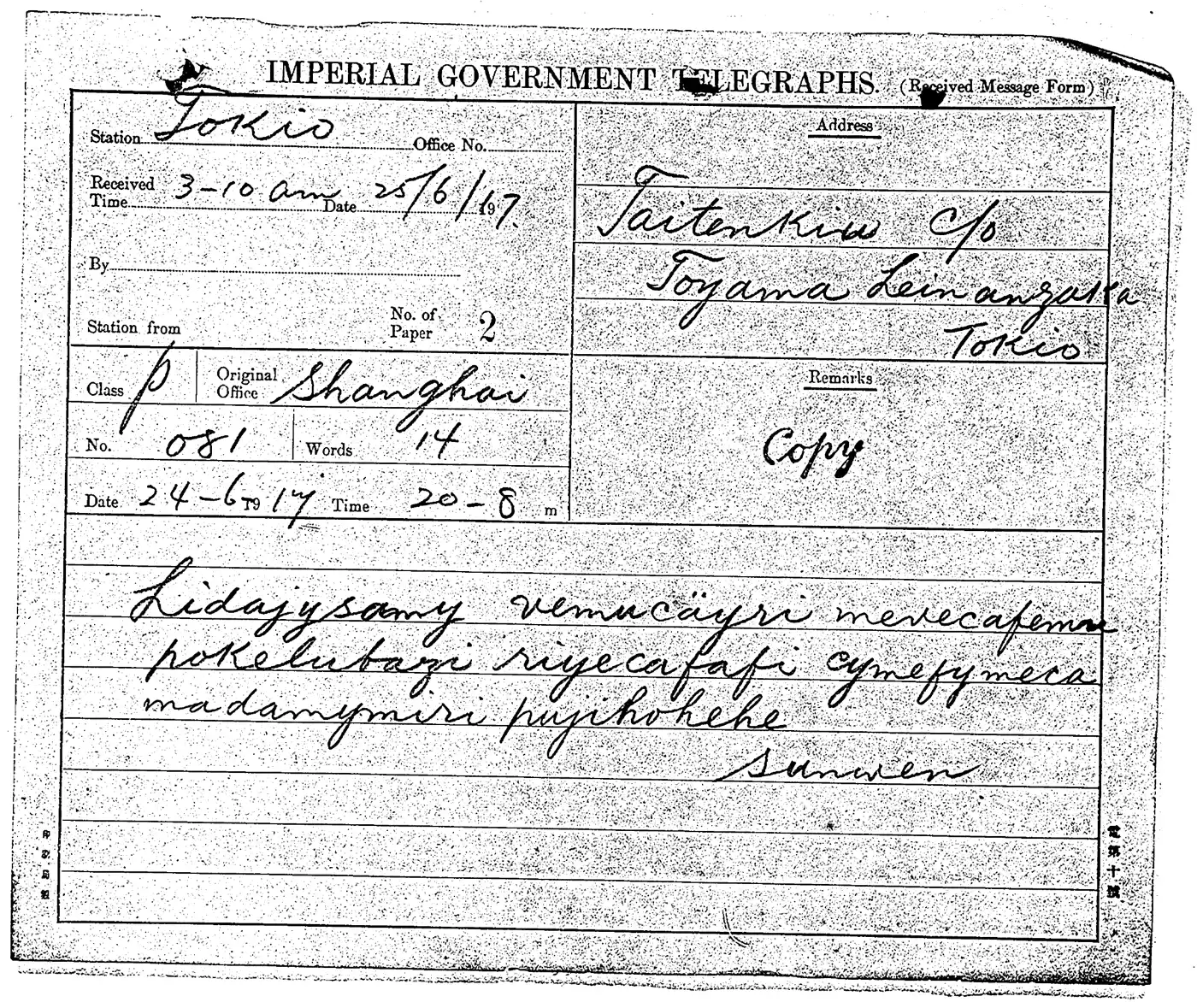
Blind reading (Brice)
lidajysamy vemucicyri mevecafemu
pokelubazi riyecafafi cymefymeca
madamymiri pujihohehe
The form (JACAR B03050090200, image 0509): click to enlarge
Only words with an uncertain letter are listed.
| Word | Read | Targeted re-reading, possible confusions |
|---|---|---|
| 2 | vemucicyri | re-read xemuciiyri: the 1st letter may be an x; the form's “ä” (Morse ·−·−) stands for e + k → vemucekyri |
| 3 | mevecafemu | re-read mexecafemx: the v could be x |
| 4 | pokelubazi | b or t? (the published transcription reads pokelutazi) |
| 8 | pujihohehe | re-read pujihoheke (k in 9th position); the published transcription reads pujihokehe |
0511a/b 29 June 1917 · Tokyo → Shanghai
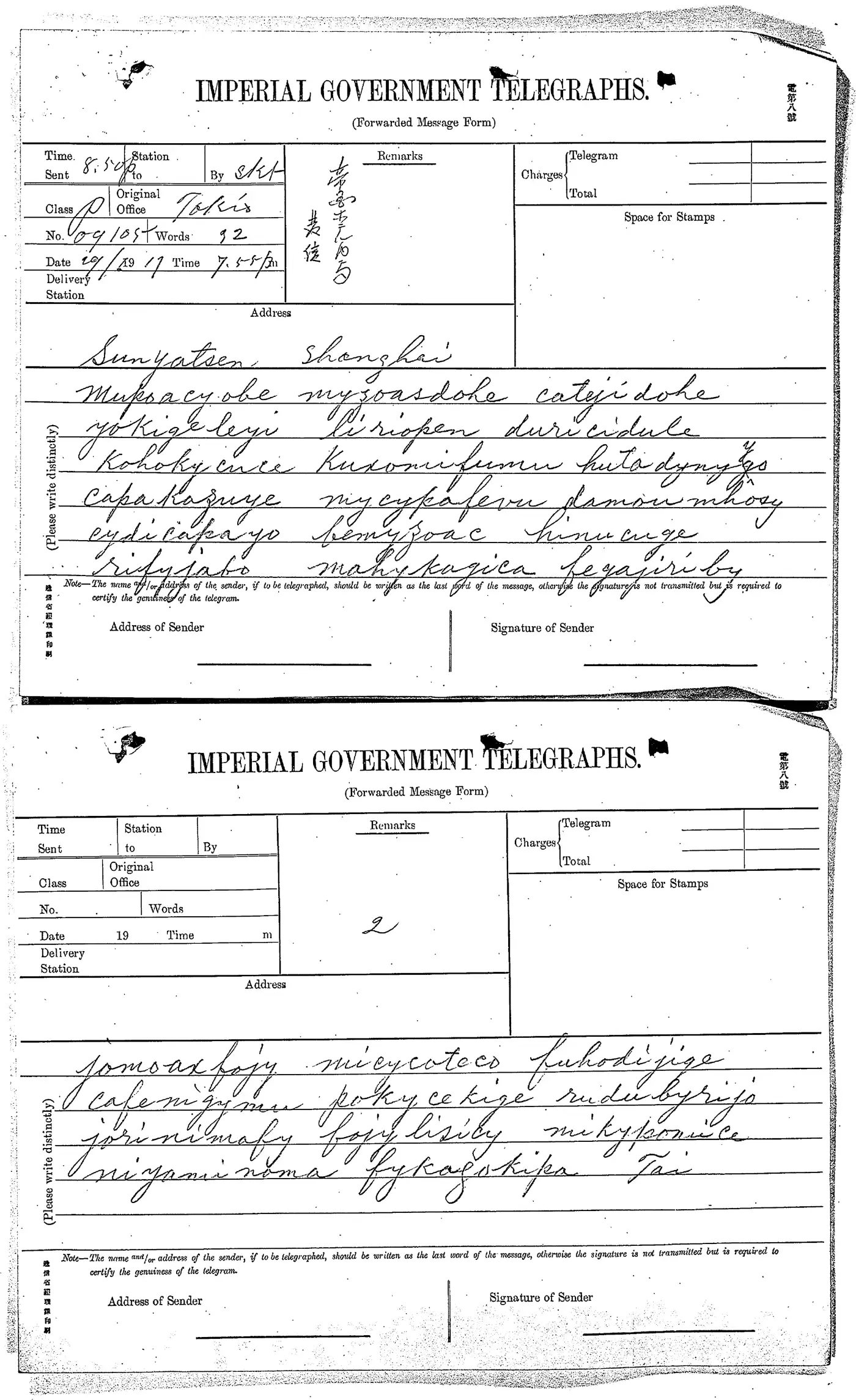
Blind reading (Brice)
a muposacyobe myzoasdohe catyidohe
yokigeleyi liriopen duricidule
kohokycuce kuxomifumu hutadynyfo
capakazuye mycykafevu damowmhosy
cydicapayo bemyzoac hinucuge
rifygabo mahykagica fegajiriby
b fomoaxfojy micycoteco fuhodigige
cafenigymu pokycekige rudubyrijo
gorinimafy fogylisicy mikypowice
niyaminoma fykagokipa Tai
The form (JACAR B03050090200, image 0511): click to enlarge
Only words with an uncertain letter are listed.
| Word | Read | Targeted re-reading, possible confusions |
|---|---|---|
| a1 | muposacyobe | targeted re-read of 12 October: mupsacyobe, 10 letters (variant mupoacyobe); the first reading counted 11 letters, with a gap and a dot before the o |
| a2 | myzoasdohe | z confirmed (the copyist's z has a descending loop, ʒ); “oas”: inverted syllable? |
| a3 | catyidohe | 9 letters; y or j? |
| a5 | liriopen | 8 letters; “op”, “en”: inverted syllables? |
| a8 | kuxomifumu | re-read kucomufumu (low confidence): x → c, i → u |
| a9 | hutadynyfo | re-read hutadynyys: the copyist wrote “nygs”, then corrected it to “nyys”; last vowel o or a |
| a10 | capakazuye | confirmed; badly formed y and m |
| a11 | mycykafevu | re-read mycykaferu: v → r |
| a12 | damowmhosy | w or m? irregular “mh”; circumflex on the o; targeted re-read: damoumhosy (variant damoumhory) |
| a14 | bemyzoac | 8 letters; “oac” |
| a16 | rifygabo | 8 letters; the copyist's j read as g |
| a18 | fegajiriby | j or g? |
| b1 | fomoaxfojy | re-read jomoacfojy: f → j, x → c; “oax” |
| b3 | fuhodigige | the copyist's j read as g (fuhodijige?) |
| b7 | gorinimafy | j read as g; variant goriximafy (n / x) |
| b8 | fogylisicy | j read as g (fojylisicy?) |
| b9 | mikypowice | variant mikyponice (w / n / m) |
| b10 | niyaminoma | confirmed; variant xiyanunoma (n / x, m / n, o / a) |
| b11 | fykagokipa | re-read fykayokipa (or fykagokipa): g or y; variant fykogokipa |
Possible confusions, in short
- j, g, y, z: the copyist's j looks like a g, and his z, with a descending loop (ʒ), like a g, a j or a y.
- n / x, m / n / w, o / a: badly closed strokes and loops.
- x / c and v / r in 0511: once these are corrected, 0511 uses only 17 consonants (b c d f g h j k l m n p r s t y z).
- 0509a is a received form, transmitted in Morse: the “ä” (·−·−) reads as e + k; v (···−) and x (−··−) can be confused.
- The copyist of 0511 corrects himself (struck letters, overwriting, accents); four words have 8 letters and one 9, and a few syllables are inverted (“oas”, “oac”, “oax”, “op”, “en”): see below.
The inverted syllables of 0511
In 0511, four ten-letter words contain a syllable written vowel first (“ac”, “as”, “um”, “ax”) instead of consonant first. All four times it is the 3rd syllable, letters 5 and 6: exactly at the junction of the word's two five-letter halves, and always right after an o. Swapping these two letters makes the words regular; swapping the two halves of the word does not (cyobemupoa would give cy ob em up oa).
| Word | Position in the message | Two five-letter halves | Letters 5 and 6 swapped |
|---|---|---|---|
| a1 | 1st word (sheet a, line 1) | mupoa ∣ cyobe | mu po ca yo be |
| a2 | 2nd word (sheet a, line 1) | myzoa ∣ sdohe | my zo sa do he |
| a12 | 12th word (sheet a, line 4) | damou ∣ mhosy | da mo mu ho sy |
| b1 | 19th word, the first of sheet b | jomoa ∣ xfojy | jo mo xa fo jy |
a1: letters 3 and 4 read po or ps depending on the re-reading (ko in the machine reading), with no effect on the inversion. a12: the 5th letter is read u in the targeted re-read of 12 October (w in the first reading).
- One telegram. All four words are in 0511 (Dai → Sun, 29 June): two open the message, one opens the second sheet, one is in the middle of the first. The two eight-letter words show the same inversion in their second half (liri ∣ op en → li ri po ne; bemy ∣ zo ac → be my zo ca).
- Controls. No inversion in 0509a, received by Morse, nor in the 136 ten-letter words of the 1916 forms read blind (their few anomalies are confusions between vowels, at scattered places).
- Interpretation. The inversion follows the way the ten-letter word was written, in two halves of five, not the code: in the continuous stream the 3rd syllable is sometimes the first, sometimes the second half of a code. It is probably a writing habit of whoever wrote out 0511 rather than a feature of the key; all our computations already use the two letters put back in order.
- An irregular first sheet. Inverted syllables, eight-letter words and corrected letters cluster on sheet a: 9 words out of 18, against 1 out of 11 on sheet b (its first word). The word count noted by the telegraph clerk, 32 (29 cipher words, the two-word address and “Tai”), confirms the division into 29 words.
What is already known
- Correspondents. 0509a is addressed to “TaitenKiu c/o Toyama, Reinanzaka, Tokio” and signed “Sunwen”; “TaitenKiu” is 天仇 (Tianchou), a pen name of Dai Jitao (戴季陶). 0511 ends with “Tai” in clear: it is Dai's reply. “Toyama, Reinanzaka” refers to the house of Tōyama Mitsuru (頭山滿) in Reinanzaka, Akasaka.
- Context. In June 1917 Sun Yat-sen sent Dai Jitao to Japan to investigate the imperial restoration movement, with letters for Admiral Akiyama Saneyuki and General Tanaka Giichi[11]. A kana telegram in clear (image 0508, 23 June) reports his arrival “last night”; 0509a left Shanghai on 24 June; 0511 left Tokyo on 29 June, two days before Zhang Xun restored Puyi (1 July).
- Structure. 0509a: 8 words, 40 two-letter syllables (20 codes). 0511: 29 words, 141 syllables; shifting 0511b by one syllable, four groups of four letters repeat (cafe twice, plus once in 0509a; kige, fojy, mafy twice each): probably frequent characters.
- Alphabet. Six vowels (a e i o u y) and, once copying confusions are corrected, 17 consonants (b c d f g h j k l m n p r s t y z): 17 × 6 = 102 cells, the smallest six-vowel table covering 100 numbers, like the 1916 Y0 grid. y is both a consonant and a vowel.
Leads explored
| Hypothesis | What was tested | Result |
|---|---|---|
| 1916 keys | the 1916 G0 and Y0 grids; the seven 1916 condenser keys | no text |
| Same family as 1916 | “n consonants × 6 vowels” grids filled linearly: about 194,000 grids on an automatic reading, 241,000 on Brice's reading | nothing stands out from chance |
| Known 1917 keys | the March 1917 key (published[1, 2]; it decodes the telegram of 25 March); the Yamada table, reconstructed from the examples published by S. Tomokiyo[8, 9] | no text |
| 17 or 18 × 6 tables | filled by rows, by columns, in serpentine, in any order, with or without transformations; control: the same computation recovers a true key 88 times out of 88 | negative |
| 20 × 6 coordinates with anchors | signature 文 or 孫文 at the end of 0509a, 戴 at the end of 0511, dates; control: with two correct anchors, 70 to 87% of the text is recovered | no anchor holds |
| Probable words | 42 words expected in June 1917 (田中, 秋山, 復辟, 張勳, 國會, 政府, 孫文…) slid over every compatible position: 2,101 trials | negative |
Provisional assessment: the June 1917 system is neither a known key nor a simple table of the 1916 type; with only 90 codes, it cannot be identified without an external foothold.
Leads to come
- More ciphertext from the same system: other intercepted telegrams from June to September 1917, in the JACAR volumes next to B03050090200[4]: does the 特定人ノ発受郵便物取調 series continue beyond volume 4, into the summer of 1917, when Sun went south to Canton? This is the most promising lead: with two or three times more codes, the methods already prepared become discriminating again.
- A renumbered codebook: if the telegraph code numbers were changed, any computation based on the standard code is blind; one would need to find that book or a contemporary decipherment (Japanese reports, Kuomintang archives).
- Better images and an independent re-reading of the uncertain passages (accents, g / j / y / z, words of 8 and 9 letters).
- Other table structures (keyword tables, double transposition…), to be tested once more text is available.
Unpublished telegrams, 1913–1916
50 telegrams, unpublished as far as we know: 11 from 1913–1914 and 39 from April 1916. Copies in the Japanese series 特定人ノ発受郵便物取調, JACAR B03050087300–87500 and B03050088500–88600, files not previously studied in this investigation. Claude’s readings incorporate Brice Dudout’s review of prefilled transcriptions (not blind). Four newly represented tables: “Sixteenth”, “Seventeenth”, “Hsuweilin” and “Hong Kong”; the others are already documented (published tables, archives and batch provenance). Unestablished identities remain unidentified. Six unreadable April telegrams and three fragile readings from 1914 are excluded.
Partial readings remain partial. Doubtful characters stay marked; the working translation does not fill gaps. Repeated words on 14 and 21 April, confirmed on the images by Brice, are retained. The reviewed transcription is displayed in full: “?” in the cells is a letter added by the solver’s alignment, never a letter certified on the scan. The details also record deletions. Raw decoding precedes the punctuated edition; retained proposals stay marked.
50 telegrams, 1635 codes; 386 doubtful, 5 unreadable; 6 proposals.