 Ciphered Europe
Second dossier · Papal correspondence
Legate Sega and the instruction from Rome, 14 May 1593
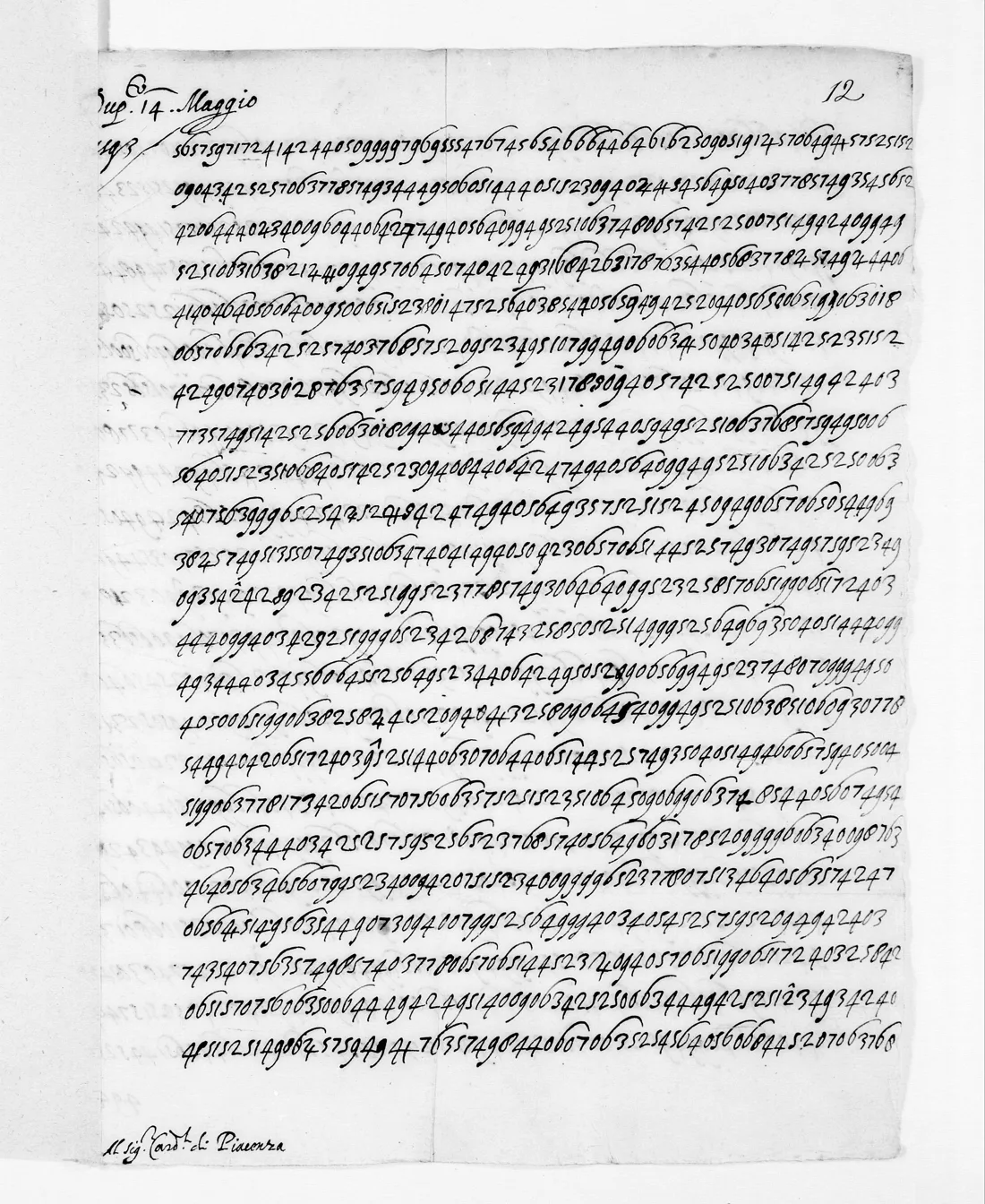
Twelve pages entirely covered in figures, sent from Rome to the papal legate in Paris while the Estates of the Catholic League were looking for a Catholic king. We propose a probable and partial decipherment: the overall sense is clear, but many passages remain incomplete or uncertain.
Update — 23 October 2026 (after Tomokiyo 2019). Our reading was aligned line by line with the preliminary reading published by Satoshi Tomokiyo in Cryptologia in 2019.[1] Where the two align, we read the same letter in 98% of cases. The differences came mainly from our transcription: in 27 places we had read 0 for 6 or 6 for 0. We corrected them after Tomokiyo 2019; all agree with the sense (frutto, sopra, ancora, figliola, manifestamente, forze, ministri, ultimamente, estremamente…). Two letter values also come from his table: 97 = s and 61 = b. Several readings change: anzi in rispetto (not dispetto), all’hora saria impossibile (not all’huomo), di dire, ma pericolosissimo. This version also includes Brice Dudout’s fourth review (22 October). On the Documents page, these corrections are underlined with dots.
Update — 21 October 2026 (third review). The 83 points that were still doubtful (guessed code words and breaks) were checked on the image by Claude (Opus 5.5), then counter-checked independently by Claude Fable: the two reviews agree on 80 points. Most corrections are unrecorded nulls. The breaks fall from 39 to 27, about 0.2% of the figures. Three nomenclator words are established: 016 = regno (9 occurrences), 540 = principi and 09 = per la. The framed 17 is a definite article (il, la or le). New passages can be read, for example infiniti parlano più liberamente, senza pericolo e disordine or aspirare alla Infanta. This review was made by a model on the image, not by a person; Brice Dudout has yet to confirm it.
Update — 20 October 2026 (second review). Brice Dudout checked 157 further doubtful points on the image. Barred 4s, signs blending 4 and 2, and “capped 9s” turn out to be nulls; the dotted 0 counts as 0. Breaks in the reading fall from about 2% to under 0.5% of the figures. Two nomenclator words are identified (75 = con, 12 = il), and new passages can be read. The previous version, from the morning of 20 October, is kept in the research dossier.
Summary: a probable and partial decipherment
What we propose. We have identified the cipher system. It uses null figures, pairs of figures for letters, and nomenclator numbers framed by nulls. The key is established well enough to read long Italian passages. They form a connected text that fits the situation of May 1593.
What we do not claim. This is neither a complete text nor a definitive edition. Several nomenclator numbers have no value yet. About 0.2% of the transcribed figures still break the reading. Some words are restored. The reading is being improved in successive passes; this page gives its state on 23 October 2026, after comparison with Satoshi Tomokiyo’s reading (2019).
Prior work. Satoshi Tomokiyo studied this piece together with two other continuous-figure ciphertexts of 1593. He gave their segmentation and a preliminary decipherment in Cryptologia 43(1), 2019.[1] Satoshi Tomokiyo sent us the article on 22 October 2026. It establishes the nulls (3 and 8, barred figures), the cipher alphabet and, in an appendix, a continuous preliminary reading of this instruction and of the Paris letter of 15 May (no. 8). The segmentation, the alphabet and the first reading of these pieces are his. Our work, done without knowing the article, recovers them independently. It adds the value of nomenclator numbers that the article left open, such as 426 Navarra, 017 Infanta, 002 His Holiness, 007 Spain, 77 che, 74 et and 76 non, together with the translation and historical commentary. Our next passes will compare our reading with his, sign by sign.
May 1593: the League looks for a king
Since the murder of Henry III in 1589, the legitimate king by order of succession has been Henry of Navarre, a Protestant. The Catholic League refuses to recognise him. In January 1593 it gathers Estates-General in Paris to elect a Catholic king. Philip II of Spain promotes his daughter, the Infanta Isabella Clara Eugenia, a granddaughter of Henry II through her mother. At the end of April, a conference opens at Suresnes between Leaguers and royalists. On 25 July 1593 Henry IV will abjure Protestantism at Saint-Denis.
Pope Clement VIII is represented in Paris by the Cardinal-Legate Filippo Sega, Bishop of Piacenza, hence his title “Cardinal of Piacenza”. The piece studied here is an instruction sent from Rome to the legate. It answers his requests point by point.
The document
In the margin of the first leaf: “Dup.to 14 Maggio 1593”, the duplicate of a dispatch of 14 May 1593. At the foot: “Al sig. Card.le di Piacenza”. The rest, twelve pages and about 14,500 figures, is written in continuous Arabic numerals with no visible breaks. The BnF catalogue and Cryptiana describe the piece as entirely in cipher.
How the text is enciphered
- Null figures. The figures 3 and 8 do not count. They are scattered everywhere, even inside words, to confuse the division. Some special signs play the same part: the barred 4 (blending 4 and 1), the “barred 4 2” (blending 4 and 2), the 9 with a cap, and other composite signs. Read as figures, they would break the reading. The dotted 0, by contrast, counts as a 0.
- Pairs for letters. Once the nulls are removed, the text reads in pairs of figures. Each pair stands for a letter, and frequent letters have several possible pairs (homophonic substitution). For example, 40 = a, 06 = e, 49 = i, 52 = o, 51 = n, 57 = s.
- A small nomenclator. Frequent or sensitive words are written as a two- or three-figure number framed by two nulls. Thus “3 77 8” = che, “3 74 8” = et, “3 76 8” = non, “3 75 8” = con, “3 12 8” = il. The third review establishes more: 016 = regno, 540 = principi, 09 = per la. The framed 17 serves as a definite article (il, la or le; probable value). The dot placed on the 0 of some code words (01 = in, 02) does not change their value. Proper names work the same way: 426 very probably stands for Navarre (Henry IV) and 017 for the Infanta.
This is not the cipher of the letter sent from Paris the next day, 15 May, kept in the same volume (f. 22). That letter is the subject of a separate reading, still in progress.
What Rome writes to the legate
A summary in modern English of the probable reading. The numbered points follow the order of the document; unread passages are left out, not reconstructed.
- No new declared excommunication. The Leaguers want the excommunication of Navarre’s supporters to be solemnly declared. Rome judges the measure useless, and even harmful for the moment. Little notice was taken of the sentence already passed against Navarre, or of the papal monitory published since. The censures are despised, and renewing them would only bring apostolic authority into further ridicule. Censures are “medicinal”, as canonists say. A formal declaration would require summoning each person individually, which is full of difficulties and dangers. Above all, it would risk driving those concerned into schism.
- Do not drive the royalist Catholics to despair. All hope of detaching them from Navarre would be lost. Some of them are held there “like prisoners”, and His Holiness knows that some are without fault.
- Excluding a house from the succession. Sentences are worthless without the force to enforce them, as Navarre and the Protestant princes show. Rome will give no approval without first being consulted. It fears rivalry among the leaders of the League.
- The third party. Rome considers that it may be necessary to take “a prince of the blood” or a “third party”. It asks who should seek the Infanta’s hand. A Catholic prince of proven religion could not be refused.
- The Infanta’s claim and the Salic law. The pope has seen the memoranda in favour of the Infanta shown to him by “Pegna”. This is probably the Spanish canonist Francisco Peña, but the identification is a hypothesis. “Any mediocre doctor, without opening a book”, could answer them. Even if the Salic law were not written, it is written “in the hearts”. Since Clovis no woman has succeeded to the crown, and custom and the consent of the peoples have always called the males.
- Spanish intentions. The Spaniards say they fight to defend the League. Their opponents say “openly” that it now appears it was not for religion. Rome fears that both parties may topple. It suspects that Spain never wanted to overthrow Navarre, but only to detach both sides, so that everything would end up in its hands (probable reading).
- What is to be feared. Navarre might win over the Catholics “under colour of a feigned conversion”. Another prince of the blood might be chosen, or the Estates might drag on without concluding, or break up without doing anything. Despite its weak forces, the Holy See “will never abandon the public cause”.
- Conduct towards Spain. The legate may support the Infanta’s claim, but only if it can be done “without danger of disorder” and with a person acceptable to the French. The pope’s intention remains “the preservation of religion”.
Some passages in Italian
Deciphered text, with lightly normalised spelling and editorial punctuation. Square brackets mark nomenclator values or restorations; “…” marks a gap.
… si va a pericolo evidentissimo di [danno], poi che potriano … traboccarsi in … uno scisma …
… [S. S.] dice che le informationi che ha visto a favore della [Infanta], mostrateli da Pegna, … non però tali, che ogni mediocre dottore, senza rivoltar libri, ci potria rispondere … quando bene la legge salica non si trovasse scritta, è però scritta [nei] cuori …
… da Clodoveo in qua … non hanno mai visto donna succedere alla corona, et più d’una volta è uscito il regno d’una famiglia et passato in un’altra …
… si potesse debellar [Navarra], ma solo staccar l’una parte et l’altra, acciò nell’ultimo gli habbino da capitar nelle mani …
… sotto colore di finta conversione aderisse a [Navarra], o si pigliasse un altro del sangue, o andasse in lungo senza concludere … le deboli forze della Sede apostolica, non abbandonerà mai la causa publica …
… non servono a niente, come vediamo in [Navarra] … nei [principi] protestanti …
… della religione non solo in quel [regno], ma ancho negl’altri …
How the reading was obtained
- Transcription. The twelve pages were transcribed figure by figure from high-definition Gallica views, with barred and composite signs noted separately.
- Identifying the system. The cipher of the 15 May letter does not apply: it covers only about 30% of the pairs. Segmenting the stream into units of variable length revealed the role of the nulls 3 and 8. With those nulls removed, the text reads in pairs.
- Control before the real test. The same solver was first run on a dummy ciphertext of the same form, made from an Italian nunciature text. It recovers 95–97% of the letters there. Only then was it run on the document, where Italian appears. One page, transcribed after the key had been fixed and read without retouching the key, served as a check.
- Review of the signs. Brice Dudout reviewed 112 doubtful signs on the image. He showed that this hand’s 6, whose very long arc passes over the neighbouring figures, had often been read as “0”. A detector built on these examples, combined with a geometric check of the loops on the image, corrected these confusions in the rest of the text. Each correction was then checked in the deciphered text.
- Second review (20 October). Brice Dudout checked 157 more points, often correcting the figures next to the flagged one. He also consistently distinguished the 4, the barred 4, the “barred 4 2”, the 9, the capped 9 and the dotted 0. Treating these signs as nulls cuts the breaks from 137 to 39; reading them as figures would raise them again.
- Third review (21 October). The 83 points still in doubt were checked on the image by Claude (Opus 5.5), then counter-checked independently by Claude Fable, judging the shape before the sense. The two reviews agree on 80 points. The corrections kept (19 points; low-confidence ones are set aside) bring the breaks down from 39 to 27. One further 6, found on the image, was restored. Another, which broke the reading, was not kept.
What remains uncertain
- Several nomenclator numbers have no value yet (notably 02, which might be molto although not every context fits, 24 and 19; number 75, first assumed to stand for Navarre, is in fact con). The values “Holy Father”, “Spain” and “France” remain weak.
- Fewer than thirty figures (about 0.2%) still break the reading, and a few rare key values remain unstable. Some rare signs (dotted 9, dotted 4, capped 2) have no established value yet.
- The ciphertext reads “Gregorio decimo tertio” where Gregory XIV, author of the 1591 monitory against Navarre, would be expected. This is probably a slip by the writer or the encipherer; we keep the reading.
- The third review was made by a model on the image. Three points remain undecided, and two low-confidence corrections were not applied.
- The identification of “Pegna” with Francisco Peña is a hypothesis.
- The quoted passages are among the best read. Elsewhere the reading is discontinuous.
References
Satoshi Tomokiyo, “Identifying Italian ciphers from continuous-figure ciphertexts (1593)”, Cryptologia 43(1), 2019, pp. 23–46. doi:10.1080/01611194.2018.1503207 ↗ Article sent by the author on 22 October 2026: segmentation, alphabet and preliminary reading of nos. 6 and 8 (appendix).
Satoshi Tomokiyo, Cryptiana, “A List of Cipher Materials in Mémoires de la Ligue in the French Archives” (entries for BnF Français 3984). cryptiana.web.fc2.com ↗
Daniel Bourdeau, catalogue of attempted but unread ciphertexts (cyphersolver repository), which listed these pieces as open.
BnF, Français 3984, no. 6, ff. 12–19. Gallica ↗
Aloys Meister, Die Geheimschrift im Dienste der päpstlichen Kurie, Paderborn, 1906 (Matteo Argenti’s systems; nomenclator between null figures).