 Ciphered Europe
Fourth dossier · American diplomatic correspondence
Madrid, 1825: what Everett would not write in clear
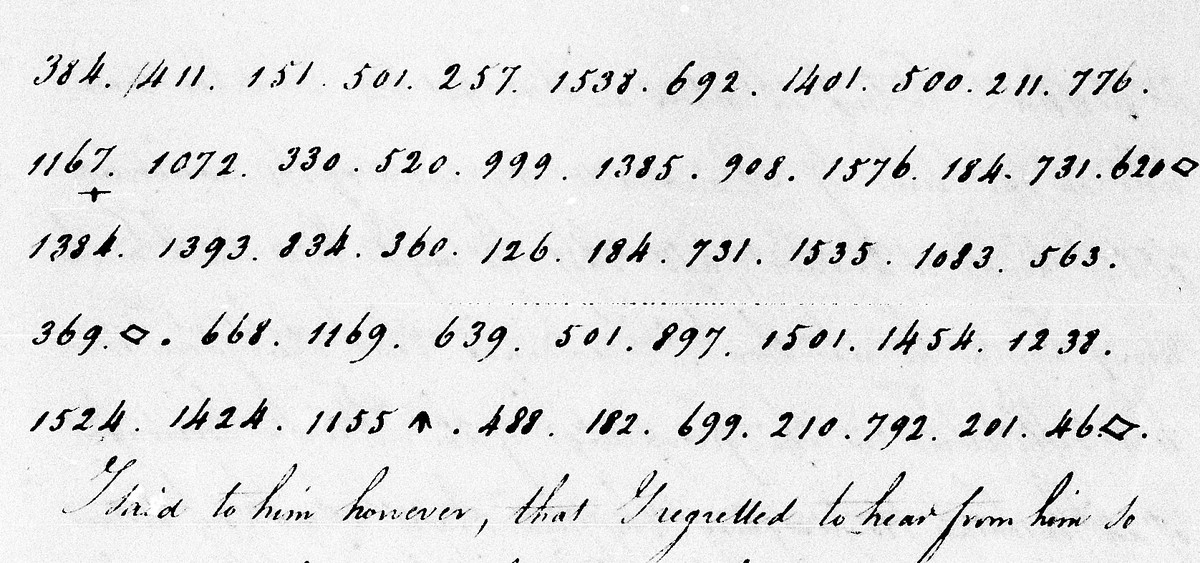
In September 1825 the new United States minister in Madrid reports his first long interview with the head of Ferdinand VII’s government: Spain, says Zea, will never recognise the independence of its former colonies. In clear, Everett reports the refusal. In cipher, he says he does not believe it. These passages, cut or left as numbers by the editors of 1826 and 1925, are read here for the first time as far as we know.
“I was pretty well satisfied from the [tenor] of his remarks that they did not [convey] his real sentiments, and were merely a language imposed upon him at present by particular circumstances.”
Everett to Clay, Madrid, 25 September 1825 (ciphered passage; words in brackets are unresolved groups read from context).
1825: Spanish America is lost, and Madrid will not say so
In December 1824 the battle of Ayacucho ended Spanish rule on the American mainland. The United States had recognised the new republics in 1822; Washington now wanted Spain to do the same and end a lost war that also threatened Cuba. Ferdinand VII, restored as an absolute monarch in 1823 with the backing of the Holy Alliance, refused. His first secretary of state, Francisco Cea (Zea) Bermúdez, a former diplomat in Russia, passed for a moderate, caught between the exiled liberals and the “apostolic” party, more absolutist than the king.
Alexander Hill Everett reached Madrid in the summer of 1825 as minister plenipotentiary. His dispatches to Henry Clay, John Quincy Adams’s secretary of state, use a nomenclature code of about 1,600 numbers, the same one Adams had used during his mission to Russia.
The dispatch of 25 September
With his dispatch no. 7 Everett encloses “Notes of a conversation with Mr Zea”. The clear text gives the official position: the king will never give up his rights over his colonies. Then Everett switches to code for his own judgement. In 1826 the State Department printed the dispatch for Congress but kept only the first clause of this passage. In 1925 William R. Manning, in his great edition of the correspondence on Latin American independence, printed the six lines as they stand, in numbers, “without decodification”. He printed nothing of the eight other ciphered pages of the same document.
What the ciphered passages say
- The refusal is a front. Zea “said many things” he could not really believe himself; Everett takes them for dissimulations, such as all public men practise.
- Russia behind the cabinet. Zea is said to have entered the government through the influence of Ugarte, “himself a creature of Russia”. Zea broke with his patron and removed him by sending him on a mission to Turin; yet he is himself thought to be committed to Russian policy.
- An unvarnished portrait. Prepossessing, bald, robust; “his teeth are good, a thing rare among the Spaniards, most of whom, beginning with the King, ruin their teeth by excessive smoking”; eyes he rolls while talking; liberal in taste, averse to the clergy, working “two or three nights in the week besides”.
- Why he dissembles. The foreign ministers in Madrid share Everett’s view: Zea is personally well disposed to recognition, but “a strong power somewhere” is acting in the contrary direction. He cannot risk his place: declaring for recognition would give his rivals the means to overthrow him. The passage breaks off on the influence of the Emperor Alexander.
- A forecast. If the strong rival party overthrows him soon, writes Everett, “we shall hear no more of him”.
What these letters tell us
Spain’s official position in 1825 is well known. What the cipher adds is how the United States’ representative read it, and what he judged too sensitive to write in clear: Madrid’s refusal was not a conviction but the price of a minister’s political survival, facing the apostolic party and Russian influence. It is also what the State Department chose not to print in 1826.
The forecast came true very quickly. Zea was dismissed a month later, at the end of October 1825. Spain recognised Mexico only in 1836, after Ferdinand VII’s death, and most of the other republics later still.
The code
It is a nomenclature code: about 1,600 numbers for whole words and syllables, in shuffled alphabetical blocks (“the” = 1385). Everett adds his own marks: a lozenge for the plural, a “v” to drop the end of a word, a “+” for a variant, a “^” for the participle ending. We applied, unchanged, the table Daniel Bourdeau reconstructed from Adams’s correspondence, after checking it on another Everett dispatch whose contemporary decipherment is printed (close to 95% agreement). Of the 1,201 groups in the document, 98% read; 18 remain without a value.
What remains uncertain
- Some of the values added to the table rest on sense or on the alphabetical position of the number; they are flagged one by one in the entry.
- There is no complete contemporary decipherment of the eight pages. A few pencil glosses on pp. 4–5 agree with our reading.
- We have not yet checked the summary of the dispatch in the Papers of Henry Clay.
References
National Archives and Records Administration, RG 59, Despatches from U.S. Ministers to Spain, vol. 25 (microfilm M31, roll 27), images 0112–0121.
William R. Manning (ed.), Diplomatic Correspondence of the United States concerning the Independence of the Latin-American Nations, vol. III, New York, 1925, doc. 1134.
Daniel Bourdeau, reconstructed table of Adams’s code (cyphersolver repository, targets/jqa); located through his catalogue, no. 638.
Entry “Everett to Clay” on the Documents page, with the groups, method and credits.