 Ciphered Europe
Method · Medici dossier, 17 October 2026
A reading must show its evidence.
The 1610 proposal relies on a cipher key, distinctions between glyphs and contextual continuations. These sources of information do not have equal evidential force.
The key and its homophones
The comparison uses a key in manuscript Français 3462, Gallica frame 112. It combines several possible signs for a letter, values representing syllables or words, numbers and nulls. Copying the key is not enough: each manuscript shape must still be assigned to the right entry.[3]
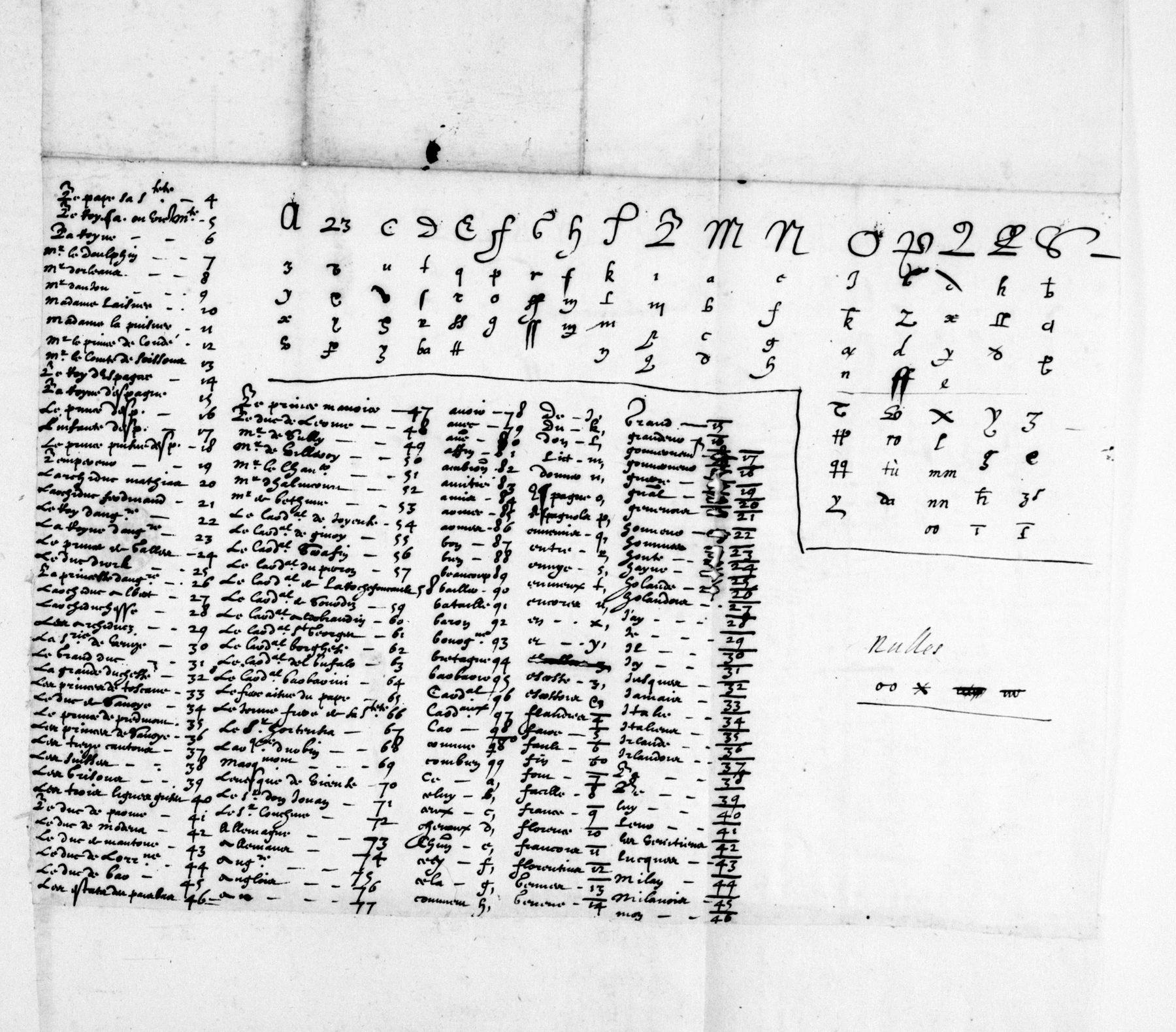
Identifiers A1, A2… refer to homophones in plaintext column A, from top to bottom. They distinguish shapes earlier transcriptions grouped under the same “y”, “c” or “m”. A single value is retained per glyph identifier; its value does not change simply to make one occurrence more plausible.
Reading the key in practice
A homophonic key offers several signs for one letter. Here, A1 and A2 are different shapes proposed as A, while D1 and S3 remain distinct despite a rough transcription as “t”. Actual shapes must therefore be compared, not merely typed letters replaced.
The nomenclator adds shortcuts. Proposed entries a, → ce, x, → en, y, → et, 4 → Sa Sainteté and 41~ → leurs give units of different lengths. “Leurs” is retained in the raw reading; both 41~→leurs occurrences were explicitly selected, without certifying the entire key.
For example, D1–I2–M4–P2–R1–U3–D1–x,–a, proposes D–I–M–P–R–U–D–EN–CE. This is not independent proof: I2 and U3 are now explicit choices by Brice; the U3 merge remains documented. Inspect the images and notes in f17 L2.
Decisions that change the reading
- A documented merge. In f17 L2, old segments 16 and 17 (counting from 1) form
tu, one glyph proposed as U3. There are therefore 99 old boxes but 98 edited glyphs. No other insertion or deletion is hidden. - Two different t shapes. The simple cross is assigned to D1, the looped t to S3. Giving them one value spoiled “imprudence” and “timidite”.
- Three similar shapes kept distinct. The straight d is proposed as P3, the unbarred delta as M4 and the crossed delta as R3. This matters in “trop” and “arogance”.
- A comma is not always a word boundary. Entries such as EN and CE can occur inside “imprudence”, “malice” and “arogance”.
- Overlining is preserved. An overlined code absent from the applicable key cannot fall back to the simple number. Earlier fallback from 72~ to 72 or 79~ to 79 produced unsupported words for those occurrences.
39~ → le is now explicitly selected. j, → de remains undecidable: “J with a small bar” does not confirm that entry. They are documented in the notes and corresponding cells without replacing the research history.
Four values now corroborated
The four values below were first proposed from context. In feedback supplied on 17 October 2026, Satoshi Tomokiyo reports matching readings. This supports the numerical values; it does not by itself validate every homophone or complete identity with Marie’s key.[7]
| Overlined code | Proposed value | Occurrences | Contextual support |
|---|---|---|---|
72~ | que | 2 | “ambition que” / “bien que Sa Sainteté” |
79~ | re | 1 | Prefix of “recognoissant” |
86~ | se | 2 | “ce se-ra” / “foible-s-se” |
90~ | tion | 1 | Suffix of “ambi-tion” |
Leads and experiments: the recorded outcomes
| Lead | Recorded outcome | Scope |
|---|---|---|
| A longer sister letter | The initial images differed from the expected item. | A documentary lead, not a decipherment of these letters. |
| Alphabet blocks on the first transcription | No continuous French; score within comparison noise. | A failure of that hypothesis on that transcription, not proof against every substitution. |
| Applying the first transcription of frame 112 | Some plausible nomenclator entries; alphabet still misread. | Possession of a key does not validate its transcription. |
| Key constraints, probable words and occurrence-level choices | Fragments and improved scores, with overfitting risk. | Exploration, not independent validation of C10. |
| Manual C10 alignment | A continuous proposed reading, 11 reservations and 6 inferred occurrences. | Traceability established; complete corroboration still absent. |
This summary follows the C00–C10 research journal. No experiment was rerun to build the site. Recorded outcomes retain their historical scope rather than becoming new validation.
Three levels of verification
Read the shapes. An initial review compares signs with the key’s homophones, keeping explicit choices, shape descriptions and observations of bars separate. Acquired choices are not automatically propagated to other occurrences.
Test a reading in context. Eight points were revisited: three possible and five undecidable. C in “recognoissant” remains possible alongside the earlier B choice; neither answer is erased to produce the expected word.
Compare with an expert reading. Satoshi’s feedback corroborates four values across six occurrences and identifies the Henri IV–Brèves key image. Records retain their history and distinguish this corroboration from proof of use in Marie’s letters. Satoshi had seen our proposal: this is expert feedback, not an independent blind experiment.
What remains to be checked
- Ambiguous shapes. Compare the eight points with other occurrences and key columns: B in ambition and foiblesse, the ending of acompagnez, DE, C/B and the S signs.
- LEUR/LEURS. Satoshi gives LEUR; Brice selected LEURS. The raw reading retains the latter pending comparison of the ending.
- Use of the key. Check the complete system on a deciphered witness, particularly Henri IV–Brèves, R2077, then compare it with Marie without adjusting assignments to expected meanings.
A homophonic substitution allows several signs for one letter, but does not permit S or Z for a genuinely identical sign depending on the desired word. A variant key remains a hypothesis to test, not an automatic explanation of contradictions.
Established findings and probable readings
The alignment covers 98 glyphs from 99 earlier boxes, with one documented merge, tu→U3. Satoshi’s feedback changes no reading or position: it adds support to six numerical occurrences. The eight reviewed points and other working readings retain their status.
We retain a first decipherment to our knowledge, with some characters probable but unconfirmed. We consider the overall meaning highly plausible. We do not present it as settled sign by sign or attribute endorsement of the entire reading to Satoshi.