Decipherment · June 1916
Qianmi (乾密): a telegram and its key
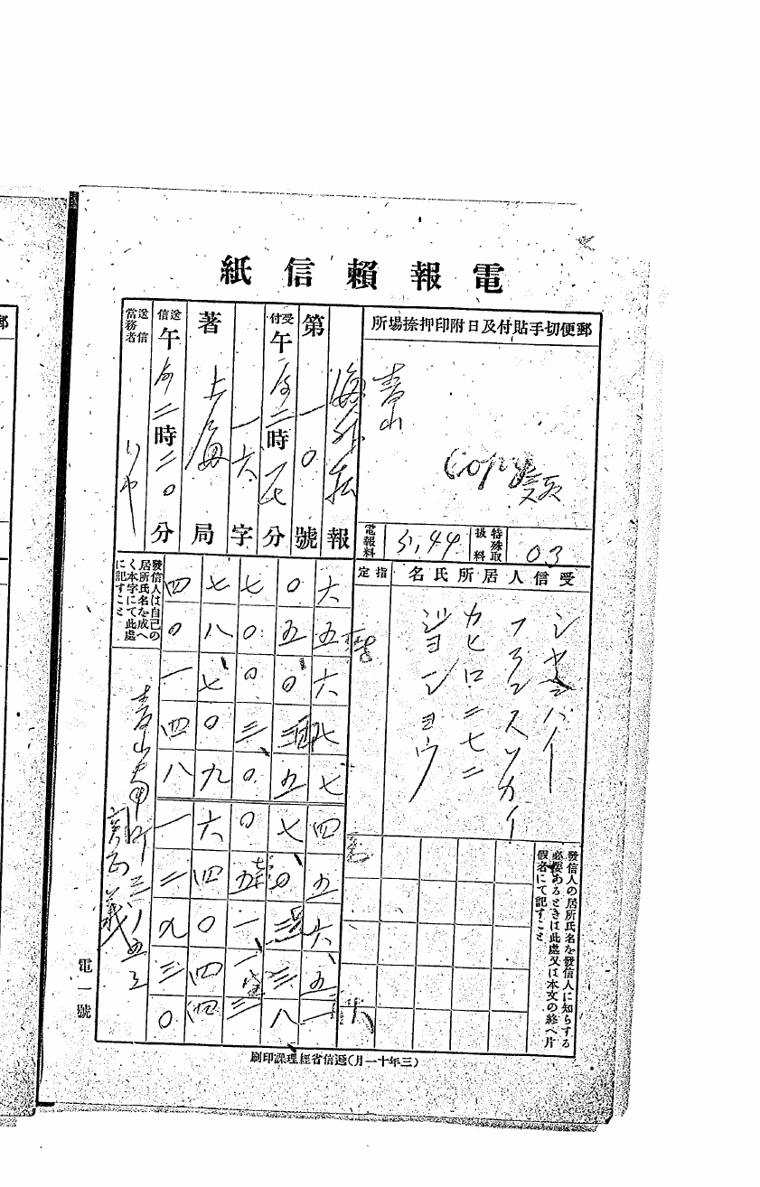
A cipher telegram sent from Tokyo by Huang Xing just after Yuan Shikai’s death: in Tokyo the attitude has not changed, and he waits for the negotiations to progress. The key, a renumbered “明密” code book, was recovered following an idea of S. Tomokiyo.[27]
Idea of the key model (renumbered 明密 book): S. Tomokiyo (Cryptiana) [22]. Grid reading order and re-reading of all digits: Brice Dudout. Transcription, key search, probable readings and translation: Claude (Anthropic).
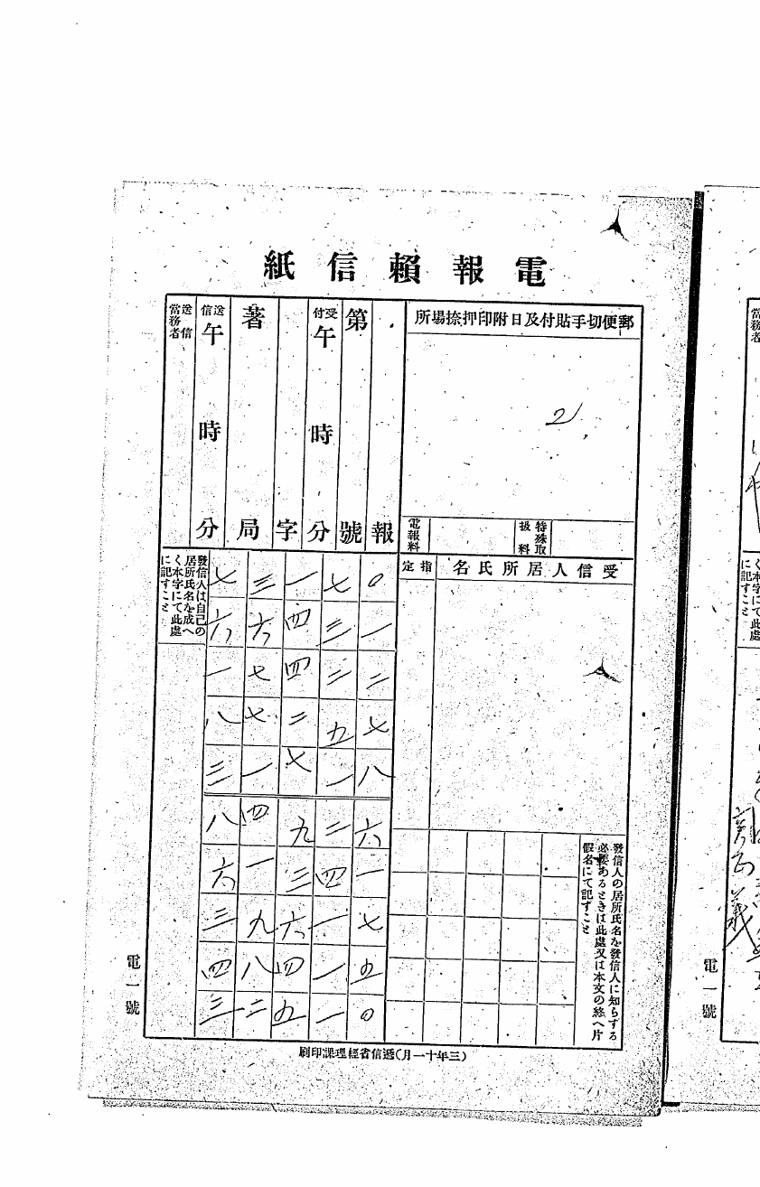
Only one telegram is read: the key rests on 17 groups. It passes the checks (controls, signature, date), but three characters are probable readings, and N03, another 乾密 telegram from the same sender, stays unreadable with it (another key or faulty digits). Translations are working proposals; identifications of people are candidates.
The key
Sheets are read in columns, right to left and top to bottom (reading order proposed by Brice Dudout), in groups of four digits. The first six groups are the address, in clear (public telegraph code); then comes the public prefix 0051 1378 = 乾密; the next 17 groups are enciphered. Each group reads as page + column + row in a “明密” code book whose numbers were rewritten: P = 100 × page + 10 × column + row, the row running from 1 to 10 (row 10 is the xxx0 character at the foot of the column); P is the character’s number in the Chinese telegraph code (CTC).
Page (first two digits): written page minus 11 — 11 = page 00, 12 = 01, …, 50 = 39, and so on.
11→00 | 12→01 | 13→02 | 14→03 | 15→04 | 16→05 | 17→06 | 18→07 | 19→08 | 20→09 | … | 50→39 |
| Digit read | 0 | 1 | 2 | 3 | 4 | 5 | 6 | 7 | 8 | 9 |
|---|---|---|---|---|---|---|---|---|---|---|
| column | 6 | 7 | 3 | 2 | 8 | 0 | 4 | 9 | 5 | 1 |
| row | 7 | 6 | 2 | 1 | 4 | 9 | 3 | 8 | 10 | 5 |
Examples:
| Group | Page | Column | Row | P | CTC |
|---|---|---|---|---|---|
7096 | 70 → 59 | 9 → 1 | 6 → 3 | 5913 | 袁 |
4044 | 40 → 29 | 4 → 8 | 4 → 4 | 2984 | 死 |
1114 | 11 → 00 | 1 → 7 | 4 → 4 | 0074 | 交 |
S. Tomokiyo’s idea. On 23 October 2026, S. Tomokiyo showed that our three keys 共密, 容密 and 辰密 are mere renumberings of the pages, columns and rows of a “明密” book, with no arithmetic at all [22]. Our finding. We applied this model to the “X密” telegrams that were still unreadable: pages numbered by a simple rule (backwards, cyclic or zero-free), columns and rows freely permuted, fitted to a language model, under a protocol fixed before computing: synthetic messages of the same length (positive controls) and shuffled digits (negative controls). N09 stands out clearly (score 4.47 against 2.88 for the best control); the text reads, ends with the expected signature 興 and begins with “袁死” (Yuan is dead), which fits its place in the file (6–9 June). The three aberrant groups were re-read twice on the image by Brice Dudout, the second time blind: the digits are sound.
In the proposed reading, {x} replaces an anomalous decoded character with a probable reading; the note says whether a variant of the cipher group differing by a single digit gives that character, or whether it is a contextual reading. 〔x〕: character kept, unresolved.
Context
The form (JACAR B03050089200, PDF 49) is a copy (“Copy”) without date. The sender is Huang Xing’s house in Tokyo, 青山南町三ノ五三; the addressee, in the French concession of Shanghai, on カヒロ (霞飛路, Avenue Joffre), is written ジヨンシヨウ, a Japanese reading of two characters we cannot identify. The inner address, in clear, asks for the message to be passed to “Ma and Geng, my two brothers” (馬, 耿), not identified.
The 乾密 prefix also appears on N03, another telegram sent from the same house in early June; N03 stays unreadable with N09’s key. Both telegrams are filed between those of 3 and 8 June.
“此間態度未變” (the attitude here has not changed) echoes N13 of 9 June: “日態度頗觀望”, Japan is still waiting and seeing.
Historical context
Yuan Shikai died on 6 June 1916. Huang Xing, then in Tokyo, had for weeks been negotiating arms purchases and loans in Japan for the provinces in revolt (see the 容密 telegrams). N09 gives the state of things just after the news: the Japanese attitude has not moved, and he will wait for the negotiations to take shape before cabling again. A few days later N13 and N17 add that Japan is waiting and will not lend to Beijing until North and South are unified.
Aligned critical translation
The segment-by-segment working translation is in French. See the French aligned translation
Sources: JACAR form [27]; key model: S. Tomokiyo [22]; day codes: Academia Sinica. Decoder and check of the key factorisation: solver/numeric1916.
See also the method and the Chenmi, Rongmi and Gongmi pages.