 Ciphered Europe
Story · Diplomacy of the American Revolution, 18th century
St Petersburg, 1783: “there is no Minister here”
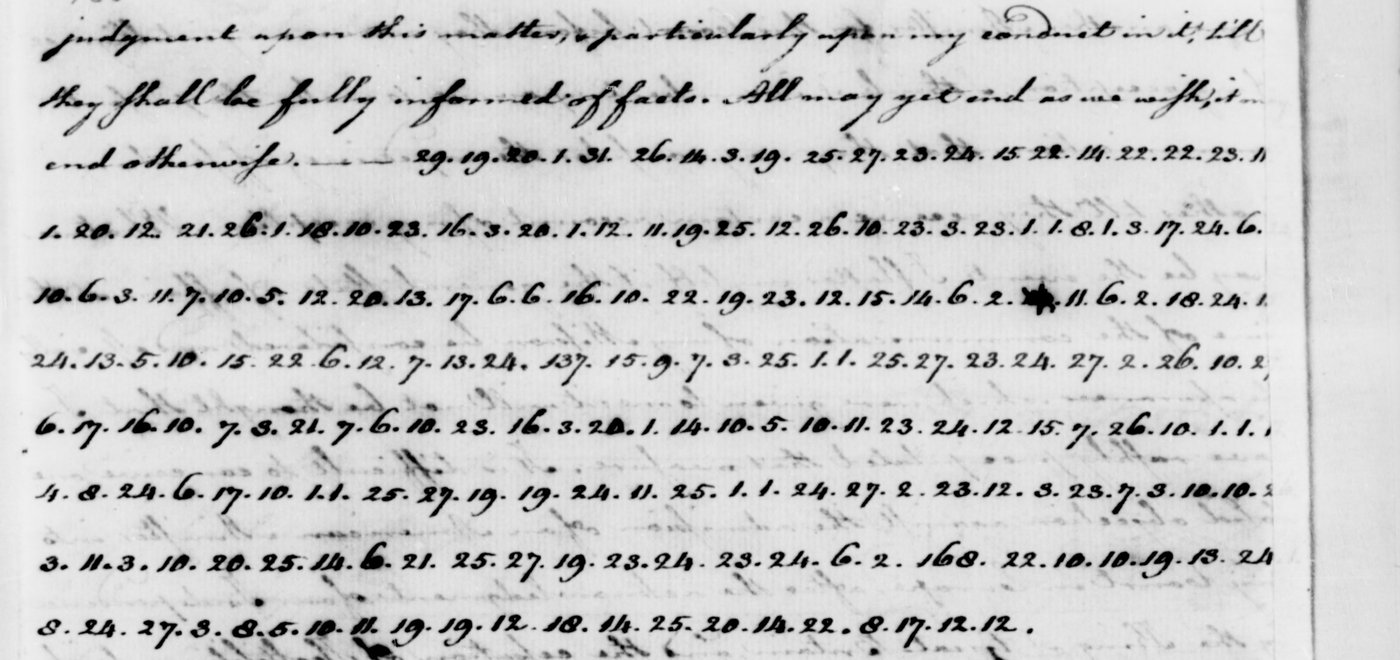
In 1780 the Congress of the United States sent a Boston lawyer, Francis Dana, to ask Catherine II to recognise the young republic. He reached St Petersburg in August 1781, with fourteen-year-old John Quincy Adams as his secretary. The Empress did not receive him. In April 1783, after twenty months of waiting, Dana ended a despatch to Congress with eight lines of numbers. The 1889 edition of his correspondence replaced them with a note: “Here follow eight lines of cipher.”
« In short, properly speaking, there is no Minister here. »
Francis Dana to Robert R. Livingston, St Petersburg, 6 April 1783 (O.S.), ciphered passage.
What is new, what was known
Known. Dana’s mission to Russia is well studied; his despatch No. 23 was printed by Wharton in 1889, without the cipher.[2][3] The cipher table he sent to Congress in October 1782 is known from the copy among John Adams’s papers. Daniel Bourdeau had flagged the undeciphered passage (catalogue no. 485).[4]
What we add, to our knowledge. (1) The first published decipherment of the eight lines (27 October 2026): read, 204 of 213 visible groups reading directly from the table (95.8%), the others each forced by a single value. (2) Dana’s table found in the same volume of the Congress papers, p. 656, with its rules. On the same day WAINUT independently recovered the key from the ciphertext alone; it is the period table that gave us the code words (Administration, Minister).
A mission without an audience
Congress appointed Dana minister to the Empress on 19 December 1780. He was to bring the United States into the League of Armed Neutrality, launched by Catherine II in 1780 against British seizures at sea, and to propose a commercial treaty.[3] But Catherine meant to mediate between Britain and its enemies: receiving the envoy of a republic at war with London would mean taking sides. Dana waited, without official standing, speaking the court’s French poorly; young Adams translated.
After the preliminaries of peace in Paris, Dana at last notified his mission by letter to the Vice-Chancellor, Count Ostermann, on 24 February / 7 March 1783. No answer came. On 6 April (17 April in the Gregorian calendar) he wrote to the Secretary for Foreign Affairs, Robert R. Livingston, asking Congress to suspend its judgment: “All may yet end as we wish; it may end otherwise.” Then he went into cipher.
What the cipher says
“In an Administration like this which is not guided by any settled principles or system, you can be certain of no measure. What the Minister adopt in this hour may be opposed by an irresistable influence in the next. In short, properly speaking, there is no Minister here. Hence my present difficulty.”
Dana is not aiming at a person. Russian foreign policy no longer had a single head: Nikita Panin, the man of armed neutrality, had been sidelined since 1781; Ostermann signed, but the Empress decided with her intimates, Bezborodko and Prince Potemkin. The postscript, in clear, reports Panin’s death, which “makes no change”, since he lived in retirement. That same month Catherine annexed the Crimea.
What followed bore the diagnosis out. Ostermann replied that the Empress could not receive a minister of the United States before the definitive peace. Dana left Russia at the end of August 1783 without having been received; the Treaty of Paris was signed on 3 September.[3] In Congress the despatch was read on 8 August; Madison wrote that Dana’s letters were “in part undecypher’d”.[4] The frankest passage of the mission had stayed unreadable to those it was written for.
Dana’s cipher
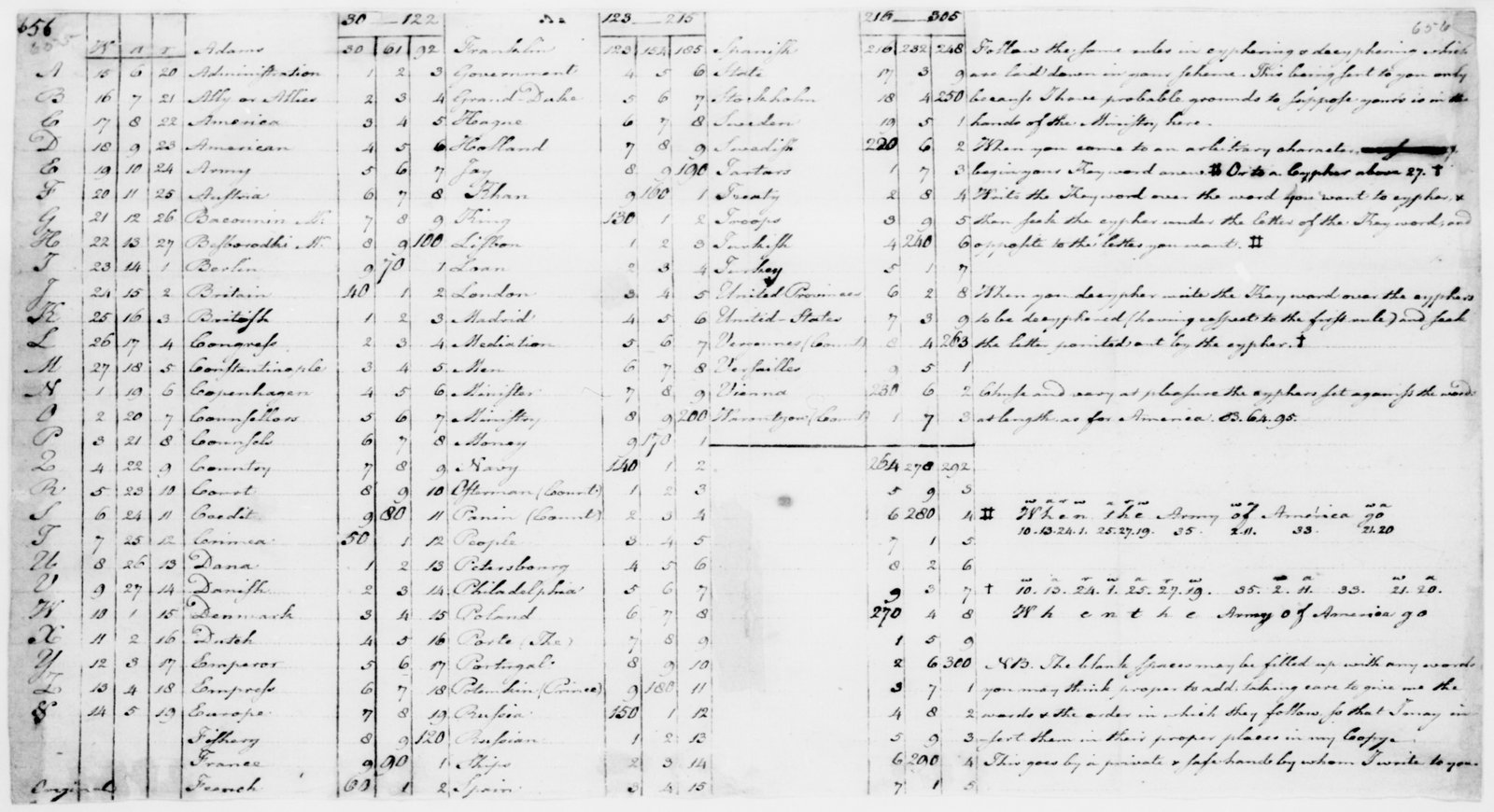
- Three shifted alphabets of 27 signs (a–z and &), used in turn: a three-letter keyword.
- A nomenclator of words and names numbered 30 to 305, three numbers per word (Administration, Minister, Osterman, Panin, Potemkin…).
- A rule: after any number above 27, begin the keyword anew.
Dana made his own table because he believed Congress’s cipher to be “in the hands of the Ministry here”. He sent it by John Quincy Adams, who left St Petersburg in October 1782.
How we read it
- Transcription of the eight lines from the NARA image.
- A blind break: a period-3 polyalphabetic cipher on 27 signs, shifts recovered from letter frequencies and English 4-gram statistics.
- An independent check: Dana’s table, found afterwards by leafing through the volume, matches the three shifts of the break; applied as it stands, it also reproduces its own example (“When the Army of America go”). English 4-gram score of the reading: −1.87 per letter, against −9.03 to −6.97 for 200 control keys.
- The reading, group by group: 201 direct letters, 3 nomenclator words, 4 errors by Dana corrected and named, 7 groups under the binding restored, each by its only possible value.
What remains uncertain
- A short passage: 213 visible groups, just over fifty words.
- The first number (29) does not exist in the table; the only possible reading is “I” (“In an Administration”).
- One copy only: the triplicate; the original and the duplicate were not looked for.
- Prior work. Checked on 27 October and again on 14 November 2026: Wharton (1889), Cresson (1930), Adams Papers (the table only), Google Books, Daniel Bourdeau’s repository (target dana1783: WAINUT’s break and our reading, 27 October 2026), online search. R. E. Weber, United States Diplomatic Codes and Ciphers (1979), was not consulted.
References
Washington, National Archives, RG 360, Papers of the Continental Congress, item 89, vol. II, pp. 727–730 (despatch No. 23, triplicate) and p. 656 (Dana’s table); microfilm M247. NARA catalogue ↗
F. Wharton (ed.), The Revolutionary Diplomatic Correspondence of the United States, vol. VI, Washington, 1889, pp. 381–383. Internet Archive ↗
“Francis Dana”, Wikipedia (en), accessed 14 November 2026. Wikipedia ↗
Daniel Bourdeau, cyphersolver catalogue, no. 485, and target dana1783 ↗: key broken from the ciphertext by WAINUT and reading by Brice Dudout (27 October 2026); the note in the Papers of James Madison flagged by Daniel Bourdeau.
Transcription, break and reading: Brice Dudout with Claude, October 2026; group-by-group table in the “Dana 1783” record on the Documents page, with credits.