 Ciphered Europe
Story · Italian Wars, 16th century
Rome, 1526: “the Pope has fled”, what Raince put in cipher for Montmorency
In March 1526 Francis I came out of his Madrid prison. In May he joined Pope Clement VII, Venice and Florence in the League of Cognac against Charles V. In Rome the secretary of the French embassy, Nicolas Raince, wrote to the Grand Master, Anne de Montmorency. What he wanted to hide he put in cipher: in May, what was said of the Emperor’s court; in November, a pope who, after the Colonna raid on the Vatican, was thinking of flight.
« Et que aussi en France se pouvoit dire par aucuns : le pape s’en est fuy. »
“And that in France too some might say: the Pope has fled”: Raince to Montmorency, Rome, 20 November 1526 (ciphered passage; “France” is a word-sign read from the sense).
What is new, what was known
Known. Raince’s letters to Montmorency form a volume of the Béthune collection; Mignet (1886), Bourrilly (1901) and Pastor print others, glossed at the time or in clear.[3] The cipher table was published by Satoshi Tomokiyo and re-measured by Daniel Bourdeau, who had partly decoded the bottom of p. 105 and the letter of 13 May (“decoded, not read”).[2][4]
What we add, to our knowledge. (1) The first complete reading of two ciphered passages without gloss: the letter of 13 May 1526 (1,112 words, 97.3% certain or probable) and that of 20 November 1526 (597 words, 98.0%), including p. 106, entirely in cipher, which nobody had dealt with. Both are read under Daniel Bourdeau’s rule. (2) The portrait of a crushed Clement VII, a year before the Sack of Rome, as the king’s agent reported it in secret.
May 1526: the Emperor’s court seen from Rome
On 13 May, nine days before the League of Cognac was signed, Raince reports what was said in Rome of Charles V’s court. After the king’s release, the Emperor had married Isabella of Portugal in Seville instead of crossing to Italy; his courtiers were at each other’s throats:
“Two factions have formed at the court of [the Emperor] since the king left: the Aragonese, Burgundians, Hainaulters and Flemings have leagued together against those of Castile, whom they accuse […] of having taken him to Seville to make him lose the fine chance he had of crossing into Italy. The Castilians say on the contrary that the aforesaid are veillacos and borachos.”
The cipher also carries the worry of a Roman informant: the king, back in his kingdom, had sent no one to visit the Pope. And it denounces the Duke of Ferrara’s men, said to be “night and day with the Imperials”: Alfonso d’Este was then negotiating with both sides.
November 1526: a pope who wants to flee
On 20 September 1526 the Colonna, allies of the Emperor, had broken into Rome and sacked the Vatican; the Pope took refuge in Castel Sant’Angelo and had to sign a truce.[5] Two months later he sent for Raince:
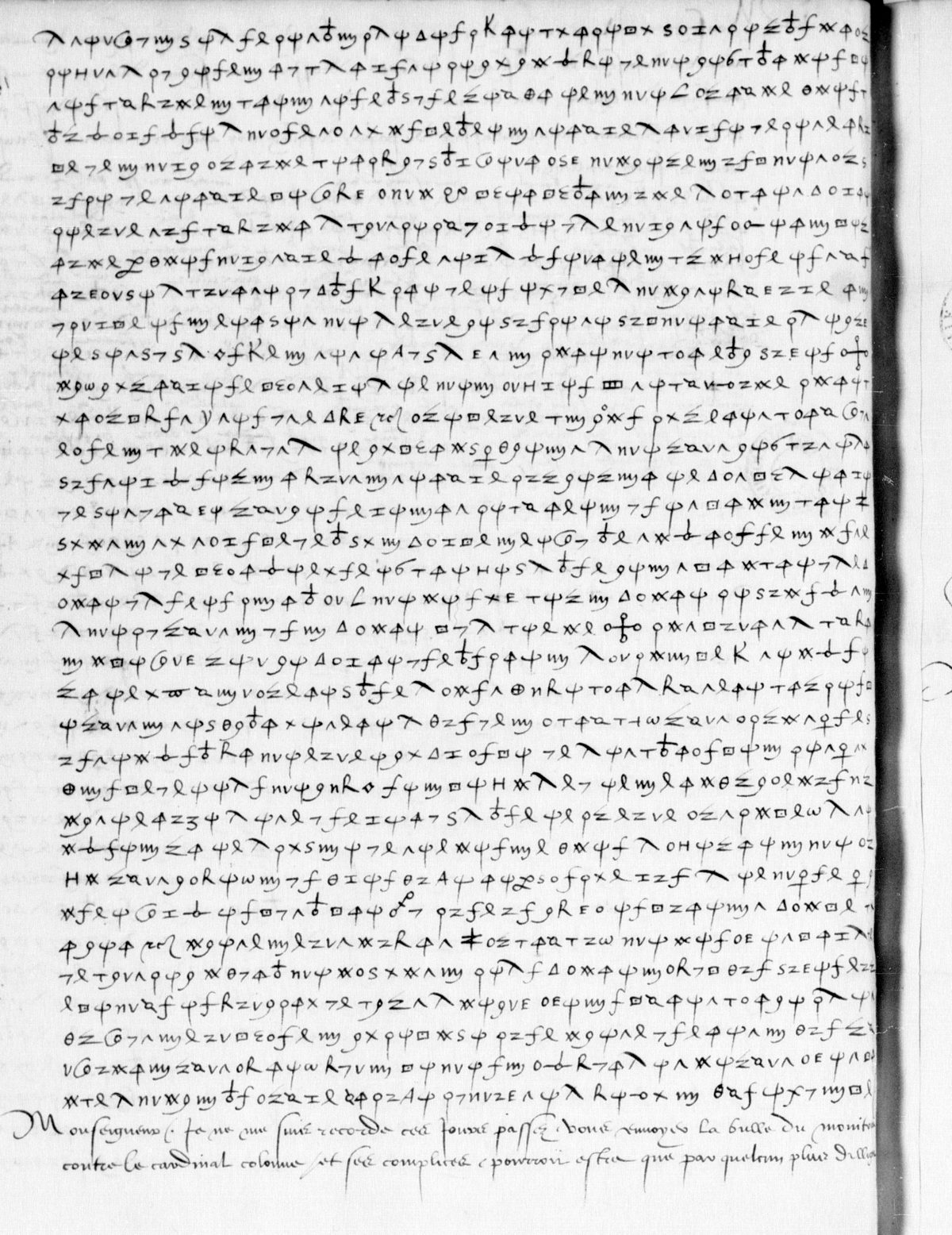
“… to prevent his being soon forced to abandon Rome and flee, and even then if God granted him the grace of doing it safely; and that his pontificate would be the cause of the total ruin of his house […], wishing for death, and speaking in such a way, sighing so deeply, that there is no heart so hard that it would not have felt the greatest compassion in the world.”
The Pope blames France: if he is in danger, it is because “on that side” there had been no break with the Emperor as there should have been. The king, he warns, would gain very little from seeing ruined “the best friend he ever had in the world”; and soon it might be said in France: “the Pope has fled”. Raince adds that he would gladly have spared himself writing words “so piteous and lachrymose”, but the Pope had expressly charged him to make the king hear them.
Six months later, on 6 May 1527, the imperial troops took Rome; Clement VII, besieged in Castel Sant’Angelo, finally fled to Orvieto in December.[5] The November letter shows that flight was being considered as early as 1526, and that it was made known to the King of France as a reproach.
Raince’s cipher
- A homophonic substitution of letters: three or four signs for a, e, i, o, r, u.
- Nulls (λ, “my”, K, a cross with two circles, a stem with two bars) to confuse.
- Word-signs: “roy”, “le pape”, “con” are in the table; others, absent from it, are read from the sense (a sign for the Emperor, a large delta for the Duke of Ferrara, another for France, one for Madame, the king’s mother).
How we read it
- The key: the table published by Satoshi Tomokiyo, re-measured by Daniel Bourdeau, frozen by SHA-256 fingerprint before reading.
- A blind validation: two ciphered lines of p. 34, whose period plain text survives on p. 17, read without looking at that text: 0.939 of characters right, against 0.535 at the 99th percentile of permuted keys and at best 0.586 for windows taken elsewhere.
- The reading, sign by sign on the Gallica microfilm at full resolution; the 85 lines of May checked one by one against Daniel Bourdeau’s partial reading (no full word contradicted, twelve lines completed); in November our two readings of the bottom of p. 105 agree on 95.6% of letters.
- The count, by script, under Daniel Bourdeau’s rule: in May, 1,074 certain words, 8 probable, 20 read from the sense (word-signs), 10 unresolved; in November, 572 certain, 13 probable, 8 from the sense, 4 unresolved.
What remains uncertain
- The word-signs outside the table are read from the sense and not counted as certain; identifying ‹ℓ°› with the Emperor or his party remains a strong hypothesis.
- A short validation: only two lines have a period plain text that is both sure and held out.
- Prior work. Checked on 28 October and again on 14 November 2026: Daniel Bourdeau’s repository (target raince: partial readings, then ours), Mignet, Bourrilly, Pastor, Molini, online search. We found no edition of these passages.
References
Paris, BnF, Français 2984 (formerly Béthune 8509): Raince to Montmorency, Rome, 13 May 1526 (pp. 29–31) and 20 November 1526 (no. 24, pp. 105–107). Source gallica.bnf.fr / BnF. May ↗ · November ↗
Daniel Bourdeau, cyphersolver catalogue, no. 5, and target raince ↗ (table re-measured, partial readings, the 95% rule).
F. Mignet (1886); V.-L. Bourrilly (1901); L. von Pastor, History of the Popes: other letters of Raince, not these passages; G. Molini, Documenti di storia italiana (1836): catalogue of the volume.
Satoshi Tomokiyo, Cryptiana, “French Ciphers during the Reign of Francis I”. Cryptiana ↗
“Pope Clement VII”, Wikipedia (en), accessed 14 November 2026. Wikipedia ↗
Transcription, reading and count: Brice Dudout with Claude, October 2026; texts and translations in the “Raince 1526” record on the Documents page, with justifications and credits.