 Ciphered Europe
Story · Spain and the Holy See, 17th century
Rome, 1648: “in no case”, Philip IV wants to keep his nuncio, the future Clement IX
In 1648, the year of the Peace of Westphalia, Pope Innocent X renewed his nuncios at the Catholic courts. In Madrid Philip IV wanted to keep his own: Giulio Rospigliosi, Archbishop of Tarsus, nuncio since 1644. He charged his ambassador in Rome, Cardinal Gil de Albornoz, with obtaining it from the Pope, and wrote it to him in cipher, twice, on two copies of the same letter. Nobody had read them. Nineteen years later Rospigliosi became pope.
« … que no desistáis por ningún caso. »
“… and that you desist in no case”: Philip IV to Cardinal Albornoz, Madrid, 24 July 1648 (ciphered passage).
What is new, what was known
Known. Rospigliosi was nuncio in Spain from 1644 to 1653, then Secretary of State and pope (Clement IX, 1667–1669).[3] Albornoz’s Roman mission has been studied by X. Arriazu García (thesis, Barcelona, 2024), who cites other ciphered letters of the Osuna collection, not this one.[5] The PARES entry sums up the subject: “for the nuncio to continue in his functions”. Daniel Bourdeau lists these letters among the unsolved items (catalogue no. 747).[2]
What we add, to our knowledge. (1) The first published decipherment of the letter: 359 ciphered groups, 353 read (98.3%), about five of them probable; six remain unresolved. (2) The key, drawn from another paper in the same collection, enciphered for Albornoz in 1649 with its plain-text copy, and validated on a part of that paper held out. (3) The reasons the king gives in secret for keeping the nuncio.
A nuncio the king wants to keep
The nuncio represents the Pope to the king; he also judges church cases in the kingdom and negotiates with the court. A nuncio well regarded in Madrid is an asset. In January 1648 Philip IV had already asked Albornoz to obtain from Innocent X that “the Archbishop of Tarsus continue his residence”. On 24 March Albornoz answered that he had made the representations; the Pope had given his reasons. On 24 July the king insists:
“This person being very worthy of favour for the care with which he attends to his ministry and to the representation he holds, and since, for the interests of the service of his prince and mine, there can be no more suitable instrument, I charge you again to continue and press your instances with His Beatitude for his retention, in conformity with the first orders, and to desist in no case.”
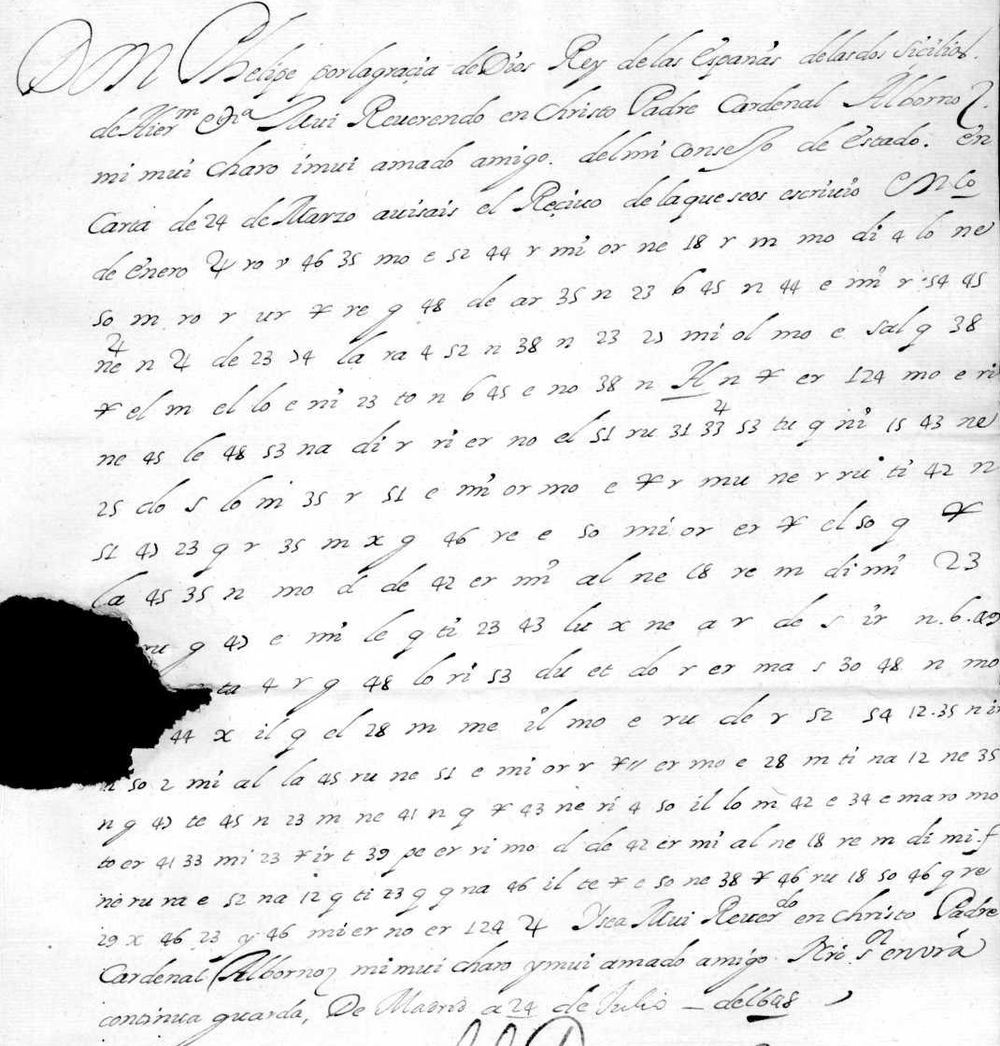
The phrase “his prince and mine” says it all: the nuncio serves two masters, and the king values the one who also serves his. Rospigliosi did stay in Madrid until 1653. Albornoz left Rome in 1649 and died in December that year.[4] The king who wanted to keep this nuncio “in no case” to be given up could not know he was insisting on a future pope; elected in 1667, Clement IX would work for peace between France and Spain.[3]
The cipher
- Disguised syllables: the consonant changed, the vowel kept (mo = co, ne = de, ra = sa, la = pa, ti = mi).
- Numbers in series of five: 35–39 = la le li lo lu; 45–49 = ra…ru; 50–54 = ta…tu.
- Single letters (2 = n, n = s, m = r) and a few code signs (✗ = que, sal = Su Santidad).
How we read it
- The wrong cipher ruled out: the key rebuilt on the royal letters of 1644–1645 from the same collection does not fit the 1648 letter, written in another system.
- The key document: the same collection keeps a chapter of a letter by Luis de Haro, “to send to Cardinal Albornoz” (1649), in clear and in cipher. The phrase “dentro de Cataluña”, enciphered twice the same way, opened the alignment.
- A held-out validation: key built on lines 1–12 of that document only and frozen by SHA-256 fingerprint; decoded mechanically, lines 13–23 (394 characters) recover 0.859 of the letters of the period plain text, against 0.476 at the 99th percentile of 200 control keys.
- The reading of both copies, checked group by group against each other.
What remains uncertain
- Six unresolved groups, four of them code signs found only here (‹74›, ‹A›, ‹124› twice, ‹✗11›); the general sense does not depend on them.
- An approximate count of probables (about five): certain groups are at least 348 of 359 (96.9%).
- A short letter, a single item: the other 1648 letters of the collection are not digitised.
- Prior work. Checked on 28 October and again on 14 November 2026: PARES entry, Arriazu García’s thesis, Daniel Bourdeau’s repository (target albornoz1648, our reading), online search.
References
Toledo, Archivo Histórico de la Nobleza, OSUNA, CT.2, D.32 (Philip IV to Cardinal Albornoz, Madrid, 24 July 1648, two copies); key document OSUNA, CT.11, D.1 (1649). PARES ↗ · Key document ↗
Daniel Bourdeau, cyphersolver catalogue, no. 747, and target albornoz1648 ↗ (the 95% rule).
“Pope Clement IX”, Wikipedia (en), accessed 14 November 2026. Wikipedia ↗
“Gil de Albornoz y Espinosa”, Wikipedia (en), accessed 14 November 2026. Wikipedia ↗
X. Arriazu García, thesis on Gil de Albornoz and his mission in Italy (1630–1649), Universitat de Barcelona, 2024. Dipòsit UB ↗
Transcription, key and reading: Brice Dudout with Claude, October 2026; text and translation in the “Albornoz 1648” record on the Documents page, with credits.